Background: Hearing problems are among the most common problems encountered in the community and are associated with long-term academic and communicative difficulties. With this background, this study aimed to assess the risk factors for Hearing impairment among MBBS students of Indira Gandhi Medical College, Shimla, Himachal Pradesh. Material and Methods: This cross-sectional survey was carried out utilizing a Google form which was distributed among MBBS students for responses via online means like email and social media platforms like WhatsApp groups, Facebook and Instagram. We collected data on their socio-demographic traits and risk factors for Hearing impairment. Epi info v7 software was used to evaluate the data using the necessary statistical tests. Results: A total of 285 MBBS students were participated in the present survey. Among them 135 (47.4%) were male while 150 (52.6%) were females, 141 (49.5%) were ≤20 Years while 144 (50.5%) were more than 20 years old. 87(30.5%) participants had more than seven risk factors for hearing impairment but there was no significant difference between participants in risk scoring according to gender and age group. 250(87.7%) participants spent > 2 hours per day on mobile/laptop/TV/computer for calling purposes/ watching Movies or serials/ listening music etc. 107(37.5%) use of earphone > 2 hours per day, 32(11.2%) were using earphones that were not properly fitted to their ears,116(58.2%) had set the volume of their earphone above 60% ,244(85.6%) didn’t ever screen their ears for hearing and 262(91.9%) didn’t know about any mobile application for hearing screening. Usage of earphone was significantly more (>2 hours/day) among females as compared to males (46.0% vs 28.1%). Significantly more number of males had habit of going to noisy places like Disco/pubs/ factories/ concerts etc. as compared to females (17.0% vs 8.0%). Time spent on mobile/laptop/TV/computer per day was significantly more (>2 hours/day) in age group of ≤20 years as compared to age group >20 years (93.6% vs81.9%). Conclusion: The findings of this study concluded that majority of MBBS students had one or more risk factors for hearing impairment and had average level of personal awareness regarding Hearing Impairment and didn’t know about screening methods for hearing impairment. Study highlighted the importance to educate young MBBS students about hearing impairment in order to help prevent it.
Keywords
Assessment
Risk Factors
Hearing Impairment
MBBS Students
Northern India
INTRODUCTION
Hearing problems are among the most common problems encountered in the community. When unaddressed, hearing loss impacts many aspects of life at individual level including communication, speech, cognition, education, employment, social isolation, loneliness and stigma [1,2].
As per World health Organization estimates, by 2050 nearly 2.5 billion people are projected to have some degree of hearing loss and at least 700 million will require hearing rehabilitation. Over 1 billion young adults are at risk of permanent, avoidable hearing loss due to unsafe listening practices. Over 5% of the world’s population or 430 million people require rehabilitation to address their disabling hearing loss (432 million adults and 34 million children). It is estimated that by 2050 over 700 million people or 1 in every 10 people will have disabling hearing loss [1,2].
Many of the causes that lead to hearing loss can be avoided through public health strategies and clinical interventions implemented across the life course. Effective strategies for reducing hearing loss include identification and management of common ear conditions, occupational hearing conservation programmes for noise exposure, safe listening strategies for the reduction of exposure to loud sounds in recreational settings and rational use of medicines to prevent ototoxic hearing loss [2-4].
Early identification of hearing loss and ear diseases is the key to effective management. This requires systematic screening for detection of hearing loss and related ear diseases in those who are most at risk. Once hearing loss is identified, it is essential that it is addressed as early as possible and in an appropriate manner, to mitigate any adverse impact [1-3].
With this background, this study aimed to assess the risk factors for Hearing impairment among MBBS students Indira Gandhi Medical College, Shimla, Himachal Pradesh
Objectives of The Study
To assess the risk factors for Hearing impairment among MBBS students Indira Gandhi Medical College, Shimla, Himachal Pradesh
MATERIALS AND METHODS
Research Approach
Descriptive
Research Design
Cross-sectional survey design
Study Area
Indira Gandhi Medical College, Shimla, Himachal Pradesh
Study Duration
During March 2023
Study Population: All MBBS students from First year to Final year studying in Indira Gandhi Medical College, Shimla, Himachal Pradesh
Sampling
Convenience Sampling
Sample Size
We tried to include all MBBS students studying in Indira Gandhi Medical College, Shimla, Himachal Pradesh
Study Tool
A google form questionnaire consisting of questions regarding socio-demography and risk factors for Hearing impairment was created. The questionnaire was initially pre-tested on a small number of MBBS students to identify any difficulty in understanding by the respondents.
Description of Tool
Demographic data survey instrument: The demographic form elicited information on participants’ background: age, gender etc.
Questionnaire: The questionnaire contains 15 structured questions regarding risk factors for Hearing impairment. One mark was given if they had that risk factor and zero mark was given if they didn’t have that risk factor.
Validity of Tool
By the experts in this field
Data Collection
Data was collected under the guidance of supervisors. The google form questionnaire was circulated via online modes like e-mail and social media platforms like WhatsApp groups, Facebook, Instagram etc. to all batches of MBBS through their class representatives.
Data Analysis
Data was collected and entered in Microsoft excel spread sheet, cleaned for errors and analyzed with Epi Info V7 Software with appropriate statistical test in terms of frequencies and percentage.
Ethical Considerations
Participants confidentiality and anonymity were maintained.
RESULTS
Through a non-experimental descriptive survey, the current study sought to assess the risk factors for Hearing impairment among MBBS students Indira Gandhi Medical College, Shimla, Himachal Pradesh.
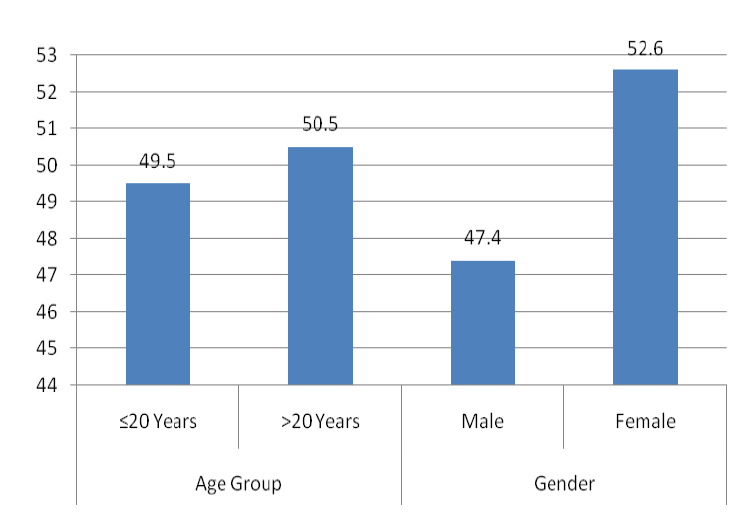
A total of 285 MBBS students were participated in the present survey. Among them 135 (47.4%) were male while 150 (52.6%) were females, 141 (49.5%) were ≤20 Years while 144 (50.5%) were more than 20 years old. Mean age of the participants was 20.84±2.741 years. (Figure 1).
Figure 1: Age and Gender Distribution of the Study Participants
In this survey, the mean time spent on mobile/laptop/TV/computer for calling purposes/ watching Movies or serials/ listening music etc among the study participants was 4.82 ± 2.490 hours per day. There was no significant difference according to gender but the mean time spent was significantly more in age group of ≤20 years. On an average, participants were using earphone 2.29±1.913 hours per day. In our survey, usage of earphone was significantly more among female and in the age group above 20 years. (Table 1)
Table 1: Time Spent on Gadgets and Usage of Earphone Among Participants
Parameters
Total
(n = 285)
Gender (n = 285)
p value
Age Group (n = 285)
p value
Male (n=135)
Female (n=150)
≤20 yrs (n=141)
>20 yrs (n=144)
Time spent on mobile/laptop/TV/computer per day for calling purposes/ watching Movies or serials/ listening music etc. (in Hours)
4.82±2.490
5.03±2.753
4.63±2.218
0.173
5.12±2.548
4.52±2.403
0.042
Usage of earphone per day (in Hours)
2.29±1.913
1.91±1.503
2.63±2.167
0.001
2.52±2.003
2.06±1.798
0.041
In our survey, 250(87.7%) participants spent > 2 hours per day on mobile, laptop, TV, computer for calling purposes, watching Movies or serials, listening music etc, 107(37.5%) participants use of earphone > 2 hours per day, 32(11.2%) participants were using earphones that were not properly fitted to their ears,116(58.2%) had set the volume of their earphone above 60%,53(18.6%) had habit of sharing earphone with others,23(8.1%) had ever discharge of pus or fluid from their ears, 60(21.1%) had ever pain in their ears, 35(12.3%) had habit of going to noisy places like Disco, pubs, factories, concerts etc. normally, 249 (87.4%) didn’t use ear plugs in noisy places to protect hearing normally, 16(5.6%) had habit of putting hot or cold oil, home remedies into the ear normally,128(44.9%) had habit of putting Q-tips, cotton buds, Hopi candles Sticks or similar things into the inner ear to clean it normally,44(15.4%) didn’t had habit of cleaning their ear normally,244(85.6%) didn’t ever screen their ears for hearing, 262(91.9%) didn’t know about any mobile application for hearing screening and 263(92.3%) didn’t know about any mobile application for monitoring sound exposure for safe listening.(Table-2)
Table 2: Various Risk Factors for Hearing Impairment Among Study Participants
No.
Statements
Frequency
Percent
Time spent on mobile/laptop/TV/computer per day for calling purposes/ watching Movies or serials/ listening music etc (in Hours)
≤ 2 Hours
35
12.3
>2 hours
250
87.7
Usage of earphone per day (in Hours)
≤ 2 Hours
178
62.5
>2 hours
107
37.5
Earphones Properly fitted to ears
No
32
11.2
Yes
253
88.8
Set the volume of earphone normally
<60%
119
41.8
60-80%
119
41.8
80-100%
38
13.3
Maximum
9
3.2
Share earphone with Others
No
232
81.4
Yes
53
18.6
Ever have Discharge of pus or fluid from the ears
No
262
91.9
Yes
23
8.1
Ever have pain in the ears
No
225
78.9
Yes
60
21.1
Go to noisy places like Disco/pubs/ factories/ concerts etc normally
No
250
87.7
Yes
35
12.3
Use ear plugs in noisy places to protect hearing normally
No
249
87.4
Yes
36
12.6
Put hot or cold oil/ home remedies into the ear normally
No
269
94.4
Yes
16
5.6
Put Q-tips/cotton buds /Hopi candles Sticks or similar things into the inner ear to clean it normally
No
157
55.1
Yes
128
44.9
Clean their ear normally
No
44
15.4
Yes
241
84.6
Ever screen their ears for hearing
No
244
85.6
Yes
41
14.4
Knew any Mobile application for hearing screening
No
262
91.9
Yes
23
8.1
Knew any Mobile application for monitoring sound exposure for safe listening
No
263
92.3
Yes
22
7.7
Total
285
100.0
In our survey, usage of earphone was significantly more (>2 hours/day) among females as compared to males (46.0% vs 28.1%). On the other hand, significantly more number of males had habit of going to noisy places like Disco, pubs, factories, concerts etc. as compared to females (17.0% vs 8.0%). Beside these, there was no significant difference between male and female participants among other risk factors for hearing impairment. (Table 3)
Table 3: Gender Wise Distribution of Various Risk Factors for Hearing Impairment among Study Participants
Statements
Gender
Total
p value
Male
Female
Time spent on mobile/laptop/TV/computer per day for calling purposes/ watching Movies or serials/ listening music etc (in Hours)
≤ 2 Hours
Count
19
16
35
0.470
%
14.1%
10.7%
12.3%
>2 hours
Count
116
134
250
%
85.9%
89.3%
87.7%
Usage of earphone per day (in Hours)
≤ 2 Hours
Count
97
81
178
0.002
%
71.9%
54.0%
62.5%
>2 hours
Count
38
69
107
%
28.1%
46.0%
37.5%
Earphones Properly fitted to the ears
No
Count
13
19
32
0.457
%
9.6%
12.7%
11.2%
Yes
Count
122
131
253
%
90.4%
87.3%
88.8%
Set the volume of earphone normally
<60%
Count
48
71
119
0.092
%
35.6%
47.3%
41.8%
60-80%
Count
58
61
119
%
43.0%
40.7%
41.8%
80-100%
Count
23
15
38
%
17.0%
10.0%
13.3%
Maximum
Count
6
3
9
%
4.4%
2.0%
3.2%
Share earphone with others
No
Count
109
123
232
0.879
%
80.7%
82.0%
81.4%
Yes
Count
26
27
53
%
19.3%
18.0%
18.6%
Ever have Discharge of pus or fluid from the ears
No
Count
127
135
262
0.277
%
94.1%
90.0%
91.9%
Yes
Count
8
15
23
%
5.9%
10.0%
8.1%
Ever have pain in the ears
No
Count
106
119
225
0.885
%
78.5%
79.3%
78.9%
Yes
Count
29
31
60
%
21.5%
20.7%
21.1%
Go to noisy places like Disco/pubs/ factories/ concerts etc. normally
No
Count
112
138
250
0.029
%
83.0%
92.0%
87.7%
Yes
Count
23
12
35
%
17.0%
8.0%
12.3%
Use ear plugs in noisy places to protect hearing normally
No
Count
117
132
249
0.859
%
86.7%
88.0%
87.4%
Yes
Count
18
18
36
%
13.3%
12.0%
12.6%
Put hot or cold oil/ home remedies into the ear normally
No
Count
129
140
269
0.240
%
95.6%
93.3%
94.4%
Yes
Count
6
10
16
%
4.4%
6.7%
5.6%
Put Q-tips/cotton buds /Hopi candles Sticks or similar things into the inner ear to clean it normally
No
Count
76
81
157
0.722
%
56.3%
54.0%
55.1%
Yes
Count
59
69
128
%
43.7%
46.0%
44.9%
Clean their ear normally
No
Count
19
25
44
0.623
%
14.1%
16.7%
15.4%
Yes
Count
116
125
241
%
85.9%
83.3%
84.6%
Ever screen their ears for hearing
No
Count
118
126
244
0.500
%
87.4%
84.0%
85.6%
Yes
Count
17
24
41
%
12.6%
16.0%
14.4%
Knew any Mobile application for hearing screening
No
Count
125
137
262
0.828
%
92.6%
91.3%
91.9%
Yes
Count
10
13
23
%
7.4%
8.7%
8.1%
Knew any Mobile application for monitoring sound exposure for safe listening
No
Count
123
140
263
0.512
%
91.1%
93.3%
92.3%
Yes
Count
12
10
22
%
8.9%
6.7%
7.7%
Total
Count
135
150
285
%
100.0%
100.0%
100.0%
In the present survey, time spent on mobile, laptop, TV, computer per day for calling purposes, watching Movies or serials/ listening music etc was significantly more (>2 hours/day) in age group of ≤20 years as compared to age group >20 years (93.6% vs 81.9%). Beside these, there was no significant difference between participants among other risk factors for hearing impairment according to age group (Table 4).
Table 4: Gender wise Distribution of Various Risk Factors for Hearing Impairment Among Study Participants
Statements
Age Group
Total
p value
≤20 yrs
>20 yrs
Time spent on mobile/laptop/TV/computer per day for calling purposes/ watching Movies or serials/ listening music etc (in Hours)
≤ 2 Hours
Count
9
26
35
0.003
%
6.4%
18.1%
12.3%
>2 hours
Count
132
118
250
%
93.6%
81.9%
87.7%
Usage of earphone per day (in Hours)
≤ 2 Hours
Count
80
98
178
0.051
%
56.7%
68.1%
62.5%
>2 hours
Count
61
46
107
%
43.3%
31.9%
37.5%
Earphones Properly fitted to the ears
No
Count
14
18
32
0.575
%
9.9%
12.5%
11.2%
Yes
Count
127
126
253
%
90.1%
87.5%
88.8%
Set the volume of earphone normally
<60%
Count
54
65
119
0.103
%
38.3%
45.1%
41.8%
60-80%
Count
56
63
119
%
39.7%
43.8%
41.8%
80-100%
Count
25
13
38
%
17.7%
9.0%
13.3%
Maximum
Count
6
3
9
%
4.3%
2.1%
3.2%
Share earphone with others
No
Count
113
119
232
0.649
%
80.1%
82.6%
81.4%
Yes
Count
28
25
53
%
19.9%
17.4%
18.6%
Ever have Discharge of pus or fluid from the ears
No
Count
128
134
262
0.520
%
90.8%
93.1%
91.9%
Yes
Count
13
10
23
%
9.2%
6.9%
8.1%
Ever have pain in the ears
No
Count
109
116
225
0.562
%
77.3%
80.6%
78.9%
Yes
Count
32
28
60
%
22.7%
19.4%
21.1%
Go to noisy places like Disco/pubs/ factories/ concerts etc. normally
No
Count
124
126
250
1.000
%
87.9%
87.5%
87.7%
Yes
Count
17
18
35
%
12.1%
12.5%
12.3%
Use ear plugs in noisy places to protect hearing normally
No
Count
120
129
249
0.287
%
85.1%
89.6%
87.4%
Yes
Count
21
15
36
%
14.9%
10.4%
12.6%
Put hot or cold oil/ home remedies into the ear normally
No
Count
135
134
269
0.615
%
95.7%
93.1%
94.4%
Yes
Count
6
10
16
%
4.3%
6.9%
5.6%
Put Q-tips/cotton buds /Hopi candles Sticks or similar things into the inner ear to clean it normally
No
Count
77
80
157
0.906
%
54.6%
55.6%
55.1%
Yes
Count
64
64
128
%
45.4%
44.4%
44.9%
Clean their ear normally
No
Count
22
22
44
1.000
%
15.6%
15.3%
15.4%
Yes
Count
119
122
241
%
84.4%
84.7%
84.6%
Ever screen their ears for hearing
No
Count
120
124
244
0.867
%
85.1%
86.1%
85.6%
Yes
Count
21
20
41
%
14.9%
13.9%
14.4%
Knew any Mobile application for hearing screening
No
Count
130
132
262
1.000
%
92.2%
91.7%
91.9%
Yes
Count
11
12
23
%
7.8%
8.3%
8.1%
Knew any Mobile application for monitoring sound exposure for safe listening
No
Count
132
131
263
0.507
%
93.6%
91.0%
92.3%
Yes
Count
9
13
22
%
6.4%
9.0%
7.7%
Total
Count
141
144
285
%
100.0%
100.0%
100.0%
In the present survey, 87(30.5%) participants had more than seven risk factors for hearing impairment but there was no significant difference between participants in risk scoring for hearing impairment according to gender and age group. (Table 5)
Table 5: Age group and Gender wise Distribution of Risk Scoring for Hearing Impairment Among Study Participants
Parameter
Risk Score
Total
p value
≤7
>7
Age Group
≤20 Years
Count
99
42
141
0.798
%
70.2%
29.8%
100.0%
>20 years
Count
99
45
144
%
68.8%
31.2%
100.0%
Gender
Male
Count
93
42
135
0.898
%
68.9%
31.1%
100.0%
Female
Count
105
45
150
%
70.0%
30.0%
100.0%
Total
Count
198
87
285
%
69.5%
30.5%
100.0%
DISCUSSION
Hearing is the key for communication, particularly spoken language, which is essential to strong relationships and to our mental well-being. Hearing loss, when unaddressed, affects many aspects of life including language development, cognition, education, livelihood, and social engagements. According to the World Health Organization, more than 360 million people live with disabling hearing loss. More than 1 billion people aged 12-35 years are at risk of hearing loss due to recreational noise exposure [1-3].
In the present survey, 87(30.5%) participants had more than seven risk factors for hearing impairment which highlights the need for awareness and scientific education. The importance of understanding the disease begins with the fact that hearing impairment are either preventable and or reversible [4,5].
Duration of exposure to noise is also a major factor when examining headphones and hearing loss. In our survey, 250(87.7%) participants spent > 2 hours per day on mobile/laptop/TV/computer for calling purposes/ watching Movies or serials/ listening music etc. 107(37.5%) participants use of earphone > 2 hours per day and 116(58.2%) had set the volume of their earphone above 60%. As a rule of thumb, you should only use MP3 devices at levels up to 60% of maximum volume for a total of 60 minutes a day. The louder the volume, the shorter the duration should be. At maximum volume, a person should listen for only about five minutes a day [6,7].
In our survey, 53(18.6%) participants had habit of sharing earphone with others, 23(8.1%) had ever discharge of pus or fluid from their ears and 60(21.1%) had ever pain in their ears. Many studies showed that hearing aids change the ear canal flora and increase the risk of infections [1,7].
In the present survey, 35(12.3%) had habit of going to noisy places like Disco/pubs/ factories/ concerts etc. normally and249 (87.4%) didn’t use ear plugs in noisy places to protect hearing normally. This is the perfect opportunity to highlight our shared responsibility to educate young MBBS students about noise-induced hearing loss in order to help prevent it [1,7].
Early diagnosis of ear diseases and hearing loss is crucial. In the current survey, 16(5.6%) had habit of putting hot or cold oil/ home remedies into the ear normally,128(44.9%) had habit of putting Q-tips/cotton buds /Hopi candles Sticks or similar things into the inner ear to clean it normally and 44(15.4%) didn’t had habit of cleaning their ear normally. All these habits put the person prone to ear infections. In all these cases, every person who has ear disease or hearing loss would benefit from timely and appropriate actions. Integration of ear and hearing care into primary care services is possible through training and capacity building at this level. Such integration will benefit people and help countries move towards the goal of universal health coverage [1-4].
In the present survey, 244(85.6%) didn’t ever screen their ears for hearing, 262(91.9%) didn’t know about any mobile application for hearing screening and 263(92.3%) didn’t know about any mobile application for monitoring sound exposure for safe listening.Hearing assessment and ear examination can be conducted in clinical and community settings. Tools such as the WHO “hearWHO” app and other technology-based solutions make it possible to screen for ear diseases and hearing loss with limited training and resources[1-3].
The most important aspect of any screening protocol in a developing country with huge population like India is meticulous follow-up. Thorough evaluation and addressing the needs of the person who did not pass the screening shall be conducted by an ENT specialist to identify their requirement and support accordingly. It is worthy to incorporate an annual regular hearing screening programme for students in all settings of the nation to promote health care, especially in these hilly areas where awareness might be lacking [1,8].
Limitations of The Study
Due to the limited sample size from only one medical college of the state and cross-sectional character, it was challenging to generalize the results. In addition, because the questionnaire was delivered online, it was impossible they give erroneous information. Future studies should concentrate on qualitative investigations with a larger sample size, such as focus groups, to uncover obstacles to promoting appropriate knowledge and practices around hearing impairment.
CONCLUSION
The findings of this study conclude that majority of MBBS students had one or more risk factors for hearing impairment and had average level of personal awareness regarding Hearing Impairment as most of them had use earphone for long duration, had exposure to loud noises, poor ear hygiene practices and didn’t know about screening methods for hearing impairment. This study may also put more importance on Hearing Impairment and raise its awareness among MBBS students. As they become more aware of this, they are more likely to seek treatment for it, reducing the chances of secondary complications caused by untreated Hearing Impairment.
REFERENCE
World Health Organization. “Deafness and hearing loss: Safe listening.” World Health Organization, www.who.int/news-room/questions-and-answers/item /deafness-and-hearing-loss-safe-listening. Accessed 5 Mar. 2023.
World Health Organization. “Deafness and hearing loss.” World Health Organization, www.who.int/news-room /fact-sheets/detail/deafness-and-hearing-loss. Accessed 5 Mar. 2023.
World Health Organization. “World hearing day.” World Health Organization, www.who.int/campaigns/world-hearing -day. Accessed 6 Mar. 2023.
Centers for Disease Control and Prevention. “World hearing day.” CDC, www.cdc.gov/nceh/hearing_loss/toolkit/pa-world-hearing-day.html. Accessed 6 Mar. 2023.
MSD Manuals. “Hearing impairment in children.” MSD Manuals, www.msdmanuals.com/home/children-s health -issues/ear-nose-and-throat-disorders-in-children/hearing-impairment-in-children. Accessed 5 Mar. 2023.
American Osteopathic Association. “Headphones and hearing loss.” Osteopathic.org, osteopathic.org/what-is osteopathic-medicine/headphones-hearing-loss. Accessed 5 Mar. 2023.
SoundGuys. “Headphone safety: Are earbuds a health risk?” SoundGuys, www.soundguys.com/headphone-safety-earbuds-health-risk-63011. Accessed 5 Mar. 2023.
KidsHealth. “Hearing factsheet.” KidsHealth, kidshealth .org/en/parents/hearing-factsheet.html. Accessed 6 Mar. 2023.
Recommended Articles
Research Article
An evaluation of Profile of Medico-legal autopsies conducted at Dr. Radhakrishnan Govt. Medical College, Hamirpur, Himachal Pradesh
Download PDF
Research Article
The Efficacy of 5- Fluorouracil Cream and 25% Podophyllin Solution in Treatment of Plantar Warts in Alternative Day Regimen ; An Open Therapeutic Trial.
Download PDF
Research Article
Imaging Evaluation of Ultrasonography Versus Magnetic Resonance,
Imaging in Diagnosis of Carpal Tunnel Syndrome among Female Patients with Positive Nerve Conduction Study
Download PDF
Research Article
Usage of Therapeutic Offloading In Diabetic Foot- A Clinical Audit
Amit Kumar C Jain,
Apoorva HC
Published: 05/05/2021
Download PDF
PO Box 101, Nakuru
Kenya.
Email: office@iarconsortium.org
Editorial Office:
J.L Bhavan, Near Radison Blu Hotel,
Jalukbari, Guwahati-India
Sachdeva, A. & None, S. (2023). Assessment of risk factors for Hearing impairment among MBBS students of Tertiary Care Hospital in the Hilly state of Northern India. International Academic Research Journal of Internal Medicine & Public Health, 4(1), 1-7.
MLA
Sachdeva, Amit and Sethi . "Assessment of risk factors for Hearing impairment among MBBS students of Tertiary Care Hospital in the Hilly state of Northern India." International Academic Research Journal of Internal Medicine & Public Health 4.1 (2023): 1-7.
Chicago
Sachdeva, Amit and Sethi . "Assessment of risk factors for Hearing impairment among MBBS students of Tertiary Care Hospital in the Hilly state of Northern India." International Academic Research Journal of Internal Medicine & Public Health 4, no. 1 (2023): 1-7.
Harvard
Sachdeva, A. and None, S. (2023) 'Assessment of risk factors for Hearing impairment among MBBS students of Tertiary Care Hospital in the Hilly state of Northern India' International Academic Research Journal of Internal Medicine & Public Health 4(1), pp. 1-7.
Vancouver
Sachdeva A, Sethi S. Assessment of risk factors for Hearing impairment among MBBS students of Tertiary Care Hospital in the Hilly state of Northern India. International Academic Research Journal of Internal Medicine & Public Health. 2023 Jan;4(1):1-7.


 Download PDF
 Download XML