Background and Objectives: In 2009, a strain of swine flu called H1N1 infected many people around the world. Cases of H1N1 also found in Gujarat. Panic in population, rapid spread from human to human and high CFR influence to study epidemiological features and factors those affecting outcomes which are helpful for controlling H1N1. So, the objective of this study is to study the epidemiologic features and clinical outcome among patients hospitalized in H1N1 ward, Sir T. Hospital Bhavnagar, Gujarat. Methods: Retrospective study was conducted of 134 suspected cases of H1N1 admitted from January 2010 to October 2012 at Sir T. Hospital Bhavnagar, Gujarat. Results: There were 79 males and 55 female admitted as a suspected H1N1 in hospital among them 24 males and 19 female found laboratory confirmed H1N1 positive. Most of the positive cases found in age between 20 to 45 years. Test positive rate among female (34.54%) higher than male (30.37%). Total 16 deaths were confirmed due to H1N1.CFR in female (57.89%) much higher comparing to male (20.83%). Most of the cases admitted with high grade fever (100%), Breathlessness (99%) and tachycardia (90%). The 24% cases developed acute respiratory distress syndrome (ARDS), of this 50% survived. Peak of cases found in winter and rainy season. Cases shows cyclical trend. Interpretation and Conclusion: High grade fever and breathlessness were the main presenting complaints. Tachycardia as clinical sign predicts development of respiratory complications. ARDS was observed to be the main cause of mortality in this study.
Keywords
Epidemiology
H1N1
CFR
INTRODUCTION
In 2009, a strain of swine flu called H1N1 infected many people around the world [1]. On June 11, 2009, the WHO raised the pandemic alert level to phase 6, indicating that a global pandemic had begun [2]. In India 267 death occur due to confirmed H1N1 in this year till October 2012 [3]. Cases of H1N1 also found in Gujarat and the index case of suspected swine flu in Gujarat was reported from Himmatnagar in Sabarkantha district on 18th June 2009 [4]. Panic in population due to rapid spread from human to human and high CFR influence to study epidemiological features and factor those affecting outcomes which are helpful for controlling H1N1 [5]. A suspected case of H1N1 infection is defined as a person with acute febrile respiratory illness with onset within 7 days of close contact with a person who is a confirmed case of H1N1 infection, or within 7 days of travel to areas where there are one or more confirmed H1N1 cases, or resides in a community where there are one or more confirmed H1N1 cases. A confirmed case of H1N1 infection is defined as a person with an acute febrile respiratory illness with laboratory confirmed H1N1 virus infection at WHO approved laboratories by one or more of the test like Real Time PCR, Viral culture and Four-fold rise in H1N1 specific neutralizing antibodies test [6]. The objective of this study is to study the epidemiologic features and clinical outcome among patients hospitalized in H1N1 ward, at Medical College Hospital Bhavnagar, Gujarat.
MATERIALS AND METHODS
Retrospective study was conducted of 134 suspected cases of H1N1 admitted from January 2010 to October 2012 at Medical College Hospital Bhavnagar, Gujarat. During study all the suspected cases of H1N1 infection which were hospitalized in H1N1 isolation ward, all of them were tested for H1N1 in designated laboratory by Government of Gujarat. The demographic, clinical and laboratory data of 134 suspected H1N1cases were collected from patient’s medical record after taking written permission from medical superintendent of Medical college Hospital Bhavnagar. The data are analysed by using appropriate statistical test.
RESULTS AND DISCUSSION
The Government Medical College and Hospital Bhavnagar is a tertiary care teaching institute. Screening, testing and treatment of patients were done according to the guidelines of the Ministry of Health and Family Welfare, Government of Gujarat.
Demographic Profile of H1N1 Cases
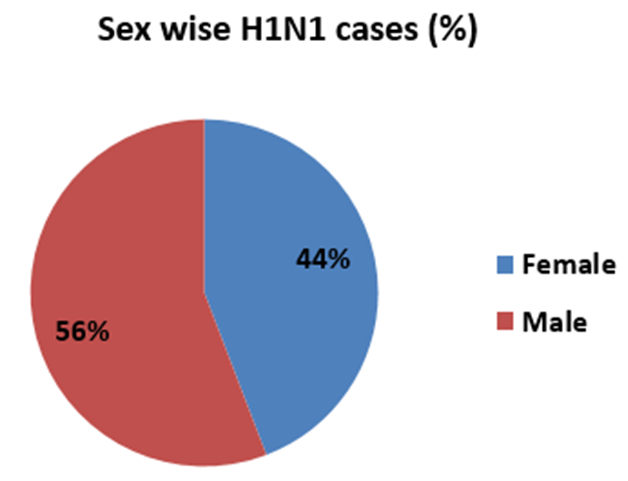
All the suspected cases of H1N1 are admitted in H1N1 isolation ward irrespective of their laboratory status. From January 2010 to October 2012, 134 patients were admitted in H1N1 isolation ward as a suspected H1N1 cases and all the cases were laboratory tested for H1N1. As per Figure 1 out of total H1N1 positive cases male cases (56%) are higher than female (44%).
Figure 1: Sex Wise H1N1 Distribution
Out of 134 suspected cases 32.09% are found test positive in which female positive rate (34.54%) is higher than male (30.37%) (Table 1). The quality of care for women in some parts of the developing world is not equal to that received by men. In some developing countries, knowledge of the pandemic was higher among men than women [7]. This reflect in low case detection rate of female patient in this study due to poor health seeking behaviour of female but high positive rate in female patient suggest that there is need of active surveillance to increase case detection rate of female.
Table 1: Sex Wise H1N1 Positivity Rate
Sex
Suspected cases
Positive cases (%)
Male
79
24 (30.37)
Female
55
19 (34.54)
Total
134
43 (32.09)
CHI SQUARE 0.61
In Government Medical College & Hospital Bhavnagar H1N1 cases admitted from Bhavnagar and Amreli Districts and out of them >90% cases from urban area. High communicability in urban area may be due to high population density.
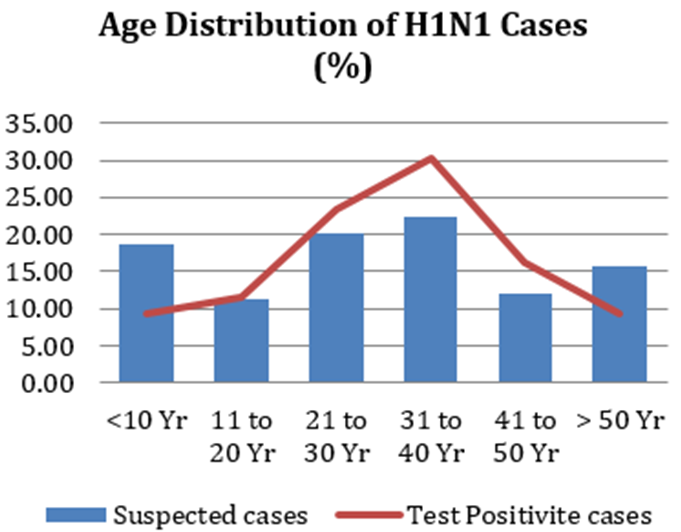
Most of the cases found positive due to H1N1 in age group between 20 to 45 years. The same result also found in study conducted by Rajesh k Chudasama in Saurashtra in Gujarat. The reason behind it may be due to young people are more exposed to community so they are more prone to get infected [8].
Figure 2: Age Distribution of H1N1 Cases
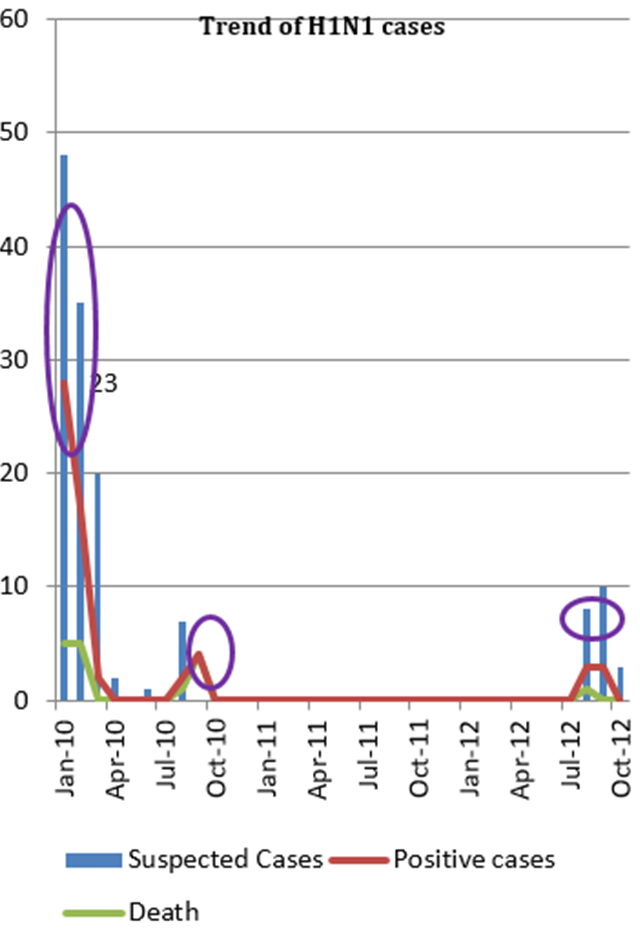
Peak of cases found in winter season. Cases shows cyclical trend. Cyclic trend suggests that early sensitization of health staff as well as community may improve in H1N1 cases early detection and improvement in clinical outcomes.
Clinical Outcomes H1N1 Cases
All the suspected H1N1 cases admitted in isolation ward were treated as per guideline of Government of Gujarat. Contacts of H1N1 confirmed cases were also given prophylactic treatment. Most of the cases admitted with high grade fever (100%), Breathlessness (99%) and tachycardia (90%).
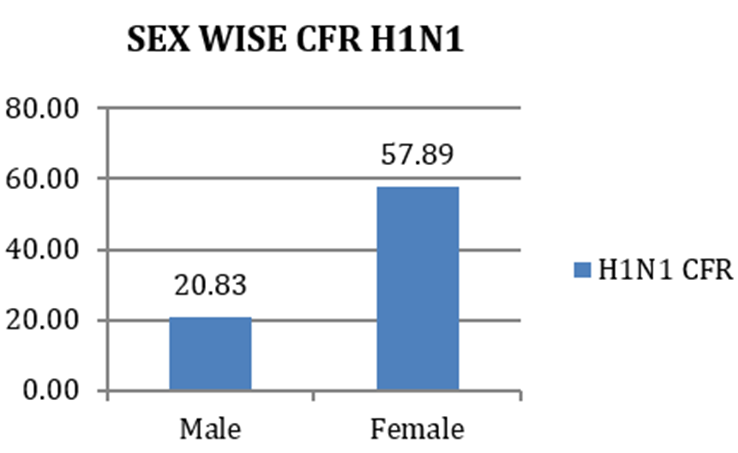
CFR due to Influenza A H1N1 was 37.21% of the admitted cases in Medical College Hospital Bhavangar as compare to study by Vijaydeep Siddharth 54.9% [8]. The CFR lower in Bhavnagar due to early admission and early start treatment according Government of Gujarat guideline. The case fatality ratio was found to much higher in female (57.89%) as compare to male (20.83%) (Figure 3). The 24% cases developed Acute Respiratory Distress Syndrome (ARDS), of this 50% survived.
Figure 3: Time Trend of H1N1 Cases
Only single death occurs due to H1N1 in Bhavnagar in this year. As per Table 2 out of total deaths in Gujarat due to H1N1 during last 3 years Bhavnagar contributes 4%.
Table 2: Sex Wise H1N1 Positivity Rate
Year
Bhavnagar
Gujarat
Cases
Death
Cases
Death
2010
38
15
1682
353
2011
0
0
7
3
2012*
5
1
87
26
*Up to October 2012
Figure 4: Sex Wise CFR in H1N1 Cases
CONCLUSION
High grade fever and breathlessness were the main presenting complaints. Tachycardia as clinical signs predicts development of respiratory complications. ARDS was observed to be the main cause of mortality in this study. Vigilance in patient with respiratory disease in young age group and during early winter may improve diagnosis of H1N1 cases and early prompt treatment according to government guideline improve clinical outcome of H1N1 cases.
REFERENCE
Acta Obstetricia et Gynecologica Scandinavica, vol. 76, 1987, pp. 1–14.
Ray, S.K. et al. “Utilization of maternal services in west bengal.” Indian Pediatrics, vol. 30, 1993, pp. 351–354.
Agarwal, P. et al. “Maternal health-care utilization among women in an urban slum in Delhi.” Indian Journal of Community Medicine, vol. 32, 2007, pp. 203–205.
Jejeebhoy, S.J. “Maternal mortality and morbidity in India: Priorities for social sciences research.” Journal of Family Welfare, vol. 42, no. 2, 1997, pp. 30–51.
Bartlett, L.A. et al. “Where giving birth is a forecast of death: maternal mortality in four districts of Afghanistan, 1999–2002.” The Lancet, vol. 365, 2005, pp. 864–870.
Kilpatrick, J.S. et al. “Preventability of maternal deaths: comparison between Zambian and American referral hospitals.” Obstetrics and Gynecology, vol. 100, 2002, pp. 321–326.
Park, J.E. and K. Park. Textbook of Preventive and Social Medicine. 18th ed., Banarsidas Bhanot Publishers, 2002, pp. 386.
Recommended Articles
Research Article
An evaluation of Profile of Medico-legal autopsies conducted at Dr. Radhakrishnan Govt. Medical College, Hamirpur, Himachal Pradesh
Download PDF
Research Article
The Efficacy of 5- Fluorouracil Cream and 25% Podophyllin Solution in Treatment of Plantar Warts in Alternative Day Regimen ; An Open Therapeutic Trial.
Download PDF
Research Article
Imaging Evaluation of Ultrasonography Versus Magnetic Resonance,
Imaging in Diagnosis of Carpal Tunnel Syndrome among Female Patients with Positive Nerve Conduction Study
Download PDF
Research Article
Usage of Therapeutic Offloading In Diabetic Foot- A Clinical Audit
Amit Kumar C Jain,
Apoorva HC
Published: 05/05/2021
Download PDF
PO Box 101, Nakuru
Kenya.
Email: office@iarconsortium.org
Editorial Office:
J.L Bhavan, Near Radison Blu Hotel,
Jalukbari, Guwahati-India
Amin, D., Patel, V. & Singh, M. (2020). Epidemiologic Features and Clinical Outcome of H1N1 Patients at Tertiary Care Hospital Bhavnagar, Gujarat. International Academic Research Journal of Internal Medicine & Public Health, 1(1), 1-3.
MLA
Amin, Dhiren, Vinod Patel and Manindrapratap Singh. "Epidemiologic Features and Clinical Outcome of H1N1 Patients at Tertiary Care Hospital Bhavnagar, Gujarat." International Academic Research Journal of Internal Medicine & Public Health 1.1 (2020): 1-3.
Chicago
Amin, Dhiren, Vinod Patel and Manindrapratap Singh. "Epidemiologic Features and Clinical Outcome of H1N1 Patients at Tertiary Care Hospital Bhavnagar, Gujarat." International Academic Research Journal of Internal Medicine & Public Health 1, no. 1 (2020): 1-3.
Harvard
Amin, D., Patel, V. and Singh, M. (2020) 'Epidemiologic Features and Clinical Outcome of H1N1 Patients at Tertiary Care Hospital Bhavnagar, Gujarat' International Academic Research Journal of Internal Medicine & Public Health 1(1), pp. 1-3.
Vancouver
Amin D, Patel V, Singh M. Epidemiologic Features and Clinical Outcome of H1N1 Patients at Tertiary Care Hospital Bhavnagar, Gujarat. International Academic Research Journal of Internal Medicine & Public Health. 2020 Jul;1(1):1-3.


 Download PDF
 Download XML