Air transportation is an essential input for downstream sectors, as it permits various economic exercises through buying and selling goods mostly in services by way of the movement of natural individuals. The preparation of aviation expanded a major number of destinations is also helpful for tourism, especially global tourism. Air transport is distinguished by both complementarity and substitutability with other systems of transport. The differences in the way of behaving passengers following the COVID-19 crisis, travel imitations forced by the government and the following economic crisis have caused significant fall in demand for airline services. Controlling costs are probably to rise for both airlines and airports with reason of extra health and safety necessities (e.g. disinfection, PPE, temperature checks or viral tests) before they can be passed on to customers. Besides, the application of social distancing measures has forced a restriction in the passenger by up to 50% of the capacity. Direct aviation jobs (at airlines, airports, manufacturers, and air traffic management) drop down by 4.8 million, and aviation-supported jobs potentially fall off by 46 million to 41.7 million (-52.5%) (a 43% reduction compared with the pre-COVID situation) these are the impact of covid -19 in the aviation industry as a whole. According to strategic planning refers to prepare for all outcomes by abstraction and thus to account for the complexity and the dynamics of the environment entails the need to build alternative future scenarios and configurations. Moreover, Strategic planning is procedure of design mission, values, goals and objectives. Some goals or plans can change based on any unplanned and sudden event. The decision-making process during the crisis is important for the dependency and the continuation of the work of the organization in order to maintain its position and effectiveness during the crisis and to be able to solve any problem as soon as possible by making a good and effective decision. This Chapter explains the certain information and details that linked to the research topic about strategic planning and decision-making during Crisis in Salam air.
Keywords
Strategic Planning
Decision-Making
Crisis Management
COVID-19
Aviation Industry
INTRODUCTION
Rational of the study
The purpose for selecting this topic is to realize how the company can use the strategic planning and decision-making during Crisis. Besides, analyze the situation happens and know what suitable strategic planning and decision making can use to handle the challenge in a critical way to make the company overcomes the crisis to achieve goals. Moreover, this research will be useful to make good and fast decision making. The control of crises has raised to design the crisis management team. As well-organized management automatically requires success in crisis management. The firm should achieve accurate planning for data about opportunities and threats of the situation in sequence to systemize strategy for using probable opportunities and protecting from chance of threats.
Statement of the problem
Every company should know the importance of strategic planning and decision-making during a crisis and how they should use it when tough times happen, because the company may fall into a difficult problem or a situation that is different from what they expected or used to, and this needs planning and a quick solution. In order to be successful defined strategy as s an approach to reach corporate goals in order to be successful on a long-term basis. There are plenty of risks of having no strategic plan, if the company fails to predict or prepare for essential changes, they might lose useful lead time to tackle them when happening. The company can’t focus on opportunities without good strategic planning. The company can’t focus on opportunities without good strategic planning. When a company makes bad decisi it
the company's name and value. Moreover, This research aims to know the importance of strategic planning and decision-making during the crisis in Salam Air and how it dealt with this crisis with good planning and making sound decisions that overcame the crisis that greatly affected their services, employees, and their profit, and all this leads to an imbalance in the country’s economy because aviation has Benefit in the growth of the economy and creates jobs.
Aims and Objectives of the Study
The goal of this research would be to explore the factors affecting strategic planning & decision-making during crisis in SalamAir. The focus of research will be on the following objectives:
To identify the key factors that affect company’s planning & decision making during covid-19 crisis
To investigate how various factors are affecting the company’s strategic planning and decision-making process during covid-19 crisis
To formulate a recommendation to improve strategic planning & decision-making process of the company in the course of crisis
Research Questions
What are the factors that have an effect in the company's strategic planning & decision-making during crisis
How different key factors influenced the strategic planning & decision making of the company in crisis.
What are the most suggested tools to improve strategic planning & decision making of the company in crisis
Scope and Limitation
Strategic-management supports corporations to find appropriate solutions for crises and enable to decide proper decision based on proper understating of the issues within business-atmosphere. Salam-Air applies strategic-management and decision-making practices during crises of COVID-19. Strategic-management enables Salam-Air to find proper solutions and to overcome the disadvantageous impacts of Covid-19. This study determines strategic-planning, and crisis-management style that can be applied to decide appropriate decisions at Salam-Air. Also, this-study focuses on crucial approaches of strategic-management and decision-making practices during crises. Crises times needs for proper strategic-management and proper decision-making to overcome crises. This study evaluates strategic-management and decision-making practice of Salam-Air during COVID-19. The study determines key issues that influences on decision-making and strategic-planning at Salam-Air during Covid-19.
It was inflexible to collect-information regarding negative impacts of COVID-19 on business operations of Salam-Air. Decision-making and strategic-planning practices at Salam-Air are considered as confidential practices.
Significance of the Study
This study is helpful for corporations that need to face various challenges and issues within business-environment. Modern companies can apply strategic-management to overcome various issues and to decide proper decisions during various-crises. Strategic-management enable to focus on various phase of the crises to find proper solution. Also, the decisions can be decided based-on crisis-planning-phase, crisis-response-phase, and crisis-evaluation-phase and learning-phase to deal effectively with the crisis of Covid-19. This study assesses strategic-management and decision-making practice of Salam-Air during COVID-19. This study finds out strategic-planning, and crisis-management style that can be implemented to decide suitable decisions at Salam-Air. Also, this study-determines key issues that influences on decision-making and strategic-planning at Salam-Air during Covid-19 to provide fit recommendation to advance strategic-management and decision-making at Salam-Air.
Conclusion
The uncertainty during covid-19 affects the aviation industry as a whole. Moreover, the industry remains exposed to a possible resurgence of the pandemic, as governments imposed new air travel restrictions to tackle outbreak or a potential second wave of virus. The expense of health measures and the shape of recovery for commercial flights resolves, to target occupations that are feasible.The COVID-19 crisis has built up a portion of the reasonings that were recently used to legitimize backing to the aviation business. In particular, liquidity challenges, increasing debt burdens and uncertain obstacles of the company.
This chapter shows the Strategic planning and decision making during the period of covid -19 crisis, and main objective also definition of some terms.
Review of Related Literature
Introduction
In the previous chapter it discussed about questions of the research, objectives and aims of the research, problem statements, and significance of the study. This chapter will focus on the strategic planning & decision-making in SalamAir during the crisis of covid-19. The relevant past studies are in the below given literature.
Concept of Strategic Planning
According to viewed strategy as the long-term goals and objectives determination, the adoption of courses of action, and associated allocation of resources required to achieve goals. As we can see there is a connection between organizations goals and strategic planning, the core meaning of strategic planning can uplift the company’s goals management wise. In order to survive the crisis such as covid-19 SalamAir should asses the external environment opportunities and threats to grow towards the overall goal in better judgment to the situation and good strategic planning & decision making.
Table 1: Definition of Terms
Concept of Strategic Planning:
Strategic Planning: “Strategic Planning specifies the basic conditions as well as the scope for future business activities”.
concept of Decision-Making:
Decision-Making: “Decision making is the selection of a course of action among alternatives; it is the core of planning”.
Concept of Crisis:
Crisis: "Crisis management refers to the identification of a threat to an organization and its stakeholders in order to mount an effective response to it.”.
Concept of Management:
Management: “Management is a multi-purpose organ that manages business and manages managers and manages workers and work”.
The Four Steps of Strategic Planning Process
According to Strategic Planning has 4 steps that business owners can use to succeed First, Environmental Scanning: which is basically examining, searching and collecting information relevant to the data to recognize opportunities and threats. Secondly, Strategy Formulation: Based upon the data and experience been collected from the first step to reach a clearer view of what needs to be assessed to accomplish the goals which in our case the goal is to have the best strategic decision for positive results in coping with the pandemic in salaam airs organization management. Thirdstep is Strategy Implementation: The most crucial part of strategy implementation is to vocalize it clearly the whole organization should be invested and be aware of company’s overall goal, in this particular step the strategy formulation process should be put in action and progress. Final step is Strategy Evaluation: Taking the time to observe what’s needed and highlight any changes accordingly from the process to get the best situation from the planning was taken and eventually reap the rewards of hard working and persistency towards the vision and goals of the management.
Decision-making
According to decision making is regarded as the heart of the management process. Decision making is the most critical, core managerial obligation. Is the most difficult part of handling an organization not to mention handling it during a crisis which in our case is covid-19 and the very uniqueness of the situation. Ddefined decision as a conscious choice among alternative courses of action. It’s basically choosing among different given options that an organization like Salaam Air can utilize its resources and decisions taken in crisis to meet its goals and required objectives.
Crisis
According to crisis is a time of intense difficulty, trouble, or danger and can be personal, or confined to small population, or a company dealing with a very serious problem. Which in our research the situation is covid-19 which is extremely dangerous and harmful from all aspects to human health and the overall businesses. Researchers such as viewed that there is a common feature between crisis and emergency, both are in urgent need for assistance or relief.
Concept of Crisis-Management
Crisis-management is vital action applied by corporation to assess and direct crisis. Crisis-management is effective arrangement which enable corporation to decrease, handle, or avoid a disaster when it occurs. Brockner, and James [1], sited that crisis-management can be classified into three main phases, pre-crisis-time, crisis-period, also after-crisis-period. Also, phases are crisis-planning, crisis-response, and crisis evaluation.
Crisis-Awareness is vital state of corporate speed to predict and effectively deal with internal-issues or external-issues. This could control crisis in corporation through consciously understating and sensibly get ready for the happening of the inescapable. However, irrespective of crisis-kind, whether emergencies, man-induced, natural, or pandemic cannot be determined.
Strategic-Planning & Crisis-Management-Style
Brockner, and James [1], sited that strategic-planning is essential key for corporation crisis-management as it deals with issues and intimidation. Also, it deals with business strengths and prospects. Strategic-planning predicts future measures that may lead to disaster. Coombs, explained that strategic-planning is essential to all businesses since it has been demonstrated to have constructive association with organizational economic objectives and non-economic objectives that impact directly on bottom-line output.
Appropriate-Strategic-Planning:
Proper strategic-planning enable to proper crisis-management in the corporation that might lead to better efficiency within organizational-setting. Strategic-planning is considered as independent aspect from crisis-management.
Facilitating dimensions to Strategic-planning and Crisis-management: Coombs, explained that there are-four dimensions to strategic-planning, and crisis management consciousness of issue, leadership, organizational-culture, and decision-making.
Impact of Covid-19 on Corporate Social Responsibility
Covid-19 has shown a significant effect on the environmental changes in modern marketing. According to crisis has put companies under test for its commitment to ethical business conduct and CSR. Which can affect the consumer behavior because in pandemic their actions and choices can be irrational due to the unexperienced of the situation. According to consumer decision making is currently driven purely by self-interest and emotions, such as fear, anger, and anxiety. Which companies should consider unique strategic planning to adopt a healthy and safety measurement for the responsibility of society.
Tools and Approaches of Strategic-Planning
According to Mintzberg and Henry [2], strategic planning relies-on various tools and approaches which facilitates the execution of strategic planning. Variety of techniques and analytical tools are implemented in strategic-planning as follows:
PEST-Analysis: covers external-environment aspects like technological, political, economic, and social approaches.
Furthermore, scenario planning can be implemented throughout large corporations to investigate future scenarios. Additionally, flowchart to the right determines practices for identifying phenomena as scenarios based on intuitive-logics-tradition
Porter-Five-Forces: determines attractiveness of particular industry and competition throughout buyers, suppliers’ power, substitute threats and new-market-entrants
Moreover, SWOT: Aanalysis, which determines internal-strengts and internal-weaknesses associated with external-opportunities and external-threats
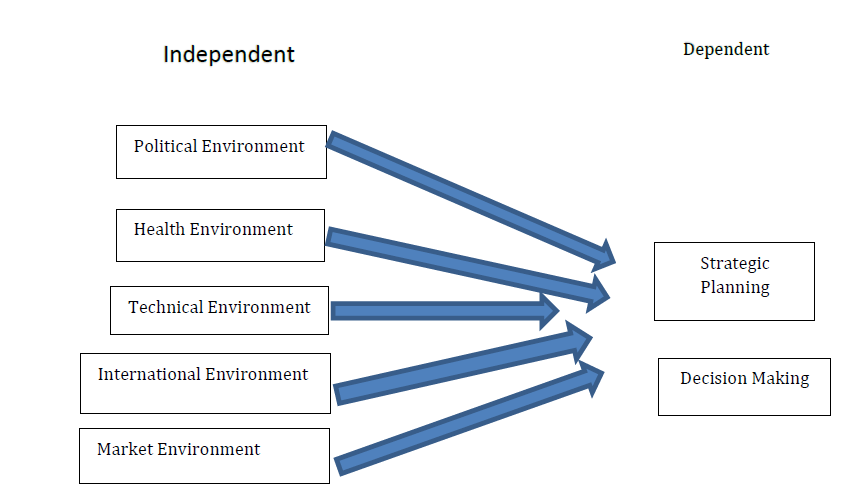
Figure 1: Conceptual Framework
Strategic-Planning-Process
George and Walker [3], strategic-planning is practice that has inputs, practice, or processes, and outcomes or outputs. This process of strategic-planning, like other processes. Strategic-planning affords inputs which can be implemented for strategic-thinking, which facilitates actual-strategy formation.
Additionally, strategic-planning encompassing practices or processes of assessing of business strategic issues and missions to strengthen existing practices and identifying necessity for new-programming. The end-result, or output of strategic planning is business strategy, covering competitive situations, environment diagnosis, guiding strategy on what corporations intend to achieve, and key action plans or initiatives for accomplishing guiding-policy.
Conceptual Framework
The conceptual framework displays the variables used in this research, in this framework below, the dependent and independent variables are shown which are linked to each other. Below framework shows that various environments related to strategic planning which has an effect on decision-making of the company.
Research Gap
The researcher faces some gaps such as evidence-gap, knowledge-gap and population gap. It was hard to deal with these gaps. Researcher obtained useful information throughout various sources like websites, articles, and books to overcome the evidence gap. Also, population gap is solved through meeting workers, and managers to get valid and reliable facts from them.
Conclusion
To conclude, this chapter describes some of past studies which linked to the research gap and objectives of the research. Moreover, the diagram illustrates how various environments related to strategic planning affect the decision-making of the company.
MATERIALS AND METHODS
Introduction
This chapter will include the various methods used to reach the aim of this research which is explore the factors affecting strategic planning and decision-making process during the period of covid-19 crisis in Salam Air.This chapterwill cover the type of research, research instruments, research design. Sources of data will include online questionnaire due to the difficulty of personally attending and handling questionnaire due to covid-19, and treatment of data will be covered along with a conclusion.
Type of Research
This type of research is quantitative, the reason for choosing this to measure accurate numbers regarding the feedback on the Strategic planning and decision-making process during the period of covid -19 crisis in SalamAir.
Research Design
The type of research design is exploratory research, which aims to explore a research problem, its effective because not much known about the topic due to recent pandemic situation and to have better understanding. In exploratory research we collect the data and transform it into numerical basis and describe the data collected along with a charts, figures and graphs to simplify data for easier understanding.
The participants of our research are employees of SalamAir working in the headquarters in office based in Muscat. The purpose of the research will consider the effect of strategic planning & decision making of the company during covid-19, The sampling method used is convenience sampling which is one of types in nonprobability sampling.
Introduction
This chapter will include the various methods used to reach the aim of this research which is explore the factors affecting strategic planning and decision-making process during the period of covid-19 crisis in Salam Air.This chapterwill cover the type of research, research instruments, research design. Sources of data will include online questionnaire due to the difficulty of personally attending and handling questionnaire due to covid-19, and treatment of data will be covered along with a conclusion.
Type of Research
This type of research is quantitative, the reason for choosing this to measure accurate numbers regarding the feedback on the Strategic planning and decision-making process during the period of covid -19 crisis in SalamAir.
Research Design
The type of research design is exploratory research, which aims to explorea research problem, its effective because not much known about the topic due to recent pandemic situation and to have better understanding. In exploratory research we collect the data and transform it into numerical basis and describe the data collected along with a charts, figures and graphs to simplify data for easier understanding.
Research Respondents
The participants of our research are employees of SalamAir working in the headquarters in office based in Muscat. The purpose of the research will consider the effect of strategic planning & decision making of the company during covid-19, The sampling method used is convenience sampling which is one of types in nonprobability sampling.
Our population size is 451 because the overall employees of Salam Air. And regarding strategic planning & decision making of the organization. So, this calculation provides us with a sample size of 43.
Research Instrument
Every company should know the importance of strategic planning and decision-making during a crisis and how they should use it when tough times happen, Because the company may fall into a difficult problem or a situation that is different from what they expected or used to, and this needs planning and a quick solution. There are plenty of risks of having no strategic plan, if the company fails to predict or prepare for essential changes, the tools of questionnaire that researchers mostly used is primary data tools. It is a group of questions for collecting information from respondents. The outline of the questionnaire contains close-ended questions using Likert scales to collect from employees their choice which is appropriate to support their opinion which they agree or disagree, to assess the objectives were started from 1=” strongly agree” to 5 = “strongly disagree”. The questionnaire was done by using 15 questions that linked with objectives. Each objective has 5 questions.
Research Procedure
In our research the data will be collected by both methods, Firstly through primary sources and the other one through secondary sources such as articles, books, and research distributions. The approach of this research to distribute an online questionnaire to the employees working in SalamAir. We mainly focused on employees as their close and familiar to the planning and decision-making of the company.
Gathering of Data
The researchers conduct this research for academic purpose and it will not be used for some other purpose. The details of data will be kept confidential. This research contains primary and secondary data. The primary data is collected from the main source using a questionnaire involve a series of questions that aim to collect a specific response. On another side, secondary data is already collected through past primary sources cover books, articles, journals, Internet searchers, and newspapers.
Treatment of Data
There are numerous forms of data analysis accessible for collected information, which majority is from scholarly articles from google scholar. In this research we would make use of Microsoft Excel to examine the data collected from the questionnaire. Which we can analyze the answers of the respondents and to be conveyed using diagrammatic representations such as tables and graphs.
Conclusion
In conclusion, this chapter covered the research methodology, it lays out a run-through on the following points such as research type, research design, instrument of the research. In addition, the procedure of the research gathering and treating of data. The next chapter will examine and cover analyzes of the data.
Presentation, Analysis, and Interpretation of Data
Introduction: In this chapter, the data collected will be evaluated in order to reach at diagrammatic results of the questionnaire analyzed and described.
Table 2: Gender distribution
Gender
Number of employees
%
Female
17
34%
Male
33
66%
Total number of employees
50
100%
Table 3: Age Distribution
Age
Number of employees
%
45 or more
7
14%
36-45
24
48%
26-35
16
32%
Less than 25
3
6%
Total number of employees
50
100%
Table 4: Work Experience
Work experience
Number of employees
%
10 years and more
10
20%
6-10 years
31
62%
Less than 5 years
9
18%
Total number of employees
50
100%
Table 5: Employment Status
Employment status
Number of employees
%
managerial
32
64%
supervisory
18
36%
Total number of employees
50
100%
Table 6: Level of Education
Level of Education
Number of employees
%
Masters
13
26%
Bachelor
26
52%
Diploma
11
22%
Total number of employees
50
100%
Table 7: The Organization Handle the Situation and Plan and Make Decisions Better than its Competitors
Scale
Frequency
%
Strongly Agree
29
58%
Agree
13
26%
Neutral
3
6%
Disagree
4
8%
Strongly Disagree
1
2%
Total number of employees
50
100%
Table 8: The Company Take the Necessary Safety Measures to Protect the Employees during the Crisis of Covid-19
Scale
Frequency
%
Strongly Agree
22
44.9%
Agree
19
38.8%
Neutral
3
6.1%
Disagree
3
6.1%
Strongly Disagree
2
4.1%
Total number of employees
50
100%
Table 9: The Company Cope Up With the Latest Technologies to Adapt the Situation of Crisis
Scale
Frequency
%
Strongly Agree
25
51%
Agree
13
26.5%
Neutral
8
16.3%
Disagree
1
2%
Strongly Disagree
2
4.1%
Total number of employees
50
100%
Questionnaire Data Analysis and Interpretation
Percentage Distribution of Respondents profile
Interpretation: The table and figure above illustrate that the 66% of the respondents are males and 34% females.
Figure 1: Gender Distribution
Figure 2: Age Distribution
Figure 3: Work Experience
Figure 4: Employment Status
Interpretation
From above diagram we can see that the majority of respondents 48% are in the age group of 36-45, while 32% are between the age 26-35 and the remaining are 14% age 45 or more and 6% less than 25.
Interpretation
According to the diagram above, the majority of the survey respondents have a work experience of 62% between 6-10 years, the middle ones are between 20% 10 years and more, 18% less than 5 years.
Figure 5: Level of Education
Figure 6: Organizational Decision-Making and Competitive Advantage
Figure 7: Employee Safety Measures during the Covid-19 Crisis
Figure 8: Adoption of Latest Technologies during the Crisis
Interpretation
It’s obvious from the above diagram majority are 64% Managerial status, and 36% are supervisory.
Interpretation
The above diagram shows that the 52% of the respondents hold a bachelor degree, and master’s degree holders are 26%, and 22% holding diploma.
Interpretation
From the above diagram 58% of the respondents strongly agree that the organization handle the situation, plan and make decisions better than its competitors, and 26% percent agree, 6% are neutral, while 8% disagreed and only 2% strongly disagreed.
Figure 9: Company’s Adoption of Latest Technologies during the Crisis
Figure 10: Customer Perception of Company’s Use of Latest Online Services
Table 10: The Decisions Taken By the Management Lead to the Path of Recovery Economic Wise checking travelers for Covid 19. 34% agree, 8% neutral, also 8% but disagree and 2% strongly disagree.
Scale
Frequency
%
Strongly Agree
26
52%
Agree
12
24%
Neutral
9
18%
Disagree
1
2%
Strongly Disagree
2
4%
Total number of employees
50
100%
Interpretation
Most of the respondents 44.9% strongly agree, 38.8% agree the company took the necessary safety measures to protect the employees during the crisis of covid-19, 6.1% neutral, while 6.1% disagree and 4.1% strongly disagree.
Interpretation
The majority of respondents 51% strongly agree that the company coped up with latest technologies to adapt the situation of crisis. And 26.5% agree, while 16.3% neutral, 2% disagree and 4.1% strongly disagree.
Interpretation
Most of the respondents 52% strongly agree the decisions taken by the management led to the path of recovery economic wise. 24% agree and 18% neutral, while 2% disagree and 4% strongly disagree.
Interpretation
48% of the respondents strongly agree the company is using the latest online services towards the customers in the market. 15% agree, and 12% neutral. While 6% disagree and 4% strongly disagree.
Table 11: Company Is Using the Latest Online Services Towards the Customers in the Market
Scale
Frequency
%
Strongly Agree
26
52%
Agree
12
24%
Neutral
9
18%
Disagree
1
2%
Strongly Disagree
2
4%
Total number of employees
50
100%
Table 12: Salamair Was Able To Provide High-Tech Equipment Specialized In Checking Travelers for Covid 19
Scale
Frequency53
%
Strongly Agree
24
48%
Agree
17
34%
Neutral
4
8%
Disagree
4
8%
Strongly Disagree
1
2%
Total number of employees
50
100%
Table 13: Pandemic Reduce the Profitability of the Organization
Scale
Frequency
%
Strongly Agree
24
48%
Agree
18
18%
Neutral
6
6%
Disagree
1
2%
Strongly Disagree
1
2%
Total number of employees
50
100%
Table 14: The Decisions Related to the Corona Crisis Affected the Change in Strategic Plannin
Scale
Frequency
%
Strongly Agree
23
46%
Agree
18
36%
Neutral
7
14%
Disagree
1
2%
Strongly Disagree
1
2%
Total number of employees
50
100%
Table 15: Quick Decision-Making Can Affect the Response and Acceptance of Employees for These Decisions
Scale
Frequency
%
Strongly Agree
24
48%
Agree
17
34%
Neutral
5
10%
Disagree
3
6%
Strongly Disagree
1
2%
Total number of employees
50
100%
Table16: The Consequences of Suspending Flights Affected Salamair
Scale
Frequency
%
Strongly Agree
28
56%
Agree
13
26%
Neutral
5
10%
Disagree
3
6%
Strongly Disagree
1
2%
Total number of employees
50
100%
Table 17: Salam Air Follows Global Standard of IATA for Business Practices during COVID-19
Scale
Frequency
%
Strongly Agree
29
58%
Agree
12
24%
Neutral
7
14%
Disagree
1
2%
Strongly Disagree
1
2%
Total number of employees
50
100%
Interpretation
Majority of the respondents agree 48% that SalamAir was able to provide high-tech equipment specialized in
Table 18: Salam Air Must Respect IATA Rules For Standardizing Services Scheduling, Traffic and Routes during Pandemic
Scale
Frequency
%
Strongly Agree
21
42%
Agree
22
44%
Neutral
4
8%
Disagree
1
2%
Strongly Disagree
2
4%
Total number of employees
50
100%
Table 19: The Pandemic Reduced the Customer Demand
Scale
Frequency
%
Strongly Agree
22
44%
Agree
17
34%
Neutral
6
12%
Disagree
4
8%
Strongly Disagree
1
2%
Total number of employees
50
100%
Table 20: The Company Market is Effected During the Crisis
Scale
Frequency
%
Strongly Agree
19
38%
Agree
22
44%
Neutral
5
10%
Disagree
2
4%
Strongly Disagree
2
4%
Total number of employees
50
100%
Table 21: Salamair Was Able to Restore Its Flights Quickly Compared to Other Airlines in the Market
Scale
Frequency
%
Strongly Agree
31
62%
Agree
9
18%
Neutral
8
16%
Disagree
1
2%
Strongly Disagree
1
2%
Total number of employees
50
100%
Table 22: Salam-Air Applies Proper Safety Practices to Avoid Negative Influences of Covid-19
Scale
Frequency
%
Strongly Agree
21
43.8%
Agree
20
41.7%
Neutral
4
8.3%
Disagree
1
2%
Strongly Disagree
2
4.2%
Total number of employees
50
100%
Figure 11: Effectiveness of SalamAir’s Covid-19 Screening Technology (Customer Perception)
Figure 12: Impact of Pandemic on Organizational Profitability
Figure 13: The Decisions related to the Corona Crisis Affected the Change in Strategic Planning
Figure 14: Quick Decision-mking Canaffect tha Rresponse and acceptance of these Decisions
Figure 15: The Consequences of Suspending Affected Salamair
Figure 16: Salam Air Follow Global Satndard of IATA for Business Practices during COVID-19
Figure 17: Salam Air Must Respect IATA Rule for Standardizing Services Scheduling,Traffic and Routes during Pandemic
Figure 18: The Pandemic Reduced the Customer Demand
Figure 19: The Company Market Get Effected during the Crisis
Figure 20: Salamair was Able to restore its Flights Quickly Compared to other Airlines in the Market
Interpretation
Most of the respondents strongly agree 46% the decisions related to the corona crisis affected the change in strategic planning. 36% agree, 14% neutral, 2% disagree and 2% strongly disagree.
Interpretation
Majority strongly agreed 48% Quick decision-making can affect the response and acceptance of employees for these decisions. 34% agree, 10% neutral, while 6% disagree and 2% strongly disagree.
Interpretation
56% of the respondents strongly agree the consequences of suspending flights affected SalamAir. 26% agree and 10% neutral, while 6% disagree and 2% strongly disagree.
Interpretation
Majority of the respondents 58% strongly agree Salam Air follows global standard of IATA for business practices During COVID-19. 24% agree, 14% neutral and 2% disagree and 2% strongly disagree.
Interpretation
42% strongly agree Salam Air must respect IATA rules for standardizing services scheduling, traffic and routes during pandemic. The most 44% agree, 8% neutral, 2% disagree and 4% strongly disagree.
Figure 21: Salam-Air Applies Proper Safety Practices to avoid Negative Influences of COVID 19
Interpretation
Majority of the respondents 48% of them agreed the pandemic reduced the profitability of the organization. 18% agree, 12% neutral, 2% disagree and 2% strongly disagree.
Interpretation
The majority of respondents 44% of them strongly agreed the pandemic reduced the customer demand. 34% agree, 12% neutral, 8% disagree and 2% strongly disagree.
Interpretation
Most of the respondents 44% agree the company market get effected during the crisis. 38% strongly agree, 10% neutral, while 4% disagree and 4% strongly disagree.
Interpretation
62% of the respondents strongly agree SalamAir was able to restore its flights quickly compared to other airlines in the market. 18% agree, 16% neutral, 2% disagree and 2% strongly disagree.
Interpretation
Most of the respondents 43.8% strongly agree with Salam-Air applies proper safety practices to avoid negative influences of Covid-19. 41.7% agree, 8.3% neutral, 2.1% disagree and 4.2% strongly disagree.
Findings and discussions
66% of the respondents are males and 34% females
Majority of respondents 48% are in the age group of 36-45, while 32% are between the age 26-35 and the remaining are 14% age 45 or more and 6% less than 25
The majority of the survey respondents have a work experience of 62% between 6-10 years, the middle ones are between 20% 10 years and more, 18% less than 5 years.
64% Managerial status, and 36% are supervisory
52% of the respondents hold a bachelor degree, and master’s degree holders are 26%, and 22% holding diploma
58% of the respondents strongly agree that the organization handle the situation, plan and make decisions better than its competitors, and 26% percent agree, 6% are neutral, while 8% disagreed and only 2% strongly disagreed
Most of the respondents 44.9% strongly agree, 38.8% agree the company took the necessary safety measures to protect the employees during the crisis of covid-19, 6.1% neutral, while 6.1% disagree and 4.1% strongly disagree
The majority of respondents 51% strongly agree that the company coped up with latest technologies to adapt the situation of crisis. And 26.5% agree, while 16.3% neutral, 2% disagree and 4.1% strongly disagree
48% of the respondents strongly agree the company is using the latest online services towards the customers in the market. 15% agree, and 12% neutral. While 6% disagree and 4% strongly disagree
Majority of the respondents agree 48% that SalamAir was able to provide high-tech equipment specialized in checking travelers for Covid 19. 34% agree, 8% neutral, also 8% but disagree and 2% strongly disagree
Majority of the respondents 48% of them agreed the pandemic reduced the profitability of the organization. 18% agree, 12% neutral, 2% disagree and 2% strongly disagree
Most of the respondents strongly agree 46% the decisions related to the corona crisis affected the change in strategic planning. 36% agree, 14% neutral, 2% disagree and 2% strongly disagree
Majority strongly agreed 48% Quick decision-making can affect the response and acceptance of employees for these decisions. 34% agree, 10% neutral, while 6% disagree and 2% strongly disagree
56% of the respondents strongly agree the consequences of suspending flights affected SalamAir. 26% agree and 10% neutral, while 6% disagree and 2% strongly disagree
Majority of the respondents 58% strongly agree Salam Air follows global standard of IATA for business practices During COVID-19. 24% agree, 14% neutral and 2% disagree and 2% strongly disagree
42% strongly agree Salam Air must respect IATA rules for standardizing services scheduling, traffic and routes during pandemic. The most 44% agree, 8% neutral, 2% disagree and 4% strongly disagree
The majority of respondents 44% of them strongly agreed the pandemic reduced the customer demand. 34% agree, 12% neutral, 8% disagree and 2% strongly disagree
Most of the respondents 44% agree the company market get effected during the crisis. 38% strongly agree, 10% neutral, while 4% disagree and 4% strongly disagree
62% of the respondents strongly agree SalamAir was able to restore its flights quickly compared to other airlines in the market. 18% agree, 16% neutral, 2% disagree and 2% strongly disagree
Most of the respondents 43.8% strongly agree with Salam-Air applies proper safety practices to avoid negative influences of Covid-19. 41.7% agree, 8.3% neutral, 2.1% disagree and 4.2% strongly disagree
Overall, the previous studies made by the researchers and the results of the questionnaire highlighted to identify, investigate and formulate the factors that affect company’s planning & decision making during COVID-19 crisis. The data collected by the survey also supports this outcome.
CONCLUSION
This-study is concentrated on strategic-planning and decision-making during the crisis in Salam-Air. Additionally, a questionnaire is implemented to collect facts concerning strategic-planning and decision-making at Salam-Air during Covid-19 crisis. Based on outcomes, most of the respondents confirmed that the corporation handles the situation, makes decisions, and plans better than its rivals. Furthermore, most of the respondents confirmed that Covid-19 impacted negatively on company profitability. Additionally, the majority of respondents Covid-19 and crises situations generate harmful influences on business operations of Salem-Air. Additionally, Salam Air takes proper decisions and controls its operations quickly. Moreover, Salam Air restored its flights promptly, compared with other corporations in airline-sector.
In conclusion, the questionnaire has determined that the corporation coped up with the latest technologies to deal efficiently with hard conditions and crisis situations. Planning, and decision making during Covid-19 supports Salam Air to deal positively with hard situations of Covid-19. Proper planning, and appropriate decision making support Salam Air to apply fit strategies.
Recommendations
Based-on, outcomes of online questionnaire, there are some recommendations as follows:
It is recommended to adjust the organizational strategy to deal effectively with negative influences of Covid-19
Salem-Air should focus on penetration, and product development to deal with negative influences of Covid-19
Salem-Air should focus on strategic planning to find proper solutions for crisis situations
Also, Salam Air must perform comprehensive analysis, conclusion macro, and micro issues within business environments to decide proper decisions
It is necessary to apply product-development strategies to improve service quality to attract customers
Salem-Air should determine key factors that influence the company's decision making and planning during the crisis of Covid-19
Alos, Salem-Air should deal with numerous factors that influence the company's decision making and strategic planning in times of crisis of Covid-19
Additionally, it is necessary to focus on macro factors like economic issues like inflation, weak purchase power and weak demand to make proper decisions
Moreover, Salem-Air should apply product-development and new-technologies to improve business operations
REFERENCE
Brockner, J. and E. James. "Toward an understanding of when executives see crisis as opportunity." The Journal of Applied Behavioral Science, vol. 44, no. 1, 2008, pp. 94–115.
Mintzberg, M. and P. Henry. Strategy-process: Cases, concepts, contexts. 3rd ed., Prentice Hall, 2018, pp. 128–131.
George, M. and P. Walker. "Does strategic planning develop organizational performance?" Public Administration Review, vol. 9, no. 16, 2019, pp. 10–19.
He, H. and L. Harris. "The impact of Covid-19 pandemic on corporate social responsibility and marketing philosophy." Journal of Business Research, vol. 116, 2020, pp. 176–182.
Al-Tarawneh H.A. "The main factors beyond decision making." Journal of Management Research, vol. 4, no. 1, 2012, pp. 1–23.
Recommended Articles
Research Article
Developing Social Media Marketing Visual Contents to Increase Engagement Rate (A Case Study of Healthy Tails Animal Clinic in Malang City)
Aditya Nirwana,
...
Felicia Joscelind Verrel
Published: 20/11/2022
Download PDF
Research Article
Longitudinal Research into the History of Debts
Kathleen Okafor
Published: 20/03/2022
Download PDF
Research Article
Responsibility Accounting in Food Enterprises – A Case Study at Kinh do Holdings Company Limited
Thi Ngoc Lan,
...
Ta Thi Thuy Hang
Published: 08/07/2023
Download PDF
Research Article
The Determinants of the Financial Behaviour of SMEs: Empirical Evidence from an Emerging Economy
Santiago Hernandez,
...
Remo Roscigno
Published: 20/03/2022
Download PDF
PO Box 101, Nakuru
Kenya.
Email: office@iarconsortium.org
Editorial Office:
J.L Bhavan, Near Radison Blu Hotel,
Jalukbari, Guwahati-India
Kumar, A., said Al-salmani, A., Abdullah Al-rashdi, I. & Najeeb Al-zadjali, N. (2022). Strategic Planning and Decision-Making Process During the Period of Covid -19 Crises in Salamair. IAR Journal of Business Management, 3(1), 1-11.
MLA
Kumar, Ajith, et al. "Strategic Planning and Decision-Making Process During the Period of Covid -19 Crises in Salamair." IAR Journal of Business Management 3.1 (2022): 1-11.
Chicago
Kumar, Ajith, Abeer said Al-salmani, Isra Abdullah Al-rashdi and Nibras Najeeb Al-zadjali. "Strategic Planning and Decision-Making Process During the Period of Covid -19 Crises in Salamair." IAR Journal of Business Management 3, no. 1 (2022): 1-11.
Harvard
Kumar, A., said Al-salmani, A., Abdullah Al-rashdi, I. and Najeeb Al-zadjali, N. (2022) 'Strategic Planning and Decision-Making Process During the Period of Covid -19 Crises in Salamair' IAR Journal of Business Management 3(1), pp. 1-11.
Vancouver
Kumar A, said Al-salmani A, Abdullah Al-rashdi I, Najeeb Al-zadjali N. Strategic Planning and Decision-Making Process During the Period of Covid -19 Crises in Salamair. IAR Journal of Business Management. 2022 Jan;3(1):1-11.


 Download PDF
 Download XML