Airway management in a patient with huge goiter is always a challenge. In this report, we present a case of 60 year old female with huge multinodular thyroid.The swelling was present for the last 10 years causing marked tracheal deviation, compression and retrosternal extension. Awake fibreoptic intubation was planned but despite being able to visualize the glottic opening, fibreoptic probe could not be advanced through it. Intubation was then attempted with King's vision video laryngoscope using bougie but even that could not be negotiated beyond vocal cords. The procedure was abandoned. We describe the case in detail; discuss various techniques of managing difficult airway in such patients and what options are we left with even after failure of fibreoptic and video laryngoscope.
Keywords
Goiter
Fibreoptic
Failed Intubation
INTRODUCTION
Enlarged thyroid swelling can lead to significant airway compromise secondary to tracheal deviation, compression or retrosternal extension. Induction of general anaesthesia in such cases is risky because it may precipitate complete airway closure and make mask ventilation and tracheal intubation nearly impossible. Awake flexible fibreoptic intubation (FFI) is the gold standard for management of anticipated difficult tracheal intubation. Awake fibreoptic intubation (FOI) has been reported successfully in patients with enlarged thyroids in a difficult airway situation [1-2]. However, there is evidence that in some patients it may prove unsuccessful [3-5].
CASE REPORT
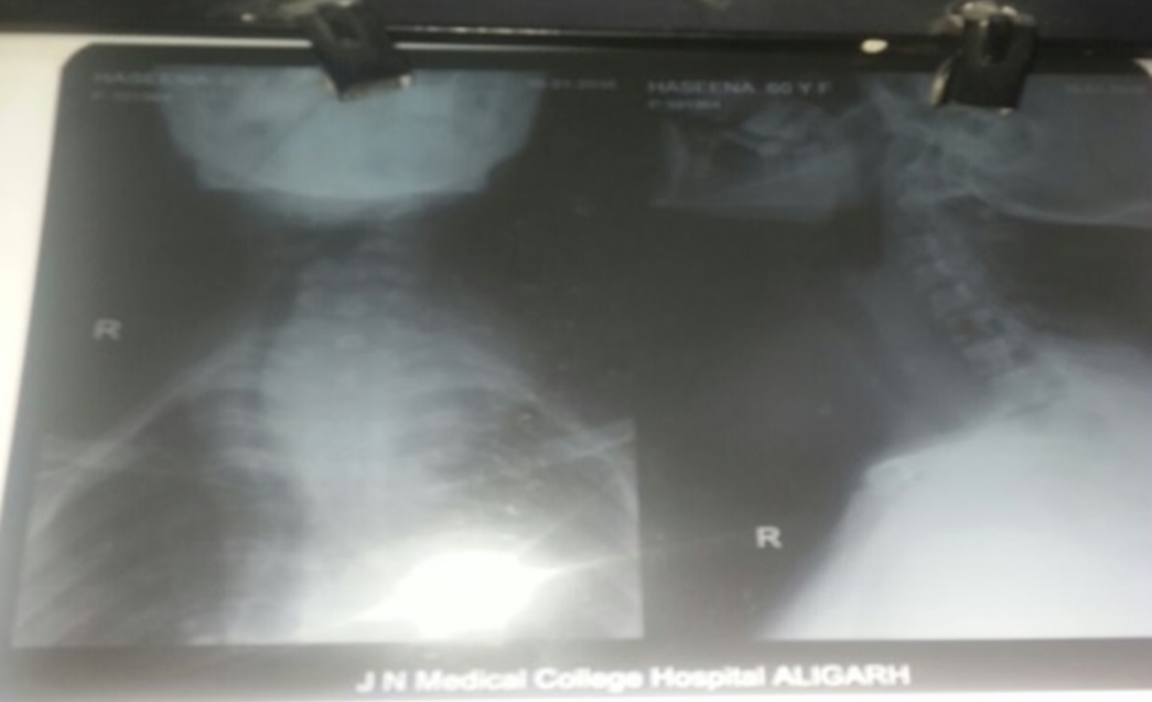
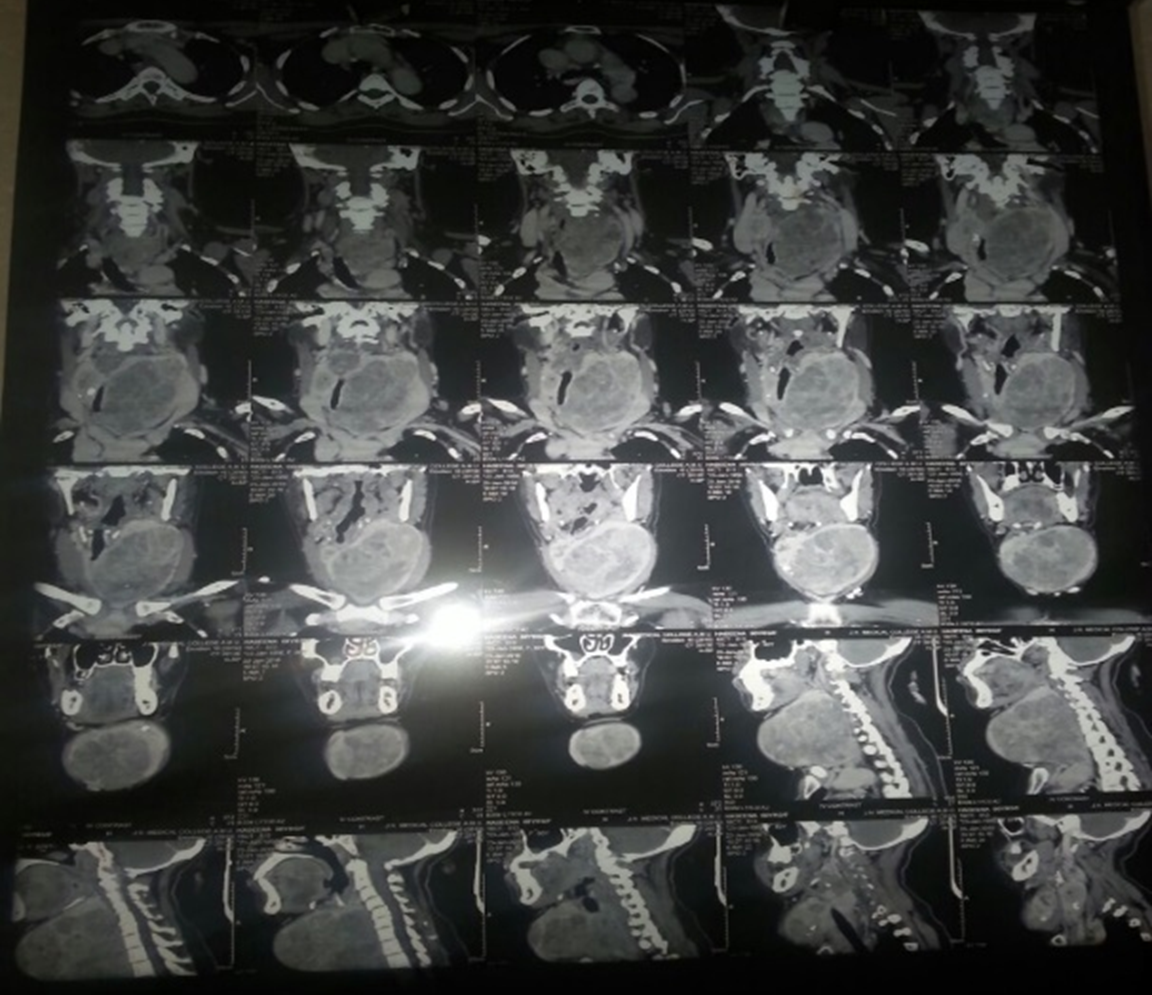
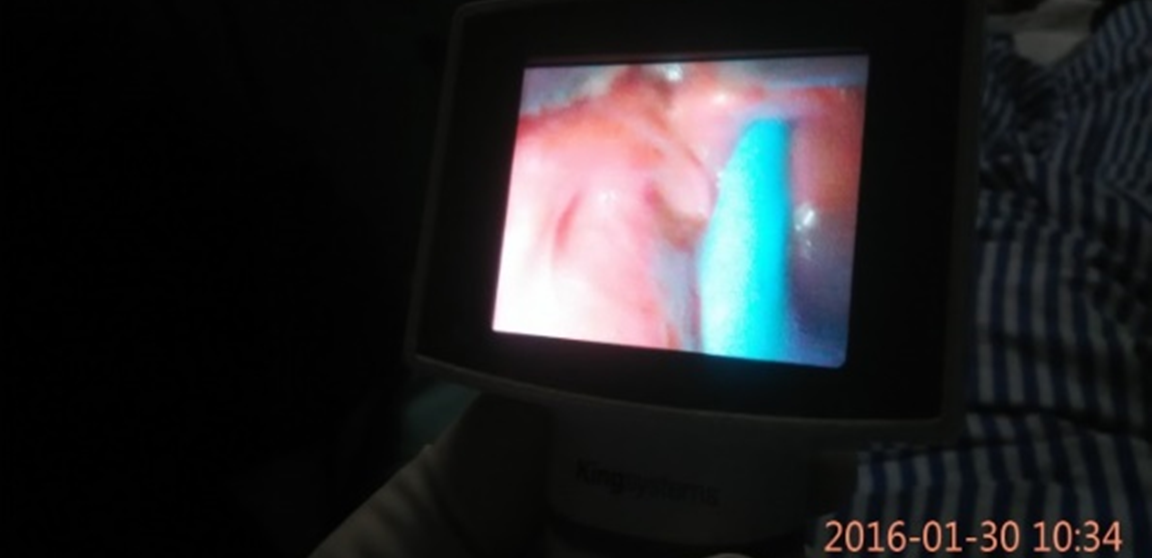
A 60-year-old female presented with gradually increasing swelling in front of neck for last 10 years. Patient had history of dyspnoea on lying down position for six months. Medical history included hypertension for 2 years for which she was put on Tab Amlodipine 5 mg and Atenolol 25 mg. She had no history of change in voice and deglutition problem. She was diagnosed as a case of multinodular goitre and advised surgery. On examination, patient was conscious and oriented. Pulse rate was 90 per min, blood pressure was 130/80 mmHg, Electrocardiograph (ECG) showed sinus rhythm. The neck swelling was 9.4×8.5×9.4 cm in size, firm, extending from lower jaw to below sternal notch and overlying skin was free. It was not possible to palpate the lower limit of the swelling. Airway examination revealed adequate mouth opening, Mallampatti class III, limited neck extension and flexion due to swelling. Indirect laryngoscopy revealed reduced mobility of vocal cords on right side. Radiological examination revealed severe tracheal deviation and compression along with retrosternal extension (Figure1). Computed Tomography scan was advised to know the extent of swelling which showed large multinodular goiter extending from C3 into retrosternal space upto the level of T3 (arch of aorta). Lesion was noted crossing the midline causing luminal narrowing and displacement of trachea, esophagus and laryngeal cartilage towards right side (Figure 2). Full blood count, blood urea, electrolytes and thyroid profile were normal. In view of anticipated difficult airway, awake fibreoptic intubation was planned. Difficult airway cart was kept ready. The procedure was explained to the patient and written consent was taken for presentation as well. Patient was kept fasting for 8 hours for solid and 3 hours for liquid and antihypertensive was continued till morning of surgery. The patient was shifted to operation theatre and standard monitors (pulse oximeter, ECG, Non-invasive blood pressure, temperature probe) were applied and baseline vitals were recorded. Inj. glycopyrrolate 0.2 mg iv, inj. ondansetron 4 mg iv was given. Patient's airway was anaesthetized with 4ml of 4 % lignocaine via nebulization, 2% lignocaine viscous gargle and lignocaine 10 % as spray. Patient was then administered midazolam 1.5 mg iv and fentanyl 50 µg iv for sedation and to allay anxiety. Fibreoptic bronchoscope was loaded with 6 mm armoured ETT. With the patient in semi sitting position, bronchoscope was inserted through one of the nostrils and advanced towards the laryngeal inlet. Once glottis opening was visualized, patient was instructed to take deep breaths but the tip of the scope could not be passed beyond vocal cords. Rescue measure in the form of lifting the thyroid by an assistant also did not work. Fibreoptic intubation was abandoned. Keeping in mind, obstruction and distal narrowing King's vision video laryngoscope was attempted using a bougie but even bougie could not be passed beyond vocal cords (Figure 3). The procedure was then abandoned and surgery deferred.
Figure 1: Chest X Ray Showing Deviation and Compression of Trachea
Figure 2: CT scan Showing Compressed Airway
Figure 3: Visualization of Tip of Bougie at Vocal Cord
DISCUSSION
Despite the decrease in the incidence of goiter throughout the world, there are still cases reported having large thyroid masses presenting for surgery [6]. Securing an airway in such patient with large thyroid poses significant challenge for the attending anaesthesiologist. Amathieu et al. reported the overall incidence of difficult intubation in thyroid surgery to be 11.1% [7]. Patients with large goiter are considered to be more likely to present with difficulty at intubation, particularly if the goiter has produced tracheal deviation or has retrosternal extension [8]. Bouaggad et al. found that there was significantly increased incidence of difficulty in endotracheal intubation with tracheal deviation, tracheal compression, presence of dyspnoea, Mallampatti class III/IV airway and with neck mobility <90 [9]. Awake fibreoptic intubation is usually claimed to be the gold standard in such patients. In this patient, the fibreoptic intubation could not yield a positive result despite the anaesthesiologist’s long experience in fibreoptic intubation.
Although various ways and devices have been used and modified accordingly for the difficult intubation cases but none can be labelled as the final device. In majority of the difficult airway situations, a trained anaesthesiologist overcomes these problems using different gadgets and manoeuvres. Awake intubation in sitting position has the advantage of facilitating visualization by gravity drainage of secretions and movement of the tip of the fiberscope downwards towards the larynx without much manipulation [10]. Memon MI et al. have suggested the use of antigravity lift in cases of large goiter to improve glottic exposure and ease the intubation to secure the airway [11]. In our case, we also used this technique of antigravity thyroid lift to pass the fiberscope beyond the glottic opening but with unsuccessful result.
Even the King vision video laryngoscope using channelled blade and bougie as an aid was tried by the same experienced anesthesiologist; but the airway could not be secured despite all efforts. Similar cases, though scarcely have been reported in literature [3,12]. In such situation, a CT scan of the neck showing the extent of narrowing and deviation of trachea may help predict the outcome. In this case, we did have a clue about this, so tried a smaller size ETT. But as the trachea was not only compressed significantly but also showed a deviation much beyond the expected level yielded a negative outcome. This dilemma of securing an airway in such situations needs to be highlighted. This peculiar case needs to be managed by alternative methods which may include the regional techniques like cervical epidural block, superficial and deep cervical plexus blocks [13-14]. Also, it can be taken up using a supraglottic device or a combination of supraglottic device with cervical epidural block. Tracheostomy too seems a questionable option as the swelling was very big and covered the entire anterior aspect of neck. However, it may not be judicious to carry out major surgery in head and neck region with known difficult airway under such techniques.
REFERENCE
Hariprasad, M. and G.J. Smurthwaite. “Management of a known difficult airway in a morbidly obese patient with gross supraglotticoedema secondary to thyroid disease.” British Journal of Anaesthesia, vol. 89, 2002, pp. 927–930.
Chakera, A. et al. “Elective awake intubation in a patient with massive multinodular goitre presenting for radioiodine treatment.” Anaesthesia and Intensive Care, vol. 30, 2002, pp. 236–239.
El-Dawlatly, A. et al. “Perioperative management of huge goiter with compromised airway.” The Internet Journal of Anesthesiology, vol. 7, no. 2, 2002.
Baddoo, H.K. and G.E. Parkins. “Fibreoptic intubation in a patient with a large mandibular fibro-osseous lesion.” Ghana Medical Journal, vol. 42, 2008, pp. 162–164.
Yeh, L. et al. “Difficult fiber-optic intubation in a patient with giant neck masses: The role of McCoy laryngoscope in elevating compressed laryngeal aperture.” Acta Anaesthesiologica Taiwanica, vol. 4, 2013, pp. 180–183.
Rath, A. et al. “A case report on difficult intubation and accidental intraoperative extubation in large thyroid mass surgery.” The Journal of Medical Research, vol. 1, 2015, pp. 134–136.
Amathieu, R. et al. “Difficult intubation in thyroid surgery: Myth or reality?” Anesthesia & Analgesia, vol. 103, 2006, pp. 965–968.
Sebel, P.S. “Anaesthesia for thyroid and parathyroid disease.” Anaesthesia, edited by W.S. Nimmo et al., Blackwell Scientific Publications, Oxford, 1994.
Bouaggad, A. et al. “Prediction of difficult tracheal intubation in thyroid surgery.” Anesthesia & Analgesia, vol. 99, 2004, pp. 603–606.
Saxena, K.N. et al. “Awake fibreoptic intubation in the sitting position in a patient with a huge goitre.” Case Reports in Anesthesiology, vol. 2011, 2011, Article ID 352672.
Memon, M.I. and M. Ashraf. “Antigravity lift technique is helpful in difficult intubation in patients with large goiters.” Anaesthesia, Pain & Intensive Care, vol. 13, no. 2, 2009, pp. 78–80.
Baba, Y.I. et al. “Perioperative airway management in the case of severe tracheal narrowing and deviation caused by multinodular goitre: Case report.” Journal of Anesthesiology and Clinical Science, vol. 3, 2014.
Jain, G. et al. “Comparison of three different formulations of local anaesthetics for cervical epidural anaesthesia during thyroid surgery.” Indian Journal of Anaesthesia, vol. 56, 2012, pp. 129–134.
Andrieu, G. et al. “Analgesic efficacy of bilateral superficial cervical plexus block administered before thyroid surgery under general anaesthesia.” British Journal of Anaesthesia, vol. 99, 2007, pp. 561–566.
Recommended Articles
Research Article
Histopathological Spectrum of Endometrial Biopsies in Abnormal Uterine Bleeding in Mosul City Iraq
Farah Talal Abdulraheem
Published: 30/06/2026
Download PDF
Research Article
A Study on the Levels for mRNA Gene Expression of NF-κB and miR-34a Genes in Human Patients with Breast Cancer: An Indication for Resistance to Chemotherapy
Najlaa O.H. Aljubury,
Salim Hussein Jari
Published: 15/12/2023
Download PDF
Research Article
Molecular Study to Detect Some Virulence Factors in Methicillin – Resistance Staphlococcus Aureus Isolated from Eye Infections in Wasit Province
Nofel Hossin Amhi Alshammari,
Haider Kareem Jassem
Published: 15/12/2023
Download PDF
Research Article
Occurrence of Multi-Drug Resistance of E. coli Isolated from Urinary Tract Infection in Najaf City
Alaa Hamza Jaber Al-Jelehawy,
...
Haneen Ali Kadham
Published: 05/10/2025
Download PDF
PO Box 101, Nakuru
Kenya.
Email: office@iarconsortium.org
Editorial Office:
J.L Bhavan, Near Radison Blu Hotel,
Jalukbari, Guwahati-India
Nasreen, F., Ali, Q. E., Amir, S. H. & Amir, S. H. (2021). Fibreoptic Aided Intubation in Huge Goiter – Still a Dilemma. Scientific Research Journal of Medical Sciences, 1(1), 1-3.
MLA
Nasreen, Farah, et al. "Fibreoptic Aided Intubation in Huge Goiter – Still a Dilemma." Scientific Research Journal of Medical Sciences 1.1 (2021): 1-3.
Chicago
Nasreen, Farah, Qazi E. Ali, Syed H. Amir and Syed H. Amir. "Fibreoptic Aided Intubation in Huge Goiter – Still a Dilemma." Scientific Research Journal of Medical Sciences 1, no. 1 (2021): 1-3.
Harvard
Nasreen, F., Ali, Q. E., Amir, S. H. and Amir, S. H. (2021) 'Fibreoptic Aided Intubation in Huge Goiter – Still a Dilemma' Scientific Research Journal of Medical Sciences 1(1), pp. 1-3.
Vancouver
Nasreen F, Ali QE, Amir SH, Amir SH. Fibreoptic Aided Intubation in Huge Goiter – Still a Dilemma. Scientific Research Journal of Medical Sciences. 2021 Jul;1(1):1-3.



 Download PDF
 Download XML