Construction projects are defined as development projects that have a significant impact on the basic infrastructure due to the money, time and human effort they invest. It is also defined as a set of sequential, overlapping and simultaneous activities carried out by a large number of individuals, equipment and materials during a specified period of time in which the contractor develops a plan. Where the research aims to study the real reasons that disrupt construction projects at the local level and the resulting waste of economic resources and social consequences affecting many parties. It is also important to assess the feasibility of public spending in two strategic sectors, especially since the housing and public equipment sectors. The current study has examined the common effects of delays in construction projects in IRAQ. Five effects of delays in construction projects have been explored to effectively achieve the aim of the study. They include: times overrun, cost overrun, dispute/disagreement between parties, complete abandonment and legal action/law suit.
When analyzing project delays, focus first on delays that affect the progress of the overall project (project end date or final milestone) or those critical delays that affect project completion [1-3]. Many project delays do not delay its complete completion. Delays that affect the completion of the project or the final milestone, are considered critical and delays that do not affect the completion of the project or the final milestone, are non-critical [4-7]. The concept of “critical” delays stems from scheduling in the critical path method, where the identification of critical activities is the main part of this scheduling but all projects, regardless of the type of scheduling used, contain “critical” activities, if those activities are delayed, it will be delayed Project end date or final milestone date. In some contracts the term 'work item control' is used to mean critical activities or critical work. Regardless of the type of scheduling used, all projects have a critical path which is the path of activities that if one of them is delayed it will delay the project's end date [8-11].
Regardless of how the project and scheduling analyzes to find delays, there is an important criterion: the analysis is considered accurate if it takes into account contemporary information about the occurrence of those delays. "Contemporary Information" is based on daily reports, realistic scheduling and any other available business data that can show the circumstances surrounding delays. Research and proper documentation removes doubts and other hypotheses orchestrated from anticipatory conclusions or previously desired outcomes [12-15].
Before the analyst concludes whether or not the delays are excused based on previous definitions only, he must refer to the contract documents. Decisions about delays must be made within the specific context of the contract [16-20]. The contract should clearly specify the factors that must be considered to certify project delays that justify additional time over the end date of the contract. For example, some contracts do not give any time additions due to weather conditions, no matter how unusual, unexpected or severe conditions [21-23].
The contract is a control document that specifies whether delays can be considered unexcused. For example, some contracts consider supplier delays to be excused if the contractor can demonstrate that he has purchased or ordered the materials within the stipulated time but the materials did not arrive due to circumstances beyond his control [24-26].
While other contracts may not consider such delays to be excused. The project owner and the designer or contract specification must ensure that the contract documentation is sufficiently clear. Before signing the contract, the contractor must fully understand the excused and unexcused delays that the contract considers [27].
Government contracts define strikes, floods, fires, acts of God and extreme weather as excused but not compensable delays. Excusable and compensable delays, such as different work site conditions, changes made by the project owner and structural changes that cause delays.
Some contracts are more stringent in defining compensable delays. It is common practice to use acquittal language within the contract regarding delays. The acquittal language is a language based on seeking excuses for a party to evade some of its responsibilities. The most general method used in contracts related to delays is the introduction of the contractual clause “no financial compensation for delay”. Writing this clause takes many forms but in general this clause states that for any excused delay, the contractor will receive additional time but no additional financial compensation. The extra time is the only compensation to the contractor for any kind of excused delays [28,29].

The research was designed by developing a strategy in order to collect data and provide a full understanding of all elements of the study, by relying on a methodology aimed at developing the study administration, which is the case study in full, which consisted of interviews with heads of construction departments in Baghdad, Iraq to study the case of delays in construction projects The analysis of the results was based on the IBM® SPSS 25 program and the results were discussed.
The five effects examined in this study are ranked based on Relative Importance Index (RII) and Mean Value.
To establish the level of importance of the different effects of delays in construction projects, the RII and Mean Value rankings are classified based on the RII classification table .
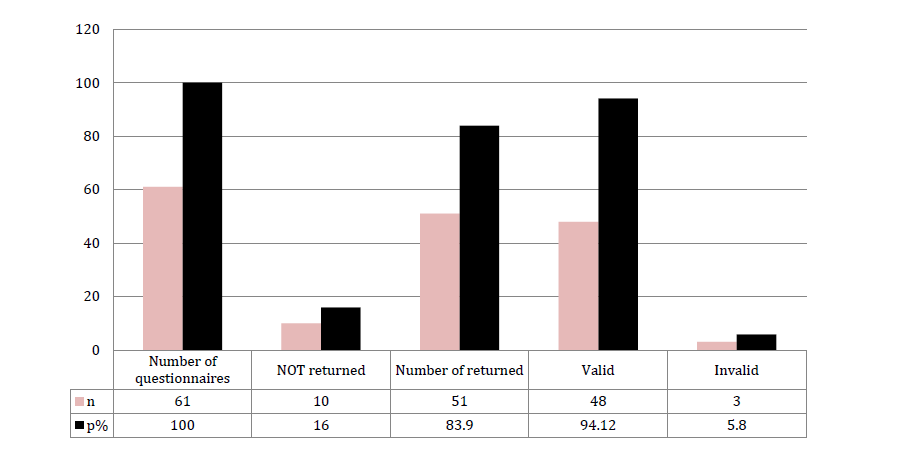
The implications of the results obtained in this exploration work are of high importance. Primarily, in working with appropriate transportation for future development projects such as private lofts, School structures, medical clinics and other critical foundations of cultural use, discoveries from this study, it is relied upon to guide development partners and their leaders on the best way to do so Make substantial efforts to reduce or impede the potential effects of development delays. This is possible accordingly, directing the improvement of long-distance proof-based procedures and approaches in the future International development projects (Figure 1, Table 1-3).
Table 1: The Respondents’ Years of Experience in the Construction Industry
YEARS | P% |
>5 years | 30 |
5 to 10 years | 50 |
11-15 years | 12 |
>15 years | 8 |
Table 2: The knowledge of the respondents concerning the company’s experiences with delay in executing construction projects
N | P% |
1-3 | 45 |
4-6 | 40 |
7-10 | 10 |
>10 | 5 |
Table 3: Analysis of the Effects of Delays in Construction Projects
S/N | Effect of delays in construction projects | RII | Mean value | RII & mean value ranking | Importance level |
1 | Time overrun | 0.61 | 3.81 | 5 | Average |
2 | Cost overrun | 0.64 | 4.56 | 2 | High-median |
3 | Dispute/Disagreement between parties | 9.62 | 3.93 | 4 | Average |
4 | Complete abandonment | 0.64 | 4.22 | 3 | High-median |
5 | Legal actionor Law suit | 0.65 | 4.44 | 1 | High-median |

Figure 1: The Respondents’ Years of Experience in the Construction Industry
As far as exploration implications, this current review fills in the information gap regarding Assessing the effects of project delays on the development of Iraq's land industry as shown by a curated and specific archive that fills as a base for future examination associated with delays in development projects, particularly in low- and middle-wage countries. Also, the future Researchers, engineers and specialists can approve discoveries of comparative exploration work being transferred, all things being equal in the future in another piece of Somaliland or elsewhere using the result of this review.
Moreover, since the impact of delays in development projects is often comprehensive, the discoveries This study would help in investigating the potential risks involved in the implementation phase future development projects. In addition, the innovation of the review comes from the way it was It gives a better understanding of the effects of delay in development projects by contributing a smart guide that can guide new development professionals and project workers in the development industry around the world.
Construction project management includes all planning, organization, resource coordination and administrative and financial control from the moment the project idea emerges to the moment it is completed and handed over to final use. These operations include managing the basic resources needed for the construction process, including labour, materials, money and time, with the aim of completing its implementation on time and within the estimated budget and in accordance with the required specifications. In the same context, the construction project manager must be able to use the available resources with high efficiency, as he is responsible for developing and managing a plan for the use of these resources in a consistent, organized and integrated manner with the master plan of the project.
Endut, I.R. et al. “Cost and Time Overruns of Projects in Malaysia.” ICONDA Proceedings of the 2nd Scottish Conference for Postgraduate Researchers of the Built and Natural Environment (PRoBE), 2005.
Enshassi, A. et al. “Delays and Cost Overruns in the Construction Projects in the Gaza Strip.” Journal of Financial Management of Property and Construction, 2009.
Falcone, P.M. “Analysing Stakeholders’ Perspectives Towards a Socio-Technical Change: The Energy Transition Journey in Gela Municipality.” AIMS Energy, 2018.
Fallahnejad, M.H. “Delay Causes in Iran Gas Pipeline Projects.” International Journal of Project Management, 2013.
Fashina, A.A. “The Major Barriers to the Implementation of Project Management in Small and Medium Construction Companies in Hargeisa.” PM World Journal, vol. 9, no. 9, 2020, pp. 1-24, https://pmworldjournal.com/article/the-major-barriers-to-the-implementation-of-project-management.
Fashina, A.A. et al. “Examining the Challenges Associated with the Implementation of Project Scope Management in Telecommunication Projects in Somaliland.” PM World Journal, vol. 9, no. 3, 2020, pp. 1-16.
Fashina, A.A. et al. “A Study on the Effects of Construction Project Delays in Somaliland Construction Industry.” Journal of Management, Economics and Industrial Organization, 2020.
Frimpong, Y. et al. “Causes of Delay and Cost Overruns in Construction of Groundwater Projects in Developing Countries: Ghana as a Case Study.”International Journal of Project Management, 2003.
Fugar, F.D. and A.B. Agyakwah-Baah. “Delays in Building Construction Projects in Ghana.” Construction Economics and Building, 1970.
Fugar, F.D. and A.B. Agyakwah-Baah. “Delays in Building Construction Projects in Ghana.” Australasian Journal of Construction Economics and Building, 2010.
Gann, D.M. and A.J. Salter. “Innovation in Project-Based, Service-Enhanced Firms: The Construction of Complex Products and Systems.” Research Policy, 2000.
Gebrehiwet, T. and H. Luo. “Analysis of Delay Impact on Construction Project Based on RII and Correlation Coefficient: Empirical Study.” Procedia Engineering, vol. 196, 2017, pp. 366-374.
Gliem, J.A. and R.R. Gliem. “Calculating, Interpreting, and Reporting Cronbach’s Alpha Reliability Coefficient for Likert-Type Scales.” Midwest Research to Practice Conference in Adult, Continuing, and Community Education, 2003.
Global Construction: A Global Forecast for the Construction Industry to 2030. Oxford Economics and Global Construction Perspectives, London, 2015.
Gunduz, M. et al. “Fuzzy Assessment Model to Estimate the Probability of Delay in Turkish Construction Projects.” Journal of Management in Engineering, 2015.
Hart, K. “Opportunities and Urban Employment in Ghana.” Journal of Modern African Studies, 1973.
Haseeb, M. “Problems of Projects and Effects of Delays in the Construction Industry of Pakistan.” Australian Journal of Business and Management Research, 2011.
Ika, L.A. “Project Success as a Topic in Project Management Journals.” Project Management Journal, 2009.
Ika, L.A. “Project Management for Development in Africa: Why Projects Are Failing and What Can Be Done About It.” Project Management Journal, 2012.
Ika, L.A. and J. Donnelly. “Success Conditions for International Development Capacity Building Projects.”International Journal of Project Management, 2017.
Kaliba, C. et al. “Cost Escalation and Schedule Delays in Road Construction Projects in Zambia.” International Journal of Project Management, 2009.
Kamanga, M.J. and W.J.V.D.M. Steyn. “Causes of Delay in Road Construction Projects in Malawi.” Journal of the South African Institution of Civil Engineering, 2013.
Kenley, R. “Managing Change in Construction Projects: A Knowledge-Based Approach.” Construction Management and Economics, 2012.
Kikwasi, G. “Causes and Effects of Delays and Disruptions in Construction Projects in Tanzania.” Australasian Journal of Construction Economics and Building Conference Series, 2013.
Koushki, P.A. et al. “Delays and Cost Increases in the Construction of Private Residential Projects in Kuwait.” Construction Management and Economics, 2005.
Le-Hoai, L. et al. “Delay and Cost Overruns in Vietnam Large Construction Projects: A Comparison with Other Selected Countries.” KSCE Journal of Civil Engineering, 2008.
Lindhard, S. and S. Wandahl. “Scheduling of Large, Complex, and Constrained Construction Projects: An Exploration of LPS Application.” International Journal of Project Organisation and Management, 2015.
Loch, C.H. et al. Managing the Unknown: A New Approach to Managing High Uncertainty and Risk in Projects. 2007.