Most countries around the world are moving towards green buildings to avoid pollution and reduce gas emissions. Through this study, we seek to evaluate the effectiveness of risk management in green building projects in Iraq. This study included the distribution of questionnaires to 70 specialists and workers in green building and risk management in Iraq. The questionnaire included two parts: the first related to the stages of risk management, and the second included identifying the risks that green building projects in Iraq could face. It included 30 risks that we worked to arrange according to the relative importance index (RII) to classify the severity of the risks. It was found that administrative and technical risks, especially time management and poor communication between design and implementation teams, in addition to the need for skilled labor, are the most prominent of these risks that threaten this type of project. Through this study, risk management emphasizes the importance of early identification of risks and their systematic evaluation, which can significantly improve the results obtained by the project in terms of cost and time and ensure the sustainability of green building projects in Iraq.
Keywords
Green Construction
Risk Management
Sustainability
Iraq
Project Performance
INTRODUCTION
Most countries have turned to searching for a method to reduce environmental pollution and to mitigate the existing carbon footprint. Since the construction sector has a significant part of this, countries have turned to applying green architecture to support the process of sustainability and mitigate the carbon impact. The green construction sector can contribute to the process of reducing the energy required for heating and cooling, in addition to reducing the carbon footprint and benefiting from recycled materials. However, this type of sector, like other projects, is fraught with risks and is exposed to risks that may be similar to other construction sectors and may differ from them in some of them. Since Iraq is one of the countries undergoing a process of reconstruction and development, we can rely on this type of construction. Therefore, through this research, we will study the risks that the green construction sector in Iraq may be exposed to. In this research, many questions appear to us, which are: What are the risks associated with green building in Iraq? How effective are risk management methods in addressing these risks? Which aspects of the risk management process have the greatest impact on project outcomes? Through this research, we will seek to answer these questions and work to achieve a benefit that could be of value in green projects and that engineers and designers working in this field can benefit from to avoid the errors and problems that could occur in this type of project.
Literature Review
The types of risks facing construction projects vary, and these risks include multiple categories, including financial, environmental, regulatory, social, and technical risks [1]. These risks lead to cost overruns and schedule delays.
Risk management strategies identify, assess, and mitigate these risks, while also monitoring them throughout the project lifecycle [2].
In addition to traditional risk management methods, it has become necessary to evolve and shift toward comprehensive, integrated strategies that leverage technological advances, whether in data collection or analysis, digital twinning, real-time monitoring, or other Methods [3]. Strong organizational culture, leadership, and effective communication across organizational levels are critical to identifying and early monitoring risks [4].
Despite the economic benefits that the implementation of green construction projects may lead to, their implementation is still limited because they require high initial costs compared to other projects.
This type of project also has significant social impacts, potentially creating more integrated cities and transforming demographic distribution in terms of distribution, size, location, and existing groups [5].
The best assessment of this type of building is one that encompasses the life cycle from the extraction of raw materials to the end of the facility's life, as well as the reuse of materials after the end of their useful life and their role in sustainability [6].
There are many risks that green projects may face, and numerous studies have covered this field. Ahmed [7] divided 48 variables into six categories, including laws and their deficiencies, the availability of new technologies, worker and skill competence, and lack of fundingResearcher Attia [8] showed through his research that green projects may be exposed to 66 types of risks. The researcher was able to review these types of risks through his study that included the Kingdom of Saudi Arabia. The researcher explained that the most prominent of these risks are those related to functional and financial risks. Researcher Koirala [9] stressed the importance of the government encouraging green building projects through its practices and policies, and keeping pace with legislation for this type of project is essential. Researcher Mishra [10] stressed the importance of risk management in the process of detecting risks to avoid and mitigate them and developing appropriate plans to eliminate them. Researcher Arshbar [11] explained that the most prominent approaches to risks facing the green construction sector are the collaborative supply chain. The most prominent risk factors, according to Huang [12], are the lack of sufficiently experienced managers and high costs. Through the researchers’ evaluation, it became clear that green construction projects face greater difficulties and risks than traditional projects. There is also an effective mitigation strategy and the development of proactive financial models that keep pace with the requirements of this type of project [13].
MATERIALS AND METHODS
This research will conduct a survey of 70 engineers and consultants working in the field of green building and risk management. Through this survey, we will identify 30 risks present in green building projects, prioritize these risks, and assess the likelihood of their occurrence by these consultants. The survey will also include a question reviewing the stages of risk management and the procedures followed during them, consistent with green building. This will be done using the Cartesian five-step method, starting with the stages of identifying, assessing, and responding to risks, as well as monitoring and control, and ending with project results. The questions will be selected based on previous reference studies and the opinions of some specialists. We will conduct the following analyses on them.
Building the Questionnaire
Following Table 1 and Table 2 shows the Questionnaire. In which different options available.
Table 1: Questionnaire
No
Question
Strongly Agree (1)
Disagree (2)
Neutral (3)
Agree (4)
Strongly Agree (5)
Risk identification
1
Risk identification occurs in the early stages of a project.
-
-
-
-
-
2
Risk identification involves contractors, consultants, and engineers.
-
-
-
-
-
3
Risk updates are maintained throughout the project.
-
-
-
-
-
4
Environmental criteria are taken into account in risk identification.
-
-
-
-
-
Risk Assessment
5
The primary criterion for risks is their likelihood of occurrence.
-
-
-
-
-
6
Priority is given based on cost, time, and quality.
-
-
-
-
-
7
Risks are assessed using advanced tools.
-
-
-
-
-
8
Environmental risk assessment includes their financial and technical impacts.
-
-
-
-
-
Risk strategies
9
Clear plans are in place to address the most serious risks.
-
-
-
-
-
10
Preventive steps are taken to prevent risks from occurring.
-
-
-
-
-
11
Alternative plans are in place to address risks.
-
-
-
-
-
12
Human resources are available to address risks.
-
-
-
-
-
Monitoring and Control
13
Risk mechanisms are updated periodically.
-
-
-
-
-
14
Global indicators are used to measure performance.
-
-
-
-
-
15
Feedback is provided for each project.
-
-
-
-
-
16
Risk management takes up a portion of the project's regular meetings.
-
-
-
-
-
Project Outcomes
17
Green Project Outcomes
-
-
-
-
-
18
One outcome of risk management is reducing project delays.
-
-
-
-
-
19
One outcome of risk management is reducing project cost overruns.
-
-
-
-
-
20
One outcome of risk management is improving project quality.
-
-
-
-
-
Table 2: Questionnaire
No
Question
Strongly Agree (1)
Disagree (2)
Neutral (3)
Agree (4)
Strongly Agree (5)
Financial Risks
1
Lack of Adequate Financing
-
-
-
-
-
2
Volatile Prices of Green Materials
-
-
-
-
-
3
High Maintenance Costs
-
-
-
-
-
4
Poor Return on Investment
-
-
-
-
-
5
Lack of Government Incentives
-
-
-
-
-
Technical Risks
6
Lack of Insufficient Expertise in Green Building Design
-
-
-
-
-
7
Poor Quality of Green Building Materials
-
-
-
-
-
8
Lack of Knowledge of Green Construction Techniques
-
-
-
-
-
9
Green Design Conflicts with Architectural and Structural Requirements
-
-
-
-
-
10
Difficulty Integrating Energy Systems
-
-
-
-
-
Environmental Risks
11
Inappropriate Use of Resources
-
-
-
-
-
12
Waste Management Failure
-
-
-
-
-
13
Negative Impact on the Local Environment
-
-
-
-
-
14
Poor Sustainability of Recycled Materials
-
-
-
-
-
15
Sudden Climate Changes Affecting Systems Management
-
-
-
-
-
Legal and Regulatory Risks
16
Lack of Supporting Legislation
-
-
-
-
-
17
Unclear Licensing Requirements
-
-
-
-
-
18
Poor Coordination Between Project Entities
-
-
-
-
-
19
Difficulty Obtaining Certifications
-
-
-
-
-
20
Poor Coordination with Public Entities
-
-
-
-
-
Operational and Administrative Risks
21
Poor Communication Between the Design and Implementation Teams
-
-
-
-
-
22
Poor Time Management
-
-
-
-
-
23
Unclear Roles and Responsibilities
-
-
-
-
-
24
Lack of Skilled Labor
-
-
-
-
-
25
Poor Monitoring and Control Systems
-
-
-
-
-
Social and Human Risks
26
Resistance to Change
-
-
-
-
-
27
Lack of Environmental Awareness
-
-
-
-
-
28
Lack of Community Engagement
-
-
-
-
-
29
Accidents and Injuries Due to Lack of Experience
-
-
-
-
-
30
Poor Community Acceptance buildings
-
-
-
-
-
RESULTS AND DISCUSSION
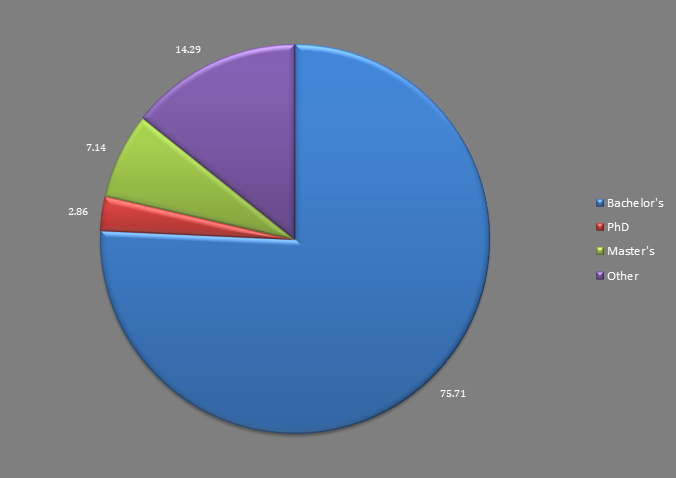
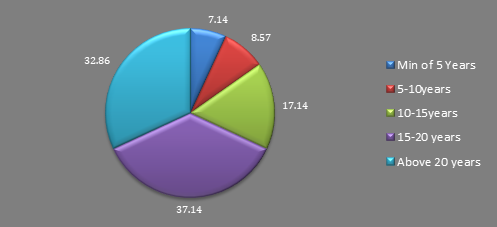
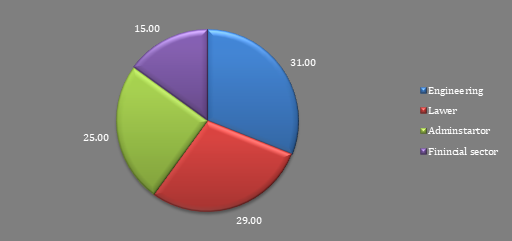
The questionnaire also included questions related to the degree held by the respondent, the number of years of experience he has, and the specialization he holds. The answers were as follows in (Figures 1,2 and 3).
Figure 1: Academic Achievement of Respondents
Figure 2: Number of Years of Experience
Figure 3: Specialization
From the figure we can notice that 75% of the respondents had a certificate that varied between holders of regular certificates and doctorates, and the highest percentage was for holders of university degrees at 75%. This diversity gives a greater idea about the answers. In addition, we notice that the respondents are from the engineering and legal sectors, in addition to the management and law sector. In addition, more than half of the respondents have more than 10 years of experience. Therefore, we notice that this sample is diverse and has experience. It can encompass all aspects of the topic through this and can give expressive, logical and useful answers.
We conducted the Cronbach's alpha test on the questionnaire results to ensure the stability of the sample, and the results were as shown in Table 3.
Table 3: Cronbach's Alpha Results
Parameters
No
Cronbach's Alpha
Risk identification
4
0.78
Risk assessment
4
0.74
Risk strategies
4
0.83
Monitoring and Control
4
0.71
Project Outcomes
4
0.81
TOTAL
20
0.89
From the table we can notice that the five groups have a Cronbach's value greater than0. 7, meaning that they have good reliability. By calculating the averages for the twenty questions, we can arrive at the Table 4. Through the average values shown in the table, we can review the answers related to the questionnaire, where we notice that for the process of identifying risks, the averages were greater than 3 and closer to the value of “OK”, which highlights the importance of the process of identifying risks and its role in reflecting on financial, technical and environmental risks. Also, for the process of risk assessment, the result was also inclined towards the value of “OK”, and the project results obtained the highest value, which highlights the importance of the risk management process, which is directly reflected in the project results in terms of quality, cost and time. By taking the total average value, we find the importance of the risk management process in environmental projects. On the other hand, by taking the average value of the questions: First, in the questions related to identifying risks, the first question related to identifying risks in the early stages was the most prominent, with 82% of the answers, which indicates the importance of this element in the process of identifying risks.
Table 4: Means and SD Results
Parameters
No
MEAN
SD
Risk identification
4
3.9
0.62
Risk assessment
4
3.7
0.71
Risk strategies
4
4.1
0.55
Monitoring and Control
4
3.6
0.74
Project Outcomes
4
4
0.59
TOTAL
20
3.86
0.64
The process of allocating time in periodic meetings to discuss risks was the most prominent factor in the answers in the monitoring and control section. In terms of risk assessment, prioritizing risks according to quality, time, and cost was the most prominent. In terms of project results, cost overruns were the most prominent criterion. In terms of risk strategies, the existence of a clear plan was the most important of these factors.By analyzing the second questionnaire regarding the types of risks that are likely to occur and which are more likely, we had the following answers and averages according to the respondents’ answers by analyzing the ranking, we get the results shown in the Table 5.
Table 5: Ranking Test Results
Risk
Mean
STD
RII
Rank
Level
Poor Time Management
4.07
0.62
0.814
1
High
Poor Communication Between the Design and Implementation Teams
4.03
0.61
0.806
2
High
Lack Of Skilled Labor
3.96
0.73
0.792
3
High
Lack of Insufficient Expertise in Green Building Design
3.90
0.68
0.780
4
High
Lack of Adequate Financing
3.86
0.60
0.772
5
High
Unclear Roles and Responsibilities
3.83
0.66
0.766
6
High
Poor Monitoring and Control System
3.78
0.72
0.756
7
Moderate
Volatile Prices of Green Materials
3.77
0.70
0.754
8
Moderate
Lack of Government Incentives
3.73
0.71
0.746
9
Moderate
Difficulty Integrating Energy System
3.71
0.69
0.742
10
Moderate
Poor Quality of Green Building Materials
3.69
0.75
0.738
11
Moderate
Lack of Knowledge of Green Construction Techniques
3.67
0.68
0.734
12
Moderate
Green Design Conflicts with architectural and Structural Requirement
3.64
0.76
0.728
13
Moderate
High Maintenance Cost
3.61
0.74
0.722
14
Moderate
Lack of Supporting Legislation
3.59
0.78
0.718
15
Moderate
Inappropriate Use of Resource
3.55
0.71
0.710
16
Moderate
Waste Management Failure
3.53
0.70
0.706
17
Moderate
Sudden Climate Changes Affecting Systems Management
3.50
0.77
0.700
18
Moderate
Poor Return on Investment
3.48
0.80
0.696
19
Moderate
Negative Impact on the Local Environment
3.46
0.73
0.692
20
Moderate
Poor Sustainability of Recycled Materials
3.44
0.66
0.688
21
Moderate
Poor Coordinated Between Project Entities
3.41
0.77
0.682
22
Moderate
Unclear Licensing Requirements
3.38
0.79
0.676
23
Low
Difficulty Obtaining Certifications
3.34
0.83
0.668
24
Low
Poor Coordination with Public Entities
3.28
0.88
0.656
25
Low
Resistance to Change
3.24
0.82
0.648
26
Low
Lack of Environmental Awareness
3.19
0.85
0.638
27
Low
Lack of Community Engagement
3.14
0.89
0.628
28
Low
Accidents and Injuries Due to Lack of Experience
3.09
0.91
0.618
29
Low
Poor Community Acceptance of Green Building
3.02
0.93
0604
30
Low
From the results shown in the previous table, which were analyzed after conducting a ranking analysis, we can see that the risks ranked first, and those considered by respondents to be the most dangerous if they occurred, were: Poor Time Management , Poor Communication Between the Design and Implementation Teams, Lack of Skilled Labor, Lack of Insufficient Expertise in Green Building Design, Lack of Adequate Financing, Unclear Roles and Responsibilities From these results, it becomes clear that administrative and technical factors are the most dangerous for this type of project and are most closely related to the success of the green project. Technical and environmental risks, such as material quality and waste management, were at the medium level. Social and organizational risks, such as community acceptance and legislation, were at the low level, but they still impact the project.
CONCLUSION
Early risk identification strategy is important as it is applied in the early stages of the project and reduces the occurrence of unexpected and difficult-to-handle events. This strategy supports proactive project planning and helps in assessing and classifying risks. The continuous monitoring and control strategy, which allocates regular time in meetings to discuss and follow up on risks, ensures continuous monitoring and updating of risk management plans according to changes and in a timely manner.
A strategy for having a clear risk management plan that ensures coordinated efforts and that each team knows its primary role in the overall situation and in the event of risks, ensuring a rapid, effective, and valuable response to risks. A strategy for controlling risk-related costs, which reduces the likelihood of budget overruns and maintains project continuity within the budget. These strategies are highly effective for green construction projects, whether implemented sequentially or individually, as each helps control the cost, time, and quality of the project.
Also, through the risks that were arranged, we were able to classify thirty types of risks that could affect green projects of various types, financial, legal, technical, administrative, societal, organizational, and others. It was concluded that applying one of the previous strategies with prior knowledge of such risks that were reviewed could lead to avoiding the occurrence of these risks, as they were classified according to their level of severity, which enables workers to arrange priorities and know how to deal with them.
REFERENCE
Atitebi, O.A. et al. “Risk management strategies in large-scale infrastructure projects: A U.S perspective.” International Journal of Advances in Engineering and Management, 2025.
Nahid, Omar Faruq et al. “Risk mitigation strategies in large scale infrastructure project: A project management perspective.” Journal of Science and Engineering Research, vol. 1, no. 1, November 2024.
Bärenbold, R. “Reducing risks in megaprojects: The potential of reference class forecasting.” Project Leadership and Society, 2023.
Baeroom, Ahmad Abdullah et al. “Green buildings and sustainability: A review of economic and environmental impacts.” International Journal of Multidisciplinary Research and Growth Evaluation, vol. 6, no. 1, January-February 2025, pp. 1089-1094.
Roebeling, P. et al. “Assessing the socio-economic impacts of green/blue space, urban residential and road infrastructure projects in the confluence (Lyon): A hedonic pricing simulation approach.” Journal of Environmental Planning and Management, vol. 60, no. 3, 2017, pp. 482-499. https://doi.org/10.1080/09640568.2016.1162138.
Devakumar, P.D. “An analysis on life cycle assessment and its impact on environmental and economic perspectives.” International Journal of Scientific Research in Engineering and Management, 2025.
Ahmed, A.M. et al. “Identifying barriers to the implementation and development of sustainable construction.” International Journal of Construction Management, vol. 23, 2021, pp. 1277-1288.
Alattyih, Wael et al. “Risk factors impacting the project value created by green buildings in Saudi Arabia.” Applied Sciences, vol. 10, 2020, pp. 7388.
Koirala, Madhav Prasad. “Urban infrastructure projects and challenges, risk identifying for emerging new cities of Nepal.” International Journal of Research - Granthaalayah, vol. 6, no. 12, 2018, pp. 97-108. https://doi.org/10.29121/granthaalayah.v6.i12.2018.1086.
Koirala, Madhav Prasad. “Urban infrastructure projects and challenges, risk identifying for emerging new cities of Nepal.” International Journal of Research - Granthaalayah, vol. 6, no. 12, 2018, pp. 97-108. https://doi.org/10.29121/granthaalayah.v6.i12.2018.1086.
Arashpour, M. and M. Arashpour. “A collaborative perspective in green construction risk management.” 2012.
Hwang, B. et al. “An exploratory analysis of risks in green residential building construction projects: The case of singapore.” Sustainability, vol. 9, 2017, pp. 1116.
Javed, N. et al. “Managing risk in green building projects: Toward a dedicated framework.” Smart and Sustainable Built Environment, 2019.
Recommended Articles
Research Article
Improvement of Medical Image Classification Based on Semi-Supervised Framework
Mohammed Moath Abdulghani
Published: 20/10/2026
Download PDF
Research Article
Beyond Conventional Crimping: The Case for Cordless Thermal Jointing for Wires and Cables in Power Distribution and Construction Environment
Prashobh Karunakaran,
...
Tonny Ling
Published: 15/09/2026
Download PDF
Research Article
Harnessing Nanotechnology to Conserve Energy in Buildings
Nada S. Abdulmajeed
Published: 30/10/2022
Download PDF
Research Article
Some Properties of Fuzzy g-Regular Spaces
Hassan Abid Al-Hadi Ahmed,
Noor Al-Huda A. Haider
Published: 10/12/2025
Download PDF
PO Box 101, Nakuru
Kenya.
Email: office@iarconsortium.org
Editorial Office:
J.L Bhavan, Near Radison Blu Hotel,
Jalukbari, Guwahati-India
Neamah, M. F. (2026). Assessing the Effectiveness of Risk Management Practices in Green
Construction Projects Evidence from Iraq. Scientific Research Journal of Engineering and Computer Sciences, 6(1), 1-6.
MLA
Neamah, Mazin F.. "Assessing the Effectiveness of Risk Management Practices in Green
Construction Projects Evidence from Iraq." Scientific Research Journal of Engineering and Computer Sciences 6.1 (2026): 1-6.
Chicago
Neamah, Mazin F.. "Assessing the Effectiveness of Risk Management Practices in Green
Construction Projects Evidence from Iraq." Scientific Research Journal of Engineering and Computer Sciences 6, no. 1 (2026): 1-6.
Harvard
Neamah, M. F. (2026) 'Assessing the Effectiveness of Risk Management Practices in Green
Construction Projects Evidence from Iraq' Scientific Research Journal of Engineering and Computer Sciences 6(1), pp. 1-6.
Vancouver
Neamah MF. Assessing the Effectiveness of Risk Management Practices in Green
Construction Projects Evidence from Iraq. Scientific Research Journal of Engineering and Computer Sciences. 2026 Jan;6(1):1-6.


 Download PDF
 Download XML