There is abundant research evidence suggesting that anger and violence remain significant problems facing modern society. This study examines how anger is expressed and controlled in traditional Gambian communities. Twenty participants were interviewed at Brufut Sanchaba Village. The findings show that 50% of the respondents express and control anger by quarrelling, uttering threatening words or by crying, 20% express and control anger by keeping quit and calm, 20% confront the one who triggered the anger so as to settled the conflict amicably, and only 10% really gets out of control by manifesting physical violence. Dialogue and conversations are cherished values in managing anger in traditional communities, often involving the active participation of relatives, village elders and leaders. The decline in traditional family structures and values in The Gambia is having some critical implications in many communities.
Anger is natural though sometimes an unwanted or irrational emotion that everybody experiences from time to time. Anger experts describe the emotion as a primary, natural emotion which has evolved as a way of surviving and protecting yourself from what is considered a wrong doing.
Expression is defined as a particular way of phrasing an idea while control is the power to influence people’s behavior or the course of events. The paper investigates how people in traditional Gambian communities express and control anger.
Historical accounts make no inference as to when Africans started developing skills to recognize anger and to take appropriate action in dealing with the situation in positive ways. These skills are inherent in Africans and cannot be said to be borrowed from anywhere.
They include recognizing the triggers for anger as early as possible and expressing these feelings and frustrations in a cool, calm and collected manner. From prehistoric times to date, Africans believe that as people, they have learnt-behavior as to how to deal with strong emotions. Alongside this believe, they recognize that it is possible to learn more positive ways of dealing with problems and frustrations associated with anger.
Major Mechanisms of Anger Expression and Control in Traditional African Communities
The first mechanism employed in traditional African communities in anger expression and control is dialogue and conversation. This is a cherished value in African human relations. People unreservedly talk about their problems and look for suggestions and solutions together. An unwillingness to do this can be interpreted as bad manners or a sign of antagonism. Above all the African believes that he or she, who discusses his or her problems with others, hardly runs into difficulties or in making many mistakes in life, according to The Gokana people of Rivers State in Nigeria believe that “anyone who seeks public opinion does not enter into trouble. In the same vein, the Igbo of Nigeria also say, “he who tells people what he does never suffers mishaps.
The human relation in traditional African communities is greatly based on inter-personal communication. Biko observed: “Ours has always been a man-centered society”. Westerners have on many occasions been surprised by the capacity we have in talking to each other not for the sake of arriving at a particular conclusion but merely to enjoy the communication for its own sake. Intimacy is a term not exclusive for particular relatives or friends but applying to a whole range of people who find themselves together whether through work or residential requirements’. Anger is also expressed and control led through religious rites and rituals in traditional African communities. In the indigenous African cultures religion was not an independents institution but an integral and inseparable part of the entire culture. Religion in the African sense was practical. One’s entire action is reflective of one’s religious concepts and practices as was seen in the order of society. This is because social morality was dependent on religion. An angered or aggrieved person can merge his or her community or express his or her feelings, by consulting oracles in shrines or marabous. In doing this, he would most likely find a control over his or her feelings[1].
Another aspect is that in the words of William Conton, “Africans generally have deep and ingrained respect for old age, and even when we can find nothing to admire in an old man, we will not easily forget that his grey hairs have earned him right to courtesy and politeness’’. Furthermore, the elders are taken to be the repository of communal wisdom and therefore they are conceded leadership in the affairs of the people. One of the reasons for this is the nearness of the elders to the ancestors. In the African concept, legitimate power lay in the office sanctioned by ancestral norms, not in the person; and the person lost his right to exact obedience once he abused that office. The elders themselves respect authority and hardly abuse it, and often are committed to the demands of their office. Basically, the above three elements are employed in anger control in traditional African communities.
In traditional Gambian communities, anger is expressed by verbal attacks, insults, threats, sarcasm or attributing nasty motives to them or a physical punishment or restriction. It is controlled with the involvement of relatives, elders and religious leaders.
Cousin brotherhood can also play a great role in controlling anger through joking words from a cousin brother or sister. This is a treasured mutual relationship and practice of cousins in The Gambia.
In 2002, Kiwanuka and Lutalo conducted a research in Uganda on the management of anger amongst 150 natives of Rakai districts and it shows that 70% of the respondents manage their anger by talking to close relatives especially grandparents and siblings. They can be calmed by the relative singing for them or telling them stories.
Twenty participants’ male and female were interviewed at the Brufut Sanchaba Village community. Their ages ranged from 25 – 50 years. Participation was voluntary and confidentiality was assured. The interview method was useful in observing and describing characteristics of the community. It has facilitated a higher community’s rate. The questions were mainly open-ended with additional relevant questions in an interactive manner even though it was initially difficult to access all respondents. A literature review was conducted and relevant findings and theories cited [2].
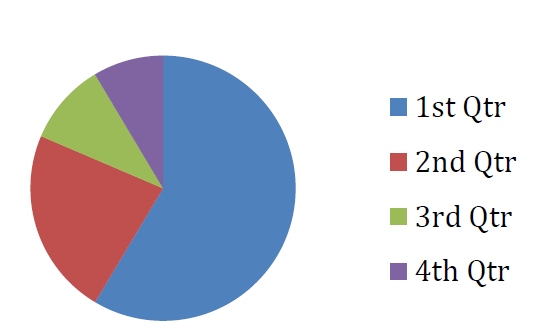
The question of the study was to investigate how anger is expressed and controlled in traditional Gambian communities. The findings reveal that 50% of the respondents express and control anger by quarrelling uttering threatening words or by crying 20% express and control anger by keeping quit and calm, 20% confront the one who triggered the anger so as to settle out of control by being physically violent [3].

Figure 1: Quarterly Sales Distribution
The pie chart above shows the percentage of the four categories of anger expression and control described above it can be clearly seen that a significant percentage of 50 % express and control anger by quarrelling, with threatening words of crying without physical fights. Only 10% can be violent.
The purpose of the study was to investigate how anger is expressed and controlled in traditional Gambian communities. It has been hypothesized that people in traditional communities express anger in various ways but control it amicably at community level. In support of this statement, natives of Brufut village were asked how they manifest and control their anger. Anger and violence are two of the most challenging problems facing society in general. This is evident among many people throughout the world, especially in most urban environments. In urban areas, even in The Gambia many incidents involving anger are taken or reported to police or taken to courts for judgments, with often no real solutions achieved. On the contrary anger related problems are commonly resolved in traditional communities peacefully and effectively as demonstrated by this study [4].
People can disagree quarrel or be angry towards each other in rural areas but once the problem is handled within the community, those in conflict continue to live together in harmony, unlike most situations in urban areas. The frustration – aggression theory suggests that anger is a reaction to any noxious experience including frustration. Most common incidences, of anger and aggression are perceived infringements of one’s authority or independence or other threats to positive self image. The traditional Gambian community is evidently blessed with an effective mechanism in anger expression and control to the extent that community members are quite cautious about manifestations of violent anger. Such manifestation can be shameful and unacceptable to community values and expectations. One benefit in this is that people learn to exercise emotional self – control and not to react violently in an anger or frustrating situation.
It may be argued that violent anger is an impediment to humanity hence the need for non – violent anger expression and control at both rural and urban community levels. The approaches applied at the rural (traditional) community level can be adapted in urban communities as well especially in view of the breaking traditional family systems and the rural – urban migration. Further research is invited on how to preserve these traditional values and practices and how to extend them into the growing urban communities in The Gambia and other African countries at large.
Glancy, G. “Brief treatment and crisis intervention.” Brief Treatment and Crisis Intervention, vol. 5, no. 2, 2002.
Herrmann, D. and J. McWhirter. “Anger and aggression management in young adolescents: An experimental validation of the SCARE program.” Education and Treatment of Children, vol. 26, 2003, pp. 273–302.
Rohini, N.S. and R. Devi. “Management of anger and enhancement of social adjustment among school students with the application of positive therapy.” Indian Journal of Community Psychology, vol. 7, no. 2, 2011, pp. 249–255.
Schwarts, Gil. Anger management: The office politics. Men’s Health Magazine, Emmaus, PA: Rodale Inc., 2006.