This survey was carried out at a General Dental Hospital, Nigeria involving patients who were screened for midline diastema. The screening became necessary to differentiate those who had no diastema before but got them created from those naturally had them to find out the reason why some desire the diastema and finally if the patients were willing to close the diastema. Objective: To evaluate the acceptability or non-acceptability of correction of maxillary midline diastema and to find out the willingness of the subject to accept treatment option available because these are factors that affect aesthetics, beauty in relation to culture, beliefs and norms in Africa and in Nigeria specifically. Methods: The screening was done in a General Dental Hospital within a space of 1 year. This involves all patients that had midline diastemas both maxillary and mandibular and the data sources includes age, sex, marital status, income bracket, social status, educational background and whether the midline diastema was natural or artificially created. The age ranges was between 16 and 55 years. Result: Out of 10214 seen only 150 had midline diastema which fall into 4 categories of maxillary midline, mandibular midline, both maxillary and mandibular midline and artificially created midline diastema. 136 had natural midline diastema involving 96 female and 40 males, educational background were classified as those who had Primary school leaving certificate, High school student, High school graduates but not in higher institution, undergraduate and postgraduate students and working graduate student. Result show that a greater percentage 35% were high school graduate but not within tertiary instituting. The income generation capacity was included to find out if cost was the limiting factor for them to seek treatment. only one of the subjects was ready to correct the anomaly albeit reluctantly. Conclusion: It was revealed that none of the patients involved in the study was ready to close the diastema as they all perceived it as a sign of beauty. Even the subject that accepted to close the diastema reluctantly, agreed to reduce the width of the diastema. Clinical Significance: There is the need to reflect the socio-cultural beliefs of Africans especially Nigerians in the treatment of maxillary midline diastema which is the option of “Leave Alone”
Keywords
Diastema
Leave Alone Treatment
Midline
Maxillary
INTRODUCTION
This study was carried out as a result of conflicting views on aetiology of this rather common dental feature called midline diastema and consequently the management of this feature. It is called an anomaly in most literature reviews of this condition, however, there is the need to look at some of these anomalies in relation to the socio – cultural differences across the divide.
Angle described the midline diastema as a common form of incomplete occlusion characterized by a space between the maxillary and less frequently the mandibular incisors. He also went further to state that it always create an unpleasant appearance and interferes with speech depending on its width [1].
The space can be a normal growth characteristic during the primary and mixed dentition it is generally known to closed by the time the maxillary canine erupt [2]. An author [3] defined an MMD as space greater than 0.5mm between the proximal surfaces of the two central incisors because such a gap is noticeable.
Andrews also stated that an occlusion without any interdental space makes the patient attractive both dentally as well as in consideration of the occlusion [4] Cultural, socio economic groups, ethnic or tribal background [5], educational status factors could affect the perception, treatment of maxillary midline diastemas.
The embryology shows that the superior labial frenum begins to form in the fetus by 10th week of gestation with the tectolabial frenum extending as a continuous band of tissue from the tuberculum on the inner side of the lip over and across the alvelolar ridge to be inserted in the palatine papillae [1,6-9].
Midline diastema is a common dentoalveolar feature which can be found in the midline of either the maxilla or the mandible. It is often said that the presence of spaces between the anterior teeth is an aesthetic problem for some patients probably the most frequent site of a diastema is between the maxillary incisor.
It is advisable that before treatment is commenced, a diagnosis of aetiology should be made including the evaluation of the occlusion. Aetiology of diastema has been discussed variously as due to genetic factors, environmental factors prominent labial frenum with non- elastic fibers extending proximally [4-6]congenital missing teeth, undersized or malformed teeth, inter-arch tooth size discrepancies, tongue thrusting, periodontal disease, posterior bite collapse [10-16].
Therefore the purpose of this study is to highlight the controversies surrounding the issue of maxillary midline diastema and how cultural and social values and beliefs affect the notion of diastema not aesthetically pleasing and of course to determine if the same treatment should be applied in all cultures and social milieu of all societies.
MATERIALS AND METHODS
Patients who attended the Dental Centre between December 2004 and. 2005 were examined for midline diastema. Out of 10214 patients that attended the centre during this period 150 were seen to have midline diastema of various category which are:
Maxillary midline diastema only
Mandibular midline diastema only
Maxillary and mandibular midline diastema
Artificially created midline diastema is when the patient patronised some persons to help create diastema when it was not present there naturally
Questionnaires (Annex 1) were administered to these patents to obtain several information which enabled the operator from differentiating between natural and artificial diastema. The patients were informed that artificial diastema will make the teeth sensitive later in life with the risk of eventual loss of their natural teeth from these side effects. With these efforts in addition to encouraging or cajoling it was possible to detect fourteen artificially created diastema which is currently gaining momentum amongst young ladies.
The questionnaires also tried to look into the social and economic background of these patients by requesting for their:
Educational status
Occupation
Types of work
Ages
Income generation capacity
Sex
The fourteen patients with artificial diastema were eliminated from this study. The width of these diastema were measured by the author using a combination of caliper compass measurement on ruler and gauge. The mesial surfaces of both the central incisors were used as reference point of measurement.
RESULTS
Out of 10214 patients seen, only 150 were seen to have varying degrees of diastema. fourteen of them were eliminated from the study because their midline diastema were artificially created 1.33% leaving out 136 suitable patients which is the sample size.
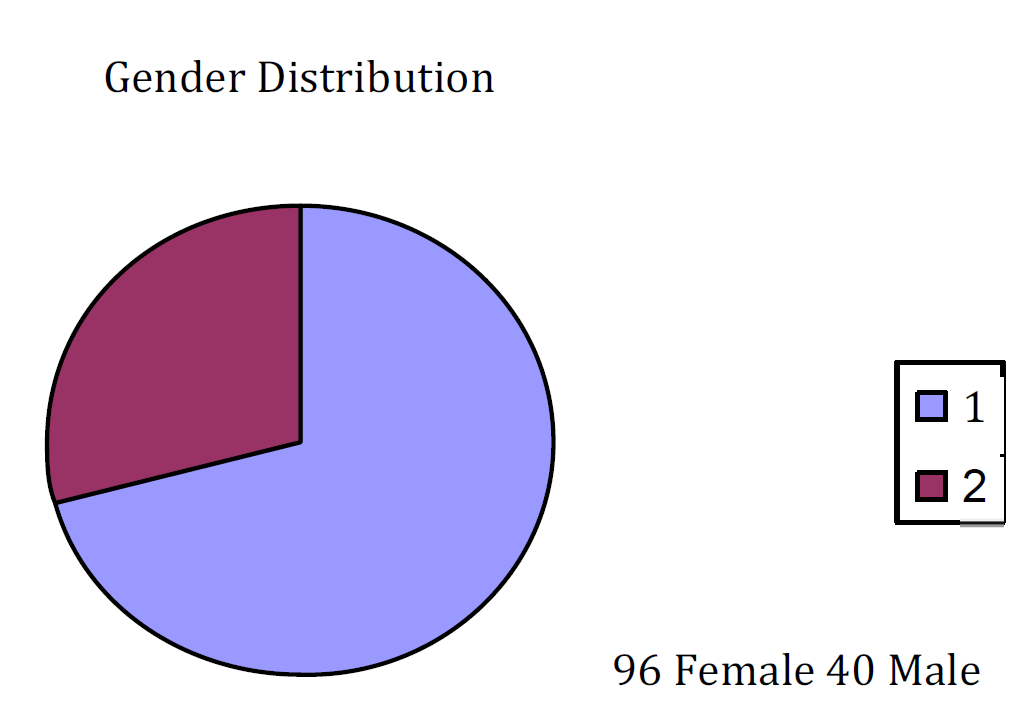
The age range was between 16 and 55 years of age with the female to male distribution of 86 to 40 respectively. (Figure 1)
Figure 1: Gender Distribution of Respondents”
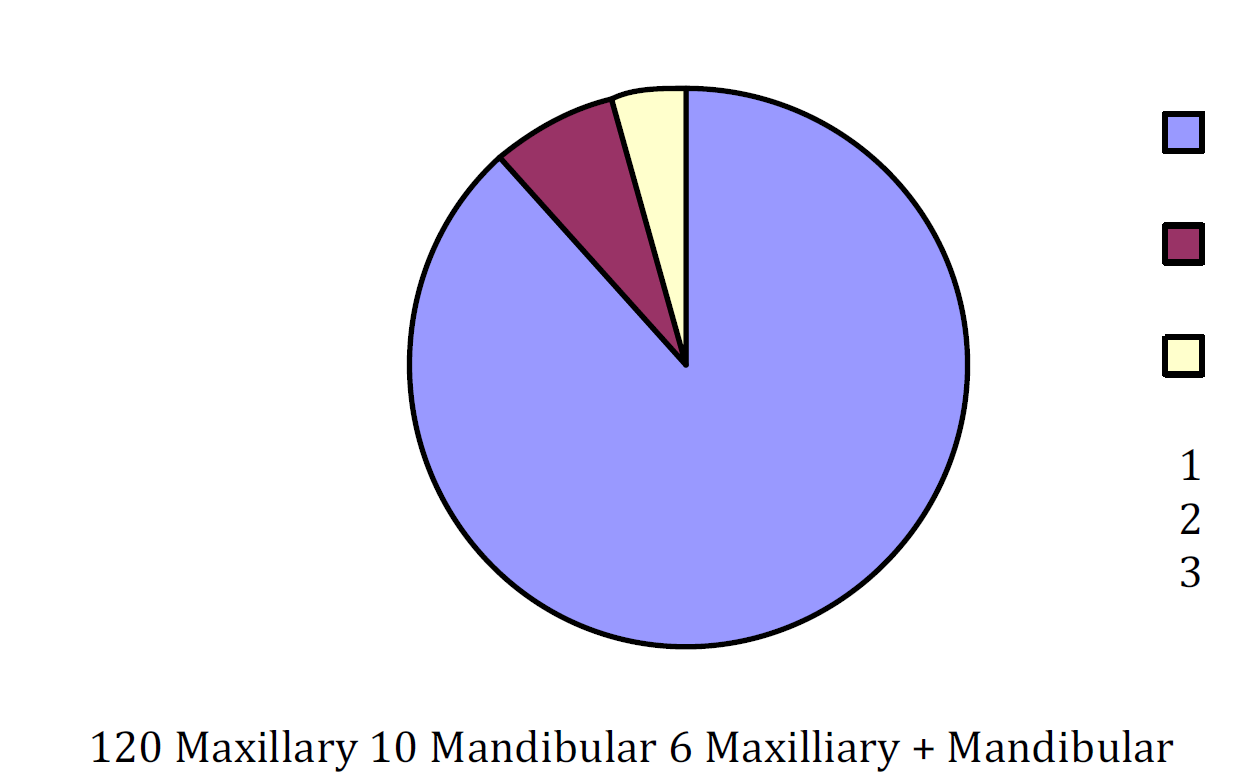
For maxillary midline diastema there were 120 subjects with female to male ratio of 83 to 57; mandibular midline diastema were 10 with female to male distribution of 8 to 2 while upper and lower midline diastema were 6, 5 were found in female and one in male. There are 3 major tribes in Nigeria but this study which was carried out at Ibadan which is the heartland of Yoruba tribe showed that there were 46 recorded Igbo patients, while the rest 90 were Yoruba’s with none from Hausa/Fulani tribe. (Figure 2)
Figure 2: Arch Distribution Midline Diastema
The subjects in the survey were categorised according to the income annually to see if the income was the reason they do not come for the treatment of the condition (affordability) and were grouped into 6 categories (Table 1).
Table 1: Annual Income of Subjects
Those whose annual income dues not exceed N50,000
- >150,000 pa <-250,000
- >250,000 pa <-400,000
- >450,000 pa <600,000
- >600,000 pa <750,000
- > 800,000
Table 2 showed the distribution of subject amongst the 6 categories with category 3 accounting for 25% of the total while categories two, three and four accounted for 69% of the survey (Table 2).
Concerning educational background, they were grouped into five categories:
Table 2: Annual Income of Subjects
Group
No of Subject
% Of Total
One
18
13.2
Two
28
20.6
Three
34
25.0
Four
32
23.5
Five
14
10.3
Six
10
7.3
136
100.0%
Those who had a primary school leaving certificates which is the minimum educational standard in the country
High school students
High school certificate holders who are not presently in a higher institution
Undergraduates and postgraduate students
Graduates who are engaged in one form of work of the other (either self-employed or employee)
The purpose of this is to analyse the understanding and knowledge and comprehension of the topic if fully explained with the implications. Sometimes the educational background also has affect on the income of the participating. 80% of the people involved in the survey were high school student, high school certificate holder, undergraduate and postgraduate student. Incidentally none of the unemployed graduate in this survey had maxillary midline diastema (Table 3).
Table 3: Education Qualification
Category
Educational status
No
%
1
Primary school holder
24
18%
2
High school students
18
15%
3
High school certificate holder
48
35%
4
Undergraduate and postgraduate students
40
30%
5
Graduate unemployed (applicants)
-
-
6
Employed graduates
6
4%
Total
136
100%
Result showed that high school certificate holders who are not in school formed the greatest part of the study 35%, while undergraduate and postgraduate students were 30%, primary school holders formed 18% of the study, high school students 15%, while first degree holders formed only 4% of this category.
According to sex out of the 136 patients 96 were females while 40 were males.
The educational status of the patients was looked into with a view to know how intelligent and informed the patients were in taking whatever decisions that they took.
The income generation capacity of each subgroup of educational status was also investigated and following results were produced 69% of people in the survey fall into the group of income earners N150,00- N600,000 (Table 4)
Table 4: Income In Relation To Educational Status
Income Grouping
Primary school certificate holder income
High school student
School certificate holder
Undergraduate Postgraduate students
Employed graduate
Total
1
18
-
-
-
18
2
2
-
18
8
-
28
3
10
-
12
12
-
34
4
6
-
14
12
-
32
5
2
-
2
8
2
14
6
4
2
-
4
10
24
18
48
40
6
136
The size of the maxillary midline diastema was also categorized on table 5 and the number of subjects exhibiting each category were 96, 26, 10, 3 for Imm, 1-2mm, 23mm, 3-4mm respectively only one subject had a MMD of 7mm with flaring of the central incisors. Table VI showed tribal distribution of MMD cording to educational status.
Of the 40 men involved in the study all agreed that the ladies found them attractive even though they did not quite agree if it made them more handsome or improves their aesthetics. Despite this they were not ready to close the diastema. The diastema width were measured.
All of the patients in the survey except one regardless of educational status or income does not want the closure of the diastema, neither did they see the condition as an anomaly or disturbing but rather as a sign of beauty.
Table 5: Categorization of Maxillary Diastema Space
1mm
= 96
>1-2mm
= 26
>2-3mm
= 10
>3-4mm
= 3
>4mm
= 1
136
Attempts were made to convince the patients to have the closure done free of charge but all declined except the patients whose diastema was measured to be about 7mm who preferred reduction rather than complete closure. This was done by enlarging the crown of both incisors with composite crowns especially from the mesial aspects of the incisors.
DISCUSSION
Moullas in a comprehensive review of maxillary midline diastema noted that there is a debate regarding the etiological factors and consequently the clinical management of such patients [17-18].
The continuing presence of a diastema between maxillary central incisors in adults often in considered an esthetic or malocclusion problems [13]
The etiology, pathogenesis and diagnosis of maxillary median diastema have been somewhat controversial over the years [13]
The prevalence of median diastema is high in children but decreases dramatically between 8 and 11 years of age, and continues a gradual decrease up to 15 years of age.20-22
Racial and gender differences also exist for diastema. A prevalence of higher maxillary midline diastema was reported in Africans (West Africa) than in Caucasians or Mongoloids [19-22].
Another report puts prevalence in black children at 19% while those of while children was 8% [23-24]. It was also reported that females in both races showed a higher prevalence than males at the age of 6 which at the age of 14 showed a reversal of higher prevalence in males in both races [25]. However, this study which was hospital based whose only inclusive criteria was presence of diastema without prejudice to race, sex. The subjects involved had an average income which ranges from N50, 000 per annum to more than N500,000 pa, However, none were interested in the closure of the diastema Table 1.
Regardless of income and educational status the respondents still are not agreeable to closure of the diastema. The educational status was brought into focus as the study included enlightenment as to the cause and effects of diastema because this will so as to ensure that the topic is understood. Table 3 and 4.
The study revealed that out of this present study the only person with the disability in pronouncing letter P, S, X and ‘th’ was the subject with the diastema width of 7mm which unfortunately refuse to close the diastema but reduce it significantly. It was, however, disheartening that none of the subjects that created midline diastema was ready to close it because their boyfriends would jilt them or leave them. The reasons given by all the subjects were that it was the sign of beauty which agreed with the other studies that has been carried out in Nigeria.
The greater percentage of the subjects earn above 50,000 so affordability is ruled out in the subjects but they refused to close the diastema and ditto for the educational status of the subjects when income was calibrated against the educational status. This study shows that about 70% are educated and comfortable with their incomes.
The respondents are of the opinion that closing the gaps would not make them attractive to suitors and that was the reason given by those that created their maxillary midline diastema. Three respondents out of the fourteen revealed that the reason they went for the creation of maxillary midline diastemas was their suitor leaving them for ladies with maxillary midline diastema.
With the various treatment offered including radical surgery with relapse occasionally occurring coupled with the expenditure of time, cost of treatment the cultural perception of maxillary midline diastema may serve as the way out for treatment of this feature which the Caucasians termed anomaly or abnormality.
Table 6 shows the distribution in terms of tribes in Nigeria even though there are more than 250 ethnic groups but for convenience there are 3 major tribes which are Hausa, Igbos and Yoruba [26].
Table 6: Tribal Distribution According To Educational Status
No
Educational Qualification
Igbos
Yoruba
Total
%
1
Primary school holder
8
16
24
17.6
2
High school students
6
12
18
13.2
3
School certificate holders`
16
32
48
35.3
4
Undergraduate and post graduate non working students (tertiary institution students)
14
26
40
29.4
5
Graduates
2
4
6
4.4
-
46
90
136
100
The study was made up of being 66.2% of the study while Igbos make up 33.8%. the study was skewed in famous of Yoruba because Ibadan, South West of Nigeria is a Yoruba dominated and populated region race while there was no Hausa/ Fulani in the study. The study was not intended to cover all the tribal groups in Nigeria but to see how the subjects perceive maxillary midline diastema.
The subjects were categorized unto income groups rather than social economic group[27] to determine if the patient has the ability to pay or not and this study went further to guarantee free treatment offer to close the diastema and the response was No in both groups of natural and artificially-produced maxillary misline diastema.
The age of the subjects ranges from 16-55 years with varying educational status and income ranges but all agreed that it was a sign of beauty as reported in other studies [28-29] but the figure obtained in this study which was 99.3% is higher than the one carried out in the same region in 2010 which was 72.8% and the one in 2015 [30]. This study also sought for closure of the diastema which all the respondents affirmed No as their answers and it cuts across the two major tribes involved in this study which goes against the opinion expressed in a study [31] that a major tribe may not consider midline diastema as a sign of beauty.
CONCLUSION
The tendency is for a maxillary diastema to undergo one form of treatment or the other ranging from classic frenectomies [7], orthodontic treatment [16], subapical osteotomies, corticoectomies, septotomies [32-33] and reverse-bevel gingirectomies [34] but none of them has recommended conservative approach of “leave alone” without subjecting the patient to a lot of stress, financially and emotionally. In this study as required by respondents their values about maxillary midline diastema is totally different from the Caucasians and the cultural values of Nigerians and Africans at large should be taken into consideration in determining treatment protocols. If the entity which is called anomaly does not cause injury but is said to add value to their aesthetics why remove the aesthetic value. It is time to recognize that some values are culturally inclined.
If the entity called anomaly did not cause bodily injury or have any negative effect to the wellbeing of the patients rather they see it as a value added to their look and it aesthetically pleasing to them, why recommending the removal of the value. It is time recognize that some values may have cultural inclinations.
Clinical Significance
There is the need to reflect the socio-cultural beliefs of Africans especially Nigerians in the treatment of maxillary midline diastema which is the option of “Leave Alone”
REFERENCE
Angle, E.H. Treatment of malocclusion of the teeth. 7th ed., Philadelphia: S. S. White Co., 1907.
Baum, A.T. "The midline diastema." J. Oral Med., vol. 21, 1966, pp. 30–39.
Keene, H.J. "Distribution of diastemas in the dentition of man." Am. J. Phys. Anthrop., vol. 21, no. 4, 1963, pp. 437–441.
Andrews, L.F. "The six keys to normal occlusion." American Journal of Orthodontics, vol. 62, no. 3, 1992, pp. 227–235.
Osterie, L.J., and W. C. Shellhart. "Maxillary midline diastema: A look at the causes." Am. J. Dent. Assoc., vol. 130, 1999, pp. 85–94.
Becker, A. "The midline diastema." Dent. Clin. North Am., vol. 22, 1978, pp. 685–710.
Edwards, J.G. "The diastema, the frenum, the frenectomy: A clinical study." Am. J. Orthod., vol. 71, 1977, pp. 489–508.
Sicher, H. Oral anatomy. 2nd ed., St. Louis: C. V. Mosby Co., 1952, pp. 185–273.
Sturdevant, C.M., et al., editors. The art and science of operative dentistry. 2nd ed., St. Louis: C. V. Mosby Co., 1985.
Grabes, T.M. Orthodontic principles and practice. 3rd ed., Philadelphia: W. B. Saunders & Co., 1972.
Rahilly, G. and C. Croaker. "Pathological migration: An unusual cause of midline diastema." Dent. Update, vol. 30, no. 10, 2003, pp. 547–549.
Edwards, J.G. "Soft tissue surgery to alleviate orthodontic relapse." Dent. Clin. North Am., vol. 37, 1993, pp. 205–225.
Huang, et al. "The midline diastema: A review of its etiology and treatment." Pediatric Dentistry, vol. 17, 1995, pp. 171–179.
Steigman, S. et al. "Characteristics and stability of spaced dentition." Angle Orthod., vol. 55, 1985, pp. 321–328.
Clark, J.D. and J.K. Williams. "The management of spacing in the maxillary incisal region." Br. J. Orthod., vol. 5, 1978, pp. 35–96.
Bishara, S. E. "Management of diastema in orthodontics." Am. J. Orthod., vol. 22, 1972, pp. 685–710.
Broadbent, B.H. "The face of the normal child (diagnosis, development)." Angle Orthod., vol. 7, 1937, pp. 183–208.
Moullas, Alexandros. "Maxillary midline diastema: A contemporary review." Hell. Orthod. Rev., vol. 8, 2005, pp. 93–103.
Adams, C.P. "Relation of spacing of the upper central incisors to abnormal frenum labii and other features of the dentofacial complex." D. Record, vol. 74, 1954, pp. 72–86.
Taylor, J.E. "Clinical observations relating to the normal and abnormal frenum labii superiors." Am. J. Orthod. Oral Surg., vol. 25, 1939, pp. 255–259.
Weyman, J. "The incidence of median diastema during the eruption of the permanent teeth." Dent. Practit., vol. 17, 1987, pp. 276–298.
Lavelle, C.L. "The distribution of diastemas in different human population samples." Scand. J. Dent. Res., vol. 78, 1970, pp. 530–534.
Horowitz, H.S. "Study of occlusal relations in 10 to 12 years old Caucasian and Negro children: Summary report." Int. Dent. J., vol. 20, 1970, pp. 593–605.
Richardson, E.R. et al. "Biracial study of the maxillary midline diastema." Angle Orthod., vol. 43, 1973, pp. 438–443.
Mbakogu, Ifeyinwa. "Socio-cultural factors and ethnic group relationships in contemporary Nigerian society." The African Anthropologist, vol. 9, 2002, pp. 117–137.
Esan, T.A. et al. "Socio-demographic factors and edentulism: The Nigerian experience." BMC Oral Health, vol. 4, 2004, p. 3.
Omotoso, G.O. and E. Kabir. "Midline diastema amongst South Western Nigerians." Internet J. Dent. Science, vol. 8, no. 2, 2010.
Oji, C. and A.E. Obiechina. "Diastema in Nigerian society." Odonto Stomat. Trop., vol. 17, 1994, pp. 4–6.
Ngom, P.I. et al. "Comparison of the perception of esthetic and orthodontic treatment need between an African and a Caucasian population." Dakar Med., vol. 51, 2006, pp. 10–16.
Akinboboye, B. et al. "Transcultural perception of maxillary midline diastema." Int. J. Esthet. Dent., vol. 10, no. 2, 2015.
"Naira to dollar exchange rate as at 2005 was #136 to a dollar." Google Search.
Kraut, R.A. and J. Payne. "Osteotomy of intermaxillary suture for closure of median diastema." J. Am. Dent. Assoc., vol. 107, 1983, pp. 760–761.
Spilka, C.J. and P.H. Mathews. "Surgical closure of diastema of central incisors." Am. J. Orthod., vol. 76, 1964, pp. 43–71.
Recommended Articles
Research Article
Effect of Laser Bio stimulation and Bone Graft in Treatment of a Large Periapical Lesion – A CBCT Analysis
Ruchika Gupta Dewan,
Unnavi Chauhan
Published: 22/11/2020
Download PDF
Research Article
Classifying Problems of Diabetic Foot
Amit Kumar C Jain
Published: 23/11/2020
Download PDF
Research Article
Rare Presentation Heterogeneous Pregnancies
Imad Abedzaid Mohan Aljanabi,
...
Marwa Habeeb Nazal
Published: 20/03/2021
Download PDF
Research Article
Emerging Role of Nutraceuticals in Covid 19
Naaz Huda,
...
Kaur Charanjeet
Published: 22/11/2020
Download PDF
PO Box 101, Nakuru
Kenya.
Email: office@iarconsortium.org
Editorial Office:
J.L Bhavan, Near Radison Blu Hotel,
Jalukbari, Guwahati-India
Bds, A. O. O. & None, F. (2021). Socio – Cultural Factors and Beliefs in the Management of Central Diastema in Ibadan, Nigeria. IAR Journal of Humanities and Cultural Studies, 2(1), 1-5.
MLA
Bds, Ajinde O. O. and Fwacs . "Socio – Cultural Factors and Beliefs in the Management of Central Diastema in Ibadan, Nigeria." IAR Journal of Humanities and Cultural Studies 2.1 (2021): 1-5.
Chicago
Bds, Ajinde O. O. and Fwacs . "Socio – Cultural Factors and Beliefs in the Management of Central Diastema in Ibadan, Nigeria." IAR Journal of Humanities and Cultural Studies 2, no. 1 (2021): 1-5.
Harvard
Bds, A. O. O. and None, F. (2021) 'Socio – Cultural Factors and Beliefs in the Management of Central Diastema in Ibadan, Nigeria' IAR Journal of Humanities and Cultural Studies 2(1), pp. 1-5.
Vancouver
Bds AOO, Fwacs F. Socio – Cultural Factors and Beliefs in the Management of Central Diastema in Ibadan, Nigeria. IAR Journal of Humanities and Cultural Studies. 2021 Jan;2(1):1-5.


 Download PDF
 Download XML