Personnel management is a key factor in an organization’s Human Relations (HR). The global economic meltdown in recent years, the rise in the application of technology in the area of business intelligence and the meteoric rise in the rate of competitions in business sectors, among others, have given rise to the need for organizations to restructure, re-strategize and reposition their method of running businesses across their established units; HR inclusive.The need for effective service delivery, enhanced decision making support system, non-biased staff relations strategy, effective and staff-oriented policy making, adequate business ethics and efficient enterprise resource planning necessitates the need to have in place an effective support mechanism for the HR department in the determination of promotion of the employees in its care.In this work, we aimed to develop an enhanced Naïve Bayes model for the prediction of staff promotion in an organization. We obtained an HR dataset from Kaggle (https://kaggle.com) – an online repository which contained staff’s personal and performance attributes and a class indicator of whether they are promoted or not. A Naïve Bayes (a probabilistic) model was developed for the preprocessed dataset. The dimension of the dataset was also reduced and its impact was assessed. The developed model gave accuracy of 91% for the full feature set and 93% for the reduced dataset. The specificity (79%) and the Negative Predicted Value (27%) for the Non-Promoted class shows that there is need for more datasets for this target class. Results also showed that the enhanced Naïve Bayes model performed better than the regular Naïve Bayes model. This work brings to the awareness of the employees and employers alike the attributes that must be given a higher attention for promotion purpose. Mutual-Information-Gain-enhanced Naïve Bayes model has proven to be a promising model in achieving a significant level of accuracy in predicting if a staff is to be promoted or not.
Keywords
Prediction of Staff Promotion Using Mutual Information
INTRODUCTION
The global economic meltdown in recent years, the rise in the application of technology in the area of business intelligence and the meteoric rise in the rate of competitions in business sectors, among others, have given rise to the need by emerging and well-established companies and corporate organizations to restructure, re-strategize and reposition their method of running businesses across their established units; human relations inclusive [1]. Technology acquisition is relatively cheap compared to the tremendous capabilities it proffers. Government and private institutions alike have placed a great prospect in the massive capacity of technology to offer substantial advantages in ameliorating the tension of rising costs and bureaucracies in the delivery of Human Resourses (HR) services.
The employment of decision support system in human relations, human resources and daily business operations with special attention on manpower is a variation of business ethics [2]. The wrongful act of favoritism among employees, deferring due promotions as well as an award of unnecessary benefit not on the basis of individual merit, but on prejudice or some other invidious or morally apprehensible attitudes may be a major setback in the progress and image of any organization [3]. It has been established that while communications technology, such as email, websites or group collaboration software packages, facilitates the problem-solving and decision-making cases in an organization, a Decision Support System (DSS) furthers the decision-making course by recommending courses of actions to the expert users [4].
Decision support systems have been proposed in many areas as one of the most viable “technological fixes” in recent times. They are developed to assist human beings (experts) in solving problems and for making better and more efficient decisions [5]. Soft systems have been developed in the recent decades to give Human Resources (HR) firms and other corporate organizations a competitive edge over others. Making an ethical and unbiased decision often involves a complex emotional, cognitive, philosophical and social challenges. Sometimes, there can be an unintentional blunder in the blend of knowing what is ethical and making straightforward and consistent decisions in alignment with these ethical values. DSS, in this case, can offer concerned experts the needed support, guidance or recommendations in making such decisions in consonant with the underling ethical values [3].
The impact of HR department in any given organization cannot be overemphasized. Their functions lie at the heart of the organization. HR has continued to merge new technology with old processes in increasing administrative efficiency and producing reports that improve decision making [6]. The concept of e-HR has been an emerging trend with the evolution technological advancements. The recent trend in technology has made it possible to develop a real-time, information-based, interactive and self-service work environment, ranging from the of computers taking advantage of network technology to provide HR experts and managers with information anytime they need it and anywhere they want it to a total e-HR systems such as enterprise resource planning (ERP) package, HR service centers, interactive voice response (IVR), web applications and manager-employee portals [7].
Promoting staff members in an organization as and when due is often a critical and a rigorous aspect of HR functions. In fact, it means as much as the workers’ satisfaction in any institution. There is therefore need to improve this crucial exercise by developing a decision-support system for the HR department of the organization for aiding the staff promotion exercise. In this work, a recommender system is developed as a decision-support engine for HR experts in promotion of staff members to their respective next and due grades.
MATERIALS AND METHODS
The focus of this work is to develop a Naïve Bayes model for the prediction of staff that are likely to be promoted based on defined personal and performance parameters. Data was obtained and feature selection was done on the preprocessed dataset and its impact on the developed model was assessed. In this section, the dataset is discussed and the model building process is presented. The workflow architecture of the prediction model developed in this study is given in Figure 1.
Data Description
In this work, we obtained the HR dataset from Kaggle online repository (https://www.kaggle.com/). The dataset contains personal and performance information of staff members in an organization in Nigeria, West Africa. It contains 38,312 staff records and 18 features per instance with their corresponding target class. The variables in the dataset are explained in Table 1. This is a binary classified dataset with a mixture of nominal and numerical values.
Figure 1: System Architecture of the Developed Staff Promotion Algorithm
Table 1: Features of the HR Dataset
No
Feature
Description
1
Staff_ID
The employee ID
2
Division
Operational department where each employee works
3
Qualification
Highest qualification received by the staff
4
Gender
Male or Female
5
Channel_of_Recruitment:
How the staff was recruited – this is via internal process, use of an agent or special referral
6
Trainings_Attended
Unique paid and unpaid trainings attended by each staff in the previous business cycle
7
Year_of_birth:
Year that the employee was born
8
Last_Performance_Score
Previous year overall performance HR score and rated on a scale of 0-14
9
Year_of_recruitment
The year that each staff was recruited into the company
10
Targets_met
A measure of employees who meet the annual set target. If met, the staff scores 1 but if not, it is a 0.
11
Previous_Award
An indicator of previous award won. If yes, it is a 1 and if No it is a 0.
12
Training_score_average
Feedback score on training attended based on evaluation
13
State_Of_Origin
The state that the employee claims
14
Foreign_schooled
An indicator of staff who had any of their post-secondary education outside the country. Responses are in Yes or No
15
Marital_Status
Marriage status of employees and recorded as Yes or No
16
Past_Disciplinary_Action
An indicator if a staff has been summoned to a disciplinary panel in the past. This is indicated as Yes or No
17
Previous_IntraDepartmental_Movement
This is an indicator to identify staff who have moved between departments in the past. Yes and No are the responses.
18
No_of_previous_
employers
A list of the number of companies that an employee worked with before joining the organisation. This is recorded as counts
19
Target_Class
Promoted or Not_promoted (P/NP)
Data Preprocessing
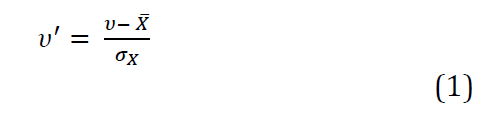
The obtained HR dataset passed through three stages of preprocessing, namely: missing value removal, nominal value replacement, timestamp replacement, label encoding and data transformation. Missing values were removed so that the data is clean and unbiased for use in the developed Naïve Bayes HR (NB-HR) model. Nominal values were also replaced so as to appropriately represent the categorical features in the dataset. Dates in the dataset was changed to discrete values and our target label (P/NP) was also encoded into numerical Boolean values. The entire dataset excluding the target class was scaled so that one feature does not overweigh the other during the computation of the model. In this work, the z-score normalization was used in the normalization in which the values are normalized based on mean and standard deviation of each feature. The z-score is given in (1).
where is the derived z-score for each HR dataset feature, is the initial value in each observation of each features, is the mean and is the standard deviation of each respective feature. The output of the preprocessing stage is a normalized, cleaned, consistent and target-encoded dataset.
Feature Selection with Mutual Information Gain (MIG)
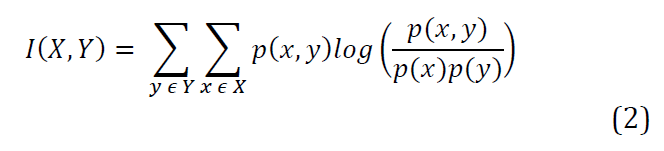
It is intended in this study to enhance the NBHR model with feature selection techniques so that the impact of feature selection can be assessed on the developed Naïve Bayes model. This is to remove features with redundant and noisy attributes while retaining only features that possess a relatively high disambiguation capabilities. In this study we used Mutual Information technique to rank the HR dataset by measuring the mutual dependence of two random variables (feature-X and target-class-Y). Formally X and Y can be defined as in 2.
where is the joint probability distribution function (pdf) of X and Y; while and are the marginal pdf of X and Y respectively. X is an individual feature and Y is the corresponding class (N or NP). We selected the top features based on this ranking because the higher the MIG score, the more contributive it is to the corresponding target class.
Data Splitting
The HR dataset was split into training and testing set and testing set. This is systematically done avoid either extremes of overfitting and underfitting. The splitting was however cross-validated using the 10.-fold cross validation. We split our data into 10 different subsets (or folds). We used 9 subsets to train our data and leave the last subset (or the last fold) as test data. We then average the model against each of the folds and then finalize our model. After that we test it against the test set. This was to ensure that our splitting is not biased.
The Naïve Bayes HR (NBHR) Model
The Naïve Bayes classifier is a probabilistic model on the Bayes rule with a strong feature-independence assumption [8-10]. This technique involves a simplifying conditional independence assumption; that is, given class (0 or 1 for P or NP respectively), the HR features are conditionally independent of one another. This initial assumption does not affect the accuracy in a negative way but rather makes it really fast for our classification problem. In this case, the maximum likelihood probability of an HR dataset feature belonging to a particular class is given by the expression in 3.
According to the Bayes’ rule, the probability of a particular feature belonging to a Class is given in 4.
Using a simplifying conditional independence assumption, that given a class (in our case, P/NP), the features are conditionally independent of each other. This simplifying assumption in the model is termed “naïve” such that (5) holds for the dataset.
Where are the individual feature in the dataset. The classifier outputs the class with the maximum posteriori probability. This model is the Bernoulli-variant of the Naïve Bayes model.
RESULTS
The feature ranking output is presented in Table 2.
Table 2: Feature Ranking with Mutual Information
No
HR Features
Gain Value
1
Training_score_average
176.754
2
State_Of_Origin
92.25447
3
Year_of_birth
57.85932
4
Year_of_recruitment
48.23977
5
Last_performance_score
43.82296
6
Division
35.965656
7
No_of_previous_employers
21.519299
8
Marital_Status
20.594328
9
Trainings_Attended
19.375461
10
Channel_of_Recruitment
16.292767
11
Qualification
11.248787
12
Targets_met
8.2298
13
Gender
0.211857
14
Previous_IntraDepartmental_Movement
0.085308
15
Foreign_schooled
0.079136
16
Previous_Award
0.022665
17
Past_Disciplinary_Action
0.003888
Experiment I
In the first experiment after the NBHR model was developed, we passed the preprocessed HR dataset into our model and the performance was observed. The confusion matrix presented in Table 3.
Table 3: Full Features in the NBHR Model
Confusion Matrix of the NBHR Model
Target
Promoted
Not Promoted
Promoted
13219
179
Positive Predicted Value
0.98
Not Promoted
1088
168
Negative Predicted Value
0.13
Sensitivity
Specificity
Accuracy = 1
Experiment II
In the second experiment, we reduced the features by selecting features whose gain rank relatively high and are more than 10. By this, 11 features were selected for our prediction and the performance is given in the confusion matrix in Table 4.
Table 4: Reduced (11) Features in the NBHR Model
Confusion Matrix of the NBHR Model
Target
Promoted
Not Promoted
Promoted
13306
92
Positive Predicted Value
0.99
Not Promoted
994
352
Negative Predicted Value
0.27
Sensitivity
Specificity
Accuracy = 3
Comparison of Performance
Figure 2 shows the correlation heatmap of the full features of the HR dataset. This shows the independent relationship across all features combined. The closer to 1.0, the more correlative a feature is to another corresponding feature.
Figure 2: Correlation Heatmap of the Full HR Features
Figure 3 shows the frequency distribution of the target class. This shows that the support for the Not_Promoted category is relatively lower than the Promoted category. This effect is felt in the result gotten for the Not_Promoted category.
Figure 3: Target Class Distribution
The performance of the two experiments was compared using their respective sensitivity, specificity, negatively predicted value (NPV), positively predicted value (PPV) and overall accuracy. This is depicted graphically in Figure 4.
Figure 4: Comparison Between Experiment I And Experiment II
DISCUSSION
Results in this study has, among others, ascertained that:
certain personal and performance attributes of staff members can decide if they can be promoted or not
training score, age, performance in last promotional examination ans state of origin are the greatest perdictors in the obtained dataset
feature selection using mutual information gain enhanced the predictive capabilities of the developed Naïve Bayes model
company's target met by staff, gender, previous transfer, foreign training record, previous award and past disciplinary action correlates with the promotional status of staff in the dataset
93% accuracy is a promising performance in the prediction of staff’s promotion
prediction performance for the negative class was low because the number of instances for the negative class is low
CONCLUSION
This work has successfully established that computational models can be applied into HR services of a given company. This can help in learning the trend of staff’s progress in the organization. It can also assist in fostering staff-oriented policies in the organization. This work also brings to the awareness of the employees and employers alike the attributes that must be given a higher attention for promotion purpose. Mutual-Information-Gain-enhanced Naïve Bayes model has proven to be a promising model in achieving a significant level of accuracy in predicting if a staff is to be promoted or not. In the future, we hope to rerun this model when the HR dataset has grown to a near balanced positive-negative ratio.
REFERENCE
Yoshimura, M. et al. “Decision-Making Support System for Human Resource Allocation in Product Development Projects.” International Journal of Production Research, vol. 44, no. 5, 2006, pp. 831–848.
Velasquez, M.G. and M. Velazquez. Business Ethics: Concepts and Cases. Vol. 111, Prentice Hall, Upper Saddle River, NJ, 2002.
Mathieson, K. “Towards a Design Science of Ethical Decision Support.” Journal of Business Ethics, vol. 76, no. 3, 2007, pp. 269–292.
Workman, M. “Expert Decision Support System Use, Disuse, and Misuse: A Study Using the Theory of Planned Behavior.” Computers in Human Behavior, vol. 21, no. 2, 2005, pp. 211–231.
Sainfort, F.C. et al. “Decision Support Systems Effectiveness: Conceptual Framework and Empirical Evaluation.” Organizational Behavior and Human Decision Processes, vol. 45, no. 2, 1990, pp. 232–252.
Lengnick-Hall, M.L. and S. Moritz. “The Impact of e-HR on the Human Resource Management Function.” Journal of Labor Research, vol. 24, no. 3, 2003, p. 365.
Lawler, E.E.III and J.W. Boudreau. “HR Support for Corporate Boards.” People and Strategy, vol. 29, no. 1, 2006, p. 15.
Eyheramendy, S. et al. “On the Naive Bayes Model for Text Categorization.” 2003.
Han, H. et al. “A Hierarchical Naive Bayes Mixture Model for Name Disambiguation in Author Citations.” Proceedings of the 2005 ACM Symposium on Applied Computing, 2005.
Jiang, L. et al. “A Novel Bayes Model: Hidden Naive Bayes.” IEEE Transactions on Knowledge and Data Engineering, vol. 21, no. 10, 2008, pp. 1361–1371.
Recommended Articles
Research Article
OBSERVATIONS ON THE HOMOGENEOUS TERNARY QUADRATIC DIOPHANTINE EQUATION x2 + 4xy + 9y2 = 21z2
Download PDF
Research Article
Machine Learning-Based Intrusion Detection for Detecting DDoS Attacks in Software-Defined Networks
Zainab Abbas Fadhil
Published: 30/06/2026
Download PDF
Research Article
Computer Driven Library Management and Service Rendering System: Mobile Library Landscape
Yekini N. A,
...
Ojo O
Published: 10/06/2020
Download PDF
Research Article
A Deep Representation Learning Framework Based on PCA-Compressed EfficientNetB0 Embeddings and Neural Spline-Based Classification for Iraqi Banknote Authentication
Saba Hussein Rashid
Published: 30/06/2026
Download PDF
PO Box 101, Nakuru
Kenya.
Email: office@iarconsortium.org
Editorial Office:
J.L Bhavan, Near Radison Blu Hotel,
Jalukbari, Guwahati-India
Olabanjo, O. A. & Wusu, A. S. (2021). Expert Decision Support System for the Prediction of Staff Promotion Using Mutual Information Gain Enhanced Naïve Bayes Model. IAR Journal of Engineering and Technology, 2(1), 1-5.
MLA
Olabanjo, Olusola A. and Ashiribo S. Wusu. "Expert Decision Support System for the Prediction of Staff Promotion Using Mutual Information Gain Enhanced Naïve Bayes Model." IAR Journal of Engineering and Technology 2.1 (2021): 1-5.
Chicago
Olabanjo, Olusola A. and Ashiribo S. Wusu. "Expert Decision Support System for the Prediction of Staff Promotion Using Mutual Information Gain Enhanced Naïve Bayes Model." IAR Journal of Engineering and Technology 2, no. 1 (2021): 1-5.
Harvard
Olabanjo, O. A. and Wusu, A. S. (2021) 'Expert Decision Support System for the Prediction of Staff Promotion Using Mutual Information Gain Enhanced Naïve Bayes Model' IAR Journal of Engineering and Technology 2(1), pp. 1-5.
Vancouver
Olabanjo OA, Wusu AS. Expert Decision Support System for the Prediction of Staff Promotion Using Mutual Information Gain Enhanced Naïve Bayes Model. IAR Journal of Engineering and Technology. 2021 Jan;2(1):1-5.



 Download PDF
 Download XML



 is the derived z-score for each HR dataset feature,