The paper makes a comparative analysis of the structure of the silicone rubber recovered in its pure state and the case in which in its structure are introduced biological materials in the form of powders from snails shell. Observations are made on the degree of smoothing of the surface, the nature of the inclusions, discontinuities and their size.
Keywords
Recovered
Silicone Rubber
Snail Shell Powder
Morphological Assessment
Microstructure
Energy Industry
INTRODUCTION
The economic activity of recovery, recycling and reuse of metallic and non-metallic materials with a high utilization coefficient is currently together with the use of non-polluting forms of energy an important pillar of support for the development of the production of material goods.
And in our country there are important concerns in this regard. The use of biocompatible materials obtained from recycling is the basis of research on obtaining new materials used in advanced fields such as medicine, microrobotics, aerospace, pharmaceuticals [1].
In this context, the energy industry occupies an important place [1]. It is known that there are electrical devices and appliances that need to be replaced after exhausting their service life. The costs of replacing them are often significant and the waste obtained is particularly toxic. For this reason, numerous efforts have been made to partially or completely recover them and reintroduce them into the productive circuit.
The recovery of silicone rubber from used composite electrical insulators has been a major concern in the attempt to reintroduce the material obtained in the production circuit to obtain new products of recovered silicone rubber with superior technical and functional characteristics and economic. [2-4].
EXPERIMENTAL SECTION
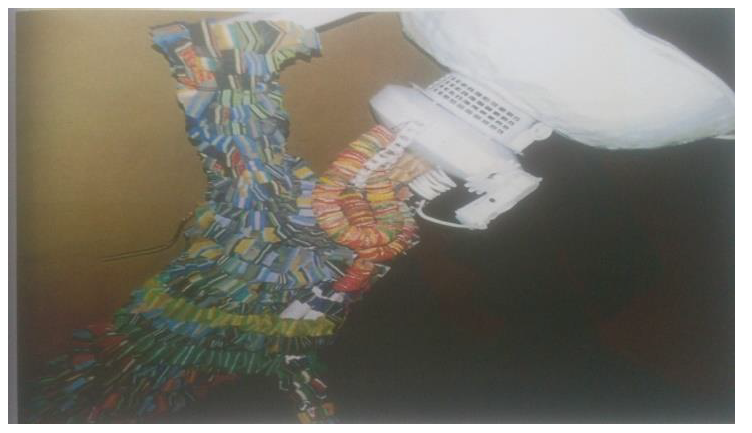
Following the research carried out, the following materials were obtained [5-6]:
Figure 2: Recycled PUR Silicone Rubber
Figure 2: Technical Plate Made Of Liquid Silicone Rubber (70%) + Silicone Powder (30%)
Figure 3: Technical Plate Made Of Liquid Silicone Rubber (68%) + Silicone Powder (29%) And Snail Shell Powder (3%)
RESULTS AND DISCUSSION
In the SEM analysis, significant sections of material for PUR silicone were highlighted, the symbolization is in Figure. 4,6,7,8., for the one mixed with silicone powder 5, and for the one mixed with snail powder 1-.
Images at a magnification of 500x, 5000x were used to provide an overview of the section, which became necessary with the examination of samples modified by different fillers. (Figure 4,5)
Microphotographs 6 - 7 showed a section in the substrate as an interface between the base material and a possible insertion, but this was not the case, this being unmodified silicone rubber. Therefore, it was only a particularity of the section. The wire observed in the upper region of the image 8 may come from the carbon strip used to fix the samples in a vertical position on the silicon wafer used as a support for all metallic fragments.
In case of using the snail powder type insertion material, 2 different fragments from the same sample were used, those marked Figure. 9,12,13 and Figure 10,11,14.
The structure of the material Figure.9, the insertion of the recycled rubber Figure.10 were identified, with enough weight the interface between the 2 materials Figure.11, fracture areas at the interface between the 2 types of rubber Figure.12 and last but not least the space created between the two elements, Figure13.
As shown in Figure. 14, there are solid rubber inserts, but there are gaps between the shard and the surrounding rubber. In this way, shards of snail shells were identified.
Figure 4: Digital Microphotography, Optical Zoom 500, Sample 100μm
Figure 5: Digital Microphotography, 5000 Optical Zoom, 10μm Sample
Figure 6: Digital Microphotography, Optical Zoom 150, Sample 400μm
Figure 7: digital microphotography, optical zoom 300, sample 200μm
Figure 8: Digital Microphotography, 1000 Optical Zoom, 50μm Sample
Figure 9: Digital Microphotography, Optical Zoom 500, Sample 100μm
Figure10: Digital Microphotography, Optical Zoom 150, Sample 400μm, Recycled Silicone Rubber Insert in the Middle Top
Figure11: Digital Microphotography, Optical Zoom 500, Sample 100μm, Interface between the 2 Materials
Figure 12: Digital Microphotography, Optical Zoom 2000, 30μm Sample, Fracture Area at the Interface between the 2 Types of Rubber
Figure 13: Digital Microphotography, Optical Zoom 5000, Sample 10μm, Space Created Between the 2 Materials
Figure 14: Digital Microphotography, Optical Zoom 500, Sample 100μm
CONCLUSION
Research has shown that it is possible to obtain pure silicone rubber, mixed with silicone powder or snail powder
The use of the SEM technique creates the possibility to study in detail the cut structure of the three material variants in order to highlight its possible changes. [7-9]
The optical zoom magnification was set in the range between 500x and 5000x
The sampling diameter varies between 10-400μm for the study of the structure in the case of recycled silicone ,, pure ,, to 10-200μm in the case of the structure for silicone mixed with powder, so that in the case of recycled silicone mixed with snail shell biological powder to be 10-400 μm
Microphotographs generally show a relatively continuous structure with more pronounced accents in the case of the snail shell insertion
There are traces of the fixing wire of the carbon strip used to fix the samples in a vertical position (Figure.8)
There were also sections in the substrate as an interface between the base material and any inserts (Figure 6-7).
When using the snail powder insert, 2 samples of samples 1 and 1 were used *
In this situation, the insertion of recycled silicone rubber was highlighted in the upper middle (Figure.10), the interface between the 2 materials (Figure.11), a fracture area at the interface between the 2 types of rubber. (Figure.12) as well as a space created between the 2 materials (Figure.13). The analysis of the length of the samples showed that they are quite rare
From the Figure.14 analysis it was identified that there are solid rubber inserts in the form of snail shell shards
For the metallization of the surfaces, 7 nm of Au were deposited, using the Neva EDV 500A vacuum coating system.For the morphological characterization of the samples, we used the field scanning electron microscope FEI Nova NanoSEM 630, [10]
REFERENCE
Popescu, D. Silicone Rubber: Engineering Applications. Craiova, Romania: SITECH, 2020.
Popescu, R.C. et al. “Application of Rubber-Based Blends.” Recent Developments in Polymer Macro, Micro and Nano Blends - Preparation and Characterisation, edited by P.M. Visakh, G. Markovic and D. Pasquini, Elsevier, 2017, pp. 75–106.
Popescu, R.C. et al. “Antimicrobial Thin Coatings Prepared by Laser Processing.” Nanostructures for Antimicrobial Therapy, Elsevier, 2017, pp. 223–236.
Popescu, D. et al. “Determining the Mechanical Characteristics of Composite Nanostructured Materials Based on Recovered Silicone Rubber.” MATEC Web of Conferences, International Symposium on Materials Application and Engineering (SMAE 2016), edited by M. Jawaid and E.-R. Kenawy, vol. 2016, Chiang Mai, Thailand, 2016, p. 03047.
Popescu, D. “Investigation of the Microstructure of Silicone Rubber Recovered from Composite Electrical Insulators.” Annals of the Oradea University, Fascicle of Management and Technological Engineering, vol. XX(X), 2011, pp. 4125–4129. Oradea, Romania: Oradea University Publishing House.
Popescu, D. and C. Cernaianu. “The Influence of Alloy Elements on the Mechanical Features of Nanostructured Composite Materials with Recovered Silicone Rubber Matrices.” Material Science & Engineering: Achievements and Solutions in Mechanical Engineering, vol. 880, 2018, pp. 262–265.
Saleem, A. et al. “Fabrication of Extrinsically Conductive Silicon Rubbers with High Elasticity and Analysis of Their Mechanical and Electrical Characteristics.” Polymers, vol. 2, no. 3, 2010, pp. 200–210.
Shit, S.C. and P. Shah. “A Review on Silicone Rubber.” National Academy Science Letters, vol. 36, no. 4, 2013, pp. 355–365.
Wang, J. and D. Chen. “Mechanical Properties of Natural Rubber Nanocomposites Filled with Thermally Treated Atapulgite.” Journal of Nanomaterials, 2013, Article ID 496584.
Recommended Articles
Research Article
OBSERVATIONS ON THE HOMOGENEOUS TERNARY QUADRATIC DIOPHANTINE EQUATION x2 + 4xy + 9y2 = 21z2
Download PDF
Research Article
Machine Learning-Based Intrusion Detection for Detecting DDoS Attacks in Software-Defined Networks
Zainab Abbas Fadhil
Published: 30/06/2026
Download PDF
Research Article
Computer Driven Library Management and Service Rendering System: Mobile Library Landscape
Yekini N. A,
...
Ojo O
Published: 10/06/2020
Download PDF
Research Article
A Deep Representation Learning Framework Based on PCA-Compressed EfficientNetB0 Embeddings and Neural Spline-Based Classification for Iraqi Banknote Authentication
Saba Hussein Rashid
Published: 30/06/2026
Download PDF
PO Box 101, Nakuru
Kenya.
Email: office@iarconsortium.org
Editorial Office:
J.L Bhavan, Near Radison Blu Hotel,
Jalukbari, Guwahati-India
Popescu, D. (2020). On The Influence of Some Biological Materials on the Structure of Recycled Silicone Rubber. IAR Journal of Engineering and Technology, 1(2), 1-4.
MLA
Popescu, Daniel. "On The Influence of Some Biological Materials on the Structure of Recycled Silicone Rubber." IAR Journal of Engineering and Technology 1.2 (2020): 1-4.
Chicago
Popescu, Daniel. "On The Influence of Some Biological Materials on the Structure of Recycled Silicone Rubber." IAR Journal of Engineering and Technology 1, no. 2 (2020): 1-4.
Harvard
Popescu, D. (2020) 'On The Influence of Some Biological Materials on the Structure of Recycled Silicone Rubber' IAR Journal of Engineering and Technology 1(2), pp. 1-4.
Vancouver
Popescu D. On The Influence of Some Biological Materials on the Structure of Recycled Silicone Rubber. IAR Journal of Engineering and Technology. 2020 Jul;1(2):1-4.


 Download PDF
 Download XML