Community Learning Center (CLC) managers in East Java, Indonesia, lack a strong vision, mission and commitment to organizational development. The manager's limited insight in managing institutions and managing adult learning and mastery of managerial competencies. This study aimed to examine and analyze the condition of the managerial competence of CLC managers, describe the application of the functional training model and determine the effectiveness of the functional training model in strengthening the managerial competence of CLC managers. The data collection method used an experiment with a one-short study quantitative approach. The data collection technique uses tests, interviews, observations and documentation. The analysis technique uses the Pre-Experimental design type. There were no control variables in this study and the samples were randomly selected, so the design form used was one group pretest-posttest. The research findings show that the average managerial competence increased (2.48) and the average score increased from (7.16) to (9.64), with a lower standard deviation from (2.75) to (2.16). The value of the standard deviation and the smaller the variance value, the better, meaning that the distribution is more homogeneous. The application of the functional training model is very effective in strengthening managerial competence for CLC managers, as evidenced by the results of the t-test that the t-count value is (-14,218) with a Sig-2 tailed value <0.05, meaning that there is a difference in the results of the pretest and posttest, which proves there is a significant relationship. There is a significant difference between the functional training model and the strengthening of the managerial competence of CLC managers. Recommendation: CLC managers must receive competency training, especially managerial competence.
Keywords
Functional Training
Managerial Competence
Clc Manager
Non-Formal Education
INTRODUCTION
Human resource development in the future until 2025 will lead to empowerment, a productive economy and entrepreneurship, especially in frontier, remote and underdeveloped areas, to achieve equitable development. The Indonesian government has launched a people-based development, including the development of a mental revolution [1]. The realization of the mental revolution development certainly requires formal and non-formal education that can improve the quality of human resources. Training is one non-formal education to follow up on the achievement of these development goals in building human resources [2]. Human resources development is a top priority through the Smart Indonesia Card and the Healthy Indonesia Card. The nature of building human resources is highly dependent on education and health [3].
The lifelong learning process is carried out through training to develop skills based on needs and solve problems encountered in everyday life. Adult learning centres on problem-solving (problem-based learning) [4]. The problems faced by the training participants are discussed in learning so that they become interesting and can be used immediately after participating in the lesson. In addition, students learn what is experienced and related to social, economic and political development [5].
Non-formal education is a conscious effort carried out outside the school system, lasts a lifetime, is carried out regularly and is planned to actualize human potential in the form of knowledge, skills and attitudes to become fully empowered human beings who love to learn. Training as a non-formal education program acquires certain skills to be better at carrying out tasks and aims to help humans become more qualified and proficient in carrying out several jobs [6].
Van Dorsal's view [7] that functional training is a process of teaching, informing, or educating humans to become better qualified in carrying out work and become better at carrying out positions with greater difficulty and responsibility. Functional training is an intervention rather than short-term learning to build attitudes, knowledge and skills that are used to meet current and future job needs. Terence Jackson [8] says that functional training is a tool that serves to improve organizational performance problems, such as; effectiveness, efficiency and productivity.
Learning in adults is the development of access so that learning is centred on the problems of the students themselves, involving experience, participatory encouragement and collaboration [8]. Thus adults are actively involved in learning from planning to evaluation. Adult learning outcomes are experiences that can be used to develop new experiences again and so on. Functional training in non-formal education can be viewed as an educational unit that can use an adult education approach [9]. Therefore, the concepts of adult education are used in the implementation of the training. Adults' learning objectives can develop abilities, enrich knowledge, improve skills and professions, acquire new ways and change adults' attitudes and behavior [10].
An individual needs competence for effective performance in carrying out organizational tasks [11]. It generally includes (1) Attitudes, skills and personal knowledge, which people bring to work, including personal qualities, skills and knowledge, attitude, experience, responsibility and accountability (2) skills in managing tasks, attitudes and organization which are what people do in the workplace, including tasks, processes and behaviours related to planning, implementation, control, procurement, etc. Finally, (3) the achievement of the standard level of the final result, which each individual has achieved; the final result follows the standards expected to be achieved by competent individuals.
A leader who has various activities has duties and responsibilities towards the institution and is much needed by the wider community and must be able to reflect an exemplary attitude. However, Community Learning Center (CLC) in East Java is still found by leaders who lack a commitment to implementing programs for the community. It was found that the program only ran when it received financial assistance from the government. After the funds were exhausted, it would cause the learning process would stop. Leaders of some communities must be responsive to needs by taking advantage of the existing potential so that the programs implemented will continue to run even though they do not receive aid funds from the government. The lack of fulfilment of learning needs makes people not aware of the existence of CLC, even if it is not known because CLC is not useful for the wider community. Only a small part of the community enjoys CLC facilities. An increase does not follow the number of CLC institutions in the number of people served, even obtaining achievements. CLC growth is only based on quantity, not quality [12]. Management distinguishes expectations and reality for society [13].
The results of observations on CLC in East Java are many that have not developed and some are no longer operating. This condition is quite pathetic. After all, managers lack a strong vision, mission and commitment to organizational development, because managers have limited insight, especially in managing institutions and adult learning and mastering manager competencies. The manager does not involve community leaders who have the potential to be involved in the socialization of programs and institutions in the community. It was found that CLC did not have a database of the learning needs of the target community. CLC is not yet known in the surrounding environment, so learning cannot run sustainably to meet the community's learning needs. Every region in East Java has local potential that can be utilized. Still, CLC managers do not yet have the vision to develop the local potential of the region and the community.CLC, as a community institution, has not yet built a network with business partners and the industrial world, even related agencies, because it has not been able to produce superior products or services as the main funding support in providing services to the community. CLC plays social and economic roles and functions to realize learning for the community [14].
A CLC manager is expected to have the ability in all aspects of activities in the institution he leads. CLC managers are decision-makers for all activities carried out by people involved in CLC activities [15]. In addition, managers are responsible for overall CLC activities, acting as administrators and supervisors [16]. As an administrator, he is responsible for managing resources to achieve learning objectives effectively and efficiently. As a supervisor, he is responsible for developing learning in CLC by assisting in developing professional abilities for educators. According to Lippman [17] that there are five tasks for CLC managers, namely: (a) teaching programs, (b) fostering staff, (c) fostering and managing learning citizens, (d) managing resources/finances and (e) managing CLC relations with the community. Ability in itself is a form of minimum competence that must be possessed as a manager, including personality competence, professional competence, social competence and managerial competence.
Managerial competence is part of the manager's main task in managing all aspects of the institution, both internally and externally. According to Leithwood and Montgomery [18], it is said that as a CLC manager, you must have the ability to: (1) Describe the rules and regulations set by higher institutions to be implemented by CLC personnel; (2) Planning and setting targets and activities to be carried out within a certain period; (3) Regulate and assign personnel involved in CLC activities; (4) Assign tasks and job details for each person involved; (5) Delegating some of their duties and authorities to the personnel involved; (6) Supervise the implementation of the duties of subordinate personnel; (7) Prepare activity reports and submit reports to their superior agencies periodically and (8) Solving problems encountered in the implementation of daily managerial tasks.
The main functions of the CLC manager and the material tested on managerial competence are as a leader of the teaching and learning process (institutional leader), as a CLC organizational manager (school manager), as an educational leader (educational leadership), as an educational supervisor (educational supervisor) and as an educational innovator.
Table 1: Minimum Standards for Independent CLC Management
Planning
Objective
Output
Compile an overview of the problem and sources of costs
Prepare the annual work plan
Formulate priority programs/activities for each sector
basic data of target groups and resources that can be utilized.
annual work program
Service programs/activities for each field
Organizing
Organizing:
Utilization of resources for the implementation of programs/activities.
Implementation of programs/activities
Education staff in CLC implementation and program/activity implementation
List of resource utilization by program/activity.
The organizational structure of education personnel and their scope of work.
Program/activity schedule/calendar.
Documents for recording and evaluation:
The state and development of resource use
The situation and development of the learning community
The state and development of education personnel
The state and development of the implementation of programs/activities from each field.
Implementation
Control
Provide educational services following the program/activity design
Provide information services to the target group following the program/activity design
Carry out functional cooperation following the partnership network development plan
Organizing technical guidance in the context of improving the performance of education personnel
Carry out monitoring and control of program/activity implementation.
Data on the progress of the process and program/activity implementation results from each field.
Evaluation
Measuring the level of achievement of the objectives of CLC implementation
Formulate input materials for the preparation of the annual work plan
Data on achieving goals from each activity program in each field
Input material for the preparation of the annual work plan
Assessment report on the implementation of CLC for one fiscal year.
Source: Adopted from BPKB Jayagiri, Indonesia
In carrying out the main functions of CLC, having a minimum standard of management for an organization is an important reference in establishing, fostering and developing CLC in the future by the government and the community. The following are the minimum standards for CLC management in East Java (Table 1).
CLC managers play an important role in the success or failure of implementing a program [19]. The problems experienced by managers in their implementation are a real reflection of the needs and involvement of the community, as well as human resources who care about improving the quality of CLC services [20]. The quality of services provided by CLC will greatly determine the program's success. Improving the quality of CLC cannot be separated from the competence of managers in implementing community programs [21]. The results of the study by the P2PNFI Jayagiri institution that the CLC manager is someone who must have the qualifications and core competencies that need attention to be responsible for the overall responsibility of the institution he leads. A leader with various activities has duties and responsibilities towards the institution and is needed by the wider community and must be able to reflect an exemplary attitude [22]. A CLC manager is expected to have the ability in all aspects of activities in the institution he leads [23].
MATERIALS AND METHODS
This research is a quantitative method with an experimental approach. A quantitative method can be defined as a research method based on the philosophy of positivism, used to examine certain populations or samples, data collection using research instruments and quantitative/statistical data analysis to describe and test predetermined hypotheses [24]. The research objectives, namely the purpose of this study, were to examine and analyze the condition of the managerial competence of CLC managers, describe the application of the functional training model and determine the effectiveness of the functional training model in strengthening the managerial competence of CLC managers.
The research location is in CLC East Java, Indonesia, with a population of 500 CLC managers, so sampling needs to be done. The sampling technique is based on the manager's considerations, called the purposive sampling technique, namely from subjects with developing conditions totalling 500 institutions, with a random sampling technique taken 10%, then 50 CLC managers are obtained. The research phase includes (1) The preparation phase. The preparation phase is carried out to determine the objectives and training materials, determine the group of training participants and formulate the results to be achieved in training. (2) The implementation stage, the stage of implementing the training with the following activities: determining the pretest, developing managerial competency training materials and developing managerial competency training strategies. (3) Evaluation stage, the evaluation stage is conducting a final test (posttest).
The data collection method used interviews to explore managerial competencies in managing CLC, obtain accurate and complete data by observing the learning directly in training and collect data in written documents to complete data from observations and interviews. First, the test is carried out before the learning process in a pretest. Then, to obtain learning outcomes, a posttest is carried out as the application of a functional training model for CLC managers to measure the strengthening of managerial competencies in the form of knowledge, skills and attitudes.
Analysis of the data used is quantitative. Quantitative analysis by conducting a series of tests used to conclude from research. The analysis technique uses the Pre-Experimental design type. There were no control variables in this study and the samples were randomly selected, so the design form used was one group pretest-posttest. Furthermore, the results of this quantitative analysis can be used as the basis for drawing conclusions and suggestions in applying the functional training model to strengthen the managerial competence of CLC managers.
RESULTS
Conditions of Managerial Competence for East Java CLC Managers
A CLC manager must have individual competence to carry out daily activities but does not necessarily have organizational competence as an organizational manager. Nevertheless, a CLC manager must have managerial competence because the institution's progress he leads depends on him [25]. A person's performance is influenced by (a) knowledge, abilities and attitudes; (b) personality, interests/interests, basic foundations, values, attitudes, beliefs and leadership styles [26]. According to Spencer [27], managerial competence is the basic foundation of people's characteristics. It indicates how to behave or think, equate situations and support for a long time. Five characteristics of managerial competence [28], namely: (1) A motive is something that people consistently think or want; motives encourage, move and choose behaviour towards certain actions or goals; (2) Traits are characteristics and consistent responses to situations or information; (3) Self-concept is a person's attitudes, values or self-image; (4) Knowledge is information possessed in a specific field and (5) Skill is the ability to do certain physical or mental tasks.
Managerial competence is possessed by everyone from birth to a minimum. Still, it requires further development to adapt to the needs of a more specialized and ever-increasing institution. CLC managers outwardly have these competencies, at least in the form of potential. Still, suppose they want to become abilities that can adapt to advances in science and technology. In that case, they are developed through continuous education and training according to the needs and developments of human civilization and society.
In P2PNFI Jayagiri, it is stated that the main functions of CLC managers and the materials tested on managerial competence [29], include: as a leader of the teaching and learning process (institutional leader); as CLC organizational manager (school manager); as an educational leader (educational leadership); as educational supervisor (educational supervisor); and as an educational innovator.
CLC managers do not yet have mastery of managerial competence in running the wheels of activities in CLC, such as; creating strategies to foster behaviour that embodies creative, innovative and productive ideas. CLC institutions are strengthened by implementing these ideas or ideas in the CLC development program plan so that strategies and behaviours grow and develop into an activity to achieve goals [30]. Therefore, the recruitment of CLC personnel is important in achieving an institution's progress. The role of human resources is very dominant in the progress achieved in the institution's course. Moreover, the manager can organize everyone involved in CLC with a detailed division of tasks. For Respondents who have a managerial competency assessment category that is more than adequate, the average managerial competence increased by 2.48% and the average score increased from 7.16 to 9.64. This shows that the respondents already have and master the managerial competence in managing the CLC they lead. Although not fully mastered, such as the ability to describe applicable rules, plan and set targets for each activity, assign personnel and details of their respective duties, be able to delegate some of their duties and authorities, supervise personnel duties, compile periodic activity reports and solve problems encountered in carrying out their duties. Therefore, it is still necessary to hold training to improve managers' managerial competence to advance the institution in managing CLC responsibilities operationally.
In addition, CLC managers lack mastery of managerial competence, so CLC institutions are still weak in competitiveness and run their programs for the community. Lack of confidence (mindset) is successful in finding strategies that are expected to be able to grow creative, innovative and productive ideas. Functional training is a solution to the lack of mastery of managerial competence for CLC managers so that managers can advance institutional stages and CLC programs to serve the community's learning needs.
As said by Sastradipoera, that functional training as an educational process has a strategic function for human resources and the environment. Therefore, functional training functions [31] include: (a) Educational function, to prepare a number of personnel to become educated and trained personnel who have professional abilities and qualified competencies and are relevant to needs; (b) Development function; human resource development and training functions as a process to foster dedication, loyalty, discipline, mentality and organizational spirit to benefit the environment and oneself as a social citizen; (c) Social marketing function; human resource development and training functions to convey, communicate and disseminate the organization's mission to the community, especially stakeholders; and (d) administrative functions; Human resource development and training functions will become data that complements human resource data, especially relating to the personality and competence of its members which can later be used as consideration for organizational leaders in making decisions, leadership regeneration and compensation.
According to Atmodiwirio [32] that (1) the benefits of training from an individual perspective, whatever its form, will have benefits such as; adding insight, knowledge about organizational development both internally and externally, environmental developments that greatly affect organizational life, increase knowledge in their field of work, increase skills in improving the implementation of their duties, improve communication skills between others, improve the ability to handle emotions, improve leadership experience; (2) the benefits of training for organizations, namely adjusting to changes that occur in their environment, are the basis for further organizational development, increasing production capabilities, increasing organizational capabilities to create collaboration and work levels.
After implementing the functional training model to strengthen managerial competence for three days, team teaching instructors improved training materials, training methods and strategies and time allocation, emphasizing managerial competence, hoping to increase knowledge, skills and attitudes for CLC managers. According to Leithwood and Montgomery [33], it is said that as a CLC manager, you must have the ability to: (1) Describe the rules and regulations set by higher institutions to be implemented by CLC personnel; (2) Planning and setting targets and activities to be carried out within a certain period; (3) Regulate and assign personnel involved in CLC activities; (4) Assign tasks and job details for each person involved; (5) Delegating some of their duties and authorities to the personnel involved; (6) Supervise the implementation of the duties of subordinate personnel; (7) Prepare activity reports and submit reports to their superior agencies periodically and (8) Solving problems encountered in the implementation of daily managerial tasks. The following are the results of the managerial competency test (Table 2).
The results of the posttest have increased to be better than the results of the pretest, meaning that there is an increase in the knowledge of the respondent's competence after being given training on managerial competence. The minimum value increased from 16 to 40, the maximum value increased from 53 to 62, the mean value increased from 31.44 to 50.04 and the standard deviation improved from 9,192 to 5,685. However, everything has increased but has not been maximized, meaning improvements to the training model still have to be carried out to achieve more optimal results (Table 3).
The posttest results increased compared to the pretest results after the training. It can be seen that the mean value increased, the standard deviation became better, as well as the standard deviation scores, the mean and standard error became better from the value of 1.300 to 0.804, meaning that the respondent's knowledge of managerial competence for CLC managers has increased. However, functional training still needs to be done to achieve optimal results.
The Table 4 shows that the posttest score is higher than the pretest. The average score increases with a smaller standard deviation and variance, meaning that the respondent's ability is more homogeneous in the posttest results than in the managerial competency test pretest results. For example, the average managerial competence increased by 2.48 and the average score increased from 7.16 to 9.64, with a lower standard deviation from 2.75 to 2.16. The smaller the standard deviation and variance, the better the distribution is more homogeneous. Conversely, the larger the standard deviation and variance, the more heterogeneous the distribution, the less good.
Table 2: Managerial Competency Test Results for CLC Managers in Model Application
Descriptive Statistics
Parameter
N
Minimum
Maximum
Mean
Std. Deviation
Competence Post Test
50
16
53
31.44
9.192
Competency Post Test
50
40
62
50.04
5.685
Valid N (listwise)
50
Table 3: Managerial Competency Pretest-Post Statistical Test Results on Model Application
Paired Samples Statistics
Pair 1
Competence Post Test
Mean
N
Std. Deviation
Std. Error Mean
31.44
50
9.192
1.300
Competency Post Test
50.04
50
5.685
0.804
Table 4: Managerial Competency Test Pretest and Posttest Results
Information
Total
Mean
Standard Devices
I
II
I
II
I
II
Managerial
358
482
7.16
9.64
2.75
2.16
Note: I = Competency test pretest result, II = Competency test pretest result
Implementation of the Functional Training Model to Strengthen Managerial Competence for CLC Managers
Activities in managerial training include the preparation stage, namely (1) preparation of materials; (2) setting the exposure time of each material; (3) recruitment of training participants; (4) selecting and assigning instructors as team teaching or teamwork so that they can complement each other's shortcomings. Materials for non-formal education, training, adult education and CLC were developed to remind the trainees. The addition of entrepreneurship material, considering that non-formal education is based on entrepreneurship, so CLC managers can develop their programs to be independent must be based on entrepreneurship. Additional time for managerial competence material with its indicators to get a wider and in-depth discussion, including the allocation for workshops. The selection is carried out by the Regency City CLC Forum so that those sent are truly CLC programs that exist and develop.
In preparing training materials, Davies [34] says that the following rules are needed: take the necessary actions to make an effective teaching preparation, identify the most effective combination of topics to incorporate into training activities and understand the importance of this approach structured to conduct the training, write a teaching plan that realistically meets the training objectives within the stipulated time limit. The instructor determines the success of training related to the learning process. The instructor's ability is the key to the success of learning [35]. Selected instructors with educational qualifications and experience in non-formal education, especially regarding managerial competence for CLC managers and entrepreneurship. Instructors as team teaching to make it easy to coordinate in-depth regarding the division of tasks and training strategies to optimize the achievement of the training objectives that have been set [36]. The methods developed are various lectures (lectures, discussions, questions and answers, brainstorming, assignments) and demonstrations (presenting the results of assignments). The training strategy develops real examples in the field carried out by CLC and participants' experiences, to be able to foster creative, innovative and productive behaviour for the trainees.
Dugan Laird [37] says that the purpose of training is (a) the goal must point to an activity/action that can be observed; (b) the objective contains only one measurable criterion; (c) contains certain prerequisites for performance to be displayed. The main objective is to increase knowledge of managerial competence for CLC managers so that they can be used in their respective institutions so that the strategic role of CLC can be achieved in building empowered and learning communities. The implementation stage begins with the opening and general presentation of policy materials regarding the Non-formal Education Sector programs each year and their development and about these programs that CLC can access online. Non-formal education materials include training, adult education and CLC. The implementation of the pretest continued with the presentation of the main material, namely managerial competence for CLC managers. Then continue to work individually to develop a learning program that is a priority to be carried out this year. Finally, I ended by doing a posttest. Evaluating the implementation of managerial competency training, as a note for the refinement of the final model, is likely to experience changes and developments in the future according to advances in science and technology. Researchers with a team of instructors evaluated to get input in implementing the training. The main note is that the time is still not long, so CLC managers can create special programs to solve problems faced by CLC.
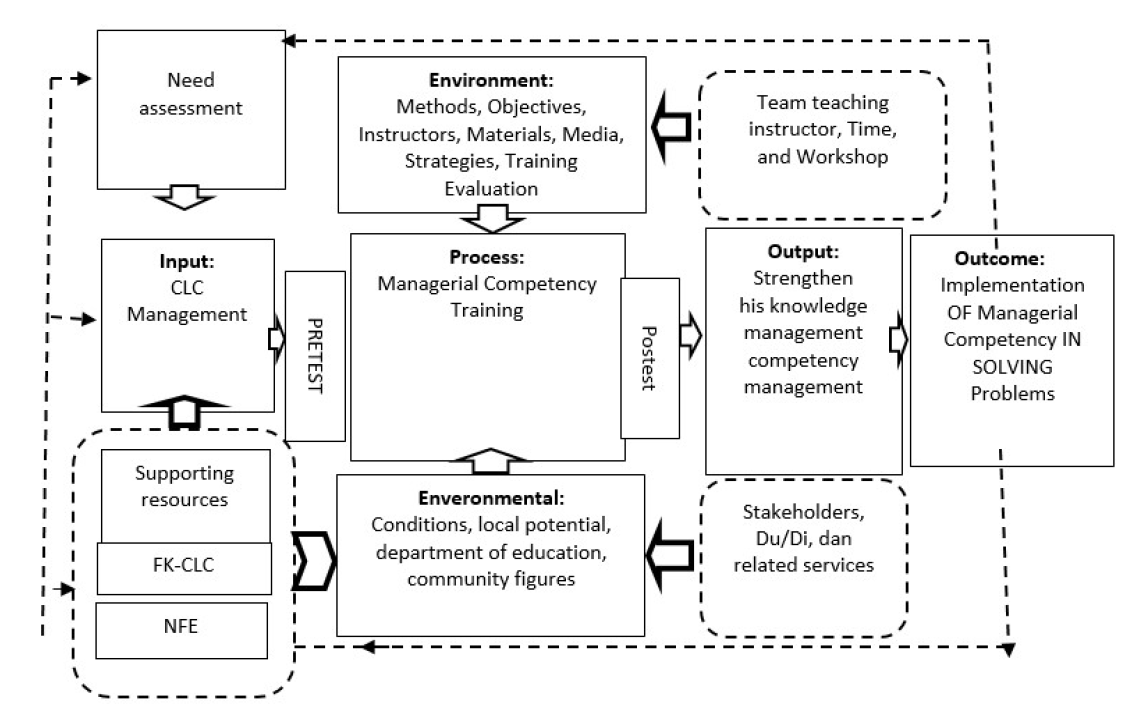
The functional training model to strengthen managerial competence for CLC managers is as follows (Figure 1).
Figure 1: Functional Training Model to Strengthen Managerial Competence
The Effectiveness of the Functional Training Model in Strengthening Managerial Competence for CLC Managers
Effectiveness is the suitability of the plan with the goals that have been set. Drucker views that effectiveness is measured by success in managing an activity and cost efficiency [38]. Dubois and Mayo said there were four effectiveness criteria, namely: Acceptance by training, gain in skill or knowledge, improvement in job performance and better results of operation [39]. In addition, effectiveness is measured by: (a) achieving organizational goals, (b) punctuality in completing work, (c) decreasing cost efficiency, (d) optimal use of human resources, (e) increasing workability and (f) ability as a result of training [40].
The statistical test results on managerial competence on the t-test showed that the t-count value was (-14,218) with a Sig-2 tailed value <0.05 (Table 5). Therefore, the t-count value is outside the Ho acceptance area or the Ha rejection area, meaning a difference. This means a relationship between the functional training model and strengthening managerial competence for CLC managers. However, the results have not been maximized, so it is still necessary to improve the model and implementation of training to get maximum results.
Table 5: Different Test Results (t-test) on the Application of the Functional Training Model in Strengthening Managerial Competence
Paired Samples Test
Pair 1
Pre-test Managerial competency model test - Post-Test Managerial Competence
Paired Differences
t
df
Sig. (2-tailed)
Mean
Std. Deviation
Std. Error Mean
95% Confidence Interval of the Difference
Lower
Upper
-3.840
1.910
0.270
-4.383
-3.297
-14.218
49
0.000
Having managerial skills is a must for CLC managers. The leader is also a manager who must have the ability to move people to stay enthusiastic and motivated to carry out their duties and manage the materials used as products. A manager must establish a strategy to foster creative, innovative and productive behavior [41]. On the other hand, it also determines behaviour to determine strategies to be productive for human resources in CLC. Even managers also integrate strategy and behaviour to achieve confidence in success in every step of their activities [42].
A CLC manager must be able to build entrepreneurial abilities because non-formal education programs must be entrepreneurial-based as an attraction for students to take part in learning. In addition, the target of non-formal education is partly adults, so learning must use adult learning principles [43]. Adults want to learn because they are ready to learn, have a self-concept, can learn and are useful in living their lives and have experiences that can be used as learning materials.
Improvements to the functional training model to strengthen managerial competence must continue to be carried out to achieve optimal results. I hope that the effect achieved can positively impact CLC managers can use it. The nature of knowledge, skills and attitudes will continue to change from time to time, whether because humans have a forgetful nature or because of advances in science and technology, the changes are very rapid. Therefore, the knowledge that has been achieved must be implemented in managing the institution to exist and achieve success.
CONCLUSION
The application of an effective functional training model to strengthen the managerial competence of CLC managers is evident from the results of the t-test that the t-count value (-14,218) with a Sig-2 tailed value <0.05 means that there is a difference. This means that there is a relationship between the functional training model and strengthening the managerial competence of CLC managers, which shows effectiveness. This means that the more intensive the application of functional training, the stronger the managerial competence of CLC managers in East Java. Therefore, the application of functional training models to strengthen managerial competence for CLC managers, including the preparation of materials, including non-formal education, training, adult education and CLC itself, as well as entrepreneurial and managerial competencies; set the time for the presentation of each material, especially on entrepreneurial and managerial competencies; recruitment of training participants, from 38 district cities as many as 50 CLC managers; select and assign instructors as team teaching or teamwork, including professional and experienced; selecting methods and determining learning strategies, such as varied lectures, problem-based learning and workshops; formulating goals, especially to strengthen knowledge of managerial competence; implementation of the training, starting with the opening and material of policies and programs, material for Non-formal Education, including training, adult education and CLC. The implementation of the pretest was continued with the presentation of the main material, namely managerial competence for CLC managers, followed by developing priority learning programs and ending with conducting a posttest, evaluating the implementation of the training and making notes to anticipate further developments.
REFERENCES
Anggusti, M. “Environmental policy in the wake of Indonesia’s fourth industrial revolution.” Environmental Policy and Law, vol. 49, nos. 2–3, 2019, pp. 125–129, https://doi.org/10.3233/EPL-190145.
Rogers, A. “Second-generation non-formal education and the sustainable development goals: operationalizing the SDGs through community learning centres.” International Journal of Lifelong Education, vol. 38, no. 5, 2019, pp. 515–526, https://doi.org/10.1080/02601370.2019.1636893.
Sodirjonov, M.M. “Education as the most important factor of human capital development.” Theoretical and Applied Science, no. 4, 2020, pp. 901–905, https://doi.org/10.15863/TAS.2020.04.84.161.
Coleman, T.E. and Money, A.G. “Student-centred digital game–based learning: a conceptual framework and survey of the state of the art.” Higher Education, vol. 79, no. 3, 2020, pp. 415–457, https://doi.org/10.1007/s10734-019-00417-0.
Gatti, L. et al. “Education for sustainable development through business simulation games: an exploratory study of sustainability gamification and its effects on students’ learning outcomes.” Journal of Cleaner Production, vol. 207, 2019, pp. 667–678, https://doi.org/10.1016/j.jclepro. 2018.09.130.
Mayombe, C. and Lombard, A. “How useful are skills acquired at adult non-formal education and training centres for finding employment in South Africa?” International Review of Education, vol. 61, no. 5, 2015, pp. 611–630, https://doi.org/10.1007/s11159-015-9517-6.
Beaulieu, L. et al. “Behavior analysts’ training and practices regarding cultural diversity: The case for culturally competent care.” Behavior Analysis in Practice, vol. 12, no. 3, 2019, pp. 557–575, https://doi.org/10.1007/s40617-018-00313-6.
Diaz, J. et al. “Expanding evaluator competency research: Exploring competencies for program evaluation using the context of non-formal education.” Evaluation and Program Planning, vol. 79, 2020, article 101790.
Fernandez Orozco, R.S. “Training and workforce re-orientation.” Handbook of Nondestructive Evaluation 4.0, Springer, 2022, pp. 1187–1243, https://doi.org/10.1007/ 978-3-030-73206-6_23.
Dawson, J. and Thomson, R. “The future cybersecurity workforce: going beyond technical skills for successful cyber performance.” Frontiers in Psychology, vol. 9, 2018, article 744, https://doi.org/10.3389/fpsyg.2018.00744.
Büttner, G. “CORINE land cover and land cover change products.” Land Use and Land Cover Mapping in Europe, Springer, 2014, pp. 55–74, https://doi.org/10.3390/ rs12020282.
Bursa, B. and Mailer, M. “Can large cycling events promote active mobility? Expectations versus reality on the example of the 2018 UCI Cycling World Championship.” Research in Transportation Business and Management, vol. 40, 2021, article 100564. https://doi.org/10.1016/ j.rtbm.2020.100564.
Apandi, S. and Wasliman, I. “Community empowerment in establishing entrepreneurial behavior.” International Journal of Educational Research and Social Sciences, vol. 3, no. 1, 2022, pp. 186–200.
Fast, S. “Assessing public participation tools during wind energy siting.” Journal of Environmental Studies and Sciences, vol. 7, no. 3, 2017, pp. 386–393, https://doi.org/10.1007/s13412-016-0419-0.
Muzaqi, M. “Management function on leadership of education at community learning center.” Proceedings of the 2nd International Conference on Education Innovation (ICEI 2018), 2018, pp. 573–576, https://doi.org/10.2991/icei-18.2018.126.
Janné, M. and Fredriksson, A. “Construction logistics in urban development projects–learning from, or repeating, past mistakes of city logistics?” The International Journal of Logistics Management, 2021, https://doi.org/10.1108/IJLM-03-2020-0128.
Engle, R.L. et al.“Identifying barriers to culture change: A qualitative analysis of the obstacles to delivering resident-centered care.” Psychological Services, vol. 14, no. 3, 2017, p. 316, https://doi.org/10.1037/ser0000169.
Wiyono, B.B. et al.“The contribution of individual characteristics of managers to the success of equivalency education programs of the community learning center in Indonesia.” Sustainability, vol. 13, no. 19, 2021, article 11001, https://doi.org/10.3390/su131911001.
Bui, T.D. et al. “Identifying sustainable solid waste management barriers in practice using the fuzzy Delphi method.” Resources, Conservation and Recycling, vol. 154, 2020, article 104625, https://doi.org/10.1016/j.resconrec.2019.104625.
Sururi, M. and Dacholfany, M.I. “Implementation of total quality management in cheap packages education program in community learning activity center (PKBM) Maju Jaya.” International Journal on Integrated Education, vol. 2, no. 5, 2019, pp. 1–9, https://doi.org/10.31149/ijie.v2i5.135.
Uygun, S.V. and Gupta, S.K. “Leadership and accountability for social development: Intellectual leadership and rectors.” International Journal of Indian Culture and Business Management, vol. 21, no. 2, 2020, pp. 171–180.
Aithal, P.S. and Kumar, P.M. “How innovations and best practices can transform higher education institutions: a case study of SIMS.” International Journal of Management (IJM), vol. 6, no. 2, 2015, pp. 83–98.
Gelo, O. et al. “Quantitative and qualitative research: Beyond the debate.” Integrative Psychological and Behavioral Science, vol. 42, no. 3, 2008, pp. 266–290, https://doi.org/10.1007/s12124-008-9078-3.
Gandhi, V.P. et al.“Institutional structure, participation and devolution in water institutions of Eastern India.” Water, vol. 12, no. 2, 2020, article 476, https://doi.org/10.3390/w12020476.
Ibrahim, R. et al. “Organizational culture and development: testing the structural path of factors affecting employees’ work performance in an organization.” Asia Pacific Management Review, vol. 22, no. 2, 2017, pp. 104–111, https://doi.org/10.1016/j.apmrv.2016.10.002.
Spencer, L.M. and Spencer, P.S.M. Competence at work: models for superior performance. John Wiley and Sons, 2008.
Saepudin, A. et al. “Training model to improve manager performance in non-formal education units in improving the quality of education services.” Journal of Nonformal Education, vol. 6, no. 2, 2020, pp. 210–217, https://doi.org/10.15294/jne.v6i2.25890.
Rahmayati, Y. “The empowerment of local community groups as a new innovation in cross-border disaster governance frameworks.” Crossing Borders, Springer, 2018, pp. 175–192, https://doi.org/10.1007/978-981-10-6126-4_10.
Kawai, N. et al. “Effects of functional training after orthognathic surgery on masticatory function in patients with mandibular prognathism.” Journal of Dental Sciences, vol. 15, no. 4, 2020, pp. 419–425, https://doi.org/10.1016/j.jds.2020.01.006.
Purwana, D. and Tunas, B. “Evaluation of leadership programs (PIM) level III for civil servants in the education and training center of the Ministry of Manpower.” International Journal of Human Capital Management, vol. 3, no. 2, 2019, pp. 70–90, https://doi.org/10.21009/IJHCM.03.02.07.
Leithwood, K.A. and Montgomery, D.J. “The role of the elementary school principal in program improvement.” Review of Educational Research, vol. 52, no. 3, 1982, pp. 309–339, https://doi.org/10.3102/00346543052003309.
Syme, S. et al. “Benchmarking Australian enabling programmes: assuring quality, comparability and transparency.” Assessment and Evaluation in Higher Education, vol. 46, no. 4, 2021, pp. 572–585, https://doi.org/10.1080/02602938.2020.1804825.
Retnawati, H. et al. “Teachers’ knowledge about higher-order thinking skills and its learning strategy.” Problems of Education in the 21st Century, vol. 76, no. 2, 2018, p. 215, https://doi.org/10.1080/13664530.2017.1338196.
Veteska, J. et al. “Longitudinal co-teaching projects: scoping review.” Orchestration of Learning Environments in the Digital World, 2022, pp. 35–53, https://doi.org/10.1007/978-3-030-90944-4_3.
Deardorff, M.E. et al. “Teacher knowledge in transition planning: does locale matter?” Rural Special Education Quarterly, vol. 40, no. 3, 2021, pp. 132–142, https://doi.org/10.1177/87568705211027982.
Pbert, L. et al. “Supporting families of children with overweight and obesity to live healthy lifestyles.” Contemporary Clinical Trials, vol. 104, 2021, article 106348, https://doi.org/10.1016/j.cct.2021.106348.
Dubois, E. et al. “Long-term outcomes of patients with ulcerative proctitis.” United European Gastroenterology Journal, vol. 8, no. 8, 2020, pp. 933–941, https://doi.org/10.1177/2050640620941345.
Maryani, Y. et al. “The relationship between work motivation, work discipline and employee performance at the Regional Secretariat of Bogor City.” International Journal of Social and Management Studies, vol. 2, no. 2, 2021, pp. 1–16, https://doi.org/10.5555/ijosmas.v2i2.14.
Asurakkody, T.A. and Shin, S.Y. “Innovative behavior in nursing context: a concept analysis.” Asian Nursing Research, vol. 12, no. 4, 2018, pp. 237–244, https://doi.org/10.1016/j.anr.2018.11.003.
Doz, Y. “Fostering strategic agility: how individual executives and human resource practices contribute.” Human Resource Management Review, vol. 30, no. 1, 2020, article 100693,https://doi.org/10.1016/j. hrmr.2019.100693.
Sichula, N.K. and Genis, G. “Pedagogical practices in non-formal adult literacy classes in Zambia.” International Review of Education, vol. 65, no. 6, 2019, pp. 879–903, https://doi.org/10.1007/s11159-019-09808-y.
Advertisement
Recommended Articles
Research Article
Pedagogic Competencies Provided To Student Teachers through Biology Teacher Education in Universities in Kenya In Light of Classroom Practice
Download PDF
Research Article
Outcome of COVID-19 in Patients with Myasthenia May Not Only Depend on the Immunologic Disease
Josef Finsterer,
...
Ana C Fiorini
Published: 31/10/2020
Download PDF
Research Article
A Study To Understand Research Into The Formation of Educator Profiles for Use by Institutions Whose Primary Mission is The Preparation of Future Educators
Jin Xianzhao,
...
Aminul Islam
Published: 29/07/2024
Download PDF
Research Article
The Effect of a Picture Book on the Pre-Primary School Children's Literacy Skills Development: Implication on the Teacher Education and Child Language Development
Dominion ,
Joanna Ngozi
Published: 15/07/2020
Download PDF
PO Box 101, Nakuru
Kenya.
Email: office@iarconsortium.org
Editorial Office:
J.L Bhavan, Near Radison Blu Hotel,
Jalukbari, Guwahati-India
Artha, I. K. A. J., Yulianingsih, W., Lestari, G. D. & Cahyani, A. D. (2022). Application of the Functional Training Model in Improving the Managerial Competence of CLC Managers in East Java, Indonesia. International Academic Journal of Education & Literature, 3(2), 1-8.
MLA
Artha, I. K. A. J., et al. "Application of the Functional Training Model in Improving the Managerial Competence of CLC Managers in East Java, Indonesia." International Academic Journal of Education & Literature 3.2 (2022): 1-8.
Chicago
Artha, I. K. A. J., Wiwin Yulianingsih, Gunarti D. Lestari and Arini D. Cahyani. "Application of the Functional Training Model in Improving the Managerial Competence of CLC Managers in East Java, Indonesia." International Academic Journal of Education & Literature 3, no. 2 (2022): 1-8.
Harvard
Artha, I. K. A. J., Yulianingsih, W., Lestari, G. D. and Cahyani, A. D. (2022) 'Application of the Functional Training Model in Improving the Managerial Competence of CLC Managers in East Java, Indonesia' International Academic Journal of Education & Literature 3(2), pp. 1-8.
Vancouver
Artha IKAJ, Yulianingsih W, Lestari GD, Cahyani AD. Application of the Functional Training Model in Improving the Managerial Competence of CLC Managers in East Java, Indonesia. International Academic Journal of Education & Literature. 2022 Jul;3(2):1-8.



 Download PDF
 Download XML