Background: Present study aimed to evaluate the Blood eosinophil count and CT score among Patients suffering from Sinonasal Polyposis attending routine ENT OPD in Dr. RPGMC Tanda. Material and Methods: The present study was done as a hospital based cross sectional study in the department of ENT and Head and Neck Surgery, in Dr. RPGMC Kangra at Tanda. It was done in 30 patients of chronic rhinosinusitis with nasal polyposis (CRSwNP) from June 2018 to June 2019 who met the inclusion criteria. Data regarding Blood eosinophil count and CT score was retrieved. Results: There were a total of 30 patients out of which there were 16 males and 14 females. The mean age observed of patients was 42.47±13.68. Among the total, 17 were classified as Eosinophilic Chronic Rhinosinusitis with Nasal Polyposis (ECRSwNP) while 13 were classified as Non-Eosinophilic Chronic Rhinosinusitis with Nasal Polyposis (NECRSwNP). Absolute Blood eosinophil count observed in the patients of NECRSwNP was 181.3±89.61 and in ECRSwNP was 653.81±189.22. Lund Mackay CT score observed was more than double in ECRSwNP (18.18±4.69) as compared to NECRSwNP (8.38±4.05). There was statistically significant association between blood eosinophil count and CT score with p value of <0.0001. Conclusion: Blood eosinophil count and CT score was significantly more in ECRSwNP as compared to NECRSwNP also there was statistically significant association between blood eosinophil count and CT score.
Sinonasal Polyposis is a multifactorial disease, with infectious, non-infectious, inflammatory, anatomic and genetic abnormalities. Most theories consider polyps to be the ultimate manifestation of chronic inflammation [1]. On histopathological examination two types are encountered- one is associated with nasal allergy and numerous eosinophilic infiltration of stroma and other is found in relation to chronic naso-sinusoidal infection termed the inflammatory or granulomatous polyp [2].
Most of the inflammatory types of nasal polyps arise from the middle meatus and clefts of the ethmoid region. These are fluid filled sacs composed of an oedematous tissue with infiltrating cells including mast cells, eosinophils, lymphocytes and plasma cells surrounded by ciliated airway epithelium [3].
Killian was the first to describe in detail and recognize the true origin of Antrochoanal polyp as Antrum of Highmore [4]. Kern and Schenck introduced the concept that the nasal polyp was allergic in origin. The association of allergy and nasal polyps was also emphasized by Myers and Myers [5].
Eosinophils play an important role in pathophysiology of polyp formation in Allergic rhinitis and chronic rhinosinusitis and CRS was at one time considered by many to be a purely eosinophilic disease [6-7]. Eosinophilic damage to the sinonasal mucosa by eosinophilic mediators is believed to be the central pathophysiological mechanism of CRS and the hallmark of disorder and polyp formation [8-9].
In contrasts to United States or Europe, studies showed that in Eastern Asian population about >50% of cases of CRS with Nasal polyposis are non eosinophilic dominant and that in some samples, neutrophils are the dominant cell type characterized by mixed T helper cell type 1 (Th1) or Th17 type inflammation [10-12]. So it has been suggested to classify CRSwNP into “eosinophilic” and “noneosinophilic” according to eosinophil infiltration within Nasal Polyp.
Relatively little research has been published with respect to Blood eosinophil count and CT score among Patients suffering from Sinonasal Polyposis in Himachal Pradesh. Therefore, this study aimed to evaluate the Blood eosinophil count and CT score among Patients suffering from Sinonasal Polyposis attending routine ENT OPD in Dr. RPGMC Tanda.

Objectives of the Study
To evaluate the evaluate the Blood eosinophil count and CT score among Patients suffering from Sinonasal Polyposis attending routine ENT OPD in Dr. RPGMC Tanda.

Source of Data: Patients suffering from Sinonasal Polyposis attending routine ENT OPD in Dr. RPGMC Tanda.

Methods of Collection of Data:
Study Area: Department of ENT, Head and Neck Surgery in Dr. RPGMC Tanda.
Study Population: 30 patients of Chronic Rhinosinusitis with Nasal Polyposis.
Study Design: Hospital based cross sectional study.
Study Period: One Year, i.e. from June 2018 to June 2019.
Inclusion Criteria
Study population included adult population (>18 years) suffering from CRSwNP who were not taking any treatment at least for the last 1-2 weeks, diagnosis being made on basis of history and clinical examination.
Clinically patient having following symptom was included:
Sneezing
Itching in nose, eyes, ears and palate
Nasal discharge
Nasal obstruction
Loss of smell
Facial Pain or pressure
Headache
Nasal polyposis
Patients not on medication for the past 2 week. All patients willing to give consent.
Exclusion Criteria
Patients didn’t will to give consent. Patients aged <18 years. Patients suffering from diseases like.
DNS
Adenoid hypertrophy
History of Sinonasal surgeries (for recurrent nasal polyp)
Patients with cystic fibrosis
Patients suffering from fungal sinusitis
Patients with immunotherapy
Pregnancy
Nasal neoplasm
Patients who have used nasal, inhaled or systemic steroids within 2 months
Chronic bronchitis
Bronchial asthma
Methodology and Type of Data Collected
Present study was conducted in the Department of ENT in Dr RPGMC Tanda, after obtaining clearance and approval from the institutional ethical committee; patients fulfilling the inclusion/exclusion criteria were included in the study after obtaining informed consent. Blood drawn from median cubital vein under all aseptic conditions in labelled EDTA vial for each patient was sent to centralized laboratory of the Institute for complete haemogram test and thus peripheral blood eosinophil count was obtained in all patients prior to surgery.
Blood eosinophil count ≥ 6 % of differential leucocyte count in CRSwNP patient is taken as Eosinophilic CRSwNP while values < 6% are considered as Non eosinophilic CRSwNP.
CT scan Nose and PNS was done in all subjects to know the extent of sinonasal polyp and to rule out other diseases. Preoperative computed tomography (CT) scan scoring of nasal polyposis was done which indicate disease severity. Lund Mackay CT scoring system was used where Maxillary sinus, Anterior ethmoid sinus, Posterior ethmoid sinus, Sphenoid sinus, Frontal sinus and Ostiomeatal complex were evaluated and scores of 0-2 were given to each site; 0 being no opacity, 1 as some opacity and 2 as total opacity on CT scan. CT score for each side (left or right) ranges between 0 and 12 while total score ranges between 0 and 24.
Statistical Analysis
The data entry and analysis was done in Microsoft Office Excel 2007 and Epi Info software. Descriptive analysis was done using frequency, percentages and Mean (+/-S.D.). Association between Absolute Eosinophil count and CT Score between non eosinophilic chronic rhino sinusitis (NECRSwNP) and in eosinophilic chronic rhinosinusitis(ECRSwNP) groups was determined by applying student ‘t’ test. p value <0.05 was taken as statistically significant.
The present study was carried out in the Department of ENT, Head and Neck Surgery at Dr. RPGMC Tanda (Himachal Pradesh) from June 2018 to June 2019. A total of 30 patients were enrolled into the study. The results of which are as below:
There was a total of 30 patients of Chronic Rhinosinusitis with Nasal Polyposis, out of which there were 16 males and 14 females with male to female ratio of 1.14:1. The mean age of all patients was 42.47±13.68 ranging from 21 to 79 years. The mean age of males was 45.88±13.3 and mean age of females was 38.57±13.53 which was less than that of males (Table 1).
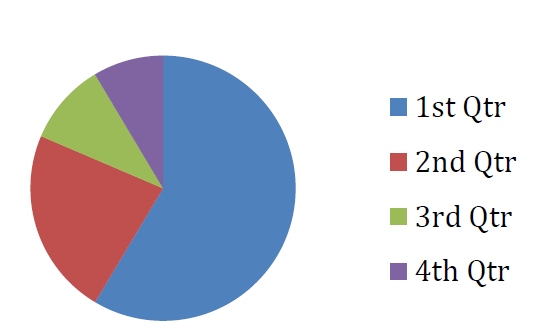
Among the total 30 patients, 17 were classified as Eosinophilic Chronic Rhinosinusitis with Nasal Polyposis (ECRSwNP) while 13 were classified as Non-Eosinophilic Chronic Rhinosinusitis with Nasal Polyposis (NECRSwNP) (Figure 1).
Absolute Eosinophil count observed in non eosinophilic chronic rhino sinusitis (NECRSwNP) was 181.3±89.61 and in eosinophilic chronic rhinosinusitis(ECRSwNP) was 653.81±189.22 . Absolute Eosinophil count in patients of ECRSwNP was significantly more than NECRSwNP statistically.(p<0.05) The CT score observed in ECRSwNP was 18.18±4.69 and it was more than two times the CT score in NECRSwNP, i.e. 8.38±4.05 but the difference in both groups was not statistically significant (Table 2).
In the present study, the association between blood eosinophil count and CT score was statistically significant with p value <0.0001.
Table 1: Age and Gender Wise Distribution of Patients
Gender | Frequency (Number) | Percentage | Mean Age ±SD | Range |
Males | 16 | 53.3 | 45.88±13.3 | 22-79 |
Females | 14 | 46.7 | 38.57±13.53 | 21-65 |
Total | 30 | 100 | 42.47±13.68 | 21-79 |
Table 2: Comparison of Blood Eosinophil Count with Ct Score in Eosinophilic and Non Eosinophilic Crs with Nasal Polyposis
Parameters | NECRSwNP (n = 13) | ECRSwNP (n = 17) | p-value |
Blood Eosinophil Count | 181.3±89.61 | 653.81±189.22 | 0.012 |
CT Score | 8.38±4.05 | 18.18±4.b69 | 0.615 |

Figure 1: Classification of Patients into ECRSwNP and NECRSwNP
The present study was carried out in the Department of ENT, Head and Neck Surgery at Dr. RPGMC Tanda (Himachal Pradesh) including 30 patients of Chronic Rhinosinusitis with Nasal Polyposis which were further classified into “Eosinophilic” and “Non eosinophilic” CRS with Nasal polyposis bases on operational definition.
In our study the mean eosinophil count in NECRSwNP was 181.3±89.61 and in ECRSwNP it was 653.81±189.22 which was similar to study by Sreeparvathi A et al. [13] having eosinophil count as 283.9±167.0 and 964.2±729.3 in NECRSwNP and ECRSwNP respectively while in a study by Honma A et al. [14] blood eosinophil count in NECRSwNP group (402±123.1) was higher and similar in ECRSwNP group (516±69.5).
CT score in our study for ECRSwNP was18.18±4.69 and in NECRSwNP it was 8.38±4.05 similar to studies by Hu Y et al. [15] (18.50 and 13.5), Honma A et al. [14] (18.4±1.34 and 14.9±1.34) in ECRSwNP and NECRSwNP groups respectively while in study by Aslan F et al. [16] the CT score for ECRSwNP group was 12.4±5.5 much lower than our study. We observed that there is significant association between blood eosinophil count and CT score with p value of <0.0001.
The present study concluded that Blood eosinophil count and CT score was significantly more in ECRSwNP as compared to NECRSwNP and there was statistically significant association between blood eosinophil count and CT score.
Kirtsreesakul V. "Update on nasal polyps: etiopathogenesis." J Med Assoc Thai, vol. 88, no. 12, 2005, pp. 1966-72.
Dasgupta A. et al. "Nasal polyps – histopathological spectrum." Ind J Otol Head Neck Surg, vol. 49, no. 1, 1997, pp. 32-7.
Bachert C. et al. "Il-5 synthesis is upregulated in human nasal polyp tissue." J Allergy Clin Immunol, vol. 99, no. 6, 1997, pp. 837-42.
Myatt H.M. and Cabrera M. "Bilateral antrochaanal polyps in a child: a case report." J Laryngol Otol, vol. 110, 1996, pp. 272-4.
Schramm V.L. and Effron M.Z. "Nasal polyps in children." Laryngoscope, vol. 90, 1980, pp. 1488-95.
Gelardi M. et al. "When allergic rhinitis is not only allergic." Am J Rhinol Allergy, vol. 23, 2009, pp. 312-5.
Khalik K.A. et al. "Significance of computerized tomography and nasal cytology in the diagnosis of rhinosinusitis." Egypt J Pediatr Allergy Immunol, vol. 1, no. 2, 2003, pp. 94-101.
Harlin S.L. et al. "A clinical and pathological study of chronic sinusitis: role of the eosinophil." J Allergy Clin Immunol, vol. 81, 1988, pp. 867-75.
Kaliner M.A. et al. "Sinusitis: bench to bedside. Current findings, future directions." Otolaryngol Head Neck Surg, vol. 116, 1997, pp. S1-S20.
Cao P.P. et al. "Distinct immunopathologic characteristics of various types of chronic rhinosinusitis in adult Chinese." J Allergy Clin Immunol, vol. 124, 2009, pp. 478-84.
Kim J.W. et al. "Histological and immunological features of non-eosinophilic nasal polyps." Otolaryngol Head Neck Surg, vol. 137, 2007, pp. 925-30.
Ikeda K. et al. "Subclassification of chronic rhinosinusitis with nasal polyp based on eosinophil and neutrophil." Laryngoscope, vol. 123, 2013, pp. 1-9.
Sreeparvathi A. et al. "Significance of blood eosinophil count in patients with chronic rhinosinusitis with nasal polyposis." J Clin Diagn Res, vol. 11, no. 2, 2017, pp. MC08-MC11.
Honma A. et al. "Reduction of blood eosinophil counts in eosinophilic chronic rhinosinusitis after surgery." J Laryngol Otol, vol. 130, no. 12, 2016, pp. 1147-52.
Hu Y. et al. "Diagnostic significance of blood eosinophil count in eosinophilic chronic rhinosinusitis with nasal polyps in Chinese adults." Laryngoscope, vol. 122, 2012, pp. 498-503.
Aslan F. et al "Could eosinophilia predict clinical severity in nasal polyps." Multidiscip Respir Med, vol. 12, 2017, pp. 21.