Introduction: In India every year nearly 500,000 people die because of non-availability of organs and this number is expected to grow due to scarcity of Organ Donors. In India there is a need of roughly 200,000 kidneys, 50,000 hearts and 50,000 livers for transplantation each year. Aim: To evaluate the effectiveness of planned teaching programme on knowledge and attitude regarding organ donation among college students.Settings and Design: It was a pre-experimental study conducted among college students of Govt. P.G. College, Solan (Himachal Pradesh), in the month of July-August 2021. Material and Methods: A pre-tested, structured questionnaire was used as a study tool. Data was collected from 80 samples that were selected by convenient sampling technique. Tool used to collect the data from the samples was structured knowledge questionnaire. It consists of two Parts-Parts A consists of Demographic variables, part B- Structured knowledge questionnaire and part C- Likert rating scale for attitude scoring. Result: The finding revealed that out of 80 subjects 36.3% students were in the age group 21-22 years, 57.5% were females which were in majority population than males who were 42.5%. 51.3% students resided in urban area.37.5% had previous source of information regarding organ donation from hospital. 97.5% students had your thoughts for organ donation. The mean difference between pre-test and post-test knowledge score was 47.33% which explains the efficiency of planned teaching program on enhancing knowledge score of college students. The mean difference between pre-test and post-test attitude score was18.50% which depicts the effectiveness of planned teaching program on broadening the perception of students on organ donation.
Keywords
Organ Donation
Knowledge
Attitude
Planned Teaching Programme
INTRODUCTION
“After I die if I am buried I will rot. If I am burnt I will become ash but if my body is donated I will live to give life and happiness to many."
Life [1], is a dynamic process. You were born with the ability to change someone’s life. We can’t help everyone but everyone can help someone. Organ Donation [2], is the caring demonstration of giving one’s organs to someone else, who is in critical need of those organs. It is characterized by the WHO as “giving human cells, tissues and organs proposed for human applications”. Giving an organ can prompt sparing as well as improving the quality of life of someone else. Transplants [3], are one of the biggest achievements of modern medicine and can save or greatly enhance the lives of other people. However, they depend completely on donors and their families consenting to organ or tissue donation. One donor can save the life of several people, restore the sight of two others and improve the quality of life of many more and give them another chance to live.
There are Myths Regarding Organ Donation. People Usually Say That
If doctor know that i am register to be an organ or tissue donor, they won’t work as hard to save my life.
If you are rich or a celebrity, you can move up the waiting list more quickly [4]
My religion does not support organ and tissue donation
My family will be charged for donating my organs
Organs can be bought or sold on the black market
Even if I say I want to only donate my corneas, they will take all of my organs
I am not healthy enough to donate because of my lifestyle choices
Enough people become donors so I don’t need to think about it
India’s first organ [5], transplant was conducted in the 1970s (It was a kidney transplant). Currently around 5,000 kidneys, 1000 livers and around 15 hearts are transplanted annually. There is a poor Organ Donation Rate – 0.26 per million in India, compared to some of the better performing countries such as America’s 26, Spain’s 35.3 and Croatia’s 36.5 per Million respectively. There is a need of roughly 200,000 kidneys, 50,000 hearts and 50,000 livers for transplantation each year.
Objectives
To assess the knowledge among college student before and after administration of planned teaching programme on organ donation
To assess the level of attitude among college student before and after administration of planned teaching programme on organ donation
To assess the effectiveness of planned teaching programme on knowledge and attitude regarding organ donation
To find out the association between post-test level of knowledge and attitude regarding organ donation and the selected demographic variables among students
MATERIALS AND METHODS
Research approach: Quantitative approach
Research Design: Pre-experimental
Setting of the study: Govt P.G College, Solan (Himachal Pradesh)
Study Population: B.A final year students
Sample Size: 80
Sampling technique: Convenient sampling techni
Inclusion Criteria
Students who are willing to participate in this study
Students who are present on the day of data collection
Students including males and females
Exclusion Criteria
Students who are not willing to participate in this study
Students who are sick
Student who are absent at the time of study
Description of Tool
Structured questionnaire consists of three sections:
Section A: Socio demographic variables consist of selected socio demographic variables to obtain personal information from the Degree college students
Table 1: Criteria Measure for Level of Knowledge
Score
Percentage
Interpretation
0-10
11-20
21-30
0-33%
34-66%
67-100%
Poor Knowledge
Average Knowledge
Good Knowledge
Section B: Self Structured knowledge questionnaire consist of Structured Questionnaire to assess the level of knowledge regarding blood donation. It deals with the structured knowledge questionnaire to assess the level of knowledge regarding organ donation. It consists of 30 multiple choice questions with three options. In those three options, one option is the correct response and it carries one mark. The other two incorrect responses carry zero mark. The total score is 30 for 30 items. To interpret the level of knowledge, the score is classified (Table 1)
Section C: Attitude Scale: Consist of Likert Scale to assess the level attitude regarding Organ donation. There were 10 statements in the scale out of which 5 are positive statements and 5 are negative statements. It contains three responses such as agree, neutral and disagree. Each correct response carries three marks and each incorrect response carries one mark. The maximum score was 30 and minimum was 10. To interpret the level of attitude the score is classified as:
Negative attitude: 30-53%
Neutral attitude: 54-76%
Positive attitude: 77-100%
RESULTS
The finding revealed that out of 80 subjects 36.3% students were in the age group 21-22 years, 57.5% were females which were in majority population than males who were 42.5%. 51.3% students resided in urban area.37.5% had previous source of information regarding organ donation from hospital. 97.5% students had you thoughts for organ donation.
The analyzed data were organized according to the objectives and presented under the following sections
Section 1: Frequency and percentage wise distribution of sample according to their demographic variable
Section 2: Assess the pre-test knowledge and attitude regarding organ donation among college students
Section 3: Assess posttest knowledge and attitude regarding organ donation among college students
Section 4: Assess effectiveness of planned teaching program on knowledge and attitude regarding organ donation
Section 5: This section consists of:
Significance difference between pretest and posttest knowledge and attitude score regarding organ donation among college students
Association between posttest knowledge and attitude regarding organ donation with selected demographic variables
Section 1
Description of demographic characteristics of degree college students (Table 2).
Table 2: Frequency and Percentage Wise Distribution of Sample According to Their Demographic Variable (N = 80)
Variables
Options
Frequency
%
Age
18-20 year
20
25
36.3
20-22 year
29
23-24 year
26
32.5
Above 24
5
6.3
Gender
Male
34
42.5
Female
46
57.5
Residential area
Urban
41
51.3
Rural
39
48.8
Source of awareness of organ donation
Mass media
23
28.8
Hospital
30
37.5
Family/ Friends / Relatives
22
27.5
Community Health Program
5
6.3
Family monthly income
Rs<2500
26
32.5
Rs 2500-Rs 5000
28
35
Rs 5000-Rs 10,000
21
26.3
Rs>10,000
5
6.3
Have you ever thought for organ donation
Yes
78
2
97.5
2.5
No
Section 2
Assess pre-test knowledge and attitude regarding organ donation among college students (Table 3,4).
Table 3: Frequency and Percentage Wise Distribution of College Students Regarding Organ Donation According to Their Level of Knowledge Score In Pre-Test (N = 80)
Criteria Measure Of Pre-Test Knowledge Score
Score Level
Frequency
Percentage
Poor knowledge (0-9)
28
35
Average knowledge (10-22)
49
61.3
Good knowledge (21-30)
3
3.8
Maximum Score = 30, Minimum Score = 0
Table 4: Frequency and Percentage Wise Distribution of College Students Regarding Organ Donation According to Their Level of Attitude In Pre-Test (N = 80)
Criteria Measure Of Pre-Test Attitude Score
Score Level
Frequency
Percentage
Negative Attitude (10-16)
7
8.8
Neutral Attitude (17-23)
67
83.3
Positive Attitude (21-30)
6
7.5
Maximum Score = 30, Minimum Score = 10
Section 3
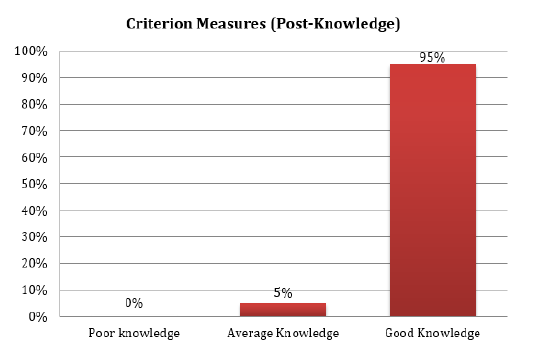
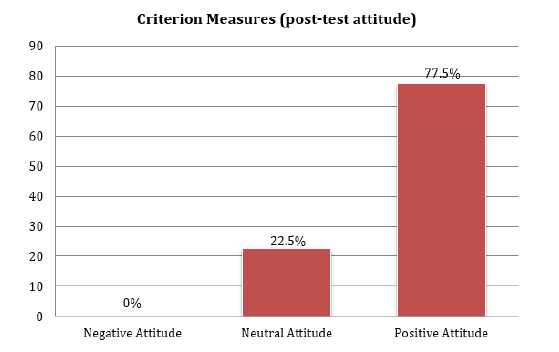
Assess post-test knowledge and attitude regarding organ donation among college students (Figure 1,2).
Figure 1: Percentage Wise Distribution of College Students According to Their Level of Knowledge Score in Post-Test
Figure 2: Percentage Wise Distribution of College Students According to Their Level of Attitude Level in Post-Test
Section 4
To assess the effectiveness of planned teaching programme on knowledge and attitude regarding organ donation.
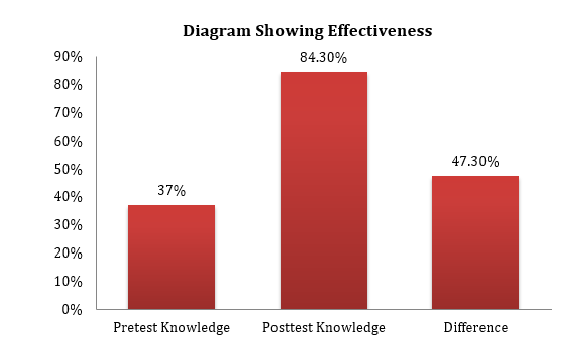
In the pre-test mean knowledge score was 11.09±4.264 which was 37% of total mean knowledge score percentage. In post test mean knowledge score was 25.29±2.264 which was 84.30% of total mean knowledge score percentage. The difference in pre test and post test mean knowledge score 47.30%. Hence it was interpreted that planned teaching program was effective in enhancing the knowledge of degree college student regarding organ donation (Figure 3).
Figure 3: Effectiveness of the Intervention Based on Pretest and Posttest Knowledge
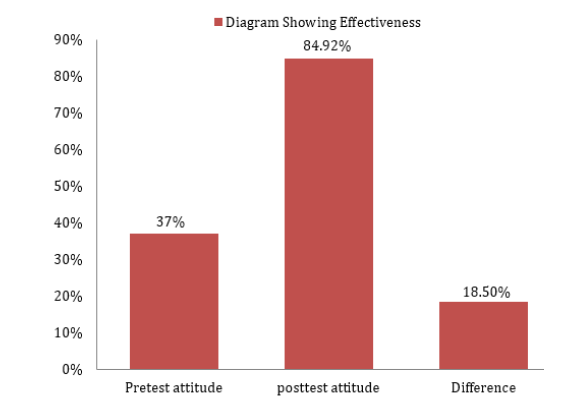
While in the pre-test mean attitude score was 19.63±2.472 which was 65.42% of total mean attitude percentage. In post test attitude was 25.18±2.555 which was 83.92% of total mean attitude percentage. The difference in pre test and post test mean attitude 18.50%. Hence it was interpreted that planned teaching program was effective in improving the attitude of degree college student regarding organ donation (Figure 4).
Figure 4: Attitude Change Analysis Using Pretest and Posttest Scores
Section 5
This section consists of:
Level of significance difference between pretest and posttest knowledge and attitude score regarding organ donation among college students
Level of association between posttest knowledge and attitude regarding organ donation with selected demographic variables
Hypothesis testing was done by using paired ҆ t ҆ test and chi-square test.
H1: There is a significant difference between the pretest and post-test level of knowledge regarding organ donation among college students.
Table 5 depicts Paired ‘t’ test was calculated to analyze the difference between pre-test and post-test knowledge scores, shows highly significant difference between pre-test and post- test.
Table 5: Comparison of Mean, SD, Mean Percentage of Pre-Test and Post-Test Knowledge Score of College Students Regarding Organ Donation Before and After Administration of Planned Teaching Programme N = 80
Knowledge
Mean±S.D.
Mean%
Range
Mean Diff.
Paired T Test
p value
Table Value at 0.05
Pretest knowledge
11.09±4.264
37.00
3-22
14.200
24.94 *Sig
<0.001
1.98
Posttest knowledge
25.29±2.274
84.30
18-29
* Significance Level≤0.05 Max. = 30 Min = 0, df-79
Hence the stated research hypothesis H1 for knowledge is accepted (p<0.05). It is interpreted that the difference observed in the mean score values of pre- test and post-test were true difference and not by chance.
H2: There is a significant difference between the pre-test and post-test level of attitude regarding organ donation among college students
Table 6, depict Paired ‘t’ test was calculated to analyze the difference between pre-test and post-test attitude, shows highly significant difference between pre-test and post-test.
Table 6: Comparison of Mean, SD, Mean Percentage of Pre-Test and Post-Test Attitude of College Students Regarding Organ Donation Before and After Administration of Planned Teaching Programme, Hypothesis Testing Was Done by Using The Paired T-Test N = 80
Knowledge
Mean±S.D.
Range
Mean Diff.
Paired T Test
p value
Table Value at 0.05
Pre-test attitude
19.63±2.472
14-27
5.550
14.909 *Sig
<0.001
1.98
Post-test attitude
25.18±2.555
19-30
* Significance Level≤0.05, Max = 30, Min = 10, df-79
Hence the stated research hypothesis H2 for attitude is accepted (p<0.05). It is interpreted that the difference observed in the mean score values of pre-test and post-test were true difference and not by chance.
H3: There is a significant association between the post-test levels of Knowledge regarding organ donation and their selected Demographic variables among college students
Table 7, This table deals with the findings related to the association between posttest knowledge score and selected socio demographic variables.
Table 7: Association Between the Post-Test Levels of Knowledge Score with Their Selected Demographic Variables (N = 80)
Association of Post-test Knowledge Scores of With Selected Socio-Demographic Variables.
Variables
Opts
Good Knowledge
Average Knowledge
Chi Test
p value
df
Table Value
Result
Age
18-20 year
20
0
7.287
0.063
3
7.815
Not Significant
20-22 year
29
0
23-24 year
23
3
Above 24
4
1
Gender
Male
34
0
3.112
0.078
1
3.841
Not Significant
Female
42
4
Residential area
Urban
38
3
0.951
0.330
1
3.841
Not Significant
Rural
38
1
Source of awareness of organ donation
Mass media
22
1
0.469
0.926
3
7.815
Not Significant
Hospital
28
2
Family/ Friends/Relatives
21
1
Community Health Program
5
0
If any other specify
0
0
Family monthly income
Rs<2500
25
1
5.622
0.132
3
7.815
Not Significant
Rs 2500-Rs 5000
28
0
Rs 5000-Rs 10,000
18
3
Rs>10,000
5
0
Have you ever thought for organ donation
Yes
No
74
2
4
0
0.108
0.742
1
3.841
Not Significant
There was no significant association found between the knowledge regarding organ donation in post-test when compared with selected demographic variables. The calculated chi squared value was 7.287 for age in years, 3.112 for gender, 0.951 for residential area, 0.469 for Source of awareness of organ donation, 5.622 for family monthly income, 0.108 for have you ever thought for organ donation. The calculated chi-square values were less than the table value at the 0.05 level of significance. Hence, hypothesis for above selected variables is rejected.
Table 8, This Table deals with the findings related to the association between posttest attitude and selected socio demographic variables.
Table 8: Association Between the Post-Test Levels of Attitude with Their Selected Demographic Variables
Association of Post-test Attitude Scores of with Selected Socio-Demographic Variables.
Variables
Options
Positive Attitude
Neutral Attitude
Chi Test
p-value
df
Table value
Result
Age
18-20 year
15
5
2.502
0.475
3
7.815
Not Significant
20-22 year
25
4
23-24 year
19
7
Above 24
3
2
Gender
Male
27
7
0.124
0.725
1
3.841
Not Significant
Female
35
11
Residential area
Urban
33
7
1.147
0.284
1
3.841
Not Significant
Rural
29
11
Source of awareness of organ donation
Mass media
19
4
1.235
0.745
3
7.815
Not Significant
Hospital
23
7
Family/ Friends/Relatives
17
5
Community Health Program
3
2
If any other specify
0
0
Family monthly income
Rs<2500
22
4
2.409
0.492
3
7.815
Not Significant
Rs 2500-Rs 5000
19
9
Rs 5000-Rs 10,000
17
4
Rs>10,000
4
1
Have you ever thought for organ donation
Yes
60
18
0.596
0.440
1
3.841
Not Significant
No
2
0
There was no significant association found between the attitudes regarding organ donation in post-test when compared with selected demographic variables. The calculated chi squared value was 2.502 for age in years, 0.124 for gender, 1.147 for residential area, 1.235 for Source of awareness of organ donation, 2.409 for family monthly income, 0.596 for have you ever thought for organ donation. The calculated chi-square values were less than the table value at the 0.05 level of significance. Hence, hypothesis for above selected variables is rejected.
DISCUSSION
In the present study participants were included in the age range of out of 80 subjects 36.3% students were in the age group 21-22 years,57.5% were females which were in majority population than males who were 42.5%.51.3% students resided in urban area.37.5% had previous source of information regarding organ donation from hospital. 97.5% students had your thoughts for organ donation.
Similar result found in the study conducted by Karpagavalli Nageswaran, Jaya Deshmukh “effectiveness of planned teaching programme on knowledge regarding organ donation among the adults”. The Analysis shown that 13% of people had average knowledge in pretest which increased in post-test 57% which falls under the calculated score of good level of knowledge [6].
In the present study posttest attitude score was 62 (77.5%) had a positive attitude and none of the students had a negative attitude. Similar results were discussed in study conducted by Sher Singh Morodiya “to assess the Knowledge and Attitude Regarding Organ Donation and Organ Transplantation”. They concluded that the 141 (94%) of the nursing staff had positive attitude and 9 (6%) of the nursing staff had negative attitude regarding organ donation and organ transplantation [7].
Implications
The findings of the study suggest many implications for the nursing research, nursing practice, nursing administration and nursing education.
Nursing education: The nursing education is framed such a way that it equips the nurses with the essential knowledge, attitude and skills for meeting the needs of the society at primary, secondary and tertiary levels. The nursing curriculum also includes the awareness of organ donation. It helps to increase the donor rate, needs to be take action to avoid legal and ethical issues
Nursing administration: The nursing administration should make necessary initiatives of collaborate with governing bodies to formulate standard policies and to emphasize the policies to the society. And also help in organize the seminars, workshop, conferences regarding organ donation among the nursing staffs and as well as in student nurses
Nursing research: Promote more research on organ donation among the various settings. and disseminates the findings of the research through conferences, seminars and publishing in the journals
CONCLUSION
The findings revealed that pre-test mean knowledge score was 11.09±4.264 which was 37% of total mean knowledge score percentage whereas in posttest mean knowledge score was 25.29±2.274 which was 84.30%. The mean difference between pre-test and post-test knowledge score was 47.33% which explains the efficiency of planned teaching program on enhancing knowledge score of college students. While in pre-test mean attitude, score was 19.63±2.472 which was 65.42%% of total mean attitude sore percentage while on posttest mean attitude score was 25.18±2.555 which was 83.92%. The mean difference between pre-test and post-test attitude score was 18.50% which depicts the effectiveness of planned teaching program on broadening the perception of students on organ donation. Paired‘t’ test was calculated to analyze the difference between pre-test and post-test knowledge and attitude score, shows highly significant difference between pre-test and post-test score. Hence the stated hypothesis is accepted (p<0.05).
REFERENCES
Goswami, M.M. et al. Effectiveness of Planned Teaching Programme on Knowledge Regarding Organ Donation Among Undergraduate Students.
Singh, M. et al. “Methodical learning on organ donation: effect on students’ knowledge and attitude.” Medico Legal Update, vol. 21, no. 1, 9 Jan. 2021, pp. 508–512.
Sharma, P.D. et al. “Effectiveness of planned teaching programme on knowledge and perception about organ donation.” Indian Journal of Public Health Research & Development, vol. 11, no. 5, 1 May 2020.
Brightlin Vigil, V. A Pre-Experimental Study to Assess the Effectiveness of Computer Assisted Teaching on Knowledge and Attitude Regarding Organ Donation among Non-Health Professional Students at Selected College in Thirupur District. Shiv Parvathi Mandradiar Institute of Health Science, College of Nursing, Erode, doctoral dissertation.
Organ India: An Initiative of the Parashar Foundation. ORGAN India, 2009, www.organindia.org.
Polit, D.F. and B.P. Hungler. Nursing Research: Principles and Methods. Michigan.
Kadam, S.D. et al. “Knowledge and attitude of the rural population towards organ donation.”
Recommended Articles
Research Article
Anti-SRP positive myositis following a SARS-CoV-2 vaccination
Josef Finsterer
Published: 30/05/2022
Download PDF
Research Article
Isolation and Molecular Characterization of Bacterial Pathogens Associated with Circumcision-Related Infections in Pediatric Patients
Ghanim A. Abbas
Published: 30/06/2025
Download PDF
Research Article
Quality of the Nursing Care Provided to Patients Diagnosed with Cerebrovascular Accident (CVA)
Qassim Jawell Odah Abed,
Hussein Abdulmohsin Dabis
Published: 30/03/2024
Download PDF
Research Article
Factors affecting pre hospital treatment delay in acute myocardial infarction patients
R. Jyoti Velmurugan,
Deepa Chugh
Published: 30/05/2022
Download PDF
PO Box 101, Nakuru
Kenya.
Email: office@iarconsortium.org
Editorial Office:
J.L Bhavan, Near Radison Blu Hotel,
Jalukbari, Guwahati-India
None, S. & Singh, R. (2022). Study to Assess the Effectiveness of Planned Teaching Program on Organ Donation In Terms Of Knowledge and Attitude among College Students. International Academic Journal of Advanced Practices in Nursing, 3(1), 1-6.
MLA
None, Shubham and Raghunandan Singh. "Study to Assess the Effectiveness of Planned Teaching Program on Organ Donation In Terms Of Knowledge and Attitude among College Students." International Academic Journal of Advanced Practices in Nursing 3.1 (2022): 1-6.
Chicago
None, Shubham and Raghunandan Singh. "Study to Assess the Effectiveness of Planned Teaching Program on Organ Donation In Terms Of Knowledge and Attitude among College Students." International Academic Journal of Advanced Practices in Nursing 3, no. 1 (2022): 1-6.
Harvard
None, S. and Singh, R. (2022) 'Study to Assess the Effectiveness of Planned Teaching Program on Organ Donation In Terms Of Knowledge and Attitude among College Students' International Academic Journal of Advanced Practices in Nursing 3(1), pp. 1-6.
Vancouver
Shubham S, Singh R. Study to Assess the Effectiveness of Planned Teaching Program on Organ Donation In Terms Of Knowledge and Attitude among College Students. International Academic Journal of Advanced Practices in Nursing. 2022 Jan;3(1):1-6.


 Download PDF
 Download XML