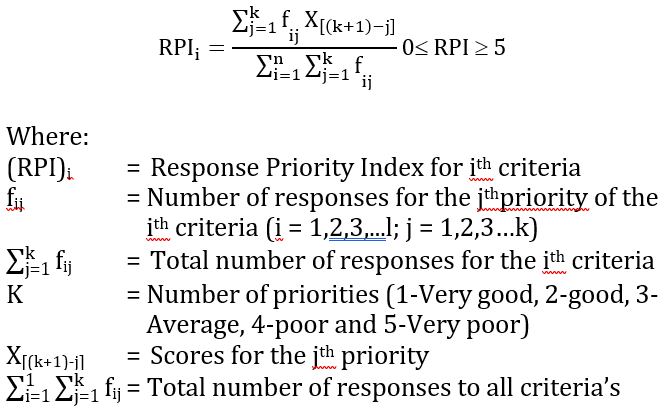
The Ockhi cyclone was one of the unforeseen events which intensely affected all normal lives. It has been believed that the characteristics of seawater would alter due to cyclones. As water is considered essential for survival, it needs to be monitored so that the organism that lives in it would have a carefree life which will result in more productivity. Water samples collected from the Colachel harbor were investigated for Physico-chemical analysis by following standard procedures. The surface temperature of seawater during the analysis was 29°C±2.0 when compared with the before cyclone it was increased by 10.3%(p<0.05), the pH range was 8.6±0.2 but when it was compared with the before cyclone there was 9.3% (p<0.05) increase in pH was noticed, the seawater salinity is 31 ppt±2.0 (p<0.05), the dissolved oxygen is one of the most important qualities of water and it was recorded as 5.4 mg/l-1±0.2 which is found to be higher by 12.9%(p<0.05) when compared with the previous cyclone, the amount of ammonia present in the seawater was 0.022 mg/l-1±0.002 when compared with the before cyclone it was decreased by -22.7%(p>0.05), the concentration of nitrite in the collected seawateris1.69 mg/l-1±0.02 but when compared to before cyclone it was reported to increase by 40.8%(p<0.05), the level of silicate in the study area was0.661mg/l-1±0.002 but when compared with the before cyclonic data, a decrease in trend was noticed by -7.4%(p>0.05).
Keywords
Colachel Seaport
Ockhi Cyclone
Physico-Chemical Parameters
Dissolved Oxygen
INTRODUCTION
Coastal regions are expected to be affected by climate change which is already more sensitive to cyclones, high rainfall, rise in temperature, and sea level [1]. Cyclones are one of the natural calamities which lead to mass destruction of onshore and offshore regions by strong winds, high precipitation, flooding, landslides. [2]. The Ockhi was a violent tropical cyclone that wrecked parts of Sri Lanka and India in 2017 and was the most severe tropical cyclone in the Arabian Sea. It started from an area of low pressure that formed over the South-West Bay of Bengal on November 28, 2017and coordinated into a depression off the South-East coast of Sri Lanka on November 29, causing mass destruction to land and lives in Sri Lanka. Because of the elevated level of environmental humidity and warm oceanic external temperature between Sri Lanka and Kanyakumari, the Ockhi deepened into a cyclonic storm on November 30, 2017 and wreaked havoc while passing by near Kanyakumari causing uprooting trees and massive damage to buildings, power lines and other infrastructure on the land and in water area. As water is a universal solvent and one of the valuable commodities essential for the survival of plant and animal life. It is inevitable to study the changes in the water after a calamitic event because it will indirectly affect human life depend on marine life for food and the economy. Water is the most exploited natural resource used for the purpose to satisfy mortal needs [3]. Water contaminates due to natural disastrous events, weathering of rocks, and artificial causes such as solid waste, effluent, and municipal discharge, leaching of the minerals and soils, mining process, etc. cause detrimental effects to the ecosystem [4]. The composition of life in water depends on the habitat conditions including landscape, water movement and stratification, salinity, oxygen, temperature, and nutrients present in the water [5]. The healthy status of any aquatic system depends on the physical, chemical, and biological qualities which also change with the season and level of pollution [6]. Due to natural and man-made activities, the physical, chemical, and biological quality of water is undergoing unsought changes which is an immense threat to mankind. As the overall environmental health is degrading, the coastal area is also encountering drastic changes due to the absence of environmental protection [7]. The present study aimed to monitor the aftereffect of the Ockhi cyclone on Colachel harbor water quality.
MATERIALS AND METHODS
Description of Study Area
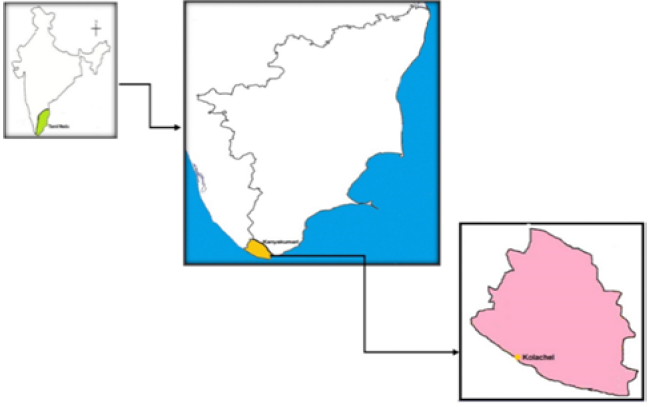
Colachel is a coastal town is located on the western shore side of the Kanyakumari District and falls in the latitudes and longitudes of 8.15°N 77.14°E. The average altitude of the town is 82 feet above Mean Sea Level. The headquarters of the Kanyakumari District, Nagercoil is 20 km away from this town in the North-East Direction (Fig 1). The colachel town is mostly characterized by a smooth terrain with a few areas in the Northwest region. The South of this town is bordered by the Arabian sea. This town is a natural harbor on the Malabar coast, located in the Southern tip of India. Colachel is an ancient port town, called ‘Colachi’ before the State re-organization in 1956 and was part of the Travancore state. After the defeat of the Dutch in 1741, a victory pillar had been set up near the beach in memorial of the victory. The town is connected to all parts of the state by roadways. The nearest railway junction to the town is at Eraniel and the nearest Air Terminal is at Thiruvananthapuram (Capital of Kerala) which is located 65 km away in the Northwest direction. A big fishing harbor is in this town was constructed jointly by Chennai and Tuticorin. The town is tilted gently from the North to South direction and sloping in a radial direction from East and West directions towards the centre portion of the town. The average maximum and minimum temperature around 33°C and 22°C and the average annual rainfall is 1,400 mm. The rainfall is distributed from April to December and falls under hot weather seasonal rainfall, Southwest monsoon, and North-East monsoon seasons (TIDCO). According to the recent census, Colachel had a population of 23,227 with a gender ratio of 974 females for every 1,000 males, much above the national average of 929 and a total of 2,661 were under the age of six, consists of 1,361 males and 1,300 females. 1.96% of the total population accounted under Scheduled Castes and Scheduled Tribes. The average literacy of the town was 80.52%. The town had a total of 5205 households of which a total of 7,902 workers doing works including cultivators, agricultural laborers, in household industries, cottage works, marginal workers, and other works (Census Info India). This town is generally spread with red gravel soil but sandy loam soil in some places. Until 1980, rice was predominantly cultivated in this area which was replaced by coconut and paddy cultivation after that. Tapioca, legumes, cashews, and tamarind are some of the crops that have been cultivated in the area. The people of Colachel do fishing with catamarans and some other non-mechanized boats and deep-sea fishing with mechanized boats. They also specialized in exporting fish, coconut, palm fibre works and production, coir making, and selling general agriculture products. There was a factory in this town for manufacturing fibre-based products (Thumbaabees) but is closed now. And there is a nearby natural mineral extraction factory called Indian Rare Earths Limited, but the local people do not get many employment opportunities from this company (Indian Rare Earth Ltd). The local tourist attraction includes Colachel beach, Basilica of our lady of presentation and prayer hall and there are many catholic churches and chapels (TIDCO).
Sampling and Analysis of Temperature, pH, and Salinity
The water sample was collected from this port at dawn (during March-2021) and kept in an icebox while transferring it to the laboratory. And the samples were analyzed following the standard protocols [8].
The temperature, pH, and salinity [9] of the water were observed on the spot. The surface temperature was measured using a mercury thermometer by dipping it in the sea surface and the measurement was noted. The pH was noted using a digital pH meter and the pH range was noted down. As for the salinity, a hand refractometer (Erma, Japan) was used by placing some drops of seawater on the sensitive analyzing area of the refractometer and press the lid and the measurements were noted down.
Estimation of Oxygen
Winkler's method [9] was used to estimate the dissolved oxygen in the water sample. The seawater was filled in a 250ml biological oxygen demand bottle without air bubbles. After some time, the cap from the BOD bottle was removed and 1.0ml of manganous sulphate reagent was added by using a pipette followed by 1.0ml of alkaline iodide solution. Immediately the bottle was restoppered, shaken thoroughly to mix the contents until the precipitated manganous -manganic hydroxide is completely dispersed and kept the bottle for some time until the precipitate has settled down and left a clear supernatant solution. And then 1.0 ml of concentrated sulphuric acid was added, restoppered the bottle and mix the contents until the precipitate dissolves. After that, 50.0 ml of solution from the BOD bottle was added to a clean conical flask and titrated it with standard 0.01 N thiosulphate solution until a very pale straw color remains. Then, 5 ml of starch indicator was added and subjected for titration. The dissolved oxygen content of the sample was calculated by using the given formula:
The nutrients such as nitrite, silicate, ammonia, phosphate was analyzed by following the standard method of Strickland and Parsons. To measure the amount of nitrite in the water sample, 1.0 ml of sulphanilamide solution was added to 50 ml of sample, mixed and the reagent could react for 2 to 5 minutes. And then 1.0 ml of naphthyl
ethylenediamine solution was added and mixed immediately. After 2 hours, the amount of nitrite was measured with the wavelength of 540 nm. And for the estimation of silicate, 10 ml of molybdate solution was added to a 50-ml measuring cylinder which has 25 ml of the sample seawater then closed with a
RESULTS
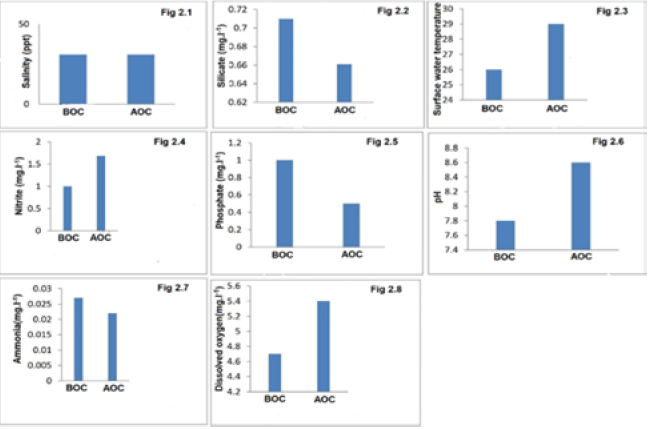
Continuous monitoring of the water quality of the coastal area is essential to assess the ecosystem health without losing its balance due to natural disasters and anthropogenic activities [10] particularly during and after the cyclone. Given this, the present study selected some physicochemical parameters to assess before and after the cyclone in Colachel seaport. The dispersal and richness of aquatic lives and chemical reaction, fish growth, reproduction, and immunity are influenced by temperature as it is one of the important factors in the marine environment. Sudden fluctuation in the temperature leads to fish lethality [4]. The surface temperature of seawater during the analysis (2021) was 29°C±2.0 (Fig 2.3) when compared with the before cyclone it was increased by 10.3% (p<0.05). The pH range was 8.6±0.2 (Fig 2.6) but when it was compared with the before cyclone there was a 9.3% (p<0.05) increase in pH was noticed. The increase in pH indicates that the study area has polluted [7-8] but it is not poisonous to the organisms [11]. It is [12] reported that chemical changes, species composition, and life processes of organisms inhabiting the aquatic environment are linked with the pH of water based on the topography and freshwater inflow, salinity varies in different ecosystems. Less salinity would be seen during the monsoon season might be due to high rainfall and low rate of evaporation. The present study reported that the seawater salinity is 31 ppt ±2.0 (Figure 2.1) (p<0.05).
Dissolved oxygen is one of the most important qualities of water and it was recorded as 5.4 mg/l-1 ±0.2 (Fig 2.8) which is found to be higher by 12.9%(p<0.05) when compared with the previous cyclone. The concentration of dissolved oxygen varies mainly based on the photosynthesis and respiration of flora and fauna present in the water. The amount of ammonia present in the seawater was 0.022 mg/l-1±0.002 (Fig 2.7) when compared with the before cyclone it was decreased by -22.7% (p>0.05). A decrease in the level of ammonia might be due to its utilization as a nitrogen nutrient for the metabolism and growth of phytoplankton. The concentration of nitrite in the collected seawater is 1.69 mg/l-1 ±0.02 (Fig 2.4) but when compared to before cyclone it was reported to increase by 40.8% (p<0.05). The high nitrite content might be due to freshwater inflow through surface runoff resulted from the heavy rainfall during and after the cyclone. The level of silicate in the study area was 0.661 mg/l-1 ±0.002 (Fig 2.2) but when compared with the before cyclonic data, a decrease in trend was noticed by -7.4% (p>0.05). Several factors that influence the concentration of silicate in seawater which includes substantial mixing of seawater with freshwater [13], utilization by phytoplankton especially by diatoms and silico-flagellates [14], clay minerals interact with the actinic compounds [15], surface assimilation of reactive silicate into slung sifted particles [16]. The level of phosphate was reported as 0.5 mg/l-1-1±0.2 in the seawater collected from Colachel seaport but when compared with the previous cyclone, the level is decreased by -50% (p >0.05) (Fig 2.5). Phosphate can be utilized in the form of organic and inorganic by the most aquatic organism for metabolism. Discharge of drainage, effluent, and terrestrial residues cause fluctuation in the range of phosphate. After all these parameters were analyzed, they were compared with the previous reports from 2014 before the Ockhi cyclone [8], and the differences between present and past were found to be statistically insignificant (p> 0.05).
Table 1: Water Quality Parameters in Colachel Seaport before and after Ockhi Cyclone Source: [8]
S.no
Parameters
BOC
AOC
1
Surface temperature
26
29±2 (10.3%)
2
pH
7.8
8.6±0.2 (9.3%)
3
Salinity
31
31±2 (0%)
4
Dissolved oxygen
4.7
5.4±0.2 (12.9%)
5
Ammonia
0.027
0.022±0.002 (-22.7%)
6
Nitrite
1
1.69±0.02 (40.8%)
7
Silicate
0.71
0.661±0.002 (-7.4%)
8
Phosphate
1
±0.2 (-50%)
Value in Parentheses Increase or Decrease Over the Cyclone, AOC-after Ockhi Cyclone/ BOC-before Ockhi Cyclone
CONCLUSION
It is concluded from the present study that, the marked decrease in the level of silicate and phosphate resulted from the mineralization of rocks and due to the ockhi cyclonic effect. However, the decrease in the level of ammonia indicates the migration of fauna from other parts of the sea. The increased level of nitrite is due to the heavy surface runoff resulted from heavy rainfall and thereby increased the dissolved oxygen. Certain measures need to be taken immediately to restore the nutritional level of the water as before and to increase the productivity of the ecosystem in the Colachel seaport.
Conflicts of Interest
“The authors declare no conflict of interest".
Acknowledgments
The authors are gratefully acknowledged the authorities of Alagappa University, Karaikudi
Funding
DST-NRDMS (No. NRDMS/CHRA/S. Ravikumar/Tamilnadu/e- 06/2019 (C),12.07.2019),MHRD-RUSA 2.0 schemes (Letter No: F.24-51/2014-U Policy (TN Multi-Gen), Dept. of Edn. Govt. of India, Dt. 09.10.2018) and UGC STRIDE COMPONENT-I (No.F.2-5/2019 (STRIDE-I), Dt.03.12.2019) New Delhi for financial assistance.
REFERENCE
Ghosh, A. et al. “The Indian Sundarban mangrove forests: history, utilization, conservation strategies and local perception.” Diversity, vol. 7, no. 2, 2015, pp. 149–169.
Wisner, B. At risk: natural hazards, people's vulnerability and disasters. Routledge, 2003.
Suji, V. et al. “Reservoir of Kanyakumari District, Tamil Nadu, and its physico-chemical attributes.” International Journal of Scientific Engineering Research, vol. 9, no. 7, 2018, pp. 452–460.
Patil, P.N. et al. “Physico-chemical parameters for testing of water: a review.” International Journal of Environmental Sciences, vol. 3, no. 3, 2012, pp. 1194–1207.
Zhang, J. et al. “Nationwide river chemistry trends in China: Huanghe and Changjiang.” Ambio, vol. 24, 1995, pp. 275–279.
Efe, S.I. et al. “Seasonal variations of physico-chemical characteristics in water resources quality in western Niger Delta region, Nigeria.” Journal of Applied Sciences and Environmental Management, vol. 9, no. 1, 2005, pp. 191–195.
Sathyakumari, I. et al. “Recent observations on physico-chemical characteristics of the coastal waters of Kanyakumari district, South India.” International Journal of Chemical Sciences, vol. 2, no. 4, 2004, pp. 595–602.
Nithya, P. et al. “Pre-monsoon and monsoon seasonal changes in physico-chemical characteristics of Chinnamuttom and Colachel harbour waters, southeast coast of India.” Indian Journal of Geo-Marine Sciences, vol. 47, no. 1, 2018, pp. 193–199.
Strickland, J.D.H. and T.R. Parsons. A practical handbook of seawater analysis. Fisheries Research Board of Canada, 1972.
Obire, O. et al. “Physico-chemical quality of Elechi Creek in Port Harcourt, Nigeria.” Journal of Applied Science and Environmental Management, vol. 17, 2003, pp. 490–497.
Lloyd, R. “The toxicity of zinc sulphate to rainbow trout.” Annals of Applied Biology, vol. 48, no. 1, 1960, pp. 84–94.
Pandey, B.N. et al. “Biomonitoring of water quality of River Ramjan (at Kishangari) in relation to its impact on biological components.” Freshwater Ecosystem of India, 1999, pp. 310–336.
Purushothaman, A. and V.K. Venugopalan. “Distribution of dissolved silicon in the Vellar estuary.” Indian Journal of Marine Sciences, vol. 1, 1972, pp. 103–105.
Liss, P.S. and C.P. Spencer. “Abiological processes in the removal of silicate from sea water.” Geochimica et Cosmochimica Acta, vol. 34, no. 10, 1970, pp. 1073–1088.
Karande, A.N. “Use of epifaunal communities in pollution monitoring.” Journal of Environmental Biology, vol. 3, 1991, pp. 191–200.
Lal, D. “Transfer of chemical species through estuaries to oceans.” Proceedings of the UNESCO/SCOR Workshop, Melreus, 1978, pp. 166–170.
Recommended Articles
Research Article
Electrochemical Comparative Studies On The Redox Behavior Of Cu(II) And Cr(II) Before And After Interactions With Ciprofloxacin In Solutions
H. M. Naseem Akhtar,
M. Q. Ehsan
Published: 10/08/2021
Download PDF
Research Article
A Rare Case Report of Waugh Syndrome in an Eight Months Old Male
Pielly Hanna,
...
Bassem Abou Merhi
Published: 10/03/2021
Download PDF
Research Article
Study on Prevalence and Etiology of Early Neonatal Deaths in Jasin district, Melaka from 2014-2017
Sujat a Khobragade,
...
Yadneshwar Khobragade
Published: 30/05/2021
Download PDF
Research Article
Clinicopathological Correlation in Cases of Acute Appendicitis: An Overview
Rahul Rai,
...
Tushar
Published: 05/04/2025
Download PDF
PO Box 101, Nakuru
Kenya.
Email: office@iarconsortium.org
Editorial Office:
J.L Bhavan, Near Radison Blu Hotel,
Jalukbari, Guwahati-India
Ravikumar, S., Jeyameenakshi, A. & Ebenezer, K. S. (2022). Assessment of Post Cyclonic Effect of Ockhi Cyclone in Colachel Seaport. International Academic Journal of Applied Bio-Medical Sciences, 3(1), 1-4.
MLA
Ravikumar, Sundaram, Annamalai Jeyameenakshi and King S. Ebenezer. "Assessment of Post Cyclonic Effect of Ockhi Cyclone in Colachel Seaport." International Academic Journal of Applied Bio-Medical Sciences 3.1 (2022): 1-4.
Chicago
Ravikumar, Sundaram, Annamalai Jeyameenakshi and King S. Ebenezer. "Assessment of Post Cyclonic Effect of Ockhi Cyclone in Colachel Seaport." International Academic Journal of Applied Bio-Medical Sciences 3, no. 1 (2022): 1-4.
Harvard
Ravikumar, S., Jeyameenakshi, A. and Ebenezer, K. S. (2022) 'Assessment of Post Cyclonic Effect of Ockhi Cyclone in Colachel Seaport' International Academic Journal of Applied Bio-Medical Sciences 3(1), pp. 1-4.
Vancouver
Ravikumar S, Jeyameenakshi A, Ebenezer KS. Assessment of Post Cyclonic Effect of Ockhi Cyclone in Colachel Seaport. International Academic Journal of Applied Bio-Medical Sciences. 2022 Jan;3(1):1-4.


 Download PDF
 Download XML