Incidence and Etiological Profile of Gram-Positive Bacterial Positivity in Invasive Bloodstream Infections in All Age Groups Using Automated Bactec in Tertiary Care Hospital of North India
Pankaj Katoch
1
,
Surinder Singh
2
1
Senior Resident, Department of Microbiology, IGMC, Shimla, India
2
Asssociate Professor, Department of Pediatrics , IGMC, Shimla, India
Background: Blood culture forms a critical part of the evaluation of patients with suspected sepsis. Hence, the present study is designed to determine the Incidence and etiological profile of gram-positive bacterial positivity in Invasive bloodstream infections in all age groups using automated Bactec systems. Material and Methods: All the blood culture samples received in the Department of Microbiology for culture by Bactec bd fx from July 2015 to June 2016 were included in the study. The blood culture was observed in the Bactec bd fx system for at least 5 days before they are reported as sterile. Results: Among the total 1275 cultures which were positive for bacteria, 344(26.98%) were of Gram-positive bacteria while 931(73.02%) were positive for Gram-negative bacteria. Among the total of 344 culture positive for Gram-positive bacteria, Staphylococcus aureus was isolated in 184(53.49%) cultures, followed by CoNS 143 (41.57%), Other spp 11(3.20%), and Enterococcus spp 6(1.74%).Among the total,100 (29.07%) were belongs to 0-1 year, 20 (5.81%) were 2-5 years, 27 (7.85%) were 6-18years, 84(24.42%) were 19-45 years, 70(20.35%) were 46-65 years, 43(12.50%) were ≥66 years. Among the total,211 (61.34%) were male while 133 (38.66%) were female. Conclusion: Staphylococcus aureus was the commonest organism among GPC isolates. CoNS was the commonest isolated organism in the neonate and adolescent age group. S.aureus was the commonest isolated organism in adults and the geriatric age group. Males were more commonly culture positive as compared to females among Gram-positive isolates.
Keywords
Blood Stream Infections
Culture
Bactec
Gram-Positive Culture
INTRODUCTION
Bacteraemia is the presence of bacteria in the blood which is evidenced by positive blood culture. It occurs when bacteria enter the bloodstream. Invasion of the bloodstream may occur by one of two mechanisms; drainage from the primary source of infection via the lymphatic system to the vascular system or by direct entry into the bloodstream through surgery, through needles, contaminated intravascular devices, catheters, or graft material. Blood cultures have become one of the most important and frequently performed tests in the clinical microbiology laboratory [1-2].
Blood cultures are the current 'Gold Standard' of BSI diagnosis. and are based on the detection of viable microorganisms present in the blood. The accurate identification of blood isolates and the identification of their portal of entry are central to the optimal management of BSI. Blood cultures, which are used to detect viable pathogens, have the advantage of allowing the evaluation of their antimicrobial susceptibility; this characteristic has still not been paralleled by any other technique available to date. This aspect is very important, as several studies have shown that inadequate antimicrobial therapy is an independent risk factor for mortality or microbiological failure for severely ill patients with life-threatening infections. In the most serious cases (Placeholder1) those of sepsis and septic shock the risk of mortality increases by the hour if antimicrobial therapy is delayed [3-5].
Indira Gandhi Medical College(IGMC) Shimla is a tertiary care hospital and patients with above mentioned clinical conditions are treated both in the outpatient department(OPD)and inpatient department (IPD) and usually require blood culture to establish the etiological diagnosis.
Previously no study has been done in IGMC Shimla using an automated Bactec BD FX machine for blood culture. Hence, the present study is designed to determine the incidence and etiological profile of gram-positive bacterial positivity in Invasive bloodstream infections in all age groups using automated Bactec systems.
Aims and Objectives
To determine the incidence and etiological profile of gram-positive bacterial positivity in Invasive bloodstream infections in all age groups using automated Bactec systems.
MATERIALS AND METHODS
Study Design: Prospective study
Study Setting: Department of Microbiology, Indira Gandhi Medical College And Hospital, Shimla
Study Period: one year from July 2015 to June 2016
Inclusion Criteria
All the blood culture samples received in the department of microbiology for blood culture by Bactec bd fx system
Patients willing for study
Blood cultures from all age groups
Exclusion Criteria
Patient not willing to study
Blood cultures showing mixed growth
Methodology
All the blood culture samples received in the department of microbiology for culture by bactec bd fx were included in the study. The blood culture was observed in the bactec bd fx system for at least 5 days before they are reported as sterile.
The sample to be tested is inoculated into the Bactec tm plus aerobic/f culture bottle for adults and bactec tm peds plus/f for children which is then inserted into the Bactec fluorescent series instrument for incubation. Each bottle contains a sensor that can detect an increase in CO2 produced by the growth of microorganisms. The sensor monitors every 10 minutes for an increase in its fluorescence, which is proportional to the amount of co2 present. A positive reading indicates the presumptive presence of viable microorganisms in the bottle. Positive bottle will be sub-cultured on blood agar and Macconkeys agar plates. Following the subculture on solid media from each positive bottle a smear will be prepared for gram staining from that blood culture bottle. The Gram-stained smear will be examined for the presence of microorganisms and presumptive report conveyed to respective departments. The blood agar and Mac Conkey agar plates will be incubated aerobically at 37ºc for 24 to 48 hrs and then observed for the growth of bacteria. All bacterial isolates will be identified using standard biochemical identification methods. Staphylococcus aureus ATCC 25923, Staphylococcus epidermidis ATCC 12228, and Streptococcus pneumonia ATCC 49619 were inoculated along with the test organisms. All the positive isolates were stocked.
Statistical Analysis
The data was analyzed using statistical analysis-epi info7. the data collected was entered into a spreadsheet. The data was checked for any missing values and completed. analysis in terms of demographic variables, positivity in the processed samples, type of species prevalent, was done using statistical software epi-info version 7(7.1.1.0).
RESULTS
In the present study, among the total of 5473 samples suspected of BSI’s received in the department of microbiology, IGMC, Shimla 1441 were positive. Among the total positive culture, 1275(88.48%) were positive for bacteria while 166(11.52%) were positive for Fungi. Among the total 1275 cultures which were positive for bacteria, 344(26.98%) were of Gram-positive bacteria while 931(73.02%) were positive for Gram-negative bacteria.
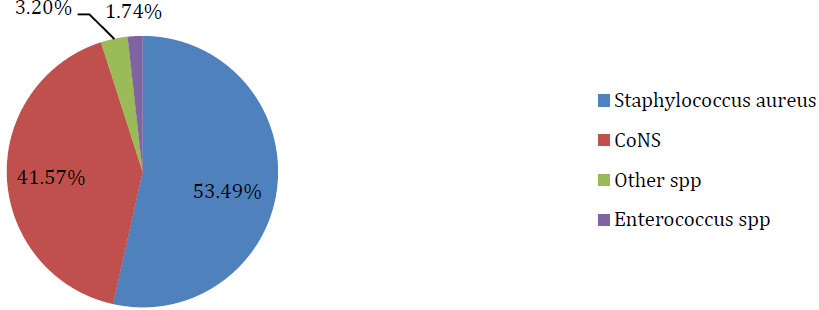
Among the total of 344 culture positive for Gram-positive bacteria, Staphylococcus aureus was isolated in 184(53.49%) cultures, followed by CoNS 143 (41.57%), Other spp 11(3.20%), and Enterococcus spp 6(1.74%).(Table1,Figure 1)
Figure 1: Distribution of Gram-Positive Bacterial Positivity in Culture
Table 1: Distribution of Gram-Positive Bacterial Positivity in Culture
Organisms
Frequency
Percent
Staphylococcus aureus
184
53.49%
CoNS
143
41.57%
Other spp
11
3.20%
Enterococcus spp
6
1.74%
Total
344
100.00%
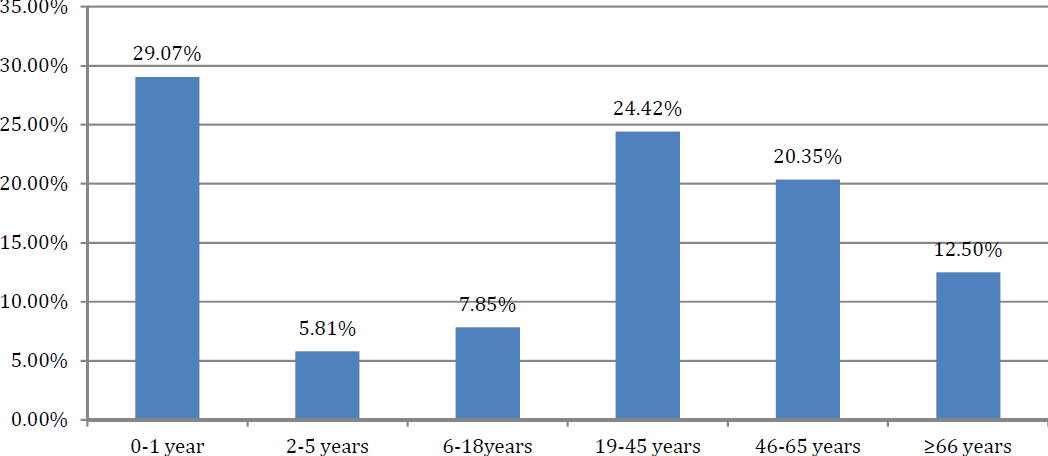
Among the total of 344 culture positive for Gram-positive bacteria, 100 (29.07%) belonged to 0-1 year, 20 (5.81%) were 2-5 years, 27 (7.85%) were 6-18years, 84(24.42%) were 19-45 years, 70(20.35%) were 46-65 years, 43(12.50%) were ≥66 years. (Figure 2)
Figure 2: Age Group Distribution of Gram-Positive Bacterial Positivity in Culture
Among the total of 100 positive cultures in the age group of 0-1 years, 45(45%) positive for staphylococcus,51(51%) were positive for CONS,2(2%) were positive for streptococcus while 2(2%) were positive for enterococcus. Among the total of 20 positive cultures in the age group of 2-5 years, 11(55%) positive for staphylococcus,8(40%) were positive for CONS,1(5%) were positive for streptococcus while none were positive for enterococcus. Among the total of 27 positive cultures in the age group of 6-18 years, 11 (40.74%) positive for staphylococcus,15(55.56%) were positive for CONS,1(3.70%) were positive for streptococcus while none were positive for enterococcus. Among the total of 84 positive cultures in the age group of 19-45 years, 49(58.33%) positive for staphylococcus,30(35.71%) were positive for CONS,4(4.76%) were positive for streptococcus while 1(1.19%) were positive for enterococcus.
Among the total of 70 positive cultures in the age group of 46-65 years, 38(54.29%) positive for staphylococcus 28(40%) were positive for CONS,2(2.86%) were positive for streptococcus while 2(2.86%) were positive for enterococcus. Among the total of 43 positive cultures in the age group of >66 years, 30(69.77%) positive for staphylococcus,11(25.58%) were positive for CONS,1(2.33%) were positive for streptococcus while 1(2.33%) were positive for enterococcus. (Table 2)
Table 2: Bacterial & Age Group Distribution of Gram-Positive Bacterial Positivity In Culture
Age Group
Staphylococcus aureus
CONS
Streptococcus species
Enterococcus
Total
0-1 year
45
51
2
2
100
Percent
45.00%
51.00%
2.00%
2.00%
100.00%
2-5 years
11
8
1
0
20
Percent
55.00%
40.00%
5.00%
0.00%
100.00%
6-18years
11
15
1
0
27
Percent
40.74%
55.56%
3.70%
0.00%
100.00%
19-45 years
49
30
4
1
84
Percent
58.33%
35.71%
4.76%
1.19%
100.00%
46-65 years
38
28
2
2
70
Percent
54.29%
40.00%
2.86%
2.86%
100.00%
≥66
30
11
1
1
43
Percent
69.77%
25.58%
2.33%
2.33%
100.00%
Total
184
143
11
6
344
Percent
53.49%
41.57%
3.20%
1.74%
100.00%
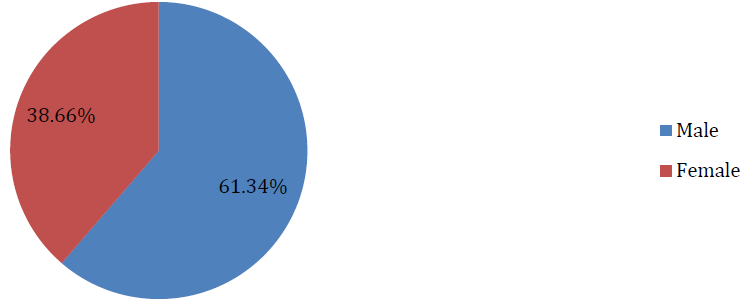
Among the total of 344 cultures positive for gram-positive bacteria, 211 (61.34%) were male while 133 (38.66%) were female. (Figure 3)
Among the total of 211 positive cultures in males, 109(51.66%) positive for staphylococcus, 93(44.08%) were positive for CONS, 4(1.90%) were positive for streptococcus while 5(2.37%) were positive for enterococcus. Among the total of 133 positive cultures in males, 75(56.39%) positive for staphylococcus, 50 (37.59%) were positive for CONS, 7(5.26%) were positive for streptococcus while 1(0.75%) were positive for enterococcus. (Table 3)
Table 3: Bacterial and Gender Wise Distribution of Gram-Positive Bacterial Positivity in Culture
Gender
Staphylococcus aureus
CoNS
Streptococcus spp
Enterococcus
Total
Male
109
93
4
5
211
Percent
51.66%
44.08%
1.90%
2.37%
100.00%
Female
75
50
7
1
133
Percent
56.39%
37.59%
5.26%
0.75%
100.00%
Total
184
143
11
6
344
Percent
53.49%
41.57%
3.20%
1.74%
100.00%
Figure 3: Gender distribution of Gram-Positive Bacterial positivity in culture
DISCUSSION
In the present study, an attempt was made to. determine the incidence and etiological profile of Gram-positive bacterial positivity in Invasive bloodstream infections in all age groups using automated Bactec systems. The results obtained in the present study were analyzed and compared with other studies.
Among the GPC S.aureus, CoNS, Enterococcus spp, Streptococcus haemolyticus, Staphylococcus epidermidis, and Streptococcus pneumonia were isolated. Among the total 1275 cultures which were positive for bacteria, 344(26.98%) were of gram-positive bacteria while 931(73.02%) were positive for gram-negative bacteria.
In the current study, among the total of 344 culture positive for Gram-positive bacteria, Staphylococcus aureus was isolated in 184(53.49%) cultures, followed by CoNS 143 (41.57%), Other spp 11(3.20%), and Enterococcus spp 6(1.74%).
In a study conducted by [6] in Nigeria, they found that Staphylococcus aureus was isolated in 48.7%. Aziz et al. [7] also reported Staphylococcus aureus 25% as the most pathogenic bacteria recovered from the blood samples
CONCLUSION
Staphylococcus aureus was the commonest organism among GPC isolates. CoNS was the commonest isolated organism in the 0-1 yr and 6-18 age group among Gram-positive organisms. S.aureus was the commonest isolated organism in the 2-5 year,19-45,45-65 & >66 years age group among Gram-positive organisms. Male are more commonly culture positive as compared to females. Among Gram-positive isolates, S.aureus was the commonest isolated organism among both males and females.
REFERENCE
Seifert, H. et al. “Bacteriology general.” Topley and Wilsons Microbiology and Microbiological Infections, edited by S.P. Borriello et al., 10th ed., vol. 1, 2010, pp. 509–516.
Young, L.S. “Sepsis syndrome.” Principles and Practice of Infectious Diseases, edited by G.L. Mandell et al., 5th ed., Churchill Livingstone, 2005, pp. 806–819.
Mancini, N. et al. “The era of molecular and other non-culture-based methods in diagnosis of sepsis.” Clinical Microbiology Reviews, vol. 23, no. 1, 2010, pp. 235–251
Peters, R.P. et al. “New developments in the diagnosis of bloodstream infections.” The Lancet Infectious Diseases, vol. 4, no. 12, December 2004, pp. 751–760.
Lamy, B. et al. “How to optimize the use of blood cultures for the diagnosis of bloodstream infections? A state-of-the-art.” Frontiers in Microbiology, vol. 7, 2016, p. 697.
Meremikwu, M.M. “Bacterial isolates from blood cultures of children with suspected septicaemia in Calabar, Nigeria.” BMC Infectious Diseases, vol. 5, 2005, p. 110.
Japoni, A. et al. “Epidemiology and antibacterial susceptibility patterns of bloodstream infections.” Pakistan Journal of Biological Sciences, vol. 11, 2008, pp. 422–427.
Recommended Articles
Research Article
Serum IL-22, miRNA-146a Expression and Total Antioxidant Status as Integrated Biomarkers in Rheumatoid Arthritis
Khalid R. Kareem
Published: 13/08/2026
Download PDF
Research Article
Electrochemical Comparative Studies On The Redox Behavior Of Cu(II) And Cr(II) Before And After Interactions With Ciprofloxacin In Solutions
H. M. Naseem Akhtar,
M. Q. Ehsan
Published: 10/08/2021
Download PDF
Research Article
A Rare Case Report of Waugh Syndrome in an Eight Months Old Male
Pielly Hanna,
...
Bassem Abou Merhi
Published: 10/03/2021
Download PDF
Research Article
Study on Prevalence and Etiology of Early Neonatal Deaths in Jasin district, Melaka from 2014-2017
Sujat a Khobragade,
...
Yadneshwar Khobragade
Published: 30/05/2021
Download PDF
PO Box 101, Nakuru
Kenya.
Email: office@iarconsortium.org
Editorial Office:
J.L Bhavan, Near Radison Blu Hotel,
Jalukbari, Guwahati-India
Katoch, P. & Singh, S. (2021). Incidence and Etiological Profile of Gram-Positive Bacterial Positivity in Invasive Bloodstream Infections in All Age Groups Using Automated Bactec in Tertiary Care Hospital of North India. International Academic Journal of Applied Bio-Medical Sciences, 2(2), 1-5.
MLA
Katoch, Pankaj and Surinder Singh. "Incidence and Etiological Profile of Gram-Positive Bacterial Positivity in Invasive Bloodstream Infections in All Age Groups Using Automated Bactec in Tertiary Care Hospital of North India." International Academic Journal of Applied Bio-Medical Sciences 2.2 (2021): 1-5.
Chicago
Katoch, Pankaj and Surinder Singh. "Incidence and Etiological Profile of Gram-Positive Bacterial Positivity in Invasive Bloodstream Infections in All Age Groups Using Automated Bactec in Tertiary Care Hospital of North India." International Academic Journal of Applied Bio-Medical Sciences 2, no. 2 (2021): 1-5.
Harvard
Katoch, P. and Singh, S. (2021) 'Incidence and Etiological Profile of Gram-Positive Bacterial Positivity in Invasive Bloodstream Infections in All Age Groups Using Automated Bactec in Tertiary Care Hospital of North India' International Academic Journal of Applied Bio-Medical Sciences 2(2), pp. 1-5.
Vancouver
Katoch P, Singh S. Incidence and Etiological Profile of Gram-Positive Bacterial Positivity in Invasive Bloodstream Infections in All Age Groups Using Automated Bactec in Tertiary Care Hospital of North India. International Academic Journal of Applied Bio-Medical Sciences. 2021 Jul;2(2):1-5.


 Download PDF
 Download XML