In the vast kingdom of antibiotics, Ciprofloxacin is one of the common family, having significant absorption activity. The principal target of this research has been settled to monitor the redox behavior of Cu (II) and Cr (III) in potassium chloride before and after interaction with ciprofloxacin involving three prominent electrochemical techniques such as cyclic voltammetry, chronoamperomety and chronocoulometry. To perform this work, Cu (II) and ciprofloxacin equimolar solution was mixed to a 1:1 ratio but Cr (III) and Ciprofloxacin solution to a 1:2 ratio. Then after interaction those were analyzed in solution. The observations for Cu (II) as well as Cu (II)-ciprofloxacin interaction systems showed that the redox couple involved in both the cases were quasi-reversible. But the Cr (III) system, before and after interaction, showed reversible and irreversible behaviour respectively. After interaction with ciprofloxacin, the chronoamperometric study showed that the rate of electrolysis for both the metal systems were decreased and the charges at τ values are also decreased in all the cases which were assigned from the chronocoulometry. These facts together indicated towards successful interaction between the metals and ciprofloxacin. Again after interaction, adsorption of reactant or products occur on the electrode, which was found from the plots Q vs t1/2 and -Qr vs θ. To conclude, it can be said that the significant activities of the metal-ciprofloxacin interaction may be employed as a basis in the field of medicine.
Keywords
Metals
Ciprofloxacin
Redox
Voltammetry
Chronoamperometry
Chronocoulometry
Pharmaceutical Applications
INTRODUCTION
From a very primitive period, human depends on plants for medicines to cure diseases. But the natural resources are not plenty and ultimately cannot handle the overall need. Recently, there is an increase in the demand of various metal-antibiotic complexes not only in the health sector but also in pharmaceutical arena as the universe is facing problem with drug-resistant bacteria. Hence it is the need of the contemporary age to find an alternative drug kingdom which is cost effective as well as instantly effective.
Ciprofloxacin is a second-generation synthetic antibiotic and belongs to the fluoroquinolone drug class [1-2]. It functions on the bacteria by interfering with the enzymes. This interference also stops protein as well as DNA synthesis. A good number of infections such as infections of respiratory tract, bones, urinary tract, joints, cellulitis, chancroid etc are treated by this specific kind of anti-microbial [3].
Copper is required in dietary amounts of 1-2 mg daily by the body for adults and is responsible for the function of certain critical enzymes. The content of chromium in common foods is generally low. The interaction between ciprofloxacin and the above metal ions was taken into consideration in the current study as all are extremely important.
MATERIALS AND METHODS
Reagents and solutions
Various reagents and chemicals such as ciprofloxacin hydrochloride, copper chloride, chromium chloride and potassium chloride were of reagent grade. Deionized water was used for cleaning as well as other purposes and for purging 99.997% (BOC, Bangladesh) nitrogen was employed.
Equipment
An Epsilon electrochemical work station of Bioanalytical Systems, Inc. (USA) was employed for the current-voltage measurements. In this work a voltammetric cell made of
borosilicate glass in a C3 cell stand (three electrode electrolysis system) was used and Glassy carbon as well as Platinum solid disk electrodes were used as working electrode, Ag/AgCl (satd. KCl) as reference electrode as well as platinum wire as counter electrode. An AGE (VELP SCIENTIFICA) magnetic stirrer was used for the agitation of the solution.
Preparation of Metal-Antibiotics Stock Solutions for Interactions
Solutions of equimolar Cu (II) and Ciprofloxacin were prepared in 0.1 M KCl solution and mixed to a ratio of 1:1, were stirred well and settled for some time for successful interaction. Then the solution was taken for the study. In the same way solutions of Cr (III) and Ciprofloxacin of same molar concentrations were prepared in saturated potassium chloride solution and mixed to a 1:2 ratio and the solution was studied after interaction.
RESULTS AND DISCUSSION
Cyclic voltammetry is one of the most extensively used electroanalytical technique specially suited for the investigation of electrochemical reactions. Generally, it is the gateway of electrochemical studies. It particularly provides a convenient evaluation of the effect of media upon the redox process.
In the current study, the individual redox behaviours of Cu (II) and Ciprofloxacin were observed using 0.1 M Potassium Chloride (KCl) as supporting electrolyte at Glassy Carbon Electrode and then those of Cr (III) and also Ciprofloxacin in saturated Potassium Chloride (KCl) at Platinum electrode. Afterwards, interactions between the metals and ciprofloxacin were also studied. Again Cu (II) and ciprofloxacin interaction was to a ratio of 1:1 and that of Cr (III) and ciprofloxacin was 1:2.
A variety of potential windows were used for the present study, because the potential range is dependent on various aspects such as supporting electrolyte, electrode material, solvent, acidity of the solution and so on. The potential windows for Ciprofloxacin at Glassy carbon electrode (GCE) and Platinum (Pt) electrode were from -2.300 V to 2.000 V, and -0.900 V to 1.400 V respectively. Again for Cu (II) at GCE and Cr (III) at Pt Electrode were from -0.850 V to 1.180 V and 0.250 V to 1.700 V respectively. Eventually the potential windows are also altered for the interactions. It was from -1.800 V to 2.000 V for Cu (II)-Cirpofloxacin interaction and from -1.000 V to 1.700 V for Cr (III)-Ciprofloxacin. All the systems were also examined at different scan rates and those were 0.050 Vs-1, 0.100 Vs-1, 0.150 Vs-1, 0.200 Vs-1, 0.250 Vs-1 and 0.300 Vs-1.
The present study also included chronoamperometry as well as chronocoulometry. Adsorption criteria and the rate of electrolysis are the prime concerns which can be characterized by the above two techniques. For performing those techniques, at first CV is done. With reference to the pair of peaks found in CV, the chronoamperometry is accomplished and its integrated form, that is the chronocoulometric response is also obtained from it.
Two sets of chronoamperometric experiments were done for Cu (II) as it shows two pair of peaks in its cyclic voltammetric study whereas for Cr (III) there is only one. Again after interactions for Cu (II) and Cr (III) the number of sets of experiments were two and one respectively.
Cyclic Voltammetry
A comparison of the redox behavior of Cu (II) before and after interaction with ciprofloxacin: Using Cyclic voltammetric technique, the redox behaviour of Cu (II) was studied before and after interaction with Ciprofloxacin. This study was done using glassy carbon electrode, at different scan rates at room temperature and in 0.1M potassium chloride.
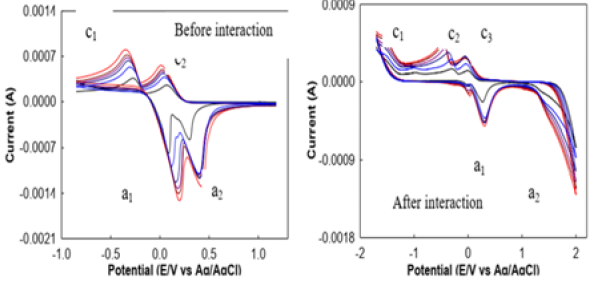
The CV of Cu (II) before interaction shows two cathodic (c1 and c2) and two anodic signals (a1 and a2), which are altered in the cathodic region after interaction. Then the system shows three signals (c1 c2 and c3) in cathodic region and two anodic (a1 and a2) signals. The first cathodic peak may be due to the ligand (Ciprofloxacin) itself and the second as well as the third cathodic peaks are originated from the parent metal (Cu (II)) as in Figure 1.
Figure 1: Cyclic Voltammograms of Cu (II) In 0.1 M Kcl Solution at Different Rates before and After Interaction with Ciprofloxacin
After interaction, the c2 and c3 move towards less negative and less positive potential. But both the anodic peaks towards less positive potentials. All these implies that the Cu (II)-ciprofloxacin interaction is successful [4-9].
Both before and after interaction and with the increasing scan rate (Figure 1) the signals in the cathodic and the anodic regions move towards more negative potential and more positive potentials respectively for the first pair of peaks. Moreover, almost all the signals become broader which has been assigned to slower charge propagation, may due to difference in permeability as well as salvation.
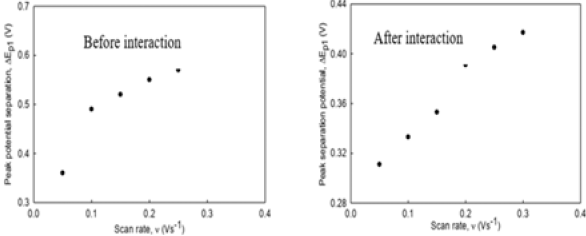
The finding that with increasing scan rate, after interaction, the peak separation potential (∆Ep1) increases; similar to those before interaction due to iR drop, which is as a result of limitation owing to charge transfer kinetics (Figure 2).
Figure 2: Variation of Peak Potential Separation with Scan Rate for Cu (II) In 0.1 M Kcl Solution Before And After Interaction With Ciprofloxacin (First Pair Of Peaks)
Again both before and after interaction,
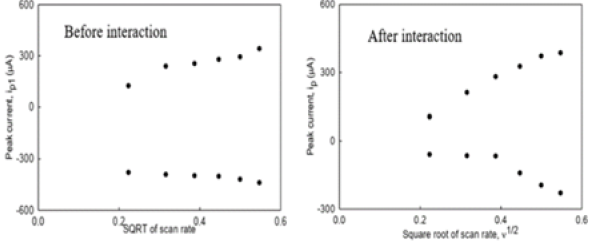
Peak currents and n1/2 are proportional for the forward scan signifying the system to be diffusion controlled [10-11]
Randle-Sevseik plot says that adsorptive controlled phenomenon is present (Figure. 3)
Figure 3: Variation of Peak Current against Square Root of Scan Rate for Cu (II) In 0.1M Kcl Solution before and After Interaction with Ciprofloxacin (First Pair of Peaks)
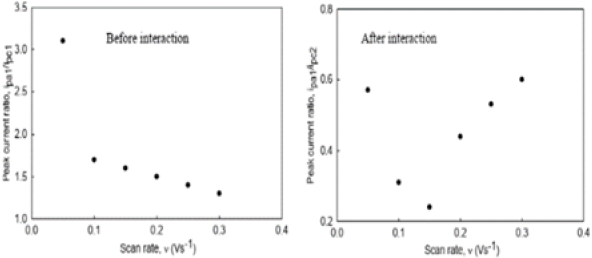
After interaction, the peak current ratio for the first pair is very much lower than unity for the first pair of peaks, which was more than unity before interaction and also indicating almost irreversible behavior after interaction.
With increasing scan rate, the peak current ratio decreases before interaction and after interaction does not show any regular character, implying exceptional character from reversible system (Figure 4).
Figure 4: Variation of Peak Current Ratio against Scan Rate for Cu (II) In 0.1 M Kcl Solution before and After Interaction with Ciprofloxacin (First Pair of Peaks)
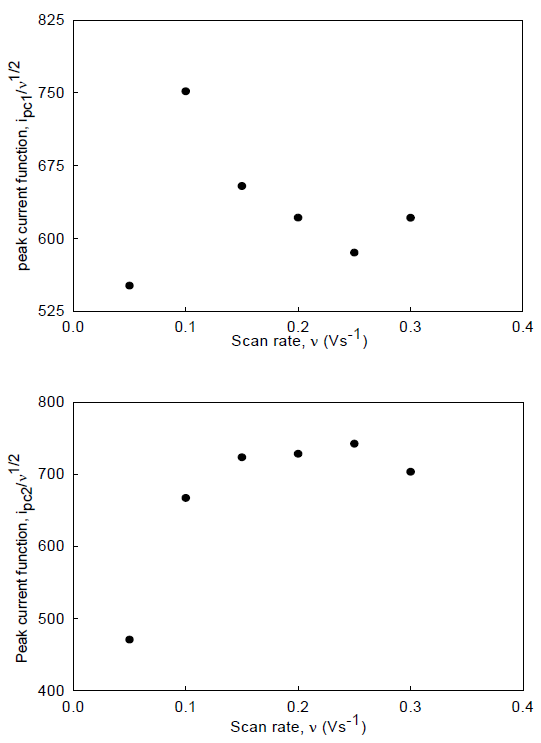
Again peak current function (ip/ν1/2) before and after interaction, shows irregular character (Figure 5) and thus not providing any explicit assumption about the electrochemical process.
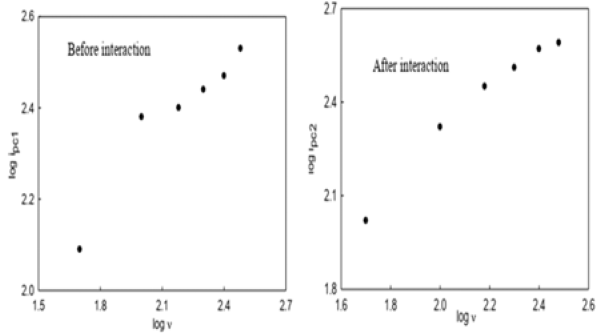
During the process, adsorption occurs on the electrode before and after interaction which is proved by the plot of log ip against log ν having a linear relationship and slope more than unity (Figure, 6).
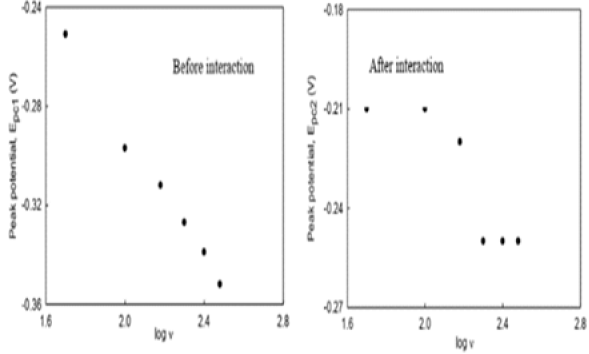
Again as the slopes of Tafel plot of both before and after interaction are not zero, the electrochemical process may be quasi-reversible (Figure 7).
All the above remarks end up to a point that the redox system both before and after interaction between Cu (II) and ciprofloxacin are quasi-reversible and also they are diffusion as well as adsorptive controlled.
A comparison of the redox behavior of Cr (III) before and after interaction with ciprofloxacin
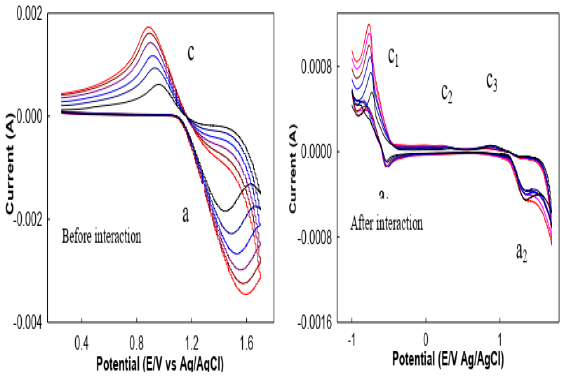
The redox attitude of Cr (III) before and after interaction with ciprofloxacin at varying scan rate in saturated potassium chloride and at Platinum electrode was studied using same technique and environment as that of the Cu (II) system (Figure.8).
The CV of Cr (III) shows one pair of peaks (c and a) before interaction but after interaction three cathodic (c1 c2 and c3) and two anodic (a1 and a2) peaks appeared. The first pair of peaks, after interaction, may be originated from ligand (ciprofloxacin) part and the third cathodic peak (c3) and the second anodic peak (a2) may be due to the Cr (III) itself. Again after interaction, peaks c3 and a2 shifts towards less positive potential. All these happenings give bold proclamation about successful interaction between the metal and the ligand.
With the increasing scan rate the cathodic signal shifts towards less positive potential and the anodic towards more positive one before interaction. But after interaction, all the cathodic peaks and the second anodic peak move in the way of same direction (i.e. c1 to more negative potential, c3 and a2 towards less positive potentials) except the first anodic peak, which shifts on the way to more positive potential. Moreover, almost all the signals become broader with the increase in scan rate which has been assigned to slower charge propagation, may due to difference in permeability as well as salvation.
After interaction, the potential separation for the peak decreases and for all the signals currents increases with increasing scan rates as well as the Randle-Sevseik plot shows that the peak currents increases linearly for all the peaks along with the square root of scan rate. These results say that after interaction the system no longer indicates the limitation due to charge transfer kinetics and the electrode process may be diffusion controlled.
Further findings after interaction are
Higher is the peak current ratio to a large extent than unity
A decrease in peak current function (ip/ν1/2) with scan rate increase. Both the characters are very much dissimilar with the system before interaction
These two facts give the conclusion
It shows almost unusual character from the reversible behavior
No explicit assumption about the Electrochemical process
Figure 5: Variation of Peak Current Function against Scan Rate for Cu (II) In 0.1M Kcl Solution before and After Interaction with Ciprofloxacin (First Pair of Peaks)
Figure 6: Plot of Log Ip Against Log Ν For Cu (II) In 0.1 M Kcl Solution Before And After Interaction With Ciprofloxacin (First Pair of Peaks)
Figure 7: Variation of Peak Potential against Log Ν for Cu (II) In 0.1 M Kcl Solution before and After Interaction with Ciprofloxacin (First Pair of Peaks)
Again after interaction, the graph of log ip against log ν shows a direct relationship having slope less than unity and slope of Tafel plot (peak potential against log ν) is not zero. The former fact indicates that the process is accompanied by diffusion, while the later signifies that the electrochemical process is irreversible.
Taking all the above points into account it can be said that the electrochemical process related with Cr (III) before interaction is about to reversible and after interaction is irreversible. Moreover, the systems both before and after interaction are both diffusion as well as adsorptive controlled.
Chronoamperometric and Chronocoulometric Study
The other two techniques named Chronoamperometry (CA) and chronocoulometry (CC) were employed to observe all the above metals before and after interaction with ciprofloxacin.
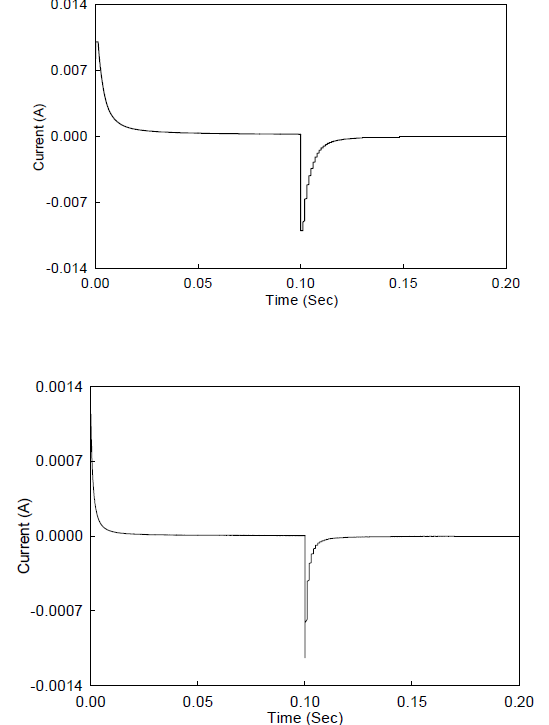
For Cu (II) before interaction the CA study was done corresponding to two pairs of peaks found in CV. Similar is the case for the after interaction phase. There was a decrease in the spike heights (Figure 8-9) after interaction with ciprofloxacin. It indicates towards a decrease in the rate of electrolysis [4] as the rate of electrolysisis proportional to the spike height. It also provides an explicit conclusion towards successful interaction between metal and ligand. Similar type of observations are found for Cr (III) system as well.
After interaction, the charges at τ are decreased for both the systems (Table 1) which is also an indication for the metal-ligand interaction in solution. This aspect was confirmed from the CC study.
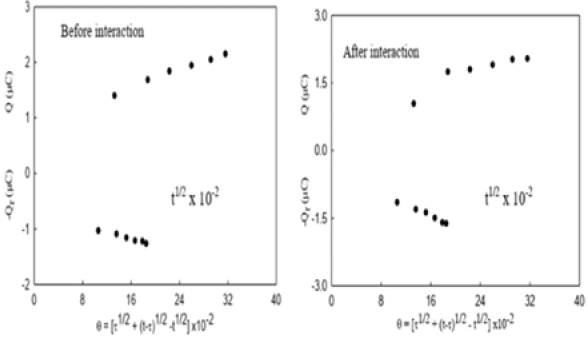
Moreover, CC shows that adsorption of reactant or products occur on the electrode [12]. It was found from the same graph, where Q value obtained from time less than τ is plotted versus t1/2 and also -Qr is plotted versus θ= [τ1/2 + (t- τ)1/2 – t1/2] for all the systems and there are two straight lines not intersecting each other at Q=0 axis (Figure. 10) as well as not having equal slopes [13-14] as well.
Figure 8: Cyclic Voltammograms of Cr (III) In Saturated Kcl Solution before and After Interaction with Ciprofloxacin at Different Scan Rates
Figure 9: Current Responses for Cu (II) In 0.1 M Kcl Solution before and After Interaction with Ciprofloxacin (First Pair of Peaks)
Table 1: Charge at τ Derived from CC Study of Different Systems for Both Pair of Peaks
Systems
Charge at τ (μC)
Before interaction
After interaction
First pair
Second pair
First pair
Second pair
Cu(II)
2.482
2.251
2.007
1.726
Cr(III)
2.459
1.497
Figure 10: Plots of Q vs t1/2 and –Qr vs θ for Cu (II) in 0.1M KCl Solution Before And After Inaction With Ciprofloxacin (First Pair of Peaks).
CONCLUSION
Successful interaction between ciprofloxacin and the metals (Cu (II) and Cr (III)) is the basic observation from this cyclic voltammetric study. Another prime issue is that both before and after interaction Cu (II) system exhibits quasi-reversible process. But the Cr (III) system is reversible before interaction and becomes irreversible after interaction with ciprofloxacin. Moreover, diffusion as well as adsorptive controlled behavior are shown by all the systems. Chronoamperometric as well as chronocoulometric studies show similar characteristics for both the interactions. The former indicates towards a decrease in the rate of electrolysis after interaction, while the later shows a decrease in the charge at τ after interaction. Both of these facts together indicate toward a successful interaction. Again the observation of adsorption of reactant or products on the electrode after interaction is also confirmed from the plots Q vs t1/2 and -Qr vs θ.
REFERENCE
Nelson, J.M. et al. “Fluoroquinolone-resistant Campylobacter species and the withdrawal of fluoroquinolones from use in poultry: A public health success story.” Clinical Infectious Diseases, vol. 44, no. 7, 2007, pp. 977–980.
Kawahara, S. “Chemotherapeutic agents under study.” Nihon Rinsho: Japanese Journal of Clinical Medicine, vol. 56, no. 12, 1998, pp. 3096–3099.
Enzmann, H. et al. “Damage to mitochondrial DNA induced by the quinolone Bay y 3118 in embryonic turkey liver.” Mutation Research: Fundamental and Molecular Mechanisms of Mutagenesis, vol. 425, no. 2, 1999, pp. 213–224.
Akhtar, H.M.N., Shaikh, A.A., and Ehsan, M.Q. “Cyclic voltammetric study of the redox behavior of Fe(II)/Fe(III) systems forming during the oxidation of Fe(II) complexes with saccharin and with saccharin and 1,10-phenanthroline.” Russian Journal of Electrochemistry, vol. 44, no. 12, 2008, pp. 1403–1408.
Sabbir, M.H., et al. “Cyclic voltammetric study on the interaction of ranitidine with iron and copper at glassy carbon, platinum and gold electrodes.” Dhaka University Journal of Science, vol. 57, no. 2, 2009, pp. 193–198.
Laiju, Monira, et al. “Cyclic voltammetric study on the effect of the introduction of secondary ligands on the redox behaviour of the copper-saccharin complex.” Journal of the National Science Foundation of Sri Lanka, vol. 38, no. 2, 2010, pp. 91–99.
Rahman, M.S. et al. “Studies on redox behaviour of Mn(II)/Mn(IV) system and interaction of Mn(II) with aspartic acid.” Journal of the Saudi Chemical Society, vol. 11, 2007, pp. 277–286.
Islam, G.J. et al. “Investigations on the redox behaviour of manganese in manganese (II)–saccharin and manganese(II)–saccharin–1,10-phenanthroline complexes.” Journal of the Saudi Chemical Society, vol. 13, no. 2, 2009, pp. 177–183.
Akhtar, H.M.N. et al. “Cyclic voltammetric study of redox behaviour of copper in copper-N-hydroxy-phthalimide complex.” Dhaka University Journal of Science, vol. 57, no. 1, 2009, pp. 75–79.
Gosser, D.K. Cyclic Voltammetry: Simulation and Analysis of Reaction Mechanisms. vol. 43, VCH, 1993.
Mascus, M. et al. “Electrocatalytic reduction of nitric oxide at electrodes modified with electropolymerized films of [Cr(v-tpy)₂]³⁺ and their application to cellular NO determinations.” Analytical Chemistry, vol. 68, no. 18, 1996, pp. 3128–3134.
Barclay, D.J. and F.C. Anson. “The combined adsorption of cadmium(II) and thiosulfate on mercury.” Journal of The Electrochemical Society, vol. 116, no. 4, 1969, p. 438.
Bard, A.J. and L.R. Faulkner. Electrochemical Methods: Fundamentals and Applications. John Wiley & Sons, 1986.
Kambara, T. “Polarographic diffusion current observed with square wave voltage: II. Basic theory for a reversible electrode.” Bulletin of the Chemical Society of Japan, vol. 27, no. 8, 1954, pp. 527–529.
Akhtar, H.M.N., and M.Q. Ehsan. “Electrochemical studies on the interactions of iron(II) with some essential amino acids.” Journal of King Saud University: Science, vol. 32, no. 2, 2020, pp. 1319–1324.
Recommended Articles
Research Article
Serum IL-22, miRNA-146a Expression and Total Antioxidant Status as Integrated Biomarkers in Rheumatoid Arthritis
Khalid R. Kareem
Published: 13/08/2026
Download PDF
Research Article
A Rare Case Report of Waugh Syndrome in an Eight Months Old Male
Pielly Hanna,
...
Bassem Abou Merhi
Published: 10/03/2021
Download PDF
Research Article
Study on Prevalence and Etiology of Early Neonatal Deaths in Jasin district, Melaka from 2014-2017
Sujat a Khobragade,
...
Yadneshwar Khobragade
Published: 30/05/2021
Download PDF
Research Article
In Acute Appendicitis, Neutrophil/Lymphocyte Rate and C-Reactive Protein’s Radiological Relation with Appendix Diameter and İnvestigation of İts İmpact on The Diagnosis
Ethem Bilgiç,
Özden Yıldırım Akan
Published: 10/03/2021
Download PDF
PO Box 101, Nakuru
Kenya.
Email: office@iarconsortium.org
Editorial Office:
J.L Bhavan, Near Radison Blu Hotel,
Jalukbari, Guwahati-India
Akhtar, H. M. N. & Ehsan, M. Q. (2021). Electrochemical Comparative Studies On The Redox Behavior Of Cu(II) And Cr(II) Before And After Interactions With Ciprofloxacin In Solutions. International Academic Journal of Applied Bio-Medical Sciences, 2(2), 1-6.
MLA
Akhtar, H. M. Naseem and M. Q. Ehsan. "Electrochemical Comparative Studies On The Redox Behavior Of Cu(II) And Cr(II) Before And After Interactions With Ciprofloxacin In Solutions." International Academic Journal of Applied Bio-Medical Sciences 2.2 (2021): 1-6.
Chicago
Akhtar, H. M. Naseem and M. Q. Ehsan. "Electrochemical Comparative Studies On The Redox Behavior Of Cu(II) And Cr(II) Before And After Interactions With Ciprofloxacin In Solutions." International Academic Journal of Applied Bio-Medical Sciences 2, no. 2 (2021): 1-6.
Harvard
Akhtar, H. M. N. and Ehsan, M. Q. (2021) 'Electrochemical Comparative Studies On The Redox Behavior Of Cu(II) And Cr(II) Before And After Interactions With Ciprofloxacin In Solutions' International Academic Journal of Applied Bio-Medical Sciences 2(2), pp. 1-6.
Vancouver
Akhtar HMN, Ehsan MQ. Electrochemical Comparative Studies On The Redox Behavior Of Cu(II) And Cr(II) Before And After Interactions With Ciprofloxacin In Solutions. International Academic Journal of Applied Bio-Medical Sciences. 2021 Jul;2(2):1-6.



 Download PDF
 Download XML