Biomaterials are natural or artificial materials that are used to act as part of a living system or to work in contact with living tissue. Additionally being used instead of diseased or damaged organs or tissues, spine stabilizers are used to appropriate somebody's functions, and biomaterials such as contact lenses, pacemakers, hearing aids are used to rise the functionality of some organs. Biomaterials are used in many areas such as surgical threads, screws, skin implantation, silicones, braces, and dental implants with the development of silver technology. Although biomaterials continue to develop in technology, their biocompatibility is very important. Adverse situations may arise during contact with biomaterials used in medical applications with living tissue for a certain period of time or continuously. The processes to accomplish these problems and the production of biocompatible biomaterials cover a multidisciplinary field of work. In this work, basic biomaterial types, their use in medical applications, and the importance of the production of new-generation biocompatible biomaterials in the future are emphasized.
Keywords
Biomaterial
Medical Application
Biocompatibility
Implant
INTRODUCTION
Biomaterials; These are materials consisting of natural or synthetic origin substances (unlike drugs) or a combination of substances that replace, treat or strengthen any organ, tissue, or function of the body, used as part or all of a system for a certain period of time [1-2]. Although biomaterials are defined as scientifically new today, their history dates back to quite old times. The artificial eyes, nose, and teeth used by the Egyptians in their mummies are the oldest biomaterials in history. The placement of prostheses made of ivory in the 1880s, the use of gold in dentistry, the use of various prostheses made of bronze and copper dates back to the time before Christ. The first metal prosthesis vitalium was produced in 1938 [3] and used as screws and plates in the treatment of broken bones [4].
Studies on the use of foreign materials in the body started in the middle of the 19th century, but have accelerated since this period. The use of many biomaterials such as the change of blood vessels in the 1950s, hip prostheses in the 1960s, and synthetic surgical threads in the 1970s has increased. In the last 45 years, many metals, ceramics, and polymers have been used for the repair and renewal of different parts of the body [5]. The human body contains protein and oxygenated saline solutions. It is important that biomaterials are not deformed or corroded during their use. However, some implant materials are accepted by the body and some are rejected. It is very important that biomaterials are not toxic and carcinogenic, have sufficient mechanical strength, do not cause reactions other than reactions occurring in the body, and do not undergo corrosion. Biomaterials, inflammation, clot formation, etc. It should have a feature that will not prevent the normal changes of tissues and will not cause unwanted reactions. Biomaterials should be accepted by the physiological environment in living things and they are important in terms of being biocompatible [6]. As the basic features of biomaterials, it should primarily preserve its physical properties, be non-carcinogenic, non-toxic, non-allergenic, long-lasting, not lose its functionality throughout its lifetime, and be sterilizable.
Biocompatibility, It is the physical, chemical, and biological adaptation of a biomaterial to body tissues and optimum adaptation to the body's mechanical behavior [7]. A biomaterial must be accepted by the living physiological environment. Biocompatibility varies depending on the type of material to be used, wherein the living building, and for how long it will be used. For example; The biocompatibility of materials that will come into direct contact with blood and materials that will come into direct contact with bone will be very different. The body's response to these materials is extremely different. The pH value of body fluids varies between 1 and 9 according to different tissues. Also, bones are subjected to variable load and tension during movements. Biomaterials placed in living tissue, depending on the properties of the structure and its movement flexibility, receive a constant response from the tissues [7].
In recent years, it is seen that important studies have been done on biomaterial/tissue interactions, and in the light of these studies, biocompatible materials (compatible with body fluids) have been developed to restructure the natural tissues of the body. Biomaterials with high biocompatibility that are being used; metallic biomaterials, bioceramics, polymer biomaterials, and biocomposites. Extensive research is ongoing to improve the biocompatibility and mechanical properties of biomaterials. Biomaterials science currently encompasses elements of medicine, biology, chemistry, tissue engineering, and materials science.
In this study, orthopedists/practitioners who will choose biomaterials in the medical world, prosthesis and implant manufacturers, about biocompatibility and mechanical properties of biomaterials.
MATERIALS AND METHODS
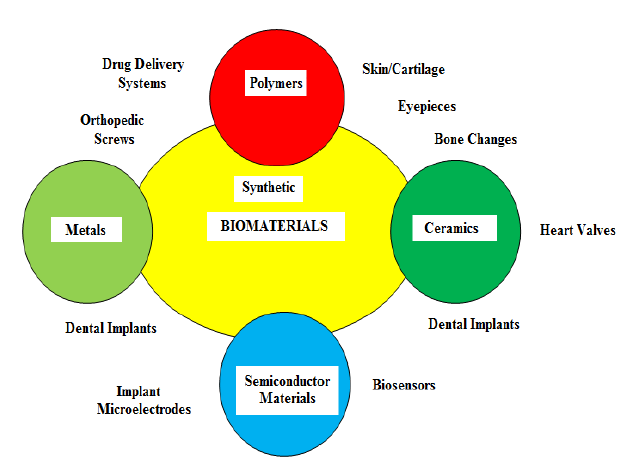
Metals; It is preferred as a biomaterial due to its durability, easy shape, and wear resistance. However, metals; Its disadvantages are that they have low biocompatibility, corrode in body fluids, are very hard compared to tissues, have high density, and cause allergic tissue reactions. Ceramics are materials with high biocompatibility and corrosion resistance, as well as being hard, brittle, difficult to process, low mechanical properties, and high density. Composite materials have been developed as an alternative to disadvantageous materials. Orthopedic and dental implants are made of metallic biomaterials and bioceramics, while the cardiovascular system and general plastic surgery materials are made of polymers. Synthetic biomaterials produced from basic material groups are given in Figure 1[8].
In addition to the disadvantages of being very hard, having high density, biometals have many advantages due to their use in joint prostheses and bone renewal materials, especially in orthopedic applications, due to their crystal structure and mechanical properties. Metallic biomaterials can corrode by chemical reaction with the structure they are in contact with. The biocompatibility of metal prostheses is related to Steel, gold, titanium, and titanium alloys, cobalt, and alloys of biometals are used in dental implants, jaw surgery, artificial heart parts, and many medical applications such as catheters [10]. Metallic biomaterials also have a large place in the production of biomedical devices for diagnosis and treatment.
Figure 1: Overview of Synthetic Biomaterials [1]
For today, metals and alloys that find the most application areas as metallic biomaterials, stainless steels (316L), titanium and titanium alloys, cobalt-chromium alloys, cobalt-nickel-chromium-molybdenum alloy, tantalum alloys, nickel-titanium alloys, amalgam, and gold. Due to the low mechanical strength of elements such as platinum, tantalum, and zircon, their use as implants is limited. The most commonly used metallic materials as load carriers are stainless steels, Co-Cr-Mo alloys, and titanium and titanium alloys.
Another point to be considered in orthopedic applications is that when different metals come into contact with each other, it creates a galvanic battery in the body fluid. If the surgical stainless steel wire comes into contact with the femur made of cobalt or titanium-based alloy, a galvanic battery is formed and galvanic corrosion occurs [11]
A result of corrosion between organs and tissues in the human body are of great importance for human health. If corrosion occurs in a metallic implant in the body, the flow of electrons in the metal, the formation of ions, causes damage to the tissues and cells they are in contact with. Low solubility and high thermodynamic stability are desirable for metallic biomaterials. Metal ions released by inorganic corrosion reactions are carried to organs such as kidneys and liver and collected there. This causes various diseases and leads to an increase in the toxicity limit. Contact of metal with organic reaction proteins causes allergic inflammatory reactions in the tissue surrounding the metal. Inflamed cells produce hydrogen peroxide, and hydroxyl radicals cause severe damage to the tissue surrounding the metallic biomaterial [8].
Bioceramic materials have superior biocompatibility, non-toxic, non-allergic, and carcinogenic, no risk of rusting due to their stable chemical structure. They are inorganic materials whose use in medical technology has become widespread due to their resistance to resistance and lightness. Bioceramics are polycrystalline and resistant to microorganisms, temperature, solvents, and pH changes. As an example of biocompatible ceramic materials; alumina, hydroxyapatite, and bioactive glass can be given. Alumina; has wide use in hip prostheses, dental implants, and orthopedic applications due to its high density, high strength, good corrosion resistance, and good biocompatibility. Alumina and hydroxyapatite (HA) is an inorganic structure of bone tissue and is a calcium phosphate-based ceramic. In the construction of various prostheses as artificial bone, repair of cracked and broken bones and metallic biomaterials, It is used for coating [12].
Mechanical Properties of Biomaterials
Biomaterials are exposed to different forces and effects in different parts of the human body. For example, stresses of 4 MPa on bones and 40-80 MPa on tendons affect the bones during daily activities. The average load on a hip joint can be up to 3 times bodyweight, while during activities such as jumping this value can be up to 10 times bodyweight. These stresses in the body; It is repeated throughout the day during activities such as standing, running, and sitting. These repetitive movements may cause fatigue, cracking, or plastic deformation of biomaterial.
Due to the low mechanical strength of elements such as platinum, tantalum, and zircon, their use as implants is limited. Metallic materials most commonly used as charge carrier; stainless steels (316L), Co-Cr-Mo alloys, and titanium and titanium alloys [13].
Pure titanium and Ti6Al4V alloy are used in biomedical applications. Pure titanium, which has a tensile strength between 240-740 MPa, is generally used in dental implants. On the other hand, Ti6Al4V is known as the most popular titanium alloy and is used as high as 50% in the world titanium market. The preference of Ti6Al4V alloy at this rate is mainly due to its high corrosion resistance and low density and high static and dynamic strength [14]. Metallic The strength and elasticity module of implants is higher than the strength of the bone [15].
While the elasticity modules of metallic biomaterials are at very high levels (200 GPa in 316L stainless steel, 110 GPa in titanium), this value is 10-15 GPa in human bone. This mechanical incompatibility causes implants to be structurally harder than human bones. Alloys with a modulus of elasticity closer to human bone carry less stress. The stiffness of metallic biomaterials is related to their modulus of elasticity. Since the elasticity module of stainless steel is higher than titanium, it has higher rigidity than titanium [16].
Particularly titanium alloys are of great importance among metallic biomaterials in terms of strength and elasticity. Stainless steels, show less tensile strength and fatigue strength but have high ductility. Pure titanium, tantalum, and niob have low fatigue strength and high elongation at fracture.
In Table 1, properties of metallic biomaterials are in Table 2; metallic Implant applications of biomaterials are given.
Table 1: Properties of metallic biomaterials [17]
Features
316L Stainless steel
CoCrMoalloy
CoNiCrMoalloy
Ti6Al4Vlloy
Tantalum
Tensile Strength (Mpa)
485-860
655
793-1793
860
207-517
Yield Strength (0,2%) (MPa)
172-690
450
240-1585
795
138-345
Elongation (%)
12-40
8
8-50
10
2-30
Section Narrowing (%)
-
8
35-65
25
-
Density (g/cm3)
7.9
8.3
9.2
4.5
16.6
Corrosion Resistance
At high stresses weak
Superior
Superior
Superior
Good
Bioceramics
They are inorganic materials with a wide variety of applications in the health sector. They are especially used in the production of thermometers, eyeglasses, fiber optics used in endoscopy. In addition, it is widely used as a filling material in dentistry [19]. Bioceramics are clinically preferred materials due to their properties of the bone coating, bone adhesion, and penetration into bone tissue [20]. Dental bioceramics are materials that are frequently used as hard tissue implants as restorative materials in the repair or renewal of hard connective tissue used as filling material in dentistry [21].
Bioceramics are examined in two groups as bioinert and bioactive
Bioactive ceramic is a ceramic material that allows the formation of a chemical bond between the tissue and the implant
The interactions of bioinert ceramics with tissue are in the form of mechanical bonds. Mechanical bonding means that the material can hold tissue together without changing tissue. Bioceramics; It can be prepared as polycrystalline ceramic (alumina and hydroxyapatite), bioactive glass, bioactive glass ceramics, or bioactive composites (polyethylene-hydroxyapatite) [22]
Table 2: Implant Applications Of Metallic Biomaterials [18]
Material
Implant Applications
316L
In bones, plates, screws, pins, nails, stents
Co28Cr6Mo
In hip, knee, elbow, shoulder, ankle and finger prostheses; bone in their plates, screws, rods, heart valves
Ti
Bone plates, screws, rods, heart valves, heart in the devices that regulate their shots
Polymers consist of long chains of organic molecules containing carbon. Polyethylene (PE), polyurethane (PU), polytetrafluoroethylene (PTFE), polyacetal (PA), polymethylmethacrylate (PMMA), polymethylmethacrylate (PET), silicone rubber (SR), polysulfone (PS), polylactic acid (PLA) and polyglycolic acid ( Polymers used in medical applications such as PGA) have a wide range of use as biomaterials, as they can be prepared in many different compositions and forms (fiber, film, gel, bead, nanoparticle) [23]Polymers show similar physical structure to soft tissues in the body. They are used as prosthetic material in areas with special texture such as cartilage, skin, veins, and lenses. Especially the dentistry and the pharmaceutical industry are the areas where it is used extensively. Some types of polymers used as biomaterials in orthopedics and their usage areas are described below. However, in the orthopedic field, their mechanical strength is weak, and the polymer properties may be affected during sterilization processes (autoclaving, ethylene oxide, Co radiation).
Composites
Composites are multi-phase materials formed by two or more materials of the different chemical structure while preserving their boundaries and properties [24]. Composites are multi-phase materials obtained by an artificial combination of different materials to obtain properties that cannot be achieved using components alone [25].
They are used especially in orthopedic applications because of their high durability and low elasticity modulus [26]. One of the biggest problems encountered in orthopedic surgery is the incompatibility between bone and metal or ceramic implant's hardness. Sharing the load on the bone and implant can prevent deformations from occurring. It is important that the stiffness of the implant is adjusted to match the tissues it is in contact with. Polymer composites are desired to be used to prevent these deformations [6]. The polymeric composite reinforced with fibers has properties that one of its constituent components cannot have on its own.
In addition, by changing the composition of the composite material, it can be easier to adapt the implant to the mechanical and physiological conditions according to the usage areas in the body. Composite materials are advantageous compared to more homogeneous materials in terms of structural compatibility [25]. Composites have superior aspects such as corrosion resistance, no metal fatigue and no release of metal ions, and reduced brittleness. Composites are used as soft tissue implants in addition to orthopedics and dentistry applications. Since polymer composites are not magnetic, they are compatible with imaging systems such as magnetic resonance (MR) and computed tomography (CT). Metal alloys and ceramics cause problems in X-ray radiography because they are radio-opaque. However, in composite materials, radio-transparency can be adjusted. Considering their lightweight and superior mechanical properties, composites are highly suitable as structural components of such imaging devices [27].
RESULTS
Biomaterials used instead of diseased or damaged organs and tissues are of vital importance for a living thing experiencing these problems. Biomaterials are used to restore or increase the functionality of organs and tissues that cannot fulfill their functions fully. In addition, screws, wires, or threads can be used as braces and silicones to help correct aesthetic problems in surgeries. Biomaterials are also used in devices prepared with diagnostic and therapeutic properties for living healthy.
Physiological acceptance is the most important aspect when designing the use of biomaterials. In the interaction of biomaterial with living structure; chemical dissolution, abrasion, expansion, and pressure are affected. Fluids in the human body; contains various ions such as water, dissolved oxygen, protein, chloride, and hydroxide. Corrosion is one of the main problems that may arise in the case of short and continuous contact of biomaterials with fluids in the body. Sometimes the body does not accept the biomaterial as a living structure and can respond as inflammation or allergy. The most important factor in using biomaterials is undoubtedly biocompatibility. Studies are continuing to minimize the adaptation problems of biomaterials used in healthcare. In the future, new-generation biomaterials that are more biocompatible with longer life and living structure will be designed and produced.
In the selection of orthopedic materials, properties such as manufacturability, formability, resistance to stresses during use, biocompatibility, toxic effect, and resistance to corrosive effects of body fluids come to the fore. Orthopedic materials should be selected according to the mechanical loads to be determined by considering the places of use in the body, the weight of the person, and the daily activities. The mechanical properties of orthopedic materials can be taken from the tables given in the text. For the selection of biocompatible materials, the information given on the biocompatibility of the materials should be considered. The suitability of the biomaterials to be used to the biological structure of the person in terms of corrosion should be tested in samples to be taken from body fluids or in solutions to be prepared in composition very close to this. However; Before the application process, the allergic nature of the person to orthopedic materials should be investigated by dermatologists with various allergy tests (such as the Patch Test, also known as the patch test). Textures in general; It is divided into two groups as hard and soft tissues. As an example of hard tissues; bone and tooth, soft tissues as examples; blood vessels, skin, and ligaments may be given. When structural compatibility is considered, metals or ceramics can be chosen for hard tissue applications and polymers for soft tissue applications.
Biomaterials and biocompatible production is a multidisciplinary application area. Material engineering is a field that covers many subjects such as genetic and biomedical engineering, nanotechnology, biology, and optics, and the importance of this sector is increasing day by day.
REFERENCE
Williams, D.F. Definitions in biomaterials. Elsevier, 1987.
Williams, D.F. The Williams dictionary of biomaterials. Liverpool University Press, 2011.
Park, J.B. and Y.K. Kim. “Metallic biomaterials.” The Biomedical Engineering Handbook, 2nd ed., CRC Press, 2000.
Niinomi, M. “Recently metallic materials for biomedical applications.” Metallurgical and Materials Transactions, 2002, pp. 477–486.
Gür, A.K. and M. Taşkın. “Metalik biyomalzemeler ve biyouyum.” Doğu Anadolu Bölgesi Araştırmaları, vol. 4, 2004.
Güven, Ş.Y. “Ortopedik malzemelerin biyouyumlulukları ve mekanik özelliklerine göre seçimi.” Ulusal Tasarım İmalat ve Analiz Kongresi, November 2010, pp. 472–484.
Gümüşderelioğlu, M. “Biyomalzemeler.” Bilim ve Teknik, TÜBİTAK, July 2000.
Williams, D.F. “Proceedings of Consensus Conference of the European Society for Biomaterials.” Elsevier, 1987.
Murr, L. “Open-cellular metal implant design and fabrication for biomechanical compatibility with bone using electron beam melting.” Journal of the Mechanical Behavior of Biomedical Materials, vol. 76, 2017, pp. 164–177.
Biehl, V. and J. Breme. “Metallic biomaterials.” Materials and Corrosion, vol. 32, 2001, pp. 137–141.
Corces, A. “Metallic alloys.” Medicine: Instant Access to the Minds of Medicine, 2004.
Pasinli, A. “Biyomedikal uygulamalarda kullanılan biyomalzemeler.” Makine Teknolojileri Elektronik Dergisi, 2004, pp. 25–34.
Çakır, A. “İnsan vücudunda kullanılan metalik implantların dünü ve bugünü.” 8th International Metallurgy and Materials Congress, 1995.
Günyüz, M. et al. “Mikro ark oksidasyon işlemi uygulanmış Ti6Al4V alaşımlarının in vivo biyouyumluluk özelliklerinin incelenmesi.” Mühendis ve Makine, vol. 51, no. 600, 2010, pp. 10–15.
Domínguez-Trujillo, C. et al. “Sol-gel deposition of hydroxyapatite coatings on porous titanium for biomedical applications.” Surface and Coatings Technology, vol. 333, 2018, pp. 158–162.
Chunxiang, C. et al. “Titanium alloy production technology, market prospects and industry development.” Materials and Design, vol. 32, 2011, pp. 1684–1691.
Saving, P., and E. Gırovd. “Metallic biomaterial.” Kungl Tekniska Högskolan, Dec. 2002, pp. 11–15.
Johnson, J.L. “Mass production of medical devices by metal injection molding.” MDDI, 2002.
Guazzato, M. et al. “Influence of grinding, sandblasting, polishing and heat treatment on the flexural strength of a glass-infiltrated alumina-reinforced dental ceramic.” Biomaterials, vol. 25, 2004, pp. 2153–2160.
Çömlekoğlu, E. et al. “Allergy in dentistry: casting alloys.” E.Ü. Diş Hekimliği Fakültesi Dergisi, vol. 29, 2008, pp. 81–92.
Hench, L.L. “Bioceramics: From concept to clinic.” Journal of the American Ceramic Society, vol. 74, 1991, pp. 1487–1510.
Hench, L.L. and J. Wilson. An introduction to bioceramics. 31st ed., World Scientific Publishing, 1993.
Aguilar, M.R. and J. San Román. Smart polymers and their applications. 2nd ed., Woodhead Publishing, 2019.
Jian, Z. et al. “Aeroelastic stability analysis of curved composite panels with embedded macro fiber composite actuators.” Composite Structures, vol. 208, 2019, pp. 725–734.
Chung, D.D.L. Composite materials: Functional materials for modern technologies. Springer, 2002.
Chevalier, J. “What future for zirconia as a biomaterial?” Biomaterials, vol. 27, 2006, pp. 535–543.
Gómez-Mascaraque, L.G. and R. Palao-Suay. Smart polymers and their applications. 2nd ed., Woodhead Publishing in Materials, 2019.
Recommended Articles
Research Article
Electrochemical Comparative Studies On The Redox Behavior Of Cu(II) And Cr(II) Before And After Interactions With Ciprofloxacin In Solutions
H. M. Naseem Akhtar,
M. Q. Ehsan
Published: 10/08/2021
Download PDF
Research Article
A Rare Case Report of Waugh Syndrome in an Eight Months Old Male
Pielly Hanna,
...
Bassem Abou Merhi
Published: 10/03/2021
Download PDF
Research Article
Study on Prevalence and Etiology of Early Neonatal Deaths in Jasin district, Melaka from 2014-2017
Sujat a Khobragade,
...
Yadneshwar Khobragade
Published: 30/05/2021
Download PDF
Research Article
Clinicopathological Correlation in Cases of Acute Appendicitis: An Overview
Rahul Rai,
...
Tushar
Published: 05/04/2025
Download PDF
PO Box 101, Nakuru
Kenya.
Email: office@iarconsortium.org
Editorial Office:
J.L Bhavan, Near Radison Blu Hotel,
Jalukbari, Guwahati-India
Gezer, R., Gezer, B. & Gezer, C. (2021). Usage Areas of Biomaterials In Medical Applications. International Academic Journal of Applied Bio-Medical Sciences, 2(1), 1-5.
MLA
Gezer, Rahşen, Bahdişen Gezer and Can Gezer. "Usage Areas of Biomaterials In Medical Applications." International Academic Journal of Applied Bio-Medical Sciences 2.1 (2021): 1-5.
Chicago
Gezer, Rahşen, Bahdişen Gezer and Can Gezer. "Usage Areas of Biomaterials In Medical Applications." International Academic Journal of Applied Bio-Medical Sciences 2, no. 1 (2021): 1-5.
Harvard
Gezer, R., Gezer, B. and Gezer, C. (2021) 'Usage Areas of Biomaterials In Medical Applications' International Academic Journal of Applied Bio-Medical Sciences 2(1), pp. 1-5.
Vancouver
Gezer R, Gezer B, Gezer C. Usage Areas of Biomaterials In Medical Applications. International Academic Journal of Applied Bio-Medical Sciences. 2021 Jan;2(1):1-5.



 Download PDF
 Download XML