The recent Pandemic of COVID-19 seems to pose the greatest threat to present humankind. Coronavirus disease (COVID-19) is an infectious disease caused by a newly discovered coronavirus. This pandemic affects every aspects of life of mankind. The pandemic has resulted in significant global social and economic disruption, including the largest global recession since the great depression. It has led to widespread supply shortages exacerbated by panic buying, agricultural disruption and food shortages, and decreased emissions of pollutants and greenhouse gases. Numerous educational institutions and public areas have been partially or fully closed, and many events have been cancelled or postponed. Misinformation has circulated through social media and mass media. The pandemic has raised issues of racial and geographic discrimination, health equity, and the balance between public health imperatives and individual rights. This review aims to enlighten our understanding about the pathogen, its mode of infection, clinical manifestation, pathogenicity and possible treatment of this disease. This disease has also affected economy, both on local and global basis and this has severe impact on countries like India. The education system has also been affected. In this review we will also discuss about effect of corona virus pandemic in economy and educational sectors.
Keywords
Coronavirus
Pandemic
Imm
INTRODUCTION
China Health authority first reported many pneumonia incidences which had been found to occur in Wuhan city of China in December 2019 [1]. The causative agent of the pneumonia and associated symptoms was first named by WHO as 2019-nCoV [2]. This was later renamed as severe acute respiratory syndrome coronavirus 2 (SARS- CoV-2) and this is done by Coronavirus Study Group [3]. The disease caused by this deadly virus was named as corona virus disease 2019 (COVID-19) by WHO [4]. On January 30, WHO announced that SARS-CoV-2 outbreak should be concerned as a Public Health Emergency of International Concern (PHEIC) [4]. Primarily in China mortality rate was 2.1% [5]. The mortality rate among the patients who were admitted in hospital was rather high. It was estimated to be 15% [6-7]. From then the disease spread throughout the world and at present time every continent is suffering from this deadly disease. America is mostly affected although developing countries like Brazil and India are also experiencing heavy disease load.
Classification and Origin of COVID-19
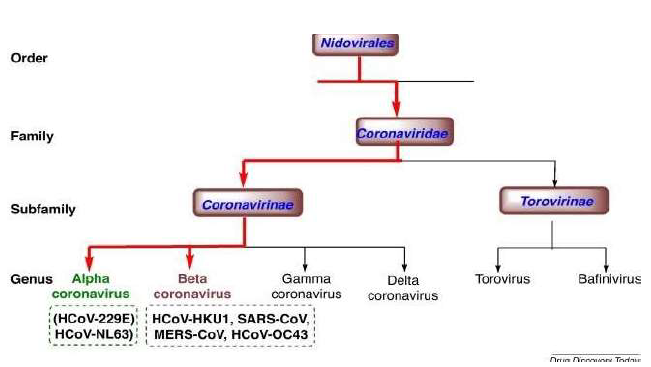
SARS-CoV-2 is included in the family-Coronaviridae and order-Nidovirales (Figure-1).
Figure 1: Schematic Diagram Showing the Origin and Classification of Corona Virus
Coronaviridae family contains two subfamilies such as Coronavirinae and Torovirinae. Coronavirinae subfamily is again consist of four genus – They are alpha coronavirus, Beta coronavirus, Gamma coronavirus and Delta corona virus (Figure- 1). Alpha coronavirus are the human coronavirus (HCoV)-229E and HCoV-NL63. Beta corona virus includes HCoV-OC43, Severe Acute Respiratory Syndrome human coronavirus (SARS-HCoV), HCoV-HKU1, and Middle Eastern respiratory syndrome coronavirus (MERS-CoV). Gamma coronavirus includes Coronavirus which are found in whales and birds. Delta Coronavirus have been found in pigs and birds [8]. SARS-CoV-2 contain an envelope and positively single strand RNA. This is a beta coronavirus [1]. Genome analysis of SARS-CoV-2, RaTG13, and SARS-CoV indicates that this virus is phylogenetically related to the virus obtained from Bat (Bat CoV RaTG13). This virus was isolated from Rhinolophus affinis from Yunnan Province Zhou et al [9]. Bats are unlikely to be the animal that is directly responsible for transmission of the virus to humans for several reasons [1]. Some studies are needed for determination of if there is any intermediate host which can transmit the virus from bat to humans. Bats are also reported to transmit some virus such as Nipah virus by shedding into raw date palm sap [10].
Structure of Coronavirus
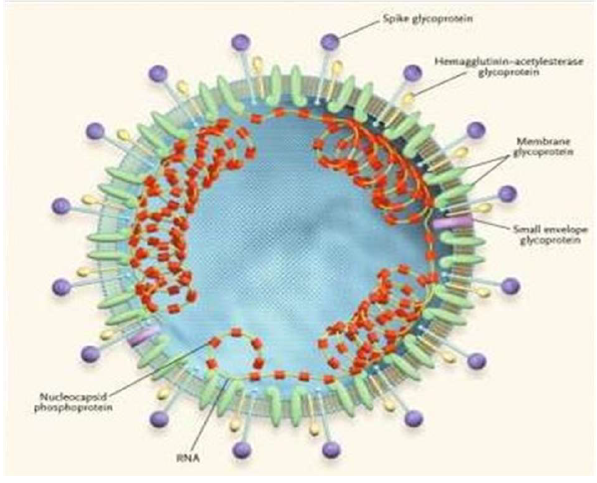
Coronavirus which are available are mainly divided into three groups serologically. The RNA and viral nucleocapsid together form a nucleocapsid which is helical in shape. In electron microscopy study, it is observed that the envelope contain many spike like structures which serve as identification characteristics of the virus (Figure- 2).
Figure 2: Schematic Diagram of a Coronavirus (COVID-19)
These spikes are made up of glycoprotein and these bind to host cell receptors and help in fusion of viral cell membrane to host cell membrane. Group 2 Coronavirus possess a hemagglutinin–acetylesterase (HE) glycoprotein which help in binding with sugar molecules on the cell membrane of host. RNA dependent RNA polymerase is present in Coronavirus helps in replication of viral genome. This polymerase sometimes causes error during replication which is the cause of point mutation and it also cause insertion and deletion of exogenous RNA into viral genome.
Transmission
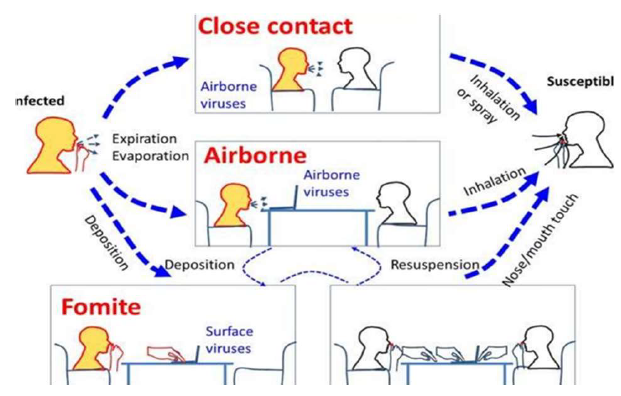
The disease was first reported to occur in Huanan from a wholesale market for seafood which was the main source of transmission. It was suggested that Corona virus pandemic has its source in this market and this virus have been transmitted to humans through animals [1]. Genome analysis suggested that the infection was spread from an unknown location in the market [11]. Human to human transmission was evidenced in the families in which the medical workers are members [12]. These human to human transmission occurs mainly through droplets which was exhaled during coughing and sneezing. This SARS-CoV can remain active on fomites for 96 hrs [13]. The major problem in transmission of Coronavirus spread through asymptomatic patients who are actually carrier of this disease (Figure 3).
Figure 3: Schematic Diagram Showing Various Route of Transmission
They do not have any symptoms of the disease but they are able to transmit the pathogen from them to other persons [14-16]. Findings about disease characteristics are rapidly changing and subject to selection bias. The incubation period of this virus varies. Some studies suggested that the incubation period is 5 days [17] whereas other studies suggested that the incubation period is 19 to 24 days [18-19]. In most cases it has been found to be 14-15 days [5]. During the acute phase of an outbreak or pre-pandemic, basic reproductive number (R0) may be unstable [20].The basic reproductive number (R0) in some previous epidemics such as SARS and H11N11 influenza were 2.7 and 2.4 respectively [21-22]. Different studies have predicted different values of R0 for Coronavirus. One study estimated R0 as 2.2 [17] whereas another study calculated it to be 3.28 [17,23]. In pregnant woman, infection with Coronavirus, do not cause any intrauterine infection by vertical transmission [7]. One major way of transmission of this disease is hospital acquired transmission. In one study it has been estimated that rate of hospital acquired infection is 41% [24-25]. Different modes of transmission of Coronavirus from one person to another is represented in the figure below (Figure-3).
Risk Actors
The probability of infection by Coronavirus found to be more in adult male persons in the age group of 34 and 59 years [16,18,26]. The infection occur mostly in persons who have chronic co-morbidities like cardio-vascular and cerebrovascular diseases, diabetes. If there is coinfections with bacteria and fungi, situation will be more worse [7]. The persons who are above 60 and have other serious disease are very much prone to this Coronavirus infection [16,27]. The children below 15 years are very less likely to be affected by this disease [16,6,26]. A study published from Wuhan have shown that children below 15 years are not affected by this virus [16,28] but subsequently 28 children were found to be affected by January 2020 [29]. Most of these patients had only mild symptoms and they did not have fever and they had recovered very soon [29]. In another study, a child was found to be had radiological ground-glass lung opacities but he was also asymptomatic [12].
Pathogenesis and Immune Response
Members of Corona virus family usually show very high species specificity. Mutation in them affect their infectivity and tissue specificity during infection and the host species choice. There are many zoonotic diseases which are caused by virus of Coronavirus family such as SARS-CoV [30] and MERS-CoV [31]. In both of these incidence human was the final host , palm civet was the intermediary host and the reservoir of infection was bat [32,12]. These intermediate hosts are mainly responsible for propagation of a virus to a new host and it help in contact of the virus to a new host and the virus changes itself for successful propagation in the new host cells. It has been demonstrated that SARS-CoV-2 utilize host receptor angiotensin-converting enzyme 2 (ACE2) for entering the host cell [33,17]. The spike protein of Coronavirus consist of S1 and S2 domain. S1 domain cause binding to the receptor and S2 domain helps in fusion of the cell membrane [1]. After entering into the host cell, the virus have to overcome the host’s innate immune response. Though the exact mechanism is still not clear . In our body, type- I interferon inhibit viral replication in our body. For combatting this interferon , viral particles have found to be code for 8 proteins which inhibit and prevent the interferon system in human body [34]. It is also a matter of concern that higher immunological activities against the virus may lead to more severe symptoms and this is mainly caused by lysis of the bacteria by the host immune system. The patients suffers from fever, cough which may lead to pneumonia and in due course of time. Gradually it may lead to Acute Respiratory Stress Syndrome (ARSS) and also causes septic shock. This is the main cause of the death in patients [35]. This virus mainly enter through AACE-2 receptor which are frequently present on ciliated cells of the airway epithelium and alveolar type II cells in humans [36]. The patients suffering from SARS, some immunological proteins or molecules are found to be present in high quantity such as IL-6, IL-12 IFN, etc. [37] The cytokine storm is the cause of severity of the disease [38].
Clinical Manifestations
The most common symptoms of Coronavirus infection are fever, sore throat, chest pain, dizziness, inability to smell and taste [39-40]. The symptoms which occur less frequently includes nausea, abdominal pain , diarrhea, headache etc [6,24]. 75% patients have found to be have bilateral pneumonia [41]. The virus have a preference for infection in lower respiratory tract and mainly causes rhinorrhoea, sneezing, or sore throat [6]. In the patients who have other health problems such as high blood pressure, heart problems, Diabetes, kidney problem are more prone to infection and multiple organ failure often reported in these patients [7]. Both Pregnant and non-pregnant women have similar characteristics [7] The confirmation of Coronavirus infection is performed in laboratories and various test are available. The most confirmatory case is the antibody test. If antibody specific for coronavirus antigen is found in a person’s serum, it is confirmed that he is infected with the coronavirus. The sample used for clinical investigations include nasopharyngeal and oropharyngeal swab and also the sputum, tracheal aspirate, or bronchoalveolar lavage collected from lower respiratory tract [40]. The patient who had been admitted to ICU had more complications than non -ICU patients and their laboratory tests are more alarming [39]. These tests should be performed in well equipped and sterilized laboratory conditions so that chance of contamination may be minimized [24,26]. Some patients have reported to have high aspartate aminotransferase, creatine kinase, creatinine, and C-reactive protein [26] . Il-1, IFN, IP-10 are also found to be in elevated concentration in patients with severe infection [6].
Treatments
Still now no definite treatment is available for the treatment of Covid-19 pandemic [41]. The only measures available is to isolate the diseased person. If the symptoms are mild then no such treatment is given. Only vitamin B complex with Vitamin C and zinc tablet is used along with healthy and nutritious foods. If the patient has other complications like severe breathing problems, then oxygen therapy is used [42]. Sometimes fluid management and antibiotic therapy is also used to prevent secondary bacterial infection [42]. Some patients experience a septic shock due to increased level of cytokines and this is often found to be lethal [6]. Multiple organ failure also found to occur in case of septic shock [45]. The early recognition of the disease is very much important to take effective measures, so that the symptoms are not worsened. Vaccines have been developed by several countries but some concerns are still there. It is often observed that a vaccine had to be withdrawn after its introduction due to some adverse side effects. In USA, it was observed in case of H1N1 vaccine that the vaccine was 50% protective in May 2009 but its efficacy has decreased to 16% in January 2010 [46]. Administration of either glucocorticoid or corticosteroid was also not prescribed for coronavirus infection. Intravenous injection of antibodies collected from persons who have recovered from the disease is also a potent mode of treatment and it is called plasma therapy [45]. Drugs which are used to treat SARS and MERS are also being used [47] as there are evidence that these antiviral drugs often prove useful in treating COVID-19 infection. Antiviral drugs such as oseltamivir combined with empirical antibiotic is also reported to be effective to some extent in infected patients [48]. One drug – called Ramdesivir which have been used for treatment in Ebola virus infection has been reported to be used against Coronavirus infection [49,45]. This drug Ramdesivir has been reported to have in vitro and in vivo efficacy in the treatment of SARS-CoV-2 and clinical trial has been initiated .But the fact is COVID-19 is more severe than SARS [28] and number of deaths is more in COVI-19 in comparison to SARS [50-51]. There should be some precautions taken in the hospital or nursing home where corona patients will be treated. They should be kept in a separate ward in the hospital where contacts with other patients should be totally prohibited. Their room should be well ventilated and with convenient access to respiratory hygiene supplies. Exhaust should be filtered through HEPA filter and the physicians or attendants who will enter the room should wear personal protective equipment(PPE) such as gloves, gown, disposable N95, and eye protection. Their rooms should be disinfected and sanitized at a regular interval [48]. As there are assumptions that this disease may be transmitted through bat [52-53], even through snakes, proper care should be taken so there will be no contacts of these animals with the patients. Common people should be aware of importance of wearing mask , and sanitize their hands frequently. Lockdown is another measures which should be maintained very strictly for prevention of spreading the disease [54].
Vaccination is the only way by which we can pause the spreading of this disease throughout the world. Along with the other countries, India have also developed vaccines against Corona virus. Covaxin and Covishield vaccines are now available in the India and mainly health care persons, aged persons, persons with co morbidity are presently receiving this vaccine. India also have exported these two vaccines to other countries like Srilanka, Bangladesh and Pakistan. The comparison between Covaxin and Covishield has been represented in Table 1.
The Impact of the Coronavirus on the Global Economy
The loss of lives due to the pandemic is causing irreparable damage to communities. In addition, COVID-19 is severely crippling the global economy. In order to limit further transmission of the disease in the community, many of the affected countries chose to impose a total lockdown. Major international flights and all types of business traffic are delayed / withdrawn between different countries. Due to the blocking of all domestic flights, rail transport services (except goods trains), buses, trucks and vehicles (except basic necessities) have been suspended. All educational, commercial, sports and spiritual facilities have been closed in almost all countries affected by COVID-19. The industry has suffered a lot because many of them, except for basic equipment, have long been closed in many countries. Members of the tourism and transportation industries also have facedgreat difficulties. The production rate became very low. The economy of many so-called strong countries are now at risk of high inflation and rising unemployment due to poor productivity and excessive costs for the care and rehabilitation of COVID-19 victims and their families (OECD Interim Economic Assessment, 2 March). 2020). The lockdown will have a direct impact on the GDP of each country in the main economy. For each month there is an estimated loss of 2 percentage points in annual GDP growth. The tourism sector itself is facing a decline in production of up to 50% to 70%. According to the World Trade Organization (WTO) and the Organization for Economic Cooperation and Development (OECD), the COVID-19 pandemic has been identified as the greatest threat to the global economy since the 2008-2009 financial crisis. Indeed, some experts say they have not faced an unprecedented situation since World War II. As such, COVID-19 will undoubtedly have a very negative impact on the daily life of the entire human society as well as on global economy.
Table 1: Comparative Analysis of COVAXIN and COVISHIELD
Criteria
Covaxin
Covishield
Developed By
Bharat Biotech
Serum Institute, Icmr Of India
Type Of Vaccine
Inactivated Non Replicating Viral Vector
Non Replicating Viral Vector
Efficacy
N/A
Dcgi:70.42%Overall
Storage Temperature
2°-8°C
2°-8°C
Doses
Two Doses (0,14 Days)
Two Doses (Gap Of 2.5 To 3months)
Availability Time In India
First Half 2021
First Half 2021
Impact of the Coronavirus on the Indian Economy
The COVID-19 epidemic is affecting the entire world and is being felt in all industries. The outbreak has been declared a national emergency by the World Health Organization. In India, the three main contributors to GDP, namely private consumption, investment and foreign trade, already been severely affected. The world and the Indian economy are trying to reduce the health risks of COVID-19 along with the economic risks and steps needed to rectify them. COVID-19 has a “deep impact" on Indian businesses and jobs are at high risk over the next months as companies seek some downsizing. It added that the COVID-19 crisis has resulted in an unprecedented fall in economic activity in recent weeks. According to nearly 72 percent of respondents surveyed, the current situation has a "high to very high" impact on their business. In addition, 70% of surveyed companies expect an increase in sales in the 2020-21 financial year. According to the report, there are three main channels affecting Indian business, namely links, supply chain and macroeconomic factors. Dun & Bradstreet's data shows that at least 6,606 Indian companies have legal relationships with companies in countries with a high number of confirmed COVID-19 cases. Doing business in overseas markets is slow, which indicates a negative impact on the return on sales of these companies. The sectors hardest hit include logistics, automotive, tourism, metals, pharmaceuticals, pharmaceuticals, electronics, SMEs and retail.
In addition, according to the World Bank, India is expected to grow by 1.5% to 2.8% and the IMF forecasts GDP growth of 1.9% for India in 2020 as the global economy is hit by the COVID pandemic - the worst recession since the Great Depression in the 1930s. Moreover, we cannot ignore the fact that lockdown and pandemics are affecting various sectors including SMEs, hotels, civil aviation, agriculture and related sectors. According to KPMG, the lockdown in India will have a significant impact on the economy, especially consumption which is the largest component of GDP. A decrease in urban transactions can lead to a sharp decrease in consumption of non-essential goods. his can become severe if the disturbance is caused by a 21-day blockade and affects the availability of staples. Weak domestic consumption and consumer sentiment could lead to a slowdown in investment, which would further add to the pressure on growth. According to KPMG, the odds largely depend on how quickly the economy recovers and how quickly problems in the supply chain are resolved. Arun M Kumar, Chairman and CEO of KPMG India, said, "Apart from providing a strong safety net for the most vulnerable, the focus is on ensuring business continuity and job creation. and there is an urgent need to mobilize resources to stimulate the economy for higher demand and jobs." According to the KPMG report, "India's economic recovery is expected to be smoother and faster than many other developed countries." In terms of trade, China is the world's largest exporter and second largest importer. This represents 13% of world exports and 11% of world imports. This has affect Indian industry at large. India's dependence on China is enormous. Of the top 20 products (under the two- digit HS code) India imports from the world, China accounts for the most significant proportion. The total imports of electronics to India reached 45% from China. About a third of the machinery and nearly two-fifths of the organic chemicals India buys from the world come from China. For auto parts and fertilizers, India's share of imports in China is more than 25%. About 65 to 70% of active pharmaceutical ingredients and about 90% of some mobile phones come to India from China. Therefore, it can be said that due to the current Coronavirus outbreak in China, dependence on imports from China will have a significant impact on Indian industry.
In terms of exports, China is India's third largest export partner, accounting for around 5%. The impact could lead to the following sectors, namely organic chemicals, plastics, fishery products, cotton, ores and others. Moreover, we cannot ignore the fact that most Indian companies are based in eastern China. In China, about 72% of businesses in India are located in cities such as Shanghai, Beijing, Guangdong, Jiangsu and Shandong. These companies operate in a variety of industries including manufacturing, manufacturing services, IT and BPO, logistics, chemicals, aviation and tourism. It can be seen that several sectors in India have been affected by the corona virus outbreak in China, including shipping, pharmaceuticals, cars, cell phones, electronics, textiles, and others. In general, the impact of the corona virus on industry is moderate. According to the CLSA report, pharmaceutical, chemical and electronics companies could face supply chain problems and prices will increase by 10 percent. The report also said India may also benefit from the positive flows as it appears the market is least affected. Several commodities such as metals, upstream and downstream oil companies can see the impact of lower global demand on commodity prices. According to CII, GDP could fall below 5% in FY 2021 if no immediate policy action is taken. It said the government should use a strong fiscal incentive of 1% of GDP of the poor, which would help them financially and also control consumer demand. In the third quarter (October to December), growth slowed to 4.7%, and the impact of COVID-19 will be seen in the fourth quarter. The FICCI survey found that 53% of Indian companies have demonstrated a significant impact of COVID-19 on business operations and 42% of respondents said it could take up to three months to return to normal.
How The Coronavirus Pandemic Affects Different Sectors Are Briefly Described Below
Chemical Industry: Several chemical plants in China are closed. So that there will be shipping / logistics restrictions. It is known that 20% of production was affected due to disruption in the supply of raw materials. China is a major supplier of indigo, which is needed for denim. Businesses in India will most likely be affected so people can secure their supplies. However, this is an opportunity. US and EU will try to diversify their markets. Part of the business can be diverted to India, which can also be seen as a profit
Shipping Industry: The coronavirus infection has affected the business of delivering freight services. According to sources, days per ship at dry wholesalers have decreased by more than 75-80%
Auto Industry: The impact on Indian companies will vary and will depend on the level of business with China. Chinese business is undoubtedly not affected. However, the current stock seems sufficient for Indian industry. If the suspension continues in China, auto production in India is expected to fall by 8-10% in 2020
Pharmaceutical Industry: Although India is one of the best exporters of pharmaceuticals in the world, the Indian pharmaceutical industry relies heavily on imports as bulk medicine. It has also been affected due to the coronavirus epidemic
Textile Industry: Due to the Coronavirus outbreak, several clothing / textile factories in China have stopped operating, which in turn has affected exports of fabrics, threads and other raw materials from India.
Solar Energy Sector: Indian developers may face shortages of raw materials for solar modules / cells and limited stocks from China
Electronics: The main suppliers are China in the field of electronics as end products or raw materials for the electronics industry. The electronics industry in India may face disruptions in supply, production and less impact on product prices as it relies heavily on direct or indirect supplies of electronic components and local production
IT Industry: New Year's Holidays in China were extended due to the coronavirus outbreak, which negatively impacted sales and growth of Indian IT companies
Tourism and Aviation: Due to the coronavirus outbreak, the entry of tourists from China and other East Asian regions to India will decrease, affecting the tourism and income sectors
Effect of corona virus on Global Education system:
COVID-19 also affects all levels of the education system, from preschool to tertiary education. Different countries have different policies, ranging from total closures in Germany and Italy (https://www.km.bayer n.de/allg emein/meldung/6901/unterricht-anbayerischen-schuen -wirdeingestellt) to targeted closures in the UK for all but workers in major industries (https://www.go v.uk/gover nment/publications/coronavirus-covid-19-maintaining-ducationalprovision/guidancefor-schools-colleges-and-local-authorities-on-maintaining-educationalprovision). More than 100 countries across the country are calling for school closures. UNESCO estimates that nearly 900 million students will be affected by the closure of educational institutions. While the intent of this closure is public health to prevent the spread of the virus within facilities and prevent its transportation to other vulnerable people, it has broad socio-economic implications (htt ps://en.unesco.org/themes/education-emergenc ies/cor onavirus-school-closures). Some of these impacts include diets due to a lack of free school meals for children from low-income families in many countries, social exclusion, dropout rates that are less likely to return after closing, and the impact on parental costs. by children for families with small children. In addition, there are large disparities in the population with high-income families who have access to technology that can ensure that education about social exclusion continues digitally. In Dubai, 13,900 people supported a petition to cut private tuition fees by 30% as parents struggled to secure these funds amid recent wage cuts of up to 50% and high living costs. In addition, parents are asked to provide confidential information to schools such as company bank statements and income statements (https: //www.ft.com /content/c9f83ca9-9107-436f-864b-da1b7e28f56f). The effects of long-term school closure have still gone unnoticed, but a study (https:/ /www.journalofin fection.com/article/S0163-4453(11)00008-9/fulltext) on a week-long school closure in Taiwan during the H1N1 epidemic in 2009 found that 27% of families were unable to work as a direct result, 18% lost income with $ 6,433 lost in wages, an estimated amount of one school, in addition to one significant impact on school staff . A study by the Brookings Institution (https:// www.brookings.edu/wpcontent/uploads/2016/06/0930_school_closure_presentation.pdf) modelling closures in major cities across the US and across the country estimated the average cost per student per week to be US $ 142. This then led to an estimate that a four week closure in New York would be an economic impact of $ 1.1 billion and that a nation-wide shutdown would cost 1% of GDP in 12 weeks. In addition, this study examines the immediate impact of closure on children of healthcare workers who lose about 6 to 19% of health hours. Estimates in the UK suggest that a longer cover could cost 3% of UK GDP [55]. However, Wren-Lewis (https://voxeu.org/content/ economics-time-covid-19) believes that this effect will be short-lived because the causes are known and determined and therefore, unlike a normal economic recession, will have a clear end point. In addition, the effect continues in the tertiary sector. As well as the impact on primary education, the greatest impact has been on the postgraduate research community as research on many non- COVID-related topics has been interrupted or suspended. In the United Kingdom, the National Health Research Funding Agency has suspended all non-COVID studies to allow clinically trained personnel who are normally on reassignment to return to baseline (https://www.nihr.ac.uk/news/dhscissues-guidance-on-the-impact-on-covid-19-on-research-funded-or-supporte d-by-nihr/24469). In the United States, the National Institutes of Health has taken similar steps to complete all non-critical research and free up staff and resources for "mission critical" research. Beyond health research, much humanities, social and other research has come to a standstill after Harvard University closed all laboratories in the Department of Arts and Sciences (https://ww w.nih.gov/news-events/news-releases/nih shiftsnonmis sioncriticallaboratoryoperationsminimalmaintenance-Phase, https://www.harvard.edu/coronaviru s). In addition, concerns have been raised about the number of scientific conferences that were cancelled or postponed (12http://theconversation.com/coronavirus social-distancing-is-delaying-vitalscientific-research-133689). This conference is key to research in many disciplines and enables the dissemination of research and networking opportunities for collaboration and job search. Many conferences held online, but these "virtual conferences" are often poorly connected to networks and more informal means of scientific communication.
Effect of corona virus on society:
Lockdown measures and social distancing which have prevented the spread of the coronavirus to some extent have raised concerns of an increase in domestic violence, including physical, emotional and sexual abuse (https://www.bbc.co.uk/news/uk-52157620). Refugees, one of the UK's domestic violence charities, have reported a 25% increase in calls to their hotlines since the blocking action was announced ( https://www.refuge.org.uk/25-increasein-calls-to-national-domesticabusehelplinesince-lockdown-measures-began/). The concentration of time in prison means vulnerable people are more vulnerable to violence and it is harder to find help. In response to growing concerns, the UK government has issued guidelines on how to identify and report domestic violence and lists all services available (https ://www .gov.uk/guidance/domestic-abuse-how-to-get-help). Additionally, the significant impact of the coronavirus pandemic is being observed in the video game industry. With so many people isolating themselves and / or staying at home under strict government regulations, online gaming has set record numbers of players, making it easier for companies to increase revenue. Conversely, negative effects include the cancellation of the E3 2020 major and annual trade events and the rescheduling and / or cancellation of popular export league (https://w ww. eurogamer.net/articles/2020-01-30-coronavirus-o utbre akforces-cancellation-ofmultiple-esports-events).
CONCLUSION
This Corona pandemic affects every aspects of our life. Though many European countries have managed to control the spread of the disease, many developing countries are still suffering from this disease and India is one of them. The rapid spreading of this disease make it more vulnerable and every day thousands of human are being affected by this disease. Only Government policies and measures are not sufficient to control the spread of the pandemic. We should change ourselves in response of this disease. We should be acquainted ourselves to the new normal situations and this is the only way we can survive in this situation. This Coronavirus pandemic have raised some serious questions in front of humankind. Human have utilized the nature for his own benefit indiscriminately. He has utilized nature and natural sources and in doing so natural balances was disrupted. This pandemic may be considered as an outrage of nature. A broad socioeconomic development plan including sector by sector plans and an ecosystem that encourages entrepreneurship so that those with robust and sustainable business models can be allowed to flourish.
REFERENCE
Lu, H. et al. “Drug treatment options for the 2019-new coronavirus (2019-nCoV).” Bioscience Trends, 2020.
Hui, D.S. et al. “The continuing 2019-nCoV epidemic threat of novel coronaviruses to global health: the latest 2019 novel coronavirus outbreak in Wuhan, China.” International Journal of Infectious Diseases, vol. 91, 2020, pp. 264–266.
Gorbalenya, A.E. et al. “Severe acute respiratory syndrome-related coronavirus: the species and its viruses—a statement of the Coronavirus Study Group.” bioRxiv, 2020, pp. 44–47.
Burki, T.K. “Coronavirus in China.” Lancet Respiratory Medicine, vol. 6, 2020, pp. 7–12.
World Health Organization. Coronavirus disease 2019 (COVID-19) situation report – 23. WHO, 2020.
Huang, C. et al. “Clinical features of patients infected with 2019 novel coronavirus in Wuhan, China.” The Lancet, vol. 395, no. 10223, 2020, pp. 497–506.
Chen, H.G.J. et al. “Clinical characteristics and intrauterine vertical transmission potential of COVID-19 infection in nine pregnant women: a retrospective review.” The Lancet, vol. 395, no. 10225, 2020, pp. 333–335.
Burrell, C. et al.Fenner and White’s medical virology. 5th ed., Academic Press, 2016, pp. 78–83.
Zhou, P. et al. “A pneumonia outbreak associated with a new coronavirus of probable bat origin.” Nature, vol. 67, 2020, pp. 45–48.
Hughes, J. et al. “Transmission of human infection with Nipah virus.” Clinical Infectious Diseases, vol. 49, no. 11, 2009, pp. 1743–1748.
Yu, W. et al. “Decoding the evolution and transmissions of the novel pneumonia coronavirus (SARS-CoV-2) using whole genomic data.” ChinaXiv, 2020.
Chan, J.F. et al. “A familial cluster of pneumonia associated with the 2019 novel coronavirus indicating person-to-person transmission.” The Lancet, vol. 395, no. 10221, 2020, pp. 134–141.
Kramer, A. et al. “How long do nosocomial pathogens persist on inanimate surfaces? A systematic review.” BMC Infectious Diseases, vol. 6, 2006, p. 130.
Rothe, C. et al. “Transmission of 2019-nCoV infection from an asymptomatic contact in Germany.” New England Journal of Medicine, vol. 45, 2020, pp. 123–128.
Kupferschmidt, K. “Study claiming new coronavirus can be transmitted by people without symptoms was flawed.” Science News, 2020.
Bai, Y. et al. “Presumed asymptomatic carrier transmission of COVID-19.” JAMA, 2020.
Li, Q. et al. “Early transmission dynamics in Wuhan, China, of novel coronavirus-infected pneumonia.” New England Journal of Medicine, vol. 382, no. 13, 2020, pp. 1199–1207.
Huang, C. et al. “Clinical features of patients infected with 2019 novel coronavirus in Wuhan, China: a descriptive study.” The Lancet, vol. 395, no. 10224, 2020, pp. 345–356.
Chu, D.K.W. et al. “Molecular diagnosis of a novel coronavirus (2019-nCoV) causing an outbreak of pneumonia.” Clinical Chemistry, vol. 56, 2020, pp. 46–54.
Bauch, C. et al. “Assessing the pandemic potential of MERS-CoV.” The Lancet, vol. 382, no. 9893, 2013, pp. 662–664.
Riley, S. et al. “Transmission dynamics of the etiological agent of SARS in Hong Kong.” Science, vol. 300, no. 5627, 2003, pp. 1961–1966.
Yang, Y. et al. “The transmissibility and control of pandemic influenza A (H1N1) virus.” Science, vol. 326, no. 5953, 2009, pp. 729–733.
Kucharski, A. et al. “The role of superspreading in Middle East respiratory syndrome coronavirus transmission.” Eurosurveillance, vol. 20, no. 25, 2015, p. 21167.
Wang, D. et al. “Clinical characteristics of 138 hospitalized patients with 2019 novel coronavirus pneumonia.” JAMA, 2020, pp. 78–81.
Sookaromdee, P. et al. “Imported cases of 2019-novel coronavirus infections in Thailand: mathematical modelling.” Asian Pacific Journal of Tropical Medicine, vol. 13, no. 3, 2020, pp. 139–140.
Chang, L.M. et al. “Epidemiologic and clinical characteristics of novel coronavirus infections involving 13 patients outside Wuhan, China.” JAMA, 2020.
Wang, M. et al. “Remdesivir and chloroquine effectively inhibit the newly emerged novel coronavirus in vitro.” Cell Research, 2020.
Liu, Y. et al. “The reproductive number of COVID-19 is higher compared to SARS coronavirus.” Journal of Travel Medicine, 2020, pp. 67–71.
Shen, K.L. et al. “Diagnosis and treatment of 2019 novel coronavirus infection in children.” World Journal of Pediatrics, 2020, pp. 89–94.
Peiris, J.S.M. et al. “Severe acute respiratory syndrome.” Nature Medicine, vol. 10, no. 12, 2004, pp. S88–S97.
Zaki, A.M. et al. “Isolation of a novel coronavirus from a man with pneumonia in Saudi Arabia.” New England Journal of Medicine, vol. 367, no. 19, 2012, pp. 1814–1820.
Guan, Y. et al. “Isolation and characterization of viruses related to the SARS coronavirus from animals in southern China.” Science, vol. 302, no. 5643, 2003, pp. 276–278.
Wan, Y. et al. “Receptor recognition by novel coronavirus from Wuhan.” Journal of Virology, 2020.
Totura, A.L. et al. “SARS coronavirus pathogenesis: host innate immune responses and viral antagonism of interferon.” Current Opinion in Virology, vol. 2, no. 3, 2012, pp. 264–275.
Chen, H.G.J. et al. “Clinical characteristics and intrauterine vertical transmission potential of COVID-19 infection in nine pregnant women.” The Lancet, 2020.
Hamming, I. et al. “Tissue distribution of ACE2 protein: a first step in understanding SARS pathogenesis.” Journal of Pathology, vol. 203, no. 2, 2004, pp. 631–637.
Wong, C.K. et al. “Plasma inflammatory cytokines and chemokines in severe acute respiratory syndrome.” Clinical and Experimental Immunology, vol. 136, no. 1, 2004, pp. 95–103.
Smits, S.L. et al. “Exacerbated innate host response to SARS-CoV in aged non-human primates.” PLoS Pathogens, vol. 6, no. 2, 2010, e1000756.
Zhu, N. et al. “A novel coronavirus from patients with pneumonia in China, 2019.” New England Journal of Medicine, 2019.
Patel, A. et al. “Initial public health response and interim clinical guidance for the 2019 novel coronavirus outbreak.” MMWR, vol. 69, 2020, p. 140.
Tang, J.W. et al. “Emergence of a novel coronavirus causing respiratory illness from Wuhan, China.” Journal of Infection, 2020, pp. 78–81.
Habibzadeh, P. et al. “The novel coronavirus: a bird’s-eye view.” International Journal of Occupational and Environmental Medicine, vol. 11, no. 2, 2020, pp. 65–71.
Chung, M. et al. “CT imaging features of 2019 novel coronavirus.” Radiology, 2020.
Chen, H.E.A. et al. “Clinical characteristics and intrauterine vertical transmission potential of COVID-19 infection.” The Lancet, 2020.
Gidengil, C. et al. “Trends in risk perceptions and vaccination intentions.” American Journal of Public Health, vol. 102, 2012, pp. 672–679.
Paules, C.I. et al. “Coronavirus infections: more than just the common cold.” JAMA, 2020, pp. 34–38.
Wang, Z. et al. “Clinical characteristics and therapeutic procedure for four cases with novel coronavirus pneumonia.” Bioscience Trends, 2020.
Holshue, M.L. et al. “First case of 2019 novel coronavirus in the United States.” New England Journal of Medicine, 2020.
Mahase, E. “Coronavirus COVID-19 has killed more people than SARS and MERS combined.” BMJ, vol. 368, 2020, m641.
Chan, J.F.W. et al. “Middle East respiratory syndrome coronavirus: another zoonotic beta-coronavirus.” Clinical Microbiology Reviews, vol. 28, no. 2, 2015, pp. 465–522.
Paraskevis, D. et al. “Full-genome evolutionary analysis of the novel coronavirus rejects the hypothesis of recent recombination.” Infection, Genetics and Evolution, 2020.
Randhawa, G.S. et al. “Machine learning analysis of genomic signatures supports association between Wuhan coronavirus and bat beta-coronaviruses.” bioRxiv, 2020.
Heymann, D.L. et al. “COVID-19: what is next for public?” The Lancet, 2020.
Keogh-Brown, M.R. et al. “The possible macroeconomic impact on the UK of an influenza pandemic.” Health Economics, vol. 19, no. 11, 2010, pp. 1345–1360.
Recommended Articles
Research Article
Electrochemical Comparative Studies On The Redox Behavior Of Cu(II) And Cr(II) Before And After Interactions With Ciprofloxacin In Solutions
H. M. Naseem Akhtar,
M. Q. Ehsan
Published: 10/08/2021
Download PDF
Research Article
A Rare Case Report of Waugh Syndrome in an Eight Months Old Male
Pielly Hanna,
...
Bassem Abou Merhi
Published: 10/03/2021
Download PDF
Research Article
Study on Prevalence and Etiology of Early Neonatal Deaths in Jasin district, Melaka from 2014-2017
Sujat a Khobragade,
...
Yadneshwar Khobragade
Published: 30/05/2021
Download PDF
Research Article
In Acute Appendicitis, Neutrophil/Lymphocyte Rate and C-Reactive Protein’s Radiological Relation with Appendix Diameter and İnvestigation of İts İmpact on The Diagnosis
Ethem Bilgiç,
Özden Yıldırım Akan
Published: 10/03/2021
Download PDF
PO Box 101, Nakuru
Kenya.
Email: office@iarconsortium.org
Editorial Office:
J.L Bhavan, Near Radison Blu Hotel,
Jalukbari, Guwahati-India


 Download PDF
 Download XML