Background: Transversus Abdominis Plane block (TAPB) is becoming a popular regional analgesic technique for postoperative pain relief in lower abdominal surgeries. Various adjuvants can be added to local anesthetics to prolong and improve their block characteristics. Material and Methods: The present randomized, double blind trial was carried out in 60 parturients of American Society of Anesthesiologists’ physical status (ASA) class Ⅰ and Ⅱ scheduled to undergo elective lower segment cesarean section (LSCS) under spinal anesthesia. After randomization, the subjects were allocated into two groups. Group R (n = 30) underwent TAPB with 39 ml of 0.375% ropivacaine and 1 ml normal saline (20 ml each side). Group C received TAPB with 39 ml of 0.375% ropivacaine and 1 ml of clonidine (50 µg) to receive 20 ml of drug solution each side. At the end of the surgery (skin closure), bilateral TAPB was performed in the lumbar triangle of Petit (ultrasound guided) using 18 G Tuohy needle (80 mm Smiths Medical Portex) at the level of anterior axillary line between 12th rib and iliac crest. All the subjects were assessed at 0, 2, 4, 8, 12, 16, 20, and 24 hours postoperatively for duration of postoperative analgesia (time to request for first analgesia), severity of pain using Visual Analog Scale score (VAS), number of doses of tramadol consumed in the first 24 hours after the block; pain, nausea, patient satisfaction scores, and possible clonidine side effects (dryness of the mouth, sedation, hypotension, and bradycardia). Results: Both the groups were similar in age, Body Mass Index (BMI) and duration of surgery. The time to request for first rescue analgesia was significantly longer in Group C (18.89±0.64 hours) as compared to Group R (6.16±0.51 hours) (p<0.001). In comparison to Group C, the total amount of rescue analgesia used was significantly more in Group R. Mean VAS score was significantly lower and patient satisfaction score higher in Group C (p<0.001). Nausea, bradycardia was not seen in any of the patients. Sedation and dry mouth was seen in a few patients in both the groups but it was statistically insignificant. No TAPB related complications were seen in either of the two groups. Conclusion: The addition of clonidine 25 μg to 20 ml ropivacaine 0.375% in TAPB bilaterally for cesarean section provides 17–18 hours of postoperative analgesia, decreases postoperative analgesic requirement, and increases maternal satisfaction compared to TAPB administration with 20 ml of ropivacaine 0.375% alone.
Lower segment cesarean section (LSCS) delivery rates are on an increasing trend mainly to avoid complications associated with vaginal delivery and to avoid pain experienced during labor [1]. Various methods for relieving post-operative pain associated with LSCS have been proposed but their relative efficacy is still unclear [2-3]. Transversus Abdominis Plane block (TAPB) is a safe and simple regional analgesic technique, described by Rafi, that has gained popularity as a modality for postoperative pain relief for lower abdominal surgeries by blocking the thoracolumbar nerves (T6–L1) supplying the anterior abdominal wall [4]. Various drugs are used either alone or in combination with local anesthetics (clonidine, dexmedetomidine, fentanyl etc) in TAPB to provide effective and prolonged analgesia but the preferable regimen and optimal dosage of adjuvants to be added to local anesthetics still remain unclear [5]. Clonidine is an alpha2 agonist used as an adjuvant with local anesthetic for peripheral and field blocks to prolong their action and analgesic time [6].
Our present randomized and double blind study was planned to determine the effect of adding 25µg clonidine bilaterally to 0.375% ropivacaine in TAPB compared to 0.375% ropivacaine alone on the efficacy of post-operative analgesia duration time in patients undergoing LSCS. A concentration of 0.375% was chosen according to a meta-analysis that preferred the use of 0.375% ropivacaine for TAPB in the clinical work [7].
After approval from the Institutional Ethical Committee (IEC/GMC/2020/738), this randomised, double blind controlled trial was conducted prospectively on 60 parturients of ASA class Ⅰ and Ⅱ aged between 18-40 years in a tertiary care hospital of North India over a period of six months (1 November 2020 to 30 April 2021) who were scheduled to undergo elective LSCS via a Pfannensteil incision. Exclusion criteria included patient refusal to participate in the study, history of drug allergy or local anesthetic toxicity, BMI>35 kg/m2, contraindication to regional anesthesia (bleeding diathesis, infection at the site of block and peripheral neuropathy), systemic cardiovascular and endocrine disease, or who were unable to communicate. The subjects were randomly allocated into two groups. Group R (n = 30) underwent TAPB with 39 ml of 0.375% ropivacaine and 1 ml normal saline (20 ml each side). Group C received TAPB with 39 ml of 0.375% ropivacaine and 1 ml of clonidine (50 µg) to receive 20 ml of drug solution each side.
To generate the random allocation sequence randomization was done using a computer generated random number table. Adequate allocation concealment was done to prevent selection bias using sequentially numbered, sealed and opaque envelopes that contained the code of the group which were opened only when the patient’s consent was obtained. To ensure blinding, the syringes containing either 40 ml 0.375% ropivacaine or 40 ml 0.375% ropivacaine with clonidine were prepared by an anesthesiologist not involved in the study or data collection and covered with a black tape. The procedure was carried out by the same anesthesiologist not knowing the drug being given (HG). Data was recorded by another observer who was blinded to the group allocation. The patients as well as the post anesthesia care unit staffs were also unaware of the group assignment. The code was broken after completion of the study and statistical analysis. All subjects received metoclopramide (10 mg) and pantoprazole (40 mg) intravenously (IV) as premedication 1 hour before surgery. Preloading was done with crystalloid 20 ml/kg by 18 gauge intravenous cannula 15 minutes before spinal anesthesia. Prophylactic antiemetics were not given. All subjects were administered a standard spinal anesthesia consisting of 1.8 ml of 0.75% hyperbaric bupivacaine with 25 µg fentanyl (total volume- 2.4ml) in L3-L4 space via midline approach in sitting position using a 27-G “Quincke” tip spinal needle (Spinocan, Braun). Sensory and motor block levels were checked every two minutes, and the surgery began once a sufficient spinal block level (T7) was achieved. Heart rate, blood pressure and SpO2 were monitored intraoperatively. At the end of the surgery (skin closure), bilateral TAPB was performed under ultrasound guidance bilaterally in the lumbar triangle of Petit by the same investigator, under all aseptic precautions. A linear transducer ultrasound probe was placed transversely on the skin midway between the costal margin and the iliac crest at the anterolateral wall of the abdomen and fascia of the external oblique, internal oblique and transverses abdominis muscles were identified. Using 18 G Tuohy needle (80 mm Smiths Medical Portex), the needle tip was introduced in the area between the musculus obliqus internus and the musculus transverses abdominis under ultrasonography. After confirmation of the needle position by injecting 1 ml of the test dose and negative aspiration, the remaining drug was injected at an incremental dose of 5 ml and repeated negative aspirations. The procedure was repeated for contralateral side. Both the groups received injection paracetamol 1 gram i.v immediately after the procedure and then 12 hourly. All the subjects were assessed at 0, 2, 4, 8, 12, 16, 20, and 24 hours postoperatively. The duration of analgesia was defined from the administration of TAPB to the time of request of first analgesia. Postoperative pain was assessed using Visual Analog Scale (VAS 0-10) score as 0- no pain and 10- worst imaginable pain. When the VAS score was >4 or the patient demanded, injection tramadol 100 mg was given intramuscularly as rescue analgesic. If the patient experienced pain early, they were instructed to request pain medication and not to wait until the next VAS score assessment schedule. The severity of nausea was rated according to a 4-point rating score (0- absent, 1- mild, 2- moderate, and 3- severe or vomiting). Nausea was treated with injection ondansetron 4 mg IV. Sedation was assessed by 4-point scale (1-fully awake, 2- somnolent, responds to verbal stimuli; 3- somnolent, responds to tactile stimuli; and 4- somnolent, responds to painful stimuli. The total number of doses of tramadol consumed in 24 hours was also recorded. At the end of the study, patients were asked to rate their satisfaction with the pain management on a 3- point scale (1- dissatisfied, 2- satisfied, 3- highly satisfied).
The primary outcome of the study was the duration of pain relief and time to first analgesic request. The secondary outcomes included the number of doses of tramadol consumed in the first 24 hours after the block; pain severity, nausea, patient satisfaction scores, and possible clonidine side effects (dryness of the mouth, sedation, hypotension, and bradycardia).
Based on a pilot study on 20 subjects conducted at our institute, the shortest clinically relevant duration of analgesia in Group R was 6.4±1.2 hours and 12.6±3.8 hours in Group C. Using the nomogram of Altman for a two sample comparison of a continuous variable, relating standardized difference, power and significance level a total population size of 52 (26 patients per group) was determined for our study to ensure 80 % power with a two sided alpha of 0.05 to detect a 20% difference in duration of postoperative analgesia between the two groups. After adjustment of possible drop outs of 3 %, we elected to recruit 30 patients per group into the study.
Data were compiled, entered in an excel sheet and analysis was done using Statistical Package for the Social Sciences 21 (SPSS IBM Inc. Chicago, USA). Descriptive statistics for continuous variables were expressed as mean ± standard deviation and categorical variables were represented as frequency and percentage. Demographic data was analyzed using Student’s t-test or Fisher’s exact test as appropriate. Distribution of variables was tested using Kolmogrov- Smirnov test. Pain scores and nausea scores data was assessed by repeated measures analysis of variance with further paired comparisons at each time interval using student’s t-test. For analysis of nonparametric variables, such as level of sedation and patient satisfaction score, Mann- Whitney U-test was used. The time to first analgesic request was analyzed using the log rank test. A p-value<0.05 was considered statistically significant.
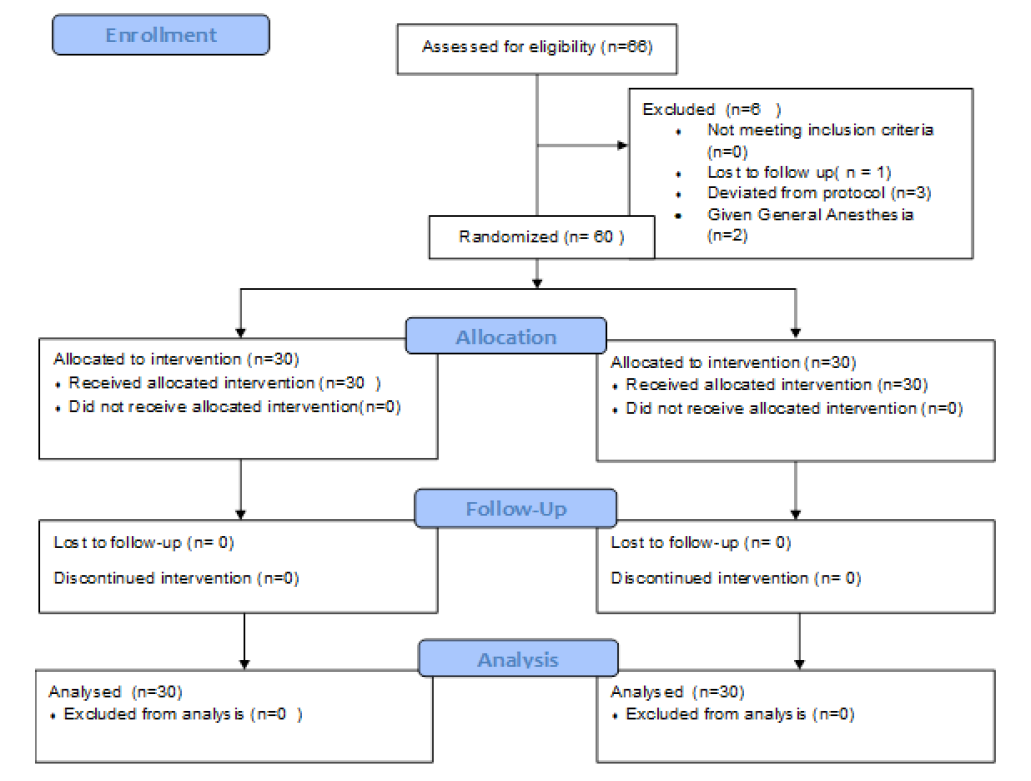
A total of 66 patients were screened (Figure 1). Six patients could not complete the study due to deviation from the prescribed analgesia protocol (n = 3), conversion to general anesthesia (n = 2) and lost to follow up (n = 1). Of the remaining 60 patients, 30 were randomized to receive TAPB with ropivacaine and 30 received TAPB with ropivacaine and clonidine. Patients’ baseline characteristics are shown in Table 1. The two groups were similar in terms of age, BMIs and duration of surgery. The time to request for first rescue analgesia was significantly prolonged in Group C (18.89±0.64 hrs) as compared to Group R (6.16±0.51 hrs) (p<0.001). The total amount of rescue analgesia used in the two groups was also statistically different. It was significantly more in Group R as compared to Group C. Mean VAS scores was significantly lower and patient satisfaction score higher in Group C (p<0.001). Nausea, bradycardia was not seen in any of the patients. Incidence of sedation and dry mouth was statistically insignificant in both groups (Table 2). In all the patients TAPB was successful without any complications like hematomas, bleeding, femoral nerve palsy or pain sensitivity at the site.
Table 1: Demographic Characters of the Patient and Duration of Surgery

| Parameters | Group R | Group C | p-value |
| Age (years) | 25±3.21 | 25.6±3.12 | 0.052 |
| Weight (kg) | 69.62±4.40 | 72.07±5.53 | 0.054 |
| BMI (kg/m2) | 29.98±1.13 | 30.10±1.14 | 0.38 |
| Duration of surgery (minutes) | 52.80±8.39 | 57. 77±13.32 | 0.057 |

Figure 1: CONSORT Flow Diagram
Table 2: Postoperative Outcome Parameters
| Parameters | Group R (n = 30) | Group C (n = 30) | p-value |
| Time to request for first analgesia (hrs) | 6.16±0.51 | 18.89±0.64 | <0.001 |
| Mean tramadol consumption (mg) | 327. 45±10.67 | 97.34±12.23 | <0.001 |
| Mean VAS score | 2.16±0.24 | 1.74±0.16 | <0.001 |
| Patient satisfaction score | 1.00±0.16 | 1.95±0.20 | <0.001 |
| Nausea, Bradycardia | 0 | 0 | - |
| Sedation | 2 (6.66%) | 5 (16.66%) | 0.034 |
| Dry Mouth | 1 (3.33%) | 3 (9.99%) | 0. 243 |
No patient developed postoperative complications such as infection or poor wound healing during hospitalization.
This randomized, double- blind, controlled trial demonstrated that the addition of clonidine to ropivacaine in single shot TAPB for cesarean section under spinal anesthesia prolonged analgesia by 17-18 hours and reduced the overall postoperative analgesic requirements by more than 200mg compared to ropivacaine alone.
Long acting neuraxial or patient controlled epidural/ intravenous opiods are the most efficient analgesia option after cesarean delivery but they are associated with respiratory depression, nausea, pruritis and decrease in bowel movements and secretion in breast milk8. Ultrasound guided TAPB offers a safe and effective means of providing successful block for postoperative pain management after various abdominal surgeries like open/laparoscopic appendectomy, caesarean section, total abdominal hysterectomy, laparoscopic cholecystectomy, open prostatectomy, renal transplantation etc with an advantage of direct visualization of the needle and accurate drug placement [9]. The TAPB aims at injecting local anesthetic agent in the plane between the internal oblique and transversus abdominis muscles thereby targeting the spinal nerves in this plane and hence interrupting the innervation to abdominal skin, muscles and parietal peritoneum4. Belavy et al. concluded that the patients undergoing TAPB using 0.5% ropivacaine 20 ml bilaterally had improved postoperative pain scores, reduced postoperative opioid consumption and higher patient satisfaction scores10. Time of request for first analgesia using ropivacaine alone in TAPB was variable in different studies. McDonell et al. used 1.5 mg/kg of ropivacaine in TAPB and duration of analgesia was 220 minutes (3.6 hours) which was significantly less than those receiving TAPB using saline [11]. However, it was significantly prolonged (11 hours) in the study done by Jadon A et al who used 40 ml of 0.375% ropivacaine for TAPB [12]. In our study, time of first analgesia request was about 6 hours which was similar to other studies [13]. A meta-analysis of randomised trial has shown that addition of clonidine to local anesthetics significantly prolongs the duration of motor block and postoperative analgesia when used for peripheral blocks [14]. The mechanism of prolonged effect of clonidine in TAPB is unclear because α2- adrenoreceptors are not present on the axon of the normal peripheral nerve. A complex interaction between clonidine and axonal ionotropic, metabolic, or structural proteins (receptors) may be responsible for its direct effect on the nerve fiber [15-16]. Another proposed mechanism for its action is the systemic absorption of the drug from the TAP [17].
In our study, we noted the time of request for rescue analgesia was significantly prolonged in group C as compared to group R. Our findings were in accordance to the studies by Hemlata et al and Kamal M who found that addition of clonidine prolonged the duration of analgesia in abdominal surgeries receiving TAPB with 0.2% ropivacaine [18-19]. In a study done by Singh et al. addition of clonidine to bupivacaine in TAPB for caesarean section reduced the requirement of postoperative rescue analgesia and prolonged analgesia by 10–12 hours [20]. Clonidine is found to have increased the duration of analgesia and decrease the opioid doses when added as adjuvant to local anesthetic in other studies as well [21-23].
In our study we found out that the VAS scores, number of opioid doses for rescue analgesia were significantly lower and maternal satisfaction scores of the patients in Group C were higher than Group R. Similar observations were made by other studies as well [19-23].
No incidence of nausea or vomiting was noted in either of our study groups. This was contrary to the findings of Hemlata et al and other authors who observed nausea in their study subjects [18,20-21]. This could be attributed to higher doses of clonidine used by them on the study groups (75µg). Our study groups had some amount of sedation and dryness of the mouth which could be attributed to the side effects of clonidine or the fasting status of the study parturients. The dose of ropivacaine used in our study (0.375%) is less as compared to the dose used in other studies [12]. It is because pregnancy can predispose to local anesthetic systemic toxicity (LAST). Furthermore, concomitant use of subarachnoid block for caesarean section leads to vasodilation (due to sympathetic blockade) that can predispose a pregnant female to systemic toxicity. Also, our centre does not have the facility to measure blood levels of ropivacaine. So, it is advisable to use lowest possible concentration of local anesthetic to achieve a successful block. So far, a few cases of complications with TAPB have been reported [24-25]. Even though the needle is visualized through ultrasound, its tip may at times not enter the plane and can lead to inadvertent intramuscular or intraperitoneal injection. To avoid these complications, visualization of the needle tip at all times during the block is warranted. The works of McDonnell et al. mentioned the possibility of liver injury and intraperitoneal injection of the drug following landmark- guided TAPB [26]. Till date, ultrasound guided complications have been seen by Jadon A et al. in one subject who had convulsions following the injection of the local anesthetic solution and by Lancaster and Chadwick in a patient with a liver laceration [12,27]. These complications can be prevented by careful aspiration and then injecting the drug. In our study, TAPB was successful in all the cases and no block related complications were noted in either of the study groups.
Our study was not without limitations. Firstly, we did not assess the pain on movement. Secondly, we assessed the postoperative analgesia requirements for the first 24 hours only. Thirdly, our findings cannot be generalized since the procedure was performed by one investigator only to decrease the variability in the performance of the block. Fourth, it was a small sized, single centre study. Larger trials would be required to assess the safety of the block and generalize the results. Also, we did not study the dose response relationship to find out if a lower dose of ropivacaine or clonidine would lead to same results. We did not follow the patients for long to note the incidence of chronic pain, if any. Also, we were unable to measure the onset time of TAPB because our patients did not fully recover from spinal anesthesia.
We conclude that the addition of clonidine 25μg to 20 ml ropivacaine 0.375% in TAPB bilaterally for cesarean section provides 17–18 hours of postoperative analgesia, decreases postoperative analgesic requirement, and increases maternal satisfaction compared to TAPB administration with 20 ml of ropivacaine 0.375% alone.
List of Abbreviations
TAPB, ASA, LSCS, VAS, IV, SPSS
Abbreviation Definition
Transversus Abdominis Plane Block, American Society of Anesthesiologists, Lower Segment Cesarean Section, Visual Analog Scale, intravenous, Statistical Package for the Social Sciences
Acknowledgements
None
Sources of Support
None
Conflicting Interest
None
Mankikar M.G. et al. "Ultrasound-guided transversus abdominis plane block for post-operative analgesia in patients undergoing caesarean section." Indian Journal of Anaesthesia, vol. 60, 2016, pp. 253–257.
Guo Q. et al. "Transversus abdominis plane block versus local anaesthetic wound infiltration for postoperative analgesia: A systematic review and meta-analysis." International Journal of Clinical and Experimental Medicine, vol. 8, 2015, pp. 17343–17352.
Boules M.L. et al. "Comparison of analgesic effect between erector spinae plane block and transversus abdominis plane block after elective cesarean section: A prospective randomized single-blind controlled study." Journal of Pain Research, vol. 13, 2020, pp. 1073–1080.
Rafi A.N. "Abdominal field block: A new approach via the lumbar triangle." Anaesthesia, vol. 56, 2001, pp. 1024–1026.
Young M.J. et al. "Clinical implications of the transversus abdominis plane block in adults." Anesthesiology Research and Practice, vol. 2012, no. 2012, 2012, pp. 731645–11.
Kirksey M.A. et al. "Local anesthetic peripheral nerve block adjuvants for prolongation of analgesia: A systematic qualitative review." PLoS One, vol. 10, 2015, e0137312.
Sun N. et al. "Postoperative analgesia by a transversus abdominis plane block using different concentrations of ropivacaine for abdominal surgery: A meta-analysis." Clinical Journal of Pain, vol. 33, 2017, pp. 853–863.
Wilwerth M. et al. "Spinal fentanyl vs. sufentanil for post-operative analgesia after C-section: A double-blinded randomised trial." Acta Anaesthesiologica Scandinavica, vol. 60, 2016, pp. 1306–1313.
Dhupia R. et al. "Effect of adding various doses of clonidine as an adjunct in transversus abdominis plane block in unilateral inguinal hernioplasty." International Surgery Journal, vol. 4, 2017, pp. 4039–4042.
Belavy D. et al. "Ultrasound-guided transversus abdominis plane block for analgesia after caesarean delivery." British Journal of Anaesthesia, vol. 103, 2009, pp. 726–730.
McDonnell J.G. et al. "The analgesic efficacy of transversus abdominis plane block after cesarean delivery: A randomized controlled trial." Anesthesia and Analgesia, vol. 106, 2008, pp. 186–191.
Jadon A. et al. "Role of ultrasound guided transversus abdominis plane block as a component of multimodal analgesic regimen for lower segment caesarean section: A randomized double blind clinical study." BMC Anesthesiology, vol. 18, 2018, p. 53.
Pratheeba N. et al. "Comparison of postoperative analgesic efficacy of wound site infiltration and ultrasound-guided transversus abdominis plane block with 0.5% ropivacaine in lower abdominal surgeries under spinal anesthesia." Anesthesia: Essays and Researches, vol. 12, 2018, pp. 80–84.
Pöpping D.M. et al. "Clonidine as an adjuvant to local anesthetics for peripheral nerve and plexus blocks: A meta-analysis of randomized trials." Anesthesiology, vol. 111, 2009, pp. 406–415.
Singh R. et al. "Addition of clonidine to bupivacaine in transversus abdominis plane block prolongs postoperative analgesia after cesarean section." Journal of Anaesthesiology Clinical Pharmacology, vol. 32, 2016, pp. 501–504.
Danelli G. et al. "Does clonidine 50 microg improve cervical plexus block obtained with ropivacaine 150 mg for carotid endarterectomy? A randomized, double-blinded study." Journal of Clinical Anesthesia, vol. 18, 2006, pp. 585–588.
Griffiths J.D. et al. "Symptomatic local anaesthetic toxicity and plasma ropivacaine concentrations after transversus abdominis plane block for caesarean section." British Journal of Anaesthesia, vol. 110, 2013, pp. 996–1000.
Hemlata et al. "Comparative evaluation of clonidine and dexamethasone as adjuvants to ropivacaine for ultrasound-guided transversus abdominis plane block." Indian Anaesthetists' Forum, vol. 22, 2021, pp. 53–59.
Kamal M. et al. "Comparison of pain scores and rescue analgesia required amongst subjects receiving ropivacaine and clonidine versus ropivacaine alone: An institutional based study." International Journal of Medical Research Professionals, vol. 5, 2019, pp. 171–174.
McCartney C.J. et al. "Should we add clonidine to local anesthetic for peripheral nerve blockade? A qualitative systematic review of the literature." Regional Anesthesia and Pain Medicine, vol. 32, 2007, pp. 330–338.
Acharya R. et al. "Comparative analysis of duration of postoperative analgesia between levobupivacaine and levobupivacaine with clonidine after ultrasound-guided transversus abdominis plane block in patients undergoing lower segment cesarean section." Anesthesia: Essays and Researches, vol. 12, 2018, pp. 943–948.
Singh R. et al. "Addition of clonidine to bupivacaine in transversus abdominis plane block prolongs postoperative analgesia after cesarean section." Journal of Anaesthesiology Clinical Pharmacology, vol. 32, 2016, pp. 501–504.
Sruthi B.M. et al. "Transversus abdominis plane block: comparison of efficacy of varying doses of clonidine combined with levobupivacaine—a double-blind randomized trial." Anesthesia: Essays and Researches, vol. 13, 2019, pp. 179–183.
Torup H. et al. "Potentially toxic concentrations in blood of total ropivacaine after bilateral transversus abdominis plane blocks: A pharmacokinetic study." European Journal of Anaesthesiology, vol. 29, 2012, pp. 235–238.
Griffiths J.D. et al. "Symptomatic local anaesthetic toxicity and plasma ropivacaine concentrations after transversus abdominis plane block for caesarean section." British Journal of Anaesthesia, vol. 110, 2013, pp. 996–1000.
McDonnell J.G. et al. "Transversus abdominis plane block: A cadaveric and radiological evaluation." Regional Anesthesia and Pain Medicine, vol. 32, 2007, pp. 399–404.
Lancaster P. and Chadwick M. "Liver trauma secondary to ultrasound-guided transversus abdominis plane block." British Journal of Anaesthesia, vol. 104, 2010, pp. 509–510.