Background: Dextrocardia is a rare congenital cardiac positional anomaly in which the heart is situated in the right hemithorax, with its apex directed toward the right side. When associated with situs inversus totalis, all thoracoabdominal organs are arranged in a mirror-image pattern. The incidence is approximately 1 in 10,000 live births, and most individuals remain asymptomatic until incidentally diagnosed during evaluation for unrelated conditions. Case Presentation: A 55-year-old hypertensive postmenopausal woman presented with complaints of bleeding per vaginum for two days. She was scheduled for hysteroscopic polypectomy and endometrial biopsy. During pre-anaesthetic assessment, dextrocardia was suspected on physical examination and confirmed by electrocardiography and chest radiography. Further evaluation with echocardiography and ultrasonography revealed dextrocardia with situs inversus totalis and normal cardiac function (EF 66%). The procedure was performed under spinal anaesthesia with appropriate monitoring and reversed ECG lead placement. The surgery and postoperative recovery were uneventful, and the patient was discharged on the first postoperative day. Conclusion: This case highlights the importance of thorough pre-anaesthetic evaluation, as dextrocardia may remain undiagnosed until incidentally discovered. Anaesthetic management of such patients requires special considerations including reversal of ECG leads, careful positioning of defibrillator paddles, and vigilance for potential associated anomalies. Awareness and appropriate perioperative planning ensure safe anaesthetic management in patients with dextrocardia and situs inversus totalis.
Keywords
Dextrocardia
Situs inversus totalis
Anaesthetic management
Hysteroscopic polypectomy
Case report
INTRODUCTION
Dextrocardia is a cardiac positional anomaly in which the heart is located in the right hemi thorax with its base to apex axis directed to the right and caudad[1]. The malposition is intrinsic to heart and not caused by extra cardiac abnormalities. Dextrocardia with situs inversus (situs inversus totalis) is a very rare congenital defect characterized by reversal of the position of the heart to the right side of the thoracic cavity along with all inversely rotated visceral organs (mirror image). It has an incidence rate of 1 out of 10,000 live births. The exact cause of dextrocardia is also unknown. However, it has been linked with a number of factors which include autosomal recessive gene inheritance, maternal diabetes, cocaine use and conjoined twinning. Equal ratio seen in both gender.
During embryological developmental 270 degree clockwise rotation instead of normal 270 degree anti clockwise of the developing thoracic abdominal organs result in mirror image positioning of abdominal and thoracic viscera [2]. Individuals with situs inversus are unaware of their unusual congenital anomaly until they seek medical attention for totally unrelated conditions. We report an unusual case of dextrocardia in a 55-year-old woman with post-menopausal bleeding posted for hysteroscopic polypectomy.
CASE REPORT
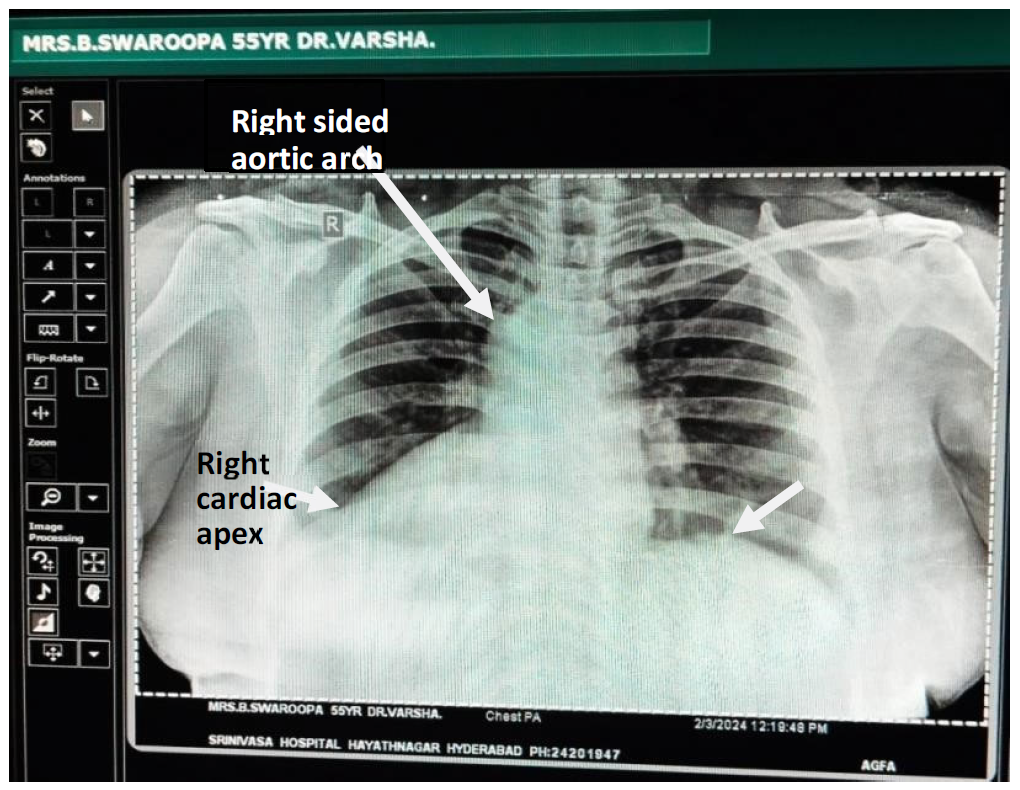
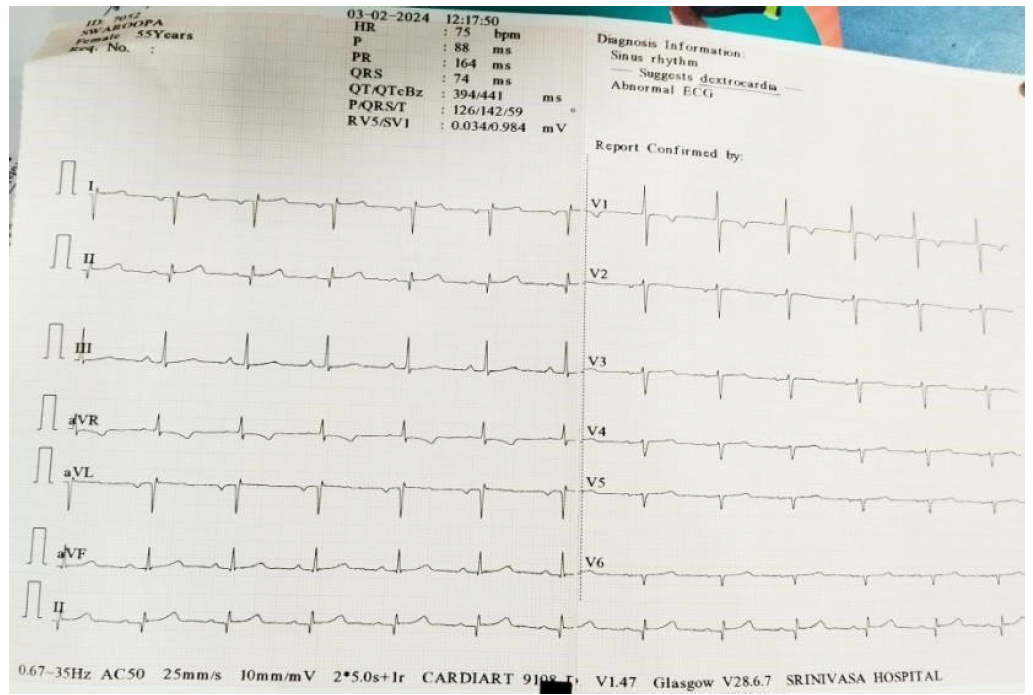
55 year female came with complaints of bleeding per vaginum since 2 days, associated with fatigue. Patient is a known hypertensive using antihypertensive medication (Tablet Telmisartan 40 mg once daily) since 2 years. She attained menopause 6 years ago. She had two full term normal deliveries. The consultant obstetrician planned for a hysteroscopy guided polypectomy and endometrial biopsy. While evaluating in the pre-anaesthesia clinic, patient gave a history of dyspnoea on brisk walking and while climbing stairs. Pulse rate:74/min, Bp 130/90 mm hg, Spo2 - 98% on room air. Airway examination and spine assessment were unremarkable. On examination, the apical impulse was felt in the right 5th intercostal space, right precordial bulge noted. On auscultation, heart sounds were not heard in the left 5th intercostal space, whereas they were heard in the right 5th intercostal space, normal vesicular breath sounds heard. Electro cardiograph revealed right axis deviation, low voltage QRS from V3-V6, positive QRS in aVR, absent R wave progression in the chest leads (dominant S waves throughout) suggesting dextrocardia. Chest x ray was done which confirmed dextrocardia with fundal gas shadow on the right side. Subsequent evaluation with cardiologist was done.2d echo showed EF: 66%, concentric LVH, dextrocardia. Ultrasound examination showed situs inversus of abdominal organs (Figure 1,2).
Figure 1: Chest X ray showing Dextrocardia
Figure 2: Electrocardiograph
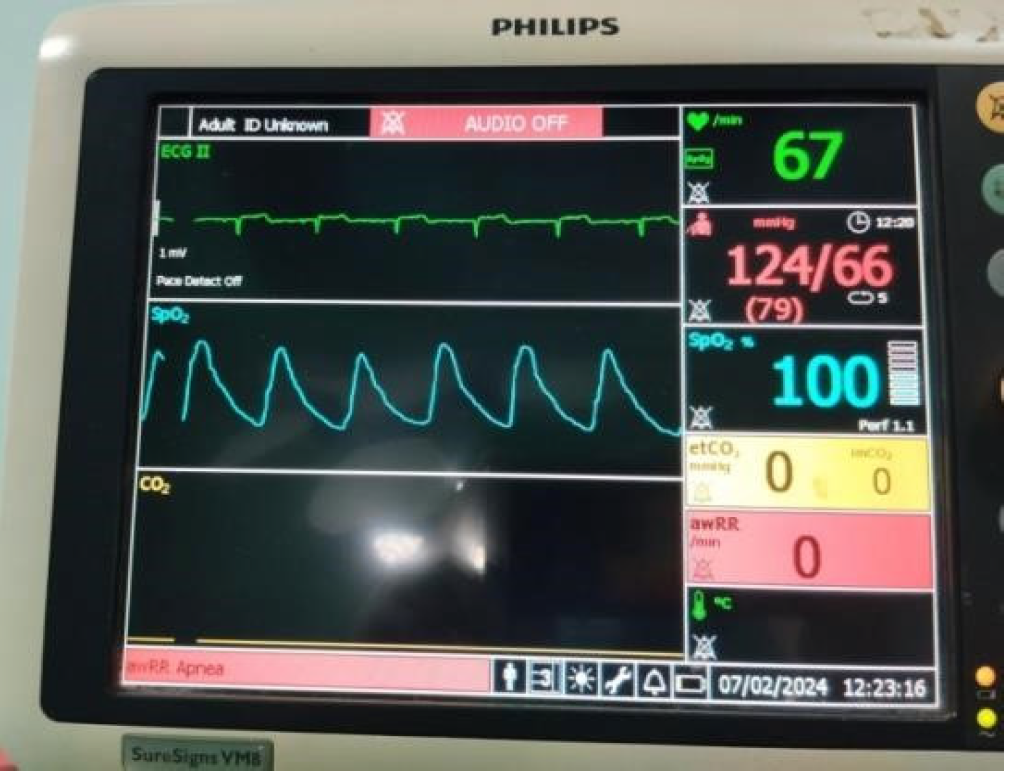
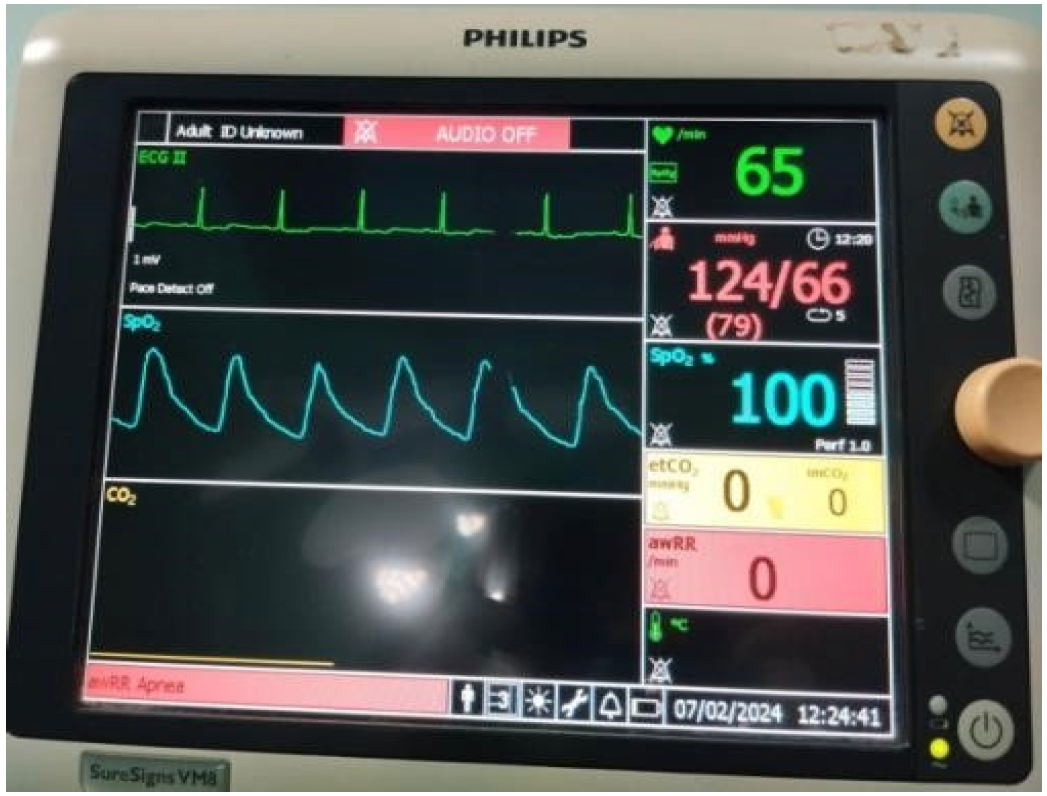
Patient was posted for hysteroscopic polypectomy and endometrial biopsy under spinal anaesthesia. Written informed consent taken. A wide bore 18 G cannula was secured, premedication with inj pantoprazole 40mg IV, inj ceftriaxone 1gm IV were given.3 lead ECG-electrodes were repositioned with reversal of leads, non-invasive blood pressure, pulse oximetry were connected. Under strict aseptic precautions, patient in sitting position, sub arachnid block was given in L3-L4 space with 27G Whitacre needle, inj bupivacaine (0.5 % heavy) 2.8 ml given. Sensory block of T6, motor block of T8 achieved. Under hysteroscopy guidance, wide based polyp arising from anterior wall and right lateral wall noted, polypectomy was done using a bipolar cautery. The surgical procedure was uneventful and post operative course was unremarkable. Tissue was sent for HPE which showed benign endometrial polyp, no evidence of granuloma/dysplasia (Figure 3,4).
Patient was discharged on first postoperative day, course was uneventful.
Figure 3: Intraoperative Monitor: 3 lead ECG in OT, LL electrode placed in the left 5th intercostal space
Figure 4: Intraoperative monitor: 3 lead ECG in OT, LL electrode in the right 5th intercostal space
DISCUSSION
Patients with dextrocardia pose unique challenges to the anaesthesiologists as well as to surgeons. Dextrocardia poses a considerable danger as it remains asymptomatic and normally remains undiagnosed unless diagnosed incidentally while investigating for another ailment. In our report, the diagnosis was made during pre-anaesthetic assessment. Dextrocardia can also be associated with heterodoxy syndromes, syndromes of asplenia and polysplenia with a tendency toward non cyanotic congenital heart defects. Situs inversus totalis with primary ciliary dyskinesia together known as Kartagener`s syndrome is characterized by the triad of situs inversus, chronic sinusitis, and bronchiectasis [3,4]. The challenge for the anaesthesiologist increases if it occurs with other syndromes like airway difficulties and pulmonary infections that can affect conduct of anaesthesia. However in this case, the patient was well without any history of sinusitis, chronic cough, and her chest was clinically clear.
This case report goes to confirm that an individual can be born with dextrocardia and if not associated with any syndrome can remain asymptomatic and only incidentally diagnosed during radiological investigation for an unrelated disease. Both General Anaesthesia and Regional anaesthesia techniques have been mentioned in these cases [5,6]. Cautious use of central venous catheter under ultrasound guidance should be used because of the likelihood of associated vascular anomalies. In the event of use of defibrillation, paddles should be placed in reverse position on the upper left and lower right of the chest. Case reports in which prolonged paralysis after administration of succinylcholine in patients with situs inversus totalis have been mentioned and hence it is prudent to avoid depolarising muscle relaxants. In preoperative evaluation of the patients with Kartagener's syndrome pulmonary function tests play an important role. Benefits of physiotherapy, incentive spirometry, antibiotics and bronchodilators should be used in the preoperative preparation of the patient. Avoid nasal intubation due to the associated sinusitis in these patients. Humidification of inspired gases should be performed to avoid viscid secretions [7].
CONCLUSION
Hence, an accurate diagnosis of situs inversus and dextrocardia, coupled with comprehensive pre-operative evaluation and knowledge, plays a pivotal role in minimizing potential complications. The management of patients with dextrocardia revolves around maintaining hemodynamic stability depending on the type and severity of the defect with concomitant attention to other organ systems which may be affected.
REFERENCE
Rapoport, Yury, et al. “Perioperative Implications and Management of Dextrocardia.” Journal of Anesthesia, vol. 29, no. 5, 2015, pp. 769–785. https://doi.org/10.1007/s00540-015-2019-7.
Bajwa, Sukhminder Jit Singh, et al. “The Challenging Aspects and Successful Anaesthetic Management in a Case of Situs Inversus Totalis.” Indian Journal of Anaesthesia, vol. 56, no. 3, 2012, pp. 295–297. https://doi.org/10.4103/0019-5049.98781.
Mathew, P.J., et al. “Anaesthetic Considerations in Kartagener's Syndrome: A Case Report.” Acta Anaesthesiologica Scandinavica, vol. 48, no. 4, 2004, pp. 518–520. https://doi.org/10.1111/j.0001-5172.2004.00357.x.
Sahajananda, H., et al. “General Anaesthesia for Lobectomy in an 8-Year-Old Child with Kartagener's Syndrome.” Paediatric Anaesthesia, vol. 13, no. 8, 2003, pp. 714–717. https://doi.org/10.1046/j.1460-9592.2003.01039.x.
Woods, Kaitlin E., et al. “Coronary Artery Bypass Grafting in a Patient with Dextrocardia with Situs Inversus.” Case Reports in Anesthesiology, vol. 2020, 2020, Article ID 8885881. December 2020. https://doi.org/10.1155/2020/8885881.
Rahman, Mustafizur, and Deepankar Sarma. “Successful Anesthetic Management of Laparoscopic Cholecystectomy in Patients with Situs Inversus Totalis.” Indian Journal of Clinical Anaesthesia, vol. 6, no. 2, 2019, pp. 304–306. https://doi.org/10.18231/j.ijca.2019.057.
Eapen, S., et al. “Anaesthetic Management for Laparoscopic Cholecystectomy in Patient with Situs Inversus Totalis.” Indian Journal of Anaesthesia, vol. 59, no. 1, 2015, pp. 57–58. https://doi.org/10.4103/0019-5049.149459.
Recommended Articles
Research Article
Evidence Guided, Experience Based and Patient Compatible 3-Step Protocol for Managing Moderate to Severe Category of COVID19 Infections
Farah Husain,
...
Kirti N Saxena
Published: 05/01/2021
Download PDF
Research Article
A Descriptive Cross-Sectional Study to Evaluate the Knowledge about Symptoms and Risk Factors for Heart Attack (Myocardial Infarction) Among the General Population of New Delhi
Aastha Sehgal,
...
Avneet Kaur
Published: 06/05/2023
Download PDF
Research Article
Knowledge About Risk and Preventive Factors for Osteoarthritis Knee among Ortho OPD Patients in Regional Hospital, Keylong in District Lahaul and Spiti of Himachal Pradesh
Ajay Thakur,
Jaspal Chaudhary
Published: 20/06/2022
Download PDF
Research Article
A Randomized Controlled Trial Comparing the Effect of Oral Preemptive Pregabalin Compared to IV Lignocaine in Attenuating Hemodynamic Response to Laryngoscopy
P. Aashik,
...
B.N. Reddy
Published: 17/05/2023
Download PDF
PO Box 101, Nakuru
Kenya.
Email: office@iarconsortium.org
Editorial Office:
J.L Bhavan, Near Radison Blu Hotel,
Jalukbari, Guwahati-India
Varsha, T. & Supriya, N. (2025). “Right Heart” on the “wrong side”? - Anaesthesia Management of Dextrocardia posted for Hysteroscopic Polypectomy. IAR Journal of Anaesthesiology and Critical Care, 6(2), 1-3.
MLA
Varsha, Tipparaju and N. Supriya. "“Right Heart” on the “wrong side”? - Anaesthesia Management of Dextrocardia posted for Hysteroscopic Polypectomy." IAR Journal of Anaesthesiology and Critical Care 6.2 (2025): 1-3.
Chicago
Varsha, Tipparaju and N. Supriya. "“Right Heart” on the “wrong side”? - Anaesthesia Management of Dextrocardia posted for Hysteroscopic Polypectomy." IAR Journal of Anaesthesiology and Critical Care 6, no. 2 (2025): 1-3.
Harvard
Varsha, T. and Supriya, N. (2025) '“Right Heart” on the “wrong side”? - Anaesthesia Management of Dextrocardia posted for Hysteroscopic Polypectomy' IAR Journal of Anaesthesiology and Critical Care 6(2), pp. 1-3.
Vancouver
Varsha T, Supriya N. “Right Heart” on the “wrong side”? - Anaesthesia Management of Dextrocardia posted for Hysteroscopic Polypectomy. IAR Journal of Anaesthesiology and Critical Care. 2025 Jul;6(2):1-3.



 Download PDF
 Download XML