Background: Cigarette smoke would contain 1016 free radical molecules per one puff. High levels of free radical could cause oxidative stress conditions and trigger lipid peroxidation in cell membranes which would produce malondialdehyde (MDA). If the level of MDA in the blood is high, then the levels of free radicals in the body will be high. To reduce MDA levels, antioxidants are needed. One of the natural antioxidants from outside the body is lemongrass (Cymbopogon citratus). Objective: This study aimed to analyze the effect of giving lemongrass leaf extract (Cymbopogon citratus) on the blood MDA levels of rats after exposure to cigarette smoke. Methods: It was used an experimental laboratory research with Pre and Post Test Control Group Design. This study compared the results of observations in the control and treatment groups after being made treatment and it compared the levels of MDA without any treatment with levels of MDA after being given treatment. The treatment administered by giving lemongrass (Cymbopogon citratus) leaves and exposure to cigarette smoke in rats, while the output was MDA levels in rat blood. Results: The group (K+) as a positive control group had the highest mean MDA level, which was 3.3620±0.69197. The negative group (K-) with only standard feeding had lower MDA levels when compared to the positive control group (K+), which was in the range of 0.3360±0.11216. Ethanol extract of lemongrass leaves (Cymbopogon citratus) provided the benefit of reducing MDA levels when given to a group of rats exposed to cigarette smoke with a total dose (P1) of 400 mg/kg BW with an average MDA level of 0.7268±0.33445 and (P2) 600 mg /kgBB with an average MDA level of 0.2200±0.07849. Conclusion: There is a difference in blood MDA levels of Wistar rats which were given lemongrass leaf extract (Cymbopogon citratus) with those of not treated with lemongrass leaf extract (Cymbopogon citratus). Thus, there are differences in blood MDA levels of Wistar rats exposed to cigarette smoke with those of not exposed to cigarette smoke.
Keywords
Ethanol Extract of Lemongrass Leaves
Exposure to Cigarette Smoke
MDA Serum
INTRODUCTION
Smoking is one of the main lifestyles that affect human health. Most smokers come from developing countries and low socioeconomic groups. Indonesia is the third country that has the highest number of active smokers in the world, namely 61.4 million smokers after China and India [1]. The Central Statistics Agency (BPS) of North Sumatra Province (Sumut) noted, based on the population of North Sumatra province, as many as 12,982. 204 people, data on the percentage of smokers aged 15 years in 2019 was 27.64 percent, then in 2018 it was 31.10 percent and in 2017 it was 28.47 percent [2].
Cigarette smoke is a source of free radicals. In one inhalation, smokers enter approximately 1016 free radical molecules and various chemicals tar, asbestos, H202, and others into their bodies [3]. Cigarette smoke can affect macrophage metabolism by activating macrophages to release leukotrienes B4, IL- 8, and TNF-α causing increased production of superoxide (O2-) and H2O2, also causing oxidative damage to macromolecules such as lipids, proteins, and DNA, can remove antioxidants and form free radicals such as nitric oxide (NO), nitric peroxide (NO2) in the gas phase as well as quinone (Q), semiquinone (HQ) and hydroquinone (HQ2) in the phase. The levels of free radicals that are greater than anti-oxidants in the body cause oxidative stress conditions and also trigger lipid peroxidation in cell membranes which will produce malondialdehyde (MDA). Thus, MDA levels can be used as a biomarker of free radicals in the body [3].
Lemongrass (Cymbopogon citratus) is one of the plants commonly used as a spice by the people of Indonesia. Lemongrass is rich in citral, which is commonly used by the fragrance and pharmaceutical industries, and bioactive compounds (flavonoid compounds and vitamin C) [4]. The presence of antioxidant activity in the ethanolic extract of lemongrass leaves is due to the content of phenolic compounds in lemongrass leaves which are compounds that prevent oxidation. The phenolic compounds contained in lemongrass leaves can prevent or inhibit the autoxidation process of fats and oils by capturing the free radicals produced during the fat propagation stage and donating their hydrogen radicals so that the fat radicals are not actively carrying out the propagation stage which will damage the fat [5].
MATERIALS AND METHODS
It applied an experimental laboratory research with the Pre and Post Test Control Group Design. This study compared the results of observations in the control and treatment groups after being given action and compares the levels of MDA when not treated with levels of MDA after being given treatment. The treatment given was by giving lemongrass (Cymbopogon citratus) leaves and exposure to cigarette smoke in rats, while the output was MDA levels in rat blood.
RESULTS
Phytochemical test results Lemongrass leaves with positive ethanol solvent contain alkaloids, saponins, flavonoids, tannins, triterpenes/steroids, and glycosides. From the results of observations, the results of the Alchaloids test with Bouchardart reagent the formation of a brick red color indicates a positive result, the results of the Saponin test with hot water then shaken indicate a color change to clear indicating a positive result, the results of the Flavonoid test with the reagent Mg Powder+Amyl Alcohol+HClp showed a color change to light yellow which indicated a positive meaning, and the results of the Glycoside test with Mollish reagent+H2SO4 showed a light yellow color change indicating a positive meaning.
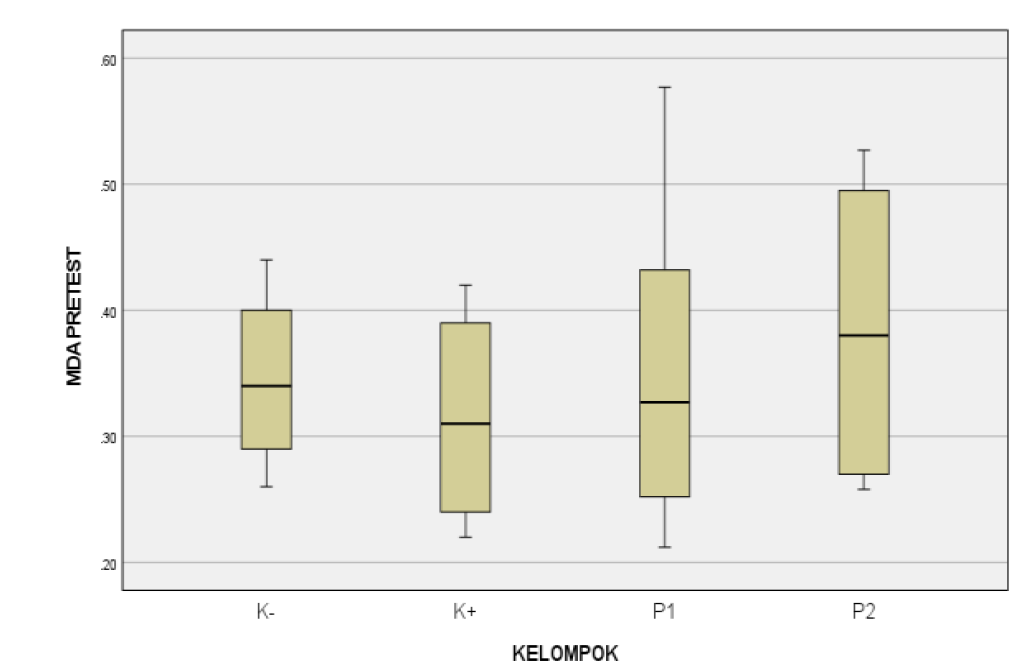
The normality test using Shapiro-Wilk resulted in a probability>alpha (5%) in the 4 pre-test and post-test groups. Then the homogeneity test was carried out using Levene and it was found that the data variance was homogeneous in Table 1 and Table 2.
One Way ANOVA statistical test at the 95% confidence level (p<0.05) showed that the MDA levels in the pre-treatment group (pre-test) did not have a significant difference with the p-value of 0.799 (p<0.05). The MDA levels of rats after being given treatment with ethanol extract of lemongrass leaves (post-test) showed a significant difference. Further analysis was carried out using Post Hoc Tukey HSD (Honestly Significance Different) to determine the level of difference in the influence of each group (Figure 1).
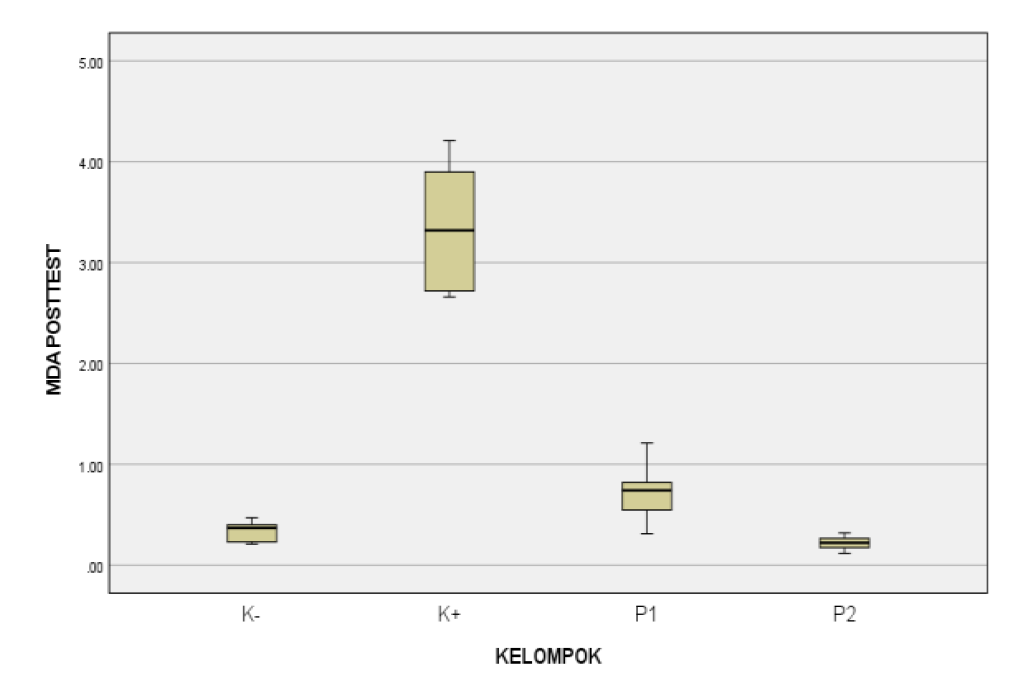
The results of the Post Hoc test for the MDA levels of post-test mice shown in Table 3 show that there are significant differences between the pairs of groups after being given treatment, namely the difference in MDA levels in the positive control group (K+) which was only exposed to cigarette smoke and the negative group (K-) which was only exposed to cigarette smoke. Given standard feed, treatment group 1 (P1) and treatment group 2 (P2). The MDA levels of mice in the negative (K-) group showed a significant difference with the positive control group (K+) and did not show a significant difference with treatment group 1 P1 which received ethanol extract of lemongrass leaves at a dose of 400 mg/kg BW per day and the treatment group 2 P2 who received lemongrass leaf extract at a dose of 400 mg/kg BW per day with p>0.05 (Figure 2).
Table 1: Phytochemical Test Results of Ethanol Extract of Lemongrass Leaves (Cymbopogon citratus)
Identification
Per / Reaction
Alkaloid
Dragendroff
Bouchardat
Meyer
+
+
+
Flavonoid
Mg powder + Alchohol Amil + HCl p
+
Glikosida
Molish + H2SO4
+
Saponin
Warm Water/shake
+
Tanin
FeCl3
+
Triterpen/Steroid
Lieberman-Bourchat
+
Table 2: Average Plasma MDA Levels (Pre-test)
Group
Average of MDA serum ± Std. Deviasi
K-
0,3460±0,07470
K+
0,3160±0,08849
P1
0,3600±0,14742
P2
0,3860±0,12414
Table 3: Average Plasma MDA Levels (Post-test)
Group
Average of MDA serum ±Std. Deviasi
K-
0,3360±0,11216
K+
3,3620±0,69197
P1
0,7268±0,33445
P2
0,2200±0,07849
Figure 1: Box Plot of Pre Test MDA Levels
Figure 2: Box Plot of Post Test MDA Levels
CONCLUSION
Rats were exposed to cigarette smoke as much as 2 sticks per berry and given 2 times a day at 8 am and 4 pm. Administration of 400 mg/kg BW ethanol extract of lemongrass leaves in treatment group 1 (P1) and 600 mg/kg BW in treatment group 2 (P2) for 21 days was effective in reducing serum MDA levels. If the treatment groups P1 and P2 were compared with the group that was exposed to cigarette smoke without being given ethanol extract of lemongrass leaves (K+), the decrease was statistically significant (p<0.05).
Suggestions
Further research is needed with a larger dose range to determine the effectiveness and toxicity of lemongrass (Cymbopogon citratus) leaves as an evaluation of its safety limit
Further research is needed on the bioactive content of the ethanolic extract of lemongrass (Cymbopogon citratus) which plays a role in reducing MDA levels in rats exposed to cigarette smoke
Further research is needed on the development of appropriate preparations for the ethanolic extract of basil leaves (O. citriodorum) into a product that can be used by the public
REFERENCE
Adyttia, A. et al. “Efek ekstrak etanol daun Premna cordifolia terhadap malondialdehida tikus yang dipapar asap rokok.” Pharmaceutical Sciences and Research, vol. 1, no. 2, 2016, pp. 104–115.
Kurniawan, R. and Soejoto, B.S. Pengaruh pemberian ekstrak jahe merah (Zingiber officinale var. rubrum) terhadap kadar MDA darah tikus setelah terpapar asap rokok. Doctoral dissertation, Diponegoro University, 2016.
Astuti, S. “Isoflavon kedelai dan potensinya sebagai penangkap radikal bebas.” Jurnal Teknologi dan Industri Hasil Pertanian, vol. 13, no. 2, 2012, pp. 126–136.
Gumilar, J. et al. “Kemampuan serbuk serai (Cymbopogon citratus) menekan peningkatan total bakteri dan keasaman (pH) dendeng domba selama penyimpanan.” Jurnal Ilmu Ternak Universitas Padjadjaran, vol. 17, no. 2, 2017, pp. 103–108.
Rizkita, A.D. “Efektivitas antibakteri ekstrak daun sereh wangi, sirih hijau, dan jahe merah terhadap pertumbuhan Streptococcus mutans.” Prosiding Semnastek, 2017.
Recommended Articles
Research Article
The Efficacy of 5- Fluorouracil Cream and 25% Podophyllin Solution in Treatment of Plantar Warts in Alternative Day Regimen ; An Open Therapeutic Trial.
Download PDF
Research Article
An evaluation of Profile of Medico-legal autopsies conducted at Dr. Radhakrishnan Govt. Medical College, Hamirpur, Himachal Pradesh
Download PDF
Research Article
Imaging Evaluation of Ultrasonography Versus Magnetic Resonance,
Imaging in Diagnosis of Carpal Tunnel Syndrome among Female Patients with Positive Nerve Conduction Study
Download PDF
Research Article
Twisted Truths: Public Awareness of Ligament Injuries and Sports-Related Orthopedic Trauma in Kangra
Subhodip Dutta ,
...
Vivek Berry
Published: 05/04/2025
Download PDF
PO Box 101, Nakuru
Kenya.
Email: office@iarconsortium.org
Editorial Office:
J.L Bhavan, Near Radison Blu Hotel,
Jalukbari, Guwahati-India
Chindy Clara, D. E., Lister, I. N. E. & Chiuman, L. (2021). Effect of Lemongrass Leaf Extract (Cymbopogon Citratus) on Blood Malondialdehyde Levels of Wistar Rats after Exposure to Cigarette Smoke. International Academic Research Journal of Internal Medicine & Public Health, 2(2), 1-3.
MLA
Chindy Clara, D. Elisabeth, I. Nyoman Ehrich Lister and Linda Chiuman. "Effect of Lemongrass Leaf Extract (Cymbopogon Citratus) on Blood Malondialdehyde Levels of Wistar Rats after Exposure to Cigarette Smoke." International Academic Research Journal of Internal Medicine & Public Health 2.2 (2021): 1-3.
Chicago
Chindy Clara, D. Elisabeth, I. Nyoman Ehrich Lister and Linda Chiuman. "Effect of Lemongrass Leaf Extract (Cymbopogon Citratus) on Blood Malondialdehyde Levels of Wistar Rats after Exposure to Cigarette Smoke." International Academic Research Journal of Internal Medicine & Public Health 2, no. 2 (2021): 1-3.
Harvard
Chindy Clara, D. E., Lister, I. N. E. and Chiuman, L. (2021) 'Effect of Lemongrass Leaf Extract (Cymbopogon Citratus) on Blood Malondialdehyde Levels of Wistar Rats after Exposure to Cigarette Smoke' International Academic Research Journal of Internal Medicine & Public Health 2(2), pp. 1-3.
Vancouver
Chindy Clara DE, Lister INE, Chiuman L. Effect of Lemongrass Leaf Extract (Cymbopogon Citratus) on Blood Malondialdehyde Levels of Wistar Rats after Exposure to Cigarette Smoke. International Academic Research Journal of Internal Medicine & Public Health. 2021 Jul;2(2):1-3.


 Download PDF
 Download XML