The effect of the Mectizan on the inhibition of bacterial growth was investigated. This was done in order to test the potency of this drug on bacteria growth due to its touted potency in the prevention of the replication of the SARS-CoV-2 virus that causes the COVID -19 and the possible use of this drug in antibiotic resistant bacteria. Clinical identified Oral bacteria, Staphylococcus aureus, Bacillus cereus, Citrobacter freundi and Enterobacter sp. were obtained from a preserved culture obtained from a recent work carried out in the Biological laboratory, faculty of sciences, Niger Delta University, Bayelsa State. The tested drugs Mectizan (Ivermectin) and Ampiclox (a positive control) were both gotten from a pharmaceutical store for the susceptibility test. The drug dose difference (3-9mg) as recommended per patients was not exceeded. Thus; 3mg/mL, 6mg/mL and 9mg/mL of Mectizan was impregnated on the tested organism and compared with the standard prescribed dose concentration of the positive control (500mg). The dose difference was tested with each of the oral pathogens: Staphylococcus aureus, Bacillus cereus, Citrobacter freudi and Enterobacter sp. The bacteria were stained with Ampiclox antibiotic and the zones of inhibition were measured after 24 hours of staining. Result of the investigation reveal that there was a significant difference (p<0.05) between the control (Ampiclox 500mg) and all dosage ranges of mectizan in bacteria inhibition of all the tested bacteria. There was no significant difference (p>0.05) in inhibition of bacteria growth with all doses of Mectizan on all bacteria types. However, higher inhibition rates were observed with increased drug doses. Mectizan had a higher inhibition on gram negative bacteria (Citrobacter freudi and Enterobacter sp) than gram positive bacteria (Staphylococcus aureus, Bacillus cereus) whereas Ampiclox had a higher effect on gram positive bacteria than gram negative bacteria. It can be concluded that Mectizan shows great promise either as an adjunct or replacement to antibiotics in the treatment of bacteria pathogen especially with increased dosage and sustained use.
There is a widening discuss in Nigeria and the entire world about the issue of Antimicrobial Resistance (AMR). Just like the COVID -19 pandemic, the world is fearful of the deadly and unrelenting surge of antibiotic resistant bacteria diseases. This fear is compounded by the fact that experts reveal that this may be the next big global health and developmental concern [1]. This issue is most critical in Nigeria and made worse by the problems of poverty, lack of awareness and a health sector begging for attention. Antimicrobial resistance is the cause of a growing number of infections such as pneumonia, tuberculosis, gonorrhea and salmonellosis [1].
To tackle this problem, many non-classical remedies and drugs have been employed and tried, some with limited success. These drugs range from herbal concoctions to known medications that were hitherto used for other purposes. Ivermectin is one of such known tested medication.
Ivermectin is an anthelmintic medication that is sold under the trade name Mectizan. It is used to treat certain parasitic round worm infections and it works by paralyzing and killing parasites. It is taken orally as a single dose or series of doses or as directed by a doctor [2]. Mectizan has potent antibacterial, antiviral and anticancer activity and also useful for the treatment of some chronic pathologies [3-5].
Given its touted efficacy and reputation as a wonder drug, there is an acute need to further test its efficacy on some strains of pathogenic bacteria. This study is therefore an attempt to gauge the in vitro inhibitory growth efficacy of the drug mectizan on some common pathogenic strains of bacteria. This will provide impetus for further action.
Sample Collection
The tested drugs Mectizan (Ivermectin) and Ampiclox (a positive control) were both gotten from a pharmaceutical store for the susceptibility test. Mectizan was one of the drugs used during the early part of the pandemic outbreak (COVID-19) and touted as a possible cure.
Sterilization
Glass wares were sterilized in an autoclave. Autoclave chamber water level was checked, then, switched on and the valve opened after 15 minutes, before the valve was closed to allow the gauge to rise to 121oC [6]. Glass wares were removed after being sterilized.
Microorganisms Used
Clinical identified Oral bacteria, Staphylococcus aureus, Bacillus cereus, Citrobacter freundi and Enterobacter sp. were obtained from a preserved culture obtained from a recent work. These organisms were re-cultured to obtain a pure culture and were inoculated each into a prepared nutrient Agar, before the impregnation of the tested drugs and incubated at 370C for the susceptibility testing.
Preparation of Sample
Preparation of Drug on Disc: The drug dose difference (3, 6 and 9mg) as recommended per patients was not exceeded. Thus; 3mg/mL, 6mg/mL and 9mg/mL of Mectizan was impregnated on the tested organism and compared with the standard prescribed dose of the positive control (500mg). The dose difference was tested with each of the oral pathogens Staphylococcus aureus, Bacillus cereus, Citrobacter freundi and Enterobacter sp.
Preparation of Antibiotic (Positive Control) Disc
The antibiotic used as control was Ampiclox (500mg), for respective bacterial as positive control. The discs were also gotten from whatman No.1 filter paper with size 6mm in diameter borer. The Ampiclox was dissolve in 1mL of deionized water to obtain a dilution and impregnated in quadruplet. All the discs were allowed to dry. The dishes were transferred aseptically to already set media containing the pathogenic microorganism. The essence of the control is to determine the degree at which the drug concentration inhibits the growth of the clinically isolated organisms [7].
Preparation of Filter Paper Discs
An oven sterilized cork borer (6mm) was used to cut uniform discs’ sizes from a Whatman Grade 1 filter paper. The cut discs were put into a Petri-dish plate and were sterilized for use, following standard techniques [6]. The discs were sterilized in hot air Oven at 1800C for 1 hour, after which they were allowed to cool with slight modification.
Preparation of Media
The primary media employed were nutrient agar (NA). All media were prepared according to manufacturer’s specification. Based on manufacturers instruction; 28g of nutrient Agar to 1000mL of distilled water. For 12 Petri-dishes, requires 6.7g of nutrient Agar into 240mL of distilled water. Therefore, 6.7g of nutrient Agar was weighed into 240mL of distilled water in a conical flask, well shaken, covered with aluminum foil and autoclaved.
Antimicrobial Susceptibility Testing
Susceptibility was determined using Agar disc diffusion method as described by Adeniyi et al, [8], Adenipekun et al. [9], Kigigha and Atuzie, [7]. Already set nutrient agar plates were inoculated aseptically with the serial dilution containing each of the test organisms and allowed to stand for 30 minutes, each of the plates were labeled appropriately with each test organism to avoid mix up. The impregnated disc containing each of the extracts was now placed aseptically on the respective media in quadruplicates using sterile forceps. The impregnated discs were well spaced on the confluent growth of the test organisms to prevent their zone of inhibition from over lapping. The inoculated nutrient agar plates were incubated for 24hour at 370C. Following incubation, the diameter of the zone of inhibition were measured with a ruler in millimeters (mm) and recorded.
Data Analysis
The means and standard deviations were calculated for all inhibitory values of mectazin doses and control. Analysis of variance (ANOVA) was employed to determine statistical differences and similarities between means at the 95% confidence limit. Turkey HSD Post HOC test was used to separate means and locate where the differences exist. This was aided by the use of SPSS® 20.0 statistical tool kit.
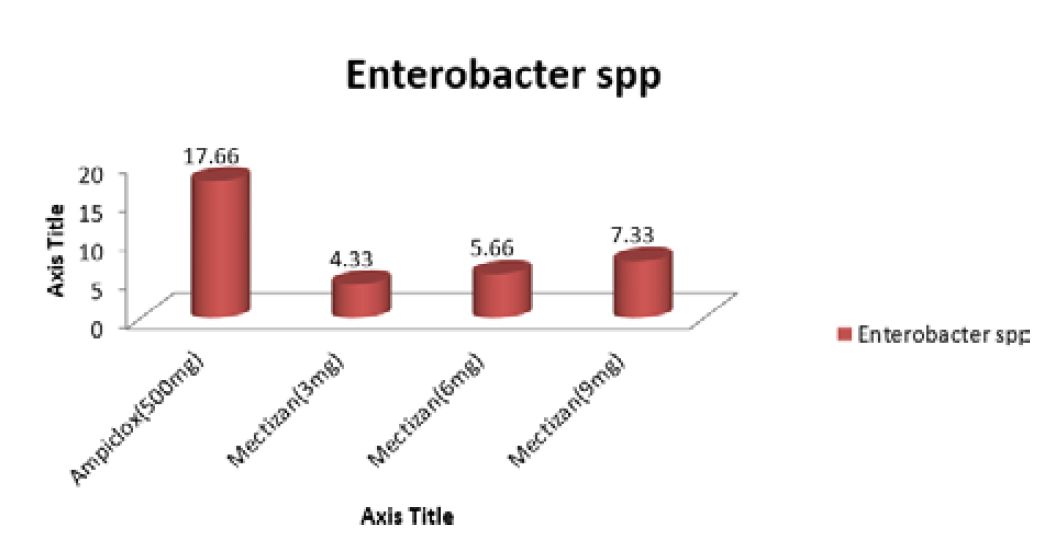
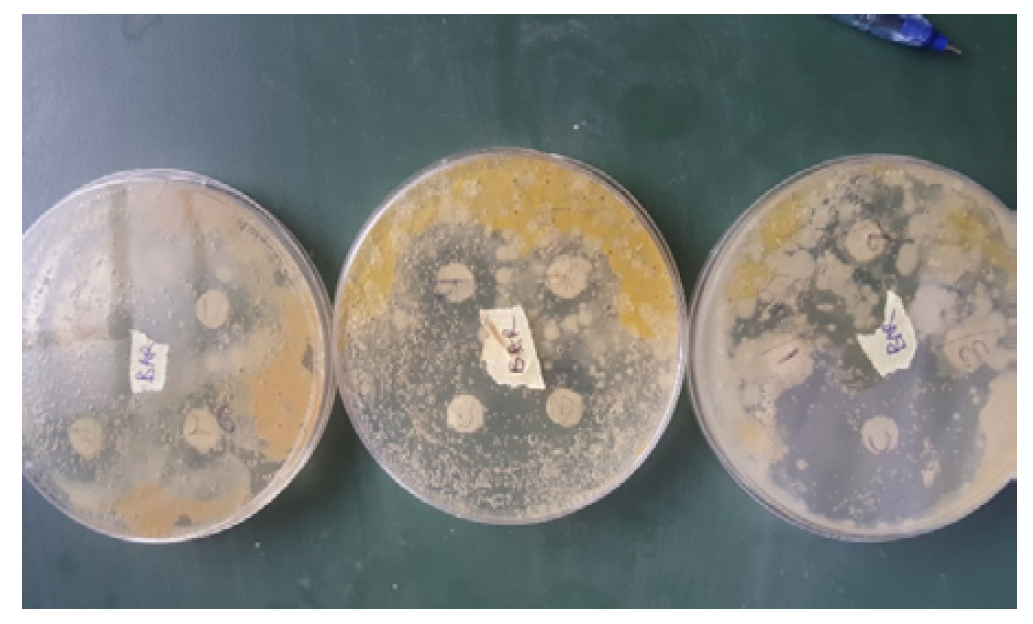
The result of the study is displayed in Table 1 and Figures 1–5. The inhibition rates of the various test bacteria were higher for the control (Ampiclox) than the different doses of ivermectin (mectizan). The rate of inhibition of these bacteria by ivermectin is dose dependent. Higher concentrations of ivermectin resulted in greater levels of bacteria inhibition. There is a significant difference (p<0.05) in inhibition rates of all the bacteria between the control treatment and all the other levels of treatment with ivermectin. There is however no significant difference (p>0.05) between all the different drug concentrations levels of ivermectin (Table 1) (Figure 1-7).
Table 1: Rates of Inhibition to Different Doses of Mectizan and Control (Ampiclox)
| Treatment | Staphylococcus | Bacillus cereus | Citrobacter freundii | Enterobacter spp |
| Ampiclox(500mg) | 17.33a±5.03 | 20.00 a ±3.60 | 16.66 a ±3.51 | 17.66 a ±4.16 |
| Mectizan(3mg) | 4.00b±1.00 | 4.33 b ±1.15 | 4.33 b ±1.527 | 4.33 b ±1.154 |
| Mectizan(6mg) | 4.667 b ±1.1547 | 5.33 b ±1.527 | 6.33 b ±1.527 | 5.66 b ±0.577 |
| Mectizan(9mg) | 5.66 b ±1.1547 | 6.66 b ±0.577 | 6.66 b ±1.154 | 7.33 b ±1.154 |
Means ± Standard deviation. Means with the same superscript along the same column are not significantly different (p = 0.05)

Figure 1: Rates of Inhibition of all Bacteria spp to Different Doses of Mectizan and Control

Figure 2: Rates of Inhibition of Staphylococcus to Different Doses of Mectizan and Control

Figure 3: Rates of Inhibition of Bacillus spp to Different Doses of Mectizan and Control

Figure 4: Rates of Inhibition of Citrobacter spp to Different Doses of Mectizan and Control
The result of the study indicates that the different doses of Mectazin tablet possess therapeutic (inhibitory) potentials on the different bacteria. This is in agreement with the findings of Ashraf et al, 2012 who also observed that ivermectin exhibited a potent anti-staphylococcal activity at the concentrations of 6.25 and 12.5 μg/mL against the two tested isolates used in their study.

Figure 5: Rates of Inhibition of Enterobacter spp to Different Doses of Mectizan and Control

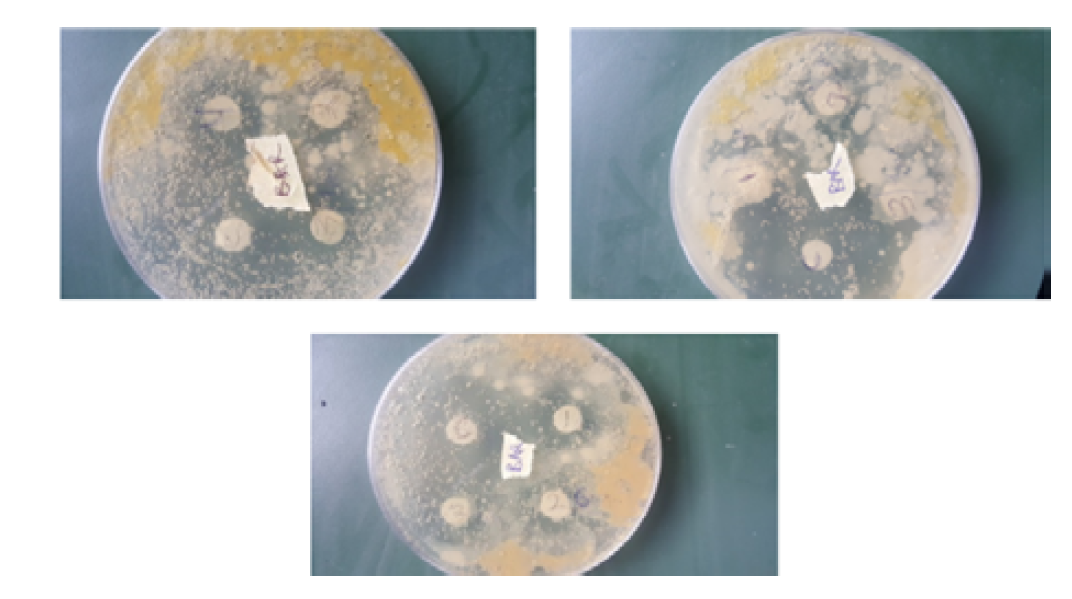
Figure 6: Some of The Culture Plates Exposed to Mectizan

Figure 7: Some Culture Plates Administered with Ampiclox and Mectizan
Interestingly, they further observed that only one of the isolates was sensitive to methicillin/cefoxitin. Their novel findings show ivermectin anti-bacterial effect against certain S. aureus isolates. Taormina et al, 2001 also reported similar findings in which they tested antibacterial activity from six floral sources of honey against Escherichia Coli, Salmonella thyphimurium, Shigella sonnei, Staphylococcus aureus and Bacillus cereus using disc diffusion method. Their findings showed the diameter of inhibition zones depends on the concentration of the honey used as well as on the type of tested pathogen.
In this study, the inhibition of bacteria growth indicates that gram-negative bacteria were more inhibited by the different doses of Mectizan as compared to gram-positive bacteria. Al-Namma, [10], also observed that honey has a great inhibitory effect on the gram-negative bacteria S typhi, P aeruginosa and E. coli. On the contrary, gram-positive bacteria were more inhibited than gram-negative bacteria with the administration of Ampiclox (control). Gram-negative bacteria have a thin peptidoglycan layer and an outer lipid membrane. Viruses also use lipids to modify their own protein as well as cellular factors to promote viral replication complex formation, production of new viral particles, viral egress and spread of infection. Since Mectizan have known properties to prevent in vitro replication of viruses in COVID-19 clinical studies, the higher inhibition for gram-negative bacteria observed in this study may be due to its affinity to bind and attack lipid cells. Mectizan acts as a bacteriostatic agent and is beneficial as the bacteriostatic antibiotics evade some problems related to bactericidal drugs. This impedes bacterial growth and enables the affected organism to produce protective immunity and thus results in immunological eradication of the bacteria [11].
However, the inhibition of gram-negative bacteria was lower than gram-positive bacteria with the use of Ampiclox antibiotic. Changes in the outer layer (membrane) by gram-negative bacteria like changing the aquaphobic properties or alterations in porins and other factors can create bacterial resistance [12]. Furthermore, endotoxins are released when bactericidal drugs kill t bacteria, which may be toxic to the affected organisms. The application of Ampiclox may have presented the avenue for passive resistance and host toxicity.
The study evaluated the growth inhibition potentials of different doses of Mectizan on some bacteria isolates. The result show that Mectizan has a dose related inhibition on the growth of bacteria (9gm>6gm>3gm). The result further revealed that Mectizan has greater inhibition potential on gram negative bacteria than the gram-positive bacteria. Conversely, Ampiclox (control) has a greater inhibition on the growth of gram-positive bacteria than the gram-negative ones. The Control drug (Ampiclox) exhibited greater growth inhibition of bacteria than the Mectazin Tablet. Given that Mectizan is administered therapeutically in continuous protracted doses over a long time, the growth inhibition potentials as observed in this study is bound to increase exponentially over time. Ampiclox (control) and all antibiotics are bactericidal while Mectizan is a bacteriostatic. The concomitant usage of antibiotics and Mectizan in combating pathogenic bacteria may be the way to go in the fight of drug resistant bacteria.
Acknowledgment
The authors would like to thank the Department of Biological Sciences, Niger Delta University for permission to use their laboratory and equipment therein.
WHO. Global Action Plan on Antimicrobial Resistance. WHO Document Production Services, Switzerland, 2020.
Lim L.E. et al. “Anthelmintic avermectins kill Mycobacterium tuberculosis, including multidrug-resistant clinical strains.” Antimicrobial Agents and Chemotherapy, vol. 57, no. 2, 2013, pp. 1040–1046.
Intuyod K. et al. “Anti-parasitic drug ivermectin exhibits potent anticancer activity against gemcitabine-resistant cholangiocarcinoma in vitro.” Anticancer Research, vol. 39, no. 9, 2019, pp. 4837–4843.
Ashraf S. et al. “Ivermectin exhibits potent anti-mitotic activity.” Veterinary Parasitology, vol. 226, 2016, pp. 1–4.
Ventre E. et al. “Topical Ivermectin improves allergic skin inflammation.” Allergy, vol. 72, no. 8, 2017, pp. 1212–1221.
Chesbrough M. District Laboratory Practice in Tropical Countries. Cambridge University Press, United Kingdom, 2010, pp. 157–199.
Kigigha L.T. et al. “Assessment of traditional medicinal application of Alchornea Cordifolia.” African Journal of Biotechnology, vol. 11, no. 8, 2012, pp. 2083–2086.
Adeniyi T.A. et al. “Investigating the phytochemicals and antimicrobial properties of three sedge (Cyperaceae) species.” Notulae Scientia Biologicae, vol. 6, no. 3, 2014, pp. 276–281.
Adenipekun P.A. et al. “Investigating the phytochemicals and antimicrobial activities of shoot and root of Pycreus smithianus (Ridl.) C.B. Clarke.” Journal of Botany, 2014. https://doi.org/10.1155/2014/761613
Al-Naama R.T. “Evaluation of in-vitro inhibitory effect of honey on some microbial isolate.” African Journal of Bacteriology Research, vol. 1, no. 6, 2009, pp. 064–067.
Krachler A.M. et al. “Targeting the bacteria–host interface.” Virulence, vol. 4, no. 4, 2013, pp. 284–294.
Miller S.I. “Antibiotic resistance and regulation of the gram-negative bacterial outer membrane barrier by host innate immune molecules.” mBio, vol. 7, no. 5, 2016, e01541–16.