Complementary feeding is defined as the practice of addition of solid, semi-solid or soft foods to infant’s diet once the infant reaches 6 months of age along with breastfeeding. According to NFHS-5, in Himachal Pradesh, 68.3% children aged 6-8 months are receiving solid or semi-solid food and breastmilk. Among children age 6-23 months only 19% are receiving an adequate diet. We have planned this study with the objective to assess the complementary feeding knowledge of Anganwadi workers (AWW) of Shimla city. Methods: We conducted a Cross-sectional study from 15th October 2021 to 15th October 2022 among 82 Anganwadi workers (AWW) of Urban Block, Shimla district of Himachal Pradesh. Anganwadi workers were interviewed on a structured, pretested and validated questionnaire. Collected data was entered into Microsoft excel spreadsheet and analyzed using Epi info version 7. Results: Mean knowledge score obtained in our study was 21.6±2.73, with 26 as maximum knowledge score and 14 as minimum score obtained. 46.3% of the Anganwadi workers had overall very good knowledge about complementary feeding practices but 52.4% of the workers does not know how to check the consistency of the complementary food given to infants and young children. 53.7% of the Anganwadi workers believe that non vegetarian food should not be given to children below 2 years of age. Conclusion: Reorientation trainings and workshops on complementary feeding practices from time to time would help in increasing the knowledge of Anganwadi workers about complementary feeding and will also improve their skills for proper implementation of complementary feeding practices in the community.
Complementary feeding is defined as the practice of addition of solid, semi-solid or soft foods to infant’s diet once the infant reaches 6 months of age along with breastfeeding. This is done to meet the nutritional and energy requirements of the infant due to increase in activity, as mother’s milk alone is no longer sufficient [1].
In India it is celebrated as Annaprashana, it marks a phase of exposure and discovery of new tastes, textures and smells [2].
Appropriate complementary feeding refers not only to the timely introduction of solid, semi-solid or soft foods but also for providing minimum adequate diet, minimum dietary diversity and minimum meal frequency [3]. Failure to introduce complementary foods or inappropriate complementary feeding practices during early life can negatively impact the growth of infants and young children and contribute to health-related problems such as delayed motor and cognitive development, nutrient deficiencies, infectious diseases or malnutrition [4]. About 66% of the under-five deaths are attributable to inadequate feeding practices, including undiversified and infrequent feeding [5].
According to the Child Nutrition Report 2021, 27% of children aged 6–8 months are not fed solid food. Among children aged 6–23 months, 48% are not fed with the minimum meal frequency, and 71 per cent do not have minimally diverse diets. The low consumption of nutritious foods is especially troubling: only 41% are getting the benefit of fruits and vegetables and 55% of eggs, fish and meat [6].
In Himachal Pradesh (NFHS-5), among children age 6-8 months 68.3% are receiving solid or semi-solid food and breastmilk. Among children age 6-23 months only 19% are receiving an adequate diet [7].
In NFHS-5 survey of district Shimla, only 69.9 % Children under the age of 6 months are exclusively breastfed. Only 18.3% of children (6-23 months) are receiving an adequate diet [8].
Anganwadi worker (AWW) is the community-based voluntary frontline worker of the ICDS program who is selected from within the community to serve the community at the grass root level [9]. The main function of the AWW is to spread awareness and educate the community regarding the nutrition of the antenatal women, lactating women and most importantly the infants and young children.
Complementary feeding practices differ from region to region, and from one community to another and influenced by the beliefs, social, cultural and economic factors exiting in the community [10]. Hence, the Anganwadi Worker (AWW) is the key person who can guide the mothers regarding appropriate infant and child feeding practices in the best possible way. Keeping in view the above points, this study has been planned with the objective to assess the complementary feeding knowledge of Anganwadi workers (AWW) of Shimla city.
We conducted a Cross-sectional study between 15th October 2021 to 15th October 2022 among Anganwadi workers of Urban Block, Shimla. There is total 82 Anganwadi centers under Urban Block, Shimla and we conducted the study among all the 82 anagnwadi workers of Shimla city.
Anganwadi workers were interviewed on a structured, pretested and validated questionnaire after obtaining their consent. The questionnaire was adapted from WHO’s Indicators for assessing infant and young child feeding practices (IYCF) [11] and Eat Right India handbook for the collection of data.
There was total 28 questions and a score of 1 was given for each correct answer thereby making a total score of 28. Knowledge score was further divided into 4 categories:
Score of >80% was considered Very good Knowledge,
60-80%- Good Knowledge,
40-60%- Fair Knowledge and
<40%- Poor Knowledge
Collected data was then entered into Microsoft excel spreadsheet and analyzed using Epi info software v7. Quantitative variables are expressed as mean and standard deviation. Categorical variables are presented in terms of frequency proportions.
In the present study conducted among 82 urban AWWs in Shimla, the Mean knowledge score obtained was 21.6±2.73 with Maximum score obtained is 26 and minimum 14 (Table1).
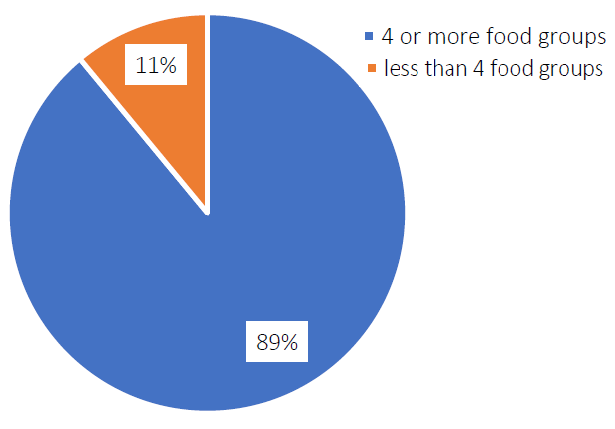
About minimum dietary diversity (MDD), 89% (73) of the Anganwadi workers knew that four or more food groups should be fed to the child in complementary feed (Figure 1).
Table 2 shows the various indicators of knowledge of AWWs regarding complementary feeding.
From the study we found that only 29.3% of the Anganwadi workers of the Shimla city knew about the minimum meal frequency (MMF) required by the children according to their age i.e. minimum number of times a child should be fed complementary feed and 70.7% did not know about MMF (Table3).

Figure 1: Knowledge about Minimum Dietary Diversity (MDD)
Table 1: Knowledge Score
Parameters | N | Percentage |
Very good knowledge | 38 | 46.3% |
Good knowledge | 41 | 50.0% |
Fair knowledge | 3 | 3.7% |
Poor knowledge | 0 | 0% |
Table2: Knowledge about Complementary Feeding Practices
S. No. | Knowledge | Correct N (%) | Incorrect N (%) |
What is exclusive breast feeding? | 82 (100) | 0 (0) | |
For how long a child can be given breastmilk | 68 (82.9) | 14 (17.1) | |
What is the right time to start complementary feeding | 16 (19.5) | 66 (80.5) | |
Can a child be given breastmilk along with complementary feed | 79 (96.3) | 3 (3.7) | |
At 6 months how many times a child should be given complementary feed in a day | 64 (78) | 18 (22) | |
How many times a child 6 months to 9 months of age should be given complementary feed in a day | 37 (45.1) | 45 (54.9) | |
How many times a child from 9 months upto 12 months of age should be given complementary feed in a day | 57 (69.5) | 25 (30.5) | |
How many times a child from 12 months upto 24 months of age should be given complementary feed in a day | 66 (80.50) | 16 (19.5) | |
At 6 months how much food is to be given to the child with each meal | 59 (72) | 23 (30) | |
From 6 months to 9 months how much food is to be given to the child with each meal | 60 (73.2) | 22 (26.8) | |
From 9 months to 12 months how much food is to be given to the child with each meal | 23 (28) | 59 (72) | |
From 12 months to 24 months how much food is to be given to the child with each meal | 75 (91.5) | 7 (8.5) | |
What should be the consistency of the complementary food | 68 (82.9) | 14 (17.1) | |
How to check the consistency of the complementary food | 39 (47.6) | 43 (52.4) | |
Can you add following items to the child’s food: Edible oils/Fats /ghee/butter | 81 (98.8) | 1 (1.2) | |
Can you add following items to the child’s food: Sugar/jaggery | 78 (95.1) | 4 (4.9) | |
Out of the following items, what can be given to the child: grains, roots and tubers | 67(81.7) | 15 (18.3) | |
legumes and nuts | 72 (87.8) | 10 (12.2) | |
dairy products (milk, yogurt, cheese) | 68 (82.9) | 14 (17.1) | |
flesh foods (meat, fish, poultry and liver/organ meats) | 43 (52.4) | 39 (47.6) | |
Eggs | 48 (58.4) | 34 (41.6) | |
vitamin-A rich fruits and vegetables | 82 (100) | 0 (0) | |
Non-vegetarian food can be given to the child | 44 (53.7) | 38 (46.3) | |
Is Hand washing necessary before preparing the food for the child | 82 (100) | 0 (0) | |
Is Hand washing necessary before feeding the child | 82 (100) | 0 (0) | |
A child can be given Complementary feed during illness | 80 (97.6) | 2 (2.4) | |
Coffee/tea can be given to the child in complementary feeding | 76 (92.7) | 6 (7.3) | |
Cold drinks/chips can be given to the child in complementary feeding | 80 (97.6) | 2 (2.4) |
Table 3: Knowledge about Minimum Meal Frequency (MMF)
MMF | N | Percentage |
Yes | 24 | 29.3% |
No | 58 | 70.7% |
Appropriate and timely complementary feeding (CF) is very important for the proper growth and development of the children below 2 years of age. Anganwadi worker is most crucial link for proper implementation of complementary feeding practices in the community. Hence, AWWs are required to have good knowledge about the complementary feeding practices so that they can educate the mothers about the right CF practices. In the present study, we found that all the anganwadi workers had knowledge about exclusive breast feeding and 82.9% of the AWW knew that child should be breastfeed for 2 years and beyond even if complementary feeding is started.
Only 19.5% of the AWW knew the right time to start the complementary feeding in children and the finding is not in correspondence with the study conducted by Anjali Mahajan et al. in Shimla in which 87% AWW knew about the right time to start the CF [12].
82.9% of the AWWs had knowledge about the right consistency of the complementary feed. In the similar study conducted by Amanjot K Singh et al. in urban Patiala only 22.8% of the AWW knew about the right consistency of the complementary feed [13].
From the current study we found that only 47.6 % knew how to check the consistency of the food. This may be due to the lack of practical workshops on IYCF practices for the skill development of AWWs. 89% of the AWWs had knowledge about the minimum food diversity (MDD) i.e. knew that 4 or more food groups should be given to the children and Only 29.3% of the AWWs knew about the minimum meal frequency (MMF)which is not in correspondence with a study conducted by Madhav Baburao Shinde et al. in which only 22.76% knew about MDD and 65.04% knew about MMF [14].
In our study 46.3% of the AWWs believe that non vegetarian food should not be given to children below 2 years of age. This may be due to the sociocultural beliefs of the AWWs as a community which needs to be addressed through trainings.
From the present study we conclude that almost all the AWWs of Shimla city have good knowledge about complementary feeding. But almost half of the AWWs believe that non-Vegetarian food should not be given to children below 2 years of age. Most of the AWWs does not know about the minimum meal frequency (MMF) and minimum adequate quantity required by the children according to their age group.
Recommendations
Periodic and refresher training sessions along with practical workshops for the skill development for AWWs should be organized focusing on timely initiation, consistency, density, dietary diversity of CF and bottle feeding. Adequate frequency and quantity of CF should also be focused on during training sessions as inappropriate feeding practices are one of the primary reasons which could be attributed to low energy and protein intake during complementary feeding. Harmful cultural beliefs and practices among AWWs should also be addressed through group discussion/trainings.
World Health Organization. Guiding Principles for Complementary Feeding of the Breastfed Child. World Health Organization, www.who.int/nutrition/publications/guiding_principles_compfeeding_breastfed.pdf. Accessed 15 Oct. 2022.
Ministry of Health and Family Welfare, Government of India. Journey of the First 1000 Days: Foundation for a Brighter Future. Rashtriya Bal Swasthya Karyakram, Apr. 2018, nhm.gov.in/images/pdf/programmes/RBSK/Resource_Documents/Journey_of_The_First_1000_Days.pdf. Accessed 15 Oct. 2022.
World Health Organization. Infant and Young Child Feeding: Model Chapter for Textbooks for Medical Students and Allied Health Professionals. World Health Organization, www.ncbi.nlm.nih.gov/books/NBK148967/.
Taha, Z. et al. “Complementary feeding practices among infants and young children in Abu Dhabi, United Arab Emirates.” BMC Public Health, vol. 20, 2020, article 1308, doi:10.1186/s12889-020-09393-y.
Ali, M. et al. “Complementary feeding practices and associated factors among children aged 6–23 months in Pakistan.” PLOS ONE, vol. 16, no. 2, 2021, e0247602, doi: 10.1371/journal.pone.0247602.
UNICEF. Fed to Fail: The Crisis of Children’s Diets in Early Life—Child Nutrition Report 2021. UNICEF, data.unicef.org/resources/fed-to-fail-2021-child-nutrition-report/. Accessed 15 Oct. 2022.
International Institute for Population Sciences. National Family Health Survey (NFHS-5), 2019–20: Himachal Pradesh Fact Sheet. iipsindia.ac.in, rchiips.org/nfhs/NFHS-5_FCTS/FactSheet_HP.pdf. Accessed 13 Oct. 2022.
International Institute for Population Sciences. National Family Health Survey (NFHS-5), 2019–20: Shimla District. rchiips.org/nfhs/NFHS-5_FCTS/HP/Shimla.pdf. Accessed 13 Oct. 2022.
Singh, A.K. et al. “Study of knowledge and skills of Anganwadi workers regarding breastfeeding and infant and young child feeding practices.” International Journal of Medical Science and Public Health, vol. 6, no. 3, 2017, pp. 515–520.
Mahajan, A. and K. Kaushal. “A study of knowledge, attitude, and beliefs of Anganwadi workers regarding infant and young child feeding practices.” Indian Journal of Community Health, vol. 26, suppl. S2, 2014, pp. 343–347.
World Health Organization. Indicators for Assessing Infant and Young Child Feeding Practices. World Health Organization, apps.who.int/iris/bitstream/handle/10665/43895/9789241596664_eng.pdf. Accessed 10 Oct. 2022.
Mahajan, A. and K. Kaushal. “A study of knowledge, attitude, and beliefs of anganwadi workers regarding infant and young child feeding practices.” Indian Journal of Community Health, vol. 26, suppl. S2, 2014, pp. 343–347, iapsmupuk.org/journal/index.php/IJCH/article/view/517/0.
Rochwani, Ritu and Aman Singh. “Perception and practices regarding complementary feeding among Anganwadi workers in Punjab, India.” International Journal of Community Medicine and Public Health, vol. 5, 2018, pp. 5205, doi:10.18203/2394-6040.ijcmph20184791.
Shinde, Madhav Baburao et al. “Study on Complementary Feeding Practices.” Journal of Medical Science and Clinical Research, vol. 3, no. 8, Aug. 2015, jmscr.igmpublication.org/v3-i8/49%20jmscr.pdf.