Introduction: Dengue fever is a common arthropod borne viral fever presenting with thrombocytopenia. There are number of study on thrombocytopenia and its correlation with severity of dengue fever, but results are conflicting. We want to study level of platelet count and its correlation with various complications of dengue like bleeding, DIC, hepatitis, shock etc. We would also like to evaluate platelet trends (increasing or decreasing) with various complication and outcome. Methods: It was prospective observational study over the period of one year. 90 Indoor patients with dengue with thrombocytopenia were studied after inclusion and exclusion criteria. Data entry and analysis was done in Microsoft excel through Descriptive statistic,’t’ test and chi-square tests. Results: In uncomplicated cases the mean platelet count was 54077±42277 and in complicated cases the mean platelet count was 29500±23197. This signifies platelet count were low in complicated dengue fever. This suggests that platelet count is surrogate marker of severity of dengue fever. With improving platelet count, most of patients survived, while patients with decreasing trend suggested poor outcome (p<0.01) with 53 time higher chances of expiring as compared to patient with increasing trend of platelet (odd ratio: 53.64). Severe thrombocytopenia was related with high mortality rate. Conclusion: From this study, we recommend that absolute platelet count & more specifically change in platelet count trend (increasing or decreasing) should be monitored closely as it can be used as a predictor of severity of dengue fever.
Keywords
Dengue Fever
Like Bleeding
DIC
Hepatitis
Shock
INTRODUCTION
Dengue fever is an arthropod borne viral fever. It is acquiring epidemic proportion in this part of word and it has become major public health problem with significant mortality. Estimates suggest that 50 million case of dengue infection and 500,000 cases of dengue hemorrhagic fever occur in Asian countries. It is vital to recognize the warning sign and symptoms, alteration in biochemical parameters and multisystem involvement pattern in dengue to reduce the mortality. In dengue fever thrombocytopenia occurs due to
Bone marrow suppression
immune mediated reaction by antiplatelet anti-body
endothelial dysfunction
There are number of study on thrombocytopenia and its correlation with severity of dengue fever, but results are conflicting. We want to study level of platelet count and its correlation with various complications of dengue like bleeding, DIC, hepatitis, shock etc.We would also like to evaluate platelet trends (increasing or decreasing) with various complication and outcome.
Aims and Objectives
Primary
Correlation of platelet count and its trend with itscomplications and outcome in Dengue fever
Secondary
To study various clinical manifestations of dengue
To study various complications of dengue fever including DHF and DSS
MATERIALS AND METHODS
The study was conducted among indoor patients admitted to our tertiary care hospital. It was prospective observational study over the period of one year.
Inclusion Criteria
All adult patients admitted with diagnosis of Severe Dengue Fever (WHO CRITERIA)
Clinical Criteria (Patient Live in Dengue Endemic Area)
Fever and 2 of the following criteria:
Anorexia and nausea
Rash
Aches and pain
Leukopenia
Tourniquet test positive
Warning sign-
Abdominal pain and tenderness
Persistent vomiting
Ascites/ pleural effusion
Mucosal bleed
Lethargy, restlessness
Liver enlargement> 2cm
Increase in HCT concurrent with rapid decrease in platelet count
Laboratory Criteria: (Confirmatory Criteria)
Dengue NS-1 Antigen detection {ELISA}
IgM ELISA (by paired sera)
Any one of the above
All patients >18 years of age willing to participates in this study
Exclusion Criteria
Fever with any other identified specific cause was excluded from the study.Dengue fever with any other identified specific cause was excluded from the study. (Mixed infection)Sample size calculated by considering the proportion of severe dengue fever 12.5%
p = 12.5%
q = 1-p
Zα/2 = level of significance= 95% =1.96
L = allowable error=7%
n = Zα/22pq = 4pq
l2 l2
=89
90 patients, who presented with clinical features such as fever, headache, joint pain, and bleeding manifestations admitted to hospital (WHO criteria of dengue fever) were included in the study
For all cases, IgM Dengue (by ELISA test) and Dengue NS-1 Antigen (by ELISA) were done
Data was entered in MS EXCEL Spread sheet and analyzed with the help of Openepi and spss software
RESULTS
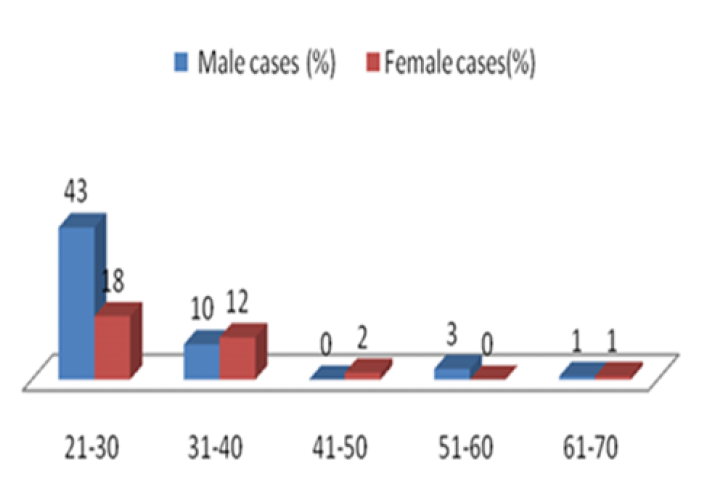
Above table and figure show, that in the age range of 21-30 years 75% males and 55% females were there. In the 31-40 years range 18% and 12%, in 41-50 years range 0% and 36%, 51 -60% range 2% and 0% and in 61-70 years range 2% and 3% males and females were there respectively (Table 1).
Table 1:Age-Wise Sex Distribution among Cases
Age in Years
Male cases (%)
Female cases (%)
21-30
43 (75%)
18 (55%)
31-40
10 (18%)
12 (36%)
41-50
0 (0%)
2 (6%)
51-60
3 (5 %)
0 (0%)
61-70
1 (2%)
1 (3%)
Total
57 (100%)
33 (100%)
Figure 1: Age Wise Sex Distribution among Cases
Maximum cases were between 20-40yrs of age. In the age group of >40 years, only 7% males and 9% females were there. Similar types of observation were there in study done by Keshva et al. (Table 2).
Above table and figure show that in the age range of 21-30 years 75% males and 55% females were there. In the 31-40 years range 18% and 12%, in 41-50 years range 0% and 36%, 51 -60% range 2% and 0% and in 61-70 years range 2% and 3% males and females were there respectively (Figure 1).
Maximum cases were between 20-40yrs of age. In the age group of >40 years, only 7% males and 9% females were there. Similar types of observation were there in study done by Keshva et al.
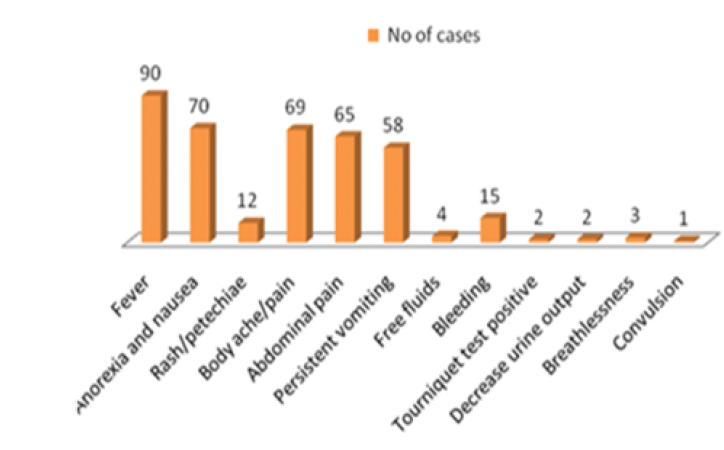
In present study, 90 (100%) cases presented with the complained of fever, 70 (78%) cases presented with anorexia and nausea, 69 (77%) cases presented with body ache and pain, 65 (72%) and 58 (64%) cases presented with abdominal pain and persistent vomiting respectively, 12 (13%) and 15 (17%) cases presented with rash/ patechaie and bleeding (haematemesis, malena, epistaxis) respectively, 4 (5%) cases presented with free fluids (pleural effusion, ascites), 3 (4%) cases presented with breathlessness, 2 (2%) and 2 (2%) cases presented with tourniquet test positive and decrease urine output respectively. 1 (1%) case presented with convulsion (Figure 2).
Table 2: Clinical Manifestations of Patients with Dengue Fever
Clinical features
No. of cases
Percentage
Fever
90
100
Anorexia and nausea
70
78
Rash/petechiae
12
13
Body ache/pain
69
77
Abdominal pain
65
72
Persistent vomiting
58
64
Free fluids
4
5
Bleeding
15
17
Tourniquet test positive
2
2
Decrease urine output
2
2
Breathlessness
3
4
Convulsion
1
1
Figure 2: Clinical Manifestations of Patients with Dengue Fever
Most common presenting clinical features was fever (100%) followed by anorexia, nausea, vomiting, abdominal pain and body ache. Other presenting features were bleeding, rash, patechaie, free fluids, breathlessness, and convulsion. Similar results were observed in a study conducted by Keshva el al and Agarwal A. In these studies, the most common presenting features were fever, nausea, vomiting, body ache, and pain in abdomen.
Similar results were observed in a study conducted by Md. Yousuf Khan et al. and C. Venkateshwarlu et al. In these studies, the most common presenting features were fever, nausea, vomiting, and pain in abdomen.
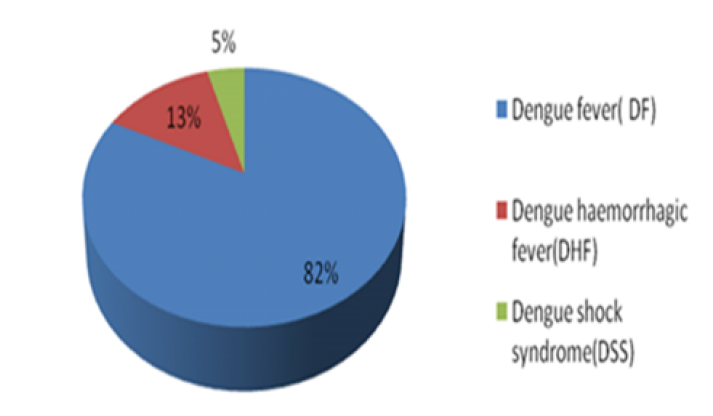
In present study, out of 90 cases, 74 (82%) were having dengue fever, 12 (13%) were having dengue hemorrhagic fever and 4 (5%) were having dengue shock syndrome (Table 3 Figure 3).
Table 3: Severity of Disease according to WHO Classification
Severity
No. of cases
Percentage
Dengue fever ( DF)
74
82%
Dengue haemorrhagic fever (DHF)
12
13%
Dengue shock syndrome (DSS)
4
5%
Figure 3: Severity of Disease according to WHO Classification
Similar results were seen in study done by Nandini Chatterjee et al. and Mainak Mukhopadhyay et al. in which 12% cases of dengue having DHF and DSS. DHF was found in 14% of the patients in study conducted by Vanamali D R et al. and 12.6% in study conducted by Sharma et al.
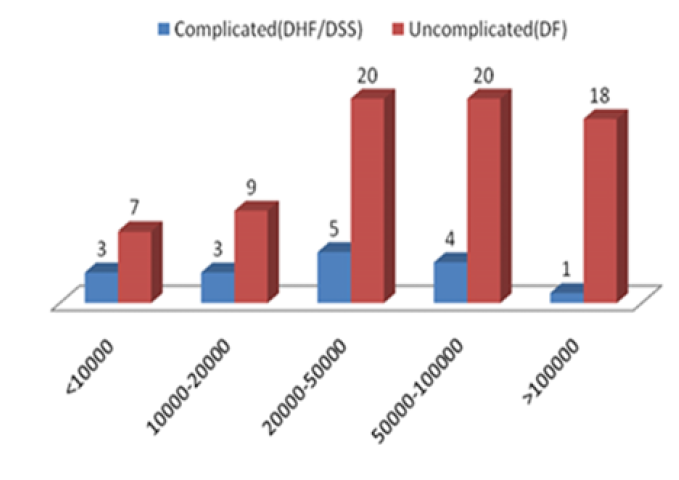
In present study, 3 (30%) cases having Platelet count <10000 developed complications and 7 (70%) were uncomplicated , 3 (25%) were having Platelet between 10000-20000 developed complication and 9 (75%) were uncomplicated, 5 (20%) were having Platelet between 20000–50000 developed complication and 20(80%) were uncomplicated, 4 (16%) were having Platelet between 50000-100000 developed complication and 20 (84%) were uncomplicated, 1 (5%) were having platelet count >100000 developed complication and 18 (95%) were uncomplicated (Figure 4 and Table 4).
Table 4: Distribution of Cases According to Lowest Platelet Count and Severity of Dengue Fever (DHF/DSS)
Lowest platelet count
Complicated (DHF/DSS)
Uncomplicated (DF)
<10000
3 (30%)
7 (70%)
10000-20000
3 (25%)
9 (75%)
20000-50000
5 (20%)
20 (80%)
50000-100000
4 (16%)
20 (84%)
>100000
1 (5%)
18 (95%)
Total
16 (18%)
74 (82%)
Figure 4: Distribution of Cases according to Lowest Platelet Count and Severity of Dengue Fever (DHF/DSS)
In uncomplicated cases the mean platelet count was 54077± 42277 and in complicated cases the mean platelet count was 29500±23197. This signifies platelet count were low in complicated dengue fever with statistical significance as compared to Uncomplicated dengue fever (p value<0.01). This was comparable with study done by K. Jayashreeet al.,G. C. Manasaet al.and P. Pallaviet al.
This suggests that complications are more commonly seen when there is severe thrombocytopenia.
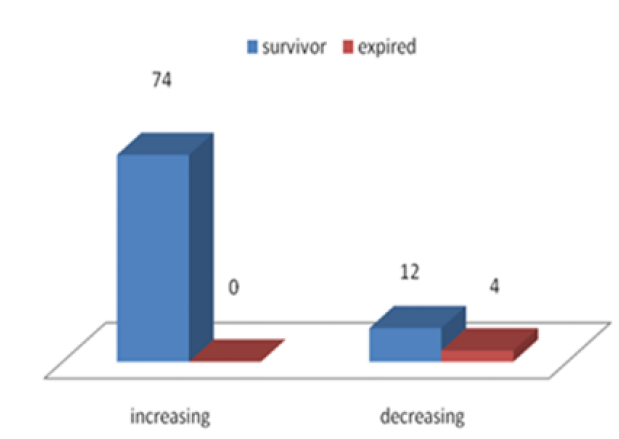
In present study, 74 cases showed increasing trend of platelet, out of which 74 (100%) survived. Total 16 cases showed decreasing trend of platelet, out of which 12 (75%) survived and 4 (25%) expired. This suggests that increasing platelet trend was associated with 100% survival rate. And decreasing platelet trend was associated with 75% survival rate and 25% mortality (Table 5 and Figure5).
Table 5: Platelet Trend in First 4 Days and Its Relation with Outcome
Platelet trend in first 4 days
No. of cases
Survivor (%)
Expired (%)
Increasing
74
74 (100%)
0 (0%)
Decreasing
16
12 (75%)
4 (25%)
Figure 5: Platelet Trend and Its Relation with Outcome
Platelet count is surrogate marker of severity of dengue fever. As platelet count improving, most of patient survived, while patient having decreasing trend suggestive of poor outcome. (p<0.01)
Patient with decreasing trend of platelet have 53 time higher chances of expiring as compared to patient with increasing trend of platelets. (Odd ratio: 53.64).
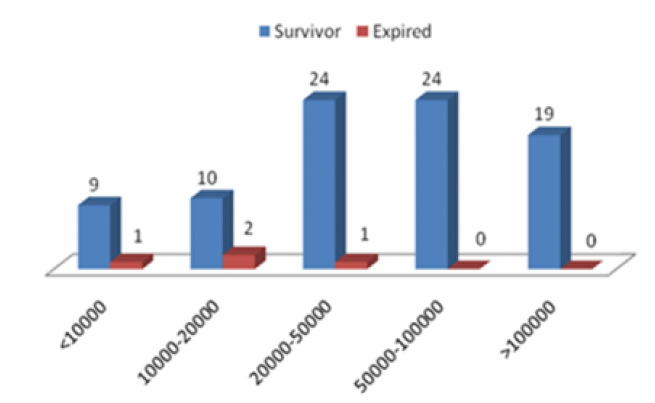
In present study, 10 cases were having lowest Platelet count <10000, in which 9(90%) survived and 1(10%) expired.12 cases were having lowest Platelet count between 10000-20000, in which 10 (84%) survived and 2 (16%) expired. 25 cases were having lowest Platelet count between 20000 – 50000, in which 24 (96%) survived and 1 (4%) expired. 24 cases were having lowest platelet count between 50000-100000, in which all patient survived and their was no mortality.19 cases were having platelet count >100000, in which all patient survived and their was no mortality. Thus severe thrombocytopenia was related with high mortality rate (Figure 6 and Table 6).
Table 6: Lowest Platelet Count Related with Outcome
Lowest Platelet count
No. of cases
Survivor
Expired
<10000
10
9 (90%)
1 (10%)
10000-20000
12
10 (84%)
2 (16%)
20000-50000
25
24 (96%)
1 (4%)
50000-100000
24
24 (100%)
0 (0%)
>100000
19
19 (100%)
0 (0%)
Total
90
86
4
Figure 6: Lowest Platelet Count Related with Outcome
DISCUSSION
Platelet Count at the Time of Admission, Compared with Other Study
In present study, 16% cases were having Platelet <20000, 19 (21%) were having Platelet between 20000 – 50000, 27 (30%) were having Platelet between 50000-100000 and 30 (33%) were having platelet count >100000 (Table 7-8).
This is comparable with study done by Md. Yousuf Khan et al. and C. Venkateshwarlu et al.
In present study, patients with platelet count <50000 had more chances to develop complicated dengue fever which is comparable to study by Navya B.N. et al.
Summary
The study was carried out at TERTIARY CARE HOSPITAL, Surat over the duration of one year in which, study of platelet counts and its correlation with severity of dengue fever was studied and analyzed
A total of 90 cases were studied
Most of the patients were between 21- 30 years. The second common age groups of patients were from the age group of 31-40 years. Mean age of the study population was 29 years
In our study, out of 90 cases, 57 (63%) were male and 33 (37%) were female
Most common presenting clinical features was fever (100%) followed by anorexia, nausea, vomiting, abdominal pain and body ache. Other presenting features were bleeding, rash, patechaie, free fluids, breathlessness, and convulsion
Out of 90 cases, 74 (82%) were having dengue fever, 12 (13%) were having dengue hemorrhagic fever (DHF), and 4(5%) were having dengue shock syndrome (DSS)
Increased bilirubin was not commonly seen in dengue fever and dengue hemorrhagic fever. It was increased only in dengue shock syndrome patients
Most of the patients of dengue were having mild elevation of liver enzymes. Out of these all the patients having SGOT/SGPT levels <1000 completely recovered, and 4 (50%) out of 8 patients with SGOT/SGPT >1000, expired
Most of the patients were found to have hemoglobin concentration in the range of 13 – 17 gm/dl
Hemoconcentration was not commonly seen with severe dengue fever in the present study. This may be because of low baseline Hb in the study population
One patient having WBC count<4000 expired. No mortality was seen in patients having WBC count between4000-11000. And 3 out of 6 patients expired
Table 7: Platelet Count at the Time of Admission, Compared with Other Study
Platelet count
Present study
Md. Yousuf Khan study
<20000
16%
15%
20000-50000
21%
41%
50000-100000
30%
28%
>100000
33%
16%
Table 8: The Lowest Platelet Counts and Severity of Dengue Fever (DHF/DSS) Compared with Other Study
in which WBC count >11000. Most of the patient who died had either leucocytopenia or leucocytosis
In uncomplicated cases the mean platelet count was 54077±42277 and in complicated cases the mean platelet count was 29500±23197. This signifies platelet count were low in complicated dengue fever.
This suggests that complications are more commonly seen when there is severe thrombocytopenia
Platelet count is surrogate marker of severity of dengue fever. As platelet count improving, most of patient survived, while patient having decreasing trend suggestive of poor outcome (p<0.01). Patients with decreasing trend of platelet have 53 time higher chances of expiring as compared to patient with increasing trend of platelet(odd ratio:53.64).Severe thrombocytopenia was related with high mortality rate
CONCLUSION
From This Study, We Conclude That
From this study, we recommend that absolute platelet count & more specifically change in platelet count trend (increasing or decreasing) should be monitored closely as it can be used as a predictor of severity of dengue fever.
REFERENCE
Bhatt, S. et al. “The global distribution and burden of dengue.” Nature, vol. 496, no. 7446, 2013, pp. 504–507.
Brady, O.J. et al. “Refining the global spatial limits of dengue virus transmission by evidence-based consensus.” PLoS Neglected Tropical Diseases, vol. 6, no. 8, 2012, pp. e1760.
Wilson, M.E. and L.H. Chen. “Dengue: Update on epidemiology.” Current Infectious Disease Reports, vol. 17, no. 1, 2015, pp. 457.
Kyle, J.L. and E. Harris. “Global Spread and Persistence of Dengue.” Annual Review of Microbiology, vol. 62, 2008, pp. 71–92.
Statler, J. et al. “Sonographic findings of healthy volunteers infected with dengue virus.” Journal of Clinical Ultrasound, vol. 36, no. 7, 2008, pp. 413–41
Recommended Articles
Research Article
Impact of GLP-1 Receptor Agonists on Cardiorenal Outcomes in Obese Patients with Type 2 Diabetes and Stage 3 CKD
Sayema Afroz,
...
Prianka Saha
Published: 21/04/2026
Download PDF
Research Article
An evaluation of Profile of Medico-legal autopsies conducted at Dr. Radhakrishnan Govt. Medical College, Hamirpur, Himachal Pradesh
Download PDF
Research Article
Imaging Evaluation of Ultrasonography Versus Magnetic Resonance,
Imaging in Diagnosis of Carpal Tunnel Syndrome among Female Patients with Positive Nerve Conduction Study
Download PDF
Research Article
The Efficacy of 5- Fluorouracil Cream and 25% Podophyllin Solution in Treatment of Plantar Warts in Alternative Day Regimen ; An Open Therapeutic Trial.
Download PDF
PO Box 101, Nakuru
Kenya.
Email: office@iarconsortium.org
Editorial Office:
J.L Bhavan, Near Radison Blu Hotel,
Jalukbari, Guwahati-India
Bochiwal, S. K., None, V. & shukla, D. (2022). A Study of Evaluation of Platelets as a Predictive Parameters in Severe Dengue Fever. International Academic Research Journal of Internal Medicine & Public Health, 3(1), 1-5.
MLA
Bochiwal, Sumit K., Vinod and Deepak shukla. "A Study of Evaluation of Platelets as a Predictive Parameters in Severe Dengue Fever." International Academic Research Journal of Internal Medicine & Public Health 3.1 (2022): 1-5.
Chicago
Bochiwal, Sumit K., Vinod and Deepak shukla. "A Study of Evaluation of Platelets as a Predictive Parameters in Severe Dengue Fever." International Academic Research Journal of Internal Medicine & Public Health 3, no. 1 (2022): 1-5.
Harvard
Bochiwal, S. K., None, V. and shukla, D. (2022) 'A Study of Evaluation of Platelets as a Predictive Parameters in Severe Dengue Fever' International Academic Research Journal of Internal Medicine & Public Health 3(1), pp. 1-5.
Vancouver
Bochiwal SK, Vinod V, shukla D. A Study of Evaluation of Platelets as a Predictive Parameters in Severe Dengue Fever. International Academic Research Journal of Internal Medicine & Public Health. 2022 Jan;3(1):1-5.


 Download PDF
 Download XML