This research determined the factors associated to the mental health state of the students in Congressional Integrated High School – Senior High School. Utilizing descriptive-correlational research design through the survey method, results reveal that sex is associated to the mental health state of the participants. Moreover, socializing through the different agents of socialization significantly improves the mental health state of the participants. The mental health state of the participants as well as the factors associated to it served as the variables in the study. It did not include the knowledge of the participants on mental health and their attitude towards people with mental health problems. The results of this study could serve as a basis in planning for a health promotion program essential in instilling among the students the importance of sustaining not only a fit body but also a healthy mind and soul.
Keywords
Mental Health
Senior High School
Health
Health Promotion
Depression
INTRODUCTION
It is essential that we value our mental health in every stage of our life. Nevertheless, we cannot avoid experiencing mental health problems that can potentially affect our mood, thoughts and behavior. According to MentalHealth.gov [1], many factors could contribute to the presence of mental health problem in a person. This includes biological factors, life experiences and family history of mental health problems. While we cannot really change how our body is programmed in terms of the mental health problems that may emerge in us genetically, we can still think of several ways to keep ourselves healthy and somehow prevent this kind of illness from being triggered in our system. Some ways include thinking positively, finding more time for relaxation and maintaining a healthful diet.
Adolescence has been described as a period of tremendous emotional mayhem. The transition from childhood to adulthood involves major physical, psychological, cognitive and social transformations which may be stressful to the adolescent. These transformational challenges are often associated with emotional instability which then leads to mental health problems such as depression. In the Philippines, one in five adolescents experience mental health problems [2]. The most common mental health problem being encountered by a Filipino adolescent is unipolar depressive disorder which has been reported to be related to blighted academic and social performance.
Congressional Integrated High School is a basic education institution in the city of Dasmariñas that caters instructional and social services among adolescents in the city. Since the start of the operation of its senior high school department in 2016, it expanded its span of clientele to those on the adolescent stage and even those in early adulthood. Because of the bulk of schoolwork, personal issues and other stressors present in their environment, the students indeed are not exempted from developing mental health problem without them knowing it. In fact, the department guidance and counselling services reported an increasing number of students manifesting depressive symptoms. This research endeavors to explore the factors that influence the mental health state of the students in CIHS. The findings herein can serve as a basis in developing the appropriate mental health program that is, as well, suitable in addressing the needs of the learners.
Research Questions
This study sought to answer the following questions:
What is the demographic profile of the participants in terms of:
Age
Sex
Religion
Grade and stand
Economic status
Companions at home
Engagement to vices
How engaged are the paticipants in dealing with the following:
Family
Peers
School
Media
What is the mental health state of the participants
Is there a significant difference in the mental health state of the participants when they are grouped according to their demographic profile
Is there a significant relationship between the participants level of socialization and their mental health state
MATERIALS AND METHODS
Research Design
This study employed descriptive-correlational research design through the survey and interview methods. As such, data were gathered from the identified participants through the use of a prepared set of data sheet and questionnaires. The prepared questionnaires contained questions that were all instrumental in addressing the research problems.
Locale of the Study
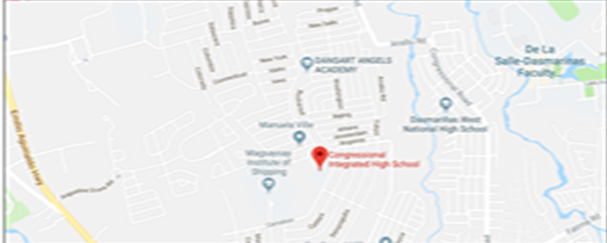
The study was conducted in Congressional Integrated High School in the city of Dasmariñas, Cavite. The school was formerly known as Congressional National High School. But since 2016, when senior high school was integrated into its grounds, the name was changed into what it is known in the present. Figure 1 shows the exact location of Congressional Integrated High School in the City of Dasmariñas.
Figure 1: Locator Map for Congressional Integrated High School
The participants of the study were the entire 1,096 senior high school students of Congressional Integrated High School during the Academic Year 2017-2018, consisting of 570 Grade 11 students and 523 Grade 12 students.
Research Instrument
A prepared questionnaire was used in the study. It was composed of various questions that were categorized into three sections: profile of the participants, influence of the different agents of socialization to the participants and assessment of the participants’ mental health state.
In the first part of the questionnaire, the participants’ profile was asked specifically, their age, sex, religion, grade and strand, economic status, companion at home and engagement to vices.
The second part of the questionnaire assessed the participants’ level of engagement to the following agents of socialization: family, peers, school and media. Twenty-five statements were given for the participants to rate according to their level of agreement using a four-point Likert scale.
The participants’ mental health state was assessed by using Beck’s Depression Inventory. It is a 21-item self-report inventory that measures the characteristic attitude and symptoms of depression among the research participants.
To ensure the validity and reliability of the research instrument developed, it was subjected to pilot testing involving 20 participants. It had been ensured that the internal consistency of the questionnaire was above 70 percent, as per Cronbach’s Alpha, before it was administered to the target participants.
Sampling Design
Total enumeration was done in identifying the number of the participants of the study. In doing so, all the members of the desired population automatically served as the participants of the study; provided, however, that they signify their willingness to take part in the research endeavor.
Operationalization of the Variables
For the demographic profile of the participants, categorization or clustering was done for their age, sex, religion, grade level and strand, economic status, companion at home and engagement to vices. This was as follows:
Age: Adolescent if 12-18 years old; young adult if 19-30 years old; and middle aged adult if 31-65 years old;
Religion: Any religious group or denomination where the participant confides to associate him or herself
Grade: Grades 11 and 12
Strand: Accountancy and Business Management (ABM), Humanities and Social Sciences (HUMSS), Science, Technology, Engineering and Mathematics (STEM), Cookery, Bread and Pastry and Food Service (CBF), Electrical Installation and Management (EIM), Technical-Drafting (TD) and Computer System Servicing (CSS)
Sex: Male and Female
Economic Status: Poor (less than PhP7,890 per month), low income (between PhP 7,890 to PhP 15,780 per month), low middle income (between PhP 15,780 to PhP 31,560 per month), middle class (between PhP 31,560 to PhP 78,900 per month), upper middle income (between PhP78,900 to PhP 118,350 per month), upper income (between PhP 118,350 to PhP 157,800 per month) and rich (at least PhP 157,800 per month)
Companion at Home: Immediate and extended family members, immediate family members only, extended familty members only and none
Engagement to Vices: Alcohol consumption, cigarette smoking, both alcohol consumption and cigarette smoking and none
The participants’ level of engagement to the different agents of socialization was determined by presenting 25 statements regarding the impact of each agent to the participants. The findings herein were obtained by computing for the mean score in reference to their answers on the 25 statements. The result was further categorized into ‘high engagement’ if the mean range is 3.25-4.00; ‘fair engagement’ if the mean range is 2.50-3.24; ‘little engagement’ if the mean range is 1.75-2.49; and ‘no engagement’ if the mean range is 1.00-1.74.
The mental health state of the participants was assessed by adding up all of the scores the participants gave on each item in the Beck’s Depression Inventory. The lowest possible score is zero while the highest is 63. The mental health state of the participant was stated depending on the category to which their score falls: ‘normal mental health state’ if the total score is 1-10; ‘mild mood disturbance’ if the total score is 11-16; ‘borderline depression’ if the total score is 17-20; ‘moderate depression’ if the total score is 21-30; ‘severe depression’ if the total score is 31-40; and ‘extreme depression’ if the total score is over 40.
Data Gathering Procedure
Before the actual conduct of the study, permission from the Office of the Principal was sought. As soon as the permission for the conduct of the study was granted, an informed consent was secured from all of the students in the high school. Before any participant gave his or her informed consent, it had been ensured that they had clear and explicit information on all the aspects of the study – the procedure to be followed and the reasons, the exact nature of the participants’ role; the risks and benefits involved; psychological stress and embarrassment; and the way in which the data would be handled and reported.
Upon having secured the participants’ informed consent, an arrangement with regard to their schedule was done so that the data gathering procedure would not interrupt any classes or any other school activities. When everything has been set, the questionnaires were administered to the participants for them to accomplish. Each participant was given 15-30 minutes to answer the questionnaire. It was emphasized that their responses are very vital for the study since the result of the study would serve as basis for a health promotion program of the school health services.
After the retrieval of the questionnaires from the participants, a one-on-one interview with the participants was conducted to validate their answer. The raw data were arranged and then encoded in a prepared database ready for analysis. The analysis and interpretation of data was done through the aid of an appropriate statistical tool. The related literatures collected were also used as bases to describe and validate the participants’ responses in the study.
Statistical Analysis
Descriptive statistics such as frequency, mean and percentage was used to describe the distribution of the respondents according to their profile and responses. Furthermore, suitable kinds of tables and figures were used to ensure clarity and intelligibility in the presentation of the findings.
In determining the significant difference on the mental health state of the participants in terms of to their demographic profile, Analysis of Variance (ANOVA) was used. Likewise, Pearson R was used to determine the significant relationship between the participants’’ level of socialization to the different agents of socialization and the mental health state of the participants.
RESULTS AND DISCUSSION
Participants’ Demographic Profile
The participants’ demographic profile was obtained in the first part of the data gathering. These was done to aid in answering the other research questions and, at the same time, provide some information to describe the sample used in the study. Such profile includes the participants’ age, sex, religion, grade level and strand, economic status, companion at home and engagement to vices. The findings herein were summarized in Table 1.
As per school records, there was a total of 1,096 senior high school students enrolled in Congressional Integrated High School, 570 of which were Grade 11 students while the remaining 523 were Grade 12 students. Upon administering the questionnaires, however, only 962 students completely supplied the information necessitated by the survey.
Age
Table 1 shows that the age of the participants ranges from 15 to 21 years old. Most of them are 17 years old (42%) while the least are 21 years old (1%). Considering the present educational system in the Philippines, where most children start going to school at five years old, it can be inferred that majority of the participants are of the ideal age in their current grade level.
The age group of most of the participants indicate that they are in the adolescent stage. Being in the adolescent stage implies that they are in the process of resolving the crisis between identity and self-diffusion, based on Erikson’s Psychosocial Theory. That is, an individual tries to explore his or her personality, capacities and abilities to finally decide what he or she would pursue in his or her later age [3]. According to Kellough and Kellough [4], significant increases in height, weight and internal organ size as well as changes in skeletal and muscular systems happen at this stage of life. Puberty likewise commences at this stage. Puberty, a phase of physiological change triggered by the release of hormones, begins in early adolescence. The onset of puberty is an intense developmental period with hormones signaling the development of primary sex characteristics (genitalia) and secondary sex characteristics (e.g., breast development in girls; facial hair in boys). Girls tend to mature one to two years earlier than boys [5].
The increased adrenal hormone production affects skeletal growth, hair production and skin changes [6]. These highly visible changes and disparate rates of maturity cause many young adolescents to feel uncomfortable about differences in their physical development [7].
The World Health Organization [8], stated that whilst most adolescents have good mental health, multiple physical, emotional and social changes, including exposure to poverty, abuse, or violence, can make adolescents vulnerable to mental health problems. In fact, they reported that mental health conditions account for 16 percent of the global burden of disease and injury in people aged 10–19 years. Half of all mental health conditions start by 14 years of age but most cases are undetected and untreated. Globally, depression is one of the leading causes of illness and disability among adolescents. Suicide is the third leading cause of death in 15–19 year olds. Sadly, the consequences of not addressing adolescent mental health conditions extend to adulthood, impairing both physical and mental health and limiting opportunities to lead fulfilling lives as adults.
Sex
Results of this research show that there are more females (51%) than males (49%) who participated in the study. Sex is a critical determinant of mental health and mental illness [8]. The morbidity associated with mental illness has received substantially more attention than the sex specific determinants and mechanisms that promote and protect mental health and foster resilience to stress and adversity. According to Magtubo [2], mental health conditions such as schizophrenia are found to be more common in males than in females in the Philippines. Suicide cases are also found to be more frequent in males than in females in the Philippines. Specific mental health disorders that greatly affect men are depression, anxiety disorder, schizoaffective disorder, acute and transient disorder and stimulant-related disorder.
Religion
Religion is as old as mankind. Primitive man had primitive religions and he worshiped the elements of nature like sun, earth, air, cloud, water. Advances in civilization led to institutionaliszed religions. Behere, Das, Yadav and Behere [9], mentioned that from mental health perspective, religion provides much-needed guidelines, which can help individuals to devise a course for their lives. Stresses and strains as well as uncertainties of life can be tolerated more easily by the believers. However, many outmoded rituals and belief systems might inhibit positive growth and may lead to mental ill-health.
In this study, majority of the participants are members of the three major Christian sects in the country: Roman Catholicism (73%), Protestantism (19%) and Iglesia ni Cristo (3 %). Only a percentage follows other religious dogmas such as Jehovah’s Witnesses, Islam, Aglipayan and Mormons. It is interesting to note, as well, that there are 40 participants who confessed not to profess any religion.
Grade Level and Strand
The study reveals that there are more Grade 11 students (55%) who participated in the study as compared to those in Grade 12 (45%). When arranged according to strand, it can be seen that students who are taking up STEM (26%) make up the highest percentage of the participants while the least are taking up CSS (5%). The result is not surprising since the school primarily caters strands in the academic track, including the STEM strand. Furthermore, CSS is a new program which is in its first year of offering hence; the small number of the students representing it in the survey.
Economic Status
The Philippine Statistics Authority, as cited by Albert et al. [10], classified Filipino families into classes according to their monthly family income upon conducting a Family Income and Expenditure Survey (FIES). Based from that classification results, this research shows that 37 percent of the participants came from a low income family class (income ranges from PhP 7,890 to PhP 15,780 per month) while two percent of them are from upper middle income family (income ranges from PhP31,560 to PhP 78,900) and high income family (income ranges from PhP 118,350 to PhP 157,800 per month) classes. It cannot be disregarded, however, that a large group of the research participants fall in the poor (26%) and low middle income (27%) classes of Filipino families.
According to Cummins [11], general economic insecurity is one factor that affects the mental health of an individual. This refers to conditions including poverty and unemployment. She cited that economic insecurity is frequently linked with stress which later develops into a mental health problem if not properly addressed. Such notion is supported by Rutter as he stated that significant associations between low Socio-Economic Status (SES) and mental disorder have been found throughout the developed world in studies of both adults and children.
Companion at Home
Among the participants, 67 percent averred that they live with their immediate family members, i.e., their parents and siblings while almost a quarter part of the participants stated that they live with immediate and extended family members. Extended family members refer to their grandparents, uncle and aunts and cousins. Interestingly, it can be seen that two percent of the participants live alone in their house. According to the participants, the reasons why they live alone in their house are the following: their parents are working abroad; only distant relatives are looking after them; and they are self-supporting students and their parents live in a far province. According to Barrett et al. [12], a person’s family structure influences the mental health state of a person. In their research, they found out that higher depressive symptoms can be present in adolescents from stepfamilies and single parent families with other relatives present, compared to mother-father families.
Engagement to Vices
Mental Health Foundation in the United Kingdom [1], mentioned that people believe that they become smokers and alcoholics because they want to relieve the depressive or anxiety symptoms that they experience in the presence of stressors. They, however, negated the idea, stressing that people usually become engaged to vices even before their problems begin. Engagement to vices does not necessarily lead to fewer symptoms of mental health problems in the long term. According to them, any short-term benefits that these vices offer to people are all outweighed by the higher probability of developing physiological infirmity, such as cancer and a more serious mental health problem.
In the study, it is noteworthy that almost all of the participants (91%) affirmed that they do not subscribe to any form of vices. Nevertheless, a considerable portion of them (7%) disclose that they are already regular alcoholic beverage consumers. There is even a percentage of them (6 participants) who consume alcohol and do cigarette smoking, at the same time. This is amidst identifying 15 participants who are smokers, as well
Level of Engagement to Basic Socialization Agents
Sawe [13], enumerated the four basic agents of socialization. These are family, peers, school and media. In this study, the participants’ level of engagement to each agent of socialization was determined since these are found to be beneficial in promoting mental health. According to Troyer [14], socializing boosts feelings of well-being and decreases feelings of depression. Research has shown that one sure way of improving one’s mood is to work on building social connections.
As shown in Table 2, the participants appear to be highly engaged in socializing with their family, peers and school while they appear to be fairly engaged in socializing to the mass media. In the midst of that, upon considering the mean score for each agent, it may be considered that they are most engaged in socializing with their family (x̄ = 0.59). This can be true since it is the family that is the first social institution where an individual experiences socialization.
Table 2: Participants’ Level of Engagement to Basic Socialization Agents
Agent
Mean
Sd
Interpretation
Family
3.48
0.59
High Engagement
Peers
3.38
0.55
High Engagement
School
3.37
0.57
High Engagement
Media
2.89
0.67
Fair Engagement
Sawe [13], stated that the family represents a person’s first emotional tie and it is by far the most significant agent of the socialization process. Children are entirely reliant on other people to survive and the parents assume the role of guiding them to be able to care for themselves. Parents or guardians provide children with their initial system of beliefs, norms and values and the system are based on their ethnic community, social status and religion among other factors. The system that parents inculcate on children normally has a profound effect throughout their lives including all asspects of their health.
Mental Health State of the Participants
The mental health state of the participants was measured using Beck’s Depression Inventory. It is a 21-item self-report inventory that measures the characteristic attitude and symptoms of depression among the research participants. In here, the participants were categorized into different mental health states based on the score that they obtained after answering the questionnaire.
The results of Table 3, show that majority of the participants (98%) have normal mental state. Nevertheless, it is remarkable that some of the participants are currently experiencing mild mood disturbance (15%), borderline depression (0.66%) and moderate depression (0.34%). Validating the answers of these participants with significant findings through a follow up interview reveals the following commonality in regard to their profile: most of them are female, under the academic track, not living with their immediate family, alcohol drinkers and of low income families.
Table 3: Mental Health State of the Participants
Mental Health State
Frequency (N = 962)
%
Normal Mental State
944
97
Mild Mood Disturbance
15
2
Borderline Depression
2
0.66
Moderate Depression
1
0.34
Majority of them consider either their peers or mass media as the agent where they are most engaged in terms of socialization. This result reflects the claims of the article Mental Health Issues Associated to Peer Pressure [15] and of Hurley [16], social scientist. The former stated that peer pressure has been one of the causes of depression among adolescents. This is because, according to them, most adolescents feel stressed because they suppress their likes, dislikes and attitude just to please others. These unresolved issues then lead to depression. On the other hand, the latter reported that too much engagement in different forms of media, more frequently on social media, causes eating and body image concerns among adolescents.
Further scrutiny revealed that the participants with significant findings experience frequent mood swings, i.e., feeling energetic to do tasks then suddenly shifting into being indifferent and passive in doing activities. Trouble falling asleep was found to be more frequent among those with borderline and moderate depression, compared to those with mild mood disturbance. Thoughts of committing suicide were also verbalized by those with borderline and moderate depression and by some of those categorized under mild mood disturbance.
Difference in the Mental Health State of the Participants According to their Demographic Profile
Table 4 presents the difference of the participants’ mental health state in terms of their demographic characteristics. As shown in the table, there is no significant difference in the mental health state level of the participants in terms of their demographic characteristics except for their sex. As shown in the earlier findings, there are more female students who confide to experience mental health issues. The results concur to the claim of the WHO [17], stating that adolescent females have a much higher prevalence of depression and eating disorders and engage more in suicidal ideation and suicide attempts than boys. The same was reported by Li et al. [18], considering a different perspective, who proposed that women might be more vulnerable to developing mental health problems because of their greater monthly and life-span fluctuations of hormones, which obviously cannot only modify neurotransmitters and neurosteroids, but also influence cognition and behavioural processes for the gender gap in these disorders. Such finding could also be because, when asked, women are more likely to report symptoms of common mental health problems than men [19]. In this study, girls are perceived to more readily disclose their feelings and thoughts than boys. An in-depth effort of interview and ecouragement was still necessitated to drive the boys to express their views and ideas about themselves.
Table 4: Difference in the Mental Health State of the Participants According to Their Demographic Profile
Characteristic
p-value*
Age
0.5
Sex
0.0006
Religion
0.08
Grade
0.4
Strand
0.7
Economic status
0.4
Companion at home
0.1
Engagement to vices
0.8
*Significant at α = 0.05
Relationship of the Participants’ Level of Engagement to the Different Agents of Socialization to Their Mental Health State
This part of the study reveals the possible relationship between the participants’ level of engagement to the different agents of socialization and their mental health state. According to Dombeck [20], socializing helps build an individual’s confidence, strengthen his or her sense that life has meaning and purpose and helps him or her get protected against the effects of stress and loss.
Likewise, Collier mentioned that human beings dream, learn, grow and work as part of society. The society where a person belongs indeed shapes his or her personal identity. Apparently, the influence of the different agents of socialization creates a considerable impact on the mental health state of an individual.
As indicated in Table 5, all of the agents of socialization have a significantly inverse relationship with the participants’ mental health state. This means that the participants’ tendency to develop depressive disorders lessens as they increase their socialization with others through the identified agents. The students can gain a more positive mental health state if they do not isolate themselves from others and if they learn to express their thoughts and viewpoints to others especially to those that are significantly influencing them. As revealed by Steger and Kashdan [21], people who are depressed may feel less of a sense of belonging and may withdraw from family and friends. Engaging in social activity, however, helps to decrease feelings of isolation and anxiety, while helping to increase social support. This research suggests that people with depressed mood react more strongly to social interactions (whether they are negative or positive) compared to those who are not depressed.
Table 5: Relationship of the Participants’ Level of Engagement to the Different Agents of Socialization to Their Mental Health State
Agent of Socialization
Pearson R Value
p-value*
Family
-0.15667
4.76 x 10⁻²⁶
Peer
-0.03962
8.52 x 10⁻¹⁵
School
-0.08199
0.001
Media
-0.01291
00.001
*Significant at α = 0.05
CONCLUSION
Based from the results obtained in the study, the following conclusions are formulated:
Most of the participants are 17-year old female Grade 11 STEM students belonging to low income earning families. Majority of them live with their immediate family members and currently do not engage in any form of vices
Family is considered as the most influential agent to the participants’ socialization
The participants generally have normal mental health state but there are some who report experiencing mild mood disturbance and borderline and moderate forms of depression
Sex is found to be associated to the mental health state of the participants
Socializing though the different agents of socialization significantly improves the mental health state of the participants
Recommendations
In light of the limitations and delimitations of the study, the following are hereby recommended:
A health program on mental health for the students may be implemented. The focus of the mental health program should be on gender difference and the importance of socialization in promoting mental health
The study may be replicated by involving the students in the junior high school department, school administrators, faculty members and staff as participants of the study
Related study may also be conducted which focuses on determining the knowledge and perception of the students on mental health. Their attitude towards people experiencing mental health problems should likewise be explored
The findings of this study may serve as reference for other researchers who are conducting studies pertinent to skin care and related disorders
Acknowledgment
The Author Would Like to Thank Everyone Who Were All Instrumental in The Completion of This Research Paper.
Magtubo C.A. “Mental health in the Philippines: By the Numbers.” Adolescent Mental Health, 2016, today.mims.com/mental-health-in-the-philippines--by-the-numbers.
Crain W. Theories of Development: Concepts and Application. Prentice-Hall, 2000, pp. 271–294.
Kellough R.D. and Kellough N.G. Teaching Young Adolescents: Methods and Resources for Middle Grades Teaching. 5th ed., Pearson Merrill Prentice Hall, 2008.
Caissy G.A. Early Adolescents: Understanding the 10 to 15 Year Olds. 2nd ed., Da Capo Press, 2002.
Dahl R.E. “Adolescent Brain Development: A Period of Vulnerabilities and Opportunities.” Annals of the New York Academy of Sciences, vol. 1021, 2004, pp. 1–22.
Simmons R. and Blyth D. Moving into Adolescence: The Impact of Pubertal Change and the School Context. Aldine Transaction, 2008.
Cummins E. “Effect of socioeconomic status on mental health.” 2018, study.com/academy/lesson/effects-of-socioeconomic-status-on-mental-health.html.
Barrett A.E. and Turner R.J. “Family structure and mental health: The mediating effects of socioeconomic status, family process and social stress.” Journal of Health and Social Behavior, vol. 46, no. 2, 2005, pp. 156–169, https://doi.org/10.1177/002214650504600203.
Li S.H. et al. “Why are women so vulnerable to anxiety, trauma-related and stress-related disorders? The Potential Role of Sex Hormones.” Lancet Psychiatry, November 2016, https://doi.org/10.1016/S2215-0366(16)30358-3.
Singleton N. and Lewis G. Better or Worse: A Longitudinal Study of the Mental Health of Adults in Great Britain. 2003.
Steger M.F. and Kashdan T.B. “Depression and everyday social activity, belonging and well-being.” Journal of Counseling Psychology, vol. 56, no. 2, 2009, pp. 289–300.
Recommended Articles
Research Article
The Efficacy of 5- Fluorouracil Cream and 25% Podophyllin Solution in Treatment of Plantar Warts in Alternative Day Regimen ; An Open Therapeutic Trial.
Download PDF
Research Article
An evaluation of Profile of Medico-legal autopsies conducted at Dr. Radhakrishnan Govt. Medical College, Hamirpur, Himachal Pradesh
Download PDF
Research Article
Imaging Evaluation of Ultrasonography Versus Magnetic Resonance,
Imaging in Diagnosis of Carpal Tunnel Syndrome among Female Patients with Positive Nerve Conduction Study
Download PDF
Research Article
Twisted Truths: Public Awareness of Ligament Injuries and Sports-Related Orthopedic Trauma in Kangra
Subhodip Dutta ,
...
Vivek Berry
Published: 05/04/2025
Download PDF
PO Box 101, Nakuru
Kenya.
Email: office@iarconsortium.org
Editorial Office:
J.L Bhavan, Near Radison Blu Hotel,
Jalukbari, Guwahati-India
Lucero, J. A. (2020). Students’ Demographics and Socialization as Correlates of their Mental Health. International Academic Research Journal of Internal Medicine & Public Health, 1(1), 1-7.
MLA
Lucero, Jeffrey A.. "Students’ Demographics and Socialization as Correlates of their Mental Health." International Academic Research Journal of Internal Medicine & Public Health 1.1 (2020): 1-7.
Chicago
Lucero, Jeffrey A.. "Students’ Demographics and Socialization as Correlates of their Mental Health." International Academic Research Journal of Internal Medicine & Public Health 1, no. 1 (2020): 1-7.
Harvard
Lucero, J. A. (2020) 'Students’ Demographics and Socialization as Correlates of their Mental Health' International Academic Research Journal of Internal Medicine & Public Health 1(1), pp. 1-7.
Vancouver
Lucero JA. Students’ Demographics and Socialization as Correlates of their Mental Health. International Academic Research Journal of Internal Medicine & Public Health. 2020 Jul;1(1):1-7.


 Download PDF
 Download XML