Online vehicle parking lot security system is proposed for vehicle thief prevention at different parking lot in the University premises. The reliability and effectiveness of the system is based on the information of the vehicle and vehicle owner stored in the database. This gives it the ability to identify the owner and the vehicle whenever he/she come to parked their vehicle. It is also able to record a stolen vehicle with full description of the vehicle and circumstances behind how the vehicle was stolen. The system has two categories of user, first is the system Admin who has full control of the system functionalities in one hand and on the other hand, The Security who is limited to certain functions like checking in and out of vehicles. The development of the system will be based on HTML, CSS and Bootstraps at the front end while PHP and MySQL at the back end.
Keywords
Parking Lots
Security System
Usmanu Danfodiyo University
University Settings
Vehicle
INTRODUCTION
In a simple term Security can be define as a situation which gives confidence and guarantee safety of lives and property in a given environment. The absent of this is what bring about Insecurity.
The issue of security is a matter of public concern in our society today. Looking at it from the National, regional and local level, the issue of protection of lives and properties have been a challenging one to our security agencies in this country and that is why it becomes necessary to all public places such as Governmental institutions Markets and even at Residential areas needs to find majors to look after their own security for them to feel more secured in their environment.
Our university, the Usmanu Dan Fodiyo University Sokoto (UDUS) been a public institution of learning, it received daily a substantial number of people for one reason or the other as student, staff and visitors as well and in this instance high number of vehicular movements are involve i.e., Buses, Cars and Motorcycles. Given to this the need to have adequate and well secured parking space cannot be over emphasized. However, the current situation indicate that parking space are not only in adequate but lack formidable and effective majors to ensure the safety of the vehicle been parked. Also, the security division of the University is lacking the capacity for detecting a possible incidence of stolen vehicle from the University premises. The current method been used of preventing tinted glass vehicle from getting into the University while for the other vehicle without tinted glass, the search remains only by opening the boots for physical assessment. These are the only observable means been taken by the University personnel.
In view of the security concern as explained above, this research feel it is desirable that an effective mechanism be put in place to provide a well secure parking lot that will mitigate any attempt to steal vehicle in and around the parking lot. This mechanism is what this research has in mind and wish to describe it as online vehicle parking lots security system. The proposed will greatly be an aid to security division in their surveillance and that will surely improve their capability and create a sense of security for cars and motorcycle owners coming into the University premises.
Related Works
Puspitasari et al. [1] resolved one of the card parking problem by using the internet of things perception. They built the system by using a smart card, machine-to-machine communication and cloud monitoring. The system integrates numerous nodes, including a sensor node and a gateway node, to record and display information about the parking lot's availability. They illustrates that the use of smart cards can stop illegal users from checking out or inspecting the parking area.
Alharbi et al. [2] contributed to the reducing traffic congestion in main centers during peak times by presenting the smart parking system through automatic detection of the vehicle number plate and supportive web system provision, in order to enable drivers to book in advance from anywhere and at any time before arriving at the intended parking location. This eliminates the need for drivers to look for a car park for a long time or being forced to park illegally.
Iqba et al. [3] introduced a Deep Learning based system where parking spaces are detected using Data Capturing Units. All the data are saved in real-time and can be accessed via mobile application. They also designed vehicle classification system that achieved an accuracy of 77% from numerous vehicle classes.
Yao et al. [4] designed an intelligent parking system using the Internet of Things technology and cloud platform to attain the highest utilization of space resources and the largest allocation rate of personnel deployment. Their web platform performs the joint operation of users and administrators to realize online reservation, parking at any time and online payment for car pickup at any time.
Tejas et al. [5] developed and implemented an automatic parking system that will enhance convenience of the public car parking zone as well as collecting parking charges automatically. Their system utilizes a camera as a sensor to obtain photos to show the residence of car parked using Python programming. It then uses OpenALPR algorithm technique for license plate extraction from car images and particular billing system to calculate the parking charges.
Singh et al. [6] employed linear Regression approach of Machine Learning to develop smart packing system that forecast and predict future parking price changes based upon the previous dataset. It enables the user to change the parking price according to his/her needs. It also describes different factors which directly or indirectly affects parking price.
Vishwanath et al. [7] proposed parking system that integrate the Wireless Sensor Technology with the Android Application so that the user can book or pre- book a slot. They enable vehicle owner to reserve a slot for his/her vehicle from anywhere and will be provided with a QR code which will be scanned on the entry of the parking area. It also provides information about the near-by parking areas and alerts when the current parking area is full.
Ali and Kurniawan [8] developed a system that helps car owners to arrange for parking spaces in malls online with web-based systems. They used descriptive research method, to present a complete depiction related to some of the variable situations examined. They also use primary and secondary data and object-oriented system techniques, which support the design of web-based information systems.
Garikapati and Chandra [9] introduced RFID based technique to resolve the unauthorized parking problem without considering the manpower. In their technique LCD display, sensors and GSM Modem were used. Also, SMS service plays a major role. By using RFID tags, they are able to identify the vehicle having a slot in parking lot or not.
Azshwanth et al. [10] proposed a smart and automated car parking model that will enable the users in booking their parking spaces in advance and the vehicle will be able to park automatically once in the parking zone. They make both the vehicle and the parking area built-in with sensors that will enable execution of safe and efficient way of parking.
Promy and Islam [11] developed a smart android based parking control application which enables drivers to find out a parking area in their nearby location. The mobile application will also enable them to pay the parking charge by online payment system. There is a counter in the application help them to count the amount of time their car have spent in the parking lot.
Chowdhury et al. [12] developed automated vehicle parking system and unauthorized parking detector. These include detection of permitted and non-permitted vehicles on the main gate, detection of unauthorized vehicle parking in the restricted zone thus sending SMS to the authority to take action and taking fine from the vehicle user. There are also parking lights which will be lit whenever a car enters a specific parking lot.
Nieto et al. [13] designed a multicamera system for vehicles detection and their corresponding mapping into the parking spots of a parking lot. They used existing parking lot security cameras for the proposed system after a simple configuration, without the need for a complete new camera deployment. Their designed system faces more complicated scenarios than the ones tackled in the state of the art. This limits their performance.
Somani et al. [14] implemented smart parking solution. Smart parking devices will be introduced to various parking spots that will be connected to the cloud and provide Real-time updated from the UHF installed sensors for available parking spaces for the user. A User-friendly app was developed for finding a parking space to booking space confirmation. The circuitry used in the whole operation is easily built and cost-effective for the organizations to implement it.
MATERIALS AND METHODS
Related works presented by expert in relevant field of study has been studied. The web-based application was implemented on a rational database system MySQL (MY Structured Query Language). Html (Hypertext Markup Language, CSS (Cascading Style Sheet) and jQuery were used to design the web-user interface, PHP (Hypertext Preprocessor) was used as the server-side script language to link the interface and the database.
Proposed Vehicle Packing Lots Security System for Vehicle Thief Prevention Design
After carefully studying the current system practice used for securing the vehicle in the Usmanu Danfodiyo University premises, a web based Vehicle Packing Lots Security System for Vehicle Thief Prevention is proposed in order to provide more reliable security to vehicle owners within the University environment. Due to the fact that the University is not well fenced, the control of vehicular movement is hard to maintain and so therefore, the need for provision of standard parking lots with efficient security at different building structure such as Library, Departments, Lecture Hall, MIS Buildings and also the Vice Chancellor (VC) complex should be created.
The operation of the proposed system aimed at automating the current system in order to provide more secure system of monitoring and surveillance vehicles of the University community.
The procedure of the new system first begins with Vehicle owner registration in which all owners will have to register their vehicles with the system. A vehicle owner can register as many vehicles as possible belonging to him or her, every vehicle is registered and tied to it Number plate which will help in preventing duplicated vehicle, if such instance exists, the vehicle should be impounded and investigated for stolen vehicle cases.
A user is registered ones and after registration the number of vehicles is added and registered to the user. To access any module or functionality of the system, the security officer will have to login and ones the he log-in, he is presented with the role and privileges assigned to him. During the vehicle registration, the make, model, type of vehicle (i.e., Motorcycle, Car), colour, Number plate is captured and also the image of the vehicle is also uploaded. The vehicle and user registration are done by the security staff assigned.
Vehicle Check-In
This module will be use to check in a vehicle into the available parking lots in the University. Since ones a vehicle and its owner are captured by the system, the owner can park at any parking lot within the University using the system. The student uses his/her admission number to check-in a vehicle i.e., ones the student admission number is inserted, the student details and the list of vehicles registered under his/her will appear. The vehicle is identified and then checked-in. Same process is also use for staff only that for staff, the staff number is use to identify the staff and the vehicle registered under him.
For a visitor, the system prints a parking lot card which will contain a unique auto generated ID in place of the Staff/Admission Number which will be issued to the visitor. The visitor come along with it at the time of checking out. The parking lot card expires once after checking-out and cannot be use by the visitor again. A visitor can belong to two categories.
Vehicle Check-Out
When the owner of vehicle come to check-out his vehicle at the end of his activities in the University, the vehicle owner is identified and then is allowed to check-out. A different person cannot check-out a vehicle without any reason stated on the check-out module, the list of all vehicle check-in appears, with a search option to search by Number plate or Staff/Student parking lot ID so as to filter the list and make check-in vehicles easily identifiable from the pool of check-in vehicle. Once a vehicle is check-out, it disappears from the list.
USE CASE Diagram
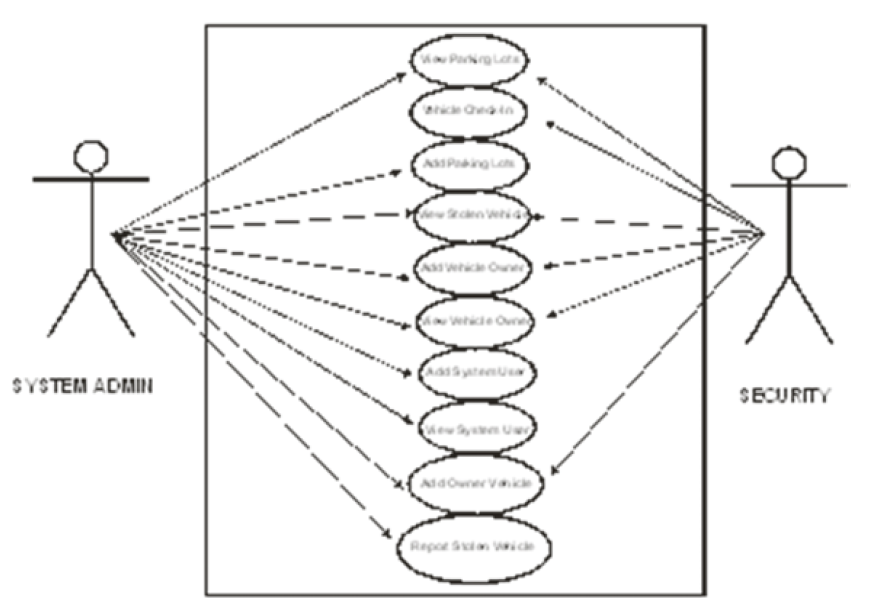
USE CASE diagram is a behavioral diagram used to describe asset of function that some system or systems (subject) should or can perform in collaboration with one or more external users of the system (actor). A use case diagram at its simplest is a representation of user’s interaction with the system that shows relationship between different use cases in which the user is involved. It is used to perform requirements analysis in order to understand the core functionalities and usage scenarios associated with the identified requirements The USE CASE diagram of the proposed system is shown in Figure 1.
The proposed system consists of two actors namely the system admin and the security. The system admin actor add parking lots, view parking lots, add vehicle owner, view stolen vehicle, etc. while security actor view parking lots, check in vehicle, view stolen vehicle and add owner vehicle.
Figure 1: Use Case Diagram of the Proposed System
Entity Relationship (ER) Diagram
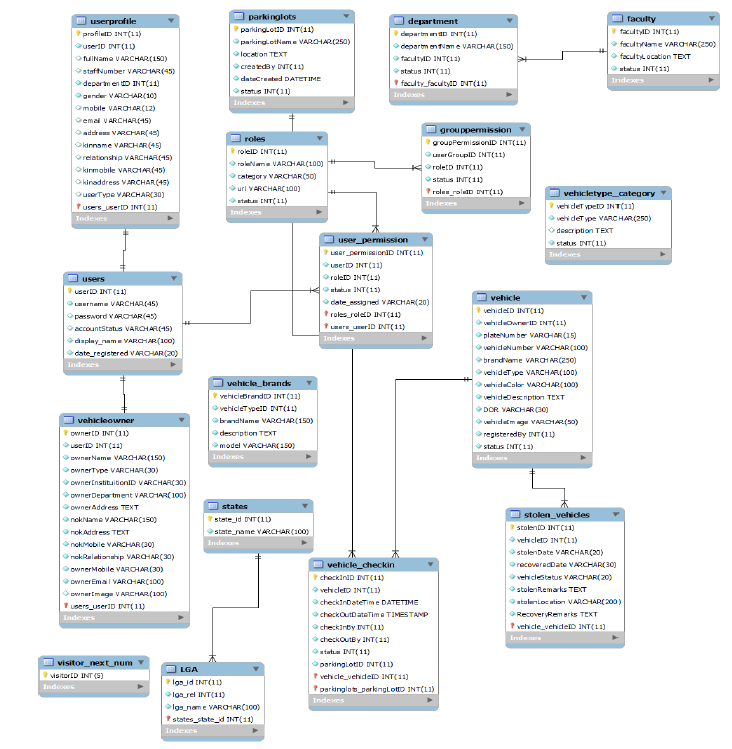
An entity relationship diagram is a data modeling technique that graphically illustrates information system entities and the relationships between those entities. An entity relationship diagram is a conceptual and representational model of data used to represent the entity framework infrastructure. The entity diagram of the proposed system can be shown in Figure 2.
The Figure 2 is the actual design blueprint of a relational database. It represents how data are structured in proposed system database.
Figure 2: Entity Relationship Diagram of the Proposed System
Proposed Vehicle Packing Lots Security System for Vehicle Thief Prevention Implementation
The vehicle Parking Lots Security System is built based on the requirement analysis done within the university environment (UDUS) and is implemented as a wed application that can be accessed via a web browser in order to eliminate the manually method been used to monitor the vehicles parked in the University premises. Prior discussion was held with the University Chief Security Officer (CSO) and subsequently a Questionnaire was preferred and administer accordingly with the CSO as the sole Respondent. The information gathered from the Questionnaire was analyzed that lead to the initial perception of how the project was to be carryout, thus ensuring the safety of vehicle in the environment and the risks involved.
After successfully developing the system to the Usmanu Dan Fodiyo University, the system should be able to solve if not all, will prevent to the barest minimum of the security risk facing the vehicles parked within the provided Parking Lots of the University.
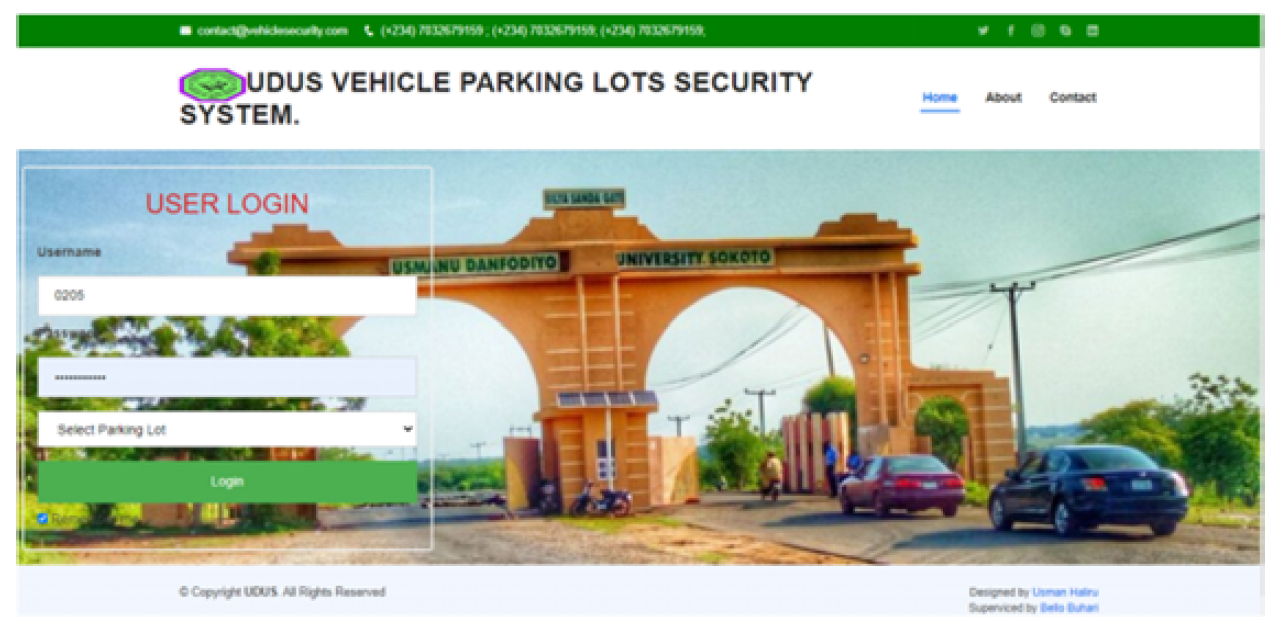
The Parking Lots Security System consists of two interfaces that the user view when using the system. These interfaces are Home page and the Dashboard page.
The Home Page which is also known as the index, it is the first page the user view on the system. To be able to operate on the system, the user has to pass through this page which can be done only if the user has been registered and given a valid user name and a password to access the restricted modules of the system based on the user role. This can be shown in Figure 3.
Figure 3: Home Page
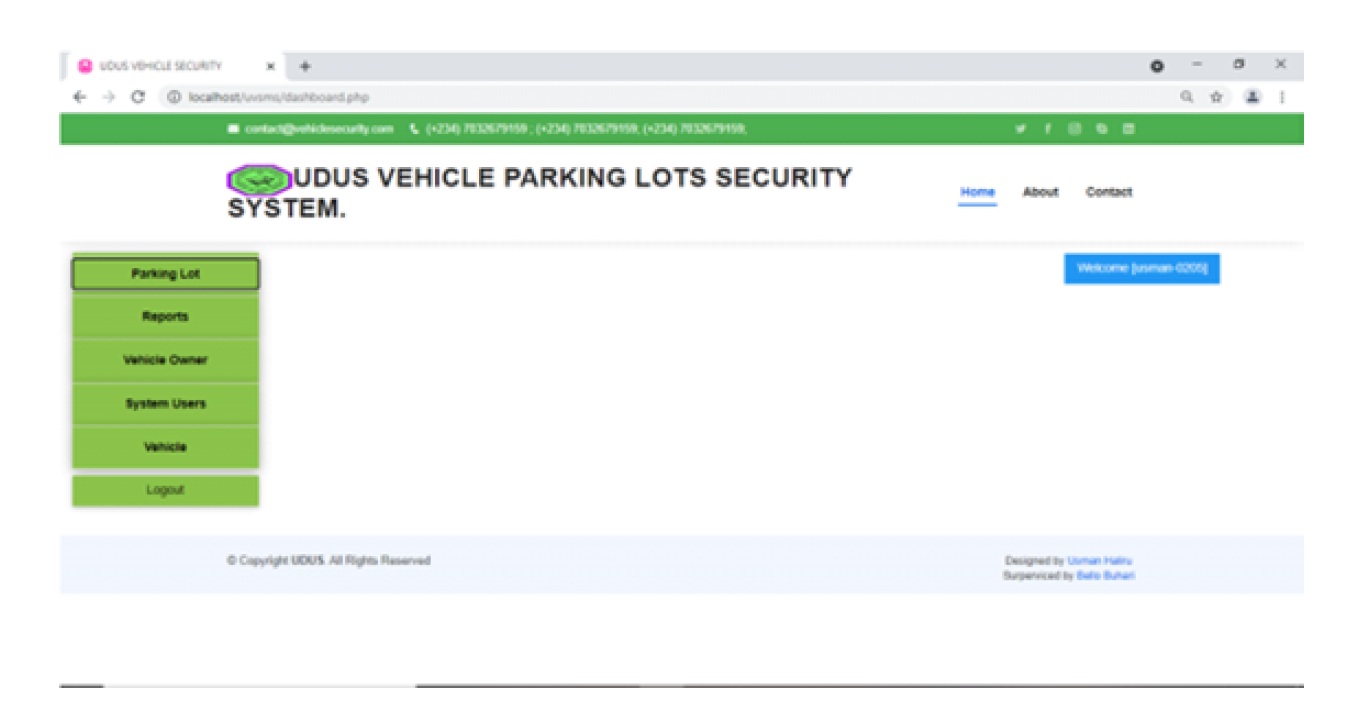
The Dashboard Page
This is the page view after an authorized user gets access to the system. The Dashboard page of the VPLSS contains different module that it operates on based on the user type e.g., System Admin. The System Admin should be able to work on different module such as Add Parking Lots, Add System User, Report Stolen Vehicle, View stolen Vehicle etc. This can be shown in Figure 4.
Figure 4: The Dashboard
Input of the Proposed System
The system is design to accept several input details more efficiently through the forms and clicks. The data captured through the user keystrokes and click are received by specific modules on the system and relayed to the back-end of the system. Below is some sample input design of the new system.
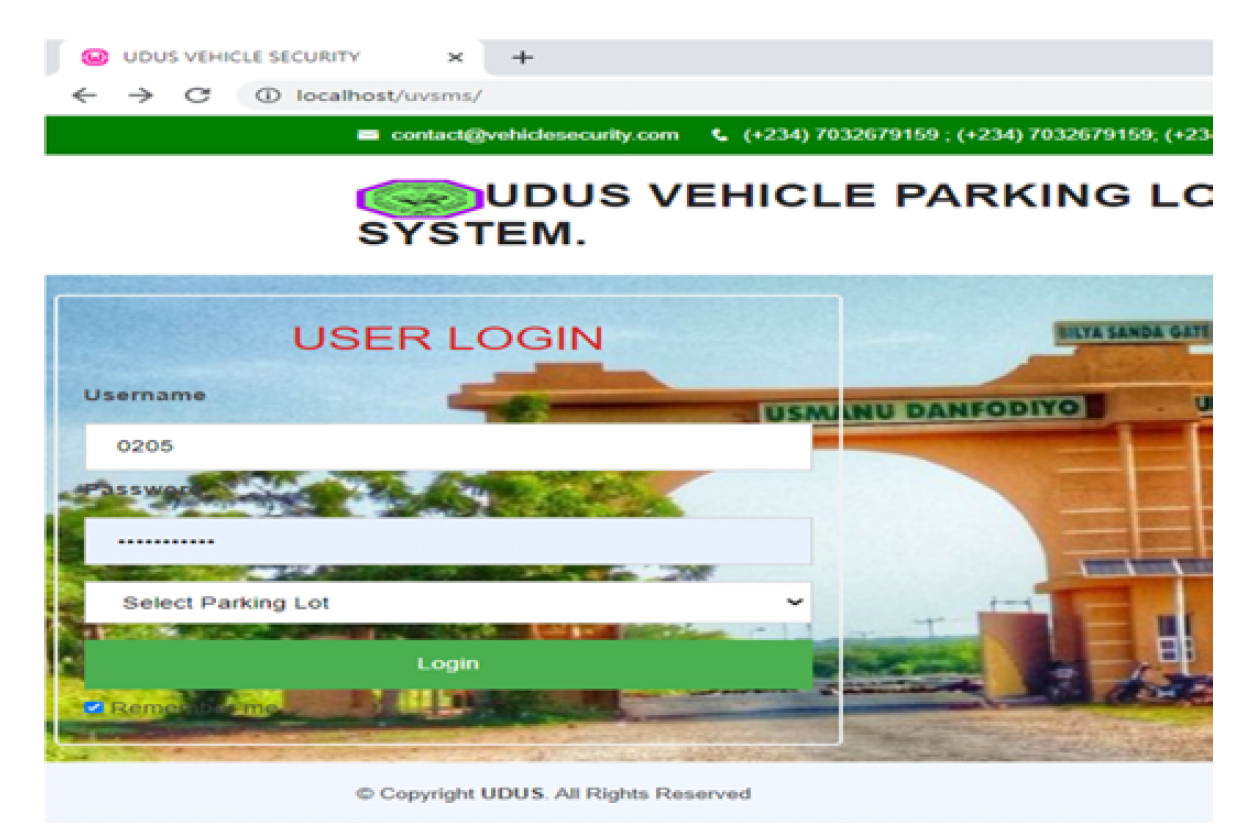
Login Page: This is where the admin or the security officer on duty puts in his/her username and a password and also select the parking lot in order to get access into the system. This can be shown in Figure 5
Figure 5: Login Page
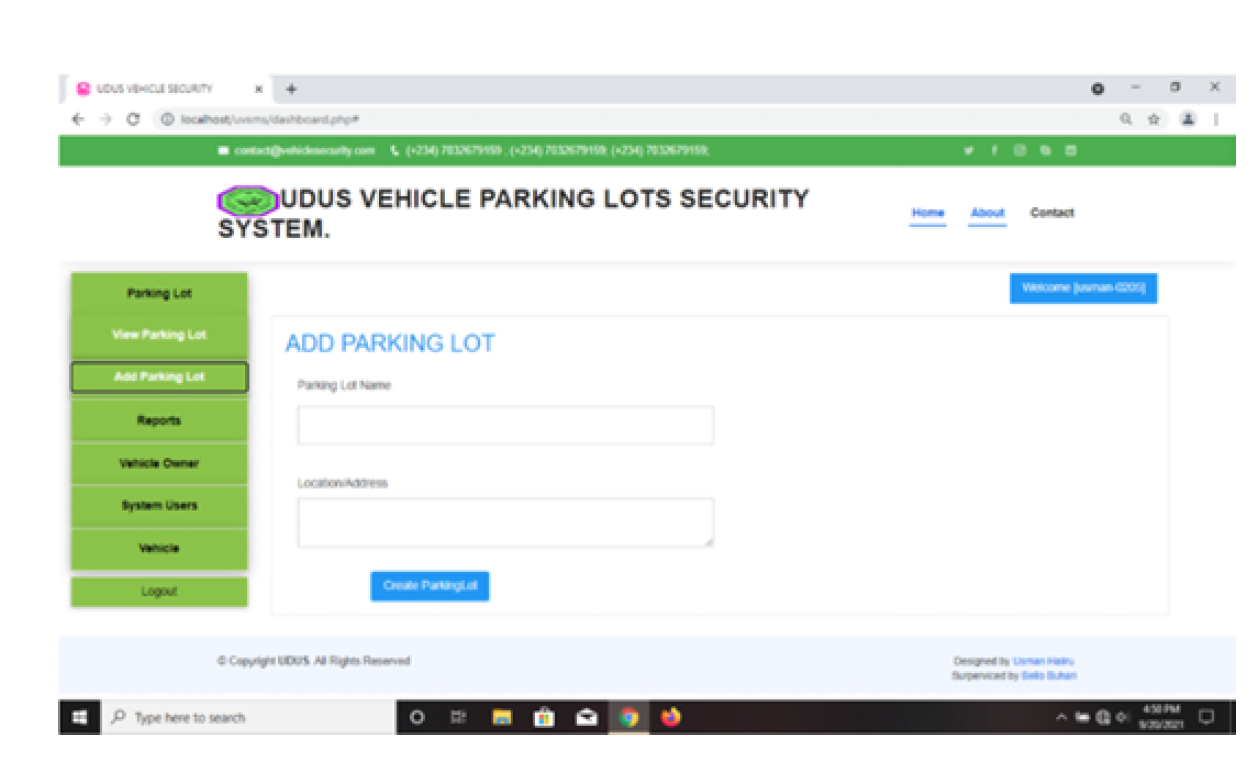
Add Parking Lots: This page is among the admin modules, where the admin can open and add a newly created parking lot in the University environment, the name given to the parking lot will be inserted and also the location in which it is created will be included. This can be shown in Figure 6
Figure 6: Add Parking Lots Form
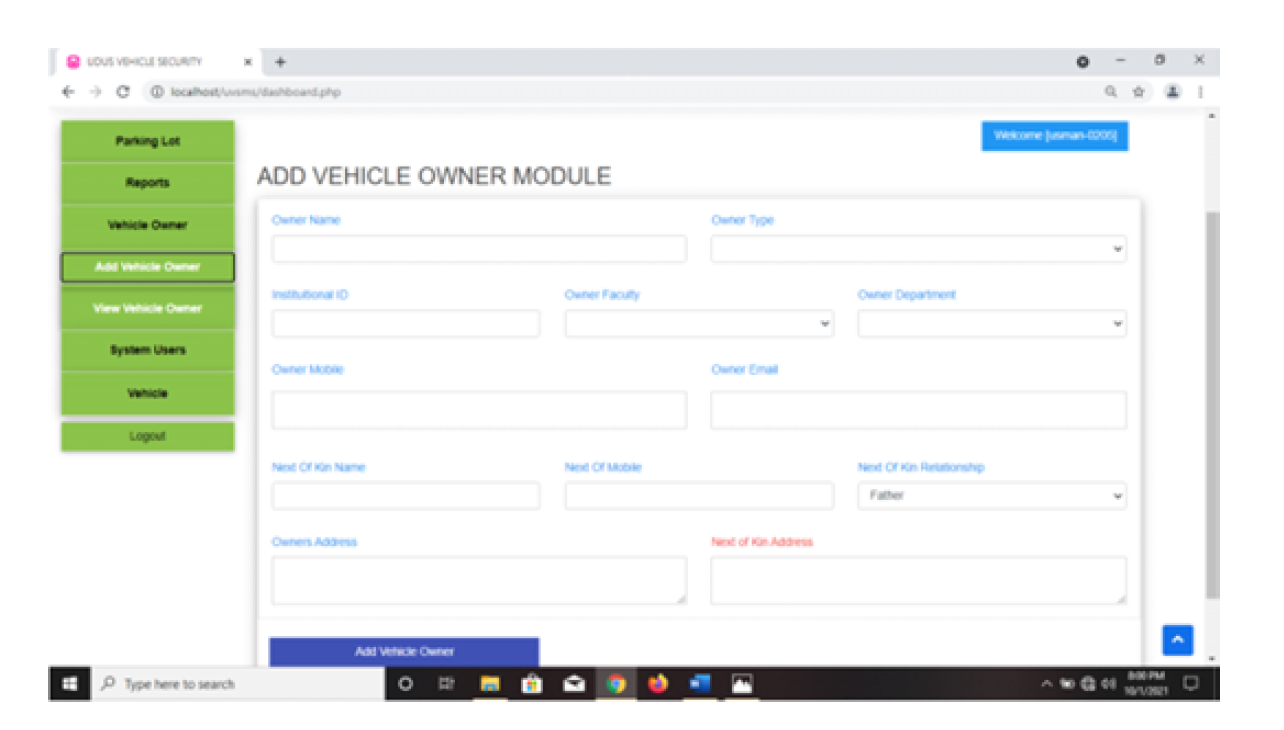
Add Vehicle Owner: This is a page that can be access by both the admin and the security guard on duty. The purpose of allowing the security guard to have access to this module is to let him/her to capture a visitor information which is not register to the system since he is not a staff or student. The page display forms that will allow the user to enter details of a person that owned the vehicle. the information includes his/her Name, Type of vehicle, institutional ID, Faculty, Department, Mobile number, Address, Email Address and Next of kin etc. This can be shown in Figure 7
Figure 7: Add Vehicle Owner Form
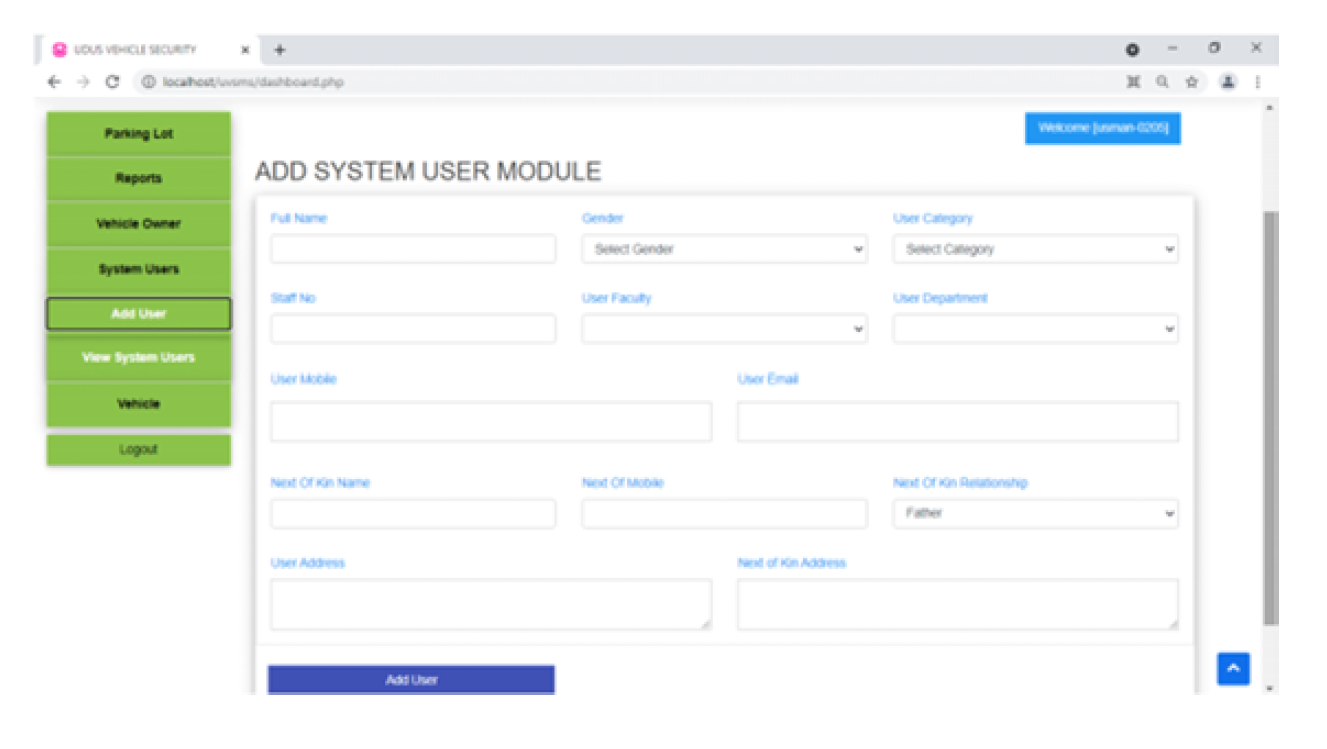
Add System User: The forms in this page can only be entered by the system admin. It’s a page where the security personnel details are registered in order to have an authorization keys i.e. username and password to access the system. The information includes Name, Gender, Staff number, Phone number, Next of kin, Email, Address etc. The Figure 8 shows the diagram of the page
Figure 8: Add System User
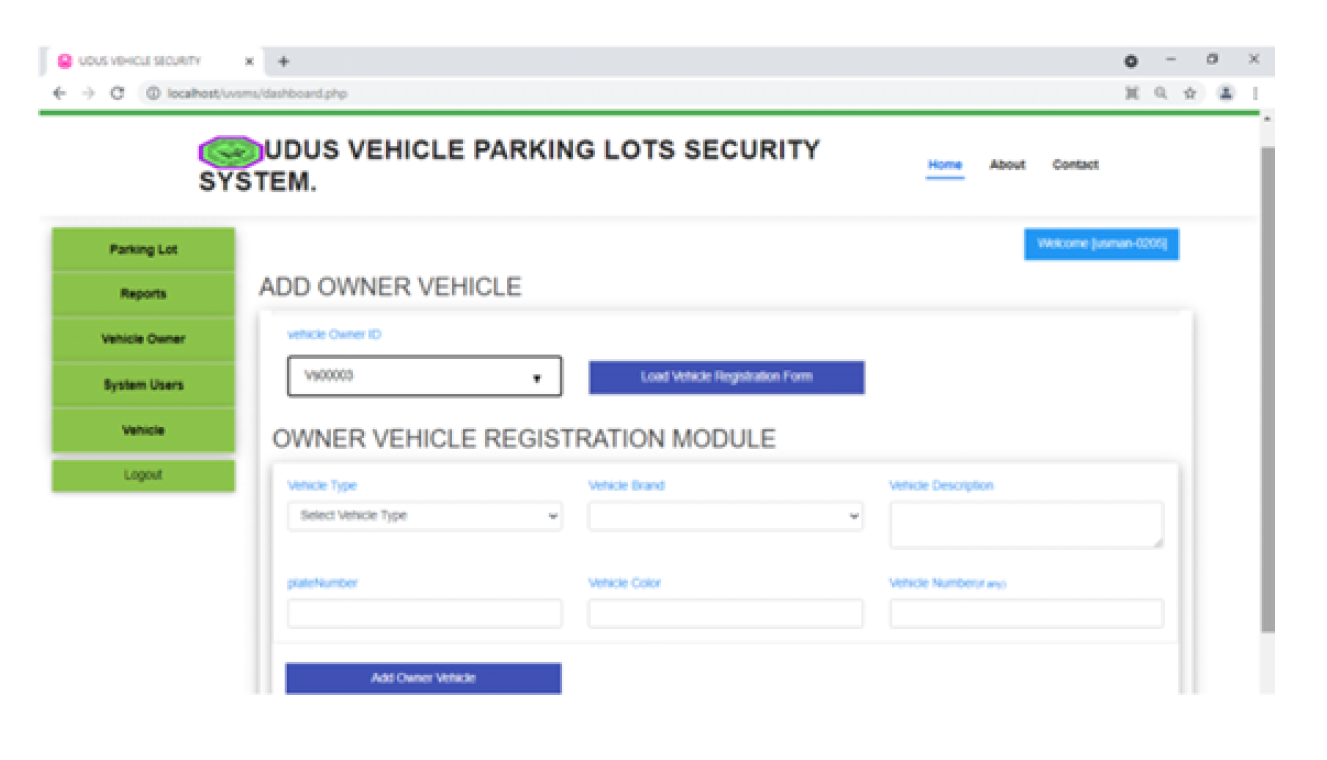
Add Owner Vehicle: In this section, the vehicle owner ID need to be put first before loading the forms that will allow you to register the vehicle. The vehicle information needed are vehicle type, vehicle brand, Number plate, vehicle color and the number of vehicles the owner has. The Figure 9 shows the form
Figure 9: Add Owner Vehicle Form
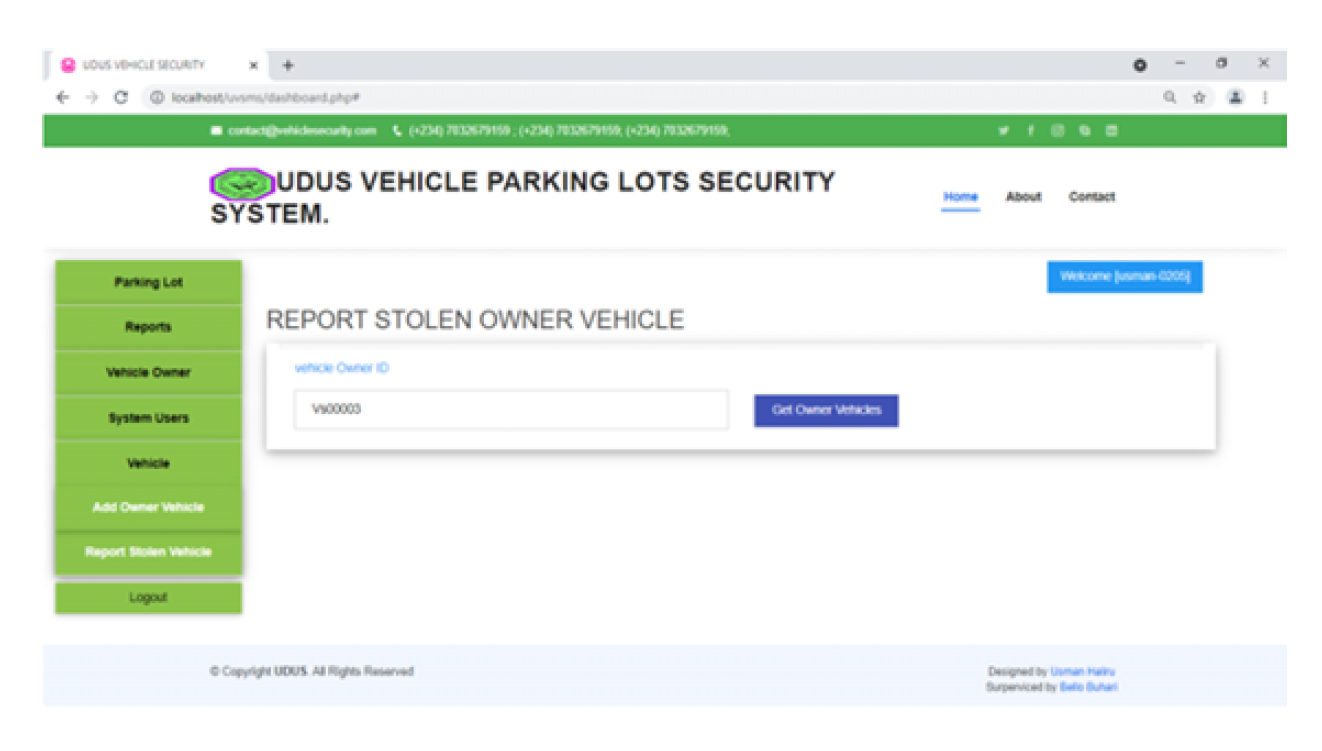
Report Stolen Vehicle: In this page not too, many information is needed because only one form is in this page i.e. vehicle owner ID. Immediately after typing-in the owner ID, the registered vehicles of the owner will be prompt regardless of how many he/she has, then the specific one stolen can be reported. The Figure 10 shows an example of the page
Figure 10: Report Stolen Vehicle Form
Output of the Proposed System
Output design of the system emphasis on producing real-time feedback of whatever action is performed on the system, the feedback displayed on the screen. Below are some of the samples of the output design of the new system.
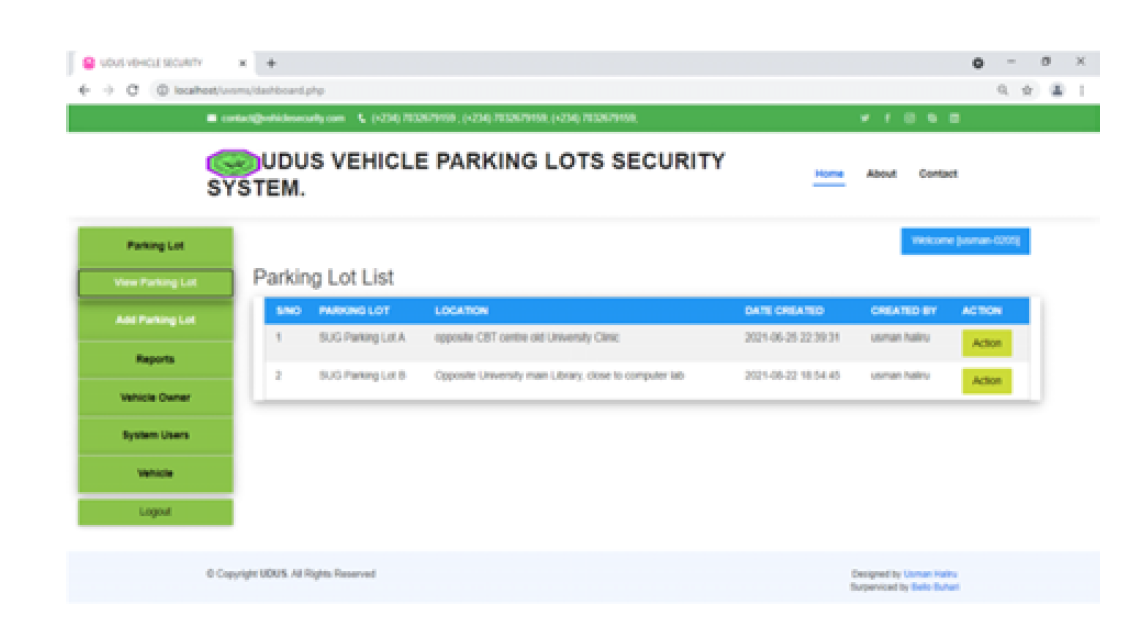
List of Parking Lots: This page can be view by both the system Admin and the security guard on duty. It’s a page that a user can see the list of all the registered parking lots in the system, their location, date they were created and the name of who created them. It also shows Whether they are active or not active. This can be shown in Figure 11
Fig 11: List of Parking Lots
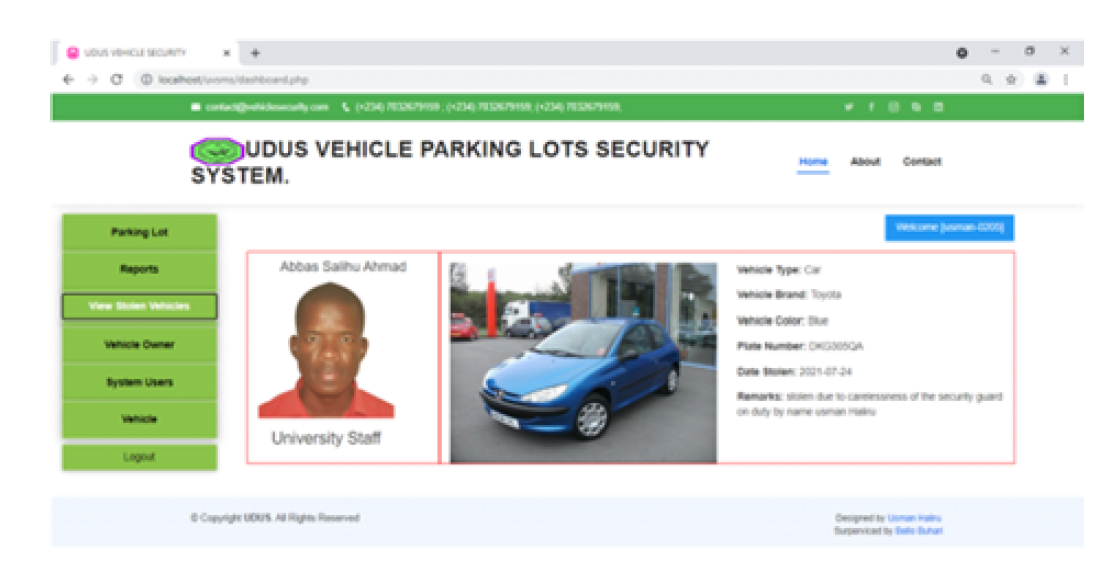
Stolen Vehicle: This is the page that shows the full details of vehicle that is stolen and currently searching for. The information includes the photograph of the owner, the vehicle and full description of the vehicle and reason behind how the vehicle was stolen and the remarks on the security guard on duty. The sample of the page is shown on Figure 12
Fig. 12: Stolen Vehicle Details
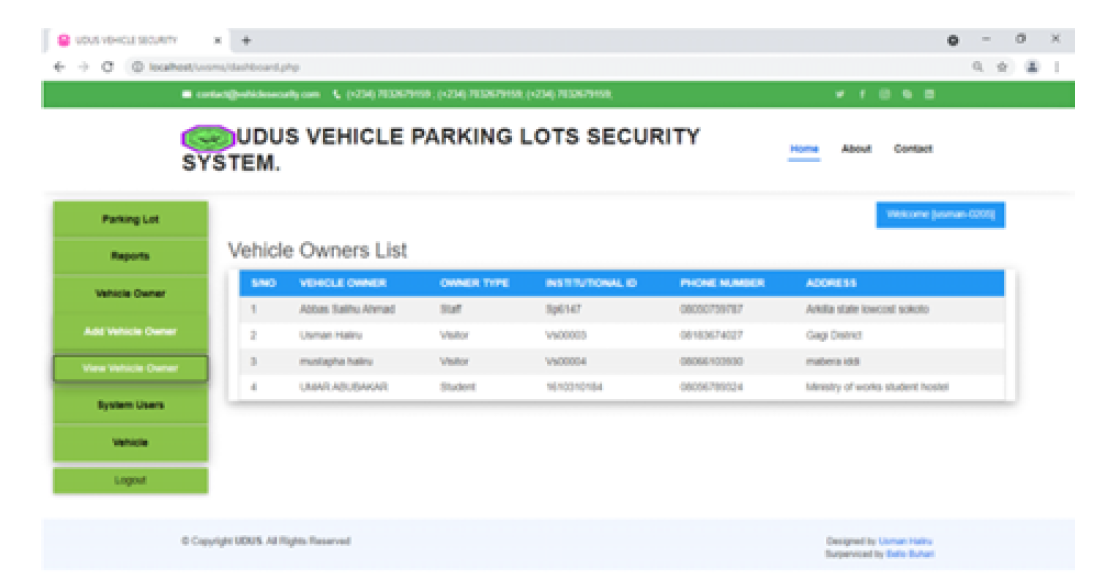
Vehicle Owners List: This is a page that simply shows the list of the people that are registered in the system, the information’s include Name, Type i.e., staff, student or visitor, institution ID, phone number and address. Figure 13 shows the list.
Fig. 13: Vehicle Owner’s List
System Users List
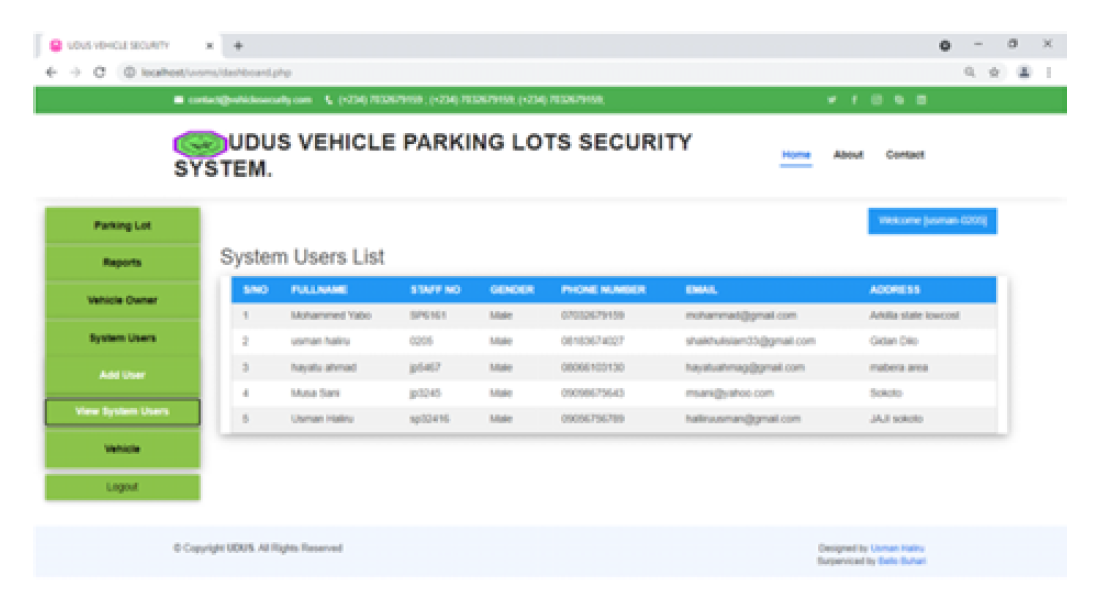
This is the page that allows the admin to view all users of the system. The Name, Staff no, Gender, Phone no, email and address can be view on the page. This can be shown in Figure 14
Fig. 14: System Users List
Proposed System Evaluation
User evaluation is carried out in order to make sure that the system fulfills the needs of user. The method of evaluation used is based on the end user providing questionnaire form to be answered after the use of the system. The questionnaire has been administered to the user to most of which are four hundred level student and the population and sample size of the population is chosen as n = 10.
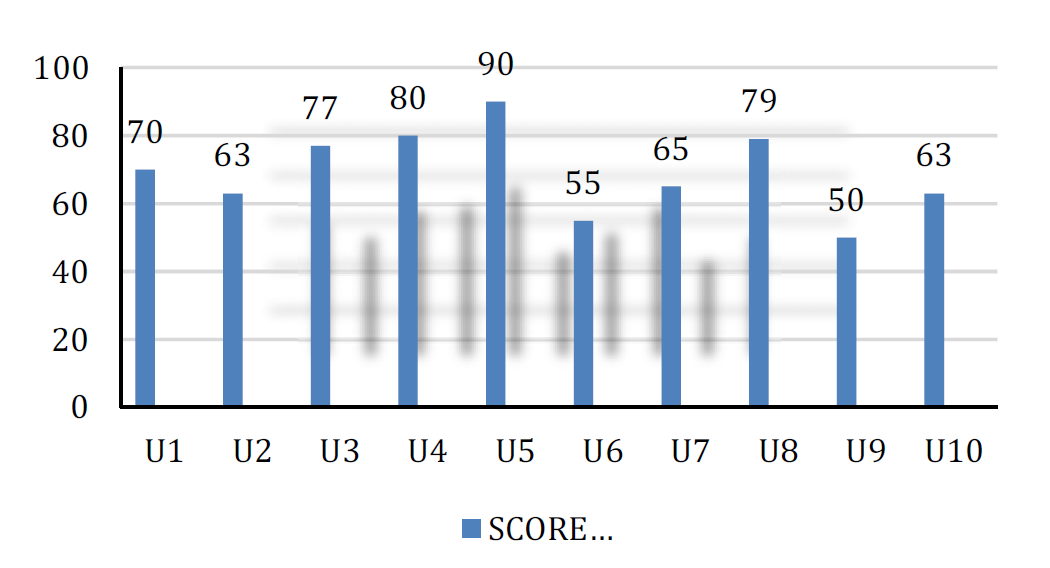
The result has been analyzed using descriptive statistics and bar chart was used for the presentation of the data. The Table 1 show and bar chart graph of the analysis.
From the Table 1 U1 indicate user 1, U2 indicate user 2, U3 indicate user 3, U4 indicate user 4, U5 indicate user 5, U6 indicate user 6, U7 indicate user 7, U8 indicate user 8, U9 indicate user 9, U10 indicates user 10. This can be shown in Figure 15.
Fig. 15: User Evaluation Column Chart
Table 1: Bar Chart Graph of the Analysis
S/No.
USER
SCORE (%)
1
U1
70
2
U2
63
3
U3
77
4
U4
80
5
U5
90
6
U6
55
7
U7
65
8
U8
79
9
U9
50
10
U10
63
CONCLUSION
The Online Vehicle Parking Lots Security System is developed for the Usmanu Dan Fodiyo University. The system was implemented and tested to make sure it conforms to its specification. This research comprises of the database at The back end and a user-friendly interface designed with PHP. User input data through the user interface forms which is often stored in the database. The system is easy to manage and used by the user in the sense that it does not require in-depth knowledge of computer training before been able to use it. Its straight forward system that was designed to increase the effectiveness of the vehicle security parked at different parking location within the University environment.
REFERENCE
Puspitasari, D. et al. “Development of Smart Parking System Using Internet of Things Concept.” Indonesian Journal of Electrical Engineering and Computer Science, vol. 24, no. 1, 2021, pp. 611-620.
Alharbi, A. et al. “Web-Based Framework for Smart Parking System.” International Journal of Information Technology, vol. 13, no. 4, 2021, pp. 1495-1502.
Iqbal, M.I. et al. “Deep Learning Based Smart Parking for a Metropolitan Area.” Proceedings of the 2021 IEEE Region 10 Symposium (TENSYMP), IEEE, August 2021, pp. 1-5.
Yao, R. et al. “Cloud Intelligent Parking Management System Based on Internet of Things Technology.” Journal of Physics: Conference Series, vol. 1865, no. 4, 2021.
Tejas, K.L. et al. “Application-Based Smart Parking Reservation System Using OpenALPR.” Engineering Management, vol. 55, 2020, pp. 4811-4816.
Singh, N. et al. “Enhanced Economy-Based Smart Parking System Using Machine Learning.” Proceedings of Industry Interactive Innovations in Science, Engineering & Technology (I3SET2K19), 2020.
Vishwanath, S. et al. “Vehicle Parking Management System.” Proceedings of the 2020 International Conference on Convergence to Digital World-Quo Vadis (ICCDW), IEEE, February 2020, pp. 1-6.
Ali, M.H. and D. Kurniawan. “Design of Information Systems Web-Based Car Parking Place Mall.” IOP Conference Series: Materials Science and Engineering, vol. 662, no. 2, 2019.
Garikapati, S. and S.S. Chandra. “Automated Unauthorized Parking Detector with Smart Vehicle Parking.” Indian Journal of Science and Technology, vol. 12, 2019.
Azshwanth, D. et al. “Automated Car Parking System.” Journal of Physics: Conference Series, vol. 1362, no. 1, 2019.
Promy, N. and S. Islam. “A Smart Android-Based Parking System to Reduce the Traffic Congestion of Dhaka City.” Proceedings of the 21st International Conference on Advanced Communication Technology (ICACT), IEEE, February 2019, pp. 124-128.
Chowdhury, I.H. et al. “Automated Vehicle Parking System and Unauthorized Parking Detector.” Proceedings of the 20th International Conference on Advanced Communication Technology (ICACT), IEEE, February 2018, pp. 542-545.
Nieto, R.M. et al. “Automatic Vacant Parking Places Management System Using Multicamera Vehicle Detection.” IEEE Transactions on Intelligent Transportation Systems, vol. 20, no. 3, 2018, pp. 1069-1080.
Somani, A. et al. “Cross Platform Smart Reservation-Based Parking System.” Proceedings of the International Conference on Smart City and Emerging Technology (ICSCET), IEEE, January 2018, pp. 1-5.
Recommended Articles
Research Article
OBSERVATIONS ON THE HOMOGENEOUS TERNARY QUADRATIC DIOPHANTINE EQUATION x2 + 4xy + 9y2 = 21z2
Download PDF
Research Article
The Possibility of Treating Corrosion in Iron Valves of Flow Regulators, Pumping Station Components, and Suspended Solids Filtration Networks in Rivers and Streams in Al-Qadisiyah Governorate
Qasim M. Turki,
...
Ahmed Hakem Jabor
Published: 02/03/2026
Download PDF
Research Article
Computer Driven Library Management and Service Rendering System: Mobile Library Landscape
Yekini N. A,
...
Ojo O
Published: 10/06/2020
Download PDF
Research Article
The Availability and Utilization of Some Selected Digital Technology Facilities among Students of Mathematical Sciences Using Krejcie and Morgan’s Sample Size Determination Technique, A Case Study of Kogi State University Anyigba
Download PDF
PO Box 101, Nakuru
Kenya.
Email: office@iarconsortium.org
Editorial Office:
J.L Bhavan, Near Radison Blu Hotel,
Jalukbari, Guwahati-India
Buhari, B. A., Haliru, U., Bodinga, B. A. & Suleiman, B. I. (2022). Online Vehicle Packing Lots Security System for Vehicle Thief Prevention in Nigerian University Settings. IAR Journal of Engineering and Technology, 3(2), 1-9.
MLA
Buhari, Bello A., et al. "Online Vehicle Packing Lots Security System for Vehicle Thief Prevention in Nigerian University Settings." IAR Journal of Engineering and Technology 3.2 (2022): 1-9.
Chicago
Buhari, Bello A., Usman Haliru, Bello A. Bodinga and Basheer I. Suleiman. "Online Vehicle Packing Lots Security System for Vehicle Thief Prevention in Nigerian University Settings." IAR Journal of Engineering and Technology 3, no. 2 (2022): 1-9.
Harvard
Buhari, B. A., Haliru, U., Bodinga, B. A. and Suleiman, B. I. (2022) 'Online Vehicle Packing Lots Security System for Vehicle Thief Prevention in Nigerian University Settings' IAR Journal of Engineering and Technology 3(2), pp. 1-9.
Vancouver
Buhari BA, Haliru U, Bodinga BA, Suleiman BI. Online Vehicle Packing Lots Security System for Vehicle Thief Prevention in Nigerian University Settings. IAR Journal of Engineering and Technology. 2022 Jul;3(2):1-9.



 Download PDF
 Download XML