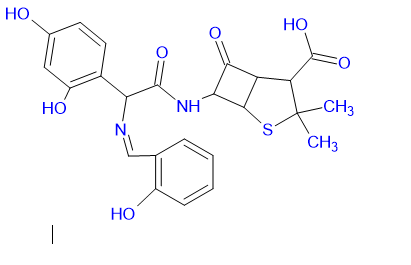
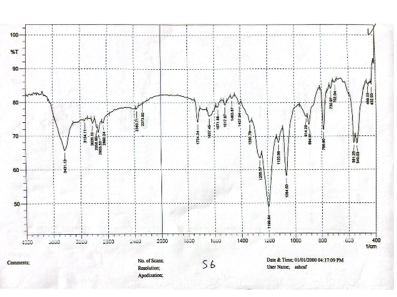
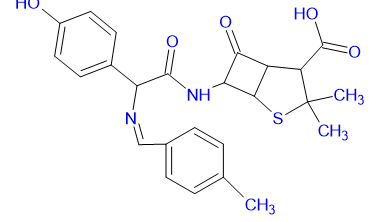
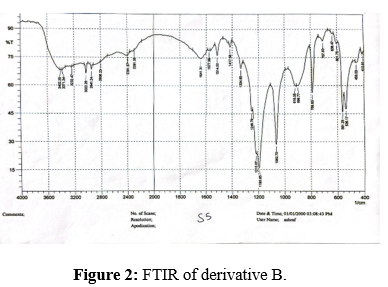
The present study provides an original way for synthesizing imines (A and B) by reacting amoxicillin with 2,4-dihydroxybenzaldehyde and 4-methylbenzaldehyde. The derivatives (A and B) were analyzed using FT-IR Spectroscopy. Using the zone inhibition method, the in vitro evaluation of synthesized derivatives (A and B) was conducted against several bacteria, including Streptococcus pneumonia and E. coli. The results indicated that specific derivatives possess enhanced antibacterial capabilities compared to the effectiveness of regular medication. The derivative A was assessed for its anticancer activity against prostate cancer PC3 cells using the MTT assay, which yielded a favorable outcome within 48 hours.
Keywords
Antibiotic
Amoxicillin
Azomethine
Bacteria resonance
Prostate cancer
INTRODUCTION
Antibiotic medications are used to treat infections and conditions caused by bacteria. Their efforts have greatly improved human health and extended life expectancy. Antibiotics have demonstrated remarkable efficacy in the treatment of certain diseases that were previously lethal. However, multiple bacterial strains have acquired resistance to pharmaceuticals [1]. This aims to explain the phenomena often known as antimicrobial resistance, which is also referred to as antibiotic resistance [2].
Some types of bacteria have developed resistance to medications that were previously effective in treating them [3]. In recent decades, Staphylococcus aureus has shown a significant level of resistance to benzylpenicillin [4]. In the past, penicillin was commonly used to treat these infections. Antibiotic resistance is increasing worldwide [5, 6]. Amoxicillin, also referred to as AMX, is a partially synthetic β-lactam antibiotic that exhibits a moderate range of effectiveness. It exhibits efficacy against a wide variety of Gram-positive bacteria and a restricted range of Gram-negative bacteria [7].
An azomethine compound is synthesized via an addition-elimination reaction between carbonyl groups (aldehydes or ketones) and a main amine element, resulting in the formation of an imine group (>C=N-) [8]. The azomethine molecule has been recognized for its significant contribution to biological activities, particularly as an antibacterial [9]. The antimicrobial effect of the azomethine compound is ascribed to the interaction between the imine group and the bacterial cell membrane, resulting in the eradication of bacterial cells. Several investigations have recorded the antibacterial effects of substances that contain 1 and 2 imine groups [10]. It has been noted that azomethine compounds containing 2 imine groups demonstrate enhanced antibacterial properties in comparison to those containing only 1 imine site.
In this research, we synthesized new azomethine derivatives (A and B). We characterized by FTIR and screened for antimicrobial activities in vitro by using zone inhibition and tested as anti-PC3 prostate cancer activity.
MATERIAL AND METHODS
Materials
All chemical used in this study were obtained from sigma Aldrich and Merch companies.
Methods
Synthesis of Azomethine derivatives (A and B)
A mixture of (0.836 g, 2.0 mmol) of amoxicillin trihydrate in 15 ml of ethanol. Added 2.0 mmole of 2,4-dihydroxybenzaldehyde, and 4-methlybenzaldehyde was refluxed for 3 h. The precipitates collected, and washed twice with absolute ethanol, dried under vacuum and kept [11, 12].
Investigation of the antimicrobial activity of azomethine derivatives (A and B).
Various kinds of bacteria, including Streptococcus pneumoniae and E. coli, were cultivated on Muller-Hinton agar dishes using a sterile loop and streaking techniques, beginning with the broth culture. Subsequently, a distinct well was established within the agar media. Each well was provided with a 100 μl volume of the appropriate dilution of azomethine derivatives (A and B), resulting in effective absorption [13]. The firmly sealed container was placed in an incubator set at a temperature of 37 ºC for a duration of 24 hours, in order to evaluate it the next day [14]. The microbial suspensions were evenly distributed over the media surface using a sterilized triangular loop. Aseptic stainless-steel cylinder with a 12 mm diameter was employed to generate cavities. The various synthetic compounds were sequentially injected into the cavities using a micropipette at varying concentrations (0.1, 0.001, and 0.00001 M). Afterwards, they were authorized to scatter for a period of sixty minutes. DMSO served as the solvent for all chemicals. The plates were placed in an incubator and maintained at a temperature of 37 degrees Celsius for 48 hours. The diameter of the zone of inhibition surrounding the cups was determined in milliliters after incubation [15].
Evaluation of the detrimental effects of the inhibitor utilizing the MTT Assay on the PC3 Cell Line
The MTT assay was employed to assess the cytotoxicity of compound (A). The contents of Kit A from Intron Biotech are a pre-assembled kit [16].
An MTT solution is a solution that contains MTT, a chemical frequently employed in biological tests. It is distributed in a total volume of 10 mL divided into 10 vials.
There are a total of two bottles, with each bottle holding a volume of 50 mL of solubilization solution.
Method:
The procedure was carried out in strict adherence to the manufacturer's instructions [17].
The cells grown with a density of 4.5 x 10⁵ were cultivated on 96-well plates. Each well had a final volume of 200 μL of complete media for cultivation. The plates were enveloped with a sterile parafilm, delicately stirred, and subsequently put into an incubator programmed to maintain a temperature of 37 °C and a carbon dioxide level of 5% for 24 hours.
2- Following the incubation period, the liquid in the container was removed, and 200 μl of a diluted solution of derivative (A) at concentrations of 25, 50, 100, 200, and 400 μg/mL was added to the small compartments. Every concentration and control underwent triplicate analysis. The plates were incubated for 48 hours at 37°C and in an environment with 5% carbon dioxide [19].
After exposure to the derivative (A), a 10 μL volume of MTT solution was added to each well. The plates were further incubated for 4 hours at 37°C and a carbon dioxide concentration of 5%.
The optical density results underwent statistical analysis to ascertain the IC50 value [18].
RESULTS AND DISCUSSION
The spectroscopic result, the appeared azomethine group in FTIR and disappeared amine group of amoxicillin drug and appeared proton of azomethine group of imine-amoxicillin at 1HNMR.
Bioactivity: Amoxil (amoxicillin) is an antibiotic of the penicillin class that is effective against bacteria that do not produce beta-lactamase enzymes (bacteria that produce beta-lactamase enzymes are typically resistant to Amoxil). This medication is commonly used to treat infections in several body parts, including the skin, lungs, and throat. Amoxicillin is a generic medication called amoxicillin. Amoxil can be synergistically used with other medicines, such as clavulanic acid (Augmentin), to enhance the efficacy of the antibiotic. The compound exerts bactericidal effects by inhibiting the formation of bacterial cell walls by binding to one or more of the penicillin binding proteins (PBPs). It inhibits specific PBPs that activate a bacterial autolytic process, resulting in a bacterial autolytic action.
Amoxicillin is an inhibitor of competition of amoxicillin-binding protein 1 and other proteins that bind to penicillin with a high molecular weight. Penicillin-binding proteins (PBPs) are enzymes that facilitate the glycosyltransferase and transpeptidase reactions, creating chemical bonds between D-alanine and D-aspartic acid in the bacterial cell walls. Bacteria undergo bactericidal activity when they cannot form and repair their cell wall due to the upregulation of autolytic enzymes, which occurs without penicillin binding proteins.
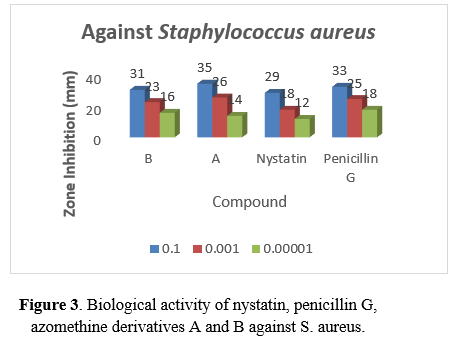
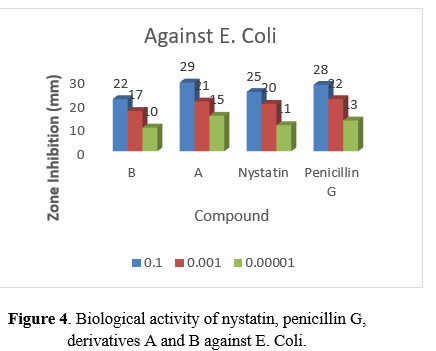
The azomethine derivative A have been highest biological activity against S. aureus by zone inhibition 35 mm at 0.1 M. The derivative A is more than derivative B because have two hydroxyl group atoms in its structure, which can form hydrogen bonding and a multi-pair electron in oxygen atoms. The less effect on zone inhibition was derivative B at 0.00001 M by 10 mm.
AMX is effectively absorbed in the gastrointestinal (GI) tract after being taken orally as a solution or tablet. However, differences have been observed in the absorption of AMX in various regions of the gastrointestinal tract, with notable absorption taking place in the upper small intestine and minimal absorption in the colon. AMX demonstrates an oral bioavailability that spans from 70% to 90%, with the highest levels of the drug reaching the bloodstream within 60 to 90 minutes after consumption [22].
The cytotoxicity of the synthesized derivative A was evaluated as an anticancer agent
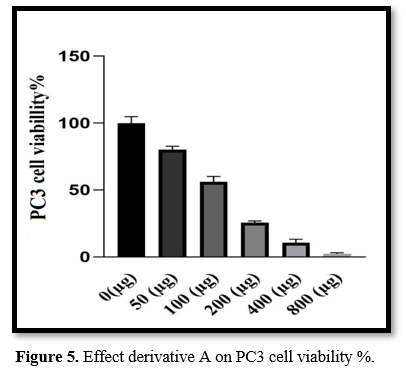
The MTT assay evaluated the cytotoxicity of derivative A towards the prostate cancer PC3 cell line. The vitality of the cells was evaluated 24 hours after treatment with various doses of each derivative, ranging from 0 to 320 g/ml. Figure 5 illustrates the outcomes of derivative A, which has a value of 2.26 at 48 hours. These values were measured on a scale ranging from 0 to 100. The findings exhibited a correlation between the dosage and the impact on the PC3 cell line.
Concentration (PPM)
Mean
SD
0
100
3.8680
20
78.2247
2.6543
40
58.8679
3.0482
80
24.94565
2.2036
160
9.90118
2.5934
320
2.263901
1.0779
CONCLUSION
Azomethine derivative derivatives (A and B) were synthesized and characterized by FTIR. Chemical reactions between amoxicillin drug and aromatic derivatives began the synthesis. The antimicrobial activity of Azomethine derivatives, including amoxicillin, against Staphylococcus epidermidis, and Escherichia coli were tested in vitro. The findings demonstrated that certain derivatives exhibit superior antibacterial properties in comparison to the efficacy of some standard drug. The derivative A tested as anti-PC3 cancer cell by MTT technique. In future, we will synthesize new derivatives of different drugs. In future, we will synthesize a new derivative and tested in vitro
REFERENCES
Gallagher, J.C. and C. MacDougall, Antibiotics simplified. 2022: Jones & Bartlett Learning.https://books.google.co.in/books/about/Antibiotics_Simplified.html?id=tvBCDQAAQBAJ&redir_esc=y
Cook, M.A. and G.D. Wright, The past, present, and future of antibiotics. Science translational medicine, 2022. 14(657): p. eabo7793.DOI:10.1126/scitranslmed.abo7793
Butler, M.S. and D.L. Paterson, Antibiotics in the clinical pipeline in October 2019. The Journal of antibiotics, 2020. 73(6): p. 329-364.DOI:10.1038/s41429-020-0291-8
Chen, J., et al., Antibiotics and food safety in aquaculture. Journal of Agricultural and Food Chemistry, 2020. 68(43): p. 11908-11919.DOI: 10.1021/acs.jafc.0c03996
Polianciuc, S.I., et al., Antibiotics in the environment: causes and consequences. Medicine and pharmacy reports, 2020. 93(3): p. 231.DOI:10.15386/mpr-1742
Lima, L.M., et al., β-lactam antibiotics: An overview from a medicinal chemistry perspective. European journal of medicinal chemistry, 2020. 208: p. 112829.https://doi.org/10.1016/j.ejmech.2020.112829
Ramirez, J., et al., Antibiotics as major disruptors of gut microbiota. Frontiers in cellular and infection microbiology, 2020. 10: p. 572912.doi: 10.3389/fcimb.2020.572912
Wei, L., X. Chang, and C.-J. Wang, Catalytic asymmetric reactions with N-metallated azomethine ylides. Accounts of chemical research, 2020. 53(5): p. 1084-1100. DOI: 10.1021/acs.accounts.0c00113
Deepthi, A., N.V. Thomas, and S. Sruthi, An overview of the reactions involving azomethine imines over half a decade. New Journal of Chemistry, 2021. 45(20): p. 8847-8873.DOI:10.1039/D1NJ01090E
Markos, A., et al., Introducing Azomethine Imines to Chemical Biology: Bioorthogonal Reaction with Isonitriles. Journal of the American Chemical Society, 2023. 145(36): p. 19513-19517.DOI:10.1021/jacs.3c07006
Boulechfar, C., et al., Schiff bases and their metal Complexes: A review on the history, synthesis, and applications. Inorganic Chemistry Communications, 2023. 150: p. 110451.DOI:10.1016/j.inoche.2023.110451
Uddin, N., et al., Synthesis, characterization, and anticancer activity of Schiff bases. Journal of Biomolecular Structure and Dynamics, 2020. 38(11): p. 3246-3259.DOI:10.1080/07391102.2019.1654924
muhammed Aziz, D., et al., New azo-azomethine derivatives: Synthesis, characterization, computational, solvatochromic UV‒Vis absorption and antibacterial studies. Journal of Molecular Structure, 2023. 1284: p. 135451.DOI:10.1016/j.molstruc.2023.135451
Al-Atbi, H.S., et al., Study of new azo-azomethine derivatives of sulfanilamide: synthesis, characterization, spectroscopic, antimicrobial, antioxidant and anticancer activity. Biochemical & Cellular Archives, 2020. 20.DOI:10.1088/1742-6596/1294/5/052033
Al-Shamry, A.A., et al., Development of new azomethine metal chelates derived from isatin: DFT and Pharmaceutical Studies. Materials, 2022. 16(1): p. 83.DOI:10.3390/ma16010083
Abu‐Dief, A.M., L.H. Abdel‐Rahman, and A.A.H. Abdel‐Mawgoud, A robust in vitro anticancer, antioxidant and antimicrobial agents based on new metal‐azomethine chelates incorporating Ag (I), Pd (II) and VO (II) cations: Probing the aspects of DNA interaction. Applied Organometallic Chemistry, 2020. 34(2): p. e5373.DOI: 10.1016/j.jphotobiol.2017.04.003
Erdoğan, M., et al., Synthesis and characterization of some benzidine-based azomethine derivatives with molecular docking studies and anticancer activities. Chemical Papers, 2023. 77(11): p. 6829-6847.DOI:10.1007/s11696-023-02981-3
Aljohani, F.S., et al., Structural inspection for novel Pd (II), VO (II), Zn (II) and Cr (III)-azomethine metal chelates: DNA interaction, biological screening and theoretical treatments. Journal of Molecular Structure, 2021. 1246: p. 131139.https://doi.org/10.1016/j.cemconres.2023.107350
Hassan, S.S., et al., antimicrobial screening involving Helicobacter pylori of nano‐therapeutic compounds based on the amoxicillin antibiotic drug. Helicobacter, 2023. 28(5): p. e13004.DOI: 10.1111/hel.13004
Mousa, E.F. and S.H. Merza, Synthesis, Characterization and Biological Activity of heterocyclic compounds derived from Amoxcilline drug. Annals of the Romanian Society for Cell Biology, 2021. 25(6): p. 5087-5102.DOI: 10.3390/molecules24224082
Jawad, A.A. and A.J. Alabdali, Synthesis, Characterization and Antibacterial Activity of Some Penicillin Derivatives. Al-Nahrain Journal of Science, 2020. 23(4): p. 29-34.DOI:10.22401/anjs.23.4.05
Terrak, M. and J.-M. Frère, β-Lactam Antibiotics, in Encyclopedia of Molecular Pharmacology. 2022, Springer. p. 911-920.DOI: 10.1016/j.ejmech.2020.112829
Recommended Articles
Research Article
Inhalation Insights: Assessing Anesthesia Knowledge among Himachal Pradesh's Resident Anesthetists
Akanksha Sharma,
...
Kanika Prashar
Published: 29/05/2023
Download PDF
Research Article
Oxidative Stress in Breast and Ovarian Cancer
Ayad Adnan Sahib,
...
Fatima Saleh Abbas
Published: 27/08/2023
Download PDF
Research Article
Extraction, Diagnose and Evaluation of the Effectiveness of Aromatic Herb Pelargonium Graveolens as an Antiseptic and Disinfectant
Abdul Razzaq D. Jasim,
...
Thuraya S. Tahir
Published: 27/04/2022
Download PDF
Research Article
Exploratory Study of Perception, Knowledge and Awareness of Prostate Cancer
Marwa Kahtan Ali,
...
Mohammed Mohammud Habash
Published: 30/06/2025
Download PDF
PO Box 101, Nakuru
Kenya.
Email: office@iarconsortium.org
Editorial Office:
J.L Bhavan, Near Radison Blu Hotel,
Jalukbari, Guwahati-India
Thame, Z. A. L. & Jaber, R. J. (2024). Modification of Amoxicillin antibacterial to promising anticancer azomethine derivatives: Synthesis and in vitro studies. Scientific Research Journal of Pharmacy, 4(1), 1-5.
MLA
Thame, Zuhoor A. L. and Roaa J. Jaber. "Modification of Amoxicillin antibacterial to promising anticancer azomethine derivatives: Synthesis and in vitro studies." Scientific Research Journal of Pharmacy 4.1 (2024): 1-5.
Chicago
Thame, Zuhoor A. L. and Roaa J. Jaber. "Modification of Amoxicillin antibacterial to promising anticancer azomethine derivatives: Synthesis and in vitro studies." Scientific Research Journal of Pharmacy 4, no. 1 (2024): 1-5.
Harvard
Thame, Z. A. L. and Jaber, R. J. (2024) 'Modification of Amoxicillin antibacterial to promising anticancer azomethine derivatives: Synthesis and in vitro studies' Scientific Research Journal of Pharmacy 4(1), pp. 1-5.
Vancouver
Thame ZAL, Jaber RJ. Modification of Amoxicillin antibacterial to promising anticancer azomethine derivatives: Synthesis and in vitro studies. Scientific Research Journal of Pharmacy. 2024 Jan;4(1):1-5.


 Download PDF
 Download XML