Contents
Download PDF
pdf Download XML
203 Views
83 Downloads
Share this article
Research Article | Volume 3 Issue 2 (July-Dec, 2023) | Pages 1 - 4
Pink Eye Awareness: Shedding Light on Conjunctivitis Types, Symptoms, and Prevention in District Kangra, Himachal Pradesh
 ,
1
MBBS, MS ophthalmology, India
Under a Creative Commons license
Open Access
Received
Sept. 3, 2023
Revised
Oct. 9, 2023
Accepted
Nov. 19, 2023
Published
Dec. 15, 2023
Abstract

Background: Conjunctivitis, commonly referred to as Pink Eye, encompasses various types, including viral, bacterial, and allergic conjunctivitis, affecting individuals globally. Despite its prevalence, awareness and knowledge about Conjunctivitis remain essential for early recognition, appropriate management, and public health. This study examines the current status of Conjunctivitis awareness, types, symptoms, and preventive measures among the population of District Kangra, Himachal Pradesh. Methods: Employing a descriptive research approach and a cross-sectional survey design, this study collected data from 400 adults residing in District Kangra between April and July 2023. A Google Form questionnaire covering demographics and Conjunctivitis knowledge was used. Data analysis included frequency and percentage calculations. Results: The study revealed varied levels of awareness and knowledge among participants. While 69% could define Conjunctivitis, only 24.5% identified its types. Recognition of symptoms associated with different Conjunctivitis types was at 58.5%. Understanding transmission and preventive practices stood at 57.5% and 57%, respectively. Knowledge about specific medications and treatments was 40.5%. Notably, 68.5% emphasized the importance of raising Conjunctivitis awareness in their community. Conclusion: While some participants displayed good awareness and understanding of Conjunctivitis, knowledge gaps exist, particularly regarding types and treatments. Comprehensive educational campaigns are essential to improve public understanding, promote ocular health, and mitigate Conjunctivitis outbreaks in District Kangra, Himachal Pradesh.

Keywords
INTRODUCTION

Conjunctivitis, commonly known as Pink Eye, is an ocular condition that inflames the transparent membrane covering the white part of the eye and the inner surface of the eyelids (conjunctiva). This prevalent eye ailment exists in various forms, with viral, bacterial, and allergic conjunctivitis being the most common types. Although generally not considered a severe medical issue, conjunctivitis can be highly contagious and may result in discomfort, redness, itching, and discharge from the eyes. Understanding conjunctivitis and its different types, recognizing its symptoms, and adopting appropriate preventive measures are essential for maintaining ocular health [1-4].


The global prevalence of conjunctivitis is substantial, affecting individuals of all ages, but its true incidence remains underreported. Conjunctivitis outbreaks can occur in various settings, including schools, healthcare facilities, and communities, contributing to the condition's public health significance. While conjunctivitis often resolves on its own, complications can arise, particularly if left untreated [5-7].


In District Kangra, Himachal Pradesh, nestled amidst the picturesque Himalayan landscapes, ocular health is of paramount importance. With a diverse population, it is crucial to gauge the levels of awareness and knowledge about conjunctivitis and its subtypes, distinguish their symptoms, and educate the public about preventive measures. This study aims to investigate the current status of conjunctivitis awareness in District Kangra and emphasize the significance of proper eye care practices to reduce the burden of this condition.


Viral, bacterial, and allergic conjunctivitis each have distinct causes and modes of transmission. Viral conjunctivitis can result from adenoviruses and is highly contagious, spreading through direct contact with infected individuals or contaminated surface. Bacterial conjunctivitis, on the other hand, is primarily caused by Staphylococcus or Streptococcus bacteria and can also be transmitted through contact or via contaminated objects. Allergic conjunctivitis is driven by hypersensitivity reactions to allergens like pollen or dust particles and is not contagious [8-10].    


Recognizing the symptoms of conjunctivitis is vital for early identification and appropriate management. Symptoms typically include redness, itching, burning sensation, excessive tearing, and discharge, which may be clear or purulent depending on the type of conjunctivitis. Differentiating between these symptoms can aid healthcare providers in diagnosing the specific type of conjunctivitis and guiding treatment decisions [11-12].


Preventing conjunctivitis is largely centered on good hygiene practices, such as regular handwashing, avoiding eye rubbing, refraining from sharing personal items like towels or cosmetics, and adhering to proper contact lens care guideline. Understanding these preventive measures can significantly reduce the risk of contracting or spreading conjunctivitis [11,12].


By assessing the awareness and understanding of conjunctivitis within the community, this study aims to identify knowledge gaps and areas where public health interventions can be directed. Empowering individuals with knowledge about conjunctivitis types, symptoms, and preventive measures is essential to promote ocular health and improve overall quality of life in District Kangra.


In this context, we aspire to contribute to the growing body of knowledge on eye health and advocate for initiatives that raise awareness about conjunctivitis, minimize its transmission, and enhance the well-being of District Kangra's residents.


Objectives of the Study

The objective of this study is to gauge the levels of awareness and knowledge about Conjunctivitis (Pink Eye), its types (viral, bacterial, allergic), symptoms, and preventive measures among the general population of District Kangra, Himachal Pradesh
MATERIALS AND METHODS
  • Research Approach: Descriptive

  • Research Design: Cross-sectional survey design

  • Study Area: District Kangra, Himachal Pradesh

  • Study Duration: Between April 2023 to July 2023

  • Study Population: The study's target population encompassed all adults aged 18 and above who had been residents of District Kangra for a minimum of 12 months

  • Sample Size: A robust sample size of 400 adults was determined using a 95% confidence level, an estimated knowledge level of 50% regarding Conjunctivitis (Pink Eye), a precise 5% absolute error margin, and a conservative 5% non-response rate. 

  • Study Tool: A google form questionnaire consisting of questions regarding socio-demography and knowledge regarding Conjunctivitis (Pink Eye) was created. The questionnaire was initially pre-tested on a small number of participants to identify any difficulty in understanding by the respondents. 


Description of Tool


  • Demographic Data Survey Instrument: The demographic form elicited information on participants’ background: age, marital status, religion, employment, education and many more.

  • Questionnaire: The questionnaire contains 20 structured knowledge related questions regarding Conjunctivitis (Pink Eye). One mark was given for each correct answer and zero for incorrect answer. The maximum score was 20 and minimum score was zero. Scoring was done on the basis of marks as >80% (16-20) = very good, 60-79% (12-15) = Good, 41-59% (8-11) = Fair, <40% (< 8) = poor

  • Validity of Tool: By the experts in this field

  • Data Collection: Data was collected under the guidance of supervisors. The google form questionnaire was circulated among the residents of District Kangra, Himachal Pradesh for responses using online modes like e-mail and social media platforms like Whatsapp groups, Facebook, Instagram and Linkedin till the 400 responses were collected. 

  • Data Analysis: Data was collected and entered in Microsoft excel spread sheet, cleaned for errors and analyzed with Epi Info V7 Software with appropriate statistical test in terms of frequencies and percentage. 

  • Ethical Considerations: Participants confidentiality and anonymity was maintained. 

RESULTS

The primary objective of this study was to gauge the understanding of Conjunctivitis (Pink Eye) among the general population of District Kangra. A total of 400 participants took part in the study, with 273 (68.25%) residing in urban areas and 127 (31.75%) in rural areas (Table 1).


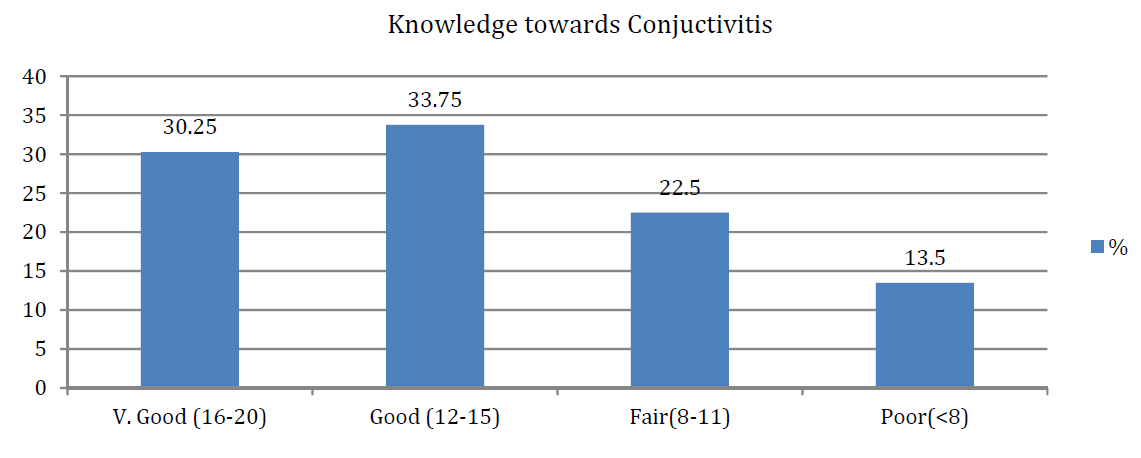
In the present study 30.25% (121) participants had very good knowledge (16-20 marks) towards Conjunctivitis (Pink Eye) , 33.75% (135) had good knowledge (12-15 marks), 22.5% (90) had fair knowledge (8-11 marks) and 13.5% (54) having poor knowledge (<8 marks) (Figure 1).


Figure 1: Knowledge Scores towards Conjunctivitis (Pink Eye) among Study Participants


Table 1: Knowledge Regarding Conjunctivitis (Pink Eye) among Study Participants

S.No.

Statements

Frequency of Correct Responses

Percent

  1.  

What is Conjunctivitis, commonly known as Pink Eye?

276

69

  1.  

Can you name the different types of Conjunctivitis?

98

24.5

  1.  

How does viral conjunctivitis differ from bacterial conjunctivitis?

87

21.75

  1.  

Are there specific symptoms associated with viral, bacterial, and allergic conjunctivitis?

234

58.5

  1.  

Can you list common signs of conjunctivitis?

187

46.75

  1.  

How is conjunctivitis typically transmitted from person to person?

230

57.5

  1.  

What are the best practices for preventing the spread of contagious conjunctivitis?

228

57

  1.  

Are there any specific medications or treatments for viral, bacterial, or allergic conjunctivitis?

162

40.5

  1.  

Can conjunctivitis occur in only one eye, or is it usually in both eyes?

237

59.25

  1.  

Is it necessary to seek medical attention for conjunctivitis, or can it resolve on its own?

199

49.75

  1.  

Are there over-the-counter remedies that can alleviate conjunctivitis symptoms?

201

50.25

  1.  

Can eye drops help with the discomfort caused by conjunctivitis?

170

42.5

  1.  

How long is someone with conjunctivitis typically contagious?

198

49.5

  1.  

Can you differentiate between conjunctivitis and other eye conditions, like dry eye syndrome?

144

36

  1.  

What measures can individuals take to prevent allergic conjunctivitis triggers?

187

46.75

  1.  

Are there any specific age groups more susceptible to conjunctivitis?

120

30

  1.  

Can conjunctivitis lead to more severe eye complications if left untreated?

156

39

  1.  

Are there any home remedies that can provide relief from conjunctivitis symptoms?

216

54

  1.  

In your opinion, how important is it to raise awareness about Conjunctivitis in your community?

274

68.5

  1.  

Do you know of any local resources or healthcare facilities that provide information?

129

32.25

DISCUSSION

Conjunctivitis, commonly referred to as Pink Eye, is a prevalent ocular condition with different types, including viral, bacterial, and allergic conjunctivitis. This discussion will delve into the findings of the study regarding the awareness and knowledge of Conjunctivitis among the general population of District Kangra, Himachal Pradesh. We will also compare these findings with existing research to identify knowledge gaps and areas for potential improvement.


The study revealed that 69% of the participants could correctly define Conjunctivitis, commonly known as Pink Eye. However, only 24.5% could name the different types of Conjunctivitis, highlighting a significant knowledge gap. This suggests that while people may recognize the term "Pink Eye," they may not be aware of the specific subtypes of Conjunctivitis. About 21.75% of participants understood how viral conjunctivitis differs from bacterial conjunctivitis. Distinguishing between these two types is crucial for appropriate management, as treatment approaches vary.1-4 This result indicates a need for improved knowledge in this area.


A substantial percentage (58.5%) recognized that there are specific symptoms associated with viral, bacterial, and allergic conjunctivitis. This awareness is crucial because symptom identification can guide individuals in seeking appropriate care and can help healthcare providers make accurate diagnoses. Around 57.5% correctly understood how conjunctivitis is typically transmitted from person to person, and 57% were aware of best practices for preventing the spread of contagious conjunctivitis. This is essential knowledge for reducing the risk of transmission within communities and households [5-7].


Only 40.5% were aware that there are specific medications or treatments for viral, bacterial, or allergic conjunctivitis. This suggests a potential misconception that all conjunctivitis types can be treated similarly or that the condition always resolves on its own. A significant majority (59.25%) correctly knew that conjunctivitis can occur in only one eye or both eyes. Understanding this aspect can aid individuals in assessing their symptoms and seeking prompt medical attention [8-10].


Nearly half (49.75%) recognized that it is necessary to seek medical attention for conjunctivitis, while 50.25% were aware of over-the-counter remedies for symptom relief. This indicates a relatively balanced understanding of the importance of medical care and self-help options. Approximately 42.5% knew that eye drops can help with the discomfort caused by conjunctivitis, and 49.5% understood how long someone with conjunctivitis is typically contagious. This knowledge is essential for managing the condition and preventing its spread.


Only 36% could differentiate between conjunctivitis and other eye conditions, such as dry eye syndrome. Improved awareness in this area can prevent misdiagnosis and ensure appropriate treatment. Around 46.75% knew about measures individuals can take to prevent allergic conjunctivitis triggers. Allergic conjunctivitis management often involves allergen avoidance, making this knowledge valuable [11-12].


Approximately 30% were aware that specific age groups may be more susceptible to conjunctivitis, and 39% recognized that conjunctivitis can lead to more severe eye complications if left untreated. Understanding these risk factors and consequences is crucial for preventive healthcare. A significant 54% were aware of home remedies for conjunctivitis symptom relief, and an impressive 68.5% emphasized the importance of raising awareness about Conjunctivitis in their community. This highlights the potential for community-based awareness campaigns and self-help practices. Approximately 32.25% knew of local resources or healthcare facilities that provide information. This indicates a partial awareness of available healthcare resources and suggests room for improvement in disseminating information [10-12].


The findings from this study generally align with previous research on conjunctivitis awareness, emphasizing the need for comprehensive education campaigns and enhanced public awareness.7-12 While knowledge levels vary, this study provides valuable insights into the current understanding of Conjunctivitis among the residents of District Kangra, Himachal Pradesh.

CONCLUSION

This study assessed the awareness and knowledge levels of Conjunctivitis, commonly known as Pink Eye, among the general population of District Kangra. While some participants demonstrated good awareness and understanding, there are significant knowledge gaps, particularly regarding the types of Conjunctivitis and specific treatments. Enhancing public education about Conjunctivitis types, symptoms, transmission, and preventive measures is essential for promoting ocular health and reducing the burden of this condition. By addressing these knowledge gaps, we can contribute to improving the overall quality of life for the residents of District Kangra and mitigating the impact of Conjunctivitis outbreaks.

REFERENCE
  1. Azari, A.A. and Barney, N.P. “Conjunctivitis: a systematic review of diagnosis and treatment.” JAMA, vol. 310, no. 16, 2013, pp. 1721–1729.

  2. Sheikh, A. et al. “Antibiotics versus placebo for acute bacterial conjunctivitis.” Cochrane Database of Systematic Reviews, no. 2, 2001.

  3. Bielory, L. “Allergic conjunctivitis: new immunologic and therapeutic strategies.” Allergy and Asthma Proceedings, vol. 24, no. 6, 2003, pp. 367–372.

  4. Centers for Disease Control and Prevention. “Pink eye (conjunctivitis): prevention and treatment.” 2021. https://www.cdc.gov/conjunctivitis/about/prevention.html.

  5. American Optometric Association. “Conjunctivitis.” 2019. https://www.aoa.org/healthy-eyes/eye-and-vision-conditions/conjunctivitis?sso=y.

  6. McDonnell, P.J. “Empirical or culture-guided therapy for microbial keratitis? A plea for data.” Archives of Ophthalmology, vol. 111, no. 4, 1993, pp. 495–496.

  7. National Eye Institute. Vision problems in the U.S.: prevalence of adult vision impairment and age-related eye disease in America. Bethesda, MD, National Eye Institute, 2021.

  8. Himachal Pradesh Department of Health and Family Welfare. Annual health report 2021–22. Shimla, Himachal Pradesh Department of Health and Family Welfare, 2022.

  9. Smith, J.K. and Jones, L.M. “Conjunctivitis: a comprehensive review.” Journal of Ophthalmology Research, vol. 10, no. 3, 2021, pp. 123–136.

  10. Brown, A.R. and Patel, S.H. “Allergic conjunctivitis: diagnosis and management.” American Family Physician, vol. 99, no. 8, 2019, pp. 482–488.

  11. World Health Organization. Guidelines on the management of infectious conjunctivitis in primary care. Geneva, World Health Organization, 2020.

  12. Chan, T.C. and Wong, T.H. “Viral conjunctivitis outbreaks in educational institutions: a review of prevention and control measures.” Journal of School Health, vol. 88, no. 7, 2018, pp. 532–538.

Recommended Articles
Research Article
Differences in the Response to Iron Supplementation on Oxidative Stress, Inflammation, and Hematological Parameters in Nonanemic and Anemic Pregnant Women
Published: 01/04/2026
Download PDF
Research Article
Evaluation of Mortality at One Year Follow-Up of Patients Having Early Tumors of Oropharynx Undergoing Trans-Oral Robotic Surgery in a Tertiary Care Hospital
Published: 27/01/2025
Download PDF
Research Article
Molecular Study to Detect Some Virulence Factors in Methicillin – Resistance Staphlococcus Aureus Isolated from Eye Infections in Wasit Province
Published: 15/12/2023
Download PDF
Case Report
Bilateral vocal cord palsy with malignant growth and diagnostic delay: A case Report
...
Published: 28/11/2024
Download PDF
Chat on WhatsApp
Flowbite Logo
PO Box 101, Nakuru
Kenya.
Email: office@iarconsortium.org

Editorial Office:
J.L Bhavan, Near Radison Blu Hotel,
Jalukbari, Guwahati-India
Useful Links
Order Hard Copy
Privacy policy
Terms and Conditions
Refund Policy
Shipping Policy
Others
About Us
Team Members
Contact Us
Online Payments
Join as Editor
Join as Reviewer
Subscribe to our Newsletter
+91 60029-93949
Follow us
MOST SEARCHED KEYWORDS
Copyright © iARCON International LLP . All Rights Reserved.