Effectiveness of the Hexagonal Thinking Strategy on Psychomotor Coordination and Learning the Forehand and Backhand Groundstrokes in Tennis for Students
Hameed Hammad Khalaf
1
1
College of Physical Education and Sports Sciences, University of Anbar, Iraq
The research aims to identify the effectiveness of the hexagonal thinking strategy in psychomotor coordination and learning the forehand and backhand groundstrokes in tennis for students, as well as to identify the preference between the hexagonal thinking strategy and the followed teaching method. The researcher hypothesized the existence of statistically significant differences between the results of the pre- and post-tests in the study's variables. The researcher utilized the experimental approach, designing two equivalent groups (control and experimental) with pre- and post-tests. The main research experiment was implemented from Wednesday (29/10/2025) until Wednesday (10/12/2025) on the research sample. The implementation of the main experiment took 7 weeks, at a rate of one educational unit per week, equating to 7 educational units. The researcher was keen on applying the elements of the hexagonal thinking strategy in both the educational and applied aspects. After collecting, tabulating, and statistically processing the data, the researcher concluded that the hexagonal thinking strategy proved its effectiveness as an innovative educational approach in teaching tennis. It achieved superior results compared to the traditional method across all the investigated variables, and it contributed to creating an interactive and cooperative environment that helped satisfy the psychological and skill-related needs of the students.
Keywords
Hexagonal Thinking Strategy
Psychomotor Coordination
Tennis Groundstrokes Hexagonal Thinking Strategy
Psychomotor Coordination
Tennis Groundstrokes
INTRODUCTION
Contemporary educational systems are witnessing radical transformations inspired by the cognitive and technological revolution, which compels researchers and specialists to develop innovative educational approaches that elevate the efficiency of the educational process and stimulate the active participation of the learner. This development is not solely limited to cognitive content but extends to encompass teaching mechanisms and strategies in pursuit of achieving integration among the pillars of the educational process (the teacher, the learner, the curriculum, and the classroom environment). Recent studies in physical education confirm that adopting active learning methods has a direct positive impact; it not only enhances theoretical understanding but is considered essential for improving motor competence and the active physical participation of students [1].
In this context, active learning strategies have emerged as a fundamental link between theory and practice, most notably the "Hexagonal Thinking" strategy, which is considered an advanced cooperative model that redefines roles within the educational environment. This strategy is predicated on empowering the learner through structured dialogues within hexagonal groups, wherein cells exchange knowledge and experiences regarding a problem or a pivotal question posed by the teacher. This mechanism is characterized by enhancing positive social interaction, developing critical communication skills, and linking new knowledge to prior knowledge to achieve a deeper and more sustainable comprehension. Potash [2] indicates that the hexagonal thinking strategy compels learners toward critical thinking and evidence-based discussion by constructing a visual network of relationships and connections between various concepts, thereby stimulating higher-order thinking levels.
If learning motor skills in sports, particularly technical sports such as tennis, requires precise integration between the cognitive and procedural-applied aspects, then the hexagonal thinking strategy offers an ideal framework to achieve this integration. It permits continuous performance evaluation through mutual peer observation and stimulates constructive competition between groups, which positively reflects on the level of skill mastery. It is no secret the pivotal role that psychomotor coordination plays in the continuity of learning and performance improvement, as psychological motivation represents a fundamental catalyst for achievement. In this regard, psychomotor coordination is considered one of the most important variables that make a difference in the performance of tennis players, as mastering basic strokes requires high perception and precise motor reactions that align with the rapid and continuous changes in the playing environment [3-4].
This study is important because it seeks to bridge an applied gap in the field of tennis education, testing the effectiveness of a modern collaborative strategy to improve complex (skill and psychological) learning outcomes. It also provides a theoretical contribution to deepen the understanding of the interrelationship between innovative educational strategies and psychomotor adjustment. On a practical level, the study can provide practical evidence that teachers can rely on to design more interesting and effective lessons, ultimately contributing to the development of students' skill performance and reinforcing their positive attitudes towards physical activity.
Research Problem
Despite the efforts made to develop tennis performance, teachers continue to present challenges in achieving an effective integration between the skills dimension and the psychological dimension of students. Through field observations of the research sample individuals and monitoring them in practical lessons, the researcher noticed a difficulty in mastering basic skills, such as the forehand and backhand groundstrokes, which are considered among the most frequently performed skills in the game and require precise synchronization between cognitive, perceptual, and motor components. Furthermore, the traditional pattern dominates many physical education lessons, thereby restricting the possibilities for social interaction and cooperative learning, which are essential for acquiring motor skills. It also became apparent to the researcher that there is a lack of applied studies testing the effectiveness of active and cooperative learning strategies, including the hexagonal thinking strategy, where most studies have focused solely on cognitive subjects, with a scarcity of their application to athletic motor skills. There is a need for the element of engagement, active participation, and strengthening self-confidence to foster feelings of balance, cooperation, and happiness that allow students to adapt effectively with their peers. This prompted the researcher to experiment with a cooperative strategy that suits the skill-oriented nature of the tennis lesson, as an attempt to establish solutions to this problem by expanding the circle of active participation in the educational process. This supports the cooperation of individuals within a single cell in answering questions posed by the subject teacher and subsequently competing with other cells, which transforms the student from a mere recipient into an active element within the cell, leading to the positivity of learning and the achievement of the desired goals.
Research Objectives
Identify the effectiveness of the hexagonal thinking strategy in psychomotor coordination and learning the forehand and backhand groundstrokes in tennis for the students in the experimental research group
Identify the preference between the hexagonal thinking strategy and the followed method regarding psychomotor coordination and learning the forehand and backhand groundstrokes in tennis for students
Research Hypotheses
There are statistically significant differences between the results of the pre- and post-tests for the two research groups in psychomotor coordination and learning the forehand and backhand groundstrokes in tennis for students
There are statistically significant differences between the results of the post-tests for the two research groups in psychomotor coordination and learning the forehand and backhand groundstrokes in tennis for students
MATERIALS AND METHODS
Research Approach
The researcher utilized the experimental approach, employing the design of two equivalent groups (experimental and control) with pre- and post-tests due to its suitability to the nature of the research and its problem [5-7].
Research Population and Sample
The research population was determined to be third-year students in the College of Physical Education and Sports Sciences – University of Anbar, morning study, for the academic year (2025-2026), totaling 127 students distributed across four sections (B, C, D, E). It is noted that Section A consists of female students and they were excluded from the experiment as they are a non-targeted sample. As for the research sample, it was selected randomly via a draw, where Section B represented the experimental group and Section C represented the control group, with each group comprising 30 students, representing 47.24% of the original population. The researcher did not conduct a homogenization process for the sample individuals because they are students in the College of Physical Education and Sports Sciences who are admitted according to specific conditions and standards; therefore, they belong to the same age and academic stage, are of the same gender, and were not athletes, thus fulfilling the conditions of homogeneity.
Devices, Tools, and Information Gathering Means
Devices
ASUS laptop computer, Chinese origin, quantity 1
Stopwatch, quantity 1
Tools
Whistle, quantity 1
Metric measuring tape
Tennis rackets, quantity 10
Tennis balls, quantity 30
Legal tennis court
Two posts, 7 feet in height
20-meter rope
Paper slips
Ball collection basket
Colored adhesive tape
Means of Gathering Information
• Observation and experimentation
• Tests and measurements
• Personal interviews
• Arabic and foreign sourcesInformation network (Internet)
• Psychomotor coordination scale
• Data collection forms
Tests Used in the Research
Psychomotor Coordination Scale in Tennis: Psychomotor coordination means the degree of a student's feeling of enjoyment, comfort, and self-efficacy while participating in learning and practicing tennis skills, and the associated social interactions and skill achievement.
Main Dimensions of the Scale
• Satisfaction with skill performance
• Satisfaction with the educational climate
• Satisfaction with social interaction
• Satisfaction with self and motivation
Detailed Model of the Scale
The scale consists of 20 items with five alternatives: (Strongly Agree, Agree, Neutral, Disagree, Strongly Disagree). All items are positive and take the scores 5, 4, 3, 2, 1 respectively, as shown in the following.
Correction and Interpretation Mechanism of the Scale
Calculating Scores
Total Score: The sum of the scores of the twenty statements ranges from 20-100 points
Dimension Scores: Each dimension (5 statements) ranges from 5-25 points
Interpreting Results
Very High: 85-100 points, excellent psychomotor coordination
Very Low: 20-39 points, lack of psychomotor coordination
The Motor Test Used in the Research Test for the Forehand and Backhand Groundstrokes
Purpose of the Test
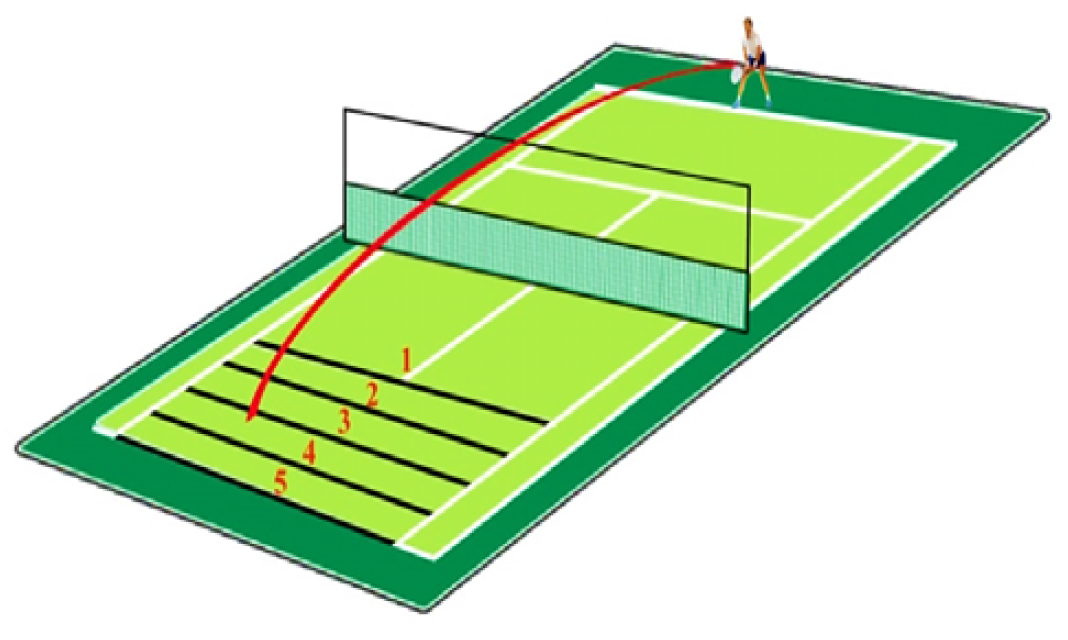
To measure the accuracy of the forehand and backhand groundstrokes
Tools Used
Tennis rackets 10, tennis balls 30, a legal tennis court, a basket for collecting balls, measuring tape, recording form, chalk, rope, two posts 8 feet high.
This test is conducted on a standard tennis court showing the areas where the subject stands, how to perform the test, and the evaluation marks
A rope is fixed on two posts on the net posts, parallel to it, at a height of 7 feet from the ground and 4 feet from the net
Three parallel lines are drawn between the service line and the baseline such that the distance between the lines is 4.5 feet
The student stands on the center mark located in the middle of the baseline and is granted five trial attempts to understand the test performance after instructions are provided by the teacher
The student starts by attempting to return the incoming ball from the teacher with their racket using either the forehand or backhand stroke. Each student is allocated ten attempts for the forehand and ten attempts for the backhand
The student's score is the total points obtained by summing their ten attempts. The ball must cross over the net and under the rope, and the student receives progressive scores from 1-5 points
The maximum score a student can obtain in the forehand groundstroke test is 50 points, and in the backhand groundstroke test is 50 points, with the minimum score for both tests being zero
If the ball passes over the rope, they are given half the evaluation mark for the correct zone it lands in. However, if the ball lands outside the evaluation marks, the student is awarded zero
Pilot Experiment
The pilot experiment was conducted on a sample of 10 students selected from Section D who are outside the individuals of the research sample. The experiment was implemented on Wednesday (15/10/2025) exactly at ten o'clock in the morning, on the outdoor tennis court at the College of Physical Education and Sports Sciences – University of Anbar. Its objective was to identify the potential obstacles that might appear in implementing the main experiment using the hexagonal thinking strategy, as well as to train the assisting work team on applying the experiment, to identify the time taken to implement the lesson, and to ascertain the validity of the devices and tools used in the experiment.
Scientific Foundations of the Scale and Motor Test
Validity
Validity is considered an important psychometric characteristic that must be present in the measurement tool, as it reveals the extent to which the scale performs the purpose for which it was designed. For the purpose of estimating the validity of the scale and the motor test, the researcher relied on "face validity and content validity" by presenting the psychomotor coordination scale, as well as a questionnaire for accuracy tests of the two groundstrokes, to a group of experts and specialists (Appendix 1). Scientific literature in sports measurement confirms that the consensus of an expert panel represents a strong indicator of content validity, especially when evaluating motor skills and related psychological scales [8]. The experts confirmed the validity of the scale and tests with an agreement rate of 100%, which provides a high indicator of the validity of the utilized tools.
Reliability
To ensure the consistency of the research tools' results, the researcher verified reliability according to procedures commensurate with the nature of each tool:
Reliability of the Psychological Scale: The split-half method was used by dividing the items of the psychomotor coordination scale, totaling 20 items, into two halves (odd and even). Using the simple correlation coefficient (Pearson), the value was 0.85 for half the scale. To obtain the total reliability of the scale, the Spearman-Brown prophecy formula was applied for length correction, yielding a reliability coefficient value of 0.88. This is considered a very high indicator, as Thomas et al. [9] note that reliability coefficients exceeding 0.80 are considered highly acceptable and reliable for use in sports academic research
Reliability of the Motor Test: The researcher relied on the test-retest method, where the first test was applied on Sunday (19/10/2025) to the pilot experiment sample of 10 students. After the passage of 7 days, the second application was conducted on the same sample on Sunday (26/10/2025). A one-week period is considered an ideal time interval in motor tests to avoid the effect of fatigue or the transfer of learning effects [10]. The value of the correlation coefficient (Pearson) between both applications was 0.91, which confirms that the skill test has a high degree of stability that justifies relying on it.
Figure 1: Illustrates the Test for the Forehand and Backhand Groundstrokes
Objectivity
Objectivity refers to the independence of the results from the subjectivity of the laboratory. The tools of this study were achieved thanks to their clear design, since for the psychological scale, the researcher chose the multiple-choice method with a clear and specific correction key, so no referee disagrees, which gives the scale a high objectivity. As for the performance accuracy test for both skills, it is very objective because its instructions, scoring method, and point calculation are specific and clearly defined. This is consistent with the principles of assessment in physical education, which emphasise that clarity of the assessment protocol and standardised instructions ensure that the personal aspect of the assessor is neutralised [8].
Field Research Procedures
Pre-tests: The researcher implemented the pre-tests for the research sample on Sunday (26/10/2025) on the outdoor tennis court at the college. Precisely at ten in the morning, the pre-tests were conducted for the experimental research group, and at exactly eleven in the morning, the pre-tests were conducted for the control research group. It began with the application of the psychomotor coordination scale, the forms of which were distributed to students to answer its items over 20 minutes, after the instructions regarding answering the scale items had been clarified. Upon completion and collection of the forms, the test for the forehand and backhand groundstrokes was applied. The researcher was diligent in stabilizing all conditions related to the tests and their execution methods, as well as adhering to all conditions pertaining to the assisting team, devices, and tools, in order to replicate the exact same conditions during the implementation of the post-tests.
The Main Research Experiment
The Hexagonal Thinking strategy is a collaborative learning approach where students work simultaneously in six-member groups arranged in a beehive-like formation. This method actively encourages teamwork, interaction and student involvement.
The Educational Aspect
The field is marked with a hexagonal stripe to indicate the collective stations
The teacher explains the skill and physically appears while observing the cohesion of the group
Colored hexagonal cards containing specific questions are used to guide the students' dialogue
Group members have distinct roles, including a designated "king" (defined by a scarf) who is responsible for managing paperwork and declaring the group's compatibility
This phase concludes with a multiple-choice question designed to stimulate group brainstorming
The Applied Aspect
The teacher deals hexagonal cards with exercises of different difficulty levels
Groups have one minute to choose the appropriate exercise and then execute the task with turn-by-turn to ensure complete learning
Cells share their experiences and showcase top performances with one another
The "king" presents the group's answers, which the teacher verifies to reinforce skill comprehension
The teacher ensures all groups practice concurrently while monitoring their progress and providing continuous feedback
Student Responsibilities
Researching and actively discussing information to answer teacher prompts based on the instructional model
Synthesizing diverse ideas to support skill execution, benefiting from an environment where the teacher accepts all student input
Applying theoretical knowledge directly to practical, collaborative exercises
Engaging in both self-evaluations and peer assessments
Teacher Responsibilities
Designing engaging materials and shifting the educational focus to student-centered learning
Encouraging student accountability, cooperative teamwork, and healthy competition
Fostering cognitive development, problem-solving abilities, and strong social bonds
The seven-week study was conducted from October 29 to December 10, 2025, consisting of one 90-minute session per week for the research sample. Each session was structured into three segments: a 20-minute preparatory phase, a 60-minute main phase (split into 20 minutes for instruction and 40 minutes for application), and a 10-minute concluding phase. Both the control and experimental groups performed 4 to 5 identical exercises per session, with the hexagonal strategy implemented for the experimental group under the researcher's direct supervision.
Post-Tests
After concluding the implementation of the hexagonal thinking strategy, the researcher conducted the post-tests for the research sample individuals on Sunday (14/12/2025) on the outdoor tennis courts at the college. This took place precisely at ten in the morning for the experimental research sample, and at eleven in the morning on the same day for the control research group. It began by applying the psychomotor coordination scale, followed by the test for the forehand and backhand groundstrokes, taking into consideration all temporal and spatial conditions in which the pre-tests were conducted, as the same timings and the exact same court were utilized. The researcher was also keen on choosing the same assisting work team and using the exact same devices and tools that were utilized in the pre-tests to control extraneous variables and fix variables as much as possible.
Statistical Methods
The researcher utilized the statistical package (SPSS V.29) to process the raw data obtained [11-14].
RESULTS
Displaying the Results of the Pre- and Post-Tests for Psychomotor Coordination and the Forehand and Backhand Groundstrokes for the Experimental Research Group
Table 1 illustrates the arithmetic means, standard deviations, differences of arithmetic means, their standard deviations, t-value, Sig., and the significance of differences between the results of pre- and post-tests for the dependent variables of the experimental group.
Table 1: Pre-test and Post-test Mean Comparison of Psychomotor Coordination and Groundstroke Skills
Variables
Unit of Measurement
Pre-test
Post-test
Mean Diff (MD)
Std. Dev of Diff (SDD)
t-value
Sig.
Significance
Mean
SD
Mean
SD
Psychomotor Coordination
Score
52.6
3.481
71.8
4.259
19.2
3.51
11.41
0.000
Significant
Forehand Groundstroke
Score
19.2
2.53
33.7
3.47
14.5
4.21
9.61
0.000
Significant
Backhand Groundstroke
Score
17.3
2.45
28.4
2.71
11.1
3.93
10.17
0.000
Significant
The tabulated (t) value reached 2.04 at degrees of freedom 30-1 = 29 and a significance level of 0.05. It is noted from Table 2 that the statistical significance value (Sig.) is less than the significance level 0.05, which means we reject the null hypothesis and accept the alternative hypothesis stipulating the existence of statistically significant differences between the results of the pre- and post-tests for the experimental research group, in favor of the post-tests.
Displaying the Results of the Pre- and Post-Tests for Psychomotor Coordination and the Forehand and Backhand Groundstrokes for the Control Research Group
Table 2 illustrates the arithmetic means, standard deviations, differences of arithmetic means, their standard deviations, t-value, Sig., and the significance of differences between the results of pre- and post-tests for the dependent variables of the control group.
Table 2: Pre-test and Post-test Comparison of Psychomotor Coordination, Forehand Groundstroke and Backhand Groundstroke Scores
Variables
Unit of Measurement
Pre-test
Post-test
Mean Diff (MD)
Std. Dev of Diff (SDD)
t-value
Sig.
Significance
Mean
SD
Mean
SD
Psychomotor Coordination
Score
51.3
3.52
62.1
2.83
10.8
3.91
12.15
0.000
Significant
Forehand Groundstroke
Score
19.9
2.42
28.2
2.03
8.3
1.73
8.41
0.001
Significant
Backhand Groundstroke
Score
16.7
2.88
25.9
3.38
9.2
3.16
10.04
0.000
Significant
The tabulated (t) value reached 2.04 at degrees of freedom 30-1 = 29 and a significance level of 0.05. It is noted from Table 3 that the statistical significance value (Sig.) is less than the significance level 0.05, which means we reject the null hypothesis and accept the alternative hypothesis stipulating the existence of statistically significant differences between the results of the pre- and post-tests for the control research group, in favor of the post-tests.
Table 3: Post-Test Comparison of Control and Experimental Groups on Selected Tennis Performance Variables
Variables
Unit of Measurement
Control Group
Experimental Group
Mean Diff (MD)
Std. Dev of Diff (SDD)
t-value
Sig.
Significance
Mean
SD
Mean
SD
Psychomotor Coordination
Score
62.1
2.83
71.8
4.259
9.7
3.41
6.73
0.003
Significant
Forehand Groundstroke
Score
28.2
2.03
33.7
3.47
5.5
3.71
3.13
0.009
Significant
Backhand Groundstroke
Score
25.9
3.38
28.4
2.71
2.5
2.62
2.89
0.017
Significant
Displaying the Results of the Post-Tests for Psychomotor Coordination and the Forehand and Backhand Groundstrokes for both the Control and
Experimental Research Groups
Table 3 illustrates the arithmetic means, standard deviations, differences of arithmetic means, their standard deviations, t-value, Sig., and the significance of differences between the results of post-tests for the dependent variables of the control and experimental groups.
The tabulated t value reached 2.002 at degrees of freedom 60-2 = 58 and a significance level of 0.05. It is noted from Table 3 that the statistical significance value (Sig.) is less than the significance level 0.05, which means we reject the null hypothesis and accept the alternative hypothesis stipulating the existence of statistically significant differences between the results of the post-tests for the control and experimental research groups, in favor of the experimental group.
DISCUSSION
It is clear from Table 3 that there are significant differences between the results of the subsequent tests of the control and experimental groups in the study variables and in favor of the experimental group. The researcher attributes these significant differences to the use of the "hive" strategy, which worked to improve joint cooperation, develop the spirit of a single team, and actively engage students to increase understanding of the details of the skill. This strategy helps build trust among students when constructive feedback is given under teacher supervision. This is consistent with what Casey and Goodyear [15] state that cooperative learning models in physical education achieve complex learning outcomes (motor, cognitive, and social) far superior to traditional methods exclusively for teachers.
The results that showed a significant superiority of the experimental group in psychomotor compatibility and both skills are explained by the double effectiveness of the hive strategy, which acted as an integrated educational system, since the environment of six organizations provided a physical and moral framework that promoted collective responsibility and facilitated immediate feedback from peers, which was directly reflected in the performance of the skills. The forehand saw a significant improvement (5.5 degrees) in its collectivity and ease of movement, while the improvement of the backstroke (more biomechanically complex) was less severe (2.5 degrees) but remained significant. Chiviacowsky and Wulf, [16] point out that peer feedback plays a crucial role in overcoming complex skill difficulties and reducing the "cognitive load" on the learner, thereby speeding up the skill retention process.
At the same time, regular collaborative interactions and a climate of mutual support transformed the educational process from a purely individual task to a satisfying social experience, which explains the significant and substantial increase in the degree of psychomotor compatibility (a difference of 9.7 points) in favor of the experimental group. This improvement confirms that there is a close reciprocal relationship between psychological improvement and motor improvement in active learning environments. This increase can be explained by Self-Determination Theory, where giving students leadership roles (such as "cell king") and space for dialogue meets their basic psychological needs (competence, independence, and belonging), which is the primary driver of self-motivation and psychological adjustment in the sports context [17-18].The researcher attributes the superiority of the experimental group in general to the integrated interactive nature of the hive strategy, which materialized through two interrelated mechanisms: the first is organizational, represented by the spatial environment defined by the groups of six groups that traced clear contours of responsibility, and the second is practical, which was manifested in the dialectic produced between the "groupthink stage" and the "practical application stage". This methodological integration not only raised the level of skill efficiency, but also took into account individual differences among students and addressed them according to the principle of specialization and intellectual and physical control, which made the hive strategy a fertile environment for both motor and psychological growth of the student.
CONCLUSION
The hexagonal thinking strategy proved its effectiveness as an innovative educational approach in teaching tennis, achieving superior results compared to the traditional method in all investigated variables
The use of the hexagonal thinking strategy granted students an opportunity for joint work, constructive cooperation, and active learning
The interactive and cooperative environment provided by the strategy contributed to satisfying the basic psychological needs of the students (competence, autonomy, relatedness)
The hexagonal thinking strategy took into account the individual differences among students in learning the investigated skills
The hexagonal thinking strategy contributed to a higher level of enthusiasm, motivation, and self-confidence among members of the experimental group
Recommendations
The researcher recommends adopting the hexagonal thinking strategy as one of the primary approaches in teaching athletic skills, particularly in individual sports
Holding training courses for teachers and coaches on how to design and implement lessons using this strategy
Focusing on the use of modern teaching strategies to keep pace with scientific development and cultivate the various capabilities and aptitudes of students
The necessity of using the hexagonal thinking strategy in conducting further research and studies across different activities
REFERENCE
Kusuma, I.J. et al. “The effect of active learning method on students' physical fitness in physical education and fitness lectures.” Proceeding Unesa, 2024, pp. 23261.
Potash, B. Hexagonal thinking in ELA: The ultimate guide. Spark Creativity, 2020.
Kızılet, A. et al. “The effect of eight-weeks coordination training on tennis and motor skills performance on 8–10 years children.” Pakistan Journal of Medical & Health Sciences, vol. 15, no. 6, 2021, pp. 1578–1581.
Sopa, I.S. and M. Pomohaci. “Psychomotor and cognitive skills that make a difference in tennis players at national level.” Discobolul – Physical Education, Sport and Kinetotherapy Journal, vol. 59, no. 4, 2020, pp. 416–425.
Mohammed Hammood, Y. et al. “The effect of a proposed training method using play exercises to develop specific agility and skill performance in football.” Retos, vol. 63, 2025, pp. 719–728.
Mohammed, K.J. et al. “The effect of colorful and varied visual skill exercises on the development of sensory perception and complex skill performance among futsal players.” Retos, vol. 69, 2025, pp. 1226–1239.
Omar, F. et al. “The impact of cognitive training on field intelligence growth and some composite skills of advanced football players.” Retos, vol. 66, 2025, pp. 46–58.
Morrow, J.R. et al.Measurement and evaluation in human performance. 5th ed., Human Kinetics, 2015.
Thomas, J.R. et al.Research methods in physical activity. 7th ed., Human Kinetics, 2015.
Baumgartner, T.A. et al.Measurement for evaluation in kinesiology. 9th ed., Jones & Bartlett Publishers, 2015.
AbdulJabbar, M.A. et al. “The effect of mental training (mental visualization and attention focus) on the accuracy and speed of offensive performance in fencing players.” Retos, vol. 70, August 2025, pp. 1097–1113.
Fayyad, F.H. et al. “Building and legalizing a test to measure the level of football agility of young players.” Retos, vol. 68, 2025, pp. 1578–1590.
Fayyad, F.H. et al. “Construction and standardization of a reliable test to measure short aerial ball shooting accuracy in football.” International Journal of Human Movement and Sports Sciences, vol. 14, no. 1, February 2026, pp. 48–58.
Hammood, Y.M. et al. “Measuring the aggressive behavior of the teams in the Iraqi Premier League in football and its relation to the results and ranking of the league for the 2022–2023 season.” Sportske Nauke i Zdravlje, vol. 14, no. 2, 2024, pp. 127–134.
Casey, A. and V.A. Goodyear. “Can cooperative learning achieve the four learning outcomes of physical education? A review of literature.” Quest, vol. 67, no. 1, 2015, pp. 56–72.
Chiviacowsky, S., and G. Wulf. “Feedback after good trials enhances learning.” Research Quarterly for Exercise and Sport, vol. 78, no. 1, 2007, pp. 40–47.
Ryan, R.M., and E.L. Deci. Self-determination theory: Basic psychological needs in motivation, development, and wellness. Guilford Publications, 2017.
Sun, H. and A. Chen. “A pedagogical understanding of the self-determination theory in physical education.” Quest, vol. 62, no. 4, 2010, pp. 364–384.
Appendix
Appendix
Appendix 1: Experts and Specialists
No.
Scientific Title and Name
Specialization
Place of Work
1
Prof. Dr. Khalil Ibrahim Suleiman
Motor Learning – Volleyball
University of Anbar – College of Physical Education and Sports Sciences
2
Prof. Dr. Majid Khalil Khamis
Motor Learning – Tennis
University of Diyala – College of Physical Education and Sports Sciences
3
Prof. Dr. Waleed Waadallah Ali
Teaching Methods – Tennis
University of Mosul – College of Physical Education and Sports Sciences
4
Prof. Dr. Nada Nabhan Ismail
Test and Measurement – Tennis
University of Baghdad – College of Physical Education and Sports Sciences
5
Prof. Dr. Ammar Jabbar Abbas
Motor Learning – Tennis
University of Diyala – College of Physical Education and Sports Sciences
Recommended Articles
Research Article
The Effect of Using Special Exercises on the Development of the Defensive Movement Speed Skill of Misan Futsal Club Players
Yasser Jumaa Falih
Published: 02/02/2026
Download PDF
Research Article
The Effectiveness of Neuromuscular Coordination Exercises in Regulating the Electrical Activity of Shoulder Muscles and Its Reflection on Biomechanical Characteristics and the Level of Shot Put Achievement for Juniors
Waleed Khairullah Fayhan
Published: 20/01/2026
Download PDF
Research Article
Design of an Electronic Device for Measuring Complex Motor Reaction Time to Auditory and Visual Stimuli
Imad Saadallah Khamis,
Ibrahim Khalil Ibrahim
Published: 22/01/2026
Download PDF
Research Article
Phosphogenic Power as a Function of Maximum Speed and Impulse Force and Their Relationship to the Triple Jump Performance of Students
Mustafa Ismal Aseen
Published: 18/01/2026
Download PDF
PO Box 101, Nakuru
Kenya.
Email: office@iarconsortium.org
Editorial Office:
J.L Bhavan, Near Radison Blu Hotel,
Jalukbari, Guwahati-India
Khalaf, H. H. (2026). Effectiveness of the Hexagonal Thinking Strategy on Psychomotor Coordination and Learning the Forehand and Backhand Groundstrokes in Tennis for Students. Scientific Research Journal of Multidisciplinary, 6(1), 1-7.
MLA
Khalaf, Hameed H.. "Effectiveness of the Hexagonal Thinking Strategy on Psychomotor Coordination and Learning the Forehand and Backhand Groundstrokes in Tennis for Students." Scientific Research Journal of Multidisciplinary 6.1 (2026): 1-7.
Chicago
Khalaf, Hameed H.. "Effectiveness of the Hexagonal Thinking Strategy on Psychomotor Coordination and Learning the Forehand and Backhand Groundstrokes in Tennis for Students." Scientific Research Journal of Multidisciplinary 6, no. 1 (2026): 1-7.
Harvard
Khalaf, H. H. (2026) 'Effectiveness of the Hexagonal Thinking Strategy on Psychomotor Coordination and Learning the Forehand and Backhand Groundstrokes in Tennis for Students' Scientific Research Journal of Multidisciplinary 6(1), pp. 1-7.
Vancouver
Khalaf HH. Effectiveness of the Hexagonal Thinking Strategy on Psychomotor Coordination and Learning the Forehand and Backhand Groundstrokes in Tennis for Students. Scientific Research Journal of Multidisciplinary. 2026 Jan;6(1):1-7.


 Download PDF
 Download XML