It is no secret that corporate social responsibility has taken root in the United States. American writers are the ones who have proposed - and since the fifties of the last century, based on moral and religious foundations.The first contribution to the field of social responsibility was from John Morris Clark in his article, The Changing Basis of Economic Responsibility, in which he recommended social control of the business as well as the preservation and protection of the environment, and the study aimed to (identify the level of social responsibility at Al-Qasim Green University. knowing the legal level at Al-Qasim Green University. knowing the level of environmental protection at Al-Qasim Green University. Identifying the role of social and legal responsibility to protect the environment at Al-Qasim Green University. The researchers used the descriptive approach in the survey method, due to its relevance to the nature and objectives of the research. The research community consisted of 75 people representing the various colleges of environmental sciences, in its two departments, pollution and environment at Al-Qasim Green University. The sample represented 100% of the research community. The researcher used a questionnaire to collect data, and the first part consisted of 6 paragraphs specialized in personal data, and general information in terms of (gender, age, educational qualification, and the number of experience years). As for the second part, social responsibility included 15 paragraphs distributed on the variable with its dimensions, moral responsibility with 7 paragraphs, voluntary responsibility with 8 paragraphs, and management review (5 paragraphs). All the paragraphs were according to the five-point Likert scale, one of the commonly used measures in management, and its value ranged from ranks 5 strongly agreed to 1 strongly disagreed at all and for all the expressions of the scale tool. The third part: the legal responsibility includes 10 paragraphs, and the fourth part: guarantees the protection of the environment 10 paragraphs. The questionnaire was distributed to the research sample, and after collecting and processing it statistically, the researcher concluded. There is a statistically significant impact of applying social and legal responsibility on environmental protection.There is a strong correlation between social responsibility and environmental protection in a linear direction. There is no weakness in social and legal responsibility, and this came as a result of weakness through the statistical indicators in the legal responsibility index, and the study recommended: The relevant institutions should activate the legal role to reduce environmental pollution. Increasing awareness sessions and seminars on environmental protection. Strengthening the voluntary aspect, such as planting trees and others to preserve the environment.
Keywords
Social Responsibility
Legal Responsibility
Protect Environment
INTRODUCTION
Research Importance
Social responsibilities vary according to a set of social variables, in connection with this, the social responsibilities carried out by females for males vary based on the gender variable. Social responsibilities also vary based on the age variable, as this variable plays a pivotal role in determining the extent of civil and criminal liability, and civil liability is legally determined. It obliges a person to repair what he has damaged, in the application of the principle that asserts that whoever damages something must repair it. The civil responsibility of a person may extend to occupy a large area, such as the responsibility of the business owner for investing maximizing his money, or the responsibility of the head of the family for the safety and care of young children, and for the service and care of his animals, as well as for maintaining the things he owns, and the responsibility of the owner of the car for an accident that occurred on his part in this Framework The conditions of civil responsibility change with the changing conditions of society and its civilized development. On the contrary, we find that criminal responsibility determines the condition of the person deserving of punishment, because of his departure from the basic system of community life, which is punishable by law. In the case of criminal responsibility, a person finds himself liable to reform a mistake he committed, in addition to bearing the consequences of the violation, misdemeanour or felony. Criminal responsibility is linked to the violation of strong and deep emotion in the human psyche, which includes a clear sense of compatibility with public order for fear of a disgraceful judgment that destroys the social status of the individual, and if the law is the minimum level of morality as decided by sociologists, or it is morality at its lowest level. In this regard, every individual must be aware of his responsibilities and what is going on around him in the environment to preserve it from pollution [1]. Realizing the importance of social responsibility to protect the environment, which allows the community in itself the ability to obtain the services it needs in various necessary aspects such as the lack of educational, cultural, and economic services in the community [2]. Since education in general and universities, in particular, constitute the umbrella and spirit of society, the relationship between universities and societies is a close and deep relationship, each of which affects and is affected by the other, but what distinguishes universities from other educational and educational institutions is that they sit at the top of the educational system pyramid of society. This position reflects its importance in playing an important role in building and developing society and meeting its knowledge and academic needs, which constitutes the social responsibility of universities. Therefore, the importance of the research is reflected in the identification of social and legal responsibility and its role in protecting the environment on a sample of the employees of Al-Qasim Green University.
Research Problem
Universities are considered the intellectual and scientific elites in society, and they are no longer viewed as the “house of wisdom” or the pulpit of knowledge but are also seen as the house of expertise for the various products and service sectors of society, regardless of their activities. one of the most important postulates upon which the university’s relationship with its society is based is that the university is not separated from society and that the university’s relationship with society is the relationship of the part to the whole, but each society has its own privacy and environment that affects directly or indirectly the nature of the university and the quality of the various activities it undertakes, whether Was these activities educational, research, or community-based? [3]. Hence, the real purpose of the university and the justification for its existence is to serve the society in which it exists by assuming its societal responsibilities, and this means that the university’s close association with its society gives it legitimacy and justification for its existence, where it is not dangerous for the university to separate from its society and confine itself within its walls, to transfer to its student's knowledge away from touching the needs and issues of society. Therefore, the failure of the democratic transformation in most third-world societies towards social responsibilities is that the equation of social loyalty and power is in favour of the patriarchal state and not in the interest of the citizens, they have become destined to do their duty without obtaining rights, which prompted citizens to refrain from participating in campaigns to preserve the environment, including rationalizing energy consumption and reducing waste in water and others, which harmed society and bequeathed it many social diseases, resulting from the reluctance to Participation in various fields, which led to a decrease in production, and the practice of protests, rebellion and sabotage, demanding fulfilment of the rights aspect in the structure of social responsibility [4]. Which is reflected in increasing desertification, an increase in water scarcity and an increase in pollution, and we stress that social responsibility in our societies - as a variable - is in a state of crisis, and the crisis can lead to collapse and death, and since societies do not die. The negative sequences of the crisis may lead to a state of creative chaos, which may lead to an objective and comprehensive change, but it may lead to new stability, and thus the research problem lies in delving into the role that social and legal responsibility plays in protecting the environment.
Research Aims
knowing the level of social responsibility at Al-Qasim Green University
knowing the level and legal at Al-Qasim Green University
Identifying the level of environmental protection at Al-Qasim Green University
Identifying the role of social and legal responsibility to protect the environment at Al Qasim Green University
Research Limits
Objective Limit: The study is limited to the extent of the role of social and legal responsibility in protecting the environment at Al-Qasim Green University.
Spatial boundary / Al-Qasim Green University
Research hypotheses
There is a statistically significant level of social responsibility at Al-Qasim Green University
There is a statistically significant effect on the legal responsibility in protecting the environment at Al-Qasim Green University
There is a statistically significant relationship between social and legal responsibility in protecting the environment
Define Terms
Responsibility: a duty or task that is required and expected of a person, such as a janitor who has many responsibilities, or the task of mowing the lawn is the responsibility of a housekeeper [5]
Social Responsibility: Social responsibility means that people, companies, and every individual connected to a community must act in a way that benefits the community itself. Social responsibility has become increasingly important for all, because of its obvious benefits in the formation of civilizations, but also in raising the well-being of society and the environment [6]
Legal Liability: Specific duties imposed on a person to take care of another person or thing, including responsibility for personal obligations as granted by the power of attorney or court order, meaning liability in law; It is the breach of the binding agreement on the responsibility of a person over someone or something [7]
Environment: It is the medium that surrounds the human being or the framework in which he lives with other living creatures and other natural conditions and other elements that are necessary for life in this medium, and human is affected by all these elements included in the environment that surrounds him and affects him at the same time
Environmental Protection: the environment in which an organization operates, including air, water, land, natural resources, plants, animals, and humans, and their interrelationships
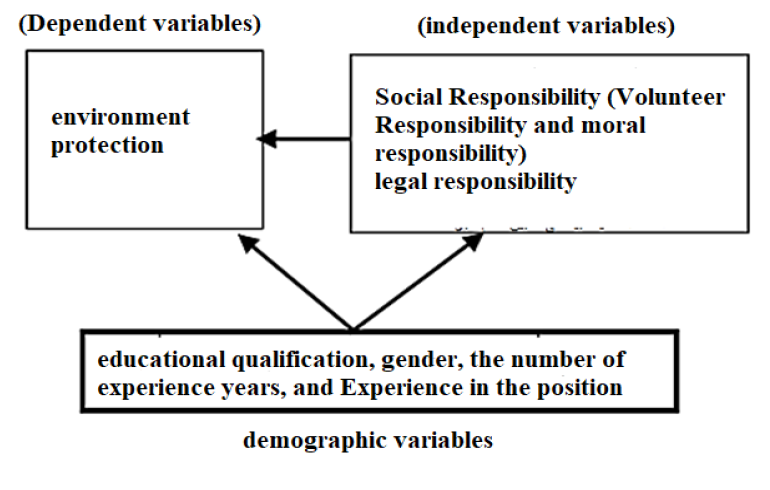
The hypothetical scheme includes the study variables
The independent Variable: social responsibility consists of (voluntary responsibility - moral responsibility), legal responsibility
Social Responsibility
Social responsibility is the first number for business organizations and nothing else is limited to investing resources efficiently in businesses that will achieve profit and economic benefits for those who own them, and that anything other than that responsibility undermines economic relations in the market and degrades the profits of business organizations, being a strategic tool for creating wealth and maximizing the value of the campaign Shares, where the organization has no social responsibility except to maximize profits [8]. Organizations have different obligations towards their stakeholders because the strength and wealth that organizations enjoy comes from the community in which they operate and therefore they must meet its needs [9], which is the early and influential statement of the modern idea of social responsibility. Bowen defined social responsibility as the commitment of the organization to pursue policies, and make desirable decisions regarding the goals and values of society. The opinion is shared by management pioneer Peter Drucker, who views social responsibility as the commitment of organizations to the society in which they operate. Despite the importance of profits for the organization, he sees that it does not represent its purpose. Organizations are social institutions and have responsibilities towards workers and towards society in general [10]. This was confirmed by [11] when they viewed social responsibility as the organization's response to what is beyond economic, technical, and legal requirements by achieving Long-term social benefits, in addition to the traditional economic returns sought by organizations. Strier, indicated that social responsibility represents society's expectations for the initiatives of business organizations in many areas that fall under different dimensions of social responsibility that business organizations bear towards society, provided that it exceeds the minimum social obligations imposed by law so that these obligations do not lead to harm to the business organization to carry out its basic functions and obtain appropriate returns from its investments. While Brammer et al. asserted that social responsibility represents an entry point for unifying social and environmental interests in the organization's operations and environmental interactions with stakeholders on a voluntary basis - and described as an administrative obligation to assume tasks that protect and improve the welfare of society as a whole, as well as benefit organizations. It also expresses the business responsibilities that contribute to building a better society, not at the operational level, but also at the voluntary level.
Social responsibility represents an effective response to the changes taking place in the needs of society, as well as the financial returns and the developed performance as a result of adopting this responsibility
The community's trust in the organization helps it maintain and consolidate its relationship with suppliers and distributors without the need to spend more time and money
A socially responsible organization can easily attract manpower from abroad
Improving the quality of services provided to the community
Increasing education and social awareness at the level of individuals, in a way that contributes to advancing development and achieving political stability
Contribute to technological development and the elimination of unemployment and other cases in which the modern state finds itself unable to carry out all its burdens without private economic organizations assuming their responsibilities in this framework [12]
Dimensions of Social Responsibility
The concepts of social responsibility have developed over time, starting with the economic responsibilities that focused on providing the products and services needed by the community and achieving the goal of the owners of capital represented in achieving the maximum possible return as a necessary goal, passing through the legal responsibilities represented by the business’s commitment to the prevailing laws and regulations, and then the moral responsibilities of compliance In what is right and just and avoiding harm, up to the voluntary responsibilities that emerged as a result of business organizations realizing the economic and social benefits that can be achieved as a result, through social responsibility frameworks that include the economic, legal and ethical dimensions of the organization’s work, in addition to its voluntary initiatives in response to social expectations, based on a model. There are several dimensions of social responsibility
Ethical Responsibilities
Ethics refers to the controls and standards that organizations rely on for the purpose of distinguishing between what is right and what is wrong. An ethical issue is a specific problem, situation or condition that requires a person to choose between a set of options that are evaluated as right or wrong, moral or immoral. Business ethics provide guidelines that guide the behaviour of both managers and employees in the decision-making process so that accepted social values, norms and traditions are not violated. Ethical responsibilities reflect the organization's view of the correct and appropriate behaviour in business by adopting ethical responsibilities to the extent that exceeds ethical requirements. Business organizations, while trying to enhance ethical behaviour, must know and be aware of the nature of the development of the moral and ethical levels of their employees. Commitment to ethical aspects has positive repercussions on the success and growth of organizations, where it achieves many advantages for the organization, the most important of which are [13].
Volunteer Responsibilities
These responsibilities come at the top of the business responsibilities pyramid, and they are optional initiatives that are not binding on the organization, in which it is initiated in a humane and voluntary manner, such as training programs that are not directly related to the work of the organization and are designed to serve the community in general or for special groups of it such as the elderly or young people and others. Business organizations implementing these programs are directly related to increasing profits or market share or others. This type of responsibility agrees with. It assumes voluntarily in its practices such as public relations activities, good citizenship and others. Through public relations activities, managers try to enhance the image of their organizations, products and services through support for charitable activities. Daft and Marcic, assert that voluntary responsibilities are responsibilities that stem from the organization's desire to participate in activities that are not economically, legally or morally binding. Thus, it expresses the organizations' keenness to be good citizens through the support they provide to establish various programs in the fields of education, health, human services, culture and arts, civil society organizations, and giving preference to society by engaging in voluntary activities. Voluntary responsibilities enhance the organization’s reputation among investors, develop systems, and ensure community cooperation, in addition to the fact that the organization's involvement in such responsibilities creates a positive image of those organizations and works to improve their image among other organizations, and then that positive social image leads to strengthening Ethical practices among workers and earning great loyalty among suppliers and customers and this works to achieve the social progress that society seeks.
Legal Responsibilities
Social responsibility is the ethical societal constitution that indicates right and wrong and its existence is necessary to ensure that individuals and businesses adopt the correct method in relationships and dealings. Legal responsibilities reflect the organization's commitment to the laws issued by the state when they conduct business. Environmental organizations, for example, want to increase their interest in the safety of the environment in which they operate and put great pressure on governments to adopt laws that govern businesses in the areas of pollution control, consumer rights protection and safety. because it represents the formation of the basic basis for the emergence of the greater social role of business at the levels (ethical and voluntary), where It does not make sense for small and medium-sized organizations to adopt social responsibilities while violating legal rules and not being able to provide the necessary products and services to society. The legal dimension of responsibility is considered not limited to the limits of the scope of the organization, the customer, the community and their relationships, but rather works to protect the organizations themselves from the unfair competition methods that may occur and the resulting conflicts and crises. Increasing competition and increasing market growth and the accompanying developments at the economic level may increase the need to issue a number of new laws that regulate economic life and constitute the best base for binding official contractual dealings that represent a somewhat balanced equivalent for all parties.
The institution is able to implement its principles. It must provide a supportive environment for it to be able to achieve this, taking into account all the problems that the institution may face in protecting the environment.
Environment Protection
Its concept: The environment is the spatial field in which human lives and is affected and affected by all the elements and data possessed by this field, whether they are natural such as rocks and what they contain minerals and energy sources etc. or climatic such as heat, pressure, wind, rain, natural plants and animals and others. Or human data that the human contributed to its existence in terms of buildings, transportation methods, transportation, farms, factories, dams... and others. Environmental protection is considered all behaviours that can achieve tangible results in changing human behaviour towards the environment, but it may take a long time, including education in its comprehensive sense for a human being since his childhood to be environmentally concerned. The use of legislation and incentives that prevent people from bearing an additional burden of tampering with the environment, and also follows the participation of civil society in planning and decision-making to achieve environmental goals, in addition to the fact that this participation builds and strengthens relationships and trust between society and decision-makers, and gives a guarantee for speedy implementation. Pre-translation to face the repercussions that may affect the environment or human health is expected and certain damages cannot be remedied in the future. These duties are binding on both persons and public authorities, so each of them has the duty to protect the environment from any confirmed aggression, or at least mitigate its consequences if it is not possible to prevent its occurrence. Pre-translation to face the repercussions that may affect the environment or human health is expected and certain damages cannot be remedied in the future. These duties are considered binding on both persons and public authorities, so each of them has the duty to protect the environment from any confirmed aggression, or at least mitigate its consequences if it is not possible to prevent its occurrence.
The Importance of Protecting the Environment
The emergence of the urgent need to give individuals and society the development of a responsibility sense towards the environment in which they live, and to give them the necessary awareness in order to be able to deal with the environment in a correct manner, in a manner that is not harmful or harmful to any of the components of the environment and society must appreciate the reciprocal relationship between it and the environment and tries to limit its environmentally harmful practices because they are the most harmful people through the activities they perform. In order to develop successful solutions when any damage occurred, environmental awareness was an indispensable necessity.
The environment plays an important role in supporting administrative activities, where it contributes to.
Protecting the environment increases natural resources and has a vital role in economic growth and development, not only for the present but for future generations.
The deterioration of the environment and its failure to protect it is a problem that limits economic growth through its negative effects on agricultural land productivity, human health, health costs and the destruction of infrastructure under the threat of natural disasters, and the consequences of that problem will be dire on the standard of human living in the future.
The process of protecting the environment at that time requires huge sums of money, especially if the destruction has reached a very dangerous level and may hinder the efforts of economic growth.
Concern for the environment stems from states' interest in it and protecting it from deterioration by development activities. Therefore, mechanisms must be put in place to perpetuate the principles of interest, and any failure in this will have a negative impact on states.
The calculation of pollution problems, solid waste disposal, environmental degradation and other issues such as economic production, national security, global warming, ozone hole and biodiversity loss, are all problems that made every person aware of environmental issues.
Environmental Protection Methods
The protection of the environment must be the direction, the practice and the thought so that the development efforts are harnessed by giving, and the human race has the opportunity to survive, and protecting the environment today has become the problem of modern civilization, rather it is the real challenge.
Protecting the environment in a safe manner has become the biggest challenge that consumes time and money, and there are laws to secure the protection of the environment that made companies liable to accountability if any injustice or harm occurred to the environment, and despite that, securing the environment is not easy at all.
Preserving the environment is the preoccupation of humans today. It was not acceptable to say that humanity must adjust its course and go in line with the imperatives of technology. Rather, the current view must see that industry must be in line with human nature and operate within strict environmental restrictions, and this does not mean that we look at the environment as a system that must be preserved as it is without change, because any economically productive and aesthetically attractive region will soon be invaded by weeds if neglected.
The orientation must be towards finding a relationship between human and the environment, the basis of which is the mutual benefit that allows the person to continue comfortable living, and the environment has the continuity of balance, and this is what is known as “coexistence with the environment”.
The preventive duty to protect the environment constitutes a prior translation to face the repercussions that may affect the environment or human health from expected damage, and to protect the environment from any confirmed attack on it, or at least mitigate its consequences in the event that it is not possible to prevent its occurrence.
Following behaviors that if followed in an integrated manner, can achieve tangible results in changing human behavior towards the environment, but it may take a long time, including education in the comprehensive sense of a person since his childhood to be environmentally concerned, and using legislation and incentives that prevent a person from bearing an additional burden of tampering with the environment.
Following the participation of civil society in planning and decision-making to achieve environmental goals, in addition to the fact that this participation builds and strengthens relations and trust between society and decision-makers, and gives a guarantee for speed of implementation.
Increasing the imposition of taxes on industrial organizations as a result of their pollution to the environment. Therefore, it is necessary for these organizations to preserve the environment and ensure that the terms of environmental licenses, legislation and specific laws are not violated.
Supporting local efforts is an integral part of international efforts to protect the environment. The United Nations and civil society institutions (who are concerned with the environment) are called upon today to set policies that contribute to reducing pollution of all kinds.
Previous Studies
Ahando Study (2016)
Study Title: The dimensions of social responsibility and its role in university education
A study aimed at the dimensions of social responsibility in university education, investigating the requirements for applying its quality, and making proposals to achieve the quality of social responsibility in university education for community service. A study aimed at defining the dimensions of social responsibility in university education, investigating the requirements for applying its quality, and making proposals to achieve the quality of social responsibility in university education to serve the community. The research used the descriptive documentary method by analysing the content of the literature and studies that discussed the issue of social responsibility and its quality in university education to serve the local community. The research concluded several results, the most important of which is that the social responsibility of university education revolves around three main dimensions, are: The social dimension, the environmental dimension, and the economic dimension, and that the application of the quality of social responsibility requires planning for the quality of social responsibility and spreading its culture, and being convinced of it, by including social responsibility and its concepts in the educational programs of the university, and working to improve the services provided by universities to the community, and creating real job opportunities and made available to members of the community.
Hersh and Schneider Study (2005)
Study title: Strengthening personal and societal responsibility in universities
Many of these institutions at the national level, such as Harvard, Stanford, and Duke, have made social responsibility an integral part of the requirements for obtaining a degree, and these universities have obligations that reflect a broader trend in the field of ethics, values, personal and societal responsibility. As for the study of Alkota et al. it serched about the development of ethical practices and social responsibility in dental faculties at the University of Chile, by identifying the perceptions of faculty members and students on a set of dimensions related to social responsibility. The study that used the method of in-depth interviews showed With sixteen individuals (eight professors and eight students) that the curricula of the College of Dentistry were prepared for technical education and training.
Study
Study Title: The contribution of the industrial establishment to protecting the environment from artificial pollution a case study of Ain Al-Tuta Cement
Corporation
The study aimed to shed light on industrial pollution and how to protect the environment to crystallize the most important foundations adopted by the industrial establishment to protect the environment from pollution and analyze the corporation’s contribution to protecting the environment by working to achieve sustainable development on the study sample (Ain Al-Tuta Foundation in the Wilayat of Batna affiliated to the Eastern Algerian Cement Complex- Case Study). The study reached several conclusions, the most important of which were: The company is trying to reduce industrial pollution based on its quest to absorb modern technologies and technological developments. The main recommendations of the study:
The need for companies to reduce industrial pollution, absorb pollutants before they occur, and employ the principle of quality
Study
Study Title: The impact of reverse logistics on environmental protection
The study aimed at the study sample working in the General Company for the manufacture of batteries in Baghdad by 125 workers using the analytical aspect. This study sought to determine the impact of reverse logistics in protecting the environment by recycling the waste materials used and industrial waste and not throwing them back into materials used for the same purpose or converting them into new materials.
The Study Concluded
Recycling is considered an important process to return waste and waste materials to their place of production or sale instead of throwing them or returning them to materials used for the same purpose or converting them into new materials. The most prominent recommendation of the study is to develop the necessary plans for how to dispose of industrial waste in the right manner in order to confront environmental risks.
MATERIALS AND METHODS
Research Methodology
The researchers used the descriptive approach in the survey method (it is a method to describe the studied phenomenon and depict it quantitatively by collecting codified information about the problem, categorizing, analyzing and subjecting it to careful study) due to its relevance to the nature of and objectives of the research.
Field Research Procedures
Research Community: The research community consisted of employees working at Al-Qasim Green University. Participated in this research, representing the various Colleges of Environmental Sciences, with its two departments, Pollution and Environment at Al-Qasim Green University. The sample represented 100% of the research community.
Data Collection Tools
The sources of data collection were the questionnaires, and the standardization tool, which was distributed to the research sample, and it is an agency for measurement.
The First Part: Included paragraphs related to personal data, and general information in terms of (gender, age, educational qualification, and the number of years of experience)
The Second Part: Included social responsibility in paragraphs distributed on the variable with its dimensions, moral responsibility in (7 paragraphs), and voluntary responsibility in (8 paragraphs). and the management review (5 paragraphs), and all the paragraphs came according to the five-point Likert scale, which is one of the commonly used standards in management, and its value ranged between ranks strongly agreed to strongly disagreed at all and for all measurement tool statements
The Third Part: The legal responsibility includes paragraphs
Part Four: Ensuring Environmental Protection (10 Paragraphs)
The validity of the measurement tool (the questionnaire) for the variable social responsibility - legal responsibility environmental protection.
Internal Consistency
To find the internal consistency for the paragraphs of the measurement tool, the researcher used a correlation coefficient for the paragraphs during the period. The values of the correlation coefficients for the social responsibility variable ranged between (0.74-62.0), the legal responsibility variable between (0.81-69.0), and the environment protection variable between (0.77-58. 0), which indicates that all the correlation coefficients for the paragraphs of the scale are statistically significant compared to the tabular value of 0.098, at the level of significance 0.05.
The Validity of the Construction
This type of Validity was achieved by extracting the discriminatory power by the method of the two peripheral groups and the relationship of the degree of paragraphs with the total degree of the measurement tool. The values of Validity coefficients ranged according to the discriminating ability of the social responsibility variable between 0.59-83.0, the legal responsibility variable between 0.85-70.0, and the environment protection variable between 0.84-62.0, which indicates that all the correlation coefficients for the paragraphs of the scale are statistically significant as being high coefficients, which indicates the validity of the measurement tool.
Stability of the Measuring Tool
Extracting the stability of the measurement tool, where the degrees of the measurement tool form were subjected to the alpha-Cronbach equation, and the stability coefficients for the research variables amounted to social responsibility - legal responsibility - environmental protection (respectively (0.82)), (0.80) (0.87), which indicates that the measurement tool is consistent Internally, it is very reliability.
The Main Experience
The researcher distributed the questionnaire to the sample members at Al-Qasim Green University, College of Environmental Sciences, in its departments, and held meetings with the employees to show how to answer the questionnaire.
Statistical Analysis
The necessary statistical methods were used that helped in processing the results and testing the research hypotheses through using the statistical package (spss), including the following:
Arithmetic averages
hypothetical mean
Standard deviations
Regression analysis
Correlation coefficients
Multiple correlation coefficients
RESULTS
First. Statistical description of the study sample: a description of the demographic data as shown in Table 1
Table (3) indicates the percentages of the research sample. The percentages came according to the gender variable, with males with a percentage of 66.66% and females with a percentage of 33.33%, as for the age variable, the group was 30 years and less with a percentage 10.52% and the group from 31-40 years with a percentage 41.03 % and the group from 41-50 years old with a percentage of 35.89%, and the group from 51 and over with a percentage of 12.82%. As for the educational qualification variable, it was a middle school certificate with a percentage of 5.13%, a bachelor’s degree with a percentage of 20.51%, and a master’s degree - with a doctorate with a percentage of 74.35%.
Table 1: Statistical Description of the Study Sample According To Demographic Data
Study variables
Number
Percentage
Gender
male
26
66.66
female
13
33.33
Age
less than 30 years
4
10.52
From 31-40 years old
16
41.03
41-50 years old
14
35.89
From 51 and over
5
12.82
Qualification
middle school
2
5.13
Bachelor's degree
8
20.51
Masters - PhD
29
74.35
*reference prepared by the researcher
Second: Presentation, analysis and discussion of the results
Presentation, analysis and discussion of the results of the independent variable, social and legal responsibility in a holistic manner
In Table 2, it appears to us through the arithmetic means, that the level of the social responsibility variable, the field of moral responsibility, came in the first place, with an arithmetic mean 4.13, followed by the social responsibility variable, the field of voluntary responsibility, with a mean 3.68, while the legal responsibility variable came with an arithmetic mean 2.53. This indicates a weak legal responsibility and a weak (neutral) level compared to the rest of the questionnaire tools. The standard deviations in the table in a relatively low way indicating the agreement of views on the policy adopted by the institution, and that the respondents live in one geographical area.
Presentation, analysis and discussion of the results for the independent variable, social and legal responsibility by gender
Presentation, analysis and discussion of the results for the independent variable, social and legal responsibility by gender (males)
Table 2: Outcomes of the Independent Variable Environmental Management
No
Social and Legal Responsibility
Arithmetic mean
standard deviation
Order
Scale
1
Social Responsibility
Volunteer Responsibility
3.68
0.74
2
approval
moral responsibility
4.13
0.51
1
very approval
2
legal responsibility
2.53
0.43
3
neutral
In Table 3 it appears to us, through the arithmetic means, that the level of the social responsibility variable in terms of gender (males), the field of moral responsibility came in the first place, with an arithmetic mean 4.13, followed by the social responsibility variable, the field of voluntary responsibility, with an arithmetic mean 3.21 in what came the responsibility variable Legal with an arithmetic mean 2.02. This indicates a weak legal responsibility and a weak (neutral) level compared to the rest of the questionnaire tools.
Presentation, analysis and discussion of the results of the independent variable, social and legal responsibility by gender (female).
Table 3: Results of the Independent Variable Environmental and Legal Management by Gender (Male)
No
Social and Legal Responsibility
Arithmetic mean
standard deviation
Order
Scale
1
Social Responsibility
Volunteer Responsibility
3.21
0.32
2
approval
moral responsibility
4.13
0.44
1
very approval
2
legal responsibility
2.02
0.84
3
neutral
In Table 4, it appears to us through the arithmetic means, that the level of the social responsibility variable according to gender (females), the field of moral responsibility came in first place with an arithmetic mean 4.26, followed by the social responsibility variable, the field of voluntary responsibility, with a mean 3.7 in what the responsibility variable came Legal with an arithmetic mean 2.43. This indicates a weak legal responsibility and a weak (neutral) level compared to the rest of the questionnaire tools.
Presentation, analysis and discussion of the results of the independent variable, social and legal responsibility according to the practical qualification
Presentation, analysis and discussion of the results of the independent variable, social and legal responsibility, according to the practical qualification (bachelor - high school)
Table 4: Outcomes of the Independent Variable Environmental Management Gender (Female)
No.
Social and Legal Responsibility
Arithmetic mean
standard deviation
Order
Scale
1
Social Responsibility
Volunteer Responsibility
3.7
0.64
2
approval
moral responsibility
4.26
0.6
1
very approval
2
legal responsibility
2.43
0.32
3
neutral
In Table 5, it appears to us through the arithmetic averages, that the level of the social responsibility variable according to the practical qualification (bachelor's degree - middle school) in the field of moral responsibility came in first place with an arithmetic average 4.09, followed by the social responsibility variable, the field of voluntary responsibility, with an arithmetic average 3.11 in what The legal responsibility variable came with arithmetic mean 2.73. This indicates a weak legal responsibility and a weak (neutral) level compared to the rest of the questionnaire tools.
Presentation, analysis and discussion of the results of the independent variable social and legal responsibility according to the practical qualification (Masters – PhD)
Table 5: Results of the Variable Social and Legal Responsibility According To the Practical Qualification (Bachelor - Preparatory)
No.
Social and Legal Responsibility
Arithmetic mean
standard deviation
Order
Scale
1
Social Responsibility
Volunteer Responsibility
3.11
0.62
2
approval
moral responsibility
4.09
0.43
1
very approval
2
legal responsibility
2.73
0.21
3
neutral
In Table 6 it appears to us through the arithmetic averages that the level of the social responsibility variable according to the practical qualification according to (Master's - PhD) the field of moral responsibility came in the first place with a mean 4.09, followed by the variable of social responsibility, the field of voluntary responsibility, with a mean 3.54 in The legal responsibility variable came with an arithmetic mean 2.73. This indicates the weakness of legal responsibility and its low (neutral) level compared to the rest of the questionnaire tools.
Presentation, analysis and discussion of the results of the independent variable, social and legal responsibility according to age
Presentation, analysis and discussion of the results of the independent variable Social and legal responsibility Practical qualification by age (25-25)
Table 6: Results of the Social and Legal Responsibility Variable According To the Practical Qualification According To (Masters - Phd)
No
Social and Legal Responsibility
Arithmetic mean
standard deviation
Order
Scale
1
Social Responsibility
Volunteer Responsibility
3.54
0.74
2
approval
moral responsibility
4.09
0.51
1
very approval
2
legal responsibility
2.37
0.43
3
neutral
In Table 7, it appears to us through the arithmetic means, that the level of the social responsibility variable by age 35-25 in the field of moral responsibility came in first place with an arithmetic mean 4.001, followed by the social responsibility variable, the field of voluntary responsibility, with an arithmetic mean 3.06 in the following The legal responsibility variable with an arithmetic mean 2.00. This indicates a weak legal responsibility and a weak (neutral) level compared to the rest of the questionnaire tools.
Presentation, analysis and discussion of the results of the independent variable Social and legal responsibility Practical qualification by age (36 and over)
Table 7: Outcomes of the Independent Variable Environmental and Legal Management by Age (25-25)
No
Social and Legal Responsibility
Arithmetic mean
standard deviation
Order
Scale
1
Social Responsibility
Volunteer Responsibility
3.06
0.32
2
approval
moral responsibility
4.001
0.44
1
very approval
2
legal responsibility
2.00
0.84
3
neutral
In Table 8, it appears to us, through the arithmetic averages, that the level of the social responsibility variable according to age (36 and over), the field of moral responsibility came in the first place with an arithmetic mean 4.32, followed by the variable of social responsibility, the field of voluntary responsibility, with a mean of 3.76, in the following The legal responsibility variable with an arithmetic mean 2.13.
This indicates a weak legal responsibility and a weak (neutral) level compared to the rest of the questionnaire tools.
Second: Presentation and discussion of the results of the variable social and legal responsibility and environmental protection
Table 8: Results of the Independent Variable Environmental Management by Age (36 and Over)
No
Social and Legal Responsibility
Arithmetic mean
standard deviation
Order
Scale
1
Social Responsibility
Volunteer Responsibility
3.76
0.31
2
approval
moral responsibility
4.32
0.87
1
very approval
2
legal responsibility
2.13
0.23
3
neutral
Table 9 for the analysis of social responsibility indicates the indicators of social responsibility, and the statistical indications came as follows:
The correlation coefficient (R) indicates the results of social responsibility and its indicators during the correlation coefficient was a high percentage in the indicators of moral responsibility with a value of 0.903, the field of voluntary responsibility with a value of 0.651, and the legal responsibility variable with a value of 0.3.5
The coefficient of determination (R2) shows the independent variable social responsibility and its indicators, moral responsibility, indicating that 513% of the total change is due to this indicator, while the field of voluntary responsibility 38.% and the correlation was weak in the legal responsibility indicator, which indicates that This indicator has a weak impact by 10% compared to other indicators, and this indicates the weakness of legal oversight and the executive authority in protecting the environment from pollution
The (T.TEST) test shows social and legal responsibility with a significant effect on the indicators of the environmental protection variable in all its indicators, except for the legal aspect indicator that had no significant and statistically significant effect, which indicates the absence of the role of the law that it plays in preserving the environment
Table 9: Presenting the Results of the Social and Legal Responsibility Variable and the Environmental Protection Variable
No
Social and Legal Responsibility
Correlation coefficient R
Correlation coefficient R2
Level of significance R
T.TEST
Level of significance T
1
Social Responsibility
Volunteer Responsibility
0.903
0.384
0.06
3.32
0,013
moral responsibility
0,651
0.513
0.10
2.32
0,015
2
legal responsibility
2.13
0.23
3
neutral
CONCLUSION
There is a statistically significant impact of the application of social and legal responsibility on environmental protection
There is a strong correlation between social responsibility and environmental protection in a linear direction
Weakness in the legal responsibility to protect the environment from pollution, and this is the result of weakness in imposing penalties on the contributors to the increase in the pollution rate
Social responsibility contributes greatly to increasing environmental protection
There is no weakness in social and legal responsibility, and this came as a result of weakness through the statistical indicators in the legal responsibility index
Recommendations
The relevant institutions should activate the legal role to reduce environmental pollution
Increasing awareness sessions and seminars on environmental protection
Strengthening the voluntary aspect, such as planting trees and others to preserve the environment
REFERENCE
Zyara, F.F. Management functions. Arabic ed., Al-Yazuri Scientific Publishing and Distribution House, 2009, Amman, Jordan.
Goetsch, D.L. et al.Quality management for organizational excellence: introduction to total quality. 6th ed., Pearson Prentice Hall, 2010, New Jersey.
Al-Qaryouti, M.Q. Organizational behaviour: a study of individual and collective human behaviour in different organizations. Al-Shorouk House for Publishing and Distribution, 2000.
Najm, A.N. Management ethics and business responsibility in business companies. 1st ed., Al-Warraq Publishing and Distribution Corporation, 2006, Amman, Jordan.
Macmenamin, J. Financial management. 1st ed., Routledge, 1999.
Al-Badawi, M. “Defining responsibility in Islamic jurisprudence and the Saudi system.” Journal of Arab Studies, vol. 3, no. 39, 2019, pp. 1563–1590.
Al-Ahdal, A.Q. Responsibility in Islam. Noor Library, 2002.
Ibrahim, I.K. Developing the social responsibility model in the light of measures of strength and ethics in the Iraqi private colleges in Baghdad. Unpublished doctoral thesis, College of Administration and Economics, University of Baghdad, 2010.
Gupta, M. Principles of management. PHI Learning Private Limited, 2009, New Delhi.
Drucker, P. The practice of management. Harper & Row; South-Western Publishing, 1954, USA.
Griseri, P.et al.Business ethics and corporate social responsibility. 1st ed., South-Western, Cengage Learning EMEA, 2010, Singapore.
Al-Rahahla, A.R.S. Social responsibility. 1st ed., Dar Al-Issan Al-Alami for Publishing and Distribution; Al-Arabi Library for Publishing and Distribution, 2011, Amman, Jordan.
Al-Ghalbi, T.M.M. et al. “The social responsibility of business organizations and the transparency of information systems: an applied study of a sample of Jordanian commercial banks.” Journal of Human Sciences, no. 36, 2005, pp. 216–236
Recommended Articles
Research Article
The Effectiveness of Neuromuscular Coordination Exercises in Regulating the Electrical Activity of Shoulder Muscles and Its Reflection on Biomechanical Characteristics and the Level of Shot Put Achievement for Juniors
Waleed Khairullah Fayhan
Published: 20/01/2026
Download PDF
Research Article
Design of an Electronic Device for Measuring Complex Motor Reaction Time to Auditory and Visual Stimuli
Imad Saadallah Khamis,
Ibrahim Khalil Ibrahim
Published: 22/01/2026
Download PDF
Research Article
Effectiveness of the Hexagonal Thinking Strategy on Psychomotor Coordination and Learning the Forehand and Backhand Groundstrokes in Tennis for Students
Hameed Hammad Khalaf
Published: 02/02/2026
Download PDF
Research Article
Phosphogenic Power as a Function of Maximum Speed and Impulse Force and Their Relationship to the Triple Jump Performance of Students
Mustafa Ismal Aseen
Published: 18/01/2026
Download PDF
PO Box 101, Nakuru
Kenya.
Email: office@iarconsortium.org
Editorial Office:
J.L Bhavan, Near Radison Blu Hotel,
Jalukbari, Guwahati-India
Musa, S. H. & Abd, M. N. (2022). The Role of Social and Legal Responsibility to Protect Environment at Al-Qasim Green University. Scientific Research Journal of Multidisciplinary, 2(2), 1-10.
MLA
Musa, Salima H. and Mohammed N. Abd. "The Role of Social and Legal Responsibility to Protect Environment at Al-Qasim Green University." Scientific Research Journal of Multidisciplinary 2.2 (2022): 1-10.
Chicago
Musa, Salima H. and Mohammed N. Abd. "The Role of Social and Legal Responsibility to Protect Environment at Al-Qasim Green University." Scientific Research Journal of Multidisciplinary 2, no. 2 (2022): 1-10.
Harvard
Musa, S. H. and Abd, M. N. (2022) 'The Role of Social and Legal Responsibility to Protect Environment at Al-Qasim Green University' Scientific Research Journal of Multidisciplinary 2(2), pp. 1-10.
Vancouver
Musa SH, Abd MN. The Role of Social and Legal Responsibility to Protect Environment at Al-Qasim Green University. Scientific Research Journal of Multidisciplinary. 2022 Jul;2(2):1-10.



 Download PDF
 Download XML