In this paper, a new method for solving some differential equations called the double Laolace-NO transform is presented. This technique is efficient in solving partial differential equations; several properties of this dual technique are introduced and the Laolace-NO transform of the basic functions is found. In addition, we apply this dual technique to find the exact solution of the Laplace and Poisson partial operator equations. The advantage of this technique is that it has three coefficients in addition to generality.
Keywords
Double Laolace-NO Technique
Laolace Transform
NO- Transform
Double Integral Transform
INTRODUCTION
There are many transforms (techniques) such as Fourier approach, Laplace approach (transform), Sumudu approach, Ezaki approach, Shehu approach, Sadiq-Emad-Eman (SEE) transform, Sadiq-Emad-Jinan Integral (SEJI) transform, Complex Emad-Eman (EE), Sadik transform and so on. are convenient mathematical tools for evaluating the solution of advance problems of natural sciences and its various branches , engineering and its departments which are expressible in terms of operator equations, delay operator models, system of differential models, partial operator equations, They play a major role in finding the exact solution to types of integral equations or partial differential models describing real natural physical phenomena [3,4,11,12,14,15-18]. Solving such equations applying transforms is more difficult than applying double techniques [3,4]. In recent years, great attention has been given to deal with the double transforms (approaches), for example [2,5,7,8,19-24]. Eltayeb and Kilicman [9], used double Laplace technique to evaluate of wave, Laplace’s and heat models and convolution properties, generalization of telegraph and partial integro-differential models. In [5] dealt with double Shehu technique to obtain the exact solution of initial and boundary value models in different areas of real life science and engineering. Hunaiber and Al-aati [13] applied on double Laplace-Shehu technique and its Properties with some applications to find the solution of Laplace, Poisson, wave and heat operator equations, via the derivation of generalization form for solutions of these operator models. Analogous to [13,2], we used new double Sadik-Shehu technique to find the solution Laplace, Poisson operator models, during the derivation of the generalization formula for exact solutions of these equations, or via using the double Laplace-Shehu technique directly to the given equation.
The main objective of the article is to present a novel technique to find the exact solution of partial differential operator equations subject to the Initial Condition (I.C) and Boundary Condition (B.C) said to be double Sadik-Shehu technique, the definition of double Laolace-No technique and its inverse. We also introduced some theorems, propositions and properties about this double technique and gave this technique of some basic functions.
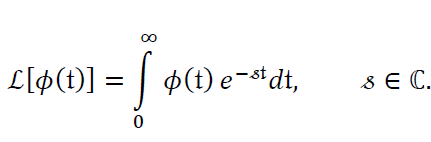
Definition [1]: The Laplace transform of the continuous function z(q) is defined by:
(1)
where, the operator L is the Laplace operator. The inverse Laplace transform is defined by:
(2)
where, k is a real constant.
Definition [25]: The NO integral transform of the function g(t) on the interval (0,∞) is defined as:
(3)
where, β∈Z and u, v, s>0 are parameters.
(4)
The inverse of The NO transform is defined as:
(5)
In general, p = a + ib with a and b being real numbers.
The integral converges when Re [p] =a > 0 and if a<0, Z(u, v, s) = 0 and i∈R.
In the following definition, we present the new double Laplace-NO transform technique.
Definition: The double Laplace-NO transform technique depend on (1 and 4) of
q, p>0 is denoted as
(6)
The above double integral converges if the limit exists, otherwise diverges.
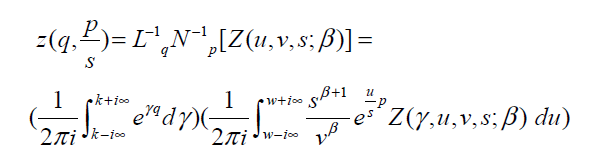
1.4 Definition: The invertible of double Laplace-NO technique depend on (2 and 5) of a function
is given by:
where, k and w are real constants.
Existence and Uniqueness of Double Laplace-NOTechnique
Definition [7]: A function
is called of exponential orders
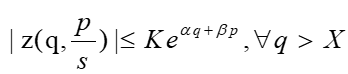
if there exist K, X and
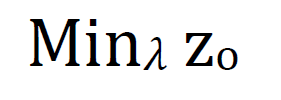
and we write:
Or, equivalently:
Theorem 2.1. Suppose that
is a continuous function in finite intervals (0,X) and (0,Y) and of exponential order exp (aq+bp), so the double Laplace-NO technique of
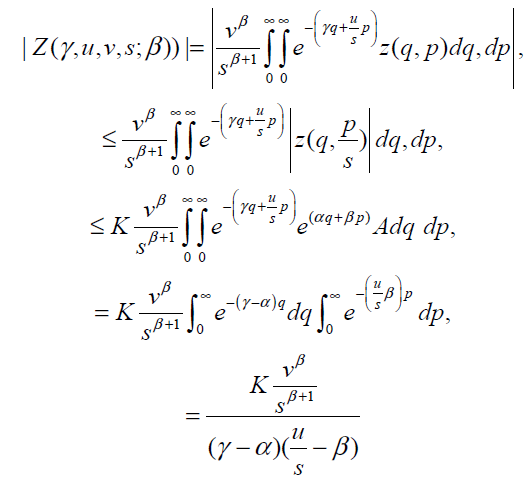
Proof. Assume that Let
be of exponential order exp(aq, bp), such that
and p>Y. And by (6) we get.
Then:
Thus, the proof is complete.
Theorem 2.3. Suppose that
and are the double Laplace-NO techniques in (6) of the continuous functions
and
defined for q, p≥0 respectively. If
Proof. Suppose that that k and w are sufficiently large, since:
we deduce that:
This ends the proof of the theorem.
Basic Important Properties of Double Laplace-NOTechnique
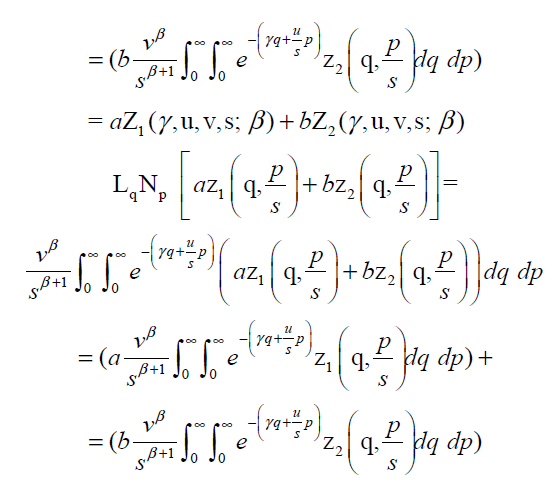
Linearity Property
If the double Laplace-NO Technique in (6) of the functions
respectively, then the double Laplace-NO technique of
is given by
with a and b are constants.
Proof:
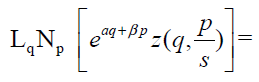
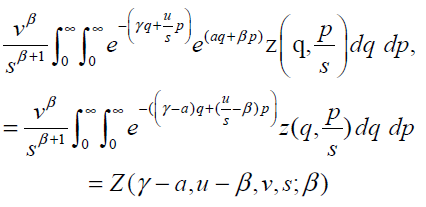
Shifting Property
If Laplace-No technique as (6) of
then double Laplace-No technique of
Proof:
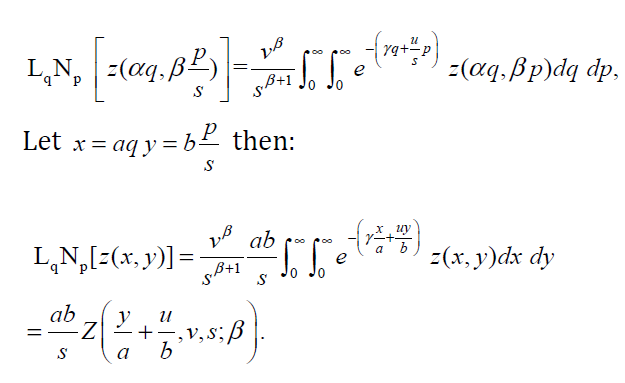
Change of Scale Property
If the double Laplace-No technique as (6) of
is
( so the double Laplace-No technique of
Proof:
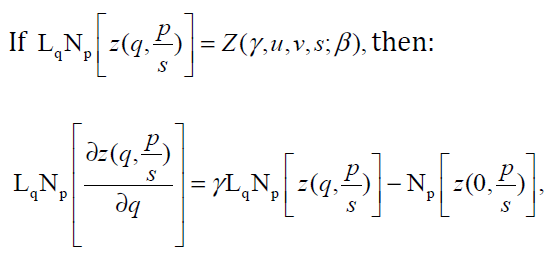
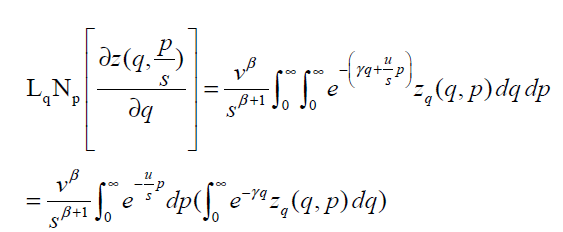
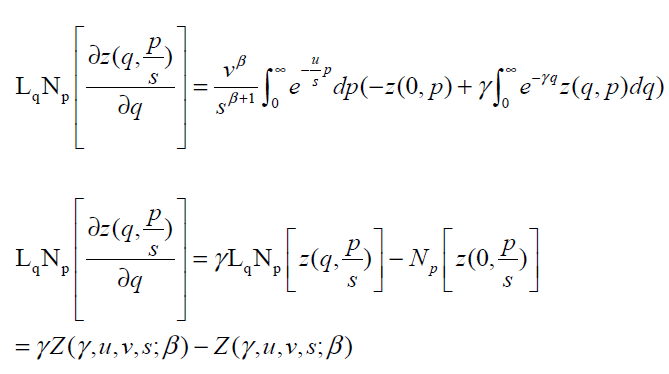
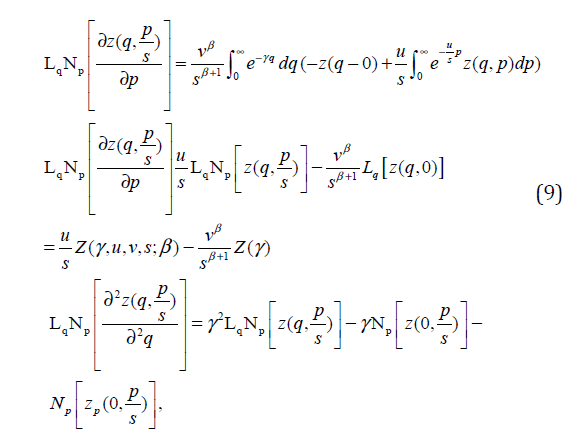
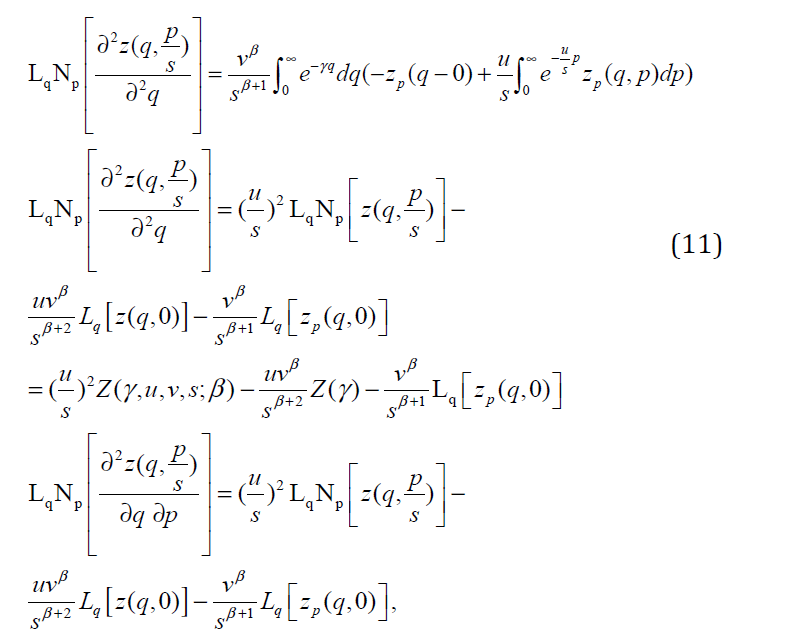
Derivatives Properties:
Proof:
Applying integration by parts, let
then we obtain:
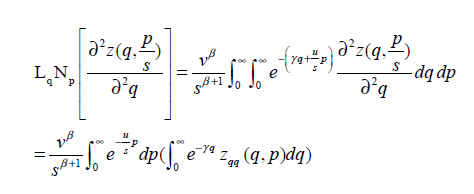
Using integration by parts, let
then we obtain:
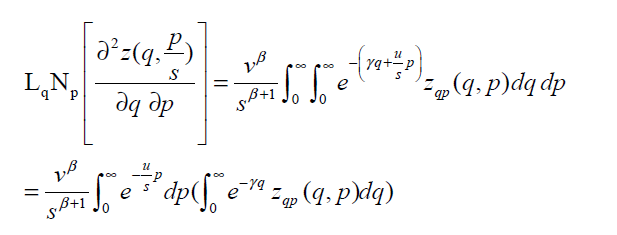
Proof:
Applying integration by parts, let
then we obtain:
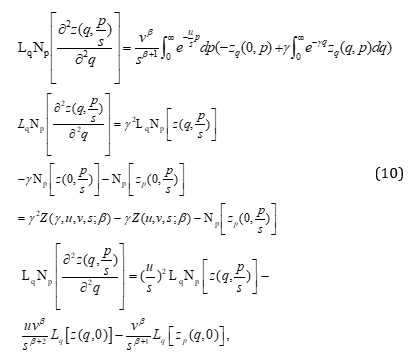
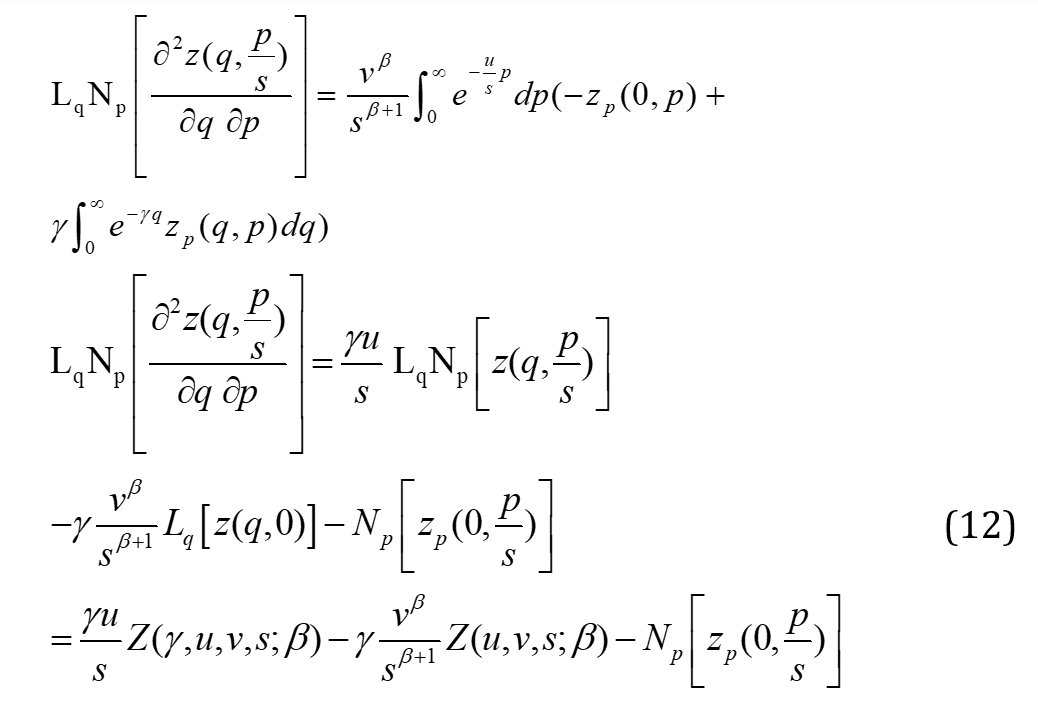
Proof:
Using integration by parts, let
then we obtain:
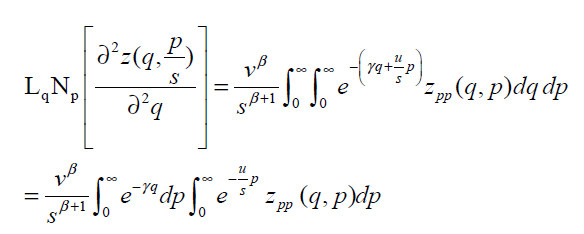
Proof:
Applying integration by parts, let
then we obtain:
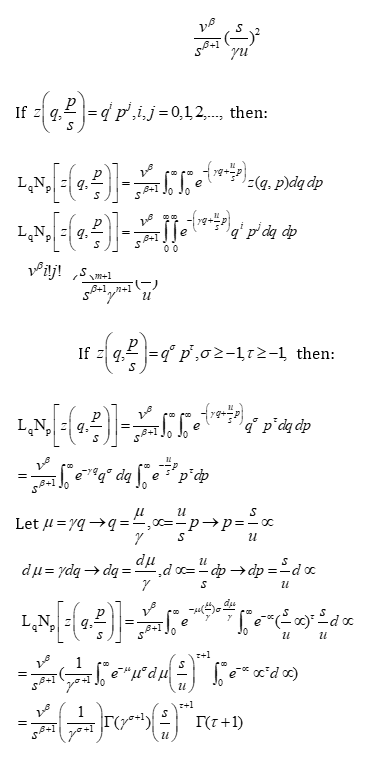
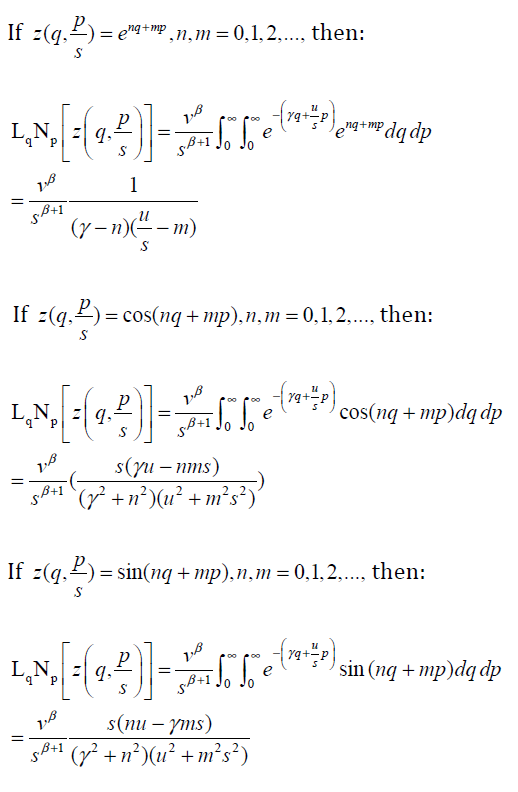
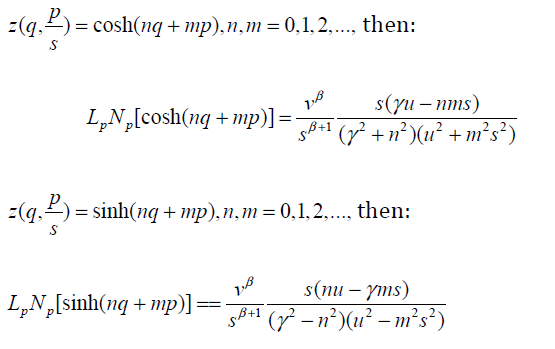
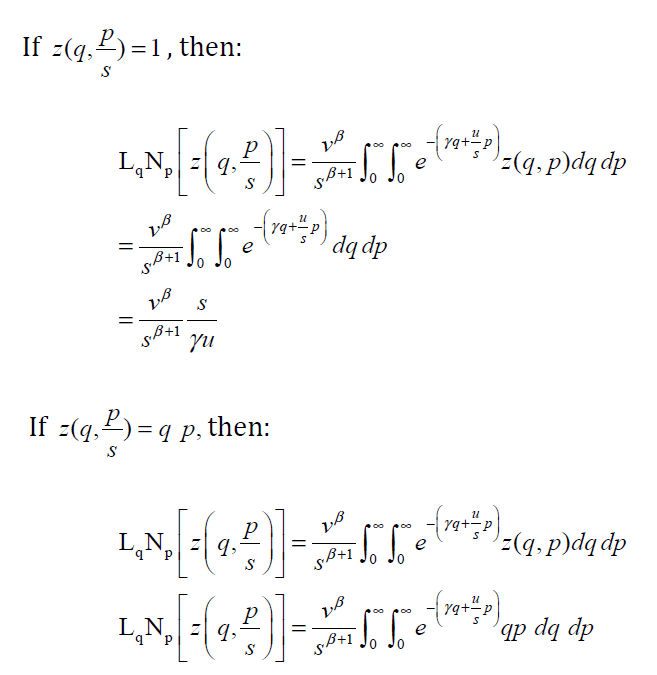
The Double Laplace-NO Technique of Important Elementary Functions
Applying integration by parts u dv,we obtain:
where, Γ(.) is Gamma function.
Consequently
Applications
In this part, we use Laplace-No technique to partial differential operator equations. Assume that the second order non-homogeneous partial differential operator equation in two independent variables be in the formula:
where, the initial conditions:
And the boundary conditions:
(5.3)
With A,B,C,D and E are fixed constants and Z(q, p) is the source term.
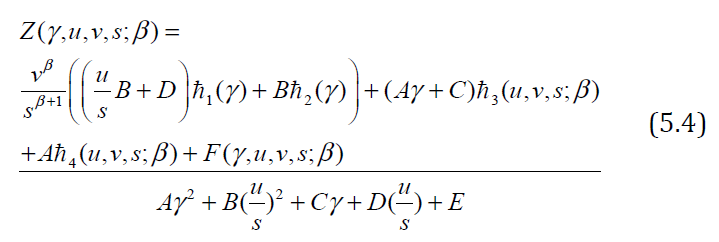
Applying the partial derivative of the Laplace-No technique for equation (5.1), Laplace transform technique for equation (5.2) and N transform for equation (5.3) and after simple computations, we get:
Solving the above algebraic equation in
and taking the inverse of double Laplace-No technique on both sides of the above equation (5.4), gets:
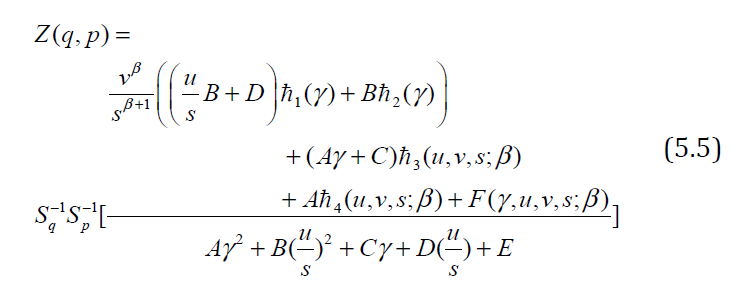
which represent the generalization form of the exact solution of (5.1) via Laplace-No transform approach.
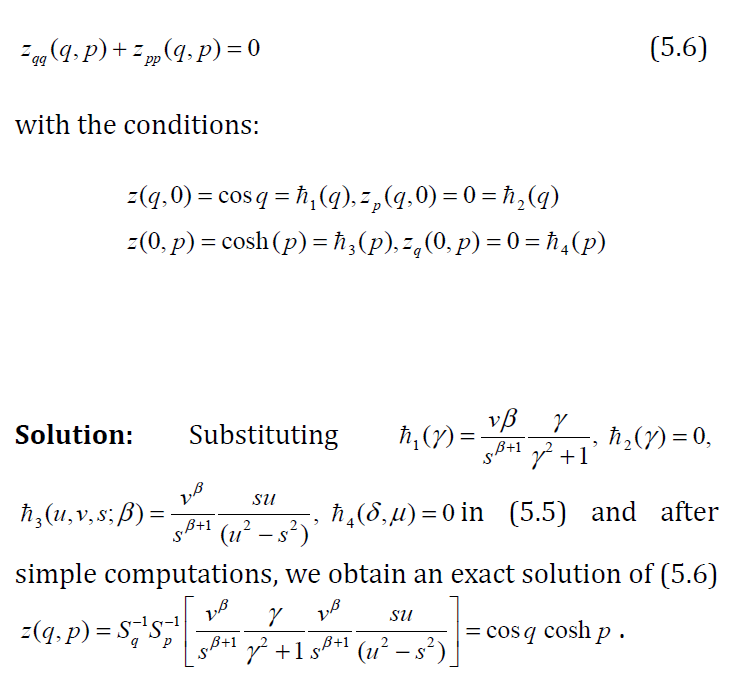
Application (5.1). Consider the boundary Laplace equation.
Application (5.2)
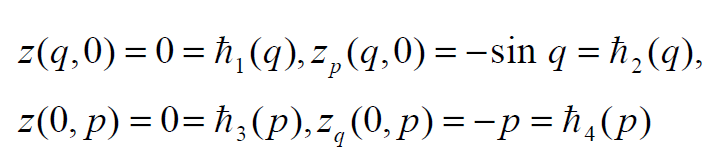
Consider boundary Poisson equation:
with the conditions:
Solution
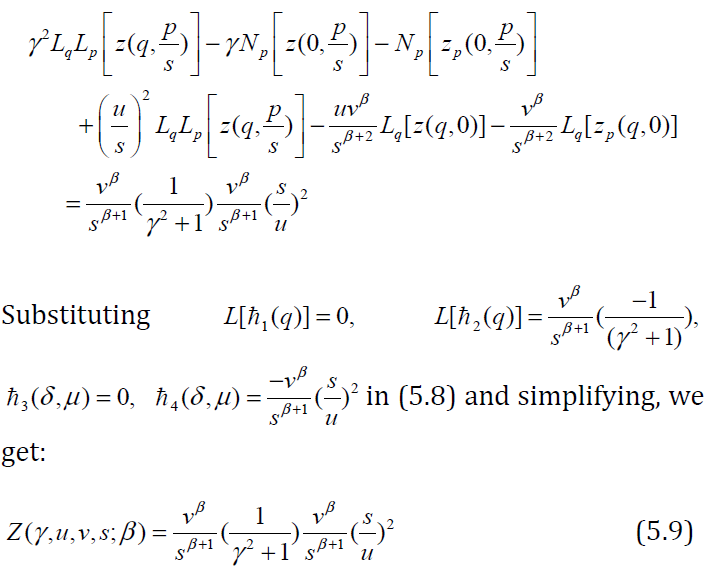
Using Laplace-No technique on both sides of equation (5.7), we obtain:
Take the invertible of Laplace-No technique of eq. (5.9), we obtain an exact solution of (5.7):
CONCLUSION
In this article, a new double integral transform was presented for solving second order partial differential equations and their applications in the branches of natural sciences. This double transform is considered more general than some double transforms (for example Laplace-Shehu transform) and it was applied to the equations of Laplace and Poisson and we found it easy to find the exact solution.
REFERENCES
Aggarwal, S. et al. "Application of Laplace transform for solving improper integrals whose integrand consisting error function." Journal of Advanced Research in Applied Mathematics and Statistics, vol. 4, no. 1, 2019, pp. 1–7.
Ahmed, S.A. et al. "Solution of partial differential equations by new double integral transform (Laplace - Sumudu transform)." Ain Shams Engineering Journal, vol. 12, no. 1, 2021, pp. 4045–4049.
Albukhuttar, A. et al. "Solve the Laplace, Poisson and telegraph equations using the Shehu transform." Turkish Journal of Computer and Mathematics Education, vol. 10, no. 1, 2021, pp. 1759–1768.
Albukhuttar, A. et al. "Applications of a Shehu transform to the heat and transport equations." International Journal of Psychosocial Rehabilitation, vol. 24, no. 1, 2020, pp. 4254–4263.
Alfaqeih, S. et al. "On double Shehu transform and its properties with applications." International Journal of Analysis and Applications, vol. 3, no. 1, 2020, pp. 381–395.
Alkaleeli, S. et al. "Triple Shehu transform and its properties with applications." African Journal of Mathematics and Computer, vol. 14, no. 1, 2021, pp. 4–12.
Debnath, L. "The double Laplace transforms and their properties with applications to functional, integral and partial differential equations." Int. J. Appl. Comput. Math, vol. 2, no. 1, 2016, pp. 223–241.
Dhunde, R. et al. "Double Laplace transform method in mathematical physics." International Journal of Theoretical and Mathematical Physics, vol. 7, no. 1, 2017, pp. 14–20.
Eltayeb, H. et al. "A note on solutions of wave, Laplace’s and heat equations with convolution terms by using a double Laplace transform." Applied Mathematics Letters, vol. 21, no. 1, 2008, pp. 1324–1329.
Lakmon, K. et al. "The Plancherel formula for the Shehu transform." Annals of Pure and Applied Mathematical Sciences, vol. 1, no. 1, 2021, pp. 14–19.
Maitama, S. et al. "New integral transfrom: Shehu transform a generalizattion of Sumudu and Laplace transfrom for solving differential equations." International Journal of Analysis and Applications, vol. 17, no. 1, 2019, pp. 167–190.
Aggarwal, S. et al. "Sadik transform for handling population growth and decay problems." Journal of Applied Science and Computations, vol. 24, no. 1, 2019, pp. 1076–5131.
Hunaiber, M. et al. "On double Laplace-Shehu transform and its properties with applications." Turk. J. Math. Comput. Sci., vol. 15, no. 2, 2023, pp. 218–226.
Turq, S.M. et al. "Anew complex double integral transform and applications in partial differential." AL-Muthanna Journal of Pure Science, vol. 10, no. 1, 2023.
Turq, S.M. et al. "On the double of the Emad-Falih transformation and its properties with applications." Ibn Al-Haitham Journal for Pure and Applied Sciences, vol. 35, no. 4, 2022. doi:10.30526/35.4.2938.
Kuffi, E.A. et al. "Applying 'Emad-Sara' transform on parial differentil equations." Springer Nature Singapore, 2022/5/11.
Mansour, E.A. et al. "Solving partial differential equations using double complex SEE integral transform." AIP Conference Proceedings, vol. 2591, no. 1, 2023/3/29.
Issa, A. et al. "On the double integral transform (complex SEE transform) and their properties and applications." Ibn AL-Haitham Journal for Pure and Applied Sciences, vol. 37, no. 1, 2024/1/20.
Mehdi, S.A. et al. "Solving the partial differential equations by using SEJI integral transform." Journal of Interdisciplinary Mathematics, vol. 26, no. 6, 2023.
Jasim, J.A. et al. "Double SEJI integral transform and its applications differential equations." General Letters in Mathematics (GLM), vol. 13, no. 4, 2023/12/1.
Mehdi, S.A. et al. "Solving the delay differential equations by using SEJI integral transform." IEEE, 2022/8/31.
Mohammed, N.S. et al. "Utilize the complex Sadik transform to solution Volterra integro-differential." Mathematics Analysis and Numerical Methods IACMC, Zaqa, Jordan, May 10–12, 2023.
Alsaoudi, M. et al. "New two parameter integral transform 'MAHA transform' and its applications in real life." WSEAS Transactions on Mathematics, vol. 23, no. 1, 2024.
Salman, N.K. et al. "Solution of partial differential equations and their application by three parameters of integral transform." Advances in Nonlinear Variational Inequalities, 2024.
Sallman, N.K. "Integral transform of three parameters with its applications." Kurdish Studies, Jan 2024.
None
Recommended Articles
Research Article
Recent Advances in β-Tilting Theory and its Generalizations in Module Categories
Dhuha Taima Al-Dawoodi
Published: 25/02/2026
Download PDF
Research Article
Assessing the Effectiveness of Risk Management Practices in Green
Construction Projects Evidence from Iraq
Mazin Fahem Neamah
Published: 25/01/2026
Download PDF
Research Article
Predictive Security Analytics for Large-Scale Multi-Tenant Linux Shared Hosting Environments: An Empirical Study
Ayad A. Yass
Published: 25/02/2026
Download PDF
Research Article
Some Properties of Fuzzy g-Regular Spaces
Hassan Abid Al-Hadi Ahmed,
Noor Al-Huda A. Haider
Published: 10/12/2025
Download PDF
PO Box 101, Nakuru
Kenya.
Email: office@iarconsortium.org
Editorial Office:
J.L Bhavan, Near Radison Blu Hotel,
Jalukbari, Guwahati-India
K. Sallman, N. (2025). On Double Laplace-NO Technique and its Applications. Scientific Research Journal of Engineering and Computer Sciences, 5(2), 1-7.
MLA
K. Sallman, Nour. "On Double Laplace-NO Technique and its Applications." Scientific Research Journal of Engineering and Computer Sciences 5.2 (2025): 1-7.
Chicago
K. Sallman, Nour. "On Double Laplace-NO Technique and its Applications." Scientific Research Journal of Engineering and Computer Sciences 5, no. 2 (2025): 1-7.
Harvard
K. Sallman, N. (2025) 'On Double Laplace-NO Technique and its Applications' Scientific Research Journal of Engineering and Computer Sciences 5(2), pp. 1-7.
Vancouver
K. Sallman N. On Double Laplace-NO Technique and its Applications. Scientific Research Journal of Engineering and Computer Sciences. 2025 Jul;5(2):1-7.


 Download PDF
 Download XML



















 we obtain: