The Impact of Emotional Capital on the Quality of the Educational Process: Knowledge Management as a Mediating Variable: An Exploratory Study of the Opinions of a Sample of Academics at the Technical Administrative College – Basra
The study aims to see the impact of the emotional capital of faculty members on the quality of the educational process along with the moderating role of knowledge management to upgrade this impact. The researcher relied on the main hypothesis that there is an effect and correlation between emotional capital and the quality of the educational process through the intermediary of knowledge management, while positive emotions such as empathy, enthusiasm, emotional flexibility improve the study environment and teaching’s student. But, the effectiveness of the institutions also varies on the extent to which they are able to manage and use the knowledge. A descriptive analytical approach was used, and a questionnaire served as a tool to collect data from a sample of 90 faculty members at the Technical Administrative College. The variables included emotional capital in its dimensions, emotional intelligence, emotional labor, emotional flexibility, knowledge management with its dimensions (organizational, cultural, human, and strategic), and the quality of the educational process with its dimensions (social, cultural, technological, and psychological). The results of the statistical analysis showed a direct and positive effect of emotional capital on the quality of the educational process. The results also indicated that knowledge management plays a partial mediating role in enhancing this effect. The study advocates for the necessity of training academic personnel to enhance emotional intelligence and implement knowledge management systems in educational institutions to facilitate interaction- and knowledge-driven instruction.
Keywords
Emotional Capital
Knowledge Management
Educational Process Quality
INTRODUCTION
The educational world is rapidly transforming. The changing scenario requires a focus on intangible elements for the development of quality education. Emotional capital can be described as a part of human capital. It is associated with the feelings, attitudes, and emotions of humans. This then affects the work performance of people. Emotional capital refers to the stock of positive feelings that people have towards their organization, colleagues and workplace. Thus, it leads to positive interactions and creates an engaging and cohesive learning environment.
Recent findings suggest that educational institutions that concentrate on improving the emotional capital of their teaching and administrative personnel achieve higher levels of commitment, job satisfaction, creativity, which exerts a positive influence on the educational process and its quality.
Through knowledge management, educational institutions can enhance their capacity to utilize emotional resources to aid the teaching-learning process. Knowledge management involves organizing, exchanging, sharing, and analyzing knowledge and expertise in the establishment. It seeks to enable individuals to engage their positive emotions in a knowledge-based education system. The aim of this study is to know the influence of emotional capital on the quality of the educational process. Besides, Knowledge management is an intervening variable that could enhance the influence. This study aims to find answers to the questions to what extent emotional capital improves the quality of the educational process and to what extent knowledge management enhances the effect of emotional capital on educational quality, referring to recent literature and best management practices in the field of education.
MATERIALS AND METHODS
Research Methodology
Research Problem: Emotional capital is one of the most essential factors affecting the educational process and the professional and personal future formation of the individual. Another key notion in the framework is emotional capital as a human asset that influence people’s behaviour and attitude. It inspires students and increases their motivation to learn. This also shows the competitive stance of the educational institution in the field of knowledge management. Formulating the research problem can be done with the following major question.
How does emotional capital affect the quality of the educational process with a mediating role of knowledge management in this regard?
Here are some possible sub-questions.
To what or to what extent is there emotional capital among the staff working in the educational organization under study?
How knowledgeable is the educational organization under study with respect to knowledge management?
How is emotional capital likely to influence education?
How does knowledge management subsequently affect the relationship between emotional capital and the quality of the educational process?
The study is of great importance. The research is important due to the following reasons.
This research raises awareness about emotional capital and knowledge management in an educational setting that can serve as a basis for future research.
The study provides practical recommendations for officials to improve emotional capital as well as knowledge management that contributes to the raising of quality of the educational process and its effect on student performance.
As a result of such research, recommendations can be produced for teachers and decision-makers to improve educational curricula and teaching methods to enhance the educational environment.
Research Objectives
The goal of the research is to describe the influence of emotional capital on the quality of the educational process and to identify the main factors that influence it.
The research aims to study the effect of knowledge management as mediating variables in the relationship between emotional capital and educational process quality.
The purpose of this paper is to supply the leaders of universities with the strategies and recommendations related to emotional capital to enhance the quality of the educational process and to improve students’ academic performance.
Research limitations
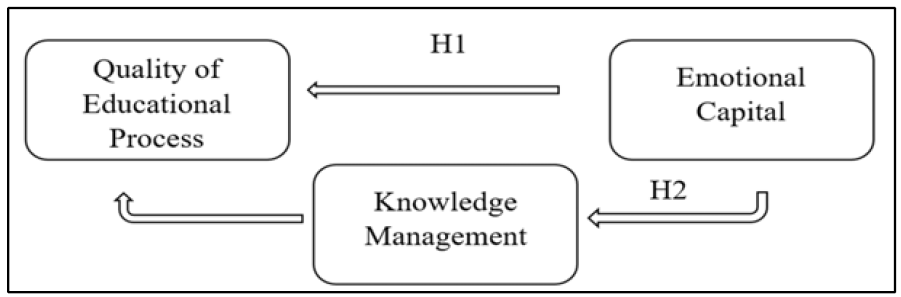
Time limitations: The time limitations of the research are represented by the period related to data collection and analysis, which extends from March 5, 2025, to May 14, 2025 (Figure 1).
Figure 1: Hypothesis Model
Spatial limits: The research was applied in the field at the Technical Administrative College in Basra
Scientific limits: The scientific limits of the research were limited to the research variables represented by emotional capital, the quality of the educational process, and knowledge management.
Research Hypotheses
The research hypotheses are based on an attempt to answer the intellectual questions raised in the research problem and objectives. The hypotheses were formulated in a way that proves the following:
Correlation Hypotheses
H1 There is a statistically significant correlation and effect between emotional capital in its dimensions and the quality of the educational process in its dimensions.
H2 There is a statistically significant correlation and effect between emotional capital and the quality of the educational process through the mediating variable of knowledge management.
Theoretical Framework
Emotional Capital
The Concept of Emotional Capital Emotional capital is defined as “the set of resources (emotional competencies) inherent in a person that are useful for personal, professional, and organizational development, contribute to social cohesion, and have personal, economic, and social returns” [1]. Emotional capital is also defined as “a three-dimensional concept consisting of emotional knowledge, management skills, and affective abilities, linking processes and personal resources to group membership and social position, in contrast to other concepts” [2].
Emotional capital is also defined as “the set of resources (emotional competencies) inherent in a person that are useful for personal, professional, and organizational development, contribute to social cohesion, and have personal, economic, and social returns” [3]. Learning environments are social environments, and learners are highly complex beings whose emotions interact with their learning process in meaningful ways. Psychological theories and educational research have provided influential explanations of how emotional experience is produced, how it influences behavior, and how it can affect learning processes and life-building, as well as professional skills.
In the context of changes or declines in the quality of life at school and work (violence, rudeness, stress, anxiety, depression, burnout, pressure, and bullying), emotions must be taken into account in economic theory because of their significant impact and economic returns if they are well managed and utilized. Just as cognitive rationality must be taken into account in individual decision-making in economic models, there is also a basis for emotional capital that must be carefully considered in education and the workplace.
It can be said that emotions also influence rational decisions and behaviors, and today we observe that in many areas, such as educational life, private life, and professional life, the role of emotions and innovation is gradually increasing. Emotional capital represents the abilities or habits that transform emotion management into various social benefits. Furthermore, emotional capital refers to useful resources in terms of an individual's personal, professional, and organizational development, as emotional capital can be expressed through emotional resources such as support, patience, and loyalty.
According to Allatt, active learning consists of emotional assets and skills such as love, affection, spending time, attention, and care. According to Walumbwa et al., EC can help individuals reduce their stress and emotional exhaustion. Based on the above, researchers believe that emotional capital is a set of emotional assets that enable individuals to perform their work effectively thanks to their emotional skills and abilities, which are love, affection, and patience. Dimensions of emotional capital: After reviewing numerous studies that addressed the dimensions of intellectual capital, the following dimensions were identified.
Emotional intelligence: The concept of emotional intelligence has received widespread attention in both scientific and popular literature [4]. Emotional intelligence has been extensively studied for decades. Mayer et al. [5] developed extensive research knowledge about emotional intelligence by creating developmental models of 16 steps ranging from childhood to adulthood and redefining emotional intelligence in cognitive and emotional terms. In line with Mayer, the emotional intelligence model consists of abilities such as perceiving, understanding, and managing one's own emotions and recognizing and influencing the emotions of others. Thus, the ability-based model of emotional intelligence depicts it as intelligence in the traditional sense, consisting of a conceptually interrelated set of mental abilities related to emotions and emotional information processing [6].
There has been widespread debate about Goleman's framework for emotional intelligence, but experts agree that emotional intelligence and IQ are part of professional achievement. However, emotional intelligence has come to be widely regarded as a prerequisite for high-performance leadership [7,8]. Emotional intelligence accounts for about 90% of what distinguishes high-performing leaders from their technically skilled peers and is associated with the overall well-being and better mental health of effective leaders [9,7].
According to Mayer et al. [6] and Singh et al. [10], the emotional intelligence of a certain person refers to his/her ability to either use his/her emotions smartly or other people’s emotions smartly. The notion made the rounds thanks largely to Daniel Goleman, who marketed the idea of emotional intelligence as a necessity for success, whether personal or professional. Emotional intelligence is the harmonization of emotional and mechanistic processes [11], social relationships [12, 13] and the general state of well-being [13]. Emotional intelligence research has evolved into three theoretical streams over time. One strand looks at ability-based emotional intelligence, in which emotional intelligence is measured as a cognitive ability using objective tests, such as the Emotional Intelligence Test. According to this perspective, emotional intelligence is a cluster of skills that relate to the perception, understanding, regulation, and use of emotions. The second stream involves self-reported measures and treats emotional intelligence as a trait assessed through self-perceptions, such as those of the trait emotional intelligence questionnaire. This technique focuses on the emotional skills that people measure themselves. The third stream consists of mixed models, which incorporate elements from both the ability and trait perspectives and add in a broader array of emotional and social skills.
An experimental study infers that false and authentic feelings that are derived from employees’ true feelings lead to emotional exhaustion. It withers away the well-being of employees [14]. When the well-being of workers suffers, it can be detrimental to businesses. On the other hand, favourable positive feelings aid an employee in contributing to organizational goal achievement. The emotions of employees become the most focused area in research, especially the sociologists and psychologists which are of paramount importance in an organization [15]. Service-based organizations in particular should monitor the well-being of employees keeping emotional labor in mind. The idea of emotional labor shows how workers change their feeling to get a positive emotional impact on co-workers and consumers [16].
These actions create a feeling in the workforce. Consequently, such workers expose themselves to affective exhaustion. From a psychological point of view, emotional labor is the undesirable change in the worker’s emotional state that negatively affects his productivity, performance, and welfare. Workplace settings in which workers must inhibit or hide their emotions cause no one to do well at work. The emotional effort put in by employees usually raises tension, which has an adverse impact on work settings and personal life, lowering employee well-being. Finally, emotional labour is portrayed via surface acting and deep acting. Surface acting refers to the alteration of outer facial expressions, while deep acting means changing inner feelings so they match the emotional demands of a job [17].
Emotional resilience: Organizations, institutions, policy makers, and academia have shown increased interest in the notion of emotional resilience. Emotional resilience refers to showing stronger positive emotions than expected in the face of challenges [18,19]. The emotional resilience, which is based on psychological theory, is the individual’s ability to foster positive emotional responses and suppress responses to negative emotions, especially during stress. Studies reveal a strong connection between emotional resilience and a decline in indicators of adverse mental health, which is crucial. Emotional resilience is well-known to be a complex, multidimensional construct that incorporates various elements, such as empathy, self-efficacy, and social support [20], among others. Emotional suppression, reduced employee well-being, and burnout are other factors.
Knowledge Management
The Concept of Knowledge Management: People regularly renew and develop knowledge. They are considered a new asset and type of capital owned by people. The present economies are becoming essentially knowledge-oriented and transferable and shareable knowledge are proving to be critical resources. Many organizations aim for innovation and renewal which for which knowledge plays an essential role to achieve this goal. As a result of this the managers need to develop knowledge management capabilities and skills which can have a positive effect on innovation and renewal process. A competitive advantage is another key issue and relies heavily on creation of knowledge, which is recognised as one of the most important knowledge management practices [21].
Knowledge management is a contemporary concept within management science. Interest in this field has grown significantly over the past two decades, resulting in the development of numerous definitions that differ depending on researchers’ areas of specialization and viewpoints. To clarify the concept of knowledge management and its definition, several fundamental approaches can be identified, as follows [22]
The Informational Approach: This involves activities related to data processing, management of information flows, database construction, and coordination of organizational processes within the institution
Technical Approach: Focuses on designing and developing IT-based knowledge management systems, including data mining tools, data warehouses, expert systems, real-time analytical processing systems, web-based information platforms, and related technologies
Cultural Approach: Focuses on the behavioral and collective aspects of knowledge management by addressing collective learning, continuous learning, and the development of learning organizations
Knowledge management has multiple definitions, but they generally converge on a shared meaning despite variations in terminology. Knowledge management can be described as a process through which organizations create, acquire, select, organize, utilize, distribute, and convert valuable information and expertise they possess, which is essential for various managerial functions such as decision-making, problem-solving, learning, and strategic planning [23].
It has also been defined as “the conscious and organized effort made by an organization or institution to collect, gather, classify, organize, and store all types of knowledge related to the establishment of the institution and make it available for circulation and sharing among individuals, departments, and units within the institution, thereby raising the level of decision-making efficiency and organizational performance” [24]. Knowledge management has also been defined as “a set of processes aimed at transforming human resources into tangible values, with a greater focus on intangible assets” [25]. From the above, knowledge management can be defined as the process that enables an organization to leverage intangible assets, represented by data and information, after converting them into knowledge and utilizing them in its various operations.
The Importance of Knowledge
The importance of knowledge for organizations is not only evident in the knowledge itself but also in its value and role in transforming them into a new knowledge economy, which focuses on individual capital based on ideas, experiences, and best practices, in addition to qualified and trained human resources. The importance of knowledge can be explained as follows [26]:
Knowledge contributes to organizational flexibility by encouraging organizations to adopt more flexible forms of coordination, design, and structuring
Knowledge enables organizations to focus on the most innovative departments and stimulates creativity and innovation
Knowledge plays a role in transforming organizations into knowledge communities that limit radical change within them, adapt to constant changes in the business environment, and cope with its increasing complexity’s. An organization can capitalize on knowledge itself as a final commodity by selling, trading, and using it to modify a specific product or innovate new products
Management knowledge guides organizational managers on how to manage their organizations’. Knowledge has become the basis for achieving and sustaining competitive advantage. From the above, we can infer that knowledge is the foundation for the survival of organizations in this era. They are created through it, derive from its sources, grow by using it, and evolve with new knowledge. Organizations may fade away when they fail to obtain the knowledge resources necessary for their continuity. Their efficiency and competitiveness will inevitably decline as their knowledge assets become obsolete
Dimensions of Knowledge Management
Organizational Dimension: There must be clear processes for documenting knowledge and sharing information between departments, reflecting the effectiveness of the organizational structure in promoting knowledge management strategies [27]
Cultural Dimension: Recent research points to the importance of culture in facilitating knowledge sharing. A study showed that an organizational culture that promotes creativity and innovation is essential for the application of new knowledge within organizations. An environment that supports innovation is essential for the success of knowledge management processes [28]
The Human Dimension: plays a crucial role in the success of knowledge management. Knowledge management requires investment in employee development to ensure that they are able to efficiently handle knowledge and apply it in the workplace [29]
Strategic Dimension: The importance of integrating knowledge management into the overall strategy of the organization. This is linked to setting goals and using knowledge to achieve tangible results, enabling organizations to adapt to market changes and achieve long-term success [30]
Types of Knowledge
Specialists have proposed several classifications of knowledge, the most common of which are [31]:
Tacit Knowledge: This is knowledge that is not written down and stored in people's minds but is acquired through the accumulation of previous experiences. It is personal in nature, making it difficult for even the most advanced to acquire, as it is stored in the mind of its owner and can only be realized by writing it down and recording it or through dialogue and discussion
Explicit Knowledge: This is written knowledge contained in references, books, documents, reports, and scientific information storage media, in addition to information stored in the organization's archives, including guidelines related to policies, procedures, documents, and operational and operational standards. This knowledge is easy to describe and define, can be easily converted from one language to another and from one form to another, is shareable, and it can be continuously reread, reproduced, stored, and retrieved
The Relationship between Knowledge Management and Educational Institutions
The organizational environment of higher education institutions, especially universities, is one of the most suitable for applying knowledge management. In fact, the environment is the most in need of this concept, given its tasks. These institutions are responsible for preparing, equipping, and training human resources, both in the public and private sectors. This requires them to employ modern management methods and concepts that contribute to improving performance and quality. There are several reasons for this, with the most important being those identified by Mata [22]:
Higher education institutions are familiar with and keep up with all developments in the field of information technology
Knowledge management is of paramount importance to these institutions, as it allows academics, researchers, and students to exchange their opinions and knowledge with others
There is a general trend and organizational culture based on trust within educational institutions, where no individual within these institutions hesitates or fears to express their opinions or publish or share the knowledge of others
The increasing development of work-related education.
The realization that practical experience is a fundamental source of learning
The growth of the concept of lifelong learning for all
Quality of the Educational Process
Concepts and Contemporary Dimensions: Definition of educational process quality: the standard of education is defined as “the extent to which the educational process is effective in achieving learning outcomes that are relevant to the needs of students, the labor market, and society” [33]. Quality is not limited to infrastructure or resources but includes teaching effectiveness, learning outcomes, the educational environment, and equity in access to knowledge. Harvey & Green [34] suggest that educational quality can be interpreted from five perspectives: quality as excellence, quality as conformity to standards, quality as added value, quality as fitness for purpose, and quality as a transformative concept. The standard of education is also characterized as outcomes encompassing knowledge, competencies, and attitudes that align with national educational objectives and encourage active participation in society [35].
Dimensions of Quality in Higher Education
Thinkers and researchers have varying opinions on the basic dimensions of quality. Among the many dimensions of service quality that higher education administrators must strive to achieve are the following:
Social Dimension: The social dimension relates to how higher education influences the promotion of social cohesion. Higher education can enhance an individual's social and political participation, contributing to sustainable development [36]
Cultural Dimension: This dimension is a key element in improving the quality of the educational process through understanding and promoting the culture of education [37]
c-Technological Dimension: This includes the use of learning management systems (LMS), interactive technologies, e-learning, and the institution's responsiveness to digital changes [38]
d- Psychological and Health Dimension: This dimension focuses on supporting students' mental health and providing a safe and stimulating learning environment, as these factors have a direct impact on motivation and academic achievement [39]
There are global models for measuring education quality and there are a number of globally recognized models:
The modified SERVQUAL model for evaluating the quality of educational services in light of students' expectations and perceptions
The EFQM model for institutional excellence, which is used to evaluate higher education in terms of leadership, strategy, resources, and results
The Quality Matters model for ensuring the quality of e-learning and evaluating the design of digital courses
Practical Aspects
Study Sample: A sample of 90 individuals was selected from the study population, consisting of teaching staff in the departments and professors holding administrative positions. The age group of 30 years and below accounted for 30% of the sample, while the age group between 31 and 40 years accounted for 40%, and the age group between 41 and 50 years and above accounted for 30%. This indicates that the college administration relies on the age groups between 31-40 and 41-50 and above to fill important administrative positions, as they represent the best age group for intellectual maturity, in addition to providing support for the individual's level to increase their ability to work. This finding indicates a positive phenomenon, namely that the college administration has a good academic level and is keen to attract qualified and educated individuals.
Data Collection Methods
The theoretical aspect relied on numerous research methods from foreign and Arab scientific references (research, articles, and books) related to the subject of the study. In addition, the questionnaire form described below was used as the main tool for data collection, in addition to conducting interviews with individuals in the sample to collect data and verify the accuracy of the information mentioned. The questionnaire form was designed to cover the variables of the study so that it serves the objectives and hypotheses of the study based on the theoretical aspect and reference to previous studies and field visits. Ninety questionnaires were distributed to a number of teachers at the college under study (Table 1).
Table 1: Distribution of the Questionnaire
percent
Number
Type of Distribution
100%
90
Number of questionnaires distributed
92%
83
Number of questionnaires returned
13%
12
Number of questionnaires invalid for analysis
78%
71
Number of questionnaires valid for analysis
Data Collection Methods
The theoretical aspect relied on numerous research methods from foreign and Arab scientific references (research, articles, and books) related to the subject of the study. In addition, the questionnaire form described below was used as the main tool for data collection, in addition to conducting interviews with individuals in the sample to collect data and verify the accuracy of the information mentioned. The questionnaire form was designed to cover the variables of the study so that it serves the objectives and hypotheses of the study based on the theoretical aspect and reference to previous studies and field visits. Ninety questionnaires were distributed to a number of teachers at the college under study.
Descriptive Analysis of Study Variables
First: Statistical processing the data collected from the questionnaires received was analyzed statistically to determine results and reach the correct conclusions and recommendations using the statistical program “SPSS” through the appropriate statistical methods used, which are:
Arithmetic means
Standard deviation
Pearson's correlation coefficient
The Cronbach's alpha coefficient can also be used
The regression analysis coefficient shows how much the independent variables influence the dependent variable
Path Analysis: To enhance understanding of the causal relationship between the research variables, path analysis was used as a statistical model to examine the direct and indirect effects between:
Emotional capital (X)
Knowledge Management (M)
Quality of the Educational Process (Y)
According to the assumed model, emotional capital not only directly affects the quality of the educational process but also exerts an indirect effect through its role in enhancing knowledge management. Thus, knowledge management plays the role of mediator in the relationship. The theoretical model for path analysis can be represented as follows:
X → M → Y
X → Y
The direct effect is represented by the path Wythe path X→M→Y represents the indirect effect through the mediating variable.
Study Tool
The questionnaire was utilized as the main instrument for gathering data related to the study variables from the selected sample, using a five-point Likert scale ranging from 1 to 5 to measure response intensity.
The validity and reliability of the study tool is based on Sekaran who opined that validity is defined as the instrument ability to measure precisely what it intends to measure and reliability is the ability of an instrument to produce consistent and stable measurement results. To ensure its validity, the questionnaire was evaluated using two methods regarding its clarity while those methods also served to make the questionnaire coherent and highly accurate. The proposed model, as well as the measurement items, were continuously developed and refined with information sourced from journals, research papers, theses, World Wide Web and articles. Business administration specialists and practitioners conducted a comprehensive review of all dimensions of the study. Some items were retained while others were removed for relevance, and further items were modified for precision and improved study instrument.
A measure of reliability for the study tool was confirmed by a Cronbach’s alpha coefficient. This assesses the internal consistency along with stability of the questionnaire. The extent to which the instrument is free from error or bias is called this and sees consistency across the items. In simple words, reliability means accuracy of measurement i.e. stability and consistency of measurement.
The stability of the questionnaire implies that it yields almost the same results again, under the same conditions at different times. Stability is a statistical concept assessed through the Cronbach’s alpha coefficient which usually ranges from zero to one. If the coefficient value is closer to one, the reliability of the instrument will be higher. Most studies generally accept the instrument to be reliable if the average value is more than 0.6. The reliability of the questionnaire was assessed using Cronbach’s alpha, and the results are shown in the Table 2.
The table above shows that the Cronbach's alpha coefficient for the total questionnaire items was 0.98, which is a very high value reflecting its high degree of stability. We also note that the stability coefficients for all variables were similar and all exceeded the minimum required to meet the stability condition, which is 0.6 (Table 2).
Table 2: Cronbach Alpha Stability Coefficient for all Study Variables
No. of Items
Cronbach’s Alpha
5
0.98
Descriptive Analysis of Study Variables
Normal distribution test: The normality test is to check whether the sample is drawn from the normally distributed population of the study community. Skewness and kurtosis tests were conducted. Skewness is one measure of the asymmetry of the distribution or, more precisely, the lack of symmetry. They reflect the amount of elevation or depression of the curve. The frequency distribution is in conformity with normal curve. It is symmetric about the mean. A distribution is skewed if it has a higher peak than the modal distribution and flat-tailed if it has a flat peak. When the peak is moderate, the distribution is neither skewed nor flat-tailed. And it is called mesokurtic. Kurtosis features are not linked to the distribution mean (mean). Since many distributions can have the same mean, they can differ from each other in shape, being clearly peaked, flat, etc. If both sides of the midpoint are similar, the data are symmetric. Also, kurtosis measures the probability of outliers in a distribution, indicating whether it has heavy or light tails compared to the normal distribution (Table 3-4).
Table 3: Cronbach’s Alpha Reliability Coefficient for Each Dimension of the Study
Paragraphs
Variables
Cronbach’s Alpha
4
Emotional Capital – Emotional Intelligence
0.908
4
Emotional Capital – Emotional Labour
0.95
4
Emotional Capital – Emotional Resilience
0.942
8
Quality of Educational Process
0.937
8
Knowledge Management
0.956
28
Total
0.98
Table 4: Descriptive Statistics for Emotional Intelligence
No
Statement
Std.D
Mean
Importance
1
The college attracts highly competent professors
1.163
3.55
High
2
You have the ability to build positive relationships with others
1.208
3.42
Medium
3
You have the ability to deal with conflicts or disagreements with others
1.299
3.42
Medium
4
The college uses methods that help in applying emotional intelligence
1.2
3.38
Medium
Total
4.87
3.4425
Medium
Source: Prepared by researchers based on computer outputs
According to Sukran, the skewness coefficient is less than 1 and the kurtosis coefficient is less than 7, so the sample was enough to represent the population of the study. Therefore, the results can be generalized to the population of the organization.
Independent Variable, Emotional Capital
First Dimension: Emotional intelligence: The study sample responses showed that the arithmetic means for emotional intelligence ranged between 3.38 and 3.55 points, compared to the overall arithmetic mean of 3.4425 points. It is noted that the first paragraph, “The college attracts highly competent professors,” had the highest arithmetic mean of 3.55 points and a standard deviation of 1.163 points, while the lowest arithmetic mean was for the fourth paragraph, “The college uses methods that help in the use of emotional intelligence,” with a mean of 2.38 and a standard deviation of 1.2.
The above results indicate that the college maintains its level of emotional intelligence by controlling the problems faced by teaching staff or students, but it needs new and advanced methods in emotional intelligence.
Second dimension
Emotional work: The results of the descriptive statistics for the emotional work dimension showed that the arithmetic means ranged between 3.53 and 3.84 points compared to the overall arithmetic mean of 3.4425 points, which also reflects the high average of positive attitudes towards all questions. It is noted that the question, "How do you assess the level of influence of your personal feelings on your work performance?" had the highest arithmetic mean of 3.84 points and a standard deviation of 1.141 points, while the lowest arithmetic mean was, "Do you feel that your colleagues support you emotionally in the work environment?" with a mean of 3.53 and a standard deviation of 1.250 (Table 5).
Table 5: Presents the descriptive statistics results for the emotional labor dimension.
No
Statement
Std.D.
Mean
Importance
1
Your personal emotions affect your job performance
1.069
3.82
Medium
2
Ability to handle fatigue at work without fear of negative reactions
1.231
3.74
Medium
3
You feel that your colleagues support you emotionally in the workplace
1.141
3.84
Medium
4
Your level of happiness affects your productivity at work
1.27
3.77
Medium
Total
1.18
3.792
Medium
Source: Prepared by researchers based on computer outputs
The results indicate that emotional labor among faculty members is an important variable and that the college needs to encourage teamwork seminars among employees and active participation through workshops and activities organized by the college.
Third dimension
Emotional flexibility: The results of the descriptive statistics for the emotional flexibility dimension showed that the arithmetic means ranged between 2.88 and 3.11 points compared to the overall arithmetic mean of 3.0322 points, as the data indicate positive attitudes towards the questions because their arithmetic mean is higher than the scale mean (3), with the exception of some questions that have negative attitudes because their arithmetic mean is lower than the scale mean (3).
The high mean also reflects positive attitudes towards all questions. It is noted that the statement “You have the ability to maintain a positive attitude despite challenges in the work environment” has the highest arithmetic mean of 3.13 points and a standard deviation of 1.251 points, while the lowest arithmetic mean for the last paragraph, “Your emotional flexibility affects your work,” was 2.88 points and a standard deviation of 1.068 points.
The results in Table 6 indicate that the college has high emotional flexibility among teaching staff and students but needs to strengthen it and build strong bonds between staff members.
The dependent variable is the quality of the educational process.
Table 6: Descriptive statistics results for emotional flexibility
No
Statement
Std.D.
Mean
Importance
1
You have the ability to maintain a positive attitude despite challenges in the workplace
1.19
3.08
Medium
2
Your emotional flexibility with colleagues affects your job performance
1.068
2.88
Medium
3
You feel that you can easily adapt to changes in your tasks or responsibilities
1.151
3.11
Medium
4
Emotional flexibility can be enhanced and developed between faculty members and students in the college
1.269
3.11
Medium
Total
1.17
3.045
Medium
Source: Prepared by researchers based on computer outputs.
Social Dimension
Table 7 shows that the arithmetic means for the social dimension ranged between (3.21-3.41) points, compared to the overall arithmetic mean of (3.2966) points. The table above indicates positive attitudes toward the above questions because their arithmetic mean is higher than the scale mean (3).
Table 7: Descriptive statistics for the social dimension
No
Statement
Std.D.
Mean
Importance
1
There is a role for social interaction between faculty members and students
1.23
3.21
Medium
2
Social relationships among students affect the improvement of the quality of the educational process
1.11
3.27
Medium
3
There are effective strategies to enhance the quality of the educational process
1.144
3.41
Medium
Total
1.16133
3.2966
Medium
Source: Prepared by researchers based on computer outputs
The high mean also reflects positive attitudes toward all questions. We should note that the college has effective strategies to enhance the quality of the educational process. has the highest arithmetic mean (3.41) and standard deviation (1.144), while the lowest arithmetic mean was for the statement “There is a role for social interaction between teachers and students,” with an arithmetic mean of (3.21) and a standard deviation of (1.110).
We conclude from the above that the college has effective strategies to enhance the quality of the educational process, but it needs to increase activities that promote social relations among the students.
Cultural Dimension
The arithmetic mean and standard deviation values for the study sample were calculated based on the respondents' answers to the paragraphs below, as shown in the Table 8.
Table 8: Descriptive statistics for the cultural dimension
No
Statement
Std.D.
Mean
Importance
1
The difference in cultures between students and faculty members affects the quality of the educational process
1.266
3.05
Medium
2
Improving students' emotional intelligence contributes to enhancing the cultural dimension and thus improving the quality of the educational process
1.179
3.18
Medium
3
The effectiveness of emotional capital influences the enhancement of culture between students and faculty members
1.219
2.98
Medium
Total
1.22133
3.07
Medium
The table above shows that the arithmetic means for the cultural dimension range between 3.05 and 2.98 points, compared to the overall arithmetic mean of 3.07 points. The table above indicates positive attitudes toward the above questions because their arithmetic mean is higher than the scale mean (3), with the exception of (the effectiveness of emotional capital in promoting culture among students and teachers), which has negative attitudes because its arithmetic mean is lower than the scale mean (3).
The high mean also reflects positive attitudes towards all questions. It is noted that improving students' emotional intelligence contributes to improving the cultural dimension and thus improving the quality of the educational process. It has the highest arithmetic mean (3.18) and standard deviation (1.179), while the lowest arithmetic mean for the paragraph (The effectiveness of emotional capital in promoting culture among students and teachers) was (2.98) with a standard deviation of (1.219).
The above results indicate that college employees use their competence in their work and that the college needs to be more transparent with regard to the cultural dimension.
Technological dimension
The arithmetic mean and standard deviation results for the study sample were derived based on the respondents' answers to the paragraphs below, as shown in the Table 9.
Table 9: Descriptive Statistics for the Technological Dimension
No
Statement
Std.D.
Mean
Importance
1
There are modern educational technologies that affect the quality of the educational process
1.344
3.32
Medium
2
Educational software affects the quality of the educational process
1.187
3.19
Medium
3
There are potential risks associated with relying on technology in the educational process
1.233
3.22
Medium
Total
1.25466
3.24333
Medium
The Table 9 above shows that the arithmetic means for the technological dimension ranged between 3.32 and 3.19 points, compared to the overall arithmetic mean of 3.24333 points. The table above indicates positive attitudes toward the questions, as their arithmetic mean is higher than the scale mean (3). The high mean also reflects positive attitudes toward all questions.
It should be noted that there are modern educational technologies that affect the quality of the educational process. It has the highest arithmetic mean (3.32) and standard deviation (1.344), while the lowest arithmetic mean for the paragraph (Educational software affects the quality of the educational process) was an arithmetic mean (3.19) and standard deviation (1.187).The above results indicate that the college needs strategies and training workshops on software and technologies to enhance their presence and utilization in the college.
Psychological Dimension
The arithmetic mean and standard deviation results for the study sample were derived based on the respondents' answers to the paragraphs below, as shown in the Table 10.
Table 10: Descriptive Statistics for the Psychological Dimension
No
Statement
Std.D.
Mean
Importance
1
Using emotional intelligence techniques to enhance the psychological factor
1.299
3.42
Medium
2
There are social activities that affect the psychological indicators of students and faculty members
1.122
3.13
Medium
3
Educational strategies affect stress and anxiety among students
1.253
3.26
Medium
Total
1.21866
3.27
Medium
The table above shows that the arithmetic means for the psychological dimension ranged between 3.42 and 3.13 points, compared to the overall arithmetic mean of 3.27 points. The table above indicates positive attitudes toward the above questions because their arithmetic mean is higher than the scale mean (3), and the high mean also reflects positive attitudes toward all questions.
It is noted that the use of emotional intelligence techniques to enhance the psychological factor has the highest arithmetic mean (3.42) and standard deviation (1.299), while the lowest arithmetic mean for the paragraph (There are social activities that affect the psychological indicators of students and teachers) is (3.13) with a standard deviation of (1.122).The above results indicate that there is an urgent need to increase social activities such as scientific trips and workshops that help strengthen relationships between students.
Mediating Variable: Knowledge management
Organizational dimension: The arithmetic mean and standard deviation results for the study sample were derived based on the respondents' answers to the paragraphs related to the organizational dimension of knowledge management.
The Table 11 above shows that the arithmetic means for the organizational dimension ranged between 3.55 and 3.44 points, compared to the overall arithmetic mean of 3.48 points.
Table 11: Descriptive Statistics for the Organizational Dimension
No
Statement
Std.D.
Mean
Importance
1
You feel that the college provides sufficient platforms for knowledge management to improve emotional flexibility between students and faculty members
1.66
3.55
Medium
2
Knowledge management affects the organization of college activities
1.16
3.44
Medium
3
The organizational dimension of knowledge management enables the college to activate emotional capital and improve the quality of the educational process
1.32
3.45
Medium
Total
1.38
3.48
Medium
The table above indicates positive attitudes toward the above questions because their arithmetic mean is higher than the scale mean (3), and the high mean also reflects positive attitudes toward all questions.
It is noted that the use of emotional intelligence techniques to enhance the psychological factor has the highest arithmetic mean (3.55) and standard deviation (1.66), while the lowest arithmetic mean for the paragraph "There are social activities that affect the psychological indicators of students and teachers" is (3.44) with a standard deviation of (1.16).The results indicate that the college needs to increase its focus on knowledge management and enable it by increasing organizational activities related to knowledge management.
Cultural Dimension
The results of the arithmetic mean and standard deviation for the study sample were derived based on the respondents' answers to the paragraphs below, as shown in the Table 12.
Table 12: Descriptive Statistics for the Cultural Dimension
No
Statement
Std.D.
Mean
Importance
1
The college’s openness to general cultures, ideas, and perspectives enhances students’ interest in emotional intelligence.
2.03
3.66
Good
2
The general culture of faculty members affects the increase of positive outcomes among students in the college.
1.3
3.6
Medium
3
There are cultural suggestions to improve knowledge management among students and faculty members.
1.43
3.22
Medium
Total
1.586
3.4933
Medium
The table above shows that the arithmetic means for the cultural dimension ranged between 3.66 and 3.22 points, compared to the overall arithmetic mean of 3.4933 points. The table above indicates positive attitudes toward the above questions because their arithmetic mean is higher than the scale mean (3). The high mean also reflects positive attitudes toward all questions.
It is noted that the college's openness to general cultures, ideas, and perspectives in order to foster emotional intelligence among students has the highest arithmetic mean (3.66) and standard deviation (2.03), while the lowest arithmetic mean for the paragraph "There are cultural suggestions to improve knowledge management among students and teachers" is 3.22 with a standard deviation of 1.43. The results indicate that the college needs to conduct awareness workshops to improve knowledge management in order to increase organizational culture among college staff.
The Human Dimension
The results of the arithmetic mean and standard deviation for the study sample were derived based on the respondents' answers to the paragraphs below, as shown in the Table 13.
Table 13: Descriptive Statistics for the Human Dimension.
No
Statement
Std.D.
Mean
Importance
1
There is support for personal skills of students and faculty members by the college
1.4
3.2
Medium
2
Emotional labor affects the overall performance of faculty members and thus improves the educational process
1.33
3.11
Medium
3
Knowledge management affects cooperation between students and faculty members and enhances emotional capital
1.53
3.32
Good
Total
1.42
3.21
Medium
The Table 13 above shows that the arithmetic means for the human dimension range between 3.32 and 3.11 points, compared to the overall arithmetic mean of 3.21 points. The table above indicates positive attitudes toward the above questions because their arithmetic mean is higher than the scale mean (3). The high mean also reflects positive attitudes toward all questions.
It is noted that knowledge management affects cooperation between students and teachers and enhances emotional capital. It has the highest arithmetic mean (3.32) and standard deviation (1.53), while the lowest arithmetic mean for the paragraph (Emotional work affects the overall performance of teaching staff and thus improves the educational process) is 3.11 with a standard deviation of 1.33. The results indicate that the college needs to form teamwork groups and increase cooperation between individuals and motivate teams to work together and help each other.
Strategic dimension
The results of the arithmetic mean and standard deviation for the study sample were derived based on the respondents' answers to the paragraphs below, as shown in the Table 14.
Table 14: Descriptive Statistics for the Strategic Dimension
No
Statement
Std.D.
Mean
Importance
1
There are knowledge management strategies in the college to support students’ well-being and enhance human relations
1.5
3.32
Medium
2
You feel that knowledge management helps in building strong professional relationships among individuals in the college
1.27
3.22
Medium
3
Strategies to enhance the work environment are among the main components in the college
1.28
3.09
Medium
Total
1.35
3.21
Medium
The Table 14 above shows that the arithmetic means for the strategic dimension ranged between 3.32 and 3.09 points, compared to the overall arithmetic mean of 3.21 points. The table above indicates positive attitudes toward the above questions because their arithmetic mean is higher than the scale mean (3). The high mean also reflects positive attitudes toward all questions.
It should be noted that there are knowledge management strategies in the college to support student well-being and enhance human relations. It has the highest arithmetic mean (3.32) and standard deviation (1.50), while the lowest arithmetic mean for the paragraph (strategies to enhance the work environment are key components in the college) was (3.09) with a standard deviation of (1.28). The results indicate that the college needs additional strategies to enhance the work environment and motivate individuals to increase flexibility at work.
Testing the Hypotheses
First hypothesis: There is a statistically significant correlation between emotional capital in its dimensions, the quality of the educational process in its dimensions, and knowledge management in its dimensions as a variable in the Technical Administrative College at a significance level (α≤0.05).To verify the validity of the hypothesis, we will conduct a simple regression test to verify the above hypothesis to confirm the existence of a correlation between the study variables at the Technical Administrative College.
The Table 15 above shows that the computed F value is 156.007 and the significance value is 0.000, which is smaller than α (≤0.05). Consequently, the null hypothesis is rejected, and the alternative hypothesis is accepted, signifying the validity of simple regression. Therefore, we ascertain a correlation between the study variables: emotional capital and the quality of the educational process, with knowledge management serving as an intermediary variable.
Table 15: Results of the Analysis of the Main Hypothesis using a Simple Regression Test
Results
Sig.
F Calculated
R²
R
Rejected
0.000
156.007
0.76
0.872
The Table 15 reveals a correlation coefficient of R = 0.872, signifying a favorable association between the independent and dependent variables. The hypothesis is validated, indicating a substantial link among the dimensions of emotional capital, the quality of the educational process, and knowledge management, with the latter serving as a mediating variable at a significance level of (α≤0.05).
Impact hypotheses
A substantial association exists between the dimensions of emotional capital, the dimensions of educational process quality, and knowledge management as a mediating variable at the Administrative Technical College, with a significance level of (α≤0.05).
Table 16 indicates that the calculated value is T= 14.065 and the sig value is (0.000), which is less than (α≤0.05).
Table 16: Outcomes of the Impact Hypothesis Analysis Employing basic Regression Testing
Results
Sig.
T Calculated
R²
R
Rejected
0.000
14.065
0.497
0.705
Thus, the null hypothesis is rejected and the alternative hypothesis is accepted, meaning that emotional capital and the quality of the educational process are related. The table also indicates that the correlation coefficient was (R= 0.705), which shows a positive relationship between the independent variable and the dependent variable, confirming the hypothesis (there is a statistically significant impact relationship between emotional capital in its dimensions and the quality of the educational process in its dimensions, with knowledge management as a mediating variable in the Administrative Technical College at the level of (α≤0.05)).Based on the analysis results, the regression coefficients indicate that the direct effect of emotional capital on educational quality was strong (β = 0.705, T = 14.065), and the relationship between emotional capital and knowledge management was statistically significant. When knowledge management was introduced as a mediating variable in the regression model, the relationship maintained its significance, indicating the presence of a mediated partial effect.
The findings indicate that part of the impact of emotional capital occurs through knowledge management, thus increasing the explanatory power of the causal model. This analysis suited for administrative and behavioural research is a better interpretation of the many relationships between the variables.
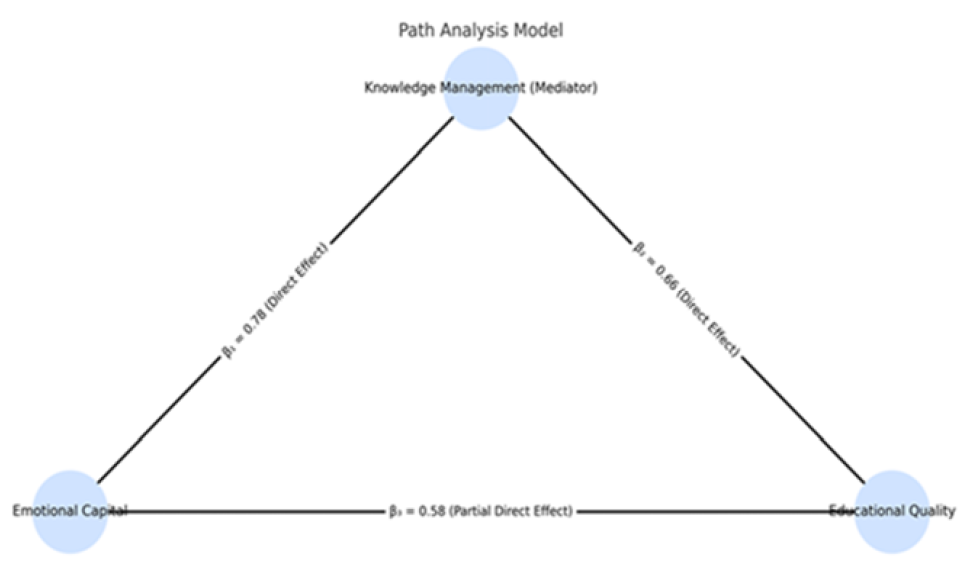
The path analysis in this study intends to test the interaction of the three endogen variables, and that is emotional capital (X), knowledge management (M), and the quality of the educational process (Y). This will happen through a causal model of the direct and indirect relationship will be made up.
This model shows that:
Emotional capital influences the educator and student educators towards a mutual understanding (X → Y).
The emotional capital influence knowledge management (X → M).
The management of knowledge, in turn, affects the quality of the educational process.
The current model will examine whether or not knowledge management mediates the association between emotional capital and educational quality in this case. The regression coefficients indicate the results of the statistical analysis.
Knowledge management practice is significantly and positively correlated with emotional capital (β1=0.78), so developing emotional competencies as emotional intelligence and emotional labour is essential for enhancing knowledge management practices in the institution. As the organizational climate for knowledge sharing improves, the performance of academic staff and students’ experiences improve and vice-versa. Knowledge management and the quality of educational process are significantly correlated (β2 = 0.66). The effect of emotional capital on the quality of education was significant (β3 = 0.58), indicating that this variable had an independent impact over and beyond knowledge management.
Figure 2: Depicts the Path Analysis Model
The Analysis of the Relations
The data pattern indicates the existence of partial mediation. Knowledge management clarifies the emotional capital-education quality nexus, but it does not eliminate the direct effect. This partial mediation suggests that academic staff that essentially possess strong emotional capital not only enhances interpersonal relations but also cultivates an advanced knowledge environment that improves educational quality. The results show that a quality improvement strategy in education includes and needs an emotional and organizational component; it is not enough to just develop emotional intelligence, this must be situated within a complete institutional knowledge management strategy. The path analysis of this research provides empirical evidence in support of the proposed conceptual model and advocates the need to develop integrated strategies to improve emotional capital and institutional knowledge framework to achieve optimum quality education.
CONCLUSION
The educational environment and development of emotional capital are crucial. Besides, there is a significant connection between emotional capital, pain and gain, and the full realization of learning potential.
Emotional capital plays an important role in enhancing the quality of the educational process. It directly influences positive interaction, student motivation, and the development of healthy relationships among the staff at the institution
Knowledge management acts as an important mediator as it helps in translating positive emotions to organizational practices that help in the academic performance
Statistical analysis (F = 156.007, Sig = 0.000, R = 0.872) indicates strong correlation and impact relationships between the three groups confirming the robustness of the causal model used
Several dimensions of emotional capital, such as emotional resilience and emotional labor have low levels in the college under study. These should be enhanced at administration/ manager level as well as professional level
In light of the findings of the research, improving knowledge management will also translate into the enhancement of the quality of education in the field of culture, human and psychological.
Recommendations
Consequently, the study recommends the following based on the conclusion.
Incorporating emotional capital into human development strategies for universities by offering specialized training on emotional intelligence, psychological resilience and emotional labour.
Improving educational institutions' systems of Knowledge Management in their digital formats and providing digital platforms on which faculty can share and exchange knowledge and experience.
In future studies, it could be useful to use advanced analytical schemes, such as path modeling or SEM, to measure causation accurately.
Creating institutional policies that promote a healthy emotional work environment, support human communication, and limit burnout.
Programmes should align educational outcomes with labor market needs by integrating emotional intelligence skills into curricula and developing social skills among students.
Comparative studies between different educational institutions to measure how emotional capital has different impacts on quality of education in different organisational and cultural contexts.
REFERENCE
Wingfield, A.H. “The (Un)Managed Heart: Racial Contours of Emotion Work in Gendered Occupations.” Annual Review of Sociology, vol. 47, 2021, pp. 197–212. https://doi.org/10.1146/annurev-soc-081320-114850.
Cottingham, Marci D. “Theorizing Emotional Capital.” Theory and Society, vol. 45, 2016, pp. 451–470.
Gendron, B. “Emotional Capital and Education Issues.” Journal of Research and Curriculum Development, vol. 2, no. 1, 2013, pp. 23–52.
Petrides, K.V., et al.“Trait Emotional Intelligence: Psychometric Investigation with Reference to Established Trait Taxonomies.” European Journal of Personality, vol. 15, no. 6, 2001, pp. 425–448. https://doi.org/10.1002/per.416.
Mayer, J.D., et al. “Emotional Intelligence: Theory, Findings, and Implications.” Psychological Inquiry, vol. 15, no. 3, 2004, pp. 197–215. https://doi.org/10.1207/s15327965pli1503_02.
Mayer, J., et al. “The Ability Model of Emotional Intelligence: Principles and Updates.” Emotion Review, vol. 8, no. 4, 2016, pp. 290–300. https://doi.org/10.1177/1754073916639667.
Goleman, D., and R.E. Boyatzis. “Emotional Intelligence Has 12 Elements. Which Do You Need to Work On?” Harvard Business Review, February 2017, https://hbr.org/2017/02/emotional-intelligence-has-12-elements-which-do-you-need-to-work-on.
Goleman, D. Emotional Intelligence: Why It Can Matter More Than IQ. Bantam Dell, 2005.
Goleman, B. Emotional Intelligence: For a Better Life, Success at Work, and Happier Relationships. Independently Published, 2019.
Singh, A., et al. “Emotional Intelligence: A Literature Review of Its Concept, Models, and Measures.” Journal of Positive School Psychology, vol. 6, no. 10, 2022, pp. 2254–2275.
Yang, H., et al. “Exploring the Relationship between Trait Emotional Intelligence and Adaptive Performance: The Role of Situational Strength and Self-Efficacy.” Personality and Individual Differences, vol. 196, 2022, p. 111711. https://doi.org/10.1016/j.paid.2022.111711.
Anto, K.A., et al. “The Mediating Role of Organizational Commitment in Influence Relationships between Interpersonal Communication and Emotional Intelligence toward Employee Performance.” International Journal of Business, Economics and Law, vol. 7, no. 2, 2015, pp. 47–56.
Shuo, Z., et al. “The Relationship between Postgraduates’ Emotional Intelligence and Well-Being: The Chain Mediating Effect of Social Support and Psychological Resilience.” Frontiers in Psychology, vol. 13, 2022, p. 865025. https://doi.org/10.3389/fpsyg.2022.865025.
Grandey, A.A., et al. “When Are Fakers Also Drinkers? A Self-Control View of Emotional Labor and Alcohol Consumption among U.S. Service Workers.” Journal of Occupational Health Psychology, 2019, pp. 482–497.
Mohsin, F.Z., and N.A. Ali. “Development of the General Emotional Labor Scale—Urdu.” Pakistan Business Review, 2018, pp. 1083–1098.
Grandey, A.A., and R.C. Melloy. “The State of the Heart: Emotional Labor as Emotion Regulation Reviewed and Revised.” Journal of Occupational Health Psychology, 2017, pp. 407–422.
Zaghini, F., et al. “The Role of Occupational Stress in the Association between Emotional Labor and Burnout in Nurses: A Cross-Sectional Study.” Applied Nursing Research, 2020.
Linnenluecke, M.K. “Resilience in Business and Management Research: A Review of Influential Publications and a Research Agenda.” International Journal of Management Reviews, vol. 19, no. 1, 2017, pp. 4–30. https://doi.org/10.1111/ijmr.12076.
McQuillan, N., et al. “Developing Resilient Graduates to Be Future Workplace Leaders.” Higher Education, Skills and Work-Based Learning, vol. 11, no. 1, 2021, pp. 214–227. https://doi.org/10.1108/HESWBL-11-2019-0162.
Zhu, Z.M. The Characteristics of Adolescent Emotional Resilience and Its Effect on Positive Emotions and Mental Health. PhD thesis, East China Normal University, 2020.
Gardeazabal, A., et al. “Knowledge Management for Innovation in Agri-Food Systems: A Conceptual Framework.” Knowledge Management Research & Practice, vol. 21, no. 2, 2023, pp. 303–315.
Omanyo, J.O., and J.R. Ndiege. “Knowledge Management Considerations in Learning Management Systems in Higher Education Institutions: A Systematic Review, Synthesis and Research Agenda.” VINE Journal of Information and Knowledge Management Systems, vol. 55, no. 3, 2025, pp. 586–603.
Iaia, L., et al. “Supporting the Implementation of AI in Business Communication: The Role of Knowledge Management.” Journal of Knowledge Management, vol. 28, no. 1, 2024, pp. 85–95.
Jarrahi, M.H., et al. “Artificial Intelligence and Knowledge Management: A Partnership between Human and AI.” Business Horizons, vol. 66, no. 1, 2023, pp. 87–99.
Adhikari, D.R., and P. Shrestha. “Knowledge Management Initiatives for Achieving Sustainable Development Goal 4.7: Higher Education Institutions’ Stakeholder Perspectives.” Journal of Knowledge Management, vol. 27, no. 4, 2023, pp. 1109–1139.
Huynh, H.T.N., et al. “The Influence of Knowledge Management, Green Transformational Leadership, Green Organizational Culture on Green Innovation and Sustainable Performance: The Case of Vietnam.” Journal of Open Innovation: Technology, Market, and Complexity, vol. 10, no. 4, 2024, p. 100436.
Martínez-Zaragoza, F.J., et al. “In Dynamic INE Journal Management Systems.” INE Journal, vol. 51, no. 4, 2021, pp. 541–558. (Note: Original entry incomplete—verify title and journal name.)
Hassan, Sei-Bryson. “The Role of Culture in Knowledge Management: A Review of Literature.” International Journal of Information Management, vol. 52, 2020, pp. 102–115.
Santos, F., et al. “Human Factors in Knowledge Management: A Systematic Review.” Journal of Knowledge Management, vol. 25, no. 5, 2021, pp. 1234–1250.
Gharakhani, D., et al. “How to Integrate Knowledge Management into Organizational Strategy.” Journal of Business Strategy, vol. 40, no. 4, 2019, pp. 27–36.
Mukherjee, Shauli, et al.Fundamentals of Educational Administration, Management and Organization. Ashok Yakkaldevi, 2022.
Mata, M.N., et al. “Collaborative Innovation, Strategic Agility, & Absorptive Capacity Adoption in SMEs: The Moderating Effects of Customer Knowledge Management Capability.” Journal of Knowledge Management, vol. 28, no. 4, 2024, pp. 1116–1140.
UNESCO. Education 2030 Framework for Action. 2015.
Harvey, L., and D. Green. “Defining Quality.” Assessment & Evaluation in Higher Education, vol. 18, no. 1, 1993, pp. 9–34.
Premalatha, T. Quality in Education. 2022, p. 26.
Church, A. Effective Leadership in Higher Education Institutions. 2018.
Kirk, C., and J. MacPherson. Community Engagement and the Role of Higher Education. 2019.
Quality Matters. Rubric Standards for Online Course Design. 2020.
WHO. Mental Health and Well-Being in Higher Education. 2022.
Recommended Articles
Research Article
Influence of Leadership Behavior, Organizational Culture and Organizational Commitment on Employee Turnover Intention
Amrita Ghosh
Published: 12/05/2026
Download PDF
Research Article
The Effect of Employer Attractiveness and Compensation on Job Persuit Intention to Fmcg Companies in Indonesia: Coporate Reputation as an Intervening Variable
Download PDF
Research Article
The Effect of Knowledge Capital in Enhancing Cognitive Performance: The Mediating Role of Organizational Learning Requirements
Download PDF
Research Article
The Effect of Beauty Vlogger on Purchase Decision for Local Skincare Products in Indonesia: Brand Image as a Mediating Variable
Download PDF
PO Box 101, Nakuru
Kenya.
Email: office@iarconsortium.org
Editorial Office:
J.L Bhavan, Near Radison Blu Hotel,
Jalukbari, Guwahati-India
Ali, L. L., Swadi, A. F. & Altuma, M. I. (2026). The Impact of Emotional Capital on the Quality of the Educational Process: Knowledge Management as a Mediating Variable: An Exploratory Study of the Opinions of a Sample of Academics at the Technical Administrative College – Basra. Scientific Research Journal of Economics and Business Management, 6(1), 1-14.
MLA
Ali, Layla L., Amel Farhan Swadi and Mohanad I. Altuma. "The Impact of Emotional Capital on the Quality of the Educational Process: Knowledge Management as a Mediating Variable: An Exploratory Study of the Opinions of a Sample of Academics at the Technical Administrative College – Basra." Scientific Research Journal of Economics and Business Management 6.1 (2026): 1-14.
Chicago
Ali, Layla L., Amel Farhan Swadi and Mohanad I. Altuma. "The Impact of Emotional Capital on the Quality of the Educational Process: Knowledge Management as a Mediating Variable: An Exploratory Study of the Opinions of a Sample of Academics at the Technical Administrative College – Basra." Scientific Research Journal of Economics and Business Management 6, no. 1 (2026): 1-14.
Harvard
Ali, L. L., Swadi, A. F. and Altuma, M. I. (2026) 'The Impact of Emotional Capital on the Quality of the Educational Process: Knowledge Management as a Mediating Variable: An Exploratory Study of the Opinions of a Sample of Academics at the Technical Administrative College – Basra' Scientific Research Journal of Economics and Business Management 6(1), pp. 1-14.
Vancouver
Ali LL, Swadi AF, Altuma MI. The Impact of Emotional Capital on the Quality of the Educational Process: Knowledge Management as a Mediating Variable: An Exploratory Study of the Opinions of a Sample of Academics at the Technical Administrative College – Basra. Scientific Research Journal of Economics and Business Management. 2026 Jan;6(1):1-14.


 Download PDF
 Download XML