The primary goal of the research is to determine workplace rituals and how they affect organizational health, Employee rituals are the primary factor behind all organizational successes, and organizational health is one of the indicators of success in terms of the organization's capacity to allocate its resources effectively and adjust to changes in its environmental variables. For this reason, the research is important in attempting to offer a set of solutions to the issues that the organization under study faces. The research problem also showed a glaring lack of understanding of the significance of using these rituals to improve the organization's overall health, The questionnaire, which was created based on the concepts of several earlier measures, was used as the primary instrument for gathering research data, and the researcher used the descriptive analytical approach in the applied portion of the study, A sample of 136 people who worked in the Karbala Governorate Health Department received it. Utilizing statistical software, the research data was entered and analyzed using SPSS, Excel, and AMOS. The analysis's moral tools produced a set of findings that supported the existence of a moral influence and correlation between the variables being examined, which served as the foundation for the acceptance of the primary and supporting hypotheses, Accordingly, the researcher concluded that the organization under study pays clear attention to how to benefit from sx in the workplace in strengthening its organizational health. Based on the research results, a number of proposals were presented related to the necessity for the hospitals under study to develop mechanisms that help them support ritual practices in the workplace due to their impact on enhancing the organizational health of the organization and improving its well-being.
Workplace rituals help transform people’s behaviors to do new things, thus giving the organization a sustainable competitive advantage. Workplace rituals are a way to negotiate stability and change and build cohesion within the group. Rituals as practices work to eliminate anxiety, stress and depression and improve the work life of employees, which is what leaders seek to achieve. In addition, organizations have focused on health programs because they provide a powerful mechanism to face challenges by introducing systematic improvements in health, maintaining productivity and achieving outstanding performance. Organizations need all of their units to be operational in order to grow continually, adapt to change, and succeed. One of the key ideas when looking at the company from this angle is organizational health, The idea of organizational health refers to the balance of the organization with all of its internal elements and surroundings, as well as its capacity to accomplish its aims and objectives, Simultaneously, organizational health addresses the state of the organization's physical environment and the tools required to realize the organization's purpose, the state of communication between the organization and senior management, and the potential for problem solving, growth, and innovation.
Organizations must have functional units in order to continuously develop, adapt to change, and be successful, When looking at the organization from this perspective, one of the most important notions is organizational health, The idea of organizational health refers to the organization's harmony with all of its internal components and environment, as well as its ability to achieve its goals and objectives, Simultaneously, organizational health addresses the state of the organization's physical environment and the tools required to realize the organization's purpose, the state of communication between the organization and senior management, and the potential for problem solving, growth, and innovation.
Organizational health also addresses input quality (competence status) and raw material safety, as well as the organization's management decision-making processes, he welfare, performance, and roles of its employees within the company, as well as their moral, mental, and physical well-being, Based on the aforementioned, the current study reviewed the literature and studies pertaining to the two primary variables (organizational health and workplace rituals), The study was split into four axes in order to identify the theoretical component that would help comprehend the concept, its significance, and its dimensions, as well as to select a practical area for , The first axis is concerned with research methods, and it comprises the topic, importance, and aims of the study, as well as a proposed model and hypotheses, The second axis covers the theoretical aspect, which involves a review of the scientific and administrative literature on the research variables, while the third axis is dedicated to the practical side, which includes statistical analysis and the testing of research hypotheses, Finally, the third axis appeared to reflect the most essential findings and suggestions linked to the research.
1- The research problem:
He growth of modern organizational thought, particularly in the middle of the 1990s and the start of the current century, has led to a number of subjects that are current and modern due to the corporate environment, competition to produce the best goods, inventiveness, and rapid changes. From here, organizations began to monitor work methods and how employees perform the tasks assigned to them to know what are the daily practices carried out by employees that are part of their lifestyles, One of the most important reasons for not paying attention to rituals in the workplace led to employees relying on one pattern of daily work routine, This created a barrier In front of organizations that prevent them from achieving their goals, they are in dire need of developing the capabilities of their employees by changing their daily routine so that they can contribute to developing their intellectual capabilities and help in enhancing organizational health and changing the image of the organization from the current situation to a desirable situation in the future.
In this field, the importance of the organizational health of the organization emerges to help it adapt to this environment and maintain its vitality and activity and continue to exploit its available resources with the least possible waste of resources. Here, the importance of the relationship between the variables under study emerges. Accordingly, The key research problem can be formulated in the present of a lack of awareness of the importance of employing the practices of work rituals for workers in enhancing their organizational health, This is what the researcher noticed through field experience in the Karbala Health Department. The research problem can be explained by developing a collection of primary questions that can be summarized as follows:
What is the availability of ritual dimensions in the workplace in the organization under study from the point of view of the doctors working there?
2. The Importance of Research
The significance of research can be explained in two areas:
The scientific significance of the study is underscored by the variables studied, which represent contemporary topics in the field of human resource management and organizational behavior in particular and business management in general. Through the ritual practices in the workplace for employees, this important resource can be invested in the best possible way, and through organizational health, the organization’s ability to adapt to its surrounding environment and exploit its resources with the least possible loss can be enhanced.
The practical importance of the research is highlighted by the data collection standards, which were developed utilizing a range of local and international standards after being applied to the application site and the sample in question, which is one of the successful Iraqi hospitals in light of the difficult circumstances that the country has gone through. As far as the field under study is concerned, this will then assist the researcher in offering a number of suggestions and answers for the issues this business is having.
3 .Research objectives
The objectives that this research seeks to achieve are highlighted as follows:
Diagnosing the reality and most important practices related to work rituals for employees the organization under study.
Identifying organizational health's significance and reality in the organization being studied.
determining the type of correlation and influencing relationships between explanatory and responsive variables using a variety of statistical techniques
arriving at a set of conclusions that accurately depict the situation in the organization being studied.
Offering a list of suggestions that would advance understanding in the area being studied.
4. Hypothetical research model
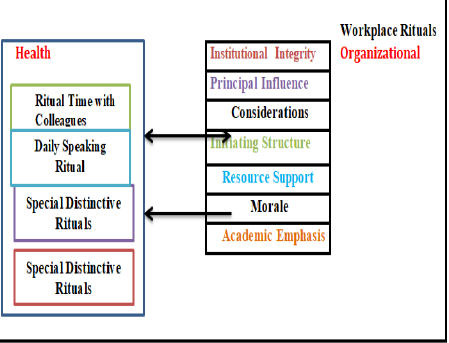
The hypothetical research plan consists of two main variables: (workplace rituals and organizational health), and each variable includes a number of sub-dimensions, as shown in Figure (1), as follows:
Figure (1)

Prepared By The Researcher
Hypotheses For Research:
After reviewing the results of previous studies, and based on what will be presented in the theoretical aspect, and in order to provide an answer to the questions of the current research and achieve its objectives, the main hypothesis of the research and its sub-hypotheses were formulated, which are as follows:
The first main hypothesis (H1): The first major hypothesis states that there is a substantial relationship between the organizational health variable and the workplace rituals variable
The second major hypothesis (H2) states that there is a significant relationship between the organizational health variable and the workplace ritual variable.
Research scales
The study questionnaire was designed according to the five-point Likert scale with a gradation (completely agree, agree, neutral, disagree, completely disagree) to know the response measurement of the research sample and to measure the research variables. Table (1) shows these criteria as follows:
Table) 1(
Scales | paragraphs | Dimension | Variable | S |
(pearson,et al ,2011) | 6 | Ritual Time with Colleagues | Workplace Rituals WR | A |
| 6 | Daily Speaking Ritual |
|
|
| 5 | Special Distinctive Rituals |
|
|
| 7 | Special Distinctive Rituals |
|
|
| 3 | institutional integrity | organizational health | B |
| 3 | principal influence |
|
|
| 3 | consideration |
|
|
(Wayne & John,1987) | 3 | initiating structure |
|
|
| 3 | Resource Support |
|
|
| 3 | Morale |
|
|
|
| Academic Emphasis |
|
|
Prepared By Researcher
The research adopted an analytical study approach based on the opinions of a sample of doctors in the Karbala Health Department. To answer the research questions and achieve its objectives, the researcher seeks, in accordance with this approach, to discover the nature of the relationship between the current study's variables. (rituals in the workplace and organizational health).
The research sample's description:
The current research aimed to select a random sample of doctors working in the Karbala Health Department in Iraq, numbering (136) doctors, with a response rate of (93 %) of the total number, as in the following table:
Table )2( Response rate
Number of forms | Description |
147 | Number of forms distributed |
138 | Number of forms received |
9 | Number of forms not received 7 |
2 | Number of forms excluded 2 |
136 | Number of forms valid for statistical analysis |
Source: Prepared By Researcher
Table (3) describes the research sample as follows::
Table( 3) Description of Demographic Variables
Category | Frequency | Percentage % |
| Gender |
|
|
Male | 90 | 66.2 |
Female | 46 | 33.8 |
| Age |
|
|
less than 24 | 40 | 29.3 |
25–34 | 50 | 36.7 |
35–44 | 30 | 22.3 |
45–54 | 16 | 11.7 |
| Organizational tenure in years |
|
|
Less than 1 | 23 | 16.9 |
2–5 | 39 | 28.7 |
6–10 | 40 | 29.4 |
11 and more | 34 | 25 |
| Education |
|
|
B.A. | 44 | 32.3 |
Diploma | 46 | 33.8 |
PhD | 35 | 25.7 |
Board | 11 | 8.2 |
|
|
|
| General Note: N=136 |
|
|
Firstly: Rituals in the workplace
Workplace rituals are defined as regulated, rule-bound, predictable, and repetitive activities carried out under conditions of explicit performance expectations, Rituals are physically executed to adhere to a specified and defined order, and are endowed with more meaning through a combination of formality and symbolism. Nine interrelated functions of ritual have been identified: making sense of work, managing anxiety, embodying and reinforcing social order, promoting group solidarity, Including and excluding others, regulating work structure, and describing and reinforcing major occurrences, These roles highlight the importance that rituals play as communication and learning systems that direct attention to what is important and steer organizational members' ideas, feelings, and behaviors, Workplace rituals are particularly important since they not only shed insight on corporate behavior, but also reinforce or challenge current cultural norms. [1]
Workplace rituals symbolize an organization's culture, They are used to help employees learn about the organization's culture and basic principles, According to Deal and Kennedy, rituals are structured patterns that demonstrate anticipated conduct among employees in the workplace, All rituals represent the company's principles and assist employees in learning about the organization's culture, Furthermore, they help employees learn how to conduct their duties successfully and meet the standards that the organization demands. [2], An organizational ritual can be seen of as a communicative relationship that has the ability to communicate values, project an image, and inspire concepts and conventions, all of which are embodied in an organization's basic principles and are an important element of its culture. Furthermore, they can be clues or nuances that guide, communicate meaning to the entire institutional existence, and develop its culture. [3]
It is defined [4] as symbolic social activities that embody basic ideals This is unexpected because the culture, often formed by the owner, is likely to strengthen a competitive edge by supporting workplace rituals that guide staff activities to give superior customer experience, produce loyal customers, and market share, Rituals, being verbal and nonverbal actions, often take into account interactions with others, Rituals are not as unusual as workplace gatherings or workplace recreation. Rather, they are important because they continue to shape our understanding of our collective experience and add context to what we think, feel, and do, They are, after all, recurring activities that help members of a group do their work,Three important elements of workplace rituals are purposeful innovation, corporate work activities, and corporate strategy [5] He stresses [6] that workplace rituals are Actions that are intentionally performed by a group of people within a workplace who use one or more symbols in a specific repetition. And describes [7] workplace rituals as actions that are performed in a ceremonial manner or according to social convention or protocol, They are frequently repeated and frequently have important meaning, Numerous elements can have an impact on workplace rituals, They might be as straightforward as an employee's everyday job routine or as intricate as the accolades that corporations bestow upon their staff.
Important of Rituals at Workplace
The topic of Rituals in the workplace is considered important at the individual, group and organizational levels. Due to its importance, it has occupied a large space in scientific and academic research to link decisions that are socially and emotionally compatible between working individuals and senior management. Thus, interaction is linked to increasing the efficiency and effectiveness of the organization, Rituals can teach employees business values by drawing their attention to what the company considers to be significant, The word "ritual" suggests that it is a recurrent action carried out in a specific way, Thinking about what the ritual is and what it is achieving can help the employee understand what the firm values most, Rituals contribute to the definition of the company and its operations since they are a component of the organizational culture, It is easy for employees to identify the type of working environment they are in based on the company's customs, Anything from a special lunch to office parties or work schedules could be considered a ritual [2],Rituals in the workplace are effective ways to teach the fundamental values that support organizational culture, but further study is required to determine the various kinds and how they work to reinforce core values in various corporate cultures. [4]
Additionally, rituals and rites are essential to organizational transformation, Rituals accomplish two vital functions: they give assurance and permit celebration, The uncertainty that change causes, as was previously mentioned, is a major factor in reluctance to change, People can plan their life around a ritual, which gives them a sense of security at times of extreme upheaval. The awareness that this event will always occur at the same time and location provides comfort and reassurance, regardless of the amount of change and chaos occurring around them, An organization should share success stories and celebrate achievements during the transition process, This encourages people in the organization to keep going by letting them know their efforts are appreciated, A ritual is a wonderful way to commemorate these accomplishments. Whether it's a monthly faculty meeting or a weekly get-together for coffee and doughnuts, the change agent should utilize the opportunity to foster a sense of security and recognize the accomplishments and hard work of all those involved in the organization. [8]
Dimension of Rituals at the Workplace
Ritual Time with Colleagues
Personal connection rituals are essential for understanding peer relationships as micro cultures, Meaningful encounters result in relational identities, Relational cultures exhibit themselves through symbolic enactments including idioms, playful sequences, co-constructed stories, and recurring rituals. Rituals are relational symbols that are important to human relationships, Rituals have been characterized in several ways, Earlier definitions of rituals claimed that they are common behaviors shared by members of a kinship or friend group and that they enable the co-creation of a relationship identity, shared history, and expected patterns of everyday interactions.
Practicing daily conversation rituals such as asking questions and generating discussion is important because it is informative. These rituals are not just aimless talk; they are rituals filled with symbolic meaning and positive expectations, especially since these conversations strengthen the relationship between thousands of employees over. The presence of rituals in the workplace indicates the presence of a state of emotional harmony and a sense of pride and belonging in the workplace.
In a study [9] Cluster analysis identifies five distinct sorts of employees based on their informal communication behaviors, These categories differ greatly in terms of the amount of informal communication they engage in and the reasons for it, Approximately 20% of employees (the chatterers) engage in significantly more informal discussion than others, The investigation shows that this type relies on informal interactions for knowledge and organizing, as well as social integration, The chatterer has two counterparts—the focuser" and "the strategist," both of whom rarely engage in informal communication in the workplace. Whereas the focuser sees informal communication as a distraction from their task, the strategist recognizes that informal discussions can be valuable for information gathering and social interchange, In this aspect, this type parallels "the networker," who engages in informal conversation for strategic reasons, This type requires this conversation in order to arrange their daily routine, obtain information that will assist them in completing tasks, and integrate into the workplace community, Finally "the small-talker" uses informal communication mostly as a distraction from work.
Special Distinctive Rituals
Distinctive rituals are sets of rituals that individuals maintain as meaning-making activities that build their unique identity or character. The practical tasks involved in completing activities may be similar among individuals or groups and the rituals themselves may be practiced. However, there are distinct and unique rituals, for a particular individual or group, that demonstrate their shared identity, culture, and values [10]
Rituals and routines for daily tasks
[11] asks: Who uses rituals in their daily work? To answer this question, we need to know that rituals and routines are daily activities, acceptable behaviors that are observed, the way things are done here, and the actions and activities of individual workers that reflect management expectations and established standards. Rituals help you create, intentionally, a better culture in your work at the level of the entire company or team - or your own practice related to repetitive tasks. So an employee who wants to make his daily work routine more productive, more in line with his morals and goals, or it could be a member of the team or a manager who knows that his work life could be more in line with their meme, and wants to bring more collaboration and creativity into his organization. In particular, people who care about their work community and culture can use rituals. These can be managers, leaders, or even new employees who care about how their organizations are run. - Rituals are ways to bring these big, abstract ideas into the practice of daily tasks. Essentially.
Secondly : Organizational Health
Concern over the treatment of employees in the workplace led to the introduction of the idea of organizational health (OH) in the 1960s. Since then, employee health and well-being have become a significant concern, Beyond the health and well-being of employees, however, organizational health has emerged as a critical concern for employers in today's business environment [12], Complex organizations must provide a safe and healthy work environment in addition to ensuring that employees' rights are upheld ,define [13] Health is defined as keeping "employees free from physical or emotional illness," and safety as "protecting employees from injuries caused by work-related accidents," In 1970, the Occupational Safety and Health Administration (OSHA) was established to prevent disease or injury, OSHA works to improve safety and health and reduce accidents, which result in lower production and higher operating expenses, It does this through workplace inspections, fines and penalties, and on-site consultations [14] confirms that: Employee commitment to their individual tasks demonstrates the organizational health concept's uniqueness, It is normal for workers to feel proud of their work and excited to start work in a solid organization, When it comes to any system's performance, employees' physical and mental health, their capacity to carry out their jobs successfully, and their capacity to evaluate both their own and others' abilities are all significantly impacted by the organization's health, An organization's organizational health is determined by its capacity to perform its tasks as effectively as possible.
From the perspective of [15], organizational health is defined as the organization’s ability to create a positive work environment in which individuals with talents, experiences, and skills want to stay and share these skills, experiences, and knowledge with each other to achieve the organization’s main goals and make it capable of adapting to developments and changes in the internal and external environment in order to overcome difficulties, solve and eliminate problems, and achieve the organization’s efficiency and effectiveness (i.e. the organization’s success), On the other hand however, according to described OH as a state in where an organization's management, operations, strategy, and culture all converge, These days, businesses focus on their overall health since a healthy organization's culture, climate, and ongoing development help create an atmosphere that can promote employee well-being and organizational effectiveness.
It is the state that seeks to maintain the integrity of procedures and transactions that take place in the organization’s environment, and to work on finding simple solutions that protect the health of the organization as a whole, and protect the health of its subsystems [16], Refers to an organization's ability to adapt and conform to the environment by maintaining organizational health programs. Integrity is described as a strict adherence to codes of values, ethical principles, integrity, honesty, and consistency of actions, principles, methods, and standards, whether at the organizational or individual level. Integrity is said to be a core value that includes serving others, acting reliably, virtuously, loyally, responsibly, and appropriately, with a clear sense of right and legitimate purpose, and not being influenced by corruption [17]
The main effect refers to the ability of high management to influence the workers in the organization with a flexible and realistic consensus ، where the leader plays an effective organizing role. Automatic behavior and stereotyped families are prevalent in many human activities, because in many cases automatic behavior is the most effective form of behavior, we exist in an unusually complex motivational environment, easily moved and complex at all in the world.
It means the manager's behavior based on openness, respect, friendliness, friendship, supportive relationship, mutual trust, concern for the workers and social care for them. That is, the basic management behavior is genuine concern for the welfare of teachers) Ibrahim, 2022: 500), Consideration is when a principal acts in a way that is kind, helpful, transparent, and cooperative; it shows that they genuinely care about the well-being of their employees.
This dimension highlights performance standards and operating procedures, the extent to which the manager demonstrates work behaviors and attitudes, and his relationship with employees, as he must clarify and define job expectations [16], Structure preparation is defined as a framework that specifies the institution's numerous internal departments and divisions, The preparation of the structure determines the lines of authority and their flow across functions, as well as the numerous administrative units that work together to achieve the goals of the institution or organization.
In the health educational institution, workers are used effectively, as the organization does not burden them with work and does not allow them to neglect, and balances between the needs of workers and the requirements of the institution, as the general coordination of individuals includes not burdening members with more than their capacity, and there is a minimum of pressure and stress as members work hard and do not feel stressed in return, as they do not work against themselves and against the organization, and the compatibility between the actions of members and the demands of the role of the educational institution is good, so members feel a personal achievement, a good feeling in their work roles, and a real and continuous feeling of learning, growth and development as individuals, as they believe that they make real and important contributions to the organization [18]
It is the feeling of individuals positively towards each other, the feeling of belonging to the organization’s community, friendship, openness and sympathy, in addition to performing work in a cooperative manner, stemming from the internal enthusiasm to accomplish the work [16], It refers to the feeling of certainty, trust, cooperation and friendship that exists between workers, i.e. their having good feelings towards each other, so that they feel that they are working well. We can describe morale as incentives that help people achieve the satisfaction of their other psychological and social needs and increase the worker's feeling of a state of advancement in his work, loyalty and achieving cooperation among his colleagues [19]
The trend towards innovating new procedures that achieve growth, excellence and academic distinction, by setting achievable ambitions and goals through providing a serious and distinguished environment. There can be complete faith by the institution’s employees in the ability of their workers to achieve high levels of achievement, which develops their enthusiasm to work seriously and respectfully, [18,20] explained that the learning organization is the organization in which individuals can continuously increase their energies and capabilities in order to achieve the results they desire, where new ideas and patterns become clear to them. He confirms that the academic focus is the extent to which the organization is interested in education, vocational and academic training, and scientific research that develops the work to become a learning organization.
1. Scale, statistical coding and reliability test (Cronbach's alpha)
Table (7) shows the independent variable and the dependent variable, their dimensions, and the number of paragraphs for each dimension, in addition to the reliability coefficient (Cronbach's alpha). It is clear that the value of Cronbach's alpha for the workplace ritual variable is (0.703), which is an acceptable value in social research. As for the value of Cronbach's alpha for the organizational health variable, it reached (0.930), which is a very high value. These values indicate that the scale has acceptable reliability for both variables.
Table (7) Scale of variables, their dimensions and stability coefficient
Variable | Dimensions | Paragraphs | Statistical Symbol | Reliability Coefficient (Cronbach's Alpha) |
(Independent Variable (Rituals In The Workplace) | Ritual Time with Colleagues | 6 فقرات | RT1-RT6 |
(0.703( |
Daily Talking Rituals | 6 فقرات | RS1-RS6 | ||
Special Distinctive Rituals | 5 فقرات | RD1-RD5 | ||
Daily Routines and Tasks | 7 فقرات | DRT1-DRT7 | ||
Dependent Variable organizational health)) | institutional integrity | 3 فقرات | IN1-IN3 |
(0.930) |
all influence | 3 فقرات | AE1-AE3 | ||
considerations | 3 فقرات | CO1-CO3 | ||
structure preparation | 3 فقرات | PS1-PS3 | ||
resource support | 3 فقرات | RSU1-RUS3 | ||
morale | 3 فقرات | MO1-MO3 | ||
academic focus | 3 فقرات | AF1-AF3 |
To confirm the questionnaire's apparent validity, it was provided to a group of specialists with specializations to gain their opinions on the applicability, adequacy, clarity, and alignment of the paragraphs with the dimensions. The researcher performed some important adjustments proposed by the arbitrators and experts to make the questionnaire more suitable for the application environment and clear.
B. Confirmatory factor analysis was used, which is considered one of the types of structural equation modeling, which shows us the confirmatory validity of the questionnaire based on the respondents’ answers and the validity of the factor structure of the dimensions and the saturation of the paragraphs on the dimensions, which is acceptable if it is greater than or equal to (0.40).

Figure (2) Confirmatory factor analysis of the workplace ritual variable
The confirmatory factor analysis of the independent variable (workplace rituals), which has four sub-dimensions, is displayed in Figure (2). We can see that the parameter estimates were higher than the percentage (0.40) following the three program-recommended adjustments, and they are all significant, as indicated by the fact that the critical ratio (C.R.) in Table (8) is all significant at the level of (0.01), confirming the variable's confirmatory validity. Accordingly, the proposed structural model has attained a high degree of conformance, confirming that the workplace rituals variable is assessed by four dimensions and a total of twenty-four paragraphs based on the research sample's responses.
Table (8) Standard weights and paths for the workplace ritual variable
path | Estimate | s.e. | c.r. | p | ||
|---|---|---|---|---|---|---|
RT6 | <--- | F1 | 1.000 | |||
RT5 | <--- | F1 | .508 | .022 | 22.707 | *** |
RT4 | <--- | F1 | .381 | .023 | 16.841 | *** |
RT3 | <--- | F1 | .702 | .028 | 25.358 | *** |
RT2 | <--- | F1 | .534 | .024 | 22.604 | *** |
RT1 | <--- | F1 | .282 | .022 | 12.635 | *** |
RS1 | <--- | F2 | 1.000 | |||
RS2 | <--- | F2 | .749 | .052 | 14.489 | *** |
RS3 | <--- | F2 | 1.315 | .073 | 18.014 | *** |
RS4 | <--- | F2 | 1.394 | .081 | 17.114 | *** |
RS5 | <--- | F2 | 1.067 | .066 | 16.137 | *** |
RS6 | <--- | F2 | .890 | .058 | 15.236 | *** |
RD5 | <--- | F3 | 1.000 | |||
RD4 | <--- | F3 | 1.232 | .060 | 20.399 | *** |
RD3 | <--- | F3 | .741 | .051 | 14.601 | *** |
RD2 | <--- | F3 | 1.342 | .064 | 20.909 | *** |
RD1 | <--- | F3 | .983 | .045 | 21.735 | *** |
DRT1 | <--- | F4 | 1.000 | |||
DRT2 | <--- | F4 | 1.307 | .071 | 18.290 | *** |
DRT3 | <--- | F4 | 1.285 | .066 | 19.571 | *** |
DRT4 | <--- | F4 | 1.553 | .083 | 18.712 | *** |
DRT5 | <--- | F4 | 1.239 | .068 | 18.207 | *** |
DRT6 | <--- | F4 | 1.095 | .061 | 17.988 | *** |
DRT7 | <--- | F4 | .855 | .053 | 16.157 | *** |
Source: AMOS V.25 outputs
The confirmatory component analysis of the dependent variable, organizational health, which has seven sub-dimensions, is displayed in Figure (3), Given that the critical ratio (C.R.) in Table (9) is all significant at the level of (0.01), which validates the variable's confirmatory validity, it is evident to us that the parameter estimates exceeded the percentage (0.40) after deleting paragraph (AE2) because it did not reach the necessary percentage. According to the research sample's responses, the proposed structural model has therefore attained a high degree of conformance, confirming that the organizational health variable is measured by seven dimensions and a total of twenty paragraphs..

Figure (3) Confirmatory factor analysis of the organizational health variable
Source: AMOS V.25 outputs
Table (9) Standard weights and paths for the organizational health variable
path | Estimate | s.e. | c.r. | p | ||
|---|---|---|---|---|---|---|
AE1 | <--- | F1 | 1.000 | |||
AE3 | <--- | F1 | .831 | .086 | 9.682 | *** |
IN1 | <--- | F7 | 1.000 | |||
IN2 | <--- | F7 | 1.088 | .152 | 7.157 | *** |
IN3 | <--- | F7 | .958 | .154 | 6.205 | *** |
PS1 | <--- | F2 | 1.000 | |||
PS2 | <--- | F2 | 1.092 | .117 | 9.348 | *** |
PS3 | <--- | F2 | 1.140 | .133 | 8.580 | *** |
RSU1 | <--- | F3 | 1.000 | |||
RSU2 | <--- | F3 | 1.000 | .114 | 8.765 | *** |
RSU3 | <--- | F3 | .976 | .124 | 7.886 | *** |
AF3 | <--- | F4 | 1.000 | |||
AF2 | <--- | F4 | 1.019 | .099 | 10.275 | *** |
AF1 | <--- | F4 | 1.224 | .109 | 11.198 | *** |
MO3 | <--- | F5 | 1.000 | |||
MO2 | <--- | F5 | .921 | .100 | 9.252 | *** |
MO1 | <--- | F5 | .814 | .079 | 10.369 | *** |
CO3 | <--- | F6 | 1.000 | |||
CO2 | <--- | F6 | 1.297 | .243 | 5.345 | *** |
CO1 | <--- | F6 | 1.768 | .307 | 5.767 | *** |
Source: AMOS V.25 outputs
3. Descriptive statistics for study variables.
A- descriptive statistical analyses of the workplace ritual variables (WR)
According to the research sample's response, table (10) displays the descriptive statistics and the overall arrangement of the dimensions of the independent variable (workplace rituals, or WR), which came out as follows (after daily conversation rituals, after daily routine and tasks, after time rituals with colleagues, after special distinctive rituals) respectively, As for the variable of the main workplace rituals, It obtained a "high" answer level, meaning that this variable received a high degree of importance based on the sample members' responses, It also achieved a general weighted arithmetic mean (of 3.78) and a standard deviation value of (0.296%) which show the dispersion of the sample's answers from its arithmetic mean. Additionally, it had a relative coefficient of variation of (7.82) percent and the intensity of the achieved answer reached was (75.70) percent.
table (10): Descriptive statistics for the variable of rituals in the workplace
dimensions | sample | mean | standard deviation | coefficient of variation | Response Intensity |
RT | 136 | 3.84 | 0.496 | 12.92 | 76.72 |
RS | 136 | 4.09 | 0.354 | 8.66 | 81.79 |
RD | 136 | 3.14 | 0.502 | 15.96 | 62.88 |
DRT | 136 | 3.94 | 0.435 | 11.04 | 78.76 |
WR | 136 | 3.78 | 0.296 | 7.82 | 75.70 |
Source: SPSS V.25 and EXCEL 2010 outputs
B-Descriptive statistics for the organizational health variable
The descriptive statistics and general arrangement of the dependent variable's (organizational health OH) dimensions are displayed in Table (11) based on the responses of the research sample. These dimensions were arranged as follows: academic focus, institutional integrity, considerations, resource support, morale, structure preparation, and the impact of all.
With regard to the primary organizational health variable, it obtained a general weighted arithmetic mean of( 3.86) and a standard deviation value of (0.506), indicating that the sample's responses were dispersed from its arithmetic mean. Additionally, it had a Relative coefficient of variation of (13.11) percent and the intensity of the achieved answer reached (77.24) percent, resulting in a "high" answer level, indicating that this variable received a high degree of importance based on the sample members' responses
table (11) The organizational health variable's descriptive statistics
dimensions | sample | mean | standard deviation | Coefficient of Variation | Response Intensity |
IN | 136 | 3.95 | 0.502 | 12.73 | 78.92 |
AE | 136 | 3.57 | 0.509 | 14.25 | 71.37 |
CO | 136 | 3.92 | 0.625 | 15.94 | 78.43 |
PS | 136 | 3.84 | 0.621 | 16.15 | 76.86 |
RSU | 136 | 3.89 | 0.590 | 15.17 | 77.75 |
MO | 136 | 3.87 | 0.688 | 17.79 | 77.30 |
AF | 136 | 4.00 | 0.664 | 16.58 | 80.05 |
OH | 136 | 3.86 | 0.506 | 13.11 | 77.24 |
Source: SPSS V.25 and EXCEL 2010 outputs
4. Hypothesis Testing
A- Testing the correlation hypotheses
Table (12) demonstrates that there is a strong association (.377**0), which is statistically significant, This finding explains that the presence of any specific level of the workplace rituals variable in the Karbala Health Department under investigation will inevitably result in a high percentage of organizational health, and that the direction of this relationship is direct, implying that the emergence of the workplace rituals variable necessitates the emergence of the organizational health variable, The correlation value is significant according to the (Sig.) index, which was within a significance level of (1%), reaching (0.000), with a confidence level of (99%).
Based on the aforementioned, in the context of the Research Sample, the Results support the acceptance of the first primary hypothesis investigated, which states that( workplace Rituals are directly associated with improved organizational health)..
table (12) The link between workplace rituals and organizational health
WR | OH | ||
WR | Pearson Correlation | 1 | 0.377** |
Sig. (1-tailed) |
| 0.000 | |
N | 136 | 136 | |
OH | Pearson Correlation | 0.377** | 1 |
Sig. (1-tailed) | 0.000 |
| |
N | 136 | 136 | |
**. Correlation is significant at the 0.01 level (1-tailed). | |||
Decision result: Accepting the hypothesis of a positive and statistically significant correlation between workplace rituals and organizational health. | |||
Source: SPSS V.25 output
B- Testing the impact hypotheses
In order to test the hypothesis of influence,( AMOS V.25) program was used to use the structural modeling approach, and the purpose of Figure (4) was to ascertain the importance of the influence linkages between the variables, Results pertaining to evaluating the direct impact of the independent variable (workplace rituals in organizational health) are displayed in Table (13) and Figure (4), A positive direct association between the variable of workplace rituals and organizational health is indicated by the marginal slope coefficient, which obtained the tested effect's value (Beta Standardized) of (ß=0.38, P<.0), This indicates that the dependent variable, organizational health, will rise by (%38) for every unit increase in the availability of the independent variable, workplace Rituals. These values are regarded as significant because the coefficient of determination (interpretation) (R2) for the variable of workplace rituals in organizational health reached (0.14), indicating that workplace rituals explain (14% of the changes that occur at the level of organizational health, with the remaining 86% being due to the influence of other variables that were not studied in the statistical model of the research, The critical value C.R. of Table (13) is (4.722), which is a significant value at (P<.001). This confirms the premise that workplace rituals have a major influence on organizational health, The foregoing findings support the idea of a direct effect path between the independent and dependent variables.

Figure (4) the impact of workplace rituals on organizational health
Table (13) Regression weights to test the relationship of influence between workplace rituals and organizational health
PATH | Estimate | S.E. | C.R. | P | ||
|---|---|---|---|---|---|---|
OH | <--- | WR | .645 | .137 | 4.722 | *** |
RT | <--- | WR | 1.359 | .084 | 16.101 | *** |
RS | <--- | WR | .821 | .075 | 10.946 | *** |
RD | <--- | WR | .840 | .127 | 6.625 | *** |
DRT | <--- | WR | .960 | .096 | 10.032 | *** |
IN | <--- | OH | .885 | .039 | 22.959 | *** |
AE | <--- | OH | .529 | .073 | 7.210 | *** |
CO | <--- | OH | .945 | .068 | 13.833 | *** |
PS | <--- | OH | 1.128 | .041 | 27.441 | *** |
RSU | <--- | OH | 1.064 | .041 | 26.185 | *** |
MO | <--- | OH | 1.223 | .051 | 24.093 | *** |
AF | <--- | OH | 1.226 | .040 | 30.747 | *** |
Source: SPSS V.25 output
First: Conclusions
Conclusions related to the description and diagnosis of the research variables
Having rituals in the workplace helps doctors increase their performance by training employees how to handle high-stakes work situations, deal with anxiety, and focus on achieving their goals. Rituals can bring a sense of control during times of uncertainty, such as a big meeting in the middle of a presentation or experiment, or when they are overwhelmed by too many deadlines.
Workplace rituals offer therapeutic properties to victims of workplace abuse, such as reduced fear, increased individual empowerment, and overall improved mental health. Therefore, they provide a general framework for reducing psychological harm in the workplace.
Organizational health is a state of complete physical, mental and social well-being that can have a significant impact on the health of workers by providing them with the physical, psychological, social and organizational conditions that protect and promote health and safety in the work environment.
The achievement of learning organizations reflects the interest of these organizations in obtaining knowledge and information stock and the scientific focus on studies and research that enhance the health of the organization.
Workplace rituals are part of the organization’s culture that improve and increase relationships and social communication between doctors and managers and between subordinates themselves, which enhances the spirit of cooperation and security and reduces feelings of fear, anxiety and depression.
It became clear that the Karbala Health Department strengthened the rituals in the workplace by focusing on the rituals of time with colleagues, resulting from spending a specific time with colleagues in recreational activities, especially since they pay attention in informal work relationships with colleagues to carry out difficult and complex activities collectively, and this is what the researcher noticed from the presence of contextual performance among officials in the Karbala Health Department.
The Holy Karbala Health Department has adopted moderately distinctive rituals to improve its work rituals, resulting from the inclusion of work relations with the cheerful colleague, in addition to the presence of favorite activities for workers that they accomplish with their colleagues in a way that does not meet ambition.
Second: Recommendations
The necessity of paying more attention to ritual practices in the workplace and their dimensions, due to its importance and impact on the well-being and satisfaction of the individual in his work in the organization and the benefits and competitive advantage it brings to the organization by enhancing communication and interaction between employees, enhancing team spirit by holding periodic meetings, organizing recreational and educational events, and providing training courses to develop skills, in addition to enhancing the culture of respect and appreciation among colleagues.
Maintaining employee morale by providing appreciation and rewards to employees for their efforts and making them feel the importance of their role in the success of the organization and their contribution to building team spirit.
The necessity of the Karbala Health Department’s commitment to the rules of professional and functional conduct, obligating working doctors, raising awareness regarding the extent of responsibility, providing the best health services, exchanging experiences regarding new work practices, and enhancing transparency in preparation for more institutional integrity program activities.
The necessity for the Karbala Health Department to realize the extent of the great influence that doctors have on work and to reach agreements and settlements with them to reduce conflicts and pressures in decisions related to their work and to emphasize that they are able to coordinate and manage work without influence from the senior management in the Karbala Health Department.
Karbala Health Department is supposed to pay attention to the rituals of working doctors to instill positivity and raise morale by placing rituals in the workplace within the organizational culture of the health department.
It is essential to share with coworkers the needs of the workplace and the concern for cleanliness and health of the workplace.
Organizations should consider workplace rituals as a specific type of interaction that can enhance emotional well-being, which is linked to all aspects of working life such as the type of employee's job, relationships with colleagues, expectations at work, and work culture through workshops and educational sessions for working doctors about the importance of workplace rituals and how to benefit from them in enhancing organizational health.
The authors declare that they have no conflict of interest
No funding sources
The study was approved by the Al-Furat Al-Awsat Technical University, Technical Institute, Karbala, Iraq,
Smith, A. C., & Stewart, B.; "Organizational Rituals: Features, Functions and Mechanisms" International Journal of Management Reviews 13.2 (2011) pp. 113–133.
Deakin, Joshua; "Exploring Organizational Culture of Restaurants Through Workplace Rituals" (2015). Honors College. https://digitalcommons.library.umaine.edu/honors/252.
Sueldo, M., Štreimikiene, D.; "Organizational Rituals as Tools of Organizational Culture Creation and Transformation: A Communicative Approach" Transformations in Business & Economics 15.2 (2016) pp. 89–110.
Erhardt, N., Martin-Rios, C., & Heckscher, C.; "Am I Doing the Right Thing? Rituals as Institutional Learning Mechanisms for Organizational Culture in Restaurants" International Journal of Hospitality Management 59 (2016) pp. 31–41.
Kusuma, S., Hubeis, A. V. S., Sarwoprasodjo, S., & Ginting, B.; "Communication Performance and Entrepreneurial Behavior in Village-Owned Enterprise in Managing Village Enterprise Case Study of Panggungharjo Village of Bantul City, Indonesia" Russian Journal of Agricultural and Socio-Economic Sciences 94.10 (2019) pp. 4150.
Slavova, M., & Metiu, A.; "Relational Work and the Knowledge Transfer Process: Rituals in Rural Ghana" Organization Science 33.1 (2022) pp. 332–352.
Dosh, A. A. Z. M., & Al-Abadi, H. F.; "Strategic Fitness and Its Role on Promoting Rituals in the Workplace: A Field Study in the General Company for Textile and Leather Industry, Baghdad" International Journal of Transformations in Business Management 13.1 (2023).
Martin, J.; "Organizational Culture and Organizational Change: How Shared Values, Rituals, and Sagas Can Facilitate Change in an Academic Library" ACRL: Indianapolis (2013).
Koch, T., & Denner, N.; "Informal Communication in Organizations: Work Time Wasted at the Water-Cooler or Crucial Exchange Among Co-Workers?" Corporate Communications: An International Journal (2022).
Muhssen, J. L., & Omar, F. A.; "Rituals at the Workplace and Its Role in Achieving Job Happiness: An Analytical Study of the Opinions of a Sample of Employees in Commercial Banks in Sulaymaniyah Governorate" University of Kirkuk Journal for Administrative and Economic Science 14.2 (2024) pp. 66–83.
Murphy, D.; "How Leadership Behaviours Influence Organizational Culture Within a Change Environment: A Study of a Non-Food Multi-Channel Retail Operation in The Republic of Ireland" (Doctoral Dissertation, Dublin, National College of Ireland, 2022).
Singh, Anupama, Jha, Sumi; "Scale Development of Organizational Health Construct" Global Business Review 19.2 (2017) pp. 1–19, doi: https://doi.org/10.1177/0972150917713522.
Ololo, O., Kennedy, Chizoma, Njemanze, Vivian, Agbanike, Tobechi, Obiahu, Agha, Emmanuel; "Organizational Health/Safety and Employees' Performance for Sustainable Development" Webology 18.1 (2021).
Alashkara, A. Shafik, & Al-Kasasbeha, M. Mufaddy; "The Effect of Organizational Health on Employee Performance in the Extractive Industries" Management Science Letters 12 (2022) pp. 229–236.
Ali, Muzaffar Hamid, & Mahmoud, Ronyaz Hayas; "The Role of Organizational Health in Cooperative Engagement: An Analytical Study of the Opinions of a Sample of Lecturers in the Colleges of Salahuddin University / Erbil" Qalay Zanist Scientific Journal 7.4 (2022).
Abu Hajir, Tariq Mufleh; "The Extent of Availability of Organizational Health Dimensions and Their Relationship to Distinguished Performance" Al-Istiqlal University Journal for Research 5.1 (2020).
Gurzawska, Agata; "Principles and Approaches in Ethics Assessment: Institutional Integrity" Ethical Assessment of Research and Innovation: A Comparative Analysis of Practices and Institutions in the EU and Selected Other Countries (2015) pp. 3–27.
Ibrahim, Mohamed Sabry Al-Ansari; "The Relative Contribution of Organizational Health in Reducing Anti-Productivity Behaviors: In Technical Secondary Education Schools in Qena Governorate" South Valley University International Journal of Educational Sciences 8 (2022) pp. 2636–2899.
Jewczyn, Nicholas; "Job Satisfaction, Morale, and Cultural Diversity: Factors Influencing Worker Perspectives, Expectations, and Management Strategies" (2010) pp. 8–9.
Senge, Peter M.; The Fifth Discipline: The Art and Practice of the Learning Organization (New York: Doubleday, 1990) pp. 3.