Football commentary language is an important issue due to media coverage, financial investments, and large audience.Commentary is defined as "a spoken account of events that are actually taking place." The role of the commentator is to enlighten the viewers about what is going on on the pitch. This reporting must accurately reflect what is happening in real time, which is often a difficult assignment given the fast-paced nature of football.The purpose of this study is to examine how commentators communicate in sports, particularly football games, using language. It makes use of a theoretical framework that Leech and Short provided as stylistic categories. Football commentators use their own vocabulary, body language, and images to accurately describe every action that takes place on the pitch and communicate it to the audience.The study concluded that a variety of linguistic strategies are used by Arab commentators. Their use of unique word structures and rhetorical strategies draws in and holds the audience's interest. The exquisite internal consistency of the commentary—achieved by employing anaphora, metaphors, and ellipses—certainly defined the discourse's artistic shape. Participants or contextual components are examples of linguistic elements. This includes demonstratives, pronouns, definite articles, and adverbs.
Keywords
Commentary
Football
Audience
Commentators
Sports
INTRODUCTION
Football commentary language is an area worth exploring, considering the extensive media coverage and financial investments in football-related sports events, along with the sizable audience captivated by these occasions. The role of commentators is important as they not only entertain but also provide game analysis. They must respond promptly and coherently to on-field events. Their unique style of speech is a product of their profession's linguistic context. This study aims to analyze the style of communicative language in sports, specifically in football matches. It utilizes a theoretical framework based on the stylistic categories proposed by Leech and Short in 2007. Football commentators employ their own language, facial expressions, and visuals to depict every action on the pitch, effectively conveying what transpires to the spectators.
The language of football commentary
Communication through language is complicated. Communicating through speech has several special qualities that make it more convincing than communicating through writing. Lyons [1] states that communication begins when a speaker selects a message he intend to convey and encodes it in language to make it transmittable. The language of football commentary is a field worth exploring, given the significant media coverage and financial expenditures associated with football-related sporting events, as well as the substantial audience that is captivated by these events [2]. As a result, the commentators' role is crucial. They have to entertain while also offering commentary on the game. They must react immediately and linguistically to what is happening on the pitch. Their peculiar linguistic environment and the nature of their work are what give rise to their highly unique speech [3].
According to Humpolík [3], the commentary made especially for these games is a fairly uncommon but unquestionably significant sort of football commentary. All of these football commentary subgenres share a lot in common, but they also all have unique characteristics. According, to Crystal and Davy [4], the definition of commentary is "a spoken account of events which are actually taking place." This concept, nevertheless, is quite general and can be used to describe a variety of language acts. Ferguson [5] definesportscasting as a "monologue or dialog-on-stage" directed at an "unknown, unseen, heterogeneous audience". The sportscaster's responsibility is to inform the audience about the events happening on the pitch. This reporting must accurately reflect the real-time happenings, and given the fast-paced nature of football, it is often a challenging task. Furthermore, there are many times throughout the game when there is little action that necessitates description, and the sportscaster (especially on the radio, when there is very little downtime) must maintain the flow of speech, often with "quite extensive narrative stretches." [6]. Sportscasters aim to entertain the audience by using engaging subject matter, terminology, and prosodic elements to convey their emotions.Both the sportscaster and the audience must be familiar with vocabulary related to the topic and the game [3]. They can achieve "grammatical structure economies" more easily, reduce repetitiveness, and enhance the "descriptive immediacy that they heavily depend on for impact" by using the existing vocabulary [4]. During international matches, sportscasters should use "we" constructions, appropriate phonological effects to indicate excitement, and positively recount their team's actions to include themselves in the imaginary community of people watching the game [4].
Theoretical Framework
Definition of Stylistics
Stylistics is the study of language style, according to Leech & Short (2007: 11), and is typically done to describe how language is used rather than for its own sake. The style of written and spoken language is of interest to stylists. It is backed up by the idea that, whether we are speaking or writing, we are always making conscious and unconscious judgements about the words we choose to use (lexical choices) and the order in which we use them (syntactic structure).
According to Widdowso [7], stylistics deals linguistically with literary discourse,linguistics and literary criticism have a shared perspective that serves as a link between the two and that they are distinct from stylistics. It combines the two academic disciplines and achieves an interdisciplinary objective. Additionally, he claims that stylistics acts as a link between many academic fields. It aims to demonstrate how stylistics is a blend of literary criticism and linguistics, both of which depend on the reader's individualized, intuitive assessment. For instance, linguistics provides descriptive strategies that pique the reader's interest.
General Stylistics
According to Betti [8] the analysis of non-literary texts is known as general stylistics. Texts are obtained from different domains like advertising, newspaper reporting, politics, academics, bureaucracy, religion, and everyday conversation. It has not been designed to read and appreciate texts, as is the case with literary stylistics, but rather to characterize different styles within a framework of general linguistic variety. Third, great emphasis has been placed on the function of context in the emergence of a particular style.
Leech and Short’s Checklist of Linguistic and Stylistic Categories
There are four broad categories that encompass lexical categories, grammatical categories, figures of speech, and cohesion and context. Semantic categories are not listed separately as they can be more conveniently accessed through other categories.
Lexical Categories
General: How difficult or easy is the vocabulary? formal vs. informal? Descriptive or judgmental? Generic or particular? How much of the word's emotional and other associations—as opposed to its referential meaning—is used by the author? If there are any idiomatic expressions in the text, what dialect or register (iii) are they related with? Is any specialised or uncommon vocabulary used? Are there any remarkable morphological categories (such compound words or words with certain suffixes)?
NOUNS: Are the nouns tangible or abstract? What categories of abstract nouns exist, such as those that pertain to events, perceptions, actions, moral values, and social attributes? What purpose do proper names serve in grouping nouns?
ADJECTIVES: Are there many adjectives? What kinds of characteristics do adjectives describe? psychological? Physical? Aural, visual, or coloured? referential? emotive? judgmental? etc. Are adjectives limiting or encompassing? is it gradable or not? predicative or attributional?
VERBS: Do the verbs contribute significantly to the meaning? Are they dynamic (relating to activities, events, etc.) or stative (related to states)? Do they'refer' to gestures, bodily actions, speech, psychic states or activities, perceptions, etc.? Are they connecting (intensive), transitive, or intransitive? Whether they are factive or not (iv).
Adverbs. Do adverbs appear often? What semantic functions—such as manner, place, direction, time, degree, etc.—do they carry out? Are sentence adverbs (conjuncts like so, therefore, but; disjoints like undoubtedly, evidently, openly) (v) used in the sentence in any noticeable ways?
Grammatical Categories
Types of Sentences: Does the author solely employ declarative sentences, or does he also include exclamations, inquiries, and commands? Or minor sentence patterns, such as verbless sentences)? What purpose do these other types serve if they are used?
COMPLEXITY OF THE SENTENCE: Is the construction of sentences generally simple or complex? What is the typical sentence length, expressed in words? How much does the complexity of dependent and independent clauses change dramatically between different sentences? Is coordination, subordination, or parataxis—the juxtaposition of phrases or other comparable structures—the primary cause of complexity? What components of a sentence tend to have complexity? For example, is there any evidence of anticipatory structure, such as complicated subjects coming before verbs or dependent clauses coming before a main clause's subject?
TYPES OF CLUSES: Which forms of dependent clauses are preferred: the many kinds of nominal clauses (that—clauses, wh—clauses, etc.); relative clauses; adverbial clauses? If so, what kinds of reduced or non-finite clauses are most frequently utilised (infinitive clauses, —ing clauses, —ed clauses, verbless clauses)?l
CLAUSES STRUCTURE: Are clause elements, such as the frequency of objects, complements, adverbs, and transitive or intransitive verb formulations, noteworthy in any way? Any odd orderings (beginning adverbs, fronting of the object or complement, etc.) are there? Do unique clause constructions happen? (For example, those who have done it there or there)
WORD CLASSES: We can now study minor word classes (sometimes known as "function words"), such as prepositions, conjunctions, pronouns, determiners, auxiliaries, and interjections. Are certain terms from this group—such as the definite or indefinite article, the first-person pronouns I, we, etc., demonstratives like this and that, and negative words like not, nothing, and no—used for a particular effect?
General: If any general grammatical constructions, such as comparative or superlative constructions, coordinative or listing constructions, parenthetical constructions, or appended or interpolated structures, such as those seen in informal speech, should be noted, do so here. Do co-ordinations and lists (like lists of nouns) typically have two, three, or more members?
Figures of Speech
Based on language patterns and competency levels, figures of speech (e.g., parallelism, divergence, and foregrounding) can be grouped together. Tropes are "foregrounded irregularities of content," and Schemes are "foregrounded repetitions of expression." These two types of content are where they belong.
Cohesion and Coherence
Does the text rely on implicit connections (e.g., juxtaposition, sequencing) or does it contain logical or other ties between sentences (e.g., and, or, but, and so, then, etc.)? Is there a lot of pronoun or ellipsis cross-referencing? Alternatively, is there "elegant variation," which refers to the use of several descriptions of the same object or person in order to prevent repetition or to indicate whose perspective we are hearing)? Does the frequent use of terms from the same semantic field or lexical repetition lead to the formation of meaning connections?
MATERIALS AND METHODS
To analyze the style of the chosen football matches, a theoretical framework based on stylistic categories will be utilized. Leech and Short (2007) developed a checklist that will be employed for this purpose.The analysiswill be applied on two matches of the international world cup 2022: France VS Argentine: Essam El Shawali. Portugal VS Morocco: Fahd el Atibi. The analysis used in the matches is a quantitative and qualitative analysis.
RESULTS AND DISCUSSION
Lexical Categories
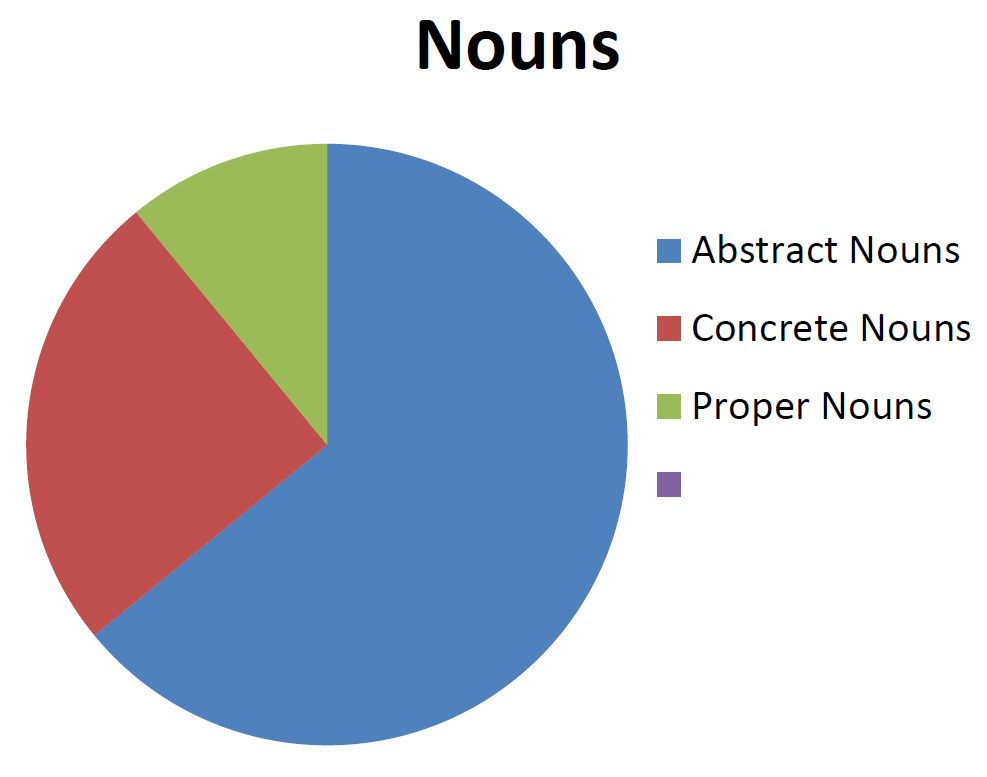
Nouns: The employment of abstract words by commentators to describe ideas, thoughts, feelings, traits, and events—such as "chance of defeat," "penalty," "fault," and "final"—“Foul” is common. Additionally, they focused heavily on employing proper nouns that refer to persons and locations as the names of their top players (Messi, Mbappé, etc.). Locations resembling nations (Moscow, Russia, France)
Abstract nouns
81
39.71%
Concrete nouns
39
19.12%
Proper nouns
84
41.18%
Total
204
100%
Adjectives
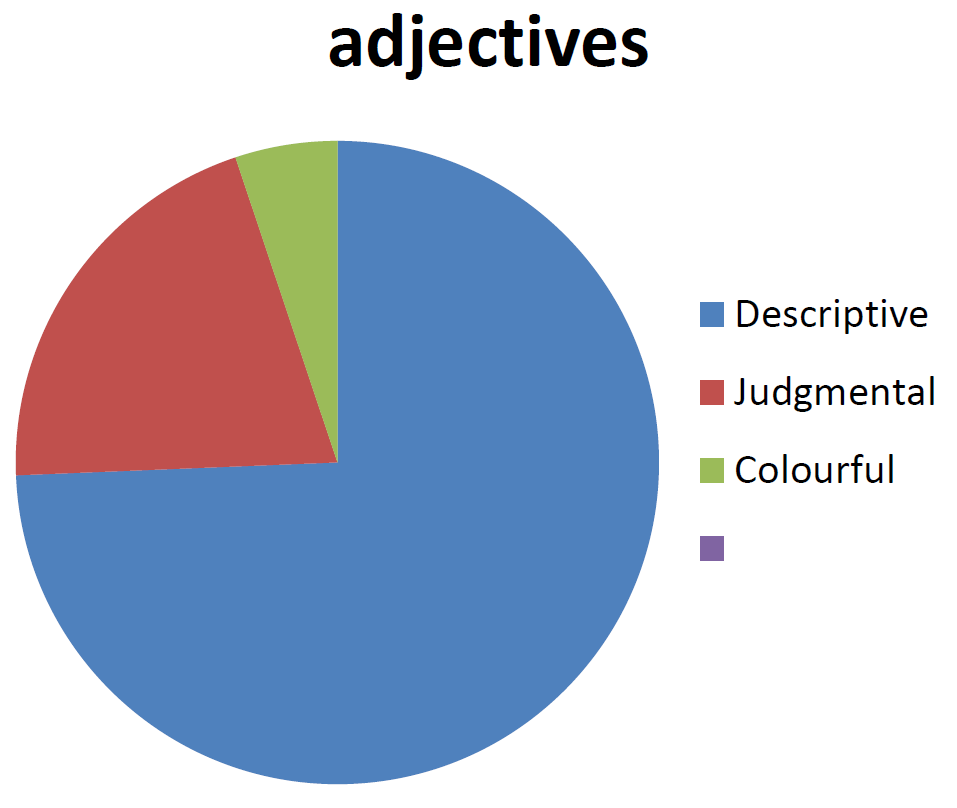
Commentators in the world of football frequentlyuse specific adjectives to describe the game. They also make extensive use of descriptivejudgmental, colorful adjectives:
أنتعجيبياولدي,حلم عربي جدبد , فتكبحلمالسودفيأهدافك. ضحىالسودفيانتصارذاتك, حمراءشكلاورقةحمرا)
)Historical scorer, Great positioning, Serious accidental hard, offside, Forward, hard, long, cross , serious, red, it seems a red card,Kill the Black Dream by your goals. Blacks sacrificed in yourself-victory, you are amazing, my boy, a new Arab dream)
Descriptive adjectives
58
74.36%
Judgmental adjectives
16
20.51%
Colorful adjectives
4
5.13%
Total
78
100%
Verbs
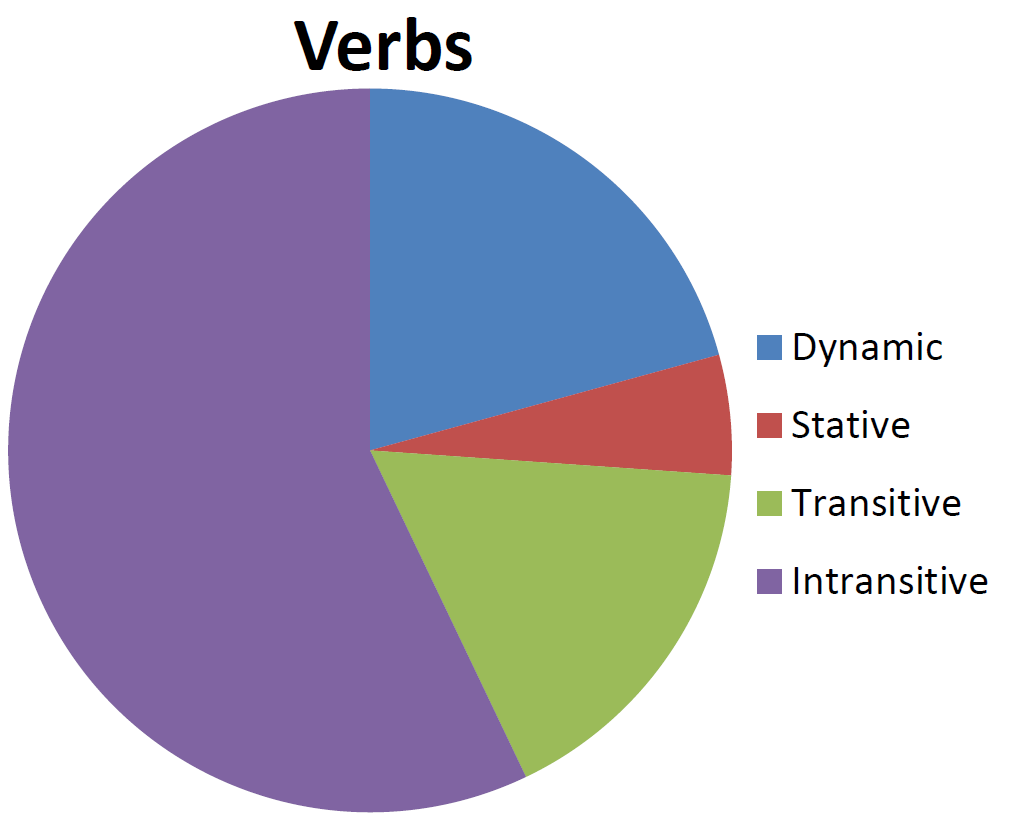
Commentators used many dynamics, Transitive verbs more than intransitive and stative verbs as (recorded – scored – lose – Perform- try-excel- send – receive- give- play- move)
Dynamic
58
43.61%
Stative
15
11.28%
Transitive
47
35.34%
Intransitive
13
9.77%
Total
133
100%
Adverbs
Commentators frequently utilize adverbs that are specific to the place and manner in which an event is taking place: (Now – Here – There – quickly – skillfully)
Figure 1: Nouns
Figure 2: Adjectives
Figure 3: Verbs
Grammatical Categories
Types of Sentences: Generally, commentators spoke in short, declarative sentences.They didn't utilize a lot of questions or commands. They depended more on independent clauses
فرنسافازتفيطريقهالكأسالعالمعلىالدانمارك
France won on their way to the World Cup over Denmark..
سجلالمدافعتورامفيالنصفالنهائيعلىالكرواتفيالفينوثمانيةعشرالهدففينصفنهائيالمونديالعلىبلجيكا In 2018,defender Turam scored in the semi-final over the Croatsin the semi-final of the World Cup against Belgium
Father and son are world champions, but Messi deprived Marcos of this achievement
هجمةمرتدةولكنكرةضائعة
A counterattack but a missed ball
Here, coordination and subordination were employed to demonstrate the coherence and connections of the ideas.
Ellipses
Commentators regularly used ellipses.Football is sometimes used in a non-leisurely and energetic manner by commentators, adhering to certain guidelines of simplicity:
(He)Hits the goal) omission of the subject)يضرب الكرة
Portugal(plays)on the right (Omission of the verb) البرتغالفيالجهةاليمنى
Cristiano Ronaldo is warming up and the player Ricardo Honda, (is warming up) too.
And again dangerousومرة اخرى خطيرة
Argentine againأرجنتينيةمرةأخرى
The usage of ellipsis in this context refers to the removal of agent and predicate elements) subject/verb) (The ball is dangerous again)- (The ball isargentine again)
The whistle and a foul onSufyan) omission of the verb)الصافرة و خطأ على سفيان
Ramos, four international matches, four goals.راموساربعةمبارياتدوليةاربعةاهداف
The omission of the verbs (played) and (recorded): Ramos played four international matches, recorded four goals
Commentators frequently speak in a condensed manner to cut down on repetition. The emphasis is shifted from the action to the agent when predicate or action verbs are dropped
Verbless Sentences
Commentators employed a string of words without a verb:
Here at the top of the champions, here at the land of dreams(Declarative verblesssentences)
هنافيقمةالكبار،هنافي أرضالأحلام
A ball in the goal.(Declarative verbless sentence)كرةفيالشباك
On the goal of the giant Mariano Martinez.(Declarative verbless sentence)
علىمرمىالعملاقماريانومارتينيز.
Figures of Speech
Repetition: According to Adams (1997: p. 114), anaphora. It refers to the "repetition of a word or phrase in an initial position". To create a sort of emphasis on their concept, commentators employed anaphoric repetition of sentences:
You are in the Mormons. You are in the bourbonأنتمفيالمورمون. أنتمفيالبوربون
Here at the top of the champions, here at the land of dreams
هنافيقمةالكبار،هنافيأرضالأحلام
Today, got creative, today they flewاليومابدعوااليومطاروا
You're amazing, my boy. You're historical, my boy. You are a legend
أنتعجيبياولدي. أنتالتاريخيياولدي. أنتأسطورة
In order to reach advanced roles in this tournament and in order to cross from reality todreams
Finally Luck smiled at you, Missyأخيراابتسملكالحظياميسي
This statement contains a personification and a metaphor. The commenter compares (luck) to a happy person.
Beating the drums of the ballيضربطبولالكورة
The commentator refers to the ball in this case as a drum.
Lions of the Atlas are looking forward to continue the journey
أسودالأطلسيبحثونعنمواصلةالمشوار
The commentator here refers to to Morocco team as the "lions."
“Have you ever seen a scared lion?” عمركرأيتالسبعخائف
The commentator here refers to Morocco team as a "lion."
Cohesion and Coherence
The participants or contextual components, such as demonstratives, pronouns, definite articles, and adverbs, are examples of linguistic elements. This exquisite internal consistency of the commentary, achieved by employing anaphora, metaphors, and ellipses, defined the discourse's artistic shape.
CONCLUSION
Commentators used abstract terminology to describe concepts, feelings, ideas, characteristics, and occurrences. They focused more on using proper nouns instead of common and collective nouns.
It appears that football commentators commonly use specific adjectives to describe the game. Moreover, they frequently employ a plethora of vivid, evaluative, and descriptive adjectives.Commentators employed more dynamic and transitive verbs compared to intransitive and stative verbs.
Commentators typically used brief, declarative words when speaking. They didn't use many directives or inquiries. Their reliance on independent clauses is greater. Commentators occasionally used complicated clauses, which switch between independent and dependent clauses.Commentators frequently employ coordinators and subordinators. They often make use of these linguistic devices.
Ellipses were frequently employed by commentators. They occasionally employ football in an intense and non-leisurely way while sticking to a few basic rules. They usually speak quickly to avoid repeating themselves.Furthermore, commentators often used verbless sentences as a crucial element of spoken language grammar.
Commentators' remarks bear witness to their extraordinary proficiency in employing anaphoric repetitions to accentuate their ideas.
The remarkable internal coherence of the commentary, achieved through the use of ellipses, repetition, metaphors, and anaphora, undoubtedly established the aesthetic form of the discourse.Linguistic elements include participants or contextual elements. This encompasses adverbs, definite articles, demonstratives, and pronouns.
The study came to the conclusion that Arab commentators employ a range of language devices. Their use of distinctive vocabulary structures and rhetorical devices captivates and maintains the attention of the audience.
REFERENCE
Lyons, J. Language and Linguistics. Cambridge University Press, 1981.
Abou Bakr, G.H. “The Language of Football Commentaries in British English and Egyptian Arabic: A Contrastive Study.” Egyptian Journal of English Language and Literature Studies, vol. 11, no. 1, 2022, pp. 181–212.
Humpolík, R. Language of Football Commentators: An Analysis of Live English Football Commentary and Its Types. Unpublished bachelor’s diploma thesis, Masaryk University, 2014.
Crystal, D., and D. Davy. Investigating English Style. Routledge, 1969.
Ferguson, C.A. “Sports Announcer Talk: Syntactic Aspects of Register Variation.” Language in Society, 1983.
Chovanec, J. “Simulation of Spoken Interaction in Written Online Media Texts.” 2009.
Widdowson, H.G. Stylistics and the Teaching of Literature. Longman, 1975.
Betti, M.J. Stylistics. University of Thi-Qar, 2021.
Recommended Articles
Research Article
Knowledge of the Patient's Family about the Level of Emergency Based on Triage with the Satisfaction of the Patient's Family in the Emergency Department of the Sumedang Area General Hospital
Roganda Situmorang,
...
Raida Rihadatul Aisyi
Published: 30/03/2024
Download PDF
Research Article
The Influence of Murottal Al Qur'an Surat Ar Rahman Irama Hijaz Therapy on the Pain Scale of Post-Explorative Laparatomy Patients in the Icu Room of Bandung City Hospital
Andri Nurmansyah,
...
Fifi Siti Fauziah Yani
Published: 30/03/2024
Download PDF
Case Report
Oculomotor Nerve Palsy in Herpes Zoster Ophthalmicus
Kritika Katoch,
...
Kavita Poonia
Published: 30/07/2024
Download PDF
Research Article
The role of IFN-g gene polymorphism (+874 T/A) as predisposing factor for pulmonary tuberculosis
Download PDF
PO Box 101, Nakuru
Kenya.
Email: office@iarconsortium.org
Editorial Office:
J.L Bhavan, Near Radison Blu Hotel,
Jalukbari, Guwahati-India
Riyadhlazim, O. (2023). Stylistic Analysis of the Language of Arabic Football Commentary. Scientific Research Journal of Clinical and Medical Sciences, 3(2), 1-6.
MLA
Riyadhlazim, Osamah. "Stylistic Analysis of the Language of Arabic Football Commentary." Scientific Research Journal of Clinical and Medical Sciences 3.2 (2023): 1-6.
Chicago
Riyadhlazim, Osamah. "Stylistic Analysis of the Language of Arabic Football Commentary." Scientific Research Journal of Clinical and Medical Sciences 3, no. 2 (2023): 1-6.
Harvard
Riyadhlazim, O. (2023) 'Stylistic Analysis of the Language of Arabic Football Commentary' Scientific Research Journal of Clinical and Medical Sciences 3(2), pp. 1-6.
Vancouver
Riyadhlazim O. Stylistic Analysis of the Language of Arabic Football Commentary. Scientific Research Journal of Clinical and Medical Sciences. 2023 Jul;3(2):1-6.



 Download PDF
 Download XML