The authors describe two cases of patients suffering from an abdominal wound caused by a stab weapon, with intestinal evisceration. Intestinal evisceration due to the mechanism of blunt injury is very rare, but whereas evisceration of abdominal organs through the abdominal wall is a relatively common event in adults after a cutting injury. In the first case we have the description of a man victim of multiple stab wounds, with evisceration of the transverse colon along the lower edge of the left shoulder blade. In the second case we have the description of a woman victim of attempted femicide, with extensive abdominal wound from a stab weapon, with evisceration of the small intestine. In both cases, an emergency exploratory laparotomy was indicated, due to intestinal evisceration with extensive trauma to the abdominal wall associated with the patients’ hemodynamic condition.
Keywords
Penetrating Abdominal Injuries
Stab Wounds
Eviscerated Bowels
Wounds and Injuries
Case Report
INTRODUCTION
Intestinal evisceration due to the mechanism of blunt injury is very rare, with an approximate prevalence of 0.2 - 1% of cases, whereas evisceration of abdominal organs through the abdominal wall is a relatively common event in adults after a cutting injury. Unlike blunt trauma where intestinal evisceration may occur through the vagina, anus, or into the pleural space, in cutting trauma the evisceration is associated with the site of injury [1].
Case Presentation
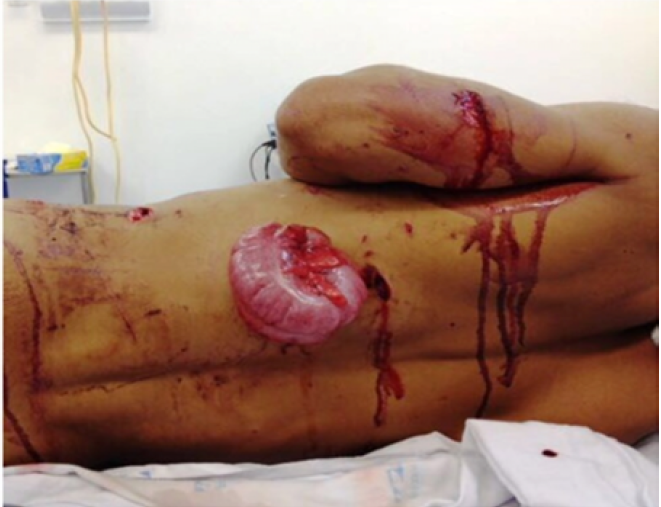
Case 1: A 24-year-old male patient, illicit drug user, with Acquired Immunodeficiency Syndrome, who was intoxicated at the time of treatment, was admitted to the Emergency Department with multiple blunt wounds on the trunk and limbs, with segmental evisceration of the transverse colon in the left dorsal region (Figure 1). He presented with hypovolemic shock, confused, aggressive and dyspneic. The presence of a hemopneumothorax was verified and chest drainage was performed using a water seal in the emergency room. The patient was taken to the operating room, where a digital reduction of the eviscerated colonic segment was performed, followed by an exploratory laparotomy, which showed a lesion in the posterior wall of the stomach, transverse mesocolon and segments of the proximal jejunum. Hemostasis of bleeding in the transverse mesocolon, gastrorrhaphy and enterorraphy were performed. At the end of the main procedure, skin sutures were performed. The patient had a satisfactory clinical evolution, escaping from the hospital on the 10th day of the postoperative period.
Figure 1: Evisceration of a Segment of the Transverse Colon in a Dorsal Lesion
Case 2
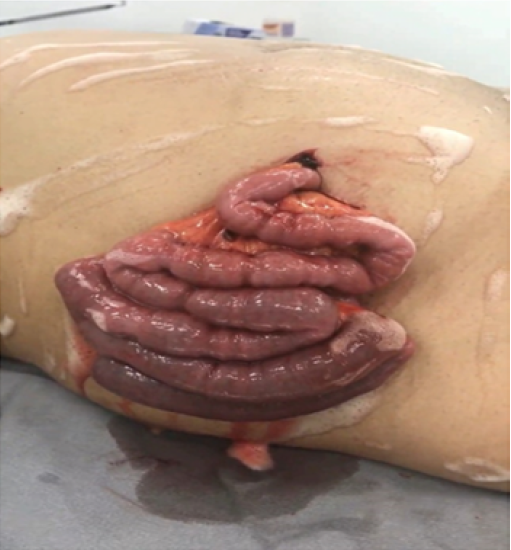
Female patient, 38 years old, admitted to the Emergency Department with a large jejunoileal evisceration, secondary to an attempted feminicide with an extensive sharp wound in the region of the right iliac fossa (Figure 2).
She was hemodynamically stable despite the severity of the injury. Laboratory tests showed no significant changes. She underwent median exploratory laparotomy with reduction of the eviscerated content and a large defect was found in the abdominal wall, through which the evisceration of the small intestine was produced. There were multiple injuries to the ileocolic mesentery, perforation of the distal ileum and intraperitoneal bladder. Mesenteric bleeding was controlled, followed by enterorrhaphy and cystorrhaphy. The traumatic blunt injury was closed by layers, requiring the interposition of a polypropylene mesh to reinforce the abdominal wall, despite the intestinal perforation. The patient had a satisfactory clinical evolution in the postoperative period, being discharged from the hospital in 7 days.
Figure 2: Extensive Evisceration of the Small Intestine by the Abdominal Injury
Ethics Statement
We conducted this study in compliance with the principles of the Declaration of Helsinki. The study’s protocol was reviewed and approved by the Institutional Review Board of General Hospital at the Valley of Parayba - Brazil (No. 0014/12-2023). Written informed consent for publication of the research details and clinical images was obtained from the patient.
DISCUSSION
The main mechanism that determines the injury is high-energy trauma against a cutting surface that causes laceration in all planes of the abdominal wall with muscle damage, aponeurotic exposure and exteriorization of abdominal contents, a condition that requires immediate surgical intervention for treatment. Traumatic abdominal evisceration is a rare injury, with a prevalence of 1 in 40,000 polytrauma patients [2,3].
Traumatic herniation of the abdominal viscera results from a simultaneous increase in abdominal pressure and the presence of shear forces that synergistically disrupt the various layers of the abdominal wall [4]. They are classified into three main types:
A small defect in the abdominal wall caused by low-energy trauma with small instruments, for example, bicycle handlebars
A larger defect in the abdominal wall caused by high energy
Rarely, intra-peritoneal hernia of bowel caused by deceleration injuries [5]
Most instances of eviscerations found in trauma are due to abdominal stab wounds, which usually require laparotomy [1]. In traumatic hernias of the abdominal wall, primary closure of the lesion is not always possible, as there is not adequate tissue to perform it. Primary closure in these situations can result in excessive tissue tension with consequent ischemia and repair failure and its reconstruction requires a multidisciplinary approach, sometimes with the use of a synthetic prosthesis [6].
Penetrating or blunt trauma or a combination of both can eviscerate intra-abdominal organs through the abdominal wall. Immediate resuscitation is the first line of treatment. It is essential to establish whether the eviscerated organ is viable. In the presence of ischemia secondary to vascular compromise, it is essential to widen the wound in the abdominal wall to ensure adequate perfusion of the eviscerated organs, if there is local vascular strangulation [5]. The most common causes of penetrating abdominal injuries faced by the trauma surgeon are stab wounds, gunshot wounds [7,8] and industrial accidents [7]. The most commonly eviscerated organs were small bowel (70%), large bowel (26%) and stomach 3% [9]. Patients with isolated omental evisceration with benign abdomen, the eviscerated omentum can safely be amputated, reduced back to peritoneal cavity and abdominal stab wound closed and observed [9,10]. However, with bowels evisceration, laparotomy is warranted [10].
Evisceration of abdominal organs through the abdominal wall is a relatively common event in adults after a penetrating injury. Evisceration due to blunt trauma is far less common and has been reported through the abdominal wall, vagina, anus and diaphragm [1]. Most instances of eviscerations encountered in trauma are caused by abdominal stab wound injuries, which generally require laparotomy [1]. A negative laparotomy occurred only in 5.7% patients with organ evisceration. There has been controversy about performing a full laparotomy or just reduction of the herniated organs and closure of the abdominal wall defect under local anaesthesia. Emergency laparotomy should be done in evisceration of both omentum and organ and in suspected cases of peritonitis [6,10]. Prognosis of intraperitoneal injuries depends on extent of trauma, time of presentation, intestinal contents peritoneal cavity contamination, haemorrhage, wide spectrum of organ injury, female sex [8], accompanying brain trauma, or bleeding disorders increases the rate mortality [7].
CONCLUSION
It is widely accepted that a patient with open abdominal trauma associated with intestinal evisceration and hemodynamically unstable or with signs of peritonitis should be immediately taken to the operating room for exploratory laparotomy. Evisceration of organs and omentum are seen as the types of trauma with the highest risk of injury to intestinal viscera. Consequently, emergency surgery has been advocated in all patients with intestinal evisceration.
REFERENCES
Nagy, K. et al. “Evisceration after abdominal stab wounds: Is laparotomy required?” Journal of Trauma, vol. 47, 1999, pp. 622–624.
Hardcastle, T.C. et al. “Evisceration from Blunt Trauma in Adults: An Unusual Injury Pattern: Three Cases and a Literature Review.” Scandinavian Journal of Trauma, Resuscitation and Emergency Medicine, vol. 13, 2005, pp. 234–235.
Jiménez Gómez, M. et al. “Evisceración abdominal traumática: reconstrucción de pared abdominal con malla biológica y terapia de presión negativa.” Cirugía Pediátrica, vol. 29, no. 2, 2016, pp. 89–92.
Henrotay, J. et al. “Traumatic abdominal wall hernia: Case report and review of the literature.” Acta Chirurgica Belgica, vol. 110, 2010, pp. 471–474.
Singal, R. et al. “Traumatic anterior abdominal wall hernia: A report of three rare cases.” Journal of Emergencies, Trauma and Shock, vol. 4, 2011, pp. 142–145.
Breuning, K. et al. “Incisional ventral hernias: review of the literature and recommendations regarding the grading and technique of repair.” Surgery, vol. 148, no. 3, 2010, pp. 544–558.
Saran, L. “Penetrating abdominal trauma.” StatPearls, StatPearls Publishing, 2020, National Center for Biotechnology Information.
Kong, V.Y. et al. “Selective nonoperative management of abdominal stab wounds with isolated omental evisceration is safe: A south African experience.” Scandinavian Journal of Surgery, vol. 110, no. 2, 2021, pp. 214–221.
da Silva, M. et al. “Evisceration following abdominal stab wounds: Analysis of sixty-six cases.” World Journal of Surgery, vol. 33, 2009, pp. 215–219.
Recommended Articles
Research Article
Advantages of Two Clips Laparoscopic Cholecystectomy (TCLC) and Conventional Laparoscopic Cholecystectomy (CLC): A Comparative Study
Anshu Attri,
...
Kartik Syal
Published: 10/01/2022
Download PDF
Research Article
Bladder Brilliance: Unveiling the Tapestry of Knowledge on Bladder Cancer in District Kangra, Himachal Pradesh
Vandana Thakur,
...
Ankita Pandey
Published: 08/12/2023
Download PDF
Research Article
A Gentle Start: Evaluating Knowledge of Erb’s Palsy and Brachial Plexus Injuries AmongHamirpur Residents
Vishal Dhatwalia,
Swati Chandel
Published: 24/12/2024
Download PDF
Research Article
Shouldering the Pain: Public Knowledge Assessment of Rotator Cuff Injuries in Himachal Pradesh
Sidhant Korla,
...
Praveen Kumar Thakur
Published: 30/07/2024
Download PDF
PO Box 101, Nakuru
Kenya.
Email: office@iarconsortium.org
Editorial Office:
J.L Bhavan, Near Radison Blu Hotel,
Jalukbari, Guwahati-India
Salles, V. J. A., Chamizo, A. L. G., Figueiredo, F. P., Rodrigues, L. D., Freires, T. S., Rodrigues, M. D. S. & Alegre Salles, I. S. D. A. (2024). Intestinal Evisceration Secondary to Abdominal Injury by Stab Weapon. International Academic Research Journal of Surgery, 4(1), 1-3.
MLA
Salles, Valdemir J. A., et al. "Intestinal Evisceration Secondary to Abdominal Injury by Stab Weapon." International Academic Research Journal of Surgery 4.1 (2024): 1-3.
Chicago
Salles, Valdemir J. A., Ana L. G. Chamizo, Fernanda P. Figueiredo, Laura D. Rodrigues, Thabata S. Freires, Milena D. S. Rodrigues and Isabela Simões D. A. Alegre Salles. "Intestinal Evisceration Secondary to Abdominal Injury by Stab Weapon." International Academic Research Journal of Surgery 4, no. 1 (2024): 1-3.
Harvard
Salles, V. J. A., Chamizo, A. L. G., Figueiredo, F. P., Rodrigues, L. D., Freires, T. S., Rodrigues, M. D. S. and Alegre Salles, I. S. D. A. (2024) 'Intestinal Evisceration Secondary to Abdominal Injury by Stab Weapon' International Academic Research Journal of Surgery 4(1), pp. 1-3.
Vancouver
Salles VJA, Chamizo ALG, Figueiredo FP, Rodrigues LD, Freires TS, Rodrigues MDS, Alegre Salles ISDA. Intestinal Evisceration Secondary to Abdominal Injury by Stab Weapon. International Academic Research Journal of Surgery. 2024 Jan;4(1):1-3.


 Download PDF
 Download XML