Lontar with that contents is one of the ancestral heritage of our ancestors which necessary to protect and preserve, therefore the digitization of lontar should be done in a conscious and real way. In this case, a rational interests consideration in using technological sophistication to achieve goals is also accompanied by strategies. Technological advances can be useful to save damaged lontars. Thus, the literature contained in the lontar consist of teachings and guidance of past lives can be saved. Digitization technology is important to do in case the lontar is lost due to natural and human factors, there are already copies stored on the media, either in the form of hard disks, CDs (compact discs), flash disks, or stored in cyberspace. Thus, the copy can be quickly accessed and found. This study employed a qualitative research with rational action theory. According to Weber, rational action is related to conscious considerations and choices that the action is declared. It means consciously digitizing as the effort of preservation.
Keywords
Digitalization
Lontar
Preservation
INTRODUCTION
The digitization of lontar is carried out consciously and clearly. In this case, rational interests’ consideration in using technological sophistication to achieve goals, in addition accompanied by strategies to achieve these goals. Technological advances can be useful to save the damaged lontars. Thus, useful literature can be saved. The role of digitizing lontar is very positive for its stability and preservation of culture in the field of Balinese literature, especially related to the national development of the preservation of the lontar [1]. Digitization is one way of preservation, because lontar come from nature whose age cannot be predicted. In fact, if the maintenance of this lontar is good, it can live up to four hundred years and some can go beyond that. If the process of making palm leaves is not good, the age of the script will not last long. This is where the role of digitizing the lontar is to save the lontar from some damage. With the digitization of the contents, it is hoped that the contents will be preserved and can be copied again even though the lontar is physically damaged [2-3]. One of the considerations for digitizing lontar is if the owner of the lontar has died, the lontar can be inherited or learned by posterity. Religious literature in the form of lontar, is the result of literary works containing Hindu religious teachings [4-5]. Therefore, these literatures require good maintenance so that they are not easily damaged, rotted or possibly sold to people who are not interested in preserving the lontar.Therefore, the importance of the existence of lontar among the Hindu community in studying and deepening religious teachings needs to be preserved and developed in the exploration of lontar that has not been explored.
One of the institutions that carry out this digitization is the Lontar Study Center starting from 2014 until now and continues from year to year. Institutions that carry out digitization for preservation as a work program for digitizing lontar at the Center for Lontar Studies at Udayana University to this day are carried out regularly. Regarding the schedule that is arranged every month, it is adjusted to the activities of the Lontar Study Center agenda. For now, there are two hundred titles of lontar manuscripts that have been digitized. The sources or lontars in the first Lontar Study Center at Udayana University are mostly collections of re-copying in 1958 when the Faculty of Letters was formed. This was adjusted to history in the form of a literary box will, so that some of the lontars which were considered or considered important in their time, were copied by elders. The first digitalized lontar copying project was carried out in 2014. At that time, two lontars were digitized. the two lontars are community lontars, and have been purchased by Udayana University and become the library collection of Udayana University. Agencies that are invited to cooperate, especially for the storage of lontar, which means that the lontar from the agency is brought to the Lontar Study Center, Udayana University for digitization. In this case, it has been carried out with Gianyar Regency, in addition, from 2017 to 2018 digitalization activities have been carried out to the public. Thus, the lontar collection that has been digitized at the Udayana University Lontar Study Center totals three hundred titles. With the digitization of the lontar, the importance of saving and preserving the lontar manuscript is very necessary, especially so that it can be read by the millennial group as a cultural heritage for the younger generation [6]. The content of the text contained in the lontar is very important to know which contains the thoughts and ideals of the ancestors in ancient times as religious, cultural and knowledge guidelines.
MATERIALS AND METHODS
This research employed qualitative research that uses rational action theory. According to Weber, rational action is related to conscious consideration and choice that the action is declared to digitize so that the lontar can be preserved. Starting from the choice that is considered with the human ratio and then followed up with real action. Weber distinguishes human social actions, such as acts of instrumental rationality (zwerk rational). This action is a social action that is carried out by a person based on conscious considerations and choices related to the purpose of the action and the availability of the tools used to achieve it. These considerations include pursuing rational interests, using advanced technology to achieve goals, and having strategies to achieve goals [7].
Coleman developed the theory of rational action, namely the theory of rational choice which states that individual actions lead to a goal and that goal (also action) is determined by values or choices. Each person/actor each aims to maximize the realization of interests that give characteristics of interdependence or systemic characteristics to their actions[8].
RESULTS
Ideological Considerations of the Lontar Digitalization
An old lontar and damaged by rodents and has weathered is left alone by the owner [9]. So, there are concerns about the loss of the value of lontar which cannot be passed on to our children and grandchildren later and therefore needs to be preserved. Saving the lontar is a teaching that explains a state of truth, especially the structure of ideological power so that people consider it valid. In de Tracy's formulation, ideology is expected to become a branch of science that aims to study and discover the laws that underlie the formation and development of ideas in society so that later these ideas can be explained rationally, free from prejudice. Lontar needs to be preserved because it contains ideological teachings that reflect the life of the Balinese people. Lontar needs to be maintained so that it is not lost and swallowed by the times by natural and human factors, so it is necessary to digitize it. As for the function of preserving the lontar so that its existence remains sustainable, if the lontar is left alone, weathering will occur and the lontar will be damaged. There is concern about the lontar being lost or destroyed due to weathering, it needs to be saved and preserved so that it is maintained by time and age. This ideological basis is pinned so that the lontar can be passed on to the next generation. In line with that, conservation of lontar palms is required as written by Ida Bagus Rai Putra et al, in a book entitled Lontar Conservation Standards Manual. Lontar as a manuscript is produced through direct human activity to express the results of his thoughts that contain important knowledge in it. To maintain the important content about the value of life, the written media is very important to be cared for and protected. Palm leaves as natural writing media are very susceptible to damage if not treated properly. Preservation activities are carried out with the aim that palm leaves can live long. That is, the palm leaf is free from its enemies, namely fragility and insects or microorganisms. The lontar manuscript is written using a writing knife called a pangrupak. The scratches are then given black dye which usually comes from natural ingredients of roasted candlenut so that the writing can be read. In addition to preservation, lontar manuscripts also require good storage methods to maintain their durability.
To save the lontar, it is also necessary to digitize it. This was conveyed by Ida Bagus Rai Putra, Head of the Lontar Study Center. Ida Bagus Rai Putra said that a strategy was needed that could save the lontar manuscripts from becoming nostalgic for knowledge in memory. This can be seen in the following quote.
“Kone I maluan taen ngelah pekak, kumpi nyastra, kasub kadi ke dura desa dueg sakti ulian melajahin lontar. Jani awake tara kepetengan tastra Bali tusing baninin, macane takutin”.
It Means
"It is said that in the past they had people whose elders (ancestors) were clever (nyastra) because they studied Balinese sciences (lontar) which were great and famous outside the region, but now they are the heirs and continuation of the family who are stupid and afraid to read Balinese script".
The reason for digitizing the lontar is as an effort to save and preserve the culture contained in the religion, culture, and knowledge (Balinese sciences) written in the lontar. The lontar contains various recordings, traces of thought, and Balinese civilization," said Sugi Lanus, who is the founder of the Hanacaraka association to BBC Indonesia, Tuesday (26/09). The basic reason for saving the lontar was also conveyed by Mr. I Gusti Ketut Dalem. The teachings on how to live life, think well, say good, do good so that harmonization of life is realized, which is often called Satyam Siwam Sundaram, is usually a reflection of life contained in lontar
From the excerpt of the interview with Mr. I Gusti Ketut Dalem lontar reflects the life of the Balinese people about the teachings of Satyam Sivam Sundaram which contains about how to think, speak until actions occur. Thinking, speaking and acting that are integrated and united in the dharma of truth really need to be cultivated at all times. Controlling these three things is carrying out the obligation to seek the true truth. Trying always to live in harmony in both thought, speech, and behavior is a daily virtue knowledge. The basis for living this life was poured out by our ancestors in lontar writings that are interconnected with one another. Rua bhineda are two different things that we always experience in our present and future lives. One of the patterns of life that also colors the lifestyle that is expressed in the expression of Satyam Siwam Sundaram should be used as a mirror in this life. Satyam is truth. Siwam is holiness. Sundaram is beauty. Mixing in the right composition to realize Satyam Siwam Sundaram in the daily habits of living in Balinese society is very necessary. Efforts to realize truth, holiness, and beauty are very useful for all of us. Thinking, speaking, and doing good in trying to achieve truth, holiness, and beauty make daily habitual lifestyle.
The Technique of Lontar Digitalization
The digitization of lontar is done by transferring information media of various types of media using various tools such as recorders. The simplest process is to use the help of a recording device (scanner) or a digital camera.
According to Chowdury [10], the digitization process is as follows.
Digitization is the process of taking a physical item, such as a book, manuscript or photograph, and making a digital copy of it. Digitization entails creating a digital copy of an analogue object.
Digitization is the process of converting all physical or analogue forms into digital form so that they can be processed directly using a computer. A more complete definition is expressed by [11] viz.
“The converting of a printed page to digital electronic form through scanning to create anelectronic page image suitable for computer storage, retrieval and transmission”.
Broadly speaking, it can be interpreted that digitization is the p Xrocess of converting printed form into electronic form through scanning to create electronic pages that are suitable for storage and rediscovered by computer transmission.
Mr. Guna Yasa also conveyed the technique of digitizing lontar palms as follows.
“Digitalization of lontar is a creative effort to save lontar manuscripts through lontar photos so that there is a transfer of media from physical lontar manuscripts to digital lontar manuscripts.
Because the process of transitioning media from physical lontar into digital form is then it becomes digitization. The suffix “ization” indicates a real process in it, namely the process of taking photos of the lontar so that we get a file in digital form. For that reason, the name became the digitalization of lontar”.
The digitization process converts physical form into digital form. The digitization process can be carried out on various forms of lontar ancient manuscript library materials. The digitization process for very old lontar manuscripts can be done with cameras, scans, and computer devices. The advantage of digital forms compared to other forms of media is that digital information contributes to a large part of the enhancement of the nation's cultural and intellectual heritage and provides important benefits for its users. The ability to generate, delete and copy information in digital form, search for text and databases, and send information quickly through network systems has created a remarkable development in digital technology. Digitizing is a digital process, namely diverting information media from various types of media. Digitization can be done using a variety of recording devices. The simplest process is to use the help of a recording device (scanner) or digital camera to produce electronic images (bitmap images). Image quality is highly dependent on the number of dots recorded by the scanner. Another factor that determines the quality of images in digital form is the type of recording device used which is able to optimally record all the details of the original physical image [12].
The Conservation Process of Lontar Scripts
The process of conservation of lontar manuscripts means cleaning of lontar manuscripts on lontar which are damaged and unreadable. Conservation is carried out especially for lontar which are old, and lontar which are weathered and damaged. In this process the papyrus script is cleaned so that it can be read. The first process, namely the cleaning of the lontar so that the letters or scripts of the lontar script that will be digitized are clearly visible. Please note that this process is conservation. Conservation is the process of preserving, cleaning, and blackening the writings of the letters in lontar using natural ingredients such as citronella oil, 95% alcohol, and candlenut. Digitization is preceded by a conservation process so that the writing or characters are clearly visible.
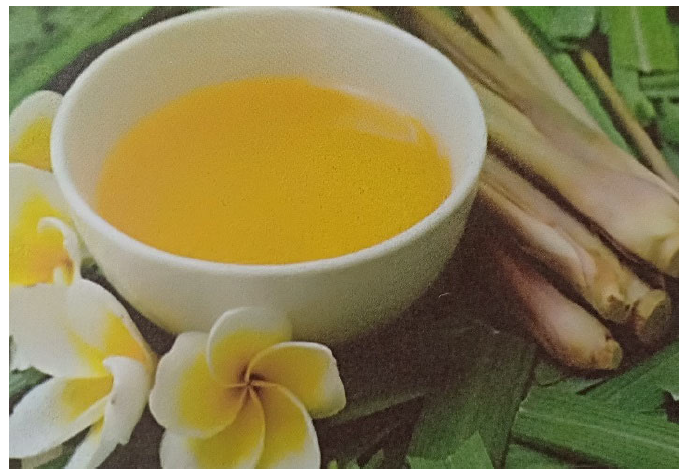
Citronella oil is made from fragrances and lemongrass by going through a distillation process. The function of citronella oil is to remove dirt attached to the lontar so that it can clarify the characters on the lontar. Alcohol is used to clean lontars caused by rodents, such as cockroaches, lontars eaten by termites, and flecks of lizard egg droppings on lontar palms. The conservation or cleaning materials for lontar consist of candlenut oil, a brush, and a soft microfibre cloth. The lontar cleaning is done with a brush, a soft cloth (microfibre), and alcohol. Its main function is to clean the dirt on the lontar so that when taking pictures the characters are clearly visible on the lontar.
Figure 1: Lemongrass Oil Conservative Ingredients
Sources: Lontar Study Center Udayana, 2019
Figure 2: Lontar Conservation or Cleanup Stage
Documentation: Lontar Study Center Udayana, 2019
The lontar conservation stage or lontar cleaning is carried out in one direction to maintain the condition of the lontar and maximize the conservation of the lontar. The stages of lontar conservation or lontar cleaning are carried out per team so that they can be completed quickly and produce maximum images after being digitized. The stages of lontar conservation are sorting the pages, identifying the type and title of the lontar manuscript. The stage of lontar conservation is cleaning the remaining alcohol or lemongrass oil mixture using a soft cloth or microfibre. At this stage, extra candlenut or hazelnut seed charcoal is applied evenly using a soft cloth or microfibre in a unidirectional motion.
In the Manual of Lontar Conservation Standards by Ida Bagus Rai Putra, et al. [13] it is stated that conservation measures are divided into three agreed stages in the focus group discussion (FGD) of lontar conservation research. These steps are
The step of cleaning the lontar manuscripts is carried out if the condition of the manuscript has not been cleaned for a long time or is dusty, even moldy
Steps to preserve lontar manuscripts, namely ways to protect lontar manuscripts from attacks or rodents
The step of blackening the lontar manuscript is carried out specifically on the lontar script whose writing is unclear or blurry because it has never been touched or treated for a long period of time. These three conservation steps become standard operating procedures for anyone who wants to carry out the stages of lontar conservation
Furthermore, Reland said that the digitization of lontar is related to a series of conservation or preservation and rescue of the lontar itself. First, to protect the lontar to be durable and avoid damage. Lontar is cleaned and preserved with preservatives. After that, it is digitized. Digitization is the media of lontar manuscripts in the form of lontars to photo and image media. Digitizing the lontar means cleaning or physically preserving the lontar so that the lontar lasts for a long time. In addition, efforts are also made to ensure that the lontar manuscripts are protected and preserved. Along with the development of technology, technology is used, namely in backing up the papyrus manuscript data. So, in addition to preserving the lontar manuscript, there is also a back up of softcopy data so that in the process of reading the lontar, for example, there is no need to directly take the lontar manuscript itself. The technical difficulty of the conservation for digitization is to change the lontar which can be processed in digital form. The length of time required in the digitization process depends on the number of pages of the papyrus manuscript. However, in terms of the number of photos, it doesn't take too much time. The important thing is that in the process one manuscript must be completed so that it can be made into one file or title. Furthermore, editing is done so that it is intact, namely the sequence of numbers is intact, and the title is also intact. In this case, everything is measured on a per sheet basis because at each process or stage, two papyrus manuscripts, pages a and b, are included, but they do not take up much time. The digitization of lontar is a series. The first step in digitizing the lontar is observation. Observation means, choosing the time to observe some manuscripts. Maybe in several manuscripts in one group, digitization was observed based on the title. After digitizing it is edited so that the results are clearer and readable. Next, copying the script, translating language, and transliterating the Balinese script into Latin script is carried out. On the other hand, language is transferring language from Old Javanese or Balinese to Indonesian, but actually it is not enough to end there. The activity usually proceeds to the copying stage. The copying of the lontar to the lontar script media which can be read and then copied to the lontar media by writing techniques or digital techniques.
The results of the interview show that before digitizing, it begins with lontar conservation. The conservation of lontar is very important so that the transfer process from the lontar media is clearly visible when it is converted into digital form. The maintenance of the activities of lontar manuscripts or ancient relics is often popularized with the term "conservation". The word "conservation" in the KKBI (Big Indonesian Dictionary) means the maintenance and protection of something on a regular basis to prevent damage and destruction by preserving it [14]. According to Rene and Wiranjaya manuscript conservation can be categorized into five things. Those five things are
Preventive conservation, namely direct or indirect action to optimize the condition of the manuscript or extend the life of the manuscript by building public awareness through professional training
Figure 3: Snapshot-Shooting Tool
Sources: Sudarsana, 2019
Figure 4: Lontar Image Processing Tool
Sources: Sudarsana, 2019
Figure 5: Throwing Constraints in a Damaged State
Sources: Lontar Study Center, Udayana
passive conservation, namely activities that are directly or indirectly related to the script to prolong life
Active conservation, namely actions that are directly related to the collection of manuscripts, such as covering manuscripts and cleaning manuscripts
Restoration, namely actions to extend the life of the manuscript by improving the appearance of the manuscript
Digitization, namely the act of making a copy of the manuscript based on digital technology
The Process of Taking Pictures
The process of taking pictures or photography (from English photography), is a process or method for producing an image or photo of an object by recording the reflection of light hitting the object on light-sensitive media. The most popular tool to capture this light is the camera. Without light, no photos can be made. According to some practitioners, photography is the art of seeing. Here it is not the subject of the work that is emphasized, but the way of "seeing" the subject that you want to capture into a meaningful photo. The types of cameras used for shooting ejection at the Center for Lontar Studies, Udayana University, are as follows.
Computer equipment, light bulbs, backround boards, high-resolution digital cameras, and numbering of lontar manuscripts are used to take pictures so that the resulting picture quality is good. The Canon 24-105 camera is used at the Lontar Study Center for digital image transfer. As one of the world's best standard zoom lenses, the Canon EF 24-105 mm f/4L is capable of producing sharp photos. After being conserved, the next process is taking pictures of lontar to be made into digital form by using a camera that is connected to a computer device as a data processor. The Center for Lontar Studies at Udayana University has several types of cameras used, one 600 D cannon and two 6 D camera cannons for taking pictures according to the physical condition of the lontar. So that the results obtained can be seen clearly, the camera used is not an ordinary camera, but a camera that has a function for six image dimensions and has a clear image quality output.
The Processing Of Image with Computer
The image processing process uses a backround board and a computer or laptop device. The specifications of this device are high and are used when processing images that have been set into a computer device and has also entered the realm of digitization which is carried out at the lontar study center. Digitization process in which photos are edited and packaged into DVD (digital video disc), VCD (video compact disc), JPG (joint photographic experts), PDF (portable document format). From the results of this digitized packaging, digital labels and titles of lontars are made to facilitate the process of checking the lontars that have been digitized. The main purpose of this process is to make lontar packaging in digital form as a medium that is used to store digitized results.
The image processing process carried out at the Udayana University Lontar Study Center as shown in the image above aims to produce digitization and is usually carried out by three people. First, operate the computer for image input. Second, the lontar script manager to find a good angle graphic photo engle. Third, give the numbering of the lontar manuscripts. The output of the ejection image is obtained after completing the stages of the image processing process, namely the computer will process the lontar image information from the computer input equipment. Furthermore, the results of the process in the form of information are displayed to computer users. Output equipment is very important because it will provide information directly to the user. Output devices are also a must in computer systems even though some of this computer output equipment are in the category of computer peripherals as additional devices. The final process is digitization. This result is obtained from the processing to digital form which is packaged into various video or image packages. When digitizing, the photos are processed on a computer or laptop and then packaged in videos and images. To avoid data loss, a copy is required. Therefore, the Lontar Study Center makes a backup of the data to the hard disk or to the storage memory. This procedure is carried out so that the accuracy of the data is maintained and the copy is still stored in accordance with the original.
The Lontar Study Center, Udayana University, Denpasar, in addition to digitizing at the Lontar Study Center, also digitizes in people's homes. The digitization of lontar is carried out in people's homes on the basis that the Lontar Study Center cares about the lontar manuscripts that need to be preserved. The digitization of lontars carried out at the Lontar Study Center, Udayana University from a technical point of view of facilities and infrastructure such as cameras, lighting, numbering, computers is sufficient. The obstacles that arise when digitizing lontar at home are the Udayana Lontar Study Center bringing various equipment for digitizing lontar.
The problem of damaged lontar was also conveyed by Mr. Widhi. Before digitizing is carried out, it is necessary to identify the manuscript and then check where the damage is, how severe the damage is, and what order the pages are in. If most of the sequence has been arranged, it can be digitized. Indeed, most of the page numbering of the papyrus which was damaged by termites was not sorted and until it came off and was scattered a lot, the digitization process was not immediately carried out. If there is such damage, the Lontar Study Center first repairs it with lontar conservation. After being repaired, it will be digitized so that the palm leaves are saved from termites and fungi. If the condition of the lontar is good after the conservation process is carried out, then the Lontar Study Center of Udayana University can immediately carry out the digitization process.
CONCLUSION
Based on the explanation above, it can be concluded as follows:
First, it was found that the old lontar palms in the community were damaged and left unattended by their owners, so that they were eaten by rodents such as cockroaches, moths, lizard egg shells, kalisasoan houses, and were weathered. Therefore lontar need to be preserved so as not to become extinct.
Second, it is important that digitalization technology is carried out with the aim that when the lontar is lost due to natural and human factors, there is already a copy stored on the media, either in the form of a hard disk, CD (compact disc), flash disk, or stored in cyberspace. Thus, the copy can be quickly accessed and found.
Third, the digitization of lontar at the Center for Lontar Studies, Udayana University, includes the following: Conservation cleans up lontar manuscripts so that damaged lontar manuscripts can be read. Shooting lontar or photography. This process aims to produce an image of an object or an object by recording the reflection of light hitting the object on a light-sensitive medium.
Image processing using a backround board and high-specification computer or laptop devices. At the time of processing the images that have been set into the digitization process are then taken, edited and packaged into DVD (digital video disc), VCD (video compact disc), JPG (joint photographic experts), and PDF (portable document format).
REFERENCES
Bint, K.A.S. Dekonstruksi sastra lontar di era globalisasi (perspektif kajian budaya). 2015.
Dian Sawitri, D.A. and N.K.S. Dharmawan. “Perlindungan transformasi karya cipta lontar dalam bentuk digitalisasi.” Acta Comitas, vol. 5, no. 2, 2020, pp. 298.
Ginting, R.T. et al. “Digitizing the Balinese lontar manuscript: A case study of Puri Kauhan Ubud, Bali.” Seventh International Conference of Asian Special Libraries (ICoASL 2021), November 2021, pp. 1–11.
Ardiyasa, I.N.S. “Eksistensi naskah lontar masyarakat Bali (studi kasus hasil pemetaan penuyuluh bahasa Bali tahun 2016–2018).” Kalangwan Jurnal Pendidikan Agama, Bahasa dan Sastra, vol. 11, no. 1, 2021, pp. 74.
Eka Suadnyana, I.B.P. and I.P. Ariyasa Darmawan. “Nilai pendidikan agama Hindu dalam lontar Siwa Sasana.” Cetta: Jurnal Ilmu Pendidikan, vol. 3, no. 2, 2020, pp. 371–391.
Sudarsana, I.M. “Digitalization of lontar, the millennials reading.” Proceeding book of 7th ICIIS virtual international conference of interreligious and intercultural studies: Living the new normal—achieving resilience & ensuring sustainable future, vol. 2, 2021, p. 150.
Turner, B.S. The new Blackwell companion to social theory. John Wiley & Sons, 2016.
Ritzer, G. and D.J. Goodman. Teori sosiologi modern, ed. 6, translated by Alimandan, Kencana, 2007.
Kurnia B.I. and I.B.K. Sudarma. “Cultural entropy on digitizing Balinese lontar manuscripts: Overcoming challenges and seizing opportunities.” IFLA World Library and Information Congress, 2017, pp. 1–15. Available at: https://2017.ifla.org/congress-information.html.
Husna, A. “Pelestarian kandungan informasi dengan alih media digital.” Materi workshop preservasi dan konservasi bahan perpustakaan, 2013.
Smith, J. et al.Introduction to chemical engineering thermodynamics, 5th ed., McGraw-Hill Book Company, 1996.
Gardjito. Pengantar digitalisasi. Tridatu Visi Komunikasi, 2002.
Putra, I.B.R. et al.Konservasi lontar program studi Universitas Udayana, edited by Swasta Nulus, Denpasar, 2018.
Tim Penyusun Kamus. Kamus besar bahasa Indonesia. Balai Pustaka, 2007.
Recommended Articles
Research Article
Classifying Problems of Diabetic Foot
Amit Kumar C Jain
Published: 23/11/2020
Download PDF
Research Article
Effect of Laser Bio stimulation and Bone Graft in Treatment of a Large Periapical Lesion – A CBCT Analysis
Ruchika Gupta Dewan,
Unnavi Chauhan
Published: 22/11/2020
Download PDF
Research Article
Rare Presentation Heterogeneous Pregnancies
Imad Abedzaid Mohan Aljanabi,
...
Marwa Habeeb Nazal
Published: 20/03/2021
Download PDF
Research Article
Emerging Role of Nutraceuticals in Covid 19
Naaz Huda,
...
Kaur Charanjeet
Published: 22/11/2020
Download PDF
PO Box 101, Nakuru
Kenya.
Email: office@iarconsortium.org
Editorial Office:
J.L Bhavan, Near Radison Blu Hotel,
Jalukbari, Guwahati-India


 Download PDF
 Download XML