Research Summary: The researcher explored "The Psychological Dimension in the Works of Artist Alfred Kubin" across four chapters. The first chapter focused on outlining the research problem, which is defined by the following questions: Do psychological dimensions influence the works of Alfred Kubin? The significance of this research lies in providing a theoretical foundation for art students and students of art psychology. It also serves as an academic study that sheds light on psychological studies and their impact on human thought and behavior, including that of the artist. The research aims to identify the psychological dimensions in the works of Alfred Kubin, and the study is limited to examining these dimensions in his works. The second chapter comprised two sections. The first was titled "Psychological Dimensions in Human Thought," while the second was "Psychological Dimensions in Expressionist Painting." The chapter concluded with indicators for the theoretical framework. The third chapter (Research Methodology) included the analysis of three samples from Alfred Kubin’s works. The researcher employed the descriptive-analytical method to achieve the research objectives. The fourth chapter presented the results and conclusions, along with recommendations and suggestions. The research concluded with references and appendices.
Keywords
Alfred Kubin
Psychological Dimensions
Expressionism
Art Psychology
Descriptive Analysis
INTRODUCTION
Visual arts have, throughout history, been the true expression of the ideas of individuals or groups, serving as the visual language of humanity across different parts of the world. Thus, they remain a testament to the vast cultural and artistic atmosphere of various peoples.
Since ancient times, we find that psychological motives occupy the focal point, while other motives remain in the periphery. For instance, fear was a driving force behind the emergence of certain visual arts, a reason for performing religious and magical rituals, and a cause for stimulating human imagination. This is evident in the famous caricatures and numerous artworks created on rocks and in caves, such as those found in Altamira. These drawings, alongside their depiction of creatures like mammoths, reindeer, and wild bulls, represent the rituals they practiced through expressive, dance-like mimicry [1].
The artist possesses the ability to reflect reality in its various aspects, in addition to striving to uncover the unconscious and the inner meanings of their internal life, along with a conscious expression that is inseparable from a deep understanding of what constitutes awareness, as well as cultural and artistic concepts. Within this framework, the psychological dimension is central to the creator's experience, whether they are a writer, painter, or actor. The history of global photography has revealed artistic efforts specific to psychological expression, which have managed to occupy a distinguished place in photography.
Expressionist painting is an artistic model that seeks to embody the artist's personal feelings. It is a relatively modern phenomenon in art. It is more common among northern human races because they tend to be more introspective than others [2].
The nature of art and painting is not limited to the artwork itself but is linked to the personality of the painter or artist, their creativity, and innovation. This indicates a close relationship between the nature of art and the nature of the human psyche, as well as the intellectual environment of society in terms of cultural, political, religious, and social ideas. This clarifies the emergence of the element of artistic taste in accordance with these relationships [3].
The unconscious of the expressionist painter is associated with spontaneity in finding symbols and meanings with internal psychological content, where the audience inevitably delves deeper into understanding the symbols, meanings, and intentions of the artist. Furthermore, the idea of the unconscious, originating from
Freudian theory, has led to an increased awareness of studying the hidden aspects of the artist's work [4].
Regardless of the points of divergence between art and psychology, there are areas of convergence between them, and intersections occur repeatedly. The influence of psychology on art will be clearly demonstrated through the researcher's exploration of this subject [5]
MATERIALS AND METHODS
Research Problem
Throughout history, visual arts have been a true reflection of the ideas of individuals or groups and serve as the visual language of humanity across different regions of the world. As such, they remain a testament to the vast cultural and artistic atmosphere of societies.
Since ancient times, psychological motivation has been at the core, while other motives remain peripheral. For example, fear has been a driving force behind the creation of certain visual arts, religious and magical rituals, and a trigger for human imagination. This is evident in caricatures and various artworks, including those found on rocks and in caves, such as in Altamira. These drawings, alongside depictions of monsters like mammoths, reindeer, wild bulls, and others, represent the magical rituals they practiced through mimetic, expressive dancing performances [1].
An artist possesses the ability to reflect reality in its various dimensions, as well as the capacity to explore the subconscious and the internal meanings of their inner life. Additionally, the artist's conscious expression is deeply connected to a profound understanding of the factors shaping awareness, cultural concepts, and artistic ideas. Within this context, the psychological dimension is central to the creative experience, whether the individual is a writer, painter, or actor. The history of global photography has revealed artistic efforts specifically aimed at psychological expression, which have secured a distinguished place in photography.
Expressionist Painting: An Artistic Model
Expressionist painting is an artistic form that seeks to embody the subjective emotions of the artist. It is a relatively modern phenomenon in the art world, particularly prevalent among Northern human races, as these groups tend to be more introspective than others.
The nature of art and painting is not limited to the artwork itself but is closely related to the personality of the painter or artist, along with their creativity and innovation. This means that there is a deep connection between the nature of art and human psychology, as well as the intellectual environment of society in terms of cultural, political, religious, and social ideas. This explains how artistic taste emerges through these relationships [3].
The unconscious mind of the expressionist painter is linked to spontaneity in discovering symbols and internal psychological meanings. As a result, the viewer is inevitably drawn to delve deeper into understanding these symbols, meanings, and the artist's intentions. Moreover, the Freudian concept of the unconscious has prompted the study of the hidden aspects of the painter’s work [4].
Despite the differences between art and psychology, there are points of convergence between the two, and their intersection occurs repeatedly. The influence of psychology on art becomes evident through the researcher’s treatment of this topic [5].
We are now faced with several questions that help shape the current research problem:
Do psychological dimensions influence the works of artist Alfred Kubin
Research Significance
The significance of the current research is highlighted by the following:
It serves as an academic study that contributes to shedding light on psychological studies and their effects on human and artist thought and behavior
It may provide, in one aspect, a conceptual foundation for students of modern art, particularly expressionist art
Research Objective
The current research aims to identify the psychological dimensions in the works of artist Alfred Kubin.
Research Scope
The research is limited to studying the psychological dimensions in the works of Alfred Kubin.
Spatial boundaries:
Temporal boundaries
Definition of Terms
Dimension is linguistically defined as the plural of "بعد" (singular), which refers to opinion and certainty [6]
The term "dimensions" derives from the verb "بَعُـدَ," which means the expansion of range or distance [7]
Mathematically, dimension refers to a measurable extension (length, width, and depth) [8]
Terminologically
Dimension is a spatial pictorial term borrowed from geometry and used in all operational concepts related to meaning. It also distinguishes between the real and the imaginary, with this distinction being determined by the standards of the era. This definition clarifies that the concept of dimensions is an operational one that differentiates between reality and illusion, which is the essential foundation of this term. It is linked to the elements that provide aesthetic qualities to a work of art [9].
The researcher defines psychological dimensions operationally, in line with the objective of the study, as follows: Psychological dimensions are a set of themes that reveal psychological implications reflecting the painter's personality (the creator of the artwork). These dimensions are intertwined with the components of the painting and the nature of their relationships, manifesting through the structural outcomes of the artwork.
Theoretical Framework
The Concept of Psychological Dimension in Human Thought: Various psychological, philosophical, and aesthetic theories have been developed to explain art, making it one of the most debated fields. This becomes evident when considering some of the opinions and theories presented by scholars in this area, which attempt to explain how a work of art is created and completed. These opinions sometimes converge and at other times diverge in how they approach the subject of painting and its interpretation. Some of these theories tend to view art as a spontaneous human activity, while others consider it a process governed by reason and logic.
The realms of art and psychology share a common ground: emotions and the human psyche, with all its complexities, contradictions, and inner struggles. A visual artist presents us with images of imaginary characters that may linger in the mind for a long time due to their close connection with the reality the artist describes and the artistic sincerity they convey. The artist employs a keen sensitivity, sharp observation, and mental abilities to uncover the hidden depths of the human psyche, penetrating its outer layers to reach the core of the mind and soul. In contrast, a psychologist relies on clinical observations and medical examinations, comparing the case in front of them with others they have encountered.
Art is a means to fulfill desires in the realm of imagination. Proponents of the psychoanalytic school believe that instinct is one of the causes of artistic creativity, and that art is a sublimation of sexual desire. Breton (), for instance, asserted that there is a hidden part within humans that plays a significant role in their artistic works. This hidden part may drive the individual to behave in ways that are unconventional, even though such behavior often indicates rare genius [5].
There is no doubt that the artist and the psychoanalyst share many commonalities, although they may appear to be opponents in terms of direct technical practice and differing objectives. Psychoanalysis is a technique that involves meanings understood by only a few people. Due to its method, it is the ideal art-science, as it addresses both art and the science of emotional and mental transformation. This stems from the nature of the unconscious, which cannot be "seen" or heard. Art transforms the unconscious into a conscious, visible, or spoken idea, and the actions of the unconscious can be recognized through the transformation of thoughts at the threshold of consciousness into dreams [10].
Schneider observes that this apparent opposition lies in the assumption that the artist is concerned solely with composition, shaping the artistic form through unknown sensory forces emerging from the unconscious. Meanwhile, the psychoanalyst is understood to focus solely on observation and interpretation through analysis, as opposed to composition. However, Schneider argues that this is a superficial and false contradiction. Psychoanalysis works to reveal the psychological meaning of the artistic form, exploring its origins, characteristics, and how it instinctively dominates the individual, enabling the person to simply listen. Given the topic of psychological dimensions in painting, the researcher believes it is useful to introduce the concept of the human personality ().
There is no doubt that the subject of personality () is one of the most important topics in psychology. Studying personality essentially involves examining the individual in all aspects—physical, emotional, mental, and social. This includes studying the individual's mental and physical activities, psychological and social attitudes, and how they interact with their environment, as well as the factors influencing their development.
This is a broad and comprehensive topic, one that has drawn the attention of many philosophers throughout the ages and has been deeply explored by prominent psychologists from various schools of thought. The researcher will briefly present what is relevant and suitable for this study.
The Psychological Dimension in Expressionist Painting
Modern Expressionist painting, in its essence, is not entirely dependent on understanding. The elements of painting transcend the boundaries of logic and cognitive processes. The act of understanding encompasses various forms of reception: sensory, emotional, and intellectual. We perceive a painting when we see its material, recognize it when we grasp some of its meanings, and especially when we succeed in constructing its imaginary world and building an image through visual reading processes. We also perceive it each time we revisit it, engaging in a renewed interpretative and meaningful reading, which makes understanding a series of stages and achieving its ultimate goal a somewhat elusive pursuit. The multiple facets and angles of perceiving modern Expressionist painting make it challenging to fully understand or grasp it from all perspectives, leading us to question how thoroughly we can interpret it.
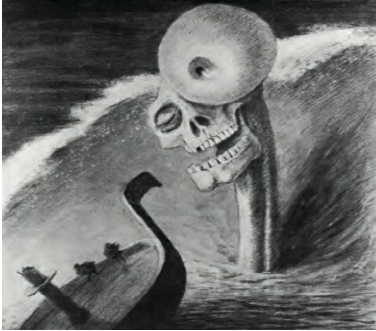
Figure 1: Surreal Depiction of a Skeletal Sea Creature Confronting a Small Boat
Artist Name: Alfred Kubin, Title of Work: The Horror, Year of Production: 1903, Dimensions: 33.8 x 31.4 cm, Technique: Watercolor, Black and White, Provenance: Leopold Collection, Vienna
Analysis often intertwines with interpretation and understanding or exegesis. Interpretation is always what we refer to as analytical reading, which can coherently reveal what the visual text attempts to obscure in terms of meaning. It is an interpretative procedure that employs analytical techniques and is a facet of interpretation [11].
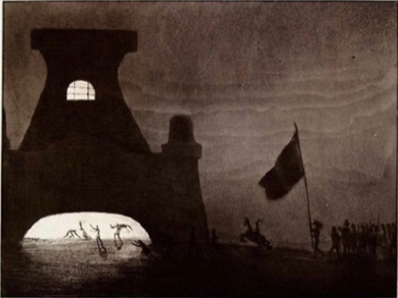
Figure 2: Symbolic Scene of Figures Entering a Fiery Furnace under a Darkened Sky, Artist: Alfred Kubin, Title: Gate of Hell, Year of Production: 1900, Dimensions: 17 x 23 cm, Technique: Watercolor on paper, Provenance:
Analysis prompts us to recall interpretative reading from a stylistic perspective by examining a new text to reveal its visual significances through delving into its content and elements. Every interpretative explanation includes the possibility of arriving at shared, deep-seated criteria and specific contemplative standards for each interpretation, independent of any conceptual mapping or traditional visual imitation.
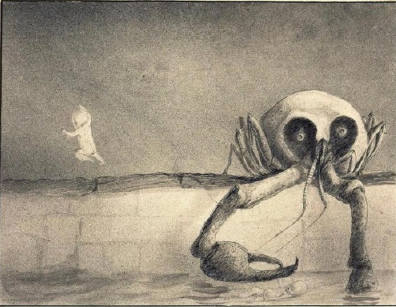
Figure 3: Surreal Illustration of a Monstrous Creature Observing a Small Fleeing Figure
Artist: Alfred Kubin, Title: The Moment of Birth, Year: 1903, Technique: Watercolor on paper, Dimensions: 33.8 x 31.4 cm, Provenance: Private collection
The mechanism of interpreting art differs from that of interpreting reality. If they were similar, art would have been exhausted long ago, with the viewer equipped with a pre-existing interpretation of visual presentations. In such a scenario, viewers would suppress themselves, rendering art futile, as it could be replaced by another method to reach the truth the viewer seeks according to a predetermined and programmed system. This would make reaching the lost truth more significant than the artwork itself, which is unacceptable in art. In art, truths are not the logical and perceptible truths of reality. An artist may choose one form over another without providing a specific reason [12].
An artist may select an expressionist image with particular significance in their work and may occasionally discuss their intentions, such as the decision to omit certain details from other works due to an initial inability to discern their relationship with other parts of the work. However, it soon becomes apparent that retaining these details was justified. This indicates that the expressionist artist embeds more in their work than their perceptive capabilities might reach. They find that despite the technical excellence of artistic mediums, they remain inadequate for conveying the imaginative image. The duality of (Reality / Imagination) nourishes each other, as the imaginative interpretive image derives its elements from reality, and the relationship between the imaginative image and the visible reality is highly complex [12].
In contemporary thought, interpretation has aligned with methodological requirements, favoring the uniqueness and spontaneity of vision, which liberates it from the centrality of perspective. It is thus closely linked with art. Subjective interpretation attempts to penetrate the psychological and emotional dimensions, analogous to psychoanalytic criticism, which examines the relationship between the artwork and psychological theories, applying them to explain the central characters of the artwork. In this context, the critic functions as a psychoanalyst, striving to understand the artistic work.
Subjective/objective interpretation is dictated by the nature of the depicted artistic work and the interpreter’s approach, whether it is objective or subjective. For example, interpreting a painting by Van Gogh often necessitates a subjective interpretation, even if we adopt an objective approach, as this involves a comprehensive awareness of the artist's psychological, intellectual, and aesthetic references, as well as their artistic and technical work. According to Husserl, the self represents the cause of intentionality, while the object represents its aim [12].
Psychological Significance of Line and Color in Art
Line is one of the oldest tools used in artistic expression. Since the era of cave art, it has been employed to delineate spaces for shapes within the visual range of that period's people.
Although line is considered one of the simplest building elements used by artists, it is simultaneously one of the most effective. Despite the complexity of the drawn areas on pictorial surfaces, at its most basic level, they consist of a series of lines, which form the structural framework of the image as a whole. Lines delineate areas of blocks or colors or shades of gray, or play a fundamental role in identifying the subject matter within the bounds of the image. They also play a crucial emotional and aesthetic role, serving as the foundation of image creation [13].
Lines serve as a pictorial tool designed to perform a symbolic function in artistic expression. This expression can be utilized on both subjective and objective levels for the viewer. Objectively, lines can describe simple measurements and surface characteristics. Subjectively, they can be manipulated to convey various emotional states and responses. One of the key attributes of a skilled artist is the sensitivity to appropriate proportions in both practical and psychological aspects.
Lines can adopt two emotional directions: one that aims to faithfully reproduce the visible shape, meaning it is a sensory line that does not rely on personal imagination but rather on sensory perception; and another that is conceptual, aimed at expressing the interactions of the spirit. Since the fourth century BC, there has been an emphasis on representing emotions and expressions. Curved lines, spirals, and twisted shapes have been used to represent visual scenes and indicate direct introspection [14].
From the above, the researcher believes there is a potential for a functional reciprocal relationship between line and color. This relationship can be explored through the expression of transparency and overlap, where one shape interplays with another, allowing both shapes to be seen simultaneously.
Color plays a significant and sensitive role in evoking emotions and generally aligns with human feelings. For example, red corresponds to anger, yellow to selfishness, and blue to wisdom. Some people have a preference or aversion to certain colors because they associate them with specific ideas. For instance, green is favored for its associations with spring, countryside, forests, and trees, while blue is appreciated for its connection to the sky. Conversely, some individuals dislike red due to its associations with danger, blood, and violence.
These color preferences, which vary among individuals, are fundamentally linked to the unconscious and are part of an individual's psychological and emotional predispositions. Colors themselves carry aesthetic values, and there is no direct relationship between associative values and the inherent aesthetic value of a color. The aesthetic relationship to color is essentially about our intuitive engagement with its nature, appreciating its depth, warmth, or hue, and then correlating these attributes with our emotions [2].
Colors leave lasting impressions in terms of pleasure and pain because they are not isolated from life but are connected to sensations, feelings, and memories, whether painful or pleasant. Most sensations are linked to memories, and color gradations, or color values, hold aesthetic, emotional, and psychological significance [15].
The researcher argues that the meaning of color is relative and depends on the context in which it is associated. For instance, the color white might signify joy, asceticism, or tranquility for one person, while it may convey different meanings for another individual.
The masterpieces created by renowned artists such as Matisse, Van Gogh, and others across various forms of visual art serve as vivid examples of how colors impact each person's psyche. These works have a tangible effect on each individual, and it is challenging to objectively interpret this psychological impact of colors. Studying each color in isolation within the nervous system requires a complete separation of the individual's mood and experiences, as each color is linked to specific emotions and feelings [16].
Indicators Derived from the Theoretical Framework:
Psychologists believe that an individual's approach to drawing serves as a reflective mirror of their behavior or the way they conduct their life. Through their drawings, we can analyze and study their personality, identifying strengths and weaknesses as well as unique traits. Consequently, drawing has been used extensively in various psychological tests, such as in psychiatry to diagnose numerous mental conditions, allowing individuals to freely express their thoughts, human struggles, and personal issues through art
Expressive drawing reflects the fulfillment of psychological and spiritual needs. It is a manifestation of the individual's life and environment, as well as an expression of the artist's intuition and personal perspective on phenomena
Color cannot be considered independently of line or other compositional elements. It is interrelated through its gradations and contrasts within the pictorial space
An expressive artist has a highly individual and distinctive personality. Each person has a unique way of feeling, thinking, and behaving, deriving from a subjective perspective that views the internal self in relation to the external objective world. This imbues colors and lines with psychological dimensions that enhance interpretation and its mechanisms
The psychological dimensions in expressive drawing have two main directions: sensory material and elevated spiritual. These directions complement and complete each other in modern art
The psychological dimension in expressive drawing aims to address many social and political issues by revealing their truths through understanding how humans perceive themselves, others around them, their society, and their environment. Each expressive artist has a unique and complex individual personality, with each individual exhibiting a distinctive approach to feeling, thinking, and behaving
Chapter Three: Research Procedures
After reviewing the theoretical framework and identifying key indicators to aid in analyzing the research sample, the researcher proceeded with the following procedures:
Determining the Research Population and Sample Selection
The researcher defined the research population as the body of works by the artist Alfred Kubin
After reviewing published and available works by Kubin and consulting with experts and specialists in the field of art, the researcher selected a representative sample from this population
Analysis Methodology
The researcher adopted a descriptive analysis method, which aligns closely with the research objectives and the question posed by the research problem
This approach was chosen as it best suited the goal of the research and facilitated answering the research question
The selected sample was analyzed based on the indicators derived from the theoretical framework, serving as a foundational basis to achieve the research objectives and derive relevant conclusions.
Alfred Kubin conjures a stark and thrilling terror, confidently utilizing a primordial archetype of fear and reveling in the eerie strangeness of his nightmarish vision. This is aptly reflected in the title of the work, "The Horror." Rising from the turbulent maelstrom of the stormy sea is a head resembling a skull, with a sinuous neck and a wide grin showing some missing teeth, threatening a small, battered boat that tilts diagonally from the lower left corner of the turbulent sea.
The boat's mast is already broken and protrudes from the empty surface like a toothpick. The boat's prow features a silhouette of a bird's head—reminiscent of Viking ship decorations—which seems to engage directly with the monstrous beast.
Two small human figures on the boat's railing appear ready to confront their terrifying adversary: disheveled by the storm and with their coats flapping in the wind, they face the bare teeth of the monstrous vision. An enormously swollen, bulging eyeball protrudes from the left bony cavity of the dreadful creature, glaring intently and taunting the tiny figures exposed to this horror.
Kubin skillfully creates a dynamic scene of boiling turmoil using contrasts between light and dark, with a shimmering spray belt arching diagonally within the square shape between the calm sea in the background and the waters rising indirectly in the whirlpool in the foreground. The eerie scene, executed in 1902, is an early work of the young painter and graphic artist, who managed to make a name for himself early on with his terrifying visions.
The artist's life was marked by profound trauma, beginning with the death of his mother when he was only ten years old. This early encounter with mortality instilled in him a constant fear and a struggle with life’s terrors, leading him to contemplate suicide, although he never succeeded. His academic failures and difficulties in the military further contributed to his sense of despair. These experiences drove him to seek solace in drawing, using it as a means to confront and express his fears on paper.
In his artwork, Kubin often portrays themes of fear, horror, and a perpetual struggle with death and evil. In his piece "The Horror," he represents life as a terrifying, stormy sea, reflecting his own ongoing battle with the unknown, symbolized by the tumultuous waters. A large skull emerges from the sea, with a long neck, fearsome teeth, and a terrifying eye, which gazes menacingly at two figures on the ship’s deck. The skull's gaze conveys a predatory intent, as if the figures are its prey, underscoring the sense of dread and inescapable danger that pervades Kubin’s work.
In his work Gate of Hell, Alfred Kubin portrays life shrouded in darkness and dust, as if captured during a fierce battle or a stormy scene. The rectangular composition depicts a line of figures on the left, waiting their turn. Each person stands in anticipation, looking to a figure bearing a black flag—a symbol of war. Nearby, another figure on horseback wields a whip, striking individuals or encouraging them to hurry through the gate.
The gate, depicted on the right side of the composition, dominates the scene with its dark brown or black hues. It features a window at the top and is flanked by figures who seem to torment those entering, suggesting a scene of infernal punishment. This gate, representing "Hell," is portrayed as an entrance to suffering and torment.
Kubin’s portrayal contrasts the dark, oppressive environment outside the gate with a seemingly brighter, yet equally grim, interior. This duality may symbolize the harshness of existence contrasted with the hope of escape or change.
Reflecting on Kubin’s personal suffering and the harsh realities he faced, it is evident that he represents life as a relentless cycle of torment and agony. The dark, pre-gate area symbolizes the pre-life phase, likened to the womb where the light of life has not yet been seen. The long flagpole or banner may allude to Freud's interpretation of phallic symbols, suggesting a representation of sexual organs, while the gate’s semi-circular shape and the horse ready to charge might signify female genitalia and sexual desire respectively.
Through this vivid depiction, Kubin encapsulates the harsh, torturous nature of human existence, reflecting the intense emotional and existential struggles he perceived in life.
In this work, the artist Alfred Kubin divided the painting into two parts. The space is dark, and the atmosphere appears stormy and frightening. On the left side of the viewer, a child is seen flying through the air as if escaping from something. The lower part of the painting shows a wall that seems to be broken, and on the right side of the viewer, there is a creature that looks like a crustacean. Its hands are on the ground, and one of its hands is holding a newborn child at that very moment.
Alfred Kubin depicts the overall atmosphere of the painting, or the visual scene of this work, as being dominated by fear and the escape from something.
When analyzing this work from a psychological perspective, we see that in "Moment of Birth," the artist portrays the child as fleeing from life, depicting life itself as a merciless, terrifying monster that can devour anything in its path. Through this visual scene, we can say that the artist experiences a difficult life filled with fear and nightmares. Referring to Alfred Kubin's life, we find that he faced a significant trauma and confrontation with death and suffering when he witnessed his mother on her deathbed fighting for her life. This event was a major shock and created a psychological trauma for him, leading him to consider ending his life multiple times and attempting suicide, though unsuccessfully. His failure to join the army further exacerbated his struggle with life. This conflict and escape from life are clearly reflected in his work "Moment of Birth," where he portrays life as a ruthless, fearsome predator.
RESULTS
Based on the analysis of the research sample and the theoretical framework, and in light of the research objectives, the researcher has arrived at the following results:
Psychological Dimensions through Line Expression: Psychological dimensions are revealed through the use of line expression by means of movement, direction, type, scale, and relationships. These elements collectively unveil a range of psychological significances
Psychological Dimensions through Color Expression: Psychological dimensions emerge from the expression of color and its psychological, symbolic, and conventional meanings, utilizing mechanisms such as saturation, impoverishment, transparency, and aesthetic color relationships. These elements uncover various psychological dimensions
Psychological Dimensions through Form Expression: Psychological dimensions are reflected through the expression of form, whether realistic, distorted, abstracted, or geometric, employing techniques such as enlargement, reduction, multiplication, minimization, elongation, shortening, omission, addition, flattening, and relationships
Psychological Dimensions through Closed Space Expression: Psychological dimensions are evident in the depiction of closed spaces and their connotations related to feelings of alienation and anxiety
Psychological Dimensions through Fear and Struggle with Life: Psychological dimensions are manifested through expressions of fear and the struggle with life
CONCLUSION
Based on the results of the research, the researcher has drawn the following conclusions:
Psychological Dimension and Art: The psychological dimension has been closely linked to art throughout the long history of art, as a value that facilitates a form of spiritual communication between the individual and their self, and between the individual and others. The psychological dimension has been a cornerstone for the human self to propose insights about the artwork. The notion of the psychological dimension only began to lessen in impact in the artist's mind with modern expressionism, which understood the psychological dimension subjectively, encompassing all previous psychological theories and exceeding expectations
Role of Color in Expressionism: Color has clearly emerged as a meaningful element in expressionist art through color variations, balance, harmony, contrast, and its dominant position within relationships that form a cohesive unity serving the overall composition. Color has been associated with personal symbols, meanings, and values in Germanic culture, and is used in spiritual values, customs, traditions, and religion
Deviation from Norms: Deviation from the norm has been a continuous form of expressing the artist's personal experiences through the formation of psychological dimensions. Expressionism has embraced a pure intentionality, suggesting a specific aim or purpose with psychological dimensions that the artist strives to achieve
Expression through Emotion and Spontaneity: The artist acted with emotion, strangeness, and spontaneity through form, line, and aesthetic relationships, which increased the ability to express a range of psychological dimensions. This has been realized in the current research sample, where modern expressionism transcends logical and objective boundaries, characterized by spontaneity and a rejection of traditional constraints
Psychological Dimensions and Social Context: The psychological dimensions in the artist's work have a clear impact on affirming that the psychological aspect of the artist is inseparable from the social, cultural, and political aspects, as reflected in the images derived from the emotional and unconscious reservoir of human and social events
Recommendations
Based on the results of the research, the researcher recommends the following:
Study of Psychological Dimensions in Art: Emphasize the study of psychological dimensions in art in general, and in visual art and drawing in particular, as it is an influential medium for intellectual communication
Establishment of a Psychological Art Studies Department: Establish a dedicated department for psychological studies in art, targeting professionals, artists, graduate students, and researchers involved in this field
Encouragement for Youth Expression: Provide opportunities for young people to express their interests, opinions, and desires through drawing and visual art, and support ongoing engagement in this area
Suggestions
To further the current research and achieve additional benefits, the researcher suggests conducting the following studies:
Psychological Dimensions in Primitive Human Art: Explore the psychological dimensions in the art of primitive humans
Psychological Dimensions in Spontaneity in Adult Drawings: Investigate the psychological dimensions of spontaneity in adult drawings
REFERENCES
El-Sayed, A.H.M. Creativity and Personality. Dar Al-Ma'arif, 1971.
Reid, H. The Present Art. 2nd ed., translated by S. Ali, Dar Al-Shu'un Al-Thaqafiya Al-Amma, 1986.
Hassan, H.M. The Aesthetic Origins of Modern Art. Dar Al-Fikr Al-Arabi, n.d.
Kamel, A. "The nature of drawing in Iraq: The psychological dimension." Afaq Arabiya, vol. 5, no. 11, July 1980, Baghdad.
Awad, R. Introductions to the Philosophy of Art. 1st ed., Gross Press, 1994.
Al-Bustani, F.E. Student’s Guide. 3rd ed., Dar Al-Mashriq, n.d.
Gibran, M. The Student Pioneer. Dar Al-Ilm Lil-Malayeen, n.d.
Abdel-Khalek, A.M. The Basic Dimensions of Personality. 2nd ed., Foreword by H.J. Eysenck, The University Press, 1983.
Alloush, S. Dictionary of Contemporary Literary Terms. 1st ed., Dar Al-Kitab Al-Lubnani, 1985.
Schneider, I. Psychoanalysis and Art. Translated by Y.A.M. Tharwat, Dar Al-Huria Printing, 1985.
Scott, R.G. The Fundamentals of Design. Translated by A.M. and others, Dar Al-Nahda Al-Arabiya, 1950.
Marouf, E.K. The Issue of Interpreting the Significance of Animal Forms in Contemporary Iraqi Drawing. Unpublished master’s thesis, Faculty of Fine Arts, Babel, 2004.
Abdel-Fattah, R. Elements of Composition in Visual Arts. 1st ed., Dar Al-Nahda Al-Arabiya, 1974.
Houeg, R. Art: Its Interpretation and Path. Translated by S. Mustafa, Ministry of Culture and National Guidance Publications, Damascus, 1978.
Al-Jubouri, M.S.M. The Impact of Colors on the Psyche and Its Relation to Art. 1st ed., Al-Liwa Printing, 1978.
Tabo, M.D. Drawing and Color. 3rd ed., 1969.
None
None
None
None
None
Recommended Articles
Research Article
Effect of Laser Bio stimulation and Bone Graft in Treatment of a Large Periapical Lesion – A CBCT Analysis
Ruchika Gupta Dewan,
Unnavi Chauhan
Published: 22/11/2020
Download PDF
Research Article
Classifying Problems of Diabetic Foot
Amit Kumar C Jain
Published: 23/11/2020
Download PDF
Research Article
Rare Presentation Heterogeneous Pregnancies
Imad Abedzaid Mohan Aljanabi,
...
Marwa Habeeb Nazal
Published: 20/03/2021
Download PDF
Research Article
Emerging Role of Nutraceuticals in Covid 19
Naaz Huda,
...
Kaur Charanjeet
Published: 22/11/2020
Download PDF
PO Box 101, Nakuru
Kenya.
Email: office@iarconsortium.org
Editorial Office:
J.L Bhavan, Near Radison Blu Hotel,
Jalukbari, Guwahati-India
Yaseen, O. A. A. (2024). The Psychological Dimension in the Works of Artist Alfred Kubin. IAR Journal of Humanities and Cultural Studies, 5(2), 1-9.
MLA
Yaseen, Omar Ali A.. "The Psychological Dimension in the Works of Artist Alfred Kubin." IAR Journal of Humanities and Cultural Studies 5.2 (2024): 1-9.
Chicago
Yaseen, Omar Ali A.. "The Psychological Dimension in the Works of Artist Alfred Kubin." IAR Journal of Humanities and Cultural Studies 5, no. 2 (2024): 1-9.
Harvard
Yaseen, O. A. A. (2024) 'The Psychological Dimension in the Works of Artist Alfred Kubin' IAR Journal of Humanities and Cultural Studies 5(2), pp. 1-9.
Vancouver
Yaseen OAA. The Psychological Dimension in the Works of Artist Alfred Kubin. IAR Journal of Humanities and Cultural Studies. 2024 Jul;5(2):1-9.



 Download PDF
 Download XML