Recently, the use of Wireless Networks (WNTs) are increasing daily and the electrical devices are becoming smaller in size. These factors assisted in expanding the use of Wireless Body Area Networks (WBAN) for medical applications. Therefore, on the basis of utilizing the WBAN for health assistance, the patients have no need to longer stay in the hospital. The personal medical-data is detected by human body sensors, then it is transmitted to the specialist (medical team). The body sensors are externally or internally used based on the medical cases; such as measuring the heart rate, body temperature and ECG. Recently, the healthcare system has improved by supporting WBAN using different types of sensors and WNTs practically. In this paper, the WBAN is designed and implemented based on using hardware parts (Arduino and a set of body sensors) with its own programs. The presented WBAN consists of only one accumulator (Fog-computing) and M number of body-sensors. The measured health parameters such as; (temperature, heart rate and ECG) are transmitted to the cloud-computing via Fog-computing using Wi-Fi technique for the purpose of monitoring the patient by a special medical team. These parameters could be monitored locally using LCD-plasma or remotely by laptop, mobile, computer via cloud-computing. Finally, as a future work, the presented WBAN can be utilized for monitoring several patients at a time based on distribution of several WBANs within a special wireless network.
Keywords
WBANs
Fog and cloud computing
Healthcare
Arduino and WBANs
Mobile phone and WBAN
INTRODUCTION
A Wireless Body Area Network (WBAN) is a network that is designed and implemented based on different intelligent electronic elements such as body sensors, nodes and coordinators. The WBAN is utilized to work with the human body and its surroundings for the purpose of health care applications. This application is very important for healthy monitoring of seniors out of hospital.
Recently, the application fields of WBAN have come up as a main research area due to its beneficial in health care and patients monitoring for different geographical regions where the patients can be cared for remotely at real-time. The WBAN has emerged as a vital technology that is capable of providing better methods to diagnose and monitor various hazardous and simple diseases. A lot of research has shown that this technology works in actual time to monitor the health issues and physiological parameters of the patients by utilising different devices [1-3].
The WBAN consists of a band of body sensors with different types worn by a patient to monitor various physiological signals. These sensors are lightweight and easy to use. Also, they are able to transmit the bio signals (vital signs) to the concerned system at a healthcare centre. The medical team retrieves the patient data and processes it.
This paper aims to present a simple design of WBAN for medical applications for both a hospital and home services based on using the Arduino and different sensors controlled by own programs. Then, utilize Wi-Fi to transmit the sensor data (reading) to the cloud-computing via Fog-computing. The main target of this network is to make possible real-time shows of the medical sensors data based on up-to-date technologies.
The main contribution of this work is to design and implement the WBAN based on up-to-date technologies, in order to make it possible to remotely read the data of medical body-sensors in real time. Then, enhancing the health-care scheme based on optimization the work distribution of the medical processing networks using Fog-cloud structure.
Related Work
Recently, the interest in the applications of WBAN for patient monitoring has grown significantly. A WBAN can be used to develop patient monitoring systems which offer flexibility to medical staff and mobility to patients. The patient's monitoring could involve a range of activities including data collection from various body sensors for storage and diagnosis, transmitting data to remote medical databases, processing the medical data and controlling medical appliances.
The WBANs can be operating at an interconnection mode for the purpose of monitoring the patient remotely using E-health/Tele-health applications. Also, this network can be used for monitoring the athletes’ performance and assisting them in training activities. For such issues, it is very important to collect and transmit the data reliably to a monitoring entity in a timely manner. The WBANs are very suitable to solve these issues [4].
For healthcare applications, the WBANs are utilized and increase in usage for different healthy applications. The advancement of WBANs is very important for the purpose of developing the real-time remote healthy monitoring system. For this purpose, the WBANs architecture has been developed based on Internet of Things (IoT) technique. In [5], the WBAN was implemented based on facilitating the internetworking process between multiple devices and their network. Then, send the patient's healthy data (vital and non-vital) to the professionals of healthcare.
In [6], the development of a wearable WBAN was presented for applications of health remote monitoring. In their work four biomedical sensors were utilized to measure different physiological signals (SPO2, ECG, breathing and heart rate) and convert these signals into useful data. On the other hand, the artificial intelligence techniques had been used for improving the diagnosis accuracy. Also, it is used as advanced strategies for the purpose of reducing the energy consumption costs [7-9].
The work of authors in [10] presented the concepts of different existing services and applications in the interested field of Internet Of Health (IOHT). Their work concludes that the existing solutions have a lack of flexibility and interoperability. In [11], the remote health monitoring distributed frame-work was designed for (WBAN) wearable body area networks. As well as, the technology of sensor-cloud to retrieve data efficiently from the sensor's body is presented. In [12], a combined visible and thermal image processing scheme based on a CMOS camera with infrared thermography for the purpose of remotely sensing multiple vital signs of patients.
The Fog-cloud structure is utilized for different applications for instance; medical applications, remote sensing, surveillance systems and so on [13-17]. This structure provides more reliability to deal with huge numbers of users and big data storage. Fog-computing is an intermediate function between cloud-layer and end-user devices.
On the other hand, a lot of researchers presented different approaches for optimization algorithms in wireless body area networks. The genetic algorithm was utilized to optimize the performance of the WBANs based on proposed different protocols and methods [18,19]. Where, the basic function of the genetic algorithm is searching algorithm. On the basis of Fuzzy logic algorithm operation mode, which helps to solve a problem after considering all available data. Different schemes utilized the Fuzzy logic for monitoring ill people [20]. Also, the Fuzzy logic algorithm and genetic algorithm have been utilized to gather in order to optimize the WBAN [21]. On the same side of consideration, the researchers in [22] were dependent on a few metrics such as; Network average delay, Throughput, PDR and Packets drop in order to enhance the network performance. In [23], the WBAN had been enhanced by optimising the energy consumption based on energy consumption metric.
MATERIALS AND METHODS
The Fog-Cloud computing structure has been an interesting area of research recently; because of this structure can be utilized in different healthcare applications. Fog-computing can verify the rapid response which is very crucial in big data applications.
This section presents WBAN-Fog-Cloud (WFC) structure for the case of patient monitoring and latency improvement. This structure consists of body sensors, Fog-computing (accumulator) and cloud-computing which work jointly with each other based on WiFi technique. In this work, the Fog-cloud structure is utilized to implement the WBAN for health-care applications based on monitoring the patient's medical parameters remotely using available electrical devices and different body sensors. The types of body sensors that can be used in this work can be classified into wearable sensors and not wearable sensors. These types of sensors are contacted to the patients in different forms based on its digital techniques.
Design of Presented WBAN
In this section, the overall block diagram of a practical WBAN for healthcare is illustrated in Figure 1.
Figure 1: An Overview of Presented WBAN
In this work, the presented WBAN consists of many devices for instance; body sensors, Fog-computing (accumulator) and cloud-computing (central server) as a hardware part which can be noted as (practical mode). These devices are controlled by special proposed algorithms, as a software part which can be noted as (algorithm mode). The progress of this work is presented as follows: first, the practical mode of the presented WBAN explains the hardware components with its details and usage. Second, the algorithm mode of the presented WBAN explains the algorithms of own programs which are required for controlling the hardware and analysing the medical data.
Practical mode of WBAN
In this subsection, the required devices for design a WBAN practically is explained and discussed as follows:
Medical Sensors for Measuring Patients Parameters
In this network, different body sensor types are used for measuring many important medical parameters. These sensors are used to measure (temperature, heart rate and ECG), which are considered the main medical parameters for initial detection cases of the patient.
The sensor (LM35) is an integrated circuit sensor which is utilized to measure the patient body temperature with an electrical output voltage proportional to the temperature (in °C). In order to measure the heart rate of the patient, the pulse-sensor is utilized for this purpose.
Where, this sensor is well-designed with low-power work based on plug-and play which is compatible to work with Arduino devices. In addition to these medical sensors, the ECG of the heart is measured by (AD8232) which is integrated signal conditioning.
Fog-Computing (Accumulator)
Fog-computing can be considered as a promising technology which proposes intelligent networks and connections between IoT devices and cloud-computing platforms. Fog-computing works as an extension of a cloud-computing platform at the network edge.
The Fog-computing (accumulator) is the upper level of this WBAN hierarchy. It is utilized to provide the first level of communication link between the medical sensor network (patient) and the cloud-computing through Fog-computing using Wi-Fi technique as illustrated in Figure 1. The second level of communication is the link between end-user (medical team) and cloud-computing for reading and monitoring the medical data aggregated by body sensors. In this work, the Arduino and Esp8622 module is representing the Fog-computing of the presented WBAN. It used to aggregation and re-prepare the readied medical parameters by body sensors. Then, send these data to the cloud-computing based on a special order from the medical team.
Cloud-Computing (Cloud-Layer)
The cloud-computing (cloud-layer) is utilized to provide the central- server which is used to store the patients' medical parameters and then pass these parameters to the authorized medical team based on Polling MAC protocol.
In this work, RemoteXY-cloud server is used at the cloud-computing to implement the presented WBAN for real time monitoring of patients medical parameters. Where, the connections to the devices of body area network BAN (accumulator and medical sensors) are carried out through this cloud server. The RemoteXY-cloud server provides medical devices from anywhere via Wi-Fi.
Algorithm Mode of WBAN
This section explains the algorithm mode which includes algorithms and configurations that are required to implement the WBAN presented in this work based on Fog-computing (Fog-layer) and cloud-computing structure. These requirements are presented as follows:
Configuration
The required configuration of devices with cloud-computing (RemoteXY-cloud) are presented and implemented in this work. Here, the RemoteXY-cloud is used to make it possible the manage devices from anywhere via Wi-Fi. The Arduino is configured to implement RemoteXY graphical interface on Arduino UNO board based on an external ESP8266 module which is connected to the serial port of Arduino UNO. The main steps of this configuration are presented in Algorithm 1 as illustrated in Figure 2.
Figure 2: (Algorithm 1) Configuration of Arduino UNO for RemoreXY-Cloud Server
Algorithm of Installing RemoteXY-library
This algorithm is noted as Algorithm 2. In this algorithm, the special code for carried out the RemoteXY-library at the Arduino UNO to allow the controlling of the end-user on the accumulator (Fog-computing) and BAN medical sensors. Moreover, programming codes are added to the Arduino UNO to power up or power down the BAN medical sensors and the aggregation of the patients' parameters.
Then, send these parameters to the cloud-layer via Wi-Fi.The main steps of algorithm 2 are illustrated in the block diagram illustrated in Figure 3.
Figure 3: (Algorithm 2) Adding RemoteXY-Library and Arduino IDE Code
Connect the Mobile Phone to the WBAN
In this work, the mobile phone of the doctor (or specialized team) is utilized to send the testing orders and receive the results from the BAN of the patients via Fog-computing and cloud-computing. The main steps of this algorithm to configure the mobile phone of the medical team are illustrated in Algorithm 3 as shown in Figure 4.
Figure 4: Main Algorithm to Connect the Mobile Phone to the WBAN (Algorithm 3)
Main Algorithm of WBAN
The important steps of the main algorithm to implement and investigate the presented WBAN are illustrated in Algorithm 4 as shown in Figure 5.
Figure 5: Main Algorithm of WBAN (Algorithm 4)
In this algorithm, the WBAN operates at all time for monitoring the medical parameters of patients and is prepared into a special Frame Message (FRMSG). Then, send it with a fixed time interval to the cloud-server via Wi-Fi. The specialized team can read these parameters from the cloud directly as illustrated in Algorithm 5 as shown in Figure 6a.
Figure 6: Reading Patient Parameter Status at Real-Time by Specialized Team and Work with: A. Simple Operation Mode (Algorithm 5). B. Demand Operation Mode (Algorithm 6)
This mode of operation is called a simple operation mode.
The Algorithm 6 shown in Figure 6b, is working in demand-mode operation. In this mode; the WBAN operates at all times and displays the medical parameters on the LCD. Moreover, when receiving demand message DEMSG from an end-user, these parameters are prepared in a special Frame Message (FRMSG) and sent to the end-user via Fog-computing and cloud-server structure.
Where, the required medical parameters are asked by a specialized team by sending DEMSG to the Fog-computing (accumulator), these medical parameters are read and sent at real time from accumulator (Fog-computing) to the specialized team via Wi-Fi through cloud-server. These parameters are prepared into a special frame message (FRMSG) and sent with a fixed time interval to the cloud-server. Where, the DEMSG is a message sent from a specialized team to the Fog-computing (accumulator) through cloud-computing with Cloud-Fig network structure. This message contains orders to read and sends different patients parameters individually at a real time for instance; (B = HR) is heart beat sensing, (C = T) is a temperature sensing, (D = ECG) is ECG sensing.
Communication Links
In this section, the approved communication links in this WBAN are presented and illustrated in Figure 7.
Figure 7: WBAN Communication Links
In this figure, the main communication links are illustrated in order to clarify the path of exchanging data. The details of these communication links are presented as follows:
First-Level Communication Link
The first-level communication link represents exchanging data between accumulator (Fog-computing) and cloud-computing using Wi-Fi technique. The accumulator is utilized to aggregate the important data from medical body-sensors of the patient and sends it to the cloud-computing via the first-level communication link.
Second-Level Communication Link
The second-level communication link represents exchanging data between end-user (specialized medical team) and cloud-computing to transmit the required orders from the medical team to the Fog-computing via cloud-computing. Then, return the required medical parameters (reading of medical sensor) to the medical team via Fog-computing and cloud-computing. The end-user can use the mobile phone or laptop or any other devices to edit them.
Polling MAC Protocol and Proposed WBAN
In this work, the polling MAC protocol is utilized to carry out the communication links between Fog-computing and medical sensors of WBAN.
The polling protocol is used to reduce the energy conception of WBAN by reducing the scheduling the transmission times of WBAN transmission system.
In this work, the polling protocol is applied based on a diagram as illustrated in Figure 8.
In this work, the WBAN network has been build based on these assumptions:
The WBAN is composed of one Fog-computer and three body sensors
At a time, one body sensor can transmit its information and clear its buffer, whereas the other body sensor nodes at the wait-state case
The time of transmission between Fog-computing and body sensor are not the same time due to the different size (length) of the data aggregated.
From this Figure 8A, the polling mechanism carried out in the presented WBAN illustrates that the polling frame cycle is applied periodically between Fog-computing and the medical body sensor, in order to read and collect the patient's medical data. Figure 8B illustrates the polling diagram of the polling frame-cycle between Fog-computing and ECG-sensor. Where, (TD) represents the time delay of the process based on the side of transmission or reception. At the Fog–computing the TD represents the time required to process and analyse the received data and prepare the next sending message to the ECG-sensor node. The TD at the ECG-sensor node represents the time required to read and prepare the required data before sending it to the Fog-computing.-
RESULTS AND DISCUSSION
In this section, the performance of the implemented WBAN is presented and discussed. In this work, the WBAN is implemented based on available simple devices and utilizing the newest techniques such as Fog-computing and cloud-computing structure. The exchanging medical data and orders between end-user (specialized team) and BAN are implemented based on two operating modes at real time.
The patient's medical parameters are read using a set of medical sensors (temperature sensor, heart rate sensor and ECG sensor). The values read by these sensors are calibrated by Arduino UNO microcontroller (Fog-computing). Then, sending these parameters to the cloud-computing via WiFi technique.
The prototype of WBAN of health monitoring systems. Where, the WBAN consists of Fog-computing (accumulator), medical sensors and LCD display. The calibrated sensor output values are displayed on the LCD so that the output results could be visible for the patients. Moreover, these results can be displayed on the mobile screen based on using RemoteXY-cloud server based on using mobile application. It is worth mentioning, the authorized medical team is able to enter the presented WBAN based on using a special password and username.
The sensor's values will be sent (as medical data) to the cloud-server via Wi-Fi. These data can be accessed from the authorized end-user through the cloud-server using the IoT application platform. On the bases of two operating modes of the presented WBAN, the output results are displayed on mobile phones as illustrated. In this figure, on the left side, the set of options are listed to select the type of measured parameter. Where option (B) represents measuring the “heart rate value”, option (C) represents measuring the “body temperature value”, option (D) represents the measuring of “ECG graph” and option (A) represents “exiting” from this application.
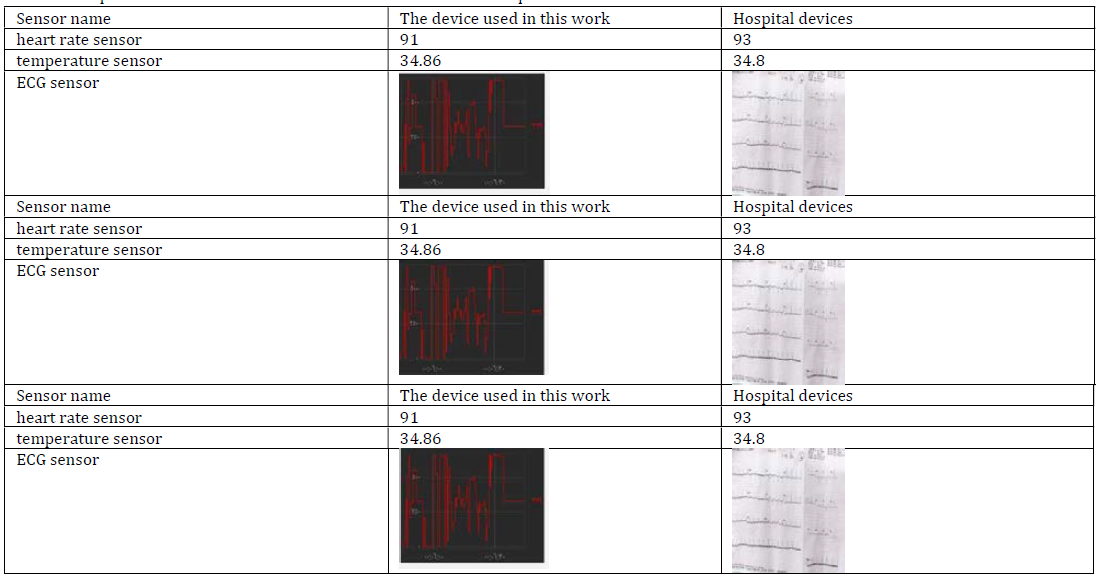
The performance of the implemented WBAN is evaluated based on comparing the output results of this WBAN with different devices working in a hospital as illustrated in Table 1. The findings in this table exhibit the results of WBAN are very close to the real results which are obtained by the hospital devices. Hence, these results prove the validity of the implemented WBAN.
Table 1: Comparison Results of WBAN of this Work with Different Hospital Devices
Comparison between Two Modes Operation
The scientific comparison between simple-mode operation and demand-mode operation are carried out based on energy saving (power efficiency) of these modes.
In this work, the power budget of implementing WBAN is controlled by managing the transmission power. The transmission unit of this network is already in the ideal case at all times. This case changes to transmission mode after receiving a Demand Message (DEMSG) from the end-user. This mode of operation (demand-mode operation) led to the introduction of a much higher level of energy saving based on management of the transmission mode of the transmission unit.
CONCLUSION
This paper aims to present and implement WBAN for monitoring the patient by a specialized medical team in real time. This WBAN is implemented based on using low cost and simple architecture for design cases. Two modes of operations are dependent such as (simple-mode operation) and (demand-mode operation). The scientific comparison between these modes is implemented based on saving energy and power efficiency.
This comparison shows that the demand-mode has better performance than simple-mode operation. On the other hand, the performance evaluation of this network is implemented based on comparing the output results of WBAN with the results of hospital devices. The compatibility of these results gives credibility and makes the WBAN very suitable for real time monitoring.
Finally, the implemented WBAN in this work makes it possible to allow and monitor the medical parameters of the patient by different specialized (end-users) at a real time. This facility is provided by the specifications of the cloud-computing techniques and its features.
Future Work
The presented WBAN is implemented and evaluated for single patients with different humans at real time. The monitoring of multi-patients at real time will be the extended work. This work can be carried out based on customised ID numbers for each patient. Also, the cloud-computing could process a large number of Fog-computers at a time. These facilities make it possible to implement the presented WBAN in this work for multi-patient at a real time.
REFERENCES
Rathee, D. et al. “Recent trends in Wireless Body Area Network (WBAN) research and cognition-based adaptive WBAN architecture for healthcare.” Health Technology, vol. 4, 2014, pp. 239–244. https://doi.org/10.1007/s12553-014-0083-x.
Zhong, L. et al. “Technological requirements and challenges in wireless body area networks for health monitoring: A comprehensive survey.” Sensors, vol. 22, no. 3539, 2022, pp. 1–22. https://doi.org/10.3390/s22093539.
Kachroo, R. and R. Bajaj. “A novel technique for optimized routing in wireless body area network using genetic algorithm.” Journal of Network Communications and Emerging Technologies, vol. 2, no. 2, 2015, pp. 90–97.
Khan, J.Y. et al. “Wireless Body Area Network (WBAN) design techniques and performance evaluation.” Journal of Medical Systems, vol. 63, no. 3, 2012, pp. 1441–1457. https://doi.org/10.1007/s10916-010-9605-x.
Zeb, A. et al. “Energy-efficient cluster formation in IoT-enabled wireless body area network.” Computational Intelligence and Neuroscience, 2022, 11 pages. https://doi.org/10.1155/2022/2558590.
Baba, E. et al. “A health remote monitoring application based on wireless body area networks.” International Conference on Intelligent Systems and Computer Vision (ISCV), 2018. https://doi.org/10.1109/ISACV.2018.8354042.
Gadekallu, T.R. et al. “Deep neural networks to predict diabetic retinopathy.” Journal of Ambient Intelligence and Humanized Computing, vol. 14, 2020, pp. 5407–5420. https://doi.org/10.1007/s12652-020-01963-7.
Deepa, N. et al. “An AI-based intelligent system for healthcare analysis using ridge-adaline stochastic gradient descent classifier.” Journal of Supercomputing, 2020, 20 pages. https://doi.org/10.1007/s11227-020-03347-2.
Maddikunta, P.K.R. et al. “Green communication in IoT networks using a hybrid optimization algorithm.” Computer Communications, vol. 159, 2020. https://doi.org/10.1016/j.comcom.2020.05.020.
Rodrigues, J.J. et al. “Enabling technologies for the Internet of Health Things.” IEEE Access, vol. 6, 2028, pp. 13129–13141. https://doi.org/10.1109/ACCESS.2017.2789329.
Gupta, A. et al. “Delay-sensitive remote health framework for secured WBAN using sensor virtualization.” 3rd International Conference on Applications and Innovations in Mobile Computing (AIMoC), IEEE, 2016.
Sun, G. et al. “Remote sensing of multiple vital signs using a CMOS camera-equipped infrared thermography system and its clinical application in rapidly screening patients with suspected infectious diseases.” International Journal of Infectious Diseases, vol. 55, 2017, pp. 113–117. https://doi.org/10.1016/j.ijid.2017.01.007.
Gia, G.T.N. et al. “Low-cost fog-assisted health-care IoT system with energy-efficient sensor nodes.” 13th International Wireless Communications and Mobile Computing Conference (IWCMC), IEEE, 2017. https://doi.org/10.1109/IWCMC.2017.7986551.
Sandeep, S.S. and I. Mahajan. “IoT–fog-based healthcare framework to identify and control hypertension attack.” IEEE Internet of Things Journal, vol. 6, no. 2, 2019, pp. 1920–1927. https://doi.org/10.1109/JIOT.2018.2871630.
Randa, A. et al. “Mobility-aware task scheduling in cloud–fog IoT-based healthcare architectures.” Computer Networks, vol. 179, 2020. https://doi.org/10.1016/j.comnet.2020.107348.
Qinglin, Q. and F. Tao. “A smart manufacturing service system based on edge computing, fog computing and cloud computing.” IEEE Access, vol. 7, 2019, pp. 86769–86777.
Margariti, S. et al. “Modeling and simulation tools for fog computing-A comprehensive survey from a cost perspective.” Future Internet, vol. 12, no. 5, 2020. https://doi.org/10.3390/fi12050089.
Kaur, N. and S. Singh. “Optimized cost-effective and energy-efficient routing protocol for wireless body area networks.” Ad Hoc Networks, vol. 61, 2017, pp. 65–84. https://doi.org/10.1016/j.adhoc.2017.03.008.
Kalaiselvi, K. et al. “Genetic algorithm-based sensor node classifications in Wireless Body Area Networks (WBAN).” Cluster Computing, 2018, pp. 1–7. https://doi.org/10.1007/s10586-018-1770-6.
Pushpan, S. and B. Velusamy. “Fuzzy-based dynamic time slot allocation for wireless body area networks.” Sensors, vol. 19, no. 9, 2019. https://doi.org/10.3390/s19092112.
Thakur, M. and Er. Parvinder. “Wireless body area network (WBAN) for health monitoring system using genetic algorithm and fuzzy logic.” International Journal of Advanced Research in Computer Science, vol. 8, no. 8, 2017, pp. 92–97. https://doi.org/10.26483/ijarcs.v8i8.4640.
Ahmad, I. “Investigation of IEEE 802.15.4 fixed duty cycle during nodes mobility under different WBAN performance metrics.” International Journal of Advanced Computer Science and Applications, vol. 17, no. 4, 2019.
Jain, S. et al. “An energy-efficient health monitoring approach with wireless body area networks.” ACM Transactions on Computing for Healthcare, vol. 3, no. 3, 2019, pp. 1–22. https://doi.org/10.1145/3501773.
None
None
None
Recommended Articles
Research Article
The Possibility of Treating Corrosion in Iron Valves of Flow Regulators, Pumping Station Components, and Suspended Solids Filtration Networks in Rivers and Streams in Al-Qadisiyah Governorate
Qasim M. Turki,
...
Ahmed Hakem Jabor
Published: 02/03/2026
Download PDF
Research Article
OBSERVATIONS ON THE HOMOGENEOUS TERNARY QUADRATIC DIOPHANTINE EQUATION x2 + 4xy + 9y2 = 21z2
Download PDF
Research Article
Computer Driven Library Management and Service Rendering System: Mobile Library Landscape
Yekini N. A,
...
Ojo O
Published: 10/06/2020
Download PDF
Research Article
The Availability and Utilization of Some Selected Digital Technology Facilities among Students of Mathematical Sciences Using Krejcie and Morgan’s Sample Size Determination Technique, A Case Study of Kogi State University Anyigba
Download PDF
PO Box 101, Nakuru
Kenya.
Email: office@iarconsortium.org
Editorial Office:
J.L Bhavan, Near Radison Blu Hotel,
Jalukbari, Guwahati-India
Jurn, Y. N. (2024). Optimization of Wireless Body Area Network Technique Based on Fog Computing Approach. IAR Journal of Engineering and Technology, 5(1), 1-8.
MLA
Jurn, Yaseen N.. "Optimization of Wireless Body Area Network Technique Based on Fog Computing Approach." IAR Journal of Engineering and Technology 5.1 (2024): 1-8.
Chicago
Jurn, Yaseen N.. "Optimization of Wireless Body Area Network Technique Based on Fog Computing Approach." IAR Journal of Engineering and Technology 5, no. 1 (2024): 1-8.
Harvard
Jurn, Y. N. (2024) 'Optimization of Wireless Body Area Network Technique Based on Fog Computing Approach' IAR Journal of Engineering and Technology 5(1), pp. 1-8.
Vancouver
Jurn YN. Optimization of Wireless Body Area Network Technique Based on Fog Computing Approach. IAR Journal of Engineering and Technology. 2024 Jan;5(1):1-8.



 Download PDF
 Download XML