The rate of increase in the cost of construction materials in Nigeria and beyond has bestowed on researchers the responsibility of seeking ways to reduce the cost of infrastructural development. This paper investigated the effect of partial replacement of Ordinary Portland Cement (OPC) with Plantain Leaf Ash (PLA) on the compressive strength of concrete. 100 concrete cylinders of diameter 100 and 200 mm height cylindrical mould were produced at percentage OPC replacement with PLA of 0, 5, 10, 15 and 20%, crushed to obtain their compressive strength value at 7, 14, 21, 28 and 56 days of curing. The result showed that the compressive strength of the concrete cylinder increased as the OPC replacement with PLA increases till 10% replacement and then started to decrease as the percentage replacement was increased beyond this point. Empirical models were developed to predict the compressive strengths of OPC-PLA blended composites using polynomial regression analysis. The model values obtained from the various equations adequately corresponded with the laboratory values. The results supported earlier researches on plantain leaf ash as a partial replacement for cement in concrete production and therefore OPC-PLA blended composite could be good for civil engineering works with good quality control.
Keywords
Composite
Concrete
Compressive Strength
Plantain Leaf Ash
Pozzolan
INTRODUCTION
High cost of Portland cement as against the need to provide affordable housing for the densely populated areas of South Eastern Nigeria has caused researchers to intensify efforts at seeking ways of reducing the cost of building projects. In a bid to reduce the cost of building projects suitable and more affordable materials could be used as partial replacement for cement to achieve this purpose. Agricultural by-products regarded as waste in technologically under developed societies could be harnessed in this regard [1]. Bakar et al. [2] asserted that supplementary cementitious materials prove to be effective in meeting most of the requirements of durable concrete and that blended cements are now used in many parts of the world. Pozzolans are substances containing reactive silica and/or alumina which on their own have little or no binding property but when mixed with lime in the presence of water, will set and harden like cement. They are important ingredients in the production of alternative cementing material to OPC. Calcium hydroxide [Ca(OH)2] is one of the hydration products of Portland cement which substantially causes the deterioration of cement composites. When a pozzolan is blended with portland cement, it reacts with the lime to produce additional calcium-silicate-hydrate (C-S-H) which is the main cementing compound. In essence the pozzolan reduce the quantity of lime and increase the quantity of C-S-H. The cementing quality is enhanced when pozzolan is blended in suitable quantity with portland cement [3].
Agricultural by-products have been used in the production of blended cement composites. Elinwa and Awari [4] successfully investigated the potentials of using groundnut husk ash as partial replacement for ordinary portland cement in concrete. Ettu et al. [1] studied the strength of binary blended cement composite containing Pawpaw Leaf Ash. Ettu et al. [5] investigated the strength variation of Ordinary Portland Cement (OPC)-Rice Husk Ash (RHA)-Saw Dust Ash (SDA) with percentage RHA-SDA and confirmed their usability as partial replacement for OPC. Adesanya [6] researched on the compressive strength of ternary blended cement sandcrete containing Coconut Husk Ash (CHA) and Plantain Leaf Ash (PLA) and inferred that it could be used for various civil engineering and building works where early strength is not a major requirement. Adesanya [7] investigated the properties of blended cement mortar, concrete and stabilized earth made from OPC and Corn Cob Ash and recommended that it can serve as replacement for OPC in the production of cement composite. Nimityongskul and Daladar [8] further studied the characteristics of laterite bricks and blocks stabilized with Corn Cob Ash as laterite stabilizer for block making. Dwivedia et al. [9] highlighted the potentials of Coconut Husk Ash, Corn Cob Ash and Peanut Shell Ash as good pozzolans. Hernandez et al. [10] successfully investigated the pozzolanicity of Bamboo Leaf Ash. Singh et al. [11] found that sugar industry solid waste such as Sugar cane Straw Ash has pozzolanic activity derived from its high content of armophous silica. Some other researchers have also confirmed the possibility of using sugar industry waste as pozzolans [12,13]. Many other researchers have confirmed Rice Husk Ash a pozzolanic material that can be used to partially replace OPC in making cement composites [14-16]. A number of researchers have also found prospects in using blended cement made with Sawdust Ash [17-19]. Chandrasekhar et al. [20] suggest that soil, climatic and geographical conditions could affect the physical and chemical properties and consequently the pozzolanicity of agricultural products.
The aim of this research is to determine the suitability of Plantain Leaf Ash (PLA) as a partial replacement to cement in the production of concrete for use in concrete interlocking tiles using compressive strength test as basis of assessment.
MATERIALS AND METHODS
Ordinary Portland cement of Ibeto brand was used as the hydraulic binder. Plantain leaf was collected from Umurumgbe in Enugu State. Plantain leaf ash was produced by incinerating plantain leaf in a purpose-made industrial incinerator at temperature of between 650 and 800°C. The temperature was measured by the use of a pyrometer. The ash was sieved and large particles retained on the 150µm sieve were used for the research. No grinding or any special treatment to improve the ash quality and therefore enhance its pozzolanicity was applied because simplicity and affordability were of main concern in the research. The coarse aggregate used for the research was crushed granite of nominal size 4.75 mm obtained from Abakaliki, Ebonyi State. Fine aggregate used was sharp river sand collected from Nyama River in Enugu. Pipe borne water fit for drinking was used for the research.
Moisture content test was conducted to determine the amount of water present in the fine aggregate sample in conformity with British Standards Institution [21]. The formula used to calculate the moisture content (w) is shown in Equation 1:
Where, M1 is the mass of the container (in grams), M2 is the mass of the container and wet sample (in grams) and m3 is the mass of the container and oven-dried sample (in grams).
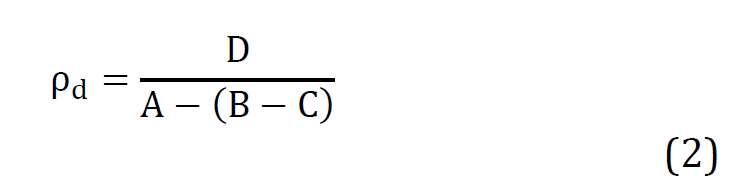
Specific gravity of the various aggregates were determined in accordance with British Standards Institution [22], Equation 2 shows the formula used to calculate it:
Where; ρ is bulk density (in Kg/m3), W1 is the mass of empty cylinder (in Kg), W2 is the mass of cylinder and sample (in Kg) and V is the volume of the cylinder (in m3).
Particle size distribution test (sieve analysis) was conducted in accordance with British Standards Institution [23,24].
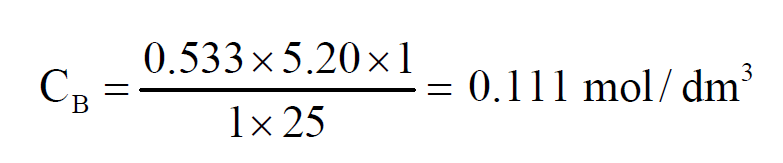
A pozzolanicity test was carried out for the PLA. It consists of mixing a given mass of the ash with a given volume of calcium hydroxide solution [Ca(OH)2] of known concentration and titrating samples of the mixture against hydrochloric acid solution of known concentration at time intervals of 30, 60, 90 and 120 minutes using phenolphtaline as indicator at normal temperature. The titre value was observed to reduce with time, confirming the ash as pozzolan that fixed more and more of the calcium hydroxide, thereby reducing the alkalinity of the mixture.
A slump test was carried out to determine the workability of the fresh concrete. This was done in conformity with British Standards Institution [25]. Also compressive strength test for the various cylindrical specimens was conducted in accordance with British Standards Institution [26], the formula is shown Equation 4:
A common mix ratio of 1:2:4 (blended cement: sand: granite) was used for the concrete cylinders. Batching was by weight and a constant water cement ratio of 0.55 was used. A mix ratio of 1:2:4 and a water/cement (w/c) of 0.55 were selected because they do not constitute the main focus of the research and they were kept constant throughout the test. Moreover, mix ratio 1:2:4 is among the most common in concrete mixes. Mixing was done manually, PLA was first thoroughly blended with OPC at the required proportion and the homogenous blend was then mixed with the fine aggregate, coarse aggregate also at the required proportions. Water was then added gradually and the entire concrete was mixed thoroughly to ensure homogeneity.
Eighty (80) concrete cylinders of 100mm diameter and 200mm height cylindrical mould were produced at percentage OPC replacement with PLA of 5, 10, 15 and 20%. Twenty concrete cylinders with 100% OPC were also produced to serve as controls. This gives a total of 100 concrete cylinders. All the concrete cylinders were cured by immersion. Four concrete cylinders for each percentage replacement of OPC with PLA and the control were tested for saturated surface by bulk density and crushed to obtain their compressive strengths at 7, 14, 21, 28 and 56 days of curing. Average values of concrete compressive strengths for various curing ages and percentages of OPC replacement with PLA were obtained and presented in tables and graphs. Empirical models were developed to predict the compressive strengths of OPC-PLA blended composites using polynomial regression analysis.
Model Development
The compressive strength of Plantain Leave Ash (PLA) concrete will be predicted using two variables, namely, curing age and percentage replacement of OPC with PLA.
An exponential function model of the form in Equation 5 was adopted for predicting the compressive strength of the PLA concrete:
Ftis compressive strength of concrete (N/mm2) at a given curing age (Days), x is the percentage replacement of OPC with PLA (%), $1 and $2 are constants. Applying natural logarithm on both sides of Equation 1 we obtain:
Through calibration, the constants " and $ can be determined. The exponential function models were subsequently developed for the curing ages of 7, 14, 21, 28 and 56 days.
A more generalized mathematical model combining logarithmic and exponential functions was subsequently developed to predict the compressive strength at any given age and percentage replacement.
RESULTS AND DISCUSSION
The resultant Plantain leaf ash had a bulk density of 755 kg/m3, specific gravity of 1.75 and fineness modulus of 1.36. The ibeto brand of Ordinary Portland Cement (OPC) had bulk density of 1650 kg/m3 and specific gravity of 3.13; river sand free from debris and organic materials had bulk density 1590 kg/m3 and specific gravity 2.66 and fineness modulus of 2.80; crushes granite of 4.75 mm nominal size and specific gravity of 2.77 and water free from organic impurity. The fine aggregate belonged to zone 3 based on British Standards Institution [27], grading limits for fine aggregate. The moisture content of the fine aggregate was found to be 14.3%. Although the quantity of water in the concrete mix has a substantial effect on the compressive strength, this effect cancelled out because the same fine aggregate was used in casting the cubes for both the control (i.e., 0% replacement) and the various percentages of PLA replacement of OPC.
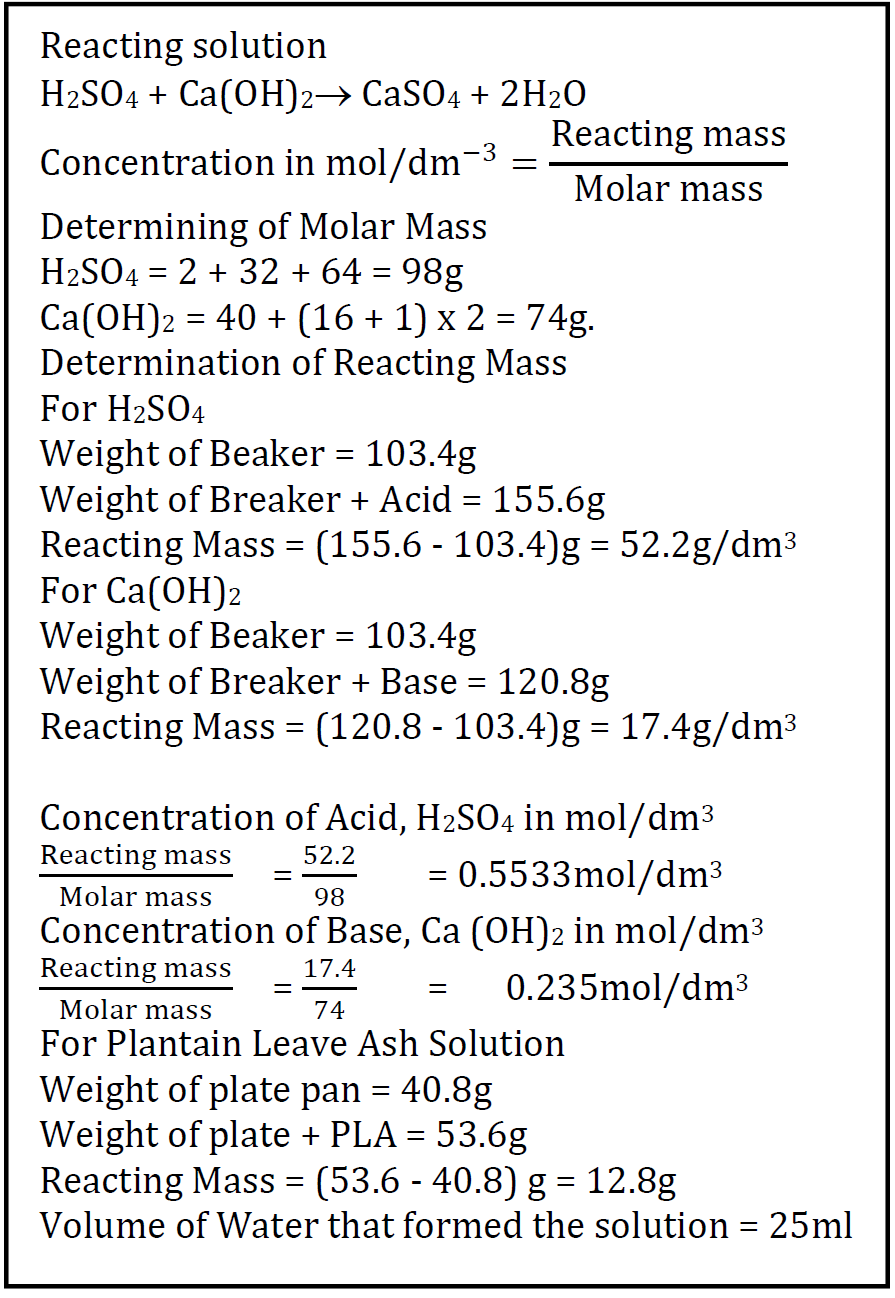
Pozzolanicity Test Calculations and Results
Table 1: Experiment Timing Table for SDA Solution
Parameters
30 minutes
60 minutes
90 minutes
120 minutes
1st Titration
2nd Titration
1st Titration
2nd Titration
1st Titration
2nd Titration
1st Titration
2nd Titration
Final burette reading (cm3)
460
460
11.3
23.4
5.20
5.20
43.8
48.0
Initial burette reading (cm3)
10.5
01.00
0.8
13.0
0.00
0.00
38.5
43.8
Volume of acid used (cm3)
10.9
11.50
10.5
10.4
5.20
5.20
5.30
4.20
Average
11.2 cm3
10.45 cm3
5.20 cm3
4.75 cm3
Table 2: Summary of the Mean Strength Result
MIX ID
% PLA
Mean Strength @ Age of Crushing (N/mm2)
7 days
14 days
21 days
28 days
56 days
Mix 1
0
20.93
24.86
30.85
33.80
38.08
Mix 2
5
18.75
24.26
31.60
34.69
40.58
Mix 3
10
19.88
24.62
32.33
33.05
42.19
Mix 4
15
17.75
20.63
26.47
32.70
36.47
Mix 5
20
16.89
19.36
25.29
30.34
33.24
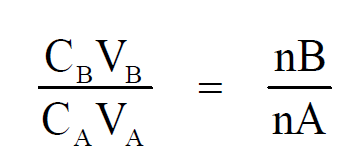
Determination of the Concentration of the PLA Mixture
Where:
CB = Concentration of base
VB = Volume of base
CA = Concentration of acid
VA = Volume of acid
nB = Molar number of base
nA = Molar number of acid
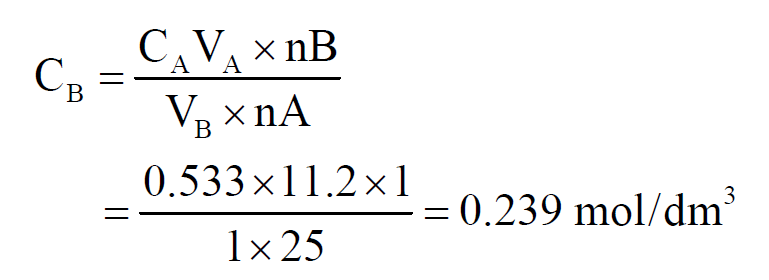
For 30 minutes:
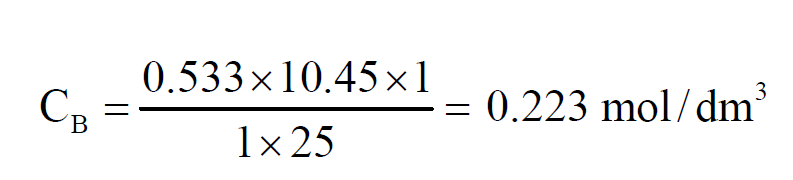
For 60 minutes:
For 90 minutes:
For 120 minutes:
The titre value was observed to reduce with time, confirming Plantain Leave Ash (PLA) as pozzolan that fixed more and more of the calcium hydroxide with time, thereby reducing the alkalinity of the mixture.
The plantain leaf ash was deliberately not pulverized to finer particles. No further grinding or processing was carried out on the ash retained on the 150 µm sieve that was used for the research. This is an indication that a higher value of compressive strength can be achieved if the particles were finer thereby increasing the pozzolanicity. The test confirmed PLA as a pozzolan since it fixed some quantities of lime over time thereby reducing the alkalinity of the mixture as reflected in the smaller titre value over time compared to the blank titre. The compressive strength of the blended cement concrete produced with OPC and SDA are shown in the Table 2.
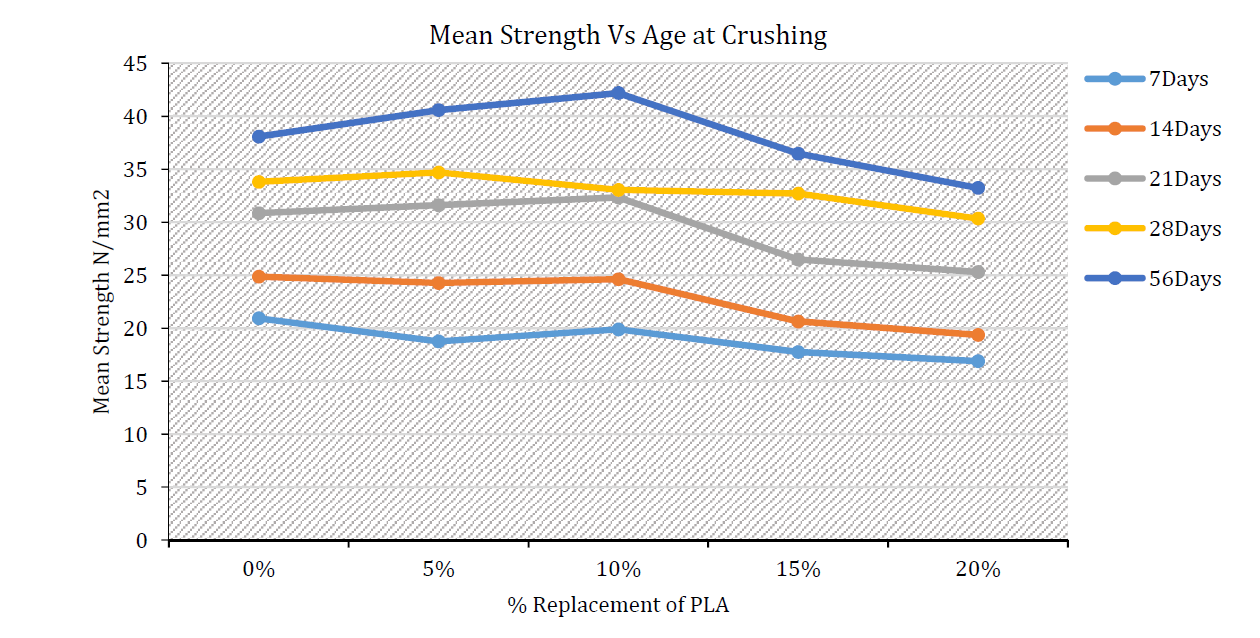
From Table 2, the compressive strength values of OPC-PLA blended cement concrete composite at all percentage replacement of OPC with PLA were much lower than the control values at 7 days but increased to become comparable to and even greater than the control values at 21, 28 and 56 days of curing. This trend is as a result of the low rate of pozzolanic reaction at early ages of curing. The silica from the pozzolan reacts with lime produced as by-product of hydration of OPC to form additional calcium-silicate-hydrate (C-S-H) that increases the binder efficiency and the corresponding strength values at later days of curing.
The 21-day strength value of 5 and 10% PLA replacement were more than the control value (i.e., 0% PLA replacement), representing about 102 and 105% of the control strength value respectively. The 28 day strength value showed 103 and 99% for the and 10% PLA, respectively. Also the 56 day strength value showed 106 and 110% for 5 and 10% PLA, respectively. Therefore 10% is the maximum replacement level beyond which the compressive strength will not be adequate for most concrete works. Beyond this point, the compressive strength value began to decline as the percentage of PLA increased. It can also be observed from Figure 1 that the strength across all percentages of replacement increased as the period of curing increased. This implies that if the samples were cured beyond 56 days, there is a potential for an improved strength. The workability and density of the concrete cylinders decreases with an increase in the percentage of PLA in the mix because the slump at the control was higher than other mixes. The results suggest that with good quality control of the concreting process, up to 10% of OPC replacement with PLA could be used for general reinforced concrete works.
It can therefore be inferred that the model equations are suitable for predicting the compressive strength of concrete made with OPC-PLA blended cement composite under prolonged curing.
Figure 1: Graph of Mean Strength Result against Percentage Replacement
CONCLUSION
The compressive strength of the concrete cylinder increased as the OPC replacement with PLA increases till 10% replacement and then started to decrease as the percentage replacement was increased beyond this point. As the percentage of PLA increased in concrete mix, the density decreased with the compressive strength at early ages of crushing. However, at later ages, the compressive strength increased up till 10% PLA replacement and then decreased. There is an increase in the compressive strength with age irrespective of the proportion of PLA to OPC in the mix. The strength variation of OPC-PLA composite suggests that with good quality control of the concreting process, 10% OPC replacement with PLA could be suitable for the production of concrete for use in concrete interlocking tiles. The workability and bulk density of the concrete cylinders decreases with increase in the percentage of Saw Dust Ash in the mix. The model values obtained from the various equations adequately corresponded with the laboratory values. This implies that the model equation can sufficiently be used to predict the compressive strength of concrete made with OPC-PLA blended cement composite under prolonged curing.
REFERENCE
Ettu, L.O. et al. “Strength of Binary Blended Cement Composites Containing Pawpaw Leaf Ash.” International Journal of Advancement in Research & Technology, vol. 2, no. 5, 2013a, pp. 236-238. ISSN 2278-7763.
Bakar, B.A. et al. “Malaysian Saw Dust Ash: Improving the Durability and Corrosion Resistance of Concrete.” Concrete Research Letters, vol. 1, no. 1, 2010, pp. 6-13.
Padney, S.P. et al. “Studies on High-Performance Blended/Multiblended Cements and Their Durability Characteristics.” Cement and Concrete Research, vol. 33, 2003, pp. 1433-1436.
Elinwa, A.U. and A. Awari. “Groundnut Husk Ash Concrete.” Nigerian Journal of Engineering Management, vol. 2, no. 1, 2001, pp. 8-15.
Ettu, L.O. et al.“Strength Variation of OPC-Rice Husk Ash-Saw Dust Ash Composite with Percentage Rice Husk Ash-Saw Dust Ash.” International Journal of Advanced Research in Civil Engineering, vol. 1, no. 7, 2013b. ISSN 2320-9100.
Ettu, L.O. et al. “Strength of Binary Blended Cement Composite Containing Oil Palm Bunch Ash.” International Journal of Engineering Science Invention, vol. 2, no. 4, 2013c. ISSN 2319-6734.
Adesanya, D.A. “Evaluation of Blended Cement Mortar, Concrete and Stabilized Earth Made from OPC and Corn Cob Ash.” Construction and Building Materials, vol. 10, no. 6, 1996, pp. 451-456.
Adesanya, D.A. “The Characteristics of Laterite Bricks and Blocks Stabilized with Corn Cob Fillers.” The Professional Builder, 2000, pp. 47-55.
Nimityongskul, P. and T.U. Daladar. “Use of Coconut Husk Ash, Corn Cob Ash and Peanut Shell Ash as Cement Replacement.” Journal of Ferrocement, vol. 25, no. 1, 1995, pp. 35-44.
Dwivedia, V.N. et al.“A New Pozzolanic Material for Cement Industry: Bamboo Leaf Ash.” International Journal of Physical Science, vol. 1, no. 3, 2006, pp. 106-111.
Hernandez, J.F. et al.“Use of Wastes of the Sugar Industry as Pozzolana in Lime Pozzolana Binders: Study of the Reaction.” Cement and Concrete Research, vol. 28, no. 11, 1998, pp. 1528-1536.
Singh, N.B. et al. “Hydration of Bagasse Ash-Blended Portland Cement.” Cement and Concrete Research, vol. 30, 2000, pp. 1485-1488.
Middendorf, B. et al. “Masonry Wall Materials Prepared by Using Agricultural Waste Lime and Burnt Clay.” Masonry Opportunities for the 21st Century, Edited by Throop, D. and R.E. Klingner, ASTM STP 1432, West Conshohocken, PA, 2003, pp. 274-283.
Cordeiro, G.C. et al. “Use of Ultrafine Saw Dust Ash with High-Carbon Content as Pozzolan in High Performance Concrete.” Materials and Structures, vol. 42, 2009, pp. 983-992.
Habeeb, G.A. and M.M. Fayyadh. “Saw Dust Ash Concrete: The Effect of SDA Average Particle Size on Mechanical Properties and Drying Shrinkage.” Australian Journal of Basic and Applied Sciences, vol. 3, no. 3, 2009, pp. 1616-1622.
Rukzon, S. et al. “Effect of Grinding on Chemical and Physical Properties of Saw Dust Ash.” International Journal of Minerals, Metallurgy and Materials, vol. 16, no. 2, 2009, pp. 242-247.
Mehta, P.K. “Properties of Blended Cement Made with Sawdust Ash.” ACI Journal Proceedings, vol. 74, 1997, pp. 440-442.
Elinwa, A.U. et al. “Assessing the Fresh Concrete Properties of Self-Compacting Concrete Containing Sawdust Ash.” Construction and Building Materials Journal, vol. 22, 2008, pp. 1178-1182.
Elinwa, A.U. and S. Abdulkadir. “Characterizing Sawdust Ash for Use as an Inhibitor for Reinforcement Corrosion.” New Clues in Sciences, vol. 1, 2011, pp. 1-10.
Chandrasekhar, S. et al. “Review: Processing, Properties and Applications of Reactive Silica from Rice Husk—An Overview.” Journal of Material Science, vol. 38, 2003, pp. 3159-3168.
British Standards Institution.BS 812, Part 109: Methods of Determination of Moisture Content. London: BSI, 1990.
British Standards Institution.BS 812, Part 2: Testing Aggregates, Methods for Determination of Physical Properties. London: BSI, 1975.
British Standards Institution.BS 1881, Part 107: Method of Determination of Density of Compacted Fresh Concrete. London: BSI, 1983.
British Standards Institution.BS 812, Part 103.1: Testing Aggregates, Methods for Determination of Particle Size Distribution. London: BSI, 1985.
British Standards Institution.BS 1881, Part 102: Testing Concrete, Method of Determination of Slump. London: BSI, 1983.
British Standards Institution.BS 1881, Part 110: Testing Concrete, Method of Making Test Cylinders from Fresh Concrete. London: BSI, 1983.
British Standards Institution.BS 882, Part 2: Grading Limits for Fine Aggregates. London: BSI, 1992.
Recommended Articles
Research Article
The Possibility of Treating Corrosion in Iron Valves of Flow Regulators, Pumping Station Components, and Suspended Solids Filtration Networks in Rivers and Streams in Al-Qadisiyah Governorate
Qasim M. Turki,
...
Ahmed Hakem Jabor
Published: 02/03/2026
Download PDF
Research Article
OBSERVATIONS ON THE HOMOGENEOUS TERNARY QUADRATIC DIOPHANTINE EQUATION x2 + 4xy + 9y2 = 21z2
Download PDF
Research Article
Computer Driven Library Management and Service Rendering System: Mobile Library Landscape
Yekini N. A,
...
Ojo O
Published: 10/06/2020
Download PDF
Research Article
The Availability and Utilization of Some Selected Digital Technology Facilities among Students of Mathematical Sciences Using Krejcie and Morgan’s Sample Size Determination Technique, A Case Study of Kogi State University Anyigba
Download PDF
PO Box 101, Nakuru
Kenya.
Email: office@iarconsortium.org
Editorial Office:
J.L Bhavan, Near Radison Blu Hotel,
Jalukbari, Guwahati-India
Chidiebere, U. D. & Ogaga Robert, O. (2021). Effect of OPC-Plantain Leaf Ash Composite on the Compressive Strength of Concrete Under Prolonged Curing. IAR Journal of Engineering and Technology, 2(1), 1-6.
MLA
Chidiebere, Ugwuanyi D. and Onosakponome Ogaga Robert. "Effect of OPC-Plantain Leaf Ash Composite on the Compressive Strength of Concrete Under Prolonged Curing." IAR Journal of Engineering and Technology 2.1 (2021): 1-6.
Chicago
Chidiebere, Ugwuanyi D. and Onosakponome Ogaga Robert. "Effect of OPC-Plantain Leaf Ash Composite on the Compressive Strength of Concrete Under Prolonged Curing." IAR Journal of Engineering and Technology 2, no. 1 (2021): 1-6.
Harvard
Chidiebere, U. D. and Ogaga Robert, O. (2021) 'Effect of OPC-Plantain Leaf Ash Composite on the Compressive Strength of Concrete Under Prolonged Curing' IAR Journal of Engineering and Technology 2(1), pp. 1-6.
Vancouver
Chidiebere UD, Ogaga Robert O. Effect of OPC-Plantain Leaf Ash Composite on the Compressive Strength of Concrete Under Prolonged Curing. IAR Journal of Engineering and Technology. 2021 Jan;2(1):1-6.


 Download PDF
 Download XML