Wet foam is a very common example of soft matter. In wet foam, molecules are more structured than in liquids but more random than they are in solids. Recently, physics of foam has become a rapidly developing branch in science and engineering. A deeper understanding is crucial for many technological applications of wet foam. Hence, in this article, the basic structure and properties of foam are reviewed based on the literature survey of published research work. Some research works, available in the literature, in which optical probes have been used to study the structure, properties and dynamics of foam. In this article, wet foam is used to study the basic structure and properties of foam for better understanding. Raman Spectroscopy and Diffusing wave Spectroscopy have been used on wet foam to establish its structure and properties are also reported. Finally, in conclusion, recent scientific, technological and commercial applications and future prospects of wet foam are proposed to build impulse on the wet foam science more to enrich our day to day life with the modern concepts of nanofoam technology. Recently, due to rapid increase of nanotechnology, different metallic (Cu, Au, Ni, Pt, Pd etc.) or nonmetallic (C) solvent-assisted nanofoam have modernized the structure, properties of foam science and hence have accelerated its day to day technological applications.
Keywords
Wet Foam
Rheology
Coarsening
Liquid Drainage
Collapse
Raman Spectroscopy
Diffusing Wave Spectroscopy
Nanofoam
INTRODUCTION
Imagine opening a carbonated cold drink bottle or a soda can after shaking it: almost instantaneously, gas bubbles rise and crowd together at the surface of the liquid forming a soft foam. Inside the bottle or can, carbon dioxide is dissolved in liquid at high pressure. Shaking of the container results in the creation of a large number of little bubbles as the agitation unbinds the carbonation from the solution. By opening the container, these gas bubbles rise to the liquid surface to release carbon dioxide into the surrounding air. Similar incident also occurs at the time of washing or shaving with soap. These are the common examples of sort lasting wet foam. the history of foam can be traced from the publication in 1873 titled Statique Experimentale et Theorique des Liquides soumis aux seules Forces Moleculaires by the Belgian physicist Joseph Antoine Ferdinand Plateau [1]. This book summarizes the previous history of foam research and also presents author's own work, which laid the foundation for the future studies. Soft foam is a very common example of soft matter (a matter which is neither liquid nor solid, but something in between). In foam, molecules are more structured than in liquids but more random than they are in solids. Foam physics has become a rapidly developing branch in science. This is due to the fact that the physics of foam is, as yet, ill-understood. Further, a deeper understanding is crucial for many technological applications of foam. There are a number of models are available in the literature to simulate the bubble growth in foam in two or three dimensions, its bubble size distribution and most essential properties of foam [2-14]. There are also a lot of experiments with wet foam in the literature to establish its essential properties [15-19]. Recently, carbon nanofoam is one of the lightest solid materials known today, having a density of ~2 mg/cm3. It has an extremely high surface area and is a good electrical insulator. It is fairly transparent, quite brittle and can withstand very high temperature. Highly uniform samples of carbon nanofoam from hydrothermal sucrose carbonization were studied by helium ion microscopy (HIM), X-ray photoelectron spectroscopy (XPS), and Raman spectroscopy [20]. Facile synthesis of Ni nanofoam using aqueous solutions at room temperature is studied for flexible and low-cost non-enzymatic glucose sensing [21]. Once more, hierarchical NiCo2O4 nanosheets are grown on Ni nanofoam as high‐performance electrodes for supercapacitors [22]. Cu nanofoams are also fabricated using a simple powder-metallurgy method which is useful for potential energy applications [23]. Bimetallic Pd/Pt nanostructure deposited on Cu nanofoam substrate by galvanic replacement are also fabricated as an effective electrocatalyst for hydrogen evolution reaction [24]. Gold nanofoams were synthesized in the Deep Eutectic Solvent (DES) with no templates, seeds, or additives [25]. Thus, there are many such foam with different advanced technological applications are reported in recent literature, but this article is focused to study the basic structure and properties of foam.
Basic Structure of foam
Foam is a two-phase cellular structure either of gas and liquid (liquid foam) or of gas and solid (solid foam). Here, in this article, we shall concentrate only on liquid foam. Liquid foam consists of a collection of gas bubbles surrounded by thin liquid films. A typical microscope image of wet foam (Gillette shaving foam) is shown in Figure 1.
Figure 1: A Typical Microscope Image of Gillette Shaving Foam
For better stability, some surface active substances (i.e. surfactants) are used while preparing liquid foam. There are mainly two types of liquid foam depending upon its liquid content (a) dry foamhas less liquid and consists of thin films between bubbles. These bubbles take the form of polyhedral cells and have a poly-disperse distribution and (b) wet foam, which has high liquid content. All bubbles in wet foam are spherical in shape and nearly mono-disperse at the initial state. In a statistical analysis of bubble size distribution using Gillette shaving foam shows coarsening of bubbles and the change in bubble size distribution in wet foam with ageing. It also shows an increase in polydispersity of foam with aging and the growth of larger bubbles at the cost of the smaller bubbles, during ageing [17].In a foamy network, the three liquid films from three nearby bubbles meet to form a scalloped-triangular channel, which is known as Plateau border. Only four Plateau borders meet at a region shared by four neighboring bubbles making equal angles and this region is known as the vertex. In foam, the Plateau borders and vertices form a continuous network. The law of Plateau defines few rules, which are necessary to obtain an equilibrium configuration of a foamy network. These rules are:
Rule 1: For dry foam, three films of three nearby bubbles intersect at a time with an angle of 120oto each other. In two dimensions, this applies to the lines, which define the cell boundaries
Rule 2: For dry foam, four bubbles meet and form a symmetric tetrahedral vertex. The angle between the films is called the Maraldi angle
Rule 3: In wet foam, Plateau border joins the adjacent films by smooth surfaces
Typical schematic diagrams of dry and wet foam with the construction of the corresponding Plateau border network are shown in Figure 2
Figure 2: Schematic Representations of Dry and Wet Foam With Plateau Border Network
In dry foam, the polyhedral bubbles are with slightly curved edges and faces. Any polyhedron (whose closed surface is topologically equivalent to that of a sphere) in three dimensional space obeys Euler's theorem, U – E + F = 2, where, U, E and F are the number of vertices, edges and faces of the polyhedron, respectively. For dry foam bubbles, the polyhedral geometry is further restricted by Plateau's rules. The coordination numbers of Plateau's laws enforce 2E = 3U and therefore, E = 3F - 6 follows for any foam polyhedron. In other words, for polyhedra in foam any of the three quantities U, E and F determines the other two. The fascinating properties of foam arise from its topological changes via T1 and T2 processes. While in the T1 process, a fourfold vertex dissociates into a stable threefold vertex (Figure 3(a)), a three-sided cell may disappear by the T2 process, as shown in Figure 3(b) [26].
Figure 3: Schematic Representations of Topological Changes in Liquid Foam via (A) T1 Process and (B) T2 Process [26]
Figure 4: A Schematic Diagram of the Stress-Strain Relation for Liquid Foam
With this introduction to the basic structure of wet foam, its essential properties are discussed in brief below.
Properties of Foam
To study the properties of foam, we have chosen wet foam for easy undersanding. In the following sections of this article, the four most essential properties of foam:
Rheology
Coarsening
Liquid drainage
Collapse, are briefly reviewed
A study about the structure and dynamics of wet foam using optical probes are also reported in the following sections.
Rheology
Foam has unique rheological properties. The mechanical response of liquid foam to an applied force is complex, exhibiting both elastic and viscous character [27]. Under low applied shear stress, foam behaves like an elastic solid. However, with an increase in stress it becomes progressively plastic; beyond a certain yield stress, the foam flows along with topological changes. The flow is intermittent and mediated by non-linear rearrangement events in which several neighboring gas bubbles suddenly hop from one tightly packed configuration to another. Such characteristics of foamy structure strongly depend on the bubble size, liquid fraction, viscosity and interfacial tension. The schematic stress-strain relation for the liquid foam is shown in Fig. 4. Both two and three dimensional foam can be accurately simulated using various models [28]. The computer simulation results provide the correlation between the shear modulus and gas/liquid fraction in the tightly packed gas bubbles [29-32]. For example, the model based on bubble-bubble interaction takes into account the pair-wise quadratic potential energies for connecting bubbles in the low compression limit. The bubble-scale model, proposed by Durian and his co-workers, explains the foam mechanics by solving the equation of motion of the individual disk (two dimensional projection of spheres) and assuming a harmonic potential for interaction between the bubbles [33-34]. The effect of liquid flow under low shear has been taken into account by including the viscous term. The model provides a connection between the complex macroscopic rheological behavior of foam and its underlying microscopic structure. Other models are also available in the literature, in which, the various aspects of the stress-strain relation have been dealt with [35-39].
Coarsening
Foams are of broad scientific interest for their ability to fill space efficiently with a random packing of bubbles and for the coarsening of this disordered structure with time. Coarsening is the gradual change of foam structure due to gas diffusion through the films from smaller bubbles to larger bubbles following the well-known Laplace-Young law. This law relates the pressure difference to the mean curvature for a surface in equilibrium. From Laplace-
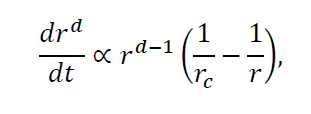
Young law, the balance in pressure difference inside a bubble, ΔP, can be expressed as: ΔP = ; where α is the surface tension of liquid film and r is the mean local radius of curvature of the film surface. r is related to the two principal curvatures r1 and r2 as: . For wet foam, the bubbles are spherical and hence r1 = r2. At equilibrium, the Laplace pressure is balanced by the disjoining pressure of the films, which originates from the mutual repulsion between the two surfaces of the thin liquid film (see Figure 5). In case of wet foam the gas diffusion takes place only through the liquid films not through the Plateau borders [40]. The increase in the average bubble size with time can be obtained from the fact that the rate of change of a bubble's volume is proportional to its surface area and to its Laplace pressure difference with respect to a certain mean or critical bubble radius rc. Thus,
Figure 5: The Mutual Repulsion (Disjoining Pressure) Between the Two Surfaces of a Thin Liquid Film
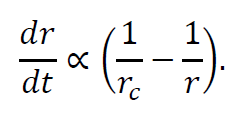
for any dimension d. for d=3
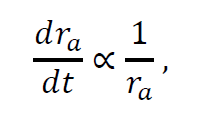
Thus, the large bubbles, r > rc, grow in size, whereas the smaller bubbles r < rcshrink. If rabe the average bubble radius, then we have
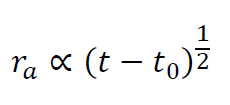
which implies that ra(t) . In general, the time-scale of evolution of the average bubble radius can be expressed as:
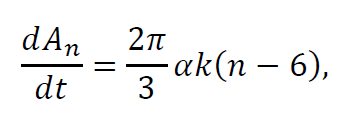
where, t0 is an initial constant. For an infinite foam network the coarsening process has no end. Thus, one can identify the asymptotic scaling behavior of foam with ageing. In 1952, von Neumann demonstrated that the time evolution of bubbles in a two dimensional foam only depends on the number of its sides, n, rather than on the size or shape of the bubbles [41]. The rate of change of area, An, of the nthbubble is given by the von Neumann's law
where, and k are the permeability constant and surface tension for the liquid films. The significance of the above equation for n = 6, is that the area of the hexagonal bubbles remain constant until they encounter a topological change. A number of models are available in the literature to simulate the bubble growth in foam in two or three dimensions [29,35,42-44].
Liquid drainage
The liquid between the bubbles can drain out in response to gravity or due to adjacent film rupture to settle into a equilibrium profile. This phenomenon is known as drainage. For fairly dry foams, the liquid is distributed in (a) the flat films that separate two neighboring bubbles, (b) the long Plateau borders and (c) the scalloped-tetrahedral vertices [45-47]. During drainage, the flow of liquid out of foam is assumed to be confined to the network of Plateau borders and/or vertices and it slows down as equilibrium is approached. Due to the density mismatch between gas and liquid, the bubbles rise and collect at the top and the liquid accumulates at the bottom. The liquid also flows because of the capillary effect, which is related to the gradient of liquid fraction in a column of foam. Such a gradient of liquid fraction implies an existence of a pressure gradient in the liquid foam. Thus, a capillary flow is induced by bringing liquid from high liquid fraction regions to regions with low liquid fraction. Liquid drainage in a column of wet foam has been modeled by non-linear partial differential drainage equation, which expresses liquid conservation as it flows in response to gravity, capillarity and viscous forces [47-49]. However, the analytical solutions of the nonlinear equation can only be obtained by ignoring the capillary term. Durian et al. designed an experiment, minimizing the capillary effect during drainage, to verify the drainage equation [50]. A generalized drainage equation for arbitrary shape of the container is also available in Ref. [50]. The complex draining action in a wet foam prompted many experiments in which the drained liquid has been measured as a function of time. In the experiments based on `forced drainage', a constant input of external liquid at the top of the foam column maintains a constant flow of liquid throughout the foam. On the other hand, for `free drainage' experiments, no external liquid is added on the top of foam surface. Free drainage is the unavoidable fate of aqueous foams under earth's gravity [45, 46]. Drainage of liquid in wet foam has been studied using various optical techniques, like absorption or transmission measurements. A detailed review is available in [51]. Free drainage with slow as well as fast coarsening of gas is a coupled phenomenon in wet foam [51, 42]. In spite of a thorough endeavor to understand the free drainage process in wet foam, the problem is still not well understood [53].
Collapse
Usually, most liquid foams do not last for long, as the bubbles collapse by the rupture of the exposed liquid films. Many factors like liquid drainage, coarsening, evaporation, impurities and additives are responsible for foam collapse. The study of foam collapse has a great practical importance because it deals with the stability of the film. Topological change in foam structure due to the bubble growth by film rupturing is less studied in the literature and remains very poorly understood. A crucial feature of liquid foam is that it irreversibly evolves with time. The spherical bubbles in fresh foam take the form of polyhedra while minimizing the energy of the system. The evolution of the bubbles in foam with time can be described by the above four mutually coupled mechanisms.
Measurement of Properties of Wet Foam with Light
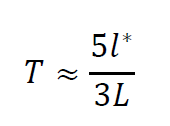
Structure and properties of foam have been probed extensively using various optical techniques. Here we mention some of the earlier works, where light has been used to measure the size, wetness, movement of bubbles and other properties of foam. Diffusing wave spectroscopy (DWS) is the most commonly used optical tool to study the behavior of foam [54-57]. This technique is an extension of Dynamic light scattering technique for a strongly scattered medium, where the propagation of light is described by the diffusion approximation [58]. The autocorrelation function of the multiple scattering of light is calculated by dividing the photons into separate diffusive paths. The distribution of these paths and the probability that the photon will follow a path of a given length is determined through the diffusion equation of light. The total correlation function is then determined by summing the contributions from all possible paths with weighted probabilities, assuming that each path is uncorrelated with the other path. The fluctuations of the transmitted scattered light result from the variation in total optical path length. The decay of the temporal autocorrelation function of the intensity of the scattered light, which reflects the temporal evolution of the path length, provides the dynamics of the medium. DWS has been extensively used to study bubble size and liquid fraction in wet foam. Using this technique the static transmission coefficient (T) of light through foam of a given thickness has been measured. Diffusion of light is characterized by the transport mean free path, l*, of the transmitted light. It has been shown that
(Considering the large thickness of the foam, L, and no absorption of light by foam). Using this relation, average bubble diameter dacan be estimated from the relation [53]. The scaling behavior of the bubble growth, discussed in the above section-3, has been verified experimentally with the average bubble diameter growing in time as tz, with [60]. It is reported that the changes in the packing conditions during the coarsening process give rise to a dynamical process that also exhibits temporal scaling. In Ref. [61], Vera et al. used the multiple scattering of light by aqueous foam to study the coupling between drainage and coarsening mechanisms. Other than confirming the fact that the transport mean free path is proportional to the bubble diameter, authors have shown that the liquid fraction in foam is proportional to . Furthermore, DWS is a potential tool to study the viscoelastic behavior of foam [62]. The technique has also been applied to model foam subjected to shear stress. The observed data reflect the local rearrangement events in the foam [63, 64]. Along DWS, various other optical techniques have been used to study the behavior of wet foam. The change in the degree of depolarization of a collimated, polarized incident light on non-absorbing foams has been studied by Wong et al. [65]. It is observed that the denser media (with a large number of bubbles) tend to depolarize the incident beam more. The degree of depolarization can be correlated to the bubble size distribution in wet foam. Durian and his coworkers used the photon channelling experiments to study the absorptivity and liquid fraction in foams [66]. The authors added a dye to the continuous liquid phase for the absorption of diffuse photons in the aqueous foams and studied the absorption mechanisms under different experimental conditions.
Study Wet Foam by Raman Scattering
In this thesis, we have studied the properties of the soft Gillette shaving foam, using a optical spectroscopic technique, based on Raman scattering. Raman spectroscopy is a powerful noninvasive tool to probe the structure and dynamics of a system at the molecular level. Our aim is to investigate, if this technique can be used to study the effect of ageing on molecular structure and to characterize the stability of wet foam. In addition, Raman scattering is caused by deformation/stretching of different vibrational bonds of molecules. Thus, if macroscopic and microscopic properties in foam are related, one expects that the analysis of Raman line profiles can be used to probe the elastic properties of wet foam, indirectly, by studying its molecular behavior. The main hindrance in using Raman spectroscopy to probe wet foam arises due to multiple scattering of light within the bubbles, which masks the Raman signal from the foamy structure, to a large extent. The signal to noise ratio in the spectrum is always poor in this case. Thus, in the literature, we do not find too many articles on Raman studies of wet foam. The most significant one is by Goutev and Nickolov [67], where the authors have studied the microstructure of stable three-dimensional foam on the basis of its molecular behavior. Based on Raman measurements of foam, authors have shown that (a) two distinct phases can exist in wet foam|a lamellar phase (with an ordered multilayer structure of surfactant molecules) and an isotropic phase, (b) in fresh foam small bilayer lamellae are dispersed in foam films and with ageing they self-organize around the bubble in large shell-like bilayer structures. It is to be noted that the quantitative estimates of the structure and properties of liquid foam depend on the liquid fraction and the chemical constituents. However, the generic features are expected to remain same for all. Since, the other groups have worked on various aspects of foam using Gillette shaving foam as their sample [59, 60, 64, 67], it is preferable to use the same material for further investigation while using a new experimental technique. Therefore, we have chosen the Gillette foam in our work. The basic ingredients of Gillette shaving foam are triethanolamine stearate with small amount (< 1%) of sodium lauril sulphate, polyethylene glycol lauril ether and emulsified liquid hydrocarbon gases. These ingredients are kept in an aqueous solution under high pressure. The foam is produced after expansion of the above mixture in air. It is reproducible and stable over the duration required for an optical measurement. For Raman measurements this commercial foam offers an extra advantage|when laser light is incident on foam it undergoes multiple scattering. In order to obtain the optimum Raman signal, the mean free path, l*, [ average diameter of the bubbles (da)] of light within the foam should be comparable with the slit-width of the spectrometer collecting the scattered light [68]. The mean diameter of bubbles in fresh Gillette shaving foam is close to 30 µm and the maximum diameter, which we have studied, is 350 m|comparable with the slit-width of our spectrometer (100 m) in order of magnitude. Below we discuss the basic principle of Raman scattering and also the instrument used by us for the Raman measurements. Different recent researches on wet foam have explained the gross properties of wet foam in light of its characteristic molecular structure using Raman spectroscopy. They have related the observed shift in the low frequency Raman peak position of the methylene rocking mode with the variation in internal stress in the system. The analysis of Raman data over the range between 1000 cm-1 and 1450 cm-1 indicates the gradual structural change of wet foam from all-trans conformation to crystalline structure with ageing [27]. Drainage of water from wet foam is discussed and in addition to free water molecules, which drain out with ageing of foam, water clusters of only a few water molecules are also present in foam. It is also shown that the correlation between the internal stress and the characteristics of a vibrational mode in wet foam. Thus the capability of the Raman spectroscopy to reveal the crystallinity in foamy materials is established [18-19].
CONCLUSION
In conclusion, the basic structure and properties of wet foam are reviewed in the light of present scientific literature to reveal interesting essential properties of wet foam. The optical probes (specially, Raman spectroscopy and Diffusing wave spectroscopy) used to study the wet foam are also briefly discussed. There are huge applications of solid foam compared to wet foam reported in the literature. Similarly, recent researches suggest that wet foam has also the huge possibilities in different technological applications like fire extinguishing, food processing, commercial chemicals and cosmetics, agricultural fields, biomedical fields, environmental safety and toy-making industries etc. [68-70]. Recently, the higher density foams like carbon nanofoam, however, show an advanced graphitization degree and a stronger sp3-type electronic contribution, related to the inclusion of sp3 connections in their surface network [20]. Again, by employing Ni nanofoam flexible and highly sensitive glucose sensors have been produced on a plastic substrate with excellent performances [21]. A high‐performance electrode for supercapacitors is also designed and synthesized by growing electroactive NiCo2O4 nanosheets on conductive Ni nanofoam [22]. Again,Cu nanofoams are also very much useful for potential energy application [23]. The gold nanofoams with no capping agents have more catalyst active sites and excellent catalytic efficiency [25].The main objective of this article is to review the structure and properties of foam to attract more research attention towards foam technology and develop this field for more scientific, technological and commercial applications for our day to day life. Diffusing wave spectroscopy and Raman spectroscopy are quick and noninvasive tool to measure the strain and hence, the stability of a wet foam [18, 19] and hence, these spectroscopic techniques can act as optical probe to study the properties of foam. Some papers use Gillette shaving foam to study wet foam characteristics. But, the composition of commercial shaving foams (like Gillette foam) is quite complex and its physicochemical properties are ill defined; it is worth to study the wet foam using simple foamy materials with well controlled composition, specially made in a laboratory. Further experiments on known surfactants will also indicate if the observed behavior of the wet foam originates from the characteristics of the surfactant itself or from its foamy structure [38,71,72]. Furthermore, using the experimental method stated in [18] at different heights of the column of foam, one can experimentally study the coupling between coarsening and drainage of liquid in wet foam.
Acknowledgment
The author wishes to acknowledge Prof. Anusree Roy, Department of Physics and Meteorology, Indian Institute of Technology, Kharagpur, India for her helpful discussions and guidance.
REFERENCE
Plateau, J.A.F. Statique Expérimentale et Théorique des Liquides Soumis aux Seules Forces Moléculaires.Gauthier-Villars, Paris, 1873. 2 vols.
Glazier, J.A. M.P. Anderson, and G.S. Grest. “Coarsening in the Two-Dimensional Soap Froth and the Large-Q Potts Model: A Detailed Comparison.” Philosophical Magazine A, vol. 62, 1990, pp. 615–629.
Lim, K.S. and M. Barigou. “Pneumatic Foam Generation in the Presence of a High-Intensity Ultrasound Field.” Ultrasonics Sonochemistry, vol. 12, 2005, pp. 385–399.
Magrabi, S.A. B.Z. Dlugogorski, and G.J. Jameson. “Bubble Size Distribution and Coarsening of Aqueous Foams.” Chemical Engineering Science, vol. 54, 1999, pp. 4007–4021.
Monsalve, A. and R.S. Schechter. “The Stability of Foams: Dependence of Observation on the Bubble Size Distribution.” Journal of Colloid and Interface Science, vol. 97, 1984, pp. 327–337.
Lemlich, R. “Prediction of Changes in Bubble Size Distribution due to Interbubble Gas Diffusion in Foam.” Industrial & Engineering Chemistry Research, vol. 17, 1978, pp. 89–95.
Hutzler, S. and D. Weaire. “Foam Coarsening under Forced Drainage.” Philosophical Magazine Letters, vol. 80, 2000, pp. 419–425.
Ganan-Calvo, A.M. et al. “Coarsening of Monodisperse Wet Microfoams.” Applied Physics Letters, vol. 84, 2004, pp. 4989–4992.
McDaniel, J.G. et al. “Inviscid Dynamics of a Wet Foam Drop with Monodisperse Bubble Size Distribution.” Physics of Fluids, vol. 14, no. 6, June 2002, pp. 1886–1894.
Kabla, A. and G. Debregeas. “Quasi-Static Rheology of Foams. Part 1. Oscillating Strain.” Journal of Fluid Mechanics, vol. 587, 2007, pp. 23–44.
Gardiner, B.S. et al. “The Evolution of Defects in a Two-Dimensional Wet Foam.” Journal of Physics: Condensed Matter, vol. 11, 1999, pp. 5437–5453.
Gardiner, B.S. et al. “The Steady Shear of Three-Dimensional Wet Polydisperse Foams.” Journal of Non-Newtonian Fluid Mechanics, vol. 92, 2000, pp. 151–166.
Sun, B. et al. “Heat and Mass Transfer.” International Journal of Heat and Mass Transfer, vol. 86, 2015, p. 898.
Tenneti, S. et al.International Journal of Heat and Mass Transfer, vol. 58, no. 1–2, 2013, p. 471.
Feitosa, K. et al. “Bubble Kinetics in a Steady-State Column of Aqueous Foam.” Europhysics Letters vol. 76, 2006, pp. 683–689.
Saint-Jalmes, A. et al. “Free Drainage of Aqueous Foams: Container Shape Effects on Capillarity and Vertical Gradients.” Europhysics Letters, vol. 50, 2000, pp. 695–701.
Barik, T.K. and A. Roy. “Statistical Distribution of Bubble Size in Wet Foam.” Chemical Engineering Science, vol. 64, no. 9, 2009, pp. 2039–2043.
Bandyopadhyay, P. et al. “Drainage and Water Clusters in Gillette Foam.” Journal of Raman Spectroscopy, vol. 39, 2008, pp. 827–831.
Barik, T.K. et al. “Probing Internal Stress and Crystallinity in Wet Foam via Raman Spectroscopy.” International Journal of Modern Physics B, vol. 23, no. 19, 2009, pp. 3711–3722.
Frese, N. et al.Beilstein Journal of Nanotechnology, vol. 7, 2016, pp. 2065–2073.
Iwu, K.O. et al.Sensors and Actuators B: Chemical, vol. 224, 2016, pp. 764–771.
Gao, G. et al.Small, vol. 11, 2015, pp. 804–808.
Jo, H. et al.Materials Chemistry and Physics, vol. 145, 2014, pp. 6–11.
Rezaei, B. et al.International Journal of Hydrogen Energy, vol. 40, 2015, pp. 6754–6762.
Jia, H. et al.Journal of Molecular Liquids, vol. 212, 2015, pp. 763–766.
Dennin, M. and C.M. Knobler. “Experimental Studies of Bubble Dynamics in a Slowly Driven Monolayer Foam.” Physical Review Letters, vol. 78, 1997, pp. 2485–2490.
Kraynik, A.M. “Foam Flows.” Annual Review of Fluid Mechanics, vol. 20, 1988, pp. 325–357.
Weaire, D. and S. Hutzler. The Physics of Foams. Oxford University Press, 1999, pp. 215–217.
Bolton, F. and D. Weaire. “Rigidity Loss Transition in a Disordered 2D Froth.” Physical Review Letters, vol. 65, 1990, pp. 3449–3452.
Feng, S. et al. “Effective-Medium Theory of Percolation on Central-Force Elastic Networks.” Physical Review B, vol. 31, 1985, pp. 276–284.
Hutzler, S. et al. “The Effects of Plateau Borders in the Two-Dimensional Soap Froth: III. Further Results.” Philosophical Magazine B, vol. 71, 1995, pp. 277–277.
Princen, H.M. and A.D. Kiss. “Rheology of Foams and Highly Concentrated Emulsions III: Static Shear Modulus.” Journal of Colloid and Interface Science, vol. 112, 1986, pp. 427–427.
Durian, D.J. “Foam Mechanics at the Bubble Scale.” Physical Review Letters, vol. 75, 1995, pp. 4780–4780.
Durian, D.J. “Bubble-Scale Model of Foam Mechanics: Melting, Nonlinear Behavior, and Avalanches.” Physical Review E, vol. 55, 1997, pp. 1739–1739.
Glazier, J.A. and E. Weaire. “The Kinetics of Cellular Patterns.” Journal of Physics: Condensed Matter, vol. 4, 1992, pp. 1867–1867.
Weaire, D. and S. McMurry. “Some Fundamentals of Grain Growth.” Solid State Physics: Advances in Research and Applications, edited by H. Ehrenreich and F. Spaepen, vol. 50, Academic Press, 1997.
Khan, S.A. and R.C. Armstrong. “Rheology of Foams: I. Theory for Dry Foams.” Journal of Non-Newtonian Fluid Mechanics, vol. 22, 1986, pp. 1–1.
Jabarkhyl, S. et al. “Innovative Food Science & Emerging Technologies.” Innovative Food Science & Emerging Technologies, vol. 64, 2020, p. 102304.
Ptaszek, P. “Food Research International.” Food Research International, vol. 54, no. 1, 2013, p. 478.
“In Ref. [20], See p. 98.”
Neumann, V. Metal Interfaces. American Society for Metals, 1952, p. 108.
Petzek, T.W. “Self-Similar Collapse of Stationary Bulk Foams.” American Institute of Chemical Engineers Journal, vol. 39, 1993, pp. 1697–1697.
Avron, J.E. and D. Levine. “Geometry and Foams: 2D Dynamics and 3D Statics.” Physical Review Letters, vol. 69, 1992, pp. 208–208.
Feitosa, K. et al. “Bubble Kinetics in a Steady-State Column of Aqueous Foam.” Europhysics Letters, vol. 76, 2006, pp. 683–683.
Bikerman, J.J. Foams. Springer-Verlag, 1973.
Prudhomme, R.K. and S.A. Khan, editors. Foams: Theory, Measurement, and Application. Marcel Dekker, 1996.
Weaire, D. et al. “A Review of Foam Drainage.” Advances in Chemical Physics, vol. 102, 1997, pp. 315–315.
Bhakta, A. and E. Ruckenstein. “Decay of Standing Foams: Drainage, Coalescence and Collapse.” Advances in Colloid and Interface Science, vol. 70, 1997, pp. 1–1.
Koehler, S.A. et al. “Dynamics of Foam Drainage.” Physical Review E, vol. 58, 1998, pp. 2097–2097.
Saint-Jalmes, A. et al. “Free Drainage of Aqueous Foams: Container Shape Effects on Capillarity and Vertical Gradients.” Europhysics Letters, vol. 50, 2000, pp. 695–695.
Saint-Jalmes, A. “Physical Chemistry in Foam Drainage and Coarsening.” Soft Matter, vol. 2, 2006, pp. 836–836.
Hilgenfeldt, S. et al. “Dynamics of Coarsening Foams: Accelerated and Self-Limiting Drainage.” Physical Review Letters, vol. 86, 2001, pp. 4704–4704.
Saint-Jalmes, A. et al. “Uniform Foam Production by Turbulent Mixing: New Results on Free Drainage vs. Liquid Content.” European Physical Journal B, vol. 12, 1999, pp. 67–67.
Miri, M.F. and H. Stark. “The Role of Liquid Films for Light Transport in Dry Foams.” Europhysics Letters, vol. 65, 2004, pp. 567–567.
Gittings, A.S. and D.J. Durian. “Gaussian and Non-Gaussian Speckle Fluctuations in the Diffusing-Wave Spectroscopy Signal of a Coarsening Foam.” Applied Optics, vol. 45, 2006, pp. 2199–2199.
Gopal, A.D. and D.J. Durian. “Shear-Induced Melting of an Aqueous Foam.” Journal of Colloid and Interface Science, vol. 213, 1999, pp. 169–169.
Håohler, R. et al. “High Resolution Diffusing-Wave Spectroscopy Using Optimized Heterodyne Detection.” Journal of the Optical Society of America A, vol. 20, 2003, pp. 2179–2179.
Weitz, D.A. et al. “Diffusing-Wave Spectroscopy: The Technique and Some Applications.” Physica Scripta T, vol. 49, 1993, pp. 610–610.
Durian, D.J. et al. “Multiple Light-Scattering Probes of Foam Structure and Dynamics.” Science, vol. 252, 1991, pp. 686–686.
Durian, D.J. et al. “Scaling Behavior in Shaving Cream.” Physical Review A, vol. 44, 1991, pp. R7902–R7902.
Vera, M.U. et al. “Scattering Optics of Foam.” Applied Optics, vol. 40, 2001, pp. 4210–4210.
Mason, T.G. p “Diffusing-Wave-Spectroscopy Measurements of Viscoelasticity of Complex Fluids.” Journal of the Optical Society of America A, vol. 14, 1997, pp. 139–139.
Earnshaw, J.C. and M. Wilson. “Strain-Induced Dynamics of Flowing Foam: An Experimental Study.” Journal of Physics: Condensed Matter, vol. 7, 1995, pp. L49–L49.
Earnshaw, J.C. and A.H. Jaafar. “Diffusing-Wave Spectroscopy of a Flowing Foam.” Physical Review E, vol. 49, 1994, pp. 5408–5408.
Wong, B.T. and M.P. Mengüc. “Depolarization of Radiation by Non-Absorbing Foams.” Journal of Quantitative Spectroscopy and Radiative Transfer, vol. 73, 2002, pp. 273–273.
Gittimgs, A.S. et al. “Photon Channelling in Foams.” Europhysics Letters, vol. 65, 2004, pp. 414–414.
Goutev, N. and Zh.S. Nikolov. “Raman Studies of Three-Dimensional Foam.” Physical Review E, vol. 54, 1996, pp. 1725–1725.
Nieto, M.I. et al. “Advances in Engineering Materials.” Advanced Engineering Materials, vol. 16, 2014, pp. 637–637.
Takahashi, M. et al. “J. Eur. Ceram. Soc.” Journal of the European Ceramic Society, vol. 29, 2009, pp. 823–823.
Subagyono, J.N. et al. “Energy Procedia.” Energy Procedia, vol. 4, 2011, pp. 839–839.
De Moraes, E.G. and P. Colombo. “Material Letters.” Materials Letters, vol. 128, 2014, pp. 128–128.
Zhao, J. et al. “Ceramics International.” Ceramics International, vol. 44, no. 1, 2018, pp. 269–269.
Recommended Articles
Research Article
OBSERVATIONS ON THE HOMOGENEOUS TERNARY QUADRATIC DIOPHANTINE EQUATION x2 + 4xy + 9y2 = 21z2
Download PDF
Research Article
Computer Driven Library Management and Service Rendering System: Mobile Library Landscape
Yekini N. A,
...
Ojo O
Published: 10/06/2020
Download PDF
Research Article
The Possibility of Treating Corrosion in Iron Valves of Flow Regulators, Pumping Station Components, and Suspended Solids Filtration Networks in Rivers and Streams in Al-Qadisiyah Governorate
Qasim M. Turki,
...
Ahmed Hakem Jabor
Published: 02/03/2026
Download PDF
Research Article
Influence of Optimum Percentage of Waste Ceramic Powder as a Fine Aggregate Replacement on Hardened Properties of Concrete
Mohammad Ali Asaad,
...
Mohammed Muhsin
Published: 11/06/2020
Download PDF
PO Box 101, Nakuru
Kenya.
Email: office@iarconsortium.org
Editorial Office:
J.L Bhavan, Near Radison Blu Hotel,
Jalukbari, Guwahati-India



 Download PDF
 Download XML



 ; where α is the surface tension of liquid film and r is the mean local radius of curvature of the film surface. r is related to the two principal curvatures r1 and r2 as: