Contents
Download PDF
pdf Download XML
25 Views
10 Downloads
Share this article
Research Article | Volume 6 Issue 2 (July-December, 2025) | Pages 1 - 7
Event Detection in Wireless Sensor Networks Using Machine Learning and Deep Learning: A Comparative Analysis for Smart Environments
1
Department of Cybersecurity Engineering Technologies, Technical Engineering College, Al-Farabi University, Baghdad 10001, Iraq
Under a Creative Commons license
Open Access
Received
Sept. 3, 2025
Revised
Oct. 9, 2025
Accepted
Nov. 19, 2025
Published
Dec. 31, 2025
Abstract

The Wireless Sensor Networks (WSNs) have a central place in the facilitation of smart environments through the provision of continuous monitoring features and real-time data collection features in various fields of use including environmental monitoring, smart cities, healthcare and industrial automation. One of the most crucial issues in the WSNs is the accurate real-time detection of events in WSNs subject to limitations of limited energy, noisy data and dynamic network conditions. The classical rule-based and threshold-based methods are not always flexible to new and dynamic trends in sensor data. In this paper, a detailed comparative study of machine learning methods in the detection of events in WSNs is described. Various models are considered such as Support Vector Machine (SVM), Random Forest (RF), K-Nearest Neighbors (KNN) and Deep Learning models such as Long Short-Memory (LSTM) and see how well each of them can detect regardless of computational resource utilization and energy consideration. The proposed structure combines the preprocessing of the data, the extraction of the features and model optimization to improve the detection performance in smart environments. The results of the experiment prove that machine learning-based methods are much more effective than traditional ones and that LSTM has a higher degree of performance with regards to capturing the temporal dependencies, whereas the Random Forest offers a reasonable trade-off between trained accuracy and the cost of computation. The results show that it is significant to choose the right models depending on the need of application and resource limitation. The research is useful in the development of smart environments that are based on WSN and development of intelligent, adaptive and energy efficient event detection systems in the next-generation wireless smart communication systems.

Keywords
INTRODUCTION

WSNs have become essential enabling technology of a smart environment and support real-time monitoring and intelligent decision-making in a broad array of applications, such as smart cities, environmental surveillance, industrial automation and healthcare systems. These networks are made up of distributed sensor nodes that have the capability of sensing, processing and transmitting the data to centralized or edge-based systems [1]. As the Internet of Things (IoT) continues to expand, WSNs have been more relevant in managing the high volumes of heterogeneous and dynamic data [2, 3]. 


Event detection is one of the most important tasks in WSNs that involves the detection of important changes or anomalies in sensed data that represent events in the real world. Precise events detection is required to intervene in time in applications like forest fire detection, intrusion tracking, fault troubleshooting and disaster management. Nevertheless, this is not an easy task because of a number of intrinsic constraints of WSNs such as energy, lack of sufficient computational capabilities, sensor noise and changing environmental factors [4]. 


The conventional event detection in WSN is mainly driven by thresholding and statistical models. Although these methods are easy and computationally inexpensive, they do not have adaptability and are unable to learn complicated trends in high-dimensional sensor data. Consequently, they tend to generate large rates of false alarms and lower rates of detection especially when operating in fluid and unpredictable conditions [5]. 


In response to such problems, machine learning (ML) tools have been used more and more to detect events in WSNs. ML-based methods may be trained on historical data and adapt to a new environment, as well as increase the accuracy of the detection process by capturing nonlinear relationships between sensor measurements. The approaches based on Support Vector Machines (SVM), Decision Trees, Random Forests, K-Nearest Neighbors (KNN) and deep learning, including Long Short-Term Memory (LSTM) networks have demonstrated encouraging performance in this area. Although the research on the ML-based event detection is increasinglygaining interest, comparative studies that assess various models on identical conditions are also lacking, especially in the domain of smart environments, where accuracy and power consumption matters. The majority of the existing literature dwells on a single algorithm or a rather small range of models without paying much attention to the practical deployment limitations [6, 7]. 


Thus, the purpose of this paper is to give a comparative analysis of several machine learning methods to detect events in WSNs in terms of their accuracy, complexity and their applicability to such resource-limited environment. Predominant contributions of this work could be summarized to be:


  • An all-encompassing system of detecting events in WSNs that incorporates preprocessing, feature extraction and classification.

  • The comparison between classical and deep learning models (LSTM) (SVM, KNN, RF). 

  • Accuracy, precision, recall, F1-score and computational cost performance analysis. 

  • Understanding the choice of suitable models of smart environment application. 


The paper will be divided into the following sections: Section 2 of the paper will be related work, Section 3 will be the proposed methodology, Section 4 will be a discussion on the experimental results and Section 5 will be the conclusion of the paper and its implications on future research.


Related Work

The maximum research on the topic of Wireless Sensor Networks (WSNs) has been initiated by their extensive use in smart environments, mostly in the event detection and anomaly identification areas. Conventional methods of event detection in the WSNs relied principally on the threshold-based and statistical methods, but these methods are usually limited in their flexibility and are not well adjusted in dynamic settings [8, 9,10].


In the recent past, there have been growing interests in hybridizing machine learning (ML) and deep learning (DL) to enhance the level of detection. As an example, Wang et al. [11] suggested a deep learning framework of anomaly detection used to integrate metric learning with spatial -temporal feature extraction, showing better accuracy and generalization in data analysis of WSN data. In the same situation, Shu et al. [12] developed an anomaly detection system of agricultural Wireless Sensor Network by applying the detection algorithm to a gateway and hence real-time filtering abnormal data as well as minimizing unnecessary transmission. In the same way, the hybrid MarkovLSTM model of anomaly detection used in the environment based on IoT protocols by Shanmuganathan et al. [13] created to overcome the shortcomings of the classical techniques in relation to processing costs and memory requirements. Their strategy was found to have a high detection rate as well as minimize false alarms that were much better than the traditional methods like the KNN. Furthermore, Noh et al. [14] invented a two-layered LSTM-based anomaly detecting model to track the indoor environmental conditions with the aid of IoT sensors, temperature, humidity, CO 2 and air quality features. The suggested model is an efficient way to detect anomaly in real time and give early warnings to facilitate automated control of the indoor environment. The experimental findings show a high level of detection, which reflects the ability of the model to augment the smart building management systems.


Frameworks that are based on machine learning have also been extensively investigated. Nguyen et al. [15] provided an extensive overview of the latest progress in machine learning and deep learning and noted their capability to handle large-scale and heterogeneous data. The paper analyzes the fast evolution of AI models and open-source software and highlights the patterns of software deployment and scalability. The authors also address the issue of parallel computing as an instrument of optimization and facilitation of effective data processing in a big data setting. Likewise, Etman et al. [16] developed a review on the use of machine learning techniques with wireless sensor networks in smart grid systems. The paper identifies the usefulness of supervised, unsupervised and reinforcement learning methods in improving system reliability, fault detection and energy efficiency. The authors determined the main datasets, issues and the direction of further research by conducting a massive examination of recent literature and were able to show that the combination of ML and WSNs enhances the overall performance of smart grid settings and makes them more sustainable. 


Moreover, a hybrid and advanced AI-based method has been suggested to optimize detection. Thakfan et al. [17] suggested a machine learning system to detect faults in the solar photovoltaic (PV) systems through thermal imaging and current voltage (Ivoltage) curve analysis. The model combines visual and electrical data to improve the accuracy of defects detection by the use of transfer learning. The results of the experimental research prove that the suggested approach is characterized by high performance (more than 98 percent in accuracy and recall) and lowering resource consumption. The research indicates the usefulness of utilizing a combination of data in the diagnosis of faults in large-scale PV systems in a reliable and efficient manner. 


Although these developments have happened, a number of issues still exist such as dealing with time-dependent relationships, decreasing the complexity of their computations and energy-efficiency of the deployment of WSNs. The majority of the literature available is on traditional machine learning models or deep learning methods on their own but there is little comparative study on both approaches under homogeneous conditions. 


Thus, the proposed study seeks to offer an in-depth comparative analysis of the two-machine learning as well as deep learning frameworks in detecting events in WSNs based on performance, computational efficiency and applicability to smart environment applications.


MATERIALS AND METHODS

Proposed Framework Overview 

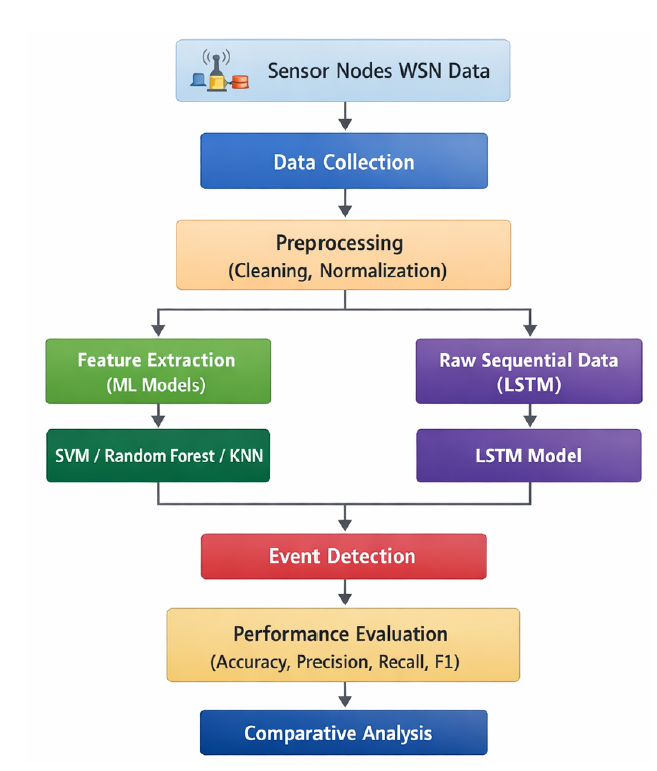
This paper suggests a single architectural design of detecting events in Wireless Sensor Networks (WSNs) with both conventional machine learning (ML) and deep learning (DL). The framework comprises of various steps where the data is gathered, preprocessed, feature extracted, the model trained and the performance measured. It is aimed at comparing the capability of various models to identify events in real-life smart environment conditions.


Data Collection and Preprocessing

The sensor information is collected by the nodes of WSN deployed on a smart environment, wherein the sensors constantly monitored the characteristics of temperature, humidity and pressure of the environment during period of time. Preprocessing is done to ensure the quality of data due to the noise, missing value and inconsistencies in raw sensor values. The preprocess stages are:


  • Handling missing values Interpolation methods are methods of dealing with missing values.

  • Noise reduction with Smart filtering.

  • The Minimum maximum scaling normalization.

  • Categorization of data according to the occurrence of events (event / non-event).


 These measures make sure that the data set is clean, consistent and fit to train the models.


Feature Extraction and Representation

Relevant features are derived out of the sensor data to improve the performance of the model. In case of the traditional ML models, statistical attributes like mean, standard deviation, variance and temporal differences are calculated in the sliding windows. In the case of deep learning (LSTM), raw sequential data are directly fed into the model avoiding the manual extraction of features and all temporal patterns and dependencies are learned by the model.


Selected Models for Event Detection

Here, the performance of both the classical and a deep learning model used in this study are assessed against each other to determine which model is the best in event detection. The selected models include:


  • Support Vector Machine (SVM)

  • Random Forest (RF)

  • K-Nearest Neighbors (KNN)

  • Long Short-Term Memory (LSTM)


Despite the fact that classical machine learning algorithms like SVM, Random Forest and KNN offer viable performance in classification, they use data samples that are independent and cannot determine temporal correlations in sensor data. On the other hand, LSTM networks are fundamentally determined to address sequential data and long-term dependencies, which make them highly applicable to detecting events within a Wireless Sensor Networks whereby events develop over time. Hence, LSTM has been incorporated in the current work to be compared with the effect of temporal modeling versus the traditional machine learning methods.


Model Training and Validation

The dataset is randomly split into the training and testing ones with a typical split ratio (e.g., 70/30). In the case of ML models, the training is done through labeled feature vectors. In the case of LSTM, time-series data are inputted in sequence. Cross-validation methods are used to achieve reliability and hyperparameters are adjusted to achieve best model performance. The consistency of performances is measured in several runs.


Comparative Analysis Strategy

Comparison is done to determine the strengths and weaknesses of both models. The comparison focuses on:


  • Discovery accuracy

  • Sensitivity to temporal patterns

  • Computational cost

  • Capability to be deployed in real time.


This discussion shall give insights into the choice of the best model to be used in detecting events in smart environments.


Figure 1: Proposed Framework for Event Detection in WSNs

RESULTS

Experimental Results 

The chosen machine learning (ML) and deep learning (DL) frameworks are tested in terms of their ability to detect events in Wireless Sensor Networks (WSNs) in this section. The examples to be taken into account are Support Vector Machine (SVM), Random Forest (RF), K-Nearest Neighbors (KNN) and Long Short-Term Memory (LSTM).


Dataset Description

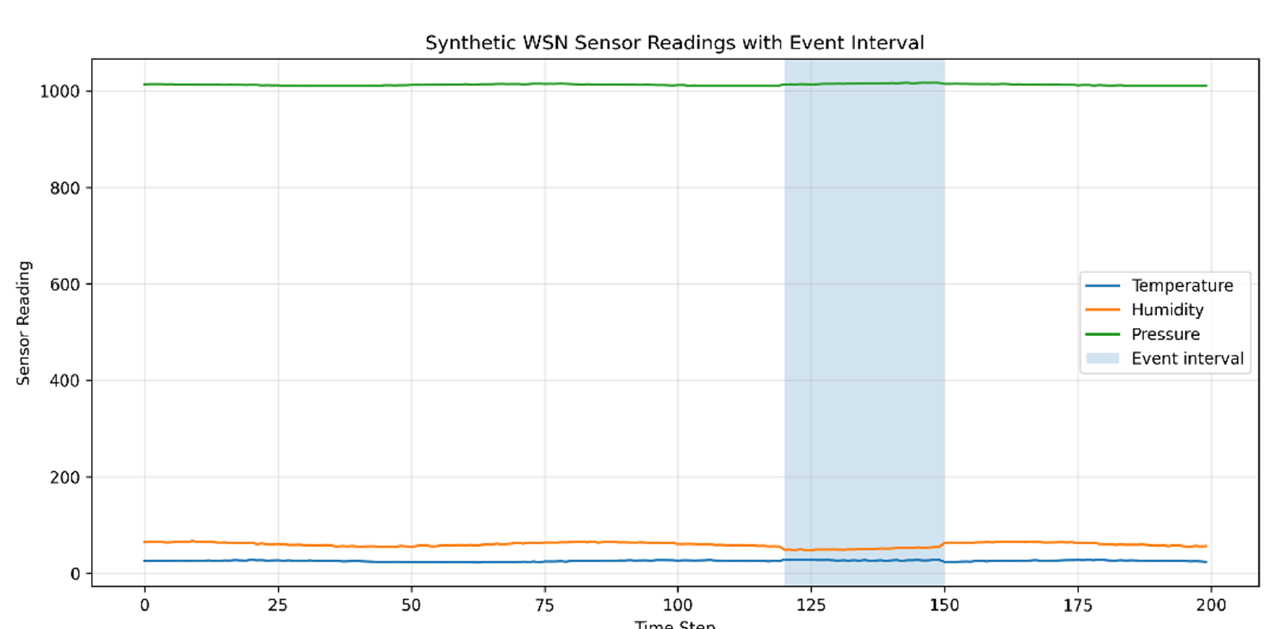
The measurement of this study is a simulated (artificial) time-series measurement that is developed to imitate the characteristics of a WSN in a smart setting. The sets of data record time-dependent data of the environment such as temperature, humidity and pressure. Figure 2 shows the synthetic dataset that was used in this study whereby in this instance multiple sensor measurements were developed as time went by to model normal and abnormal conditions in a WSN-based smart environment.


Figure 2: Synthetic WSN Sensor Data on Temperature, Humidity and Pressure Time-Dependent and Injected Event Period, which is an Indication of Unnatural Condition


The data points are all identified as:


  • 0 → Normal condition (non-event) 

  • 1 → Event condition (abnormal) 


The synthetic data sets consist of realistic features like noise, temporal variation and dynamism in environmental variations and are therefore suitable to test event detection models of smart environments. Dataset Characteristics:


  • samples Number: ~12,000 instances 

  • features Number: 3–6 sensor attributes 

  • Data type: Time-series 


Synthetic Data Generation Model

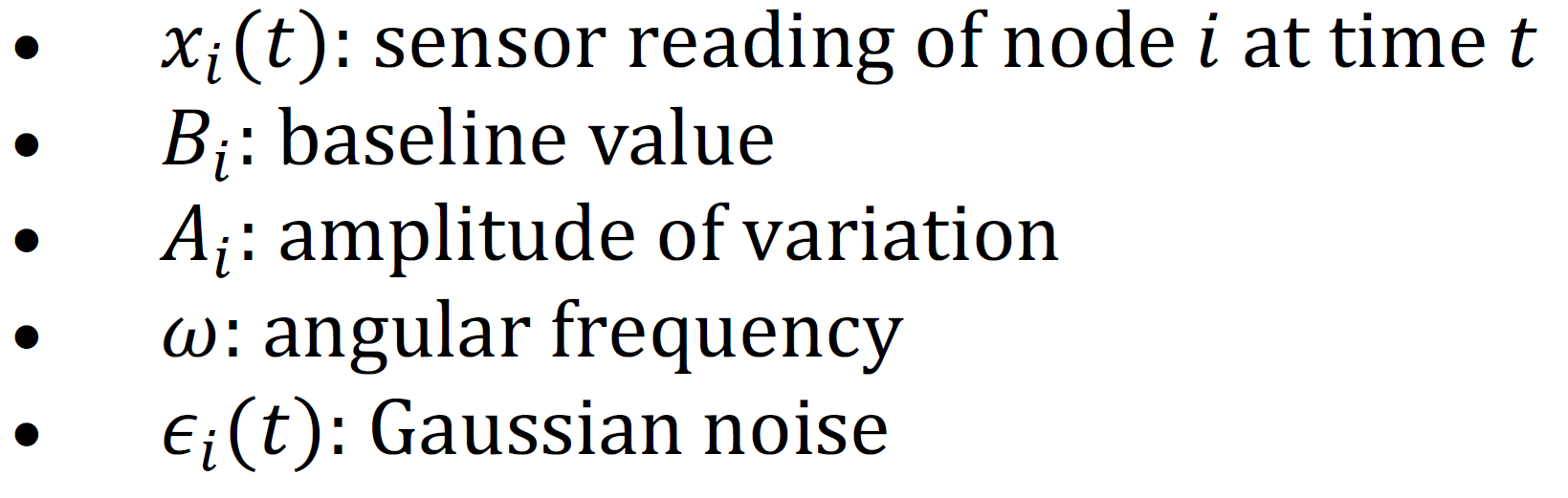
In order to make the sensors act realistically, every sensor reading is represented as a mix of the signal, time variation and noise:


Where:


Simulation of events is achieved through abnormal deviation:


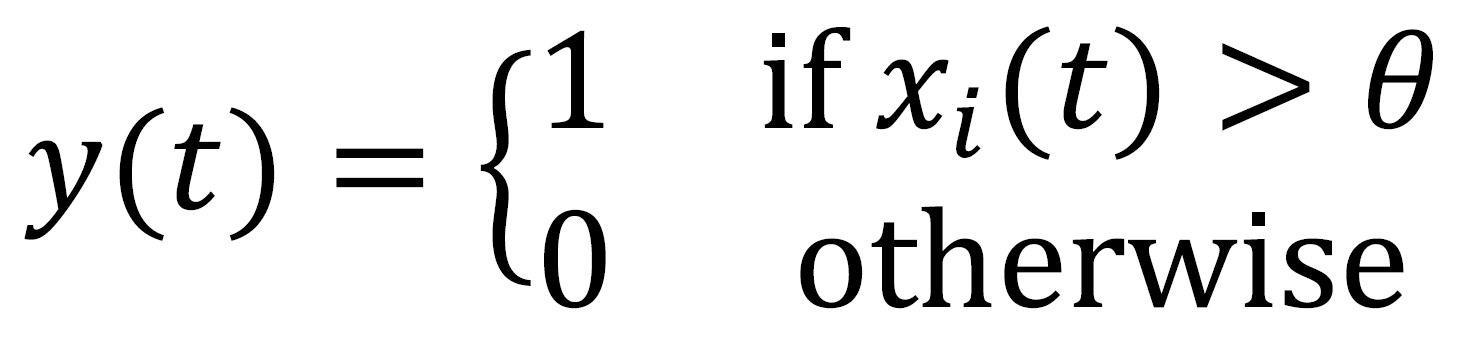
When a threshold has been surpassed, an event is called:


Performance Evaluation

In order to determine how successful the suggested models are in detecting events in WSNs, a number of conventional classification measures are used, such as accuracy, precision, recall and F1-score. These measures are able to give holistic evaluation of model performance regarding its accuracy and dependability. Accuracy is the general rate of correct classification and precision is a reporting of the model to detect the cases of events correctly. Recall tests the ability of the model to identify real events and this is especially crucial in the WSN systems where an event could trigger some dire effects. F1-score is a harmonic average of precision and recall,  which gives an objective model assessment. Table 1 summarizes the performance of the chosen models Support Vector Machine (SVM), Random Forest (RF), K-Nearest Neighbors (KNN) and Long Short-Term Memory (LSTM).


Table 1: Performance Comparison of ML and DL Models

Model

Accuracy (%)

Precision (%)

Recall (%)

F1-score (%)

SVM

88.4

86.9

87.5

87.2

KNN

85.7

84.3

83.9

84.1

RF

90.2

89.5

88.7

89.1

LSTM

94.6

93.8

94.2

94.0


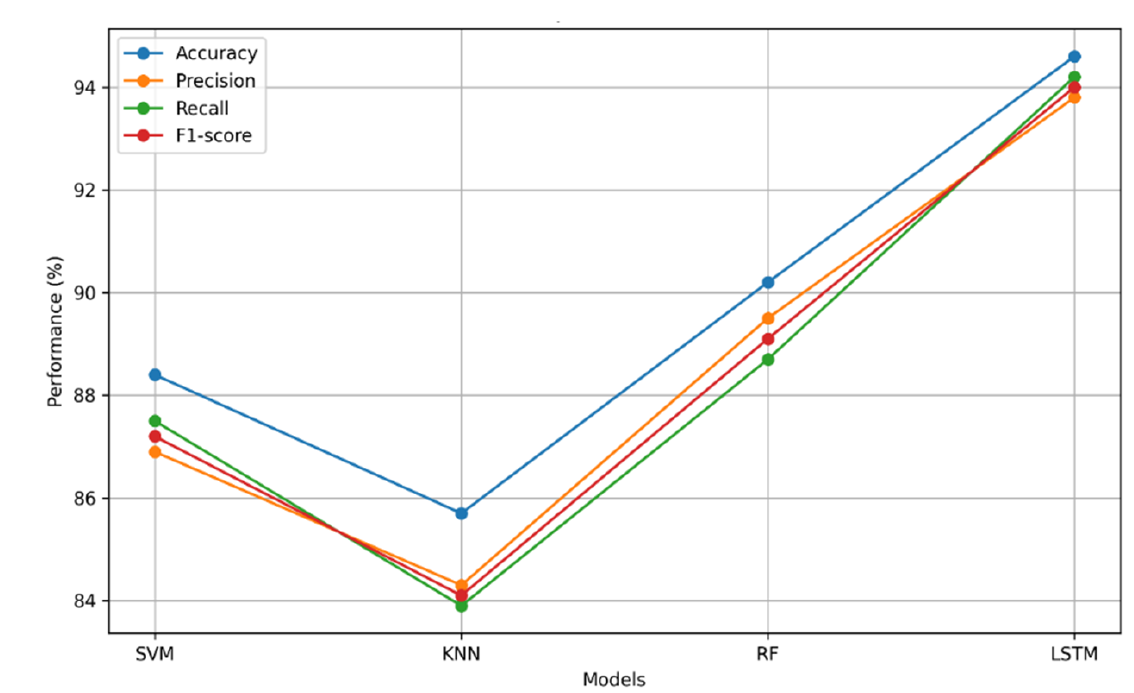
The findings show that the LSTM model is the most effective in terms of all measures of evaluation. This high performance can be explained by the fact that it is able to learn time-dependency in time- series sensor data that are imperative in correct event detection in dynamical WSN setting. Random Forest is also shown to be a strong performer by its ability to generalize by using ensemble learning which minimizes overfitting and maximizes the generalization. Conversely, the performance is relatively low with SVM and KNN since their design is not necessarily to make use of temporal relationships of sequential data. On the whole, the results indicate that conventional machine learning models offer an acceptable level of performance, but more promising outcomes can be achieved with the deep learning models like LSTM which can be used to detect events in WSN-based smart environments. Figure 3 shows a comparative analysis of the performance of evaluated models using accuracy, precision, recall and F1-score.


Figure 3: Performance Comparison of Machine Learning and Deep Learning Models


Computational Cost Analysis 

Besides classification performance, one should also consider the computational cost of a specific model, especially when resource-constrained Wireless Sensor Network is involved.


According to the table 2, LSTM is more costly to train since it is a deep architecture compared to conventional models such as SVM and KNN which are cheaper to train.


Table 2: Computational Cost Comparison of ML and DL Models

Model

Training Time (s)

Testing Time (ms/sample)

Complexity

SVM

12.5

1.8

Medium

KNN

8.3

3.5

High (during testing)

RF

15.2

2.1

Medium

LSTM

45.7

1.2

High


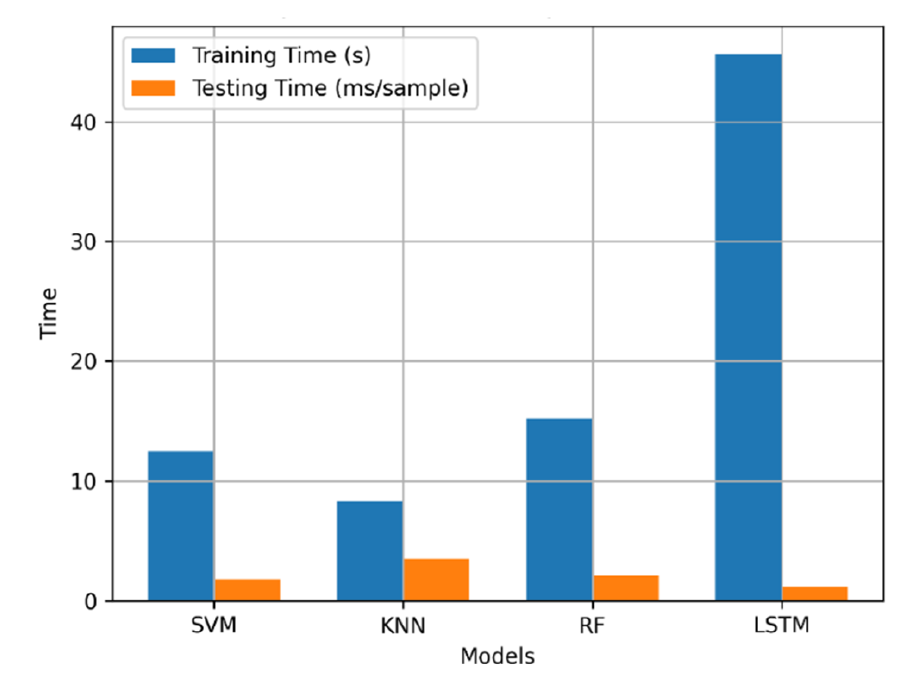
However, trained LSTM can make relatively fast inferences hence it may be applicable to real-time. Rather, KNN takes more time testing since it is an instance based. The results show the trade of between model accuracy and model computation in the selection of models that can be deployed in the detection of any type of event through the deployment of WSNs. To further explain the computational cost of the models under discussion, Figure 4 is a visual depiction of the training and test time.


Figure 4 shows that the training time of LSTM model is very high compared to the traditional machine learning models due to its depth architecture. It is however relatively low in testing time hence suitable to be used in real time application upon its deployment. In comparison, KNN takes longer time in testing since it is an instance based model than the SVM and random forest models whose trade off between training and inference time is equal.


Figure 4: Computational Cost Comparison

DISCUSSION

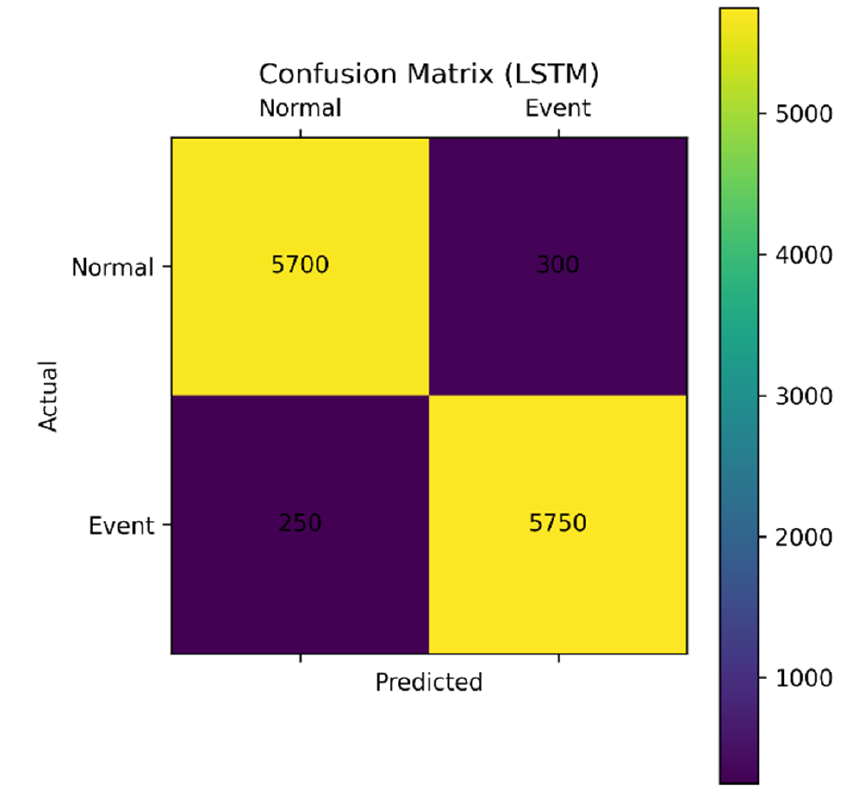
As evidenced by the experimental findings, deep learning and machine learning models show different levels of performance when performance in event detection task in Wireless Sensor Networks is considered. LSTM is the best-performing model with high accuracy and an overall performance rate as it is able to capture temporal dependencies of sequential sensor data. As Figure 5 shows, the confusion matrix confirms that the LSTM model makes a large percentage of correct classification and misclassification is low, which once again proves its efficacy.


Figure 5: Confusion Matrix of LSTM Model


Random Forest also presents high performance, which is advantageous because it takes the form of an ensemble that enhances generalization and minimizes overfitting. Nevertheless, it does not explicitly represent temporal relationships hence restricting its applicability in time-dependent situations. On the contrary, SVM and KNN exhibit a relatively poorer performance. SVM is good in high dimension feature space and cannot handle sequential data, but KNN is sensitive to noise and inefficiency when dealing with large datasets. 


In practical sense, LSTM offers better performance in terms of detection rates, however, due to its complexity in computation and energy consumption it might not be easily utilized in the resource limited WSN setting. Thus, both system and performance constraints must be considered in the choice of the right model. Random Forest can be used as a viable alternative in applications with real-time constraints and limited resources and LSTM is better suited in the case of applications that need high accuracy and time sensitivity. In general, the findings illustrate the relevance of introducing temporal modeling methods to event detection systems and prove that deep learning methods can be of great benefit to smart environment applications. 

CONCLUSION

The paper has offered a comparative study about the use of machine learning and deep learning methods in detecting events in wireless sensor networks in smart environments. An integrated model was created to assess the work of SVM, KNN, Random Forest and LSTM models. The experimental findings have shown that LSTM has higher accuracy, precision and recall rates and F1-score than the conventional machine learning models because it is capable of modeling the time-dependent aspects of sensor data. Random Forest also had a good competitive performance and provided a compromise between accuracy and computational cost. Although deep learning models have its benefits, it is more computationally expensive which limits its use in the resource-constrained settings of WSN. As such, the appropriate choice of a model is based on the application specific needs such as accuracy, latency and power. In the future, the work will be directed at the development of light and energy-efficient deep learning applications, as well as the implementation of edge computing and federated learning methods to improve the detection of events in large-scale deployments of WSNs in real-time.


REFERENCE
  1. SK, W.H. et al. “AI-Integrated Sensor Data Analytics for Real-Time Decision-Making in Wireless Sensor Networks.” 2025 International Conference on Machine Learning and Autonomous Systems (ICMLAS), 2025, pp. 1644–1649. 

  2. Ali, I. et al. “Data Collection in Studies on Internet of Things (IoT), Wireless Sensor Networks (WSNs) and Sensor Cloud (SC): Similarities and Differences.” IEEE Access, vol. 10, 2022, pp. 33909–33931. 

  3. Trigka, M. and E. Dritsas. “Wireless Sensor Networks: From Fundamentals and Applications to Innovations and Future Trends.” IEEE Access, 2025. 

  4. Abdulhussain, S.H. et al. “A Comprehensive Review of Sensor Technologies in IoT: Technical Aspects, Challenges and Future Directions.” Computers, vol. 14, 2025, p. 342. 

  5. Sakkijha, Z. et al. “An Energy Efficient WSN Implementation for Monitoring and Critical Event Detection.” 2019 2nd IEEE Middle East and North Africa Communications Conference (MENACOMM), 2019, pp. 1–6. 

  6. Kim, T. et al. “Machine Learning for Advanced Wireless Sensor Networks: A Review.” IEEE Sensors Journal, vol. 21, 2020, pp. 12379–12397. 

  7. Al Sukkar, G. and S. Al-Sharaeh. “Enhancing Security in Wireless Sensor Networks: A Machine Learning-Based DoS Attack Detection.” Engineering, Technology & Applied Science Research, vol. 15, 2025, pp. 19712–19719. 

  8. Trigka, M. and E. Dritsas. “Wireless Sensor Networks: From Fundamentals and Applications to Innovations and Future Trends.” IEEE Access, 2025. 

  9. Qureshi, M.I. et al. “Learning and Optimization in Wireless Sensor Networks.” Wireless Sensor Networks in Smart Environments: Enabling Digitalization from Fundamentals to Advanced Solutions, 2025, pp. 35–64. 

  10. Tossa, F. et al. “Wireless Sensor Network Deployment: Architecture, Objectives and Methodologies.” Sensors, vol. 25, 2025, p. 3442. 

  11. Wang, Z. et al. “An Anomaly Node Detection Method for Wireless Sensor Networks Based on Deep Metric Learning with Fusion of Spatial–Temporal Features.” Sensors, vol. 25, no. 10, 2025, p. 3033. 

  12. Shu, J. et al. “An LSTM–AE–Bayes Embedded Gateway for Real-Time Anomaly Detection in Agricultural Wireless Sensor Networks.” Smart Agricultural Technology, vol. 11, 2025, p. 100944. 

  13. Shanmuganathan, V. and A. Suresh. “LSTM-Markov Based Efficient Anomaly Detection Algorithm for IoT Environment.” Applied Soft Computing, vol. 136, 2023, p. 110054. 

  14. Noh, S.-H. and H.J. Moon. “Anomaly Detection Based on LSTM Learning in IoT-Based Dormitory for Indoor Environment Control.” Buildings, vol. 13, 2023, p. 2886. 

  15. Nguyen, G. et al. “Machine Learning and Deep Learning Frameworks and Libraries for Large-Scale Data Mining: A Survey.” Artificial Intelligence Review, vol. 52, 2019, pp. 77–124. 

  16. Etman, A.M. et al. “A Survey on Machine Learning Techniques in Smart Grids Based on Wireless Sensor Networks.” IEEE Access, vol. 13, 2024, pp. 2604–2627. 

  17. Thakfan, A. and Y. Bin Salamah. “Development and Performance Evaluation of a Hybrid AI-Based Method for Defects Detection in Photovoltaic Systems.” Energies, vol. 18, 2025, p. 812.

Recommended Articles
Research Article
OBSERVATIONS ON THE HOMOGENEOUS TERNARY QUADRATIC DIOPHANTINE EQUATION x2 + 4xy + 9y2 = 21z2
Download PDF
Research Article
Design and Implementation of a GSM-Based SMS Controlled DC Motor Speed Regulation System
...
Published: 31/12/2025
Download PDF
Research Article
Computer Driven Library Management and Service Rendering System: Mobile Library Landscape
...
Published: 10/06/2020
Download PDF
Research Article
The Availability and Utilization of Some Selected Digital Technology Facilities among Students of Mathematical Sciences Using Krejcie and Morgan’s Sample Size Determination Technique, A Case Study of Kogi State University Anyigba
Download PDF
Chat on WhatsApp
Flowbite Logo
PO Box 101, Nakuru
Kenya.
Email: office@iarconsortium.org

Editorial Office:
J.L Bhavan, Near Radison Blu Hotel,
Jalukbari, Guwahati-India
Useful Links
Order Hard Copy
Privacy policy
Terms and Conditions
Refund Policy
Shipping Policy
Others
About Us
Team Members
Contact Us
Online Payments
Join as Editor
Join as Reviewer
Subscribe to our Newsletter
+91 60029-93949
Follow us
MOST SEARCHED KEYWORDS
Copyright © iARCON International LLP . All Rights Reserved.