Presupposition is a significant concept in the study of language, both in semantics and pragmatics. However, there are ongoing debates among linguists regarding its nature, leading to different perspectives. Taking into account, the semantic view proposed by Levinson, which identifies six types of Presupposition, this study aims to explore the role of semantic presupposition (referred to as SP) in facilitating the interpretation of texts. The focus of this study is the analysis of Anton Chekhov's short story, "The Orator," using the framework of the six types of SP mentioned earlier. The research is organized into four sections, along with a bibliography. The first section serves as an introduction, outlining the background and context of the study. In the second section, the theoretical foundations relevant to the research are presented. The third section details the methodology employed, including the analysis of selected data and the presentation of the findings. Lastly, the fourth section offers the study's conclusions and recommendations. In summary, this study investigates the role of semantic presupposition in decoding texts, utilizing Chekhov's short story, "The Orator," as a case study. By examining the story through the lens of the six types of SP, the study aims to provide insights into the interpretative potential enabled by semantic presupposition.
Keywords
Presupposition
Semantic Presupposition
Levinson’s Theory Text Interpretation
Discourse Analysis
Anton Chekhov
INTRODUCTION
Presupposition is a linguistic phenomenon, which is still a source of debate among linguists as having two major aspects named semantic and pragmatic presupposition. Part of those emphasize the later aspect and overlook the later while others consider the two as important. However, the present study attempts to tackle this phenomenon from its semantic aspects.
The present study is basically based on the following hypothesis: Semantic presupposition is an important factor that facilitate the process of interpretation and arriving at presupposed meaning and it endeavors to achieve the following aims:
Understanding semantic presupposition
Apply and analyze the selected data
Evaluating the role of SP in the process of interpretation and arriving at the presupposed meaning
Finally, the present study is limited to define the concept of SP, analyze the data in terms of the six types of SP and assess the role of SP in the presupposed meaning to give a further justification to the chosen literary test.
The Concept of Semantic Presupposition (SP)
Therefore, Cresswell [2] points out that to know the meaning of a sentence is to know the conditions under which a sentence is true, e.g., the sentence Ali is married assumes, as a necessity, the truth of Ali’s being married. Thus, the sentence is true in a circumstance in which he is married and false in a circumstance in which he is not married. Accordingly, the semantic account of presupposition is based closely on the truth or falsity of sentences uttered in isolation without any special context.
In fact, semantic presupposition of a sentence has two separated concepts. The first of these is tackled in philosophy, regarding the nature of “reference and referring expressions” concepts. Levinson [3] states that this approach is proposed by Frege, who raises many issues that are central to presupposition. According to Frege and his followers a presupposition is a referential condition under which the proposition expressed by a declarative sentence can be either true or false. Considering Jacobsen's example where 1a presupposes 1b:
1a. Ali likes Sara
b. Ali exists and Sara exists
By the same token, 2a presupposes 2b:
2a. The president of America is a woman
b. There exists a person who is the president of America
Since 2b is obviously false, 2a does not succeed in making a statement, i.e., it has no truth values.
Levinson [3] refers to Frege’s statement and points out those assertive sentences (statements) always contain presuppositions. He clarifies, “if anything is asserted there is always an obvious presupposition that any simple or compound proper names used have a reference.” If a man therefore says Sam passed away, it has the presupposition that Sam (as a name) defines an entity. Accordingly, understanding the term ‘Sam as titling an entity is but a presupposition of the statement that ‘Sam passed away.’
Palmer, argues that Frege poses a question about considering sentences that are without “proper referents” as in 3 can be said to be untrue:
3. My neighbor is smart
Frege focused on the difference between the concept of “sense and reference” to solve the problem where the latter “deals with the relationship between the linguistic elements, words, sentences, etc. and the non-linguistic world of experience.” Therefore, he proposes that reference involves the linguistic “signifier,” which is the name, besides the extra linguistic “signified,” which refers to the real entity in the world to which the signifier refers. The concept “Sense” is concerned with the relationships among the linguistic elements themselves (the words in each sentence) and its primary focus is on the relations that connect between the linguistic constructions. What he has suggested is that such statements can get their meaning even if they do not have referents, consequently, they lose their truth value.
Presupposition Types
The idea of presupposition is mainly connected to the constructions of any string of words to form sentences, phrases, or any linguistic constructions. These linguistic buildings were discreet by Semitists as a base of presuppositions called presupposition or lexical triggers. Semanticists, so far, has not made a clear classification to the types of presupposition. Nevertheless, Yule [4] identifies different classifications to the concept of presupposition; these types are six as follows: existential, lexical, structural, factive, non-factive and counter-factual presuppositions.
Existential Presupposition
The existence of an entity is the fundamental philosophical start for the presupposition. The sentence some mermaids have read hair its meaning is taken from the presupposition that there is a universe of discourse where mermaids do exist and real [5]. Therefore, the fundamental idea of presupposition is that it is the supposition that something is real and exist.
There are two different types of the existential presuppositions as Bickerton added; the first one depends on the existence of people or objects and the other type of presuppositions corresponds to how actions or events occur. Thus, Ali is eating or (Ali doesn’t eat) has the presupposition that Ali is there and exists; Ali bought or (Ali did not buy) Ahmed’s car indicates that Ahmed had a car; on the other hand, “Ahmed’s driving annoys (does not annoy) Sara” has the presupposion that “Ahmed drives”; etc. [6].
The test of consistency under negation is important for this type of presupposition. Where the negative sentence Sara’s dog is not old still has the same presumed ideas that Sara has a dog and that girl is actually there. This result shows that all ‘definite names’ presuppose the existence of their referents unlike the indefinites which lose their referents under negation, Bickerton [6]:
10. “I did not shoot the dog”
Indication of existing dog to be shot
11. “I did not shoot a dog.”
(does not) .. No dogs to shoot.
Another feature of the existential presupposition is that the merit of paraphrasing for the indefinites as in 11: (there is a dog such as that I did not shoot) and no paraphrasing for the definite sentence (10), the only acceptable paraphrase for the second sentence would be:
12. “There is no dog such that I shot it.”
As a conclusion, all the definite nouns has a presupposed reference that is existent and fixed under negation, but the indefinite nouns are not.
Lexical Presupposition
The lexical presupposition indicates that the use of one form with its meaning is interpreted predictably to presuppose that another non-asserted meaning is assumed. This type of presupposition is associated with the presence of specific words, like managed, stop, again, etc. Lexical presupposition is discussed by Yule [4] declaring that the use of the verb “managed” has a clear presumed idea that X was able to do something and he succeeded in doing that thing. Still, in negating the verb “did not manage” we also have the idea that X tried to do that thing but he did not succeed in perusing it. Therefore, the verb ‘managed’ has the implications of ‘success’ and ‘trying’.
Levinson [3] indicated this type of verbs as ‘implicative verbs’ which has the property of assuming the basic idea based on the asserted sentence as in the following examples:
13a. Ahmed managed to clean the window.
b. Ahmed tried to clean the window.
a. Ahmed avoided watching that movie.
b. Ahmed was expected to or ought to avoid watching that movie.
a. Odd things happened to Ahmed on his way home.
b. Ahmed didn't plan or intend to face these odd things.
The other type of the lexical presuppositions is the ‘aspectual verbs’ which have a kind of switch presupposition that the new state is both presupposed and known as not to have prior change as shown in Saeed's [7] following instances:
14a. Muna began filming a movie
b. Muna (did not use to) film a movie
a. Sami finished reading the novel
b. Sami (used to) read a novel
Structural Presupposition
Structural presupposition is the certain consistent sentence structure in which a part of the structure is meant to be definitely true. Receivers could use such structures to deal with information as presupposed to be true, so, accordingly, meant to be accepted as true when received by the recipient. Wh-questions are good examples for this kind, in which structures of English, as clarified in 16 usually presuppose that the facts are identified to be true after the wh–form, e.g.:
16a. What do they play?
b. They play tennis.
a. When did she stop drinking?
b. She stopped drinking a month a go
This exemplified kind in 16 shows that the given information is totally true and just an assumption. Eventually, the question what did she read? the asker of the question is quite certain that she read a book and not just a speculation [4].
Nevertheless, Lyons [8] adds that this type is not consistent under negation because in asking, for example, what did Ali do? There is a presupposition that Ali did something and anyone answering the question must accept this fact, but the question what didn't Ali do? Does not include the presupposition that Ali did something, but instead of that there is something that Ali did not do.
Factive Presupposition
The term ‘factive’ as argued in Crystal [9] refers to the “verb that has a complement clause”, by which means that the speaker can conceive the fact and gain the true proposition by understanding the full clause. So, the reason behind calling these presuppositions as ‘factives’ because the assumptions implied in the complimentary clauses are true:
17a. He couldn’t recognize that she is sick.
b. She is sick
a. I forced to answer her
b. I told her
Examples in 17 show that the subsequent data given after the verbs ‘recognize and ‘forced to’ is considered as a truth and identified as factive presupposition. Other examples including: realize, regret, agree, appreciate, know, etc.
Adjectives and noun constructions can work as Factive predicators as well, Yule [4] suggest the following instances:
18a. it is surprising that she is engaged
b. She is engaged
a. I is tragic that that she died yesterday
b. She died yesterday
a. It’s shameful that they looted
b. They looted
Be aware that, be significant that, be weird that, are other examples of this set.
Leech shows that the factive presupposition has two categories: ‘pure factives’ and ‘conditional factives’. “Pure factives are predicates such as REALIZE BE-SORRY' KNOW' 'AMUSE', REGRET, BEAR-IN-MIND', 'APPRECIATE', etc., which are in the main associated with that-clauses or -ing clauses. Conditional factives are predicates such as 'CAUSE', 'BECOME' 'HAVE-TO', 'FORCE, 'SEE', 'HEAR', etc., mainly associated with infinitive constructions and nominalizations. When the factive predicate is positive, both these types behave in the same way, attributing factual reality to the subordinate predication” (1974:303).
Pure factives:
19a. I am sorry that he missed the flight.
b. He missed the fligh.
a. People amusd that the elections were not fair.
b. The elections were not fair.
Conditional factives:
20a. He forces them to see his friends.
b. They saw his friends.
a. Sara saw Dr. Ali giving a lecture.
b. Dr. Ali gave a lecture.
Non–Factive Presupposition
‘Non–factive’ presupposition is the opposite of the ‘factive presupposition’ type in the sense that it does not include the truth value expressed in the complement clause, Taylor. The enlisted verbs below shows that the next is not certain, [4].
21a. She suspected that he is dead.
b. He is not dead.
a. They wanted to travel to India.
b. They did not travel to India.
a. Sam pretends to be busy.
b. Sam is not busy.
Further verbs used in this kind of presupposition are: dream, imagine, think, consider, suppose, seem, be likely, be possible etc.
Leech [10] argues that some constructions of syntax may play a role in addressing factuality or vice versa:
22. “They'll send us postcards of the interesting places they visit' pre-
Supposes *They will visit (some) interesting places.” Leech [10]:
23. “Please send us postcards of any interesting places you visit' does
not presuppose "You will visit (some) interesting places.'” Leech [10].
3. “If you enjoy history, Rome is the European city for you to visit*
does not presuppose 'You will visit/have visited some European city.” Leech [10].
Accordingly, the usage of ‘any’ in 23 and the infinitive clause in 24 that neutralized the factuality of the given examples.
Counter-Factual Presupposition
Counter-factual structures presume that the complement clause expresses a false proposition. Thus, in this type, presuppositions entail false indications or not true facts [11].
According to McCawley’s [12] confirmation to Karttunen [13] and Lakoff’s [14] declarations that the word ‘pretend’ which is a verb has a counter-factive presupposition, in the sense that the speaker in 25a knows that the words follow the verb ‘pretend’ are false and 25b has the truth value:
25a. Mary pretends that she feels ill.
b. Mary does not feel ill.
McCawley explains the discrepancy between “factive and counter-factive presuppositions” in the sense of the feature of transitivity availablity in the factive presuppositions unlike the counter-factive presuppositions, as in the usage of the verb realize in the following examples:
26a. Mary feels sorry she realizes that she is ill.
b. Mary realizes that she is ill.
c. Mary is ill.
The feature of transitivity dominates the role of the type of presupposition in the earlier examples:
27a. Mary pretends that she realizes that she is ill.
b. Mary realizes that she is ill.
c. Mary is ill.
d. Mary is not ill.
Yule [4] comments on the factuality of the “if-clause” and its truth value in the time of speech, an in the example below:
28a. you will see many beautiful scens if you travel to Prais.
b. He didn’t travel to Paris.
a. They could recognize the thief If John has only one more camera.
b. John does not have another camera.
However, Leech [10] indicates that the three types of presupposition ‘factive’ ‘non-factive’ and ‘counter-factive’ are intermix and not desecrated entirely. Because of the dual function of some predicates to work as factive, non-factive, or counter-factive depending on the context:
29. It is nice that the twin have many cars. (factive)
It is nice to have many cars. (non-factive)
30. Muna hopes to see Sara’s collection. (non-factive) Muna hopes she can see Sara’s collection. (counter-factive)
Anton Chekhov’s The Orator
Known as the greatest Russian short story teller and paly-write and addition to his work as a physician, Anton Pavlovich Chekhov’s works dealt with the human condition of the Russian people and based on his impressions and depictions. Chekhov’s works have the ability to change the reader’s perspectives and give them the opportunity to meet the real life needs and corruptions.
Chekhov known as a reformist, independent thinker and a democratic writer concerned with justice, equality and human rights. In his testimonies and plays, he exposes the troubles of an authoritarian society and considers how humans react inside it, manifesting the dominant thoughts and beliefs of the “Russian intelligentsia-utilitarianism, utopianism, nihilism and, also, skepticism and pessimism resulting from disillusionment” while beliefs fail to emerge as reality. Chekhov noted lifestyles that rest on the premise of false ideals as a kind of slavery. The ideological answers to the troubles advocated by him and using political thinkers and artists in his time, as he predicted, to a point been superseded were the main concentrations in his works. However, his own vision on people’s circumstances and his deep perception into human beings, collectively together along with his funny and compassionate technique as expressed in his art, maintain to activate audiences and readers into new concerns of the questions he requested as an approximately needed lifestyles [15].
"The Orator" is Chekhov’s short story that entails a story of an orator with good reputation faces an embarrassing and difficult situation when he stands in front of crowded gathering of people at a funeral. He starts to assert all the good merits of the dead person, succeeded with letting people grief and shed some tears, though, some of them noticed that most of the praising and facial features that the orator talks about are not really exist. However, they keep listening and Zapoikin, the oratorm goes on and on exaggerating in his false and lying praising to the dead man; until he noticed that the dead man is still alive! At that moment, he knew that he was talking about a very different person! However, his friend, Poplavsky, told him to keep talking.
It is very criticizing and satirical work about the hypocrisy in societies and how narrow-minded people interact with appearances and speeches, Chekhov successfully shows how the world can be deceived and reflected in the eyes of a dead person.
SP in Chekhov’s the Orator
Data: As aforementioned, the present study source of data is Anton Chekhov’s short story “The Orator”. Sentences from this text will be analyzed in terms of the six types of SP. The following section tackles the tables for analyzing SP types found in the data.
Data Analysis
In order to achive the aims of the present study, a set of sentences has been picked out for the analyses from the text of Chekhov’s short story “The Orator”. As stated below in the Table 1, six types of SP has been chosen to assess the data in terms of the employment of the SP.
Table 1: The Analysis of Sentences from Chekhov’s The Orator
Types of SP
Pre.Ed Sentence
Syntactic Form
Pre. Ing Sentence
Existential
Existential
Factive
There is a person named Kiril Ivanvitch.
He has a bad wife.
He is an alcoholic
Declarative
“One fine morning the collegiate assessor, Kirill Ivanovitch Babilonov, who had died of the two afflictions so widely spread in our country, a bad wife and alcoholism, was being buried.”
Existential
Existential
Lexical
Existential
There is a coffin accompanied by people.
They are going to bury a dead man
Zapoikin left the funeral.
Poplavsky’s friend.
Zapiokin is a popular man.
Declarative
“As the funeral procession set off from the church to the cemetery, one of the deceased's colleagues, called Poplavsky, got into a cab and galloped off to find a friend, one Grigory Petrovitch Zapoikin, a man who though still young had acquired considerable popularity.”
Lexical
Zapoikin is a talented orator
Declarative
“Zapoikin, as many of my readers are aware, possesses a rare talent for impromptu speechifying at weddings, jubilees, and funerals”
Lexical
He has the abaility of speaking in different circumastances
Declarative
“He can speak whenever he likes: in his sleep, on an empty stomach, dead drunk or in a high fever.”
Lexical
Factive
He has a set of oratorical words.
These words are unique.
Declarative
“His words flow smoothly and evenly, like water out of a pipe, and in abundance; there are far more moving words in his oratorical dictionary than there are beetles in any restaurant.”
Lexical
Lexical
He has to speak for a long time.
He sometimes exceeds the demanded amount of speech.
Declarative
“He always speaks eloquently and at great length, so much so that on some occasions, particularly at merchants' weddings, they have to resort to assistance from the police to stop him.”
Factive
Factive
He was at another place.
Zapoikin is an old man.
Declarative
“I have come for you, old man!" began Poplavsky, finding him at home”
Existentail
There was a hat and coat.
Declarative
“Put on your hat and coat this minute and come along.”
Structural
Lexical
They did not start the ceremonies.
The addressee will speak on the coffin.
Declarative
“One of our fellows is dead, we are just sending him off to the other world, so you must do a bit of palavering by way of farewell to him...”
Non-factive
They did not find a person who will speak on the coffin.
Declarative
“You are our only hope.”
Lexical
The secretar has sent for the addressee.
Conditional
“If it had been one of the smaller fry it would not have been worth troubling you, but you see it's the secretary . . . a pillar of the office, in a sense.”
Non-factive
Lexical
They did not buried the person.
The dead person is an important person.
Conditional
“It's awkward for such a whopper to be buried without a speech.”
Lexical
The secretary is an alcoholic.
Exclamatory
Interrogative
“Oh, the secretary!" yawned Zapoikin.”
“You mean the drunken one?”
Lexical
You are going to eat
Declarative
“Yes. There will be pancakes, a lunch . . . you'll get your cab-fare”
Factual
They arrived at the graveyard
Declarative
“In the cemetery came the service by the graveside.”
Existential
Existential
Existential
Lexical
Lexical
The dead man has a mother-in-law.
He has a sisier in law too.
His wife is alive.
They were in the cemetery.
They were sad for the death.
Declarative
“the mother-in-law, the wife, and the sister-in-law in obedience to custom shed many tears.”
Factive
Couinter Factive
They put the dead in the grave.
His wife was very sad.
She was very sad.
Declarative
“When the coffin was being lowered into the grave the wife even shrieked "Let me go with him!" but did not follow her husband into the grave probably recollecting her pension.”
Lexical
Structural
They finished burying the dead.
Zapoikin will talk.
Declarative
“Waiting till everything was quiet again Zapoikin stepped forward, turned his eyes on all present, and began:”
Non-Factual
He does not believe.
Interrogative
“Can I believe my eyes and ears?”
Non-Factual
The grave is a true one.
Interrogative
“Is it not a terrible dream this grave, these tear-stained faces, these moans and lamentations?”
Non-Factual
The man was really died.
Exclamatory
“Alas, it is not a dream and our eyes do not deceive us!”
Factive
Lexical
Lexical
Lexical
The dead person is a good man.
He passed away.
He was a selfless man.
He is buried
Declarative
“He whom we have only so lately seen, so full of courage, so youthfully fresh and pure, who so lately before our eyes like an unwearying bee bore his honey to the common hive of the welfare of the state, he who . . . he is turned now to dust, to inanimate mirage. ”
Factive
Lexical
The dead person was not married.
He used to make charities for poor people,
Declarative
“Devoted to good works and his official duty, he gave up the joys of this life and even renounced the happiness of domestic existence; as you are aware, to the end of his days he was a bachelor. ”
Lexical
That man was a member of party.
Interrogative
“And who will replace him as a comrade? ”
Factive
Lexical
That man has not a beard.
He was a kind person.
Declarative
“I can see now the kindly, shaven face turned to us with a gentle smile, I can hear now his soft friendly voice. noble toiler! ”
Existential
Lexical
There was people present in the funeral
They were weeping and sad.
Declarative
“His speech pleased everyone and drew some tears, but a good many things in it seemed strange”
Existential
Factive
Prokofy Osipithc was not dead.
The dead person is Kirill Ivanivitch.
Declarative
“In the first place they could not make out why the orator called the deceased Prokofy Osipitch when his name was Kirill Ivanovitch.”
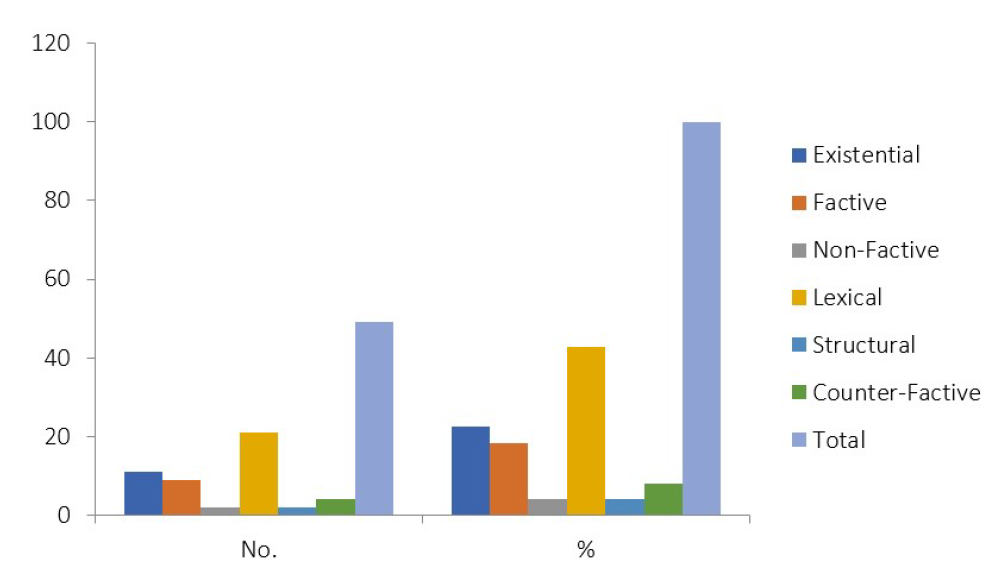
Figure 1: Types of SP in the Data
Table 2: SP Types in the Selected Data of Chekhov’s The Orator
SP Type
No.
%
Existential
11
22.44
Factive
9
18.36
Non-Factive
2
4.08
Lexical
21
42.85
Structural
2
4.08
Counter-Factive
4
8.16
Total
49
100
RESULTS AND DISCUSSION
Accordingly, as shown in Table 2, the statistics has rvealed that the sentences have a good potential of SPs and the analyzed ones as accounted as 49 SP as total. The highest quanitity is made by the lexical subtype as being of 21. The second portion is made by 11 existential. However, Factive and Non-Factive account as 9 for the former and only 2 for the later. The least number is made by 4 counter-factive SPs and only 2 structural SPs. Figure 1, explain these ratios.
CONCLUSION
As obtained through the analysis of the present study data, Semantic presupposition types stand as a good source of the semantic presupposition of texts. In turn, lexical presupposition dominates in regard to other types. However, the usage of other types also plays a vital role in establishing the way that we decode the information.
In addition to this, SP provides a good ground for making other types of presupposition like PS. In turn, readers and writers may consider this notion while composing their texts.
Literary texts and fictional works may rely on Semantic presupposition as a means for getting and interpreting them. This helps readers, teachers and learners to make a better understanding of the literary works.
In light of the obtained results, the present study recommends that SP to be regarded while reading, studying and teaching literary texts. Translators also may benefit from this notion while translating foreign texts. Future studies may contracts SP with Pragmatic presupposition that relay to a large extent on the SP types and this what has been found by the present study as SP an important factor for establishing presuppositions.
REFERENCES
Lyons, J. Language and Linguistics. Cambridge University Press, 1981.
Cresswell, M.J. Semantical Essay: Possible Worlds and Their Rivals. Kluwer Academic Publishers, 1988.
Levinson, S.C. Pragmatics. Cambridge University Press, 1983.
Yule, G. Pragmatics. Cambridge University Press, 1996.
Tyler, S.A. The Said and the Unsaid: Mind, Meaning, Culture. Harcourt Academic Press, Inc., 1978.
Grossman, R. et al.Papers from the Eleventh Regional Meeting. Goodspeed Hall, 1975.
Saeed, J. Semantics. Blackwell Ltd., 1997.
Lyons, J. Semantics. Cambridge University Press, 1977.
Crystal, D. and D. Davy. Investigating English Style. Longman Group Ltd., 1969.
Leech, G. Semantics. Penguin Books Ltd., 1974.
Crystal, D. and D. Davy. The Cambridge Encyclopedia of Language. Cambridge University Press, 1987.
McCawley, J.D. Grammar and Meaning: Papers on Syntactic and Semantic Topics. Academic Press, Inc., 1976.
Karttunen, L. “Presupposition of Compound Sentences.” Linguistic Inquiry, vol. 10, no. 3, 1979, pp. 164–193.
Lakoff, G. “Presupposition and Relative Well-Formedness.” Semantics and Psychology: An Interdisciplinary Reader in Philosophy, Linguistics and Psychology, edited by D.D. Steinberg and L.A. Jakobovits, Cambridge University Press, 1971, pp. 329–340.
Whyman, R. Anton Chekhov: Routledge Modern and Contemporary Dramatists. Routledge, 2011.
Advertisement
Recommended Articles
Research Article
Pedagogic Competencies Provided To Student Teachers through Biology Teacher Education in Universities in Kenya In Light of Classroom Practice
Download PDF
Research Article
Outcome of COVID-19 in Patients with Myasthenia May Not Only Depend on the Immunologic Disease
Josef Finsterer,
...
Ana C Fiorini
Published: 31/10/2020
Download PDF
Research Article
A Study To Understand Research Into The Formation of Educator Profiles for Use by Institutions Whose Primary Mission is The Preparation of Future Educators
Jin Xianzhao,
...
Aminul Islam
Published: 29/07/2024
Download PDF
Research Article
The Effect of a Picture Book on the Pre-Primary School Children's Literacy Skills Development: Implication on the Teacher Education and Child Language Development
Dominion ,
Joanna Ngozi
Published: 15/07/2020
Download PDF
PO Box 101, Nakuru
Kenya.
Email: office@iarconsortium.org
Editorial Office:
J.L Bhavan, Near Radison Blu Hotel,
Jalukbari, Guwahati-India
Nooruldin, N. M. (2023). A Study of Semantic Presupposition in Anton Chekhov’s “The Orator”. International Academic Journal of Education & Literature, 4(1), 1-6.
MLA
Nooruldin, Noor M.. "A Study of Semantic Presupposition in Anton Chekhov’s “The Orator”." International Academic Journal of Education & Literature 4.1 (2023): 1-6.
Chicago
Nooruldin, Noor M.. "A Study of Semantic Presupposition in Anton Chekhov’s “The Orator”." International Academic Journal of Education & Literature 4, no. 1 (2023): 1-6.
Harvard
Nooruldin, N. M. (2023) 'A Study of Semantic Presupposition in Anton Chekhov’s “The Orator”' International Academic Journal of Education & Literature 4(1), pp. 1-6.
Vancouver
Nooruldin NM. A Study of Semantic Presupposition in Anton Chekhov’s “The Orator”. International Academic Journal of Education & Literature. 2023 Jan;4(1):1-6.



 Download PDF
 Download XML