The purpose of this study was to identify and describe the computer studies programme strategies that secondary schools in Cameroon have put in place to implement computer studies. A survey was carried out in 120 secondary schools in the 10 Regions of Cameroon. Data were collected through various means: document analysis, classroom observations, questionnaires, interviews, analysis of students’ academic performance in computer studies at the General Certificate of Education Advanced Level and Baccalauréats and a focus group discussion with national inspectors. The data so collected were analysed using descriptive statistics of mean and standard deviation. Findings revealed that the strategies used for the implementation of computer programme include infrastructure and readiness strategies, planning and preparation strategies, strategies for training in computer, strategies for motivating students and teachers in the use of computer skills, sustainability, maintenance and support strategies and strategies for evaluating the computer studies programme. It also found out that school socio-economic area, the school type (or ownership) and the type of education offered by the school affected the strategies for implementing the programme. Recommendations were formulated for practice at the national, regional, school and classroom levels. The study recommended that both the Government of Cameroon and other stakeholders in education should plan adequately and prepared secondary schools to be ready for the implementation of the computer programmes in the school system.
Keywords
Curriculum
Strategies
Planning
Infrastructure
Training on Computer Studies
Implementation
Secondary Schools Words
INTRODUCTION
The forgoing section dealing with the Cameroon context described the action of the Ministry of Secondary Education since 2001, in the implementation of the computer studies programme and related strategies in secondary schools. This move by the Ministry followed the launching by President Biya, in that year of the first secondary school multimedia centre in Cameroon at Lycée Leclerec (High School) in Yaoundé. From that description it seems clear that the Ministry moved very rapidly to integrate computer studies as a formal area of studies or subject in the secondary school curriculum. The rapid move by the Ministry could be attributed to pressure from the government and the educational community. This pressure was geared to ensuring that students develop the computer skills necessary for Cameroon to respond adequately to the challenge of globalisation and its associated new Information and Communication Technologies (ICTs).
Stressing on this objective, Tchombe [1] points out that, Information and Communication Technologies are the driving factors of major changes reshaping the world’s economic, social and cultural configurations in the advent of electronic media, radical transformation in the way people acquire knowledge and new teaching learning approaches. The perspective of the Cameroon government in its vision of ensuring that Cameroon schools integrate ICTs in the curriculum is contained in the Growth and Employment Strategy (GESP) published in 2009.
According to the strategy; the education offered must be based on a dynamic balance between general and technical education that prepares students for higher education in priority fields for the development of an economic system geared to more and more industrialisation. Teaching should be more oriented to quality assurance by the creation of scientific series and use of laboratories and computer equipment. The programmes offered must be geared to the needs of the job market and must be characterized by its accessibility, equity, effectiveness, quality and sustainability (pp.73-75, paragraph 3.3.2).
The problem with introducing a programme under intense pressure and so rapidly is that such a programme may not adequately address the issues or criteria of accessibility, equity, effectiveness, quality and sustainability that are spelt out in the Growth and Employment Strategy (GESP). This problem needs to be addressed in some systematic manner in order to promote quality assurance in the computer studies programme in Cameroon secondary schools. Otherwise, a gap could exist between what the society and government expect and what the schools offer in computer studies. From that perspective, the investigation in this study focused on whether the computer studies programme and related strategies recently introduced in secondary education through a series of ministerial texts or instructions are accessible, effective, equitable and sustainable as prescribed by the Growth and Employment Strategy (GESP).
Objective of the Paper
The main objective of this paper is to describe the strategies that have been developed for implementing the various components of curriculum in Cameroon secondary schools.
Literature Review
Concepts and Approaches to Curriculum Implementation: Teachers often complain that their professional input is minimal, consisting of nothing more than implementing predetermined, pre-packaged materials [2]. Curriculum authors have expanded on implementation as a domain devoted to teachers. Some selected approaches to curriculum implementation studies are presented in this section, for their relevance to this study is justified by the ontological, epistemological and methodological assumptions underpinning our research.
Implementation means that teachers put into effect the decisions that were made in the planning stage, particularly those related to teaching methods, strategies and learning tasks and activities. Implementation occurs when teachers are interacting with students [3]. Sarason [4] and Ornstein and Hunkins [2] noted two kinds of basic understanding essential to implementation. The first is an understanding of organisational change and how information and ideas fit into a real-world context. The second is an understanding of the relationship between curricula and the social-institutional contexts into which they are introduced that is implemented. We will elaborate on these two views of curriculum implementation by examining its various characteristics. Firstly, we will look at curriculum implementation as a subject for policy analysis; secondly, as an administrative concept; thirdly, as an instrumental action; fourthly, as a situational praxis; fifthly, as an interpretive act; and finally, as a multifaceted process.
Implementation as a Subject for Policy Analysis
The emergence of implementation as a subject for policy analysis coincides closely with the discovery by policy analysts that decisions are not self-executing [5]. Policy analysts who are economists tend to reduce implementation analysis to a simple choice between market and non-market mechanisms. Defining implementation analysis as such, Elmore argues, is diverting attention from and trivialising an important problem: how to use the structure and process of organisations to elaborate, specify and define policies.
In fact, most policy analysts, economists or not, usually regard complex organisation as barriers to the implementation of public policy not as instruments to be capitalised upon and modified in the pursuit of policy objectives. Therefore, it is important to underline the reciprocal nature of authority relations. Generally, formal authority travels from top to bottom in organisation, while the informal authority that derives from expertise, skill and proximity to the essential tasks that an organisation performs, travels in the opposite direction.
Curriculum Implementation as an Administrative Concept
Implicit is the idea that the curriculum policy document reflects an unmistakably transparent stand that will descend into the schools. In this perspective, the curriculum policy document and its implementation are perceived as discrete entities in which the former is privileged.
The curriculum policy document is generally interpreted as an expression of political purposes, a statement of the course of action that policymakers and administrators intend practitioners to follows [6]. Here, the meaning of implementation is restricted to narrowly-defined strategic interests in how to put a given curriculum plan into practice. This means that a curriculum is said to be implemented when the authorial intent presumed to lie behind the policy text becomes embedded in schooling. More specifically, when the syllabuses meet the required specifications, the text books and other teaching materials have been made available and the planned outcomes are achieved. This understanding of curriculum implementation as an administrative concept denotes the process of installing a curriculum decision into classroom practice [7].
Curriculum Implementation as an Instrumental Action
Again at the producer-consumer paradigm borrowed from the business metaphor, curriculum implementation is a unidirectional flow where experts produce for non-experts. Under this paradigm of the relationships between the “haves and the haves-not”, curriculum experts produce programmes for the consumer teachers and students.
As such, curriculum implementation problems are typically seen as practical problems for which solutions are sought pragmatically. Teachers, on whom the success of the implementation depends, try to make sense of the curriculum. For example, should they commit themselves to the new curriculum? Should they make visible token commitments, or should they make the programme relevant to their own students? Or should they compromise between what they have been doing and what they are expected to do? How teachers’ experience within their situation is viewed depends wholly on the perspective employed to guide our interpretation of the experience of the teachers engaged in implementation.
Implementing a programme under this paradigm rests on the basic problem of how to communicate effectively with people who have not been involved in setting goals, designing resources, teaching and learning strategies nor in evaluation plans [8]. This implies that a competent teacher-implementer is one who has skills and techniques oriented towards efficient control. Such a know-how-to-do view of implementation is imbedded in scientific and technological thought-action-framework, which reduces human competence to instrumental reason and instrumental action. Hence, the teacher is seen as a rule-oriented being cast within a manipulative ethos, an ethos in which even his future is conceived in terms of rules. This technological paradigm is reflected in the dominance of the Research, Development, Diffusion and Adoption model (RDDA) elaborated by Guba and which has not worked well [8].
Viewing curriculum implementation as an instrumental or technological action is minimizing the interpretive activities teachers are engaged in when they encounter a curriculum.
Curriculum Implementation as a Situational Praxis
In the contemporary sense, praxis is reflection (thought) and action (practice) upon the world in order to transform it (Freire, 1993). Curriculum implementation as a situational praxis is an idea taking ground in teachers’ experiences in the classroom. This is the experimental world of the teachers with their students who co-dwell within the insistent presence of a curriculum to be implemented. Interpreting the curriculum implementation as praxis acknowledges assumptions that humanisation is the basic of human action; that people are capable of transforming their realities; and that education is never neutral [8].
The essence of such a perspective is that the teacher called upon to implement a curriculum must be seen not in terms of a being-as-thing, but as a human being interested in his own and others’ becoming. Additionally, a teacher is seen as a person who acts and thus as a creator of his own reality. As such he interprets from within his horizon a given curriculum and engages situationally in its transformation. In this case curriculum implementation is a political act for, within a social relational context, the activity of implementation is a matter of power and control. Understanding curriculum implementation as praxis leads to the realm of the classroom where teachers interpret a given curriculum.
Curriculum Implementation as an Interpretative Action
In curriculum implementation, the interpretive act is the effort by teachers to fuse the horizon of the curriculum plant as text, with the horizon of teaching as a lived experience [8]. A teachers’ perspective of the curriculum in the interpretative action philosophy is has its roots in the concrete and contingent classroom setting of his students. Within this philosophy, interpretation of the curriculum depends upon the teachers stock of knowledge and beliefs about how students learn, what society wants, what the future will be like and the teachers’ understanding of the organizational context of their work. Interpretation of the curriculum is a complex because the teaching act as a practical activity is grounded in a form of rationality which is different from the rationality inherent in the plan [8].
In order to accomplish curriculum making, teaching is conceptualized and rationalized into its component parts: the articulated goals, planned activities, identified displays, evaluation strategies and so on. This much of teaching and more, is technical; it is governed by the skillful development and application of appropriate methods in order to reach predefined ends [9].
Apart from these methodological considerations teaching is governed by pedagogical concern for children and is therefore oriented towards the good. Practical actions take on the character of situational decision making along the lines of doing the right thing at the time. These actions are grounded in ethics rather that technique. Implicit within such ethical decision are aspirations and hopes for students and the future, which remain unarticulated but nonetheless serve as real guides to appropriate action [8].
Curriculum Implementation as a Process
Fullan and Park and Leithwood [7] define implementation as process. Fullan precises that implementation is a process of putting into practice an idea, programme, or a set of activities new to the people attempting or expected to change. In curriculum implementation, it is therefore right to say that the process results in a change in practice on the part of teachers and students, which affects outcomes. Thus, implementation involves reducing the differences between existing practices and practices suggested by the innovation. These perspectives suggest that curriculum implementation should be examined successively as: (1) a personal and social process; (2) a hierarchically ordered process; (3) a dispersed and decentralised process and (4) a change process.
Curriculum Implementation as a Personal and Social Process
Implementation emphasizes on the process of interaction between the curriculum developers and teachers [10]. Implementation is not one-sided rather it is a process during which the teacher adapts the programme to his subjective reality (Fullan and Leithwood (op.cit.).
Because implementation is a human activity, the teacher is expected to teach a new programme in the classroom while working within a complex social system. This is why curriculum implementation may be considered as a process that leads to the shared school type of the innovation. During this process, change will likely occur in an interactive way, both in the teacher and in the innovation. The teacher acquires some “school type” of the new programme and the developer relinquishes some control [10].
Curriculum Implementation as a Hierarchically Ordered Process
This perception of curriculum implementation is borrowed from policy analysts who assume that “more explicit policy directives, greater attention to administrative responsibilities and clearer statements of intended outcomes will improve the implementation” [5].
This assumption reinforces the myth that implementation is controlled from the top, following the hierarchical relationship. Here the implementation process is dominated by regulations, formal organisational structures and management-control.
Therefore, concludes the author, two other assumptions derives from the former one: (1) the closer one is to the source of the policy, the greater is one’s authority and influence; (2) the ability of complex systems such as educational systems to respond to implementation problem, depends on the establishment of clear lines of authority and control.
Curriculum Implementation as a Dispersed and Decentralised Process
In this paradigm the standard of success or failure of curriculum implementation is not the policy itself, or the policy makers’ intent. This paradigm offers instead a standard of success that is in all respects, conditional. That is, one’s definition of success is predicated on an estimate of the limited ability of actors at one level of the implementation process, to influence the behaviour of actors at other levels; and the limited ability of public organisations as a whole to influence private behaviour [5]. Specifically, the closer one is to the source of the problem, the greater is one’s ability to influence it and the problem solving ability of complex systems depends not on hierarchical control, but on maximizing discretion at the point where the problem is most immediate. The influence hierarchical relationships have in curriculum implementation process naturally goes with the aim of policymakers to impact change.
Curriculum Implementation as a Change Process
Curriculum implementation means the open use of a curriculum through the school system; the implementation here may be sectorial or widespread. In centralised educational systems, a programme may either become compulsory for all schools of a certain type, or be among a list of authorised alternative programmes from which each school chooses those most suitable for its needs [11].
In both cases, implementation entails certain changes in the system. These are from three orders: (1) in teacher training programmes; (2) for obtaining the support and cooperation of supervisory staff; (3) for making the appropriate changes in a national examination system.
One of the characteristics of curriculum implementation is that the “curriculum policy text” and the implementing teacher are not timeless, but produced for particular purposes within specific historical, social and political conditions [6]. In this context, how is the change viewed and enacted by teachers, students and stakeholders of educational system?
Margaret et al. (op. cit) think that the way in which teachers perceive the reality in implementing the curriculum is linked with power systems. This is not, they argue, about whether curriculum change happens within the classrooms, but how that change is understood and the effectiveness of its discursive constitution. In the same line, Ornstein and Hunkins [2] state that the purpose of curriculum development, regardless of level, is to make a difference, to enable student to attain the school’s, the society’s and perhaps most importantly, their own aims and goals.
Implementation is an essential part of curriculum development for it brings into reality anticipated changes. Curriculum activity is a change activity, for it raises problematic issues related to change such as: what happens when change occurs; the value and the source of change, people’s motivation as well as their capacity to predict the consequences of change; the worth of change for students and the society; the ability of educators to control change.
Elmore [12] argues that educators are more expert in managing change than in determining the values and benefits of change desired and accomplished. In effect, a better understanding of change is required if one were to exert control over the process of change; this statement is true with teachers. The knowledge of the value or worth of change must not ignore the reality that change occurs in several ways. Ornstein and Hunkins quoted earlier emphasize two most obvious types of change: slow change and rapid change. The first concerns minor adjustment whereas the latter and the most significant and common, results from new knowledge or social trends affecting schools such as computers being introduced into classrooms (Ornstein and Hunkins, op. cit.).
Models of Curriculum and Programmes Implementation
In this we attempt to present the different models of curriculum implementation models under the following classification: (1) based on the business paradigm; (2) based on policymakers’ perspectives; and (3) based people concerns. The main idea is to group them according to the philosophies guiding their proponents.
Classification Based On the Business Paradigm
When considering implementation, curricular specialists and education policy makers are faced with two acute problems. The first is how to deal with the implementation problem, i.e. the problem that so many curricula have not been implemented? The second, presented more positively is how to stimulate the implementation so that the target group impacts the changing process for the improvement expected?
To address these issues, Fullan [13] presents two different general approaches: the programmed approach and the adaptive-evolutionary approach. Elmore [5] suggests backward and forward mapping approaches.
The Programmed Approach
The programmed approach (or "fidelity approach") aims to solve the implementation problem by concentrating on flaws in the specification of the "product", e.g. (a) gaps in the existing specification of innovations practices; (b) failure to articulate the innovation's implication for teachers’ behaviour and (c) theoretical inadequacies with respect to identified means for achieving the intended outcomes of an innovation [14]. This means that if the specification of the curriculum and the implementation process are clear, the problems of implementation would be fewer. In the programmed approach the innovation is shaped before the initiation stage or the curriculum making process.
Figure 1: Comparison of Programmed Approach and Adapttive-Evolutionary Approach [15]
The Adaptive-Evolutionary Approach
The adaptive-evolutionary approach accepts that the innovation as it has been devised will be modified in the course of its implementation. This is not only seen as just a feature of mundane circumstances, wise and realistic persons have to accept, but as an essential characteristic of implementation. The primary feature of effective implementation could be called “mutual adaptation», in which the project is adapted to its institutional context and organizational patterns are adapted to meet the demands of the project" [15].
The adaptive-evolutionary approach additionally claims that with complex innovations, it is conceptually unsound, socially unacceptable and empirically impossible to solve the implementation problem by programming the persons concerned by giving them detailed elaborations of the desired practice and step by step specifications for the implementation. Rather, innovators should suggest "intelligent hypotheses" to their audience [16]. Stenhouse therefore invites practitioners to rethink and further develop the new curriculum for the specific circumstances they are working in, through negotiation and transaction. In this model, practitioners are expected to use their practical situational knowledge for implementation and for modifying the original models according to the demands and resources of the specific locality [15].
In practice, any practical implementation project will be situated somewhere between the extremes of the dichotomy just introduced. However, from Altrichter’s view it makes sense for curriculum developers to ask themselves what type of solution of the implementation problem they implicitly or explicitly favor through their organization of the implementation process and if this fits to the messages their curriculum implies and to the localities it has to work in and how will the people in charge of the implementation react.
The programmed approach or "fidelity approach" and the adaptive-evolutionary approach of implementation reveals that, for the programmed approach curriculum development takes place exclusively before implementation, the implementation being the application of pre-specified models; for the adaptive-evolutionary approach, the curriculum is made during and through implementation.
In addition, in the programmed approach, the implementation is evaluated through the correspondence between the actual use of the innovation and the developers' intentions [14]. The adaptive-evolutionary approach does not just test the effects of an innovation against a set of pre-specified objectives, since the responsibility for practice will ask for evaluating the overall effects, i.e. including side-effects [17]. Thus, an evaluation must provide a comprehensive understanding of the complex reality (or realities) surrounding the programme in order to illuminate the state of the innovation and the options for its further development for the different constituencies involved [18].
According to Altrichter [15], the programmed approach has certain strengths: it takes care to communicate its intentions and ways of implementation as clearly as possible and, thus, its evaluation criteria are unambiguous. However, it has also some weaknesses. The most important of which are: first, it is only suitable for innovations that are actually programmable; second, the needs and characteristics of persons and organizations in different regions may vary so much that some leeway is desirable in order to cope with the situational implementation problems. Many researchers claim that curricula for more complex educational goals are not easily programmable because our knowledge about the conditions of application is not sufficient. Says the same author, the adaptive-evolutionary approach is strong in adapting an innovation to situational characteristics. It also claims that complex changes necessitate relearning and, thus, invites participants to participate actively in the process of implementation, which is seen as a prime opportunity for internalizing the main characteristics of the innovation. The main weaknesses of the adaptive-evolutionary approach are that the problems may arise because of ambiguous objectives, variation of ways of implementation and shifting evaluation criteria. A second issue observed for this approach is that the evaluation of success is difficult and may vary between different persons and constituencies because no common criteria are available from the outset [19].
Similarly, Berman [20] has argued that the programmed approach and the adaptive-evolutionary approach have their merits and that the implementation approach should be chosen according to its fit to the specific implementation situation. So, the programmed approach is appropriate under the following circumstances: the amount of change intended is small or orchestrated in a gradual manner, the curriculum may be specified according to tested and widely known teaching methods, the persons concerned by the implementation agree to objectives and methods and when the school is comparatively integrated and its environment comparatively stable.
In the cases where these conditions are not met, an adaptive strategy may be more appropriate [13]. The Figure 1 compares the programmed approach and the adaptive-evolutionary approach.
Classification Based People Concerns
The Overcoming-Resistance-to-Change Model: The Overcoming-Resistance-to-Change model (ORC) rests in the assumption that the success or failure of planned organizational change basically depends on leaders’ ability to overcome staff resistance to change (Neal Cross as reported by Ornstein and Hunkins). The strategy used is to give school administrators and teachers equal power by involving them in discussions and decisions about programme change. This makes the members to view innovation as self-created and therefore committed to it [2].
Within the ORC paradigm, Hall and Loucks [21] have divided the implementation into four stages as far as people concerns are addressed during the implementation process. These stages are represented as follows in Figure 2.
As seen on the Figure 2 and as the explanation below shows, the principle is that people’s concerns are more and more specified as the implementation of an innovation induces change in people routine:
Stage 1: Unrelated Concerns: At this stage, teachers do not see a relationship between themselves and the suggested change which they therefore do not resist
Stage 2: Personal Concerns: At this stage, teachers react to the innovation in terms of their personal situation, how the new programme will affect what they are doing
Stage 3: Tasks Related-Concerns: These concerns relate to the actual use of the innovation in the classroom: The methods, time, materials, strategies etc
Stage 4: Impact Related-Concerns: At this stage, teachers are concerned with how the innovation will affect the students, colleagues and the community. Teachers might also want to determine the impact of the programme on their subject area
Communication is therefore very important in the ORC model of implementation in order that people’s personal, task-related and impact-related concerns are considered. Information could be gathered through questionnaire and discussions.
Figure 2: Stages of Staff's Concerns in a Change Process
The Organisational-Development Model
The Organisational-Development approach is an effort to improve an organization’s problem-solving and renewal processes, through collaborative diagnosis and management. The emphasis is on teamwork and organizational culture. The OD model views implementation as an ongoing, interactive process. This is so because the approach rests on the assumption that individuals care about the future and desire to be actively engaged in designing, developing, implementing and evaluating the educational system. It also treats implementation as never finished. The reason is that there are always new ideas to bring to the new programme, new materials and methods to try out, new students to excite. Enacting the curriculum continually engages teachers and students in growth by providing enriched learning that benefits the total person [2].
The Concern-Based-Adoption Model
Curriculum leaders identify and deal with staff’s concerns because they understand that individuals must change before organizations can be altered.
The Concerned-Based Adoption Model (CBAM) is an approach that looks at the implementation process from the standpoint of the users of an innovation, by focusing on the concerns or viewpoints which potential users have and the kinds or levels of use they make of the innovation [22]. The CBAM approach was developed at the University of Texas-Austin, USA. The concern-model holds that people considering and experiencing change evolve in the kinds of questions they ask and in their use of whatever the change is. In general, early questions are more self-oriented.
Figure 3: Stages and Typical Expressions of Concern about An innovation [23]
The CBAM approach uses a system of instruments and techniques for data collection and analysis. Four of these are: the Stages of Concern Questionnaire (SoCQ), the Levels of Use Questionnaire (LoUQ), the Innovation Configuration Matrix (ICM) and the Intervention Taxonomy (IT). As far as curriculum implementation is concerned, the Stage of Concern Questionnaire and the Levels of Use Questionnaire are the most adequate instruments.
The SoCQ is used to find out the attitudes or concerns of stakeholders about the innovation. Stages of concern defines human learning and development as going through seven stages during which a person’s focus or concern shifts in rather predictable ways: awareness, informational, personal, management, consequence, collaboration and refocusing. The three lower stages are focused on oneself; meanwhile the middle stage is focused on the mastery of tasks and the upper three stages focused on the results and impact of the activity, as shown on Figure 3.
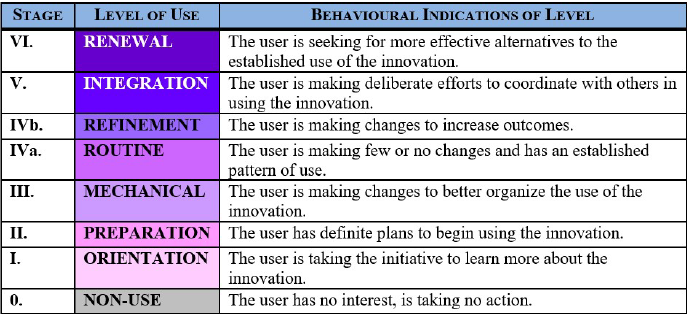
Another instrument used by the CBAM is the Levels of Use Questionnaire. This instrument provides information on the sort of application that users of the innovation are making [22]. These levels of use correspond to the stages of adoption process, namely: Awareness, interest, evaluation, trial, adoption and integration. At each of these stages of the adoption process, individuals exhibit different behaviours, as shown on Figure 4.
Figure 4: Levels of Use of the Innovation and Typical Behaviours (From Taking Charge of Change, Hord et al.)
Loucks-Horsley [23] underlines the major implications of the CBAM for professional development. The authors first pointed out the importance of attending to where people are and addressing the questions they are asking when they are asking them. Secondly their model suggests the importance of paying attention to implementation for several years, because it takes at least three years for early concerns to be resolved and later ones to emerge. Also important is the evaluation of the discrepancy between the planned curriculum and the reaction of the people intended to implement it along the system.
Classification Based On Policy Makers’ Perspectives
Forward Mapping: Forward mapping is the strategy that is commonly used when policymakers try to affect the implementation process. It begins at the top of the process with as clear a statement as possible of the policymaker’s intent. It then proceeds through a sequence of increasingly more specific steps to define what is expected of the implementers at each level. At the bottom of the process, one states, again with as much precision as possible, what a satisfactory outcome would be, measured in terms of the original statement of the intent [5]. The policy document issued in this context contains regulations and administrative actions consistent with the intent and an elaborated division of responsibilities between the central and lower levels of implementation. If the implementation of that policy depends on the adoption of some form of technology, one can describe the state of technology necessary at each stage. Forward mapping have some weaknesses and limitations. Elmore notes its implicit and unquestioned assumption that policymakers control the organizational, political and technological processes that affect implementation [5]. This control leads to implementation’s failures because there is a lack of suitable alternative, no place for initiative from the implementers; all actions are controlled from the top.
In effect, forward mapping assumes that organizational units in the implementation process are linked in essentially hierarchical relationships. This assumption has two corollaries: the closer one is to the source of the policy, the greater is one’s authority and influence; and the ability of complex systems to respond to problems depends on the setting of clear lines of authority and control.
Backward Mapping
On the other hand, as defined by Elmore [5], backward implementation begins not at the top of the implementation process rather at the last possible stage, the point at which administrative actions intersect with private choices. Backward implementation begins not with a statement of intent, but with a statement of the specific behaviour at the lowest level of the implementation process that generates the need for a policy. Only after that behaviour is described does the analysis presume to state an objective. The objective is first stated as a set of organizational operations and then as a set of effects, or outcomes, that will result from these operations.
Having established a relatively precise target at the lowest level of the system, the analysis backs up through the structure of implementing agencies. Here two determinant questions are asked at each level: (1) what is the ability of this unit to affect the behaviour that is the target of the policy? (2) What resources does this unit require in order to have that effect? In the final stage of analysis the policymaker describes a policy that directs resources at the organizational units likely to have the greatest effect.
Although backward mapping takes the policymaker’s perspective on the implementation process, it does not assume that policy is the only or major influence on the behaviour of people engaged in the process. Furthermore, it does not rely on compliance with the policymaker’s intent as the standard of success or failure. It offers instead a standard of success that is in all respects conditional. This model assumes that one’s definition of success is predicated on an estimate of the limited ability of actors at one level of the implementation process to influence the behaviour of actors at the other levels and on the limited ability of public organizations as a whole to influence private behaviour [5].
In a nutshell, backward mapping shares with forward mapping the notion that policymakers have a strong interest in affecting the implementation process and the outcomes of policy decisions. Backward mapping assumes essentially the opposite: the closer one is to the source of the problem, the greater is one’s ability to influence it; and the problem-solving ability of complex systems depends not on hierarchical control but on maximizing discretion at the point where the problem is most immediate.
However, backward mapping explicitly questions the assumption that policymakers ought to, or do, exercise the determinant influence over what happens in the implementation process. Additionally, backward model questions the assumption that explicit policy directives, clear statements of administrative responsibilities and well-defined outcomes will necessarily increase the likelihood that policies will be successfully implemented. The logic of backward mapping is, in all important respects, the opposite of forward mapping.
Strategies for Implementation of a Technology Curriculum
Fullan [1] identifies a number of strategies that can lead to a successful implementation process that apply to the implementation of computer studies programme. These are preparation, initiation and participation, vision building, evolutionary development, initiative-taking and empowerment, staff development and resource assistance, monitoring, evaluation and problem-coping, restructuring and intensive communication.
Preparation, Initiation and Participation
Some preparatory collection and analysis of data about the state of the system to be innovated will help to focus energy.
Vision Building
If an organization or a project has a vision, it permeates the (project) organization with value and purpose, which give direction and driving power for development.
Evolutionary Development
Fullan again argued that for major change, highly specified planning is unwise. That is why he recommends communication between the people involved at all levels in the implementation.
Initiative-Taking and Empowerment
Leaders in successful schools support and stimulate initiative-taking by others; set up cross-hierarchical steering groups and delegate authority and resources to the steering group, while maintaining active involvement with the groups.
Pressure and Support
Various arrangements of interaction between the implementers serve to integrate both pressure and support. Staff Development and Resource Assistance are other strategies. Innovation here is a strategy that involves a process of relearning competencies and attitudes for the existing personnel.
Monitoring, Evaluation and Problem-Coping
Self-reflection, self-evaluation and monitoring the outcomes and the process of change, is an essential element of every effective implementation strategy.
Restructuring
Where this task of restructuring is taken up explicitly and pro-actively in the course of the implementation, the chance of producing sustainable results will be higher.
Intensive Communication and Relationships to External Agencies
Clear and pro-active information and communication with the organization's environment and the interested public is important in order to avoid adverse reactions, to make the innovative changes understood and, at times, to invite alternative perspectives.
MATERIALS AND METHOD
The research design adopted for this study was a cross-sectional survey. This design allows the researcher to observed computer teachers and students in their classrooms across the ten regions of Cameroon. A sample of 300 computer teachers and 1100 upper sixth computer students were selected from this population, using random and purposive sampling procedures. Four research instruments were used for this study. The instruments include: structured questionnaire (paper and electronic), observation checklist, interview and focus group discussion guides. The instruments were translated into French, in order to reach the French speaking participants. The classroom observation checklist was developed the purpose of observing teaching and learning interactions with computer studies in the classroom. This observation checklist focused on: School characteristics, classroom instructional conditions, students’ characteristics, their involvement in instruction and teachers’ characteristics.
Classroom observations were afterward completed with interviews. For this reason, two interview guides were developed, one for principals and the other for computer teachers. The aim of these complementary interviews was to know “how” and “why” people reacted the way they did during the observations. The content of these interviews centred on the choices made regarding strategies used by secondary schools in delivery as well as the perspectives for using computers in instruction were also discussed. Two types of questionnaires were constructed: one for teachers and another one for students from secondary schools where the computer studies programme is implemented. Each of the two questionnaires had four sections. The first section of the questionnaire dealt with the description of the schools participating in the investigation, followed by the description of participants according to gender, age, academic profile and experience with computer studies. The second section was related to the content, sources and delivery conditions and techniques of the computer studies programme, factors determining the content, sources and delivery conditions and techniques of the computer studies programme.
The third section of the instrument, a question required of the participants to identify the techniques, methods and means used by secondary school to deliver the content of the computer studies programme. These strategies were listed and scored on a four point Likert scale representing participants’ perception of programmes and strategies for the computer studies programme in their secondary schools. The questionnaire used had a 4-scale Likert design. In order to understand whether the questions in the questionnaire all reliably measure the same latent variable, we used the Cronbach’s alpha. The collected data were analysed using descriptive statistics of mean and standard deviation.
RESULTS
Answer to Research Question: “What Strategies are used to implement the Computer Studies Programme in Cameroon Secondary Schools?” The aim of this question was to describe the strategies secondary school put in place in order to implement the computer studies programme in their school context. The third component of the questionnaires inquired about the description of these strategies. Participants were presented a series of items. Some items applied to teachers and to students separately and others to both of them. The items were organized into six themes, namely: Strategies for planning and preparation; strategies for infrastructure and readiness; strategies for training; strategies for utilizing computer studies skills in the curriculum; strategies for sustainability; maintenance and support; and strategies for evaluating the computer studies programme. The findings are presented in tables corresponding to these themes.
Strategies for Planning and Preparation
Only teachers’ opinions were requested for the identification of planning and preparation strategies for the computer studies. Planning strategies deal with seven aspects namely: establishing a monitoring committee for the computer studies, providing an appropriate training to individuals involved in the implementation of the computer studies, carrying out a comprehensive needs assessment and consultation prior to the implementation, formulating and adopting guidelines for the implementation of the computer studies, setting standards for acquisition and management of computer rooms, furniture and equipment, attracting and maintaining teachers and technicians with computer skills and aptitudes and recruiting computer teachers and freeing them from administrative duty in the school. From the analysis, schools in rural areas seem to be more concerned than those from urban and sub-urban areas. Their means are 3.56; 2.76 and 1.4 respectively (Table 1).
Table 1: Mean Scores of Planning Strategies for Computer Studies Programme According to School Socio-Economic Area (Teachers’ Data)
SN
Strategy
Means
Urban Area
Sub Urban
Rural
1
Establishing a monitoring committee
1.18
2.61
3.42
2
Providing an appropriate training to individuals involved
1.15
2.18
3.21
3
Carrying out a comprehensive needs assessment and consultation
1.33
2.65
3.42
4
Formulating and adopting guidelines
1.70
3.00
3.88
5
Setting standards for acquisition and management of computer rooms, furniture and equipment
1.74
3.00
3.79
6
Attracting and maintaining teachers and technicians with computer skills and aptitudes
1.67
3.12
4.00
7
Recruiting computer teachers and freeing them from administrative duty in the school.
1.40
2.73
3.19
Total
10.17
19.29
24.91
Average
1.4
2.76
3.56
These findings can be explained by the fact that schools in rural and those from sub-urban areas are still looking for ways to start the implementation, while those from urban areas have already completed the planning phase or have simply omitted it, as seen in the field. Table 2 shows that private schools (3.47), than public schools (1.97), are more concerned with planning and preparation strategies. The reason may be that the quality of computer equipment and facilities offered by schools attracts parents and students. Since there is a competition between the private and the public sector, the planning strategies put in place, for the implementation of the computer studies programme make the difference.
Table 2: Mean Scores of Planning Strategies for Computer Studies Programme According to Type of School (Teachers’ Data)
SN
Strategy
Means
Public
Private
1
Establishing a monitoring committee
1.75
3.33
2
Providing an appropriate training to individuals involved
1.53
3.16
3
Carrying out a comprehensive needs assessment and consultation
1.86
3.33
4
Formulating and adopting guidelines
2.24
3.69
5
Setting standards for acquisition and management of computer rooms, furniture and equipment
2.26
3.62
6
Attracting and maintaining teachers and technicians with computer skills and aptitudes
2.22
4.00
7
Recruiting computer teachers and freeing them from administrative duty in the school.
1.94
3.15
Total
13.8
24.28
Average
1.97
3.47
With respect to the type of education, the findings show that schools offering general education and schools offering general and technical education are working more on planning strategies (3.35 and 3.90 respectively) than schools offering technical education (1.99). The explanation is that, technical education started computer studies long before general education. Schools offering both types of education are now planning to extend the implementation of the computer studies programme to their general section (Table 3).
Table 3: Mean Scores of Planning Strategies for Computer Studies Programme According to School Type of Education (Teachers’ Data)
SN
Strategy
Means
Technical
General
General and Technical
1
Establishing a monitoring committee
1.77
3.13
4.00
2
Providing an appropriate training to individuals involved
1.56
3.00
3.69
3
Carrying out a comprehensive needs assessment and consultation
1.88
3.13
4.00
4
Formulating and adopting guidelines
2.26
3.66
4.00
5
Setting standards for acquisition and management of computer rooms, furniture and equipment
2.28
3.55
4.00
6
Attracting and maintaining teachers and technicians with computer skills and aptitudes
2.25
4.00
4.00
7
Recruiting computer teachers and freeing them from administrative duty in the school.
1.96
3.00
3.62
Total
13.96
23.47
27.31
Average
1.99
3.35
3.90
The observations in the field showed that none of the five principals we interviewed had adequately planned or was ready for the implementation of the computer studies programme in his secondary school. This situation, as one principal said, was due to the fact that:
The Ministry of Secondary Education launched the programme just after the Presidency of the Republic of Cameroon officially offered multimedia centres in some government secondary schools. This decision did not give enough time for planning the implementation.
In order to abide by the Ministerial texts launching computer education throughout the secondary education system, principals adopted some emergency preparatory strategies, such designation of a committee for the implementation of the computer studies programme. They sometimes expected national or regional pedagogic inspectors for computer education to assist the secondary schools in this task. Considering their commitments and the insufficient number of computer inspectors, principals adopted an alternative strategy. This consisted of training the individuals involved in the planning and management of the computer studies programme by professionals from private, or public administration, or by a skilled computer teacher. The content of this training was based on presentation of hardware, technological evolution of computers and related devices and basic components of the computer studies programme. Principals said that under such conditions, they could not actually conduct a comprehensive needs assessment for computer studies or formulate and adopt a suitable policy prior to the implementation.
Strategies for Infrastructure and Readiness
Strategies for infrastructure and readiness identified in this study are related to assessing the physical environment to determine infrastructure requirements for computer studies, acquiring the necessary infrastructure to facilitate the implementation, securing computer infrastructure and equipment, ensuring that students and teachers and people involved in the implementation are ready for computer studies and making available pertinent information for effective implementation processes and equipment.
Concerning strategies on infrastructure and students’ readiness for computer studies, findings from both students and teachers show that schools from rural (3.77) and those from sub-urban (2.91) areas were more concerned by infrastructure and readiness strategies than schools in urban areas (1.62) (Table 4).
Table 4: Mean Scores of Infrastructure and Readiness Strategies for Computer Studies Programme According to School Socio-Economic Area (Teachers’ Data)
SN
Strategy
Means
Urban Area
Sub Urban
Rural
8.
Assessing the physical environment to determine infrastructure requirements
1.47
2.99
3.98
9.
Acquiring the necessary infrastructure to facilitate the implementation
1.85
3.08
4.00
10.
Securing computer infrastructure and equipment
1.92
3.25
4.00
11.
Ensuring student readiness for computer studies
1.44
2.62
3.58
12.
Making available pertinent information
1.40
2.63
3.30
Total
8.08
14.57
18.86
Average
1.62
2.91
3.77
In urban areas, the acquisition of the necessary infrastructure (1.85) and securing the infrastructure so acquired for computer studies (1.92) were not rated highly as it is in sub-urban (3.08 and 3.25) and in rural areas (4.00 and 4.00). This may be justified by the fact that (1) schools in urban areas have more possibilities of acquisition: donations, partnerships with business sector, importation and transportation advantages, to name but few; (2) besides, the technology is evolving and more and more present in homes and offices at a low cost and available for students in urban areas; (3) schools sub-urban and in rural areas have to deal with problems related to local technological, economical development, combined to their geographical isolation and lack of finance.
Table 5: Mean Scores of Infrastructure and Readiness Strategies for Computer Studies Programme According to Type of School (Teachers’ Data)
SN
Strategy
Means
Public
Private
8.
Assessing the physical environment to determine infrastructure requirements
2.10
3.76
9.
Acquiring the necessary infrastructure to facilitate the implementation
2.33
3.91
10.
Securing computer infrastructure and equipment
2.43
4.00
11.
Ensuring student readiness for computer studies
1.91
3.45
12.
Making available pertinent information
1.89
3.24
Total
10.66
18.36
Average
2.13
3.67
From findings on Table 5, private schools rated infrastructure strategies higher (3.67) than public schools (2.13). A possible explanation is that private schools can better afford the cost of computer equipment and facilities than public schools. Another reason is that the possession of an adequate computer infrastructure is more and more a criteria for parents and students to selecting a private school. Table 6 presents infrastructure strategies as used according to types of education.
Table 6: Mean Scores of Infrastructure and Readiness Strategies for Computer Studies Programme According to Type of Education (Teachers’ Data)
SN
Strategy
Means
Technical
General
General and Technical
8.
Assessing the physical environment to determine infrastructure requirements
1.57
3.31
4.00
9.
Acquiring the necessary infrastructure to facilitate the implementation
1.32
2.92
4.00
10.
Securing computer infrastructure and equipment
1.17
3.02
4.00
11.
Ensuring student readiness for computer studies
1.48
3.52
4.00
12.
Making available pertinent information
1.82
3.70
4.00
Total
1.56
16.47
20.00
Average
1.56
3.30
4.00
The findings here again show that in general education and in schools offering technical and general education, infrastructure strategies are more crucial (3.30 and 4.00) than they are in schools offering technical education (1.56). The reason being that computer studies have been implemented in technical schools long before they were planned for general education. Another reason is that the enrolment in general education is large and so providing the schools with sufficient computer equipment is difficult in this type of education.
During the interviews the researcher was told by teachers that secondary schools undertake assessment of the physical environment to determine infrastructure requirements. In one school, it was said that the Government took the initiative to offer the necessary infrastructure and equipment and that teachers were offered computer training prior to the implementation. In the five schools where observations and interviews were conducted, principals said that they made use of the available budget. In urban areas, the PTA and private corporations contributed to give an impetus to computer studies in schools of the locality. However, in rural areas, the economic situation does not usually permit the principal to afford the cost of the infrastructure necessary for computer studies. In this context, the school administration calls for fund raising from the local elites. Usually the same computer equipment also serves for school administration, for teacher training and for student learning. This leads to the presentation of strategies that secondary schools use for training students and teachers in computer studies.
Strategies for Training
Training strategies for computer studies identified are related to the efforts schools make to provide appropriate training to people before implementing computer studies, making teaching and learning materials available, encouraging the procurement of instructional materials and training people to use computer studies skills in teaching and learning. Here are the findings in relation to the independent variables of the study, first of all, the strategies used by secondary schools to provide training to people involved in implementation of the computer studies and to students.
Strategies for training in computer are more crucial in schools in rural areas (3.84) and in schools in sub-urban areas (2.78). The reason may be that in rural and in sub-urban areas, the schools lack resources of all sorts, therefore they look for various ways to train the people involved in computer implementation and acquire the necessary equipment, so as to provide effective computer courses to students. Urban schools on the other hand put less emphasis on training strategies (1.80). This may be so because they have alternative possibilities for finding qualified teachers and students in these areas can use alternative approaches to learning and acquiring computer skills, as their environment offers more resources (Table 7).
Table 7: Mean Scores of Training Strategies for Computer Studies Programme According to School Socio-Economic Area (Teachers’ Data)
SN
Strategy
Means
Urban Area
Sub-Urban Area
Rural Area
13.
Making provision for appropriate training before implementation of computer studies
2.19
3.13
4.00
14.
Making teaching and learning materials available
2.18
3.08
4.00
15.
Encouraging the procurement of instructional materials and training on its use
1.04
2.11
3.53
Total
5.41
8.32
11.53
Average
1.80
2.78
3.84
Table 8 shows that private schools work more on training strategies for computer studies (3.77) than public schools (2.16). In fact, public schools use teachers trained in government teacher training colleges by the Government. In Government schools, these teachers put less effort in their work. These same teachers do part time teaching in private schools where they are attracted by quick income, so they display quality teaching. Private schools plan more for the acquisition of instructional material and train people on its use than public schools (3.91 against 2.52).
Table 8: Mean Scores of Training Strategies for Computer Studies Programme According to Type of School (Teachers’ Data)
SN
Strategy
Means
Public
Private
13.
Making provision for appropriate training before implementation of computer studies
2.53
4.00
14.
Making teaching and learning materials available
2.52
3.91
15.
Encouraging the procurement of instructional materials and training on its use
1.44
3.40
Total
6.49
11.31
Average
2.16
3.77
General education schools (3.74) and those offering general and technical education (4.00) deploy more effort on strategies for training in computer studies than schools offering technical education (2.19). The reason given is that computer studies is a new teaching subject in general education, so these schools are more focused on strategies for training teaching staff to integrate computer education in the curriculum effectively than those in technical education where computer studies were implemented first (Table 9).
Table 9: Mean Scores of Training Strategies for Computer Studies Programme According to Type of Education (Teachers’ Data)
SN
Strategy
Means
Technical
General
General and Technical
13.
Making provision for appropriate training before implementation of computer studies
2.56
4.00
4.00
14.
Making teaching and learning materials available
2.53
3.97
4.00
15.
Encouraging the procurement of instructional materials and training on its use
1.46
3.26
4.00
Total
6.55
11.23
12
Average
2.19
3.74
4.00
The five teachers observed said that their respective schools made training materials available to teachers and students and that their schools encouraged the procurement of educational technology and instructional materials that must be used by teachers. Their schools also assisted in providing training in their use. The principals interviewed said that training sessions were organised for the people involved in the computer studies programme by pedagogic animator. In urban areas, principals build partnerships with private corporations to enable teachers benefit from short in-service training sessions. In rural areas where such opportunities do not exist, teachers are encouraged to look for personal ways to develop their skills in computer teaching. In government schools, the pedagogic animator is in charge of putting adequate information at the disposal of teachers of his department. In one private secondary school, the role of animator was played by a computer contractor who determined the software to use and conducted the training sessions for teachers.
Strategies for Motivating Students and Teachers to use Computer Studies in the Curriculum
Strategies for motivating students and teachers to utilizing computer studies skills identified in this study consist of providing equitable access to computer for teachers and students, implementing optimal computer and ICT configurations, organising and participating in competitions and technology fairs, formulating guidelines for integrating computer studies in teaching and learning, using adaptive computer programmes to meet the needs, interests and learning styles of individual students and organising and participating in competitions and technology fairs.
We learn from Table 10 that in rural and sub-urban areas, schools work more towards motivating teachers and students in computer studies (3.57 and 2.83) than do schools from urban areas (1.48). In urban and sub-urban areas, since the computer studies programme are widely used, it is not as imperative to motivate students and teachers on their importance, as it is in rural areas. Moreover, the use of computer skills seems to be an unachievable objective for students and teachers from rural areas, as the interviews revealed.
Table 10: Mean Scores of Strategies for Motivating People in Computer Studies Programme According to School Socio-Economic Area (Teachers’ Data)
SN
Strategy
Means
Urban Area
Sub Urban area
Rural area
16.
Providing equitable access to computer for teachers and students
1.91
3.18
4.00
17.
Implementing optimal computer and ICT configurations
1.69
2.81
3.58
18.
Organising and participating in competitions and technology fairs
1.37
2.82
3.40
19.
Formulating guidelines for integration of computer studies in teaching and learning
1.18
2.68
3.40
20.
Using adaptive computer programmes to meet the needs, interests and learning styles of individual students
1.25
2.68
3.49
Total
7.4
14.17
17.87
Average
1.48
2.83
3.57
Hence, a necessity for principals in rural areas to look for strategies to motivate the teaching staff and students on the importance and application of computer skills.
Let us see how public and private schools stood with regard to these strategies. Strategies for motivating people in computer studies are more used in private schools, (3.49) than in public schools (2.02). Teachers in public schools are more involved in national examinations and moreover are trained by the Government. That is why, since these teachers are supervised by national inspectors, it seems that the principals in public secondary schools do not perceive the necessity to put special effort to build strategies to motivate them in computer studies. Private schools for their part deploy a great deal of strategies for motivating teachers and students in computer studies. This may be because they want to make their schools more competitive in national examinations and on the job market, in order to maintain a good reputation.
Table 11: Mean Scores of Strategies for Motivating People in Computer Studies Programme According to Type of School (Teachers’ Data)
SN
Strategy
Means
Public
Private
16.
Providing equitable access to computer for teachers and students
2.39
4.00
17.
Implementing optimal computer and ICT configurations
2.14
3.45
18.
Organising and participating in competitions and technology fairs
1.96
3.31
19.
Formulating guidelines for integration of computer studies in teaching and learning
1.78
3.31
20.
Using adaptive computer programmes to meet the needs, interests and learning styles of individual students
1.83
3.38
Total
10.1
17.45
Average
2.02
3.49
From Tables 12 technical education schools use strategies for motivating people in computer studies (2.04) less than schools offering general education (3.35) and those offering both general and technical education (4.00).
Table 12: Mean Scores of Strategies for Motivating People in Computer Studies Programme According to Type of Education (Teachers’ Data)
SN
Strategy
Means
Technical
General
General and Technical
16.
Providing equitable access to computer for teachers and students
2.42
4.00
4.00
17.
Implementing optimal computer and ICT configurations
2.16
3.32
4.00
18.
Organising and participating in competitions and technology fairs
1.98
3.11
4.00
19.
Formulating guidelines for integration of computer studies in teaching and learning
1.81
3.11
4.00
20.
Using adaptive computer programmes to meet the needs, interests and learning styles of individual students
1.85
3.21
4.00
Total
10.22
16.75
20
Average
2.04
3.35
4
The findings on strategies for motivating students and teachers in computer studies are supported by data collected during interviews and field visits. Three teachers out of five interviewed reported that their school facilitates and offers equitable access to equipment and infrastructure to teachers and students. The two others explained that their school implements configurations that are optimal for the implementation of the computer studies programme. One teacher additionally said that his school organises and participates in competitions and technology fairs to showcase the work and accomplishments of teachers and students of computer studies.
A teacher however regretted that:
“Due to the crucial lack of computer equipment in his school, there was no strategy for the utilisation of computer in the curriculum for the moment”.
Said another teacher:
“Although there is a strong management will to enable students and teachers use computer in the curriculum, there is no support from his colleagues”.
Strategies for Sustainability, Maintenance and Support for Computer Studies
With reference to sustainability, maintenance and support for computer studies, the following strategies were identified: facilitating funding mechanisms, building constructive partnerships with community, enterprises and NGOs, effecting a regular update of computer-related products, exploring options for acquisition of computer equipment, formulating rational protocol for the acquisition of computer equipment, providing effective maintenance and technical support mechanism and encouraging local generation of revenues to maintain computer equipment such as through computer club.
As shown on Tables 13 schools in rural areas (3.50) and schools in sub-urban areas (2.55) concentrate more effort than schools in urban areas (1.39) in strategies for sustainability, maintenance and support for computer studies. This means that schools in these localities seem to put more efforts towards achieving the national goals in computer studies than schools in urban areas.
Table 13: Mean Scores of Sustainability, Maintenance and Support Strategies According to School Socio-Economic Area (Teachers’ Data)
SN
Strategy
Means
Urban Area
Sub Urban Area
Rural Area
21.
Facilitating funding mechanisms
1.07
2.22
3.09
22.
Building constructive partnerships with community/enterprises/NGO
1.22
2.31
3.40
23.
Effecting a regular update of computer-related products
1.42
2.65
3.23
24.
Exploring options for acquisition of computer equipment
1.52
2.59
3.49
25.
Formulating rational protocol for the acquisition of computer equipment
1.47
2.59
4.00
26.
Providing effective maintenance and technical support mechanism
1.62
3.00
3.88
27.
Encouraging local generation of revenues to maintain computer equipments (i.e. Computer club)
1.40
2.49
3.40
Total
9.72
17.85
24.49
Average
1.39
2.55
3.50
Concerning sustainability, maintenance and support strategies, private schools have a mean score of 3.50, while public schools have 1.74. This means that schools from private sector work more on making their programmes sustainable than schools in public sector. This may be justified by the fact that private schools are self financed. Another reason is that they do not need much formalities and procedures as public schools need in order to build partnerships (Table 14).
Table 14: Mean Scores of Sustainability, Maintenance and Support Strategies for Computer Studies Programme According to School Type (Teachers’ Data)
SN
Strategy
Means
Public
Private
21.
Facilitating funding mechanisms
1.50
3.07
22.
Building constructive partnerships with community/enterprises/NGO
1.91
3.80
23.
Effecting a regular update of computer-related products
1.91
3.18
24.
Providing effective maintenance and technical support mechanism
2.19
3.69
25.
Encouraging local generation of revenues to maintain computer equipments (i.e. Computer club)
1.83
3.31
26.
Formulating rational protocol for the acquisition of computer equipment
1.47
4.00
27.
Encouraging local generation of revenues to maintain computer equipments (i.e. Computer club)
1.40
3.40
Total
12.21
24.45
Average
1.74
3.50
Schools offering technical and general education work more on sustainability strategies for computer studies (3.87). For secondary schools offering general education the mean is 3.27 and 1.87 for school offering technical education (Table 15).
Table 15: Mean Scores of Sustainability, Maintenance and Support Strategies for Computer Studies Programme According to Type of Education (Teachers’ Data)
SN
Strategy
Means
Technical
General
Technical and General
21.
Facilitating funding mechanisms
1.53
3.00
3.31
22.
Building constructive partnerships with community/enterprises/NGO
1.66
3.11
4.00
23.
Effecting a regular update of computer-related products
1.93
3.00
3.77
24.
Exploring options for acquisition of computer equipment
1.96
3.21
4.00
25.
Formulating rational protocol for the acquisition of computer equipment
1.93
3.82
4.00
26.
Providing effective maintenance and technical support mechanism
2.21
3.66
4.00
27.
Encouraging local generation of revenues to maintain computer equipment (i.e. Computer club)
1.85
3.11
4.00
Total13.07
13.07
22.91
27.08
Average
1.87
3.27
3.87
In the field, two teachers out of five acknowledged that the programmes and strategies developed by their schools were:
“Not as sustainable as expected. The reason was that the available equipment was not maintained in good state of functioning, since nothing was done to train teachers and students to work in this line”.
One teacher explained that his
School “benefited from the expertise of students and teachers from the electronics departments”. That the “PTA has hired technicians to care for the equipment”. That, “under these conditions, the strategies produced the beneficial effect expected”.
Additionally, students in this school are well-informed on preventive maintenance. Another factor contributing to the sustainability of computer studies was the effective involvement of the Vice-Principals in charge of computer. As for another teacher, he recognised, the awareness for maintenance, security and sustainability of the material are highly emphasised during computer classes.
For sustainability, maintenance and support for the computer studies programme, principals use strategies such as fundraising mechanisms, constructive partnerships with community, enterprises, NGOs and vendors or suppliers of computer equipments’. In rural areas however, the local elites are called for support by connecting the locality to the energy network, for the acquisition of new computers, periodical replacement of the necessary equipment and teachers’ tenure. In general, this aid takes the form of donation of second hand equipment. As three of the principals acknowledged, this equipment is:
“Out of date and its maintenance profoundly affects the already meagre budget of the school”.
To ensure the good state of the equipment, two principals said that “students are taught preventive maintenance” and that “a strict surveillance is carried out to secure the equipment from vandalism, loss, virus infection and misuse”.
Additionally, said the same principles:
“Information sign boards, posters, verbal reminders and coercive measures and sanctions are systematically used against teachers and students.
To maintain and support the computer studies programme, one of the five principals said that “his school organises local events for revenues generation to maintain computer equipment”.
This secondary school publishes a monthly bulletin, a quarterly journal and various others management and learning tools through its multimedia centre. The activities involve the entire community of students, teachers and administrative staff under the leadership of the computer department. Since local enterprises pay for advertisement in these publications, the revenues gained enhance the teaching and learning of other subjects in the secondary school in general and of computer studies in particular.
This principal further commented that:
“Thanks to these activities, the computer department trains students on real projects and thus participates in their professionalization”.
What strategies secondary schools employ for evaluating their computer studies programme? Are students and teachers given an opportunity to contribute to that evaluation?
Strategies for Evaluating the Computer Studies Programme
Strategies for evaluating the computer studies programme as identified in this study encompass efforts schools make towards performing a regular review of the computer studies programme, staying abreast with computer developments in education and job market opportunities and giving opportunities to students to share in the evaluation of the computer studies programme implementation.
From Table 16, schools in rural areas use strategies for evaluating computer studies (3.40) more than schools in sub-urban areas (2.59) and those from urban areas (1.42). This is understandable because rural and sub-urban schools are still at the starting phase of the implementation, while those in urban areas have already completed this phase. However, as we know, no matter the stage of the implementation process, evaluation is necessary.
Table 16: Mean Scores of Evaluation Strategies for Computer Studies Programme According to School Socio-Economic Area (Teachers’ Data)
SN
Strategy
Means
Urban Area
Sub-Urban Area
Rural Area
28.
Giving opportunities to teachers to share in the evaluation
1.37
2.41
3.30
29.
Staying abreast with computer developments in education and job market opportunities
1.40
2.63
3.40
30.
Performing a regular review of the computer studies programme
1.48
2.72
3.49
Total
4.25
7.76
10.19
Average
1.42
2.59
3.40
Table 17 shows the mean scores for evaluation strategies according to types of schools. Private schools adopt strategies for evaluating the computer studies programme than schools in the public sector. The respective mean scores are 3,31 and 1.88. Private schools work for profit and are in a competitive arena, hence their endeavour to perform system evaluation. As concerning public schools, the evaluation is not so strict in relation to goals of education because the clientele is taken for granted. Moreover, the evaluation of the implementation is mostly done by pedagogic inspectors.
Table 17: Mean Scores of Evaluation Strategies for Computer Studies Programme According to School Type (Teachers’ Data)
SN
Strategy
Means
Public
Private
28.
Giving opportunities to teachers to share in the evaluation
1.76
3.24
29.
Staying abreast with computer developments in education and job market opportunities
1.89
3.31
30.
Performing a regular review of the computer studies programme
1.98
3.38
Total
5.63
9.93
Average
1.88
3.31
Table 18 presents the findings on strategies for evaluation with respect to the type of education offered in secondary schools. It appears that in general education schools and in schools offering general and technical education the mean scores are respectively 3.11 and 4, while in technical education, this mean is 1.9. Normally, because technical education trains students directly for the job market, evaluation of programmes like computer studies, which are professionally oriented, should be done regularly. This evaluation is supposed to be carried out by all the stakeholders of education such as professionals from enterprises.
Table 18: Mean Scores of Evaluation Strategies for Computer Studies Programme According to Type of Education (Teachers’ Data)
SN
Strategy
Means
Technical
General
General and Technical
28.
Giving opportunities to teachers to share in the evaluation
1.79
3.00
4.00
29.
Staying abreast with computer developments in education and job market opportunities
1.91
3.11
4.00
30.
Performing a regular review of the computer studies programme
2.00
3.21
4.00
Total
5.7
9.32
12
Average
1.9
3.11
4.00
In relation to strategies for programme evaluation, the teachers interviewed said that their schools do not carry out such an evaluation. The reason is that programme evaluation is the duty of pedagogic inspectors at the regional and national levels. According to principals, the strategies for evaluating the computer studies programme are mainly related to the physical inventory of the available computer equipment. Teachers and students do not share in this evaluation of the implementation of the computer studies programme. The review of the computer studies programme was not reported by principals. One principal said that:
“I do not see the importance of developing strategies for the evaluation of the computer studies programme because the Ministry is the one in charge of programmes, contents and methods”.
Another principal said that:
“As far as the delivery conditions and methods used for the implementation of computer studies subjects, [as well as of other programmes] do not call for the attention of the Ministry of Secondary Education, the results obtained from this implementation will not affect the decision of the Ministry either. Therefore I do not see the importance of reviewing the implementation of the computer studies programme in my secondary school”.
DISCUSSION
The present study used the backward mapping and CBAM principles which enabled the researcher to look at programme implementation from the users’ standpoint [5,22]. The findings have permitted one to confirm the potential users of an innovation have and the kinds or levels of use they make of that innovation, as well as their concerns.
The findings underline that secondary schools in Cameroon implement computer studies at different levels and are using a variety of strategies. This is because during their introduction in the national education landscape computers were the domain of technical education for the training of secretaries, accountants and industrial technicians. As said in the introductory section, computer studies started to be an area of study in general education in Cameroon as from 1995. This was a consequence of the recommendations from the national forum on education and the issuance of law No98/004 by the National Assembly, to lay down guidelines for the development of education for the decades to come [9]. The dedication of the first school multimedia centre in 2001 by the Head of State unquestionably gave an overall impulsion to computer studies development in secondary education [24,25].
The way secondary schools in this study reacted to the introduction ofcomputer studies in their curriculum also suggested the strategies they employed to implement the programme. Additionally, depending on their social and environmental conditions, ownership and type of education, some Cameroon secondary schools follow international trends while others remain on the edges of computer technology evolution. The findings of this study corroborate a policy implementation research by DiMaggio and Powel [26]. These authors identified three isomorphic implementation strategies that schools use to accommodate policy imperatives. Some schools, they explain, exhibit mimic isomorphism in which they replicate suitable practices, due to their level of uncertainty. Others adopt normative isomorphism, which is the learned norm experience that guides the school to react to the new policy, in order to adhere to norms or educational experiences, through networking or the act of socialisation. Still others adopt coercion isomorphism, a process in which the school reacts to external pressure due to government regulation.
School socio-economic factors play an important role when it comes to implementing technology oriented curricula. In this study, institutions from rural areas were more focused on strategies for the implementation of the computer studies programme namely: Planning and preparation, infrastructure and people’s readiness, training, utilizing computer in curriculum, sustainability, maintenance and support and programmes evaluation. The findings showed that institutions from sub-urban areas in contrast, were focused on infrastructure and training than those of urban areas. As for secondary schools in urban areas, the responses showed an absence of major concerns about the strategies for implementing the programmes.
CVBH
Compared on the variable type of education, general education secondary schools were more concerned by computer studies strategies than technical education were. The reason is that, in Cameroon, computer studies and related subjects have long been part of the curriculum. Technical education is at the phase of revising the computer programmes, while general education is in the earlier phases of the implementation process. In technical education, the computer courses are core to commercial and industrial options. Moreover, the requirement of a minimum of equipment and infrastructure for laboratories including computer facilities is a basic requirement for the creation and opening of technical education in Cameroon private and public sectors.
This research made it clear that implementation of the computer studies programme was innovative and was however hindered by lack of clarity about goals and means. Furthermore, this study has revealed a complexity in the amount of new skills required of the people in charge of implementation and supervision. In the absence of effective support from regional administrators, individual teachers or single schools seemed isolated from the innovation affecting the broader education system. As Fullan [19] puts it, teachers in this condition know enough not to take change seriously unless local administrators demonstrate through actions that they should.
CONCLUSION
Based on the findings obtained from analysis of the objective of this study. The following findings were made:
Planning and Preparation Strategies
Schools in rural and those from sub-urban areas are still looking for ways to start the implementation of computer studies. Those from urban areas have already concluded the planning phase. Some, as seen in the field, have omitted this phase. Private schools, the public schools, seem to be more concerned with planning and preparation strategies. Schools offering general education and schools offering general and technical education work more on planning strategies than schools offering technical education.
Infrastructure and Readiness Strategies
Schools from sub-urban and those in rural areas seem to be more preoccupied with strategies for infrastructure and readiness for computer studies. Private schools are more preoccupied by infrastructure strategies than public schools. In general education and in schools offering technical and general education, infrastructure strategies seem more crucial than they are in schools offering technical education.
Strategies for Training in Computer
Seem to be more used in schools in rural and sub-urban areas. General education schools and schools offering general and technical education deploy more efforts on strategies for training in computer studies than schools offering technical education. Private schools seem to work more on training strategies for computer studies than public schools.
Strategies for Motivating Students and Teachers in the use of Computer Skills
Schools in rural and sub-urban areas work more towards motivating teachers and students in computer studies than do schools from urban areas. Strategies for motivating people in computer studies seem to be more used in private schools than in public schools. Technical education schools seem to use strategies for motivating people in computer studies less than schools offering general education and those offering both general and technical education.
Sustainability, Maintenance and Support Strategies
Schools in rural areas and those from sub-urban areas seem to put more effort in strategies for sustainability, maintenance and support for computer studies. Schools from private sector work more on making their programmes sustainable than schools in public sector. Schools offering both technical and general education seem to work more on sustainability strategies than schools offering general education while school offering technical education do less effort in this regards.
Strategies for Evaluating the Computer Studies Programme
Schools in rural areas seem to use strategies for evaluating computer studies more than schools in sub-urban and urban areas. More private schools adopt strategies for evaluating the computer studies programme than schools in the public sector. It appears that general education schools and schools offering general and technical education are more concerned with strategies for evaluation than technical education schools.
Recommendations
Based on conclusion arrived at this study, the following recommendations were made:
The government of Cameroon and other education stakeholders should plan in time and adequate preparation should be made to ensure a smooth implementation of computer programme in secondary schools
Adequate infrastructure should be provided by the government and other stakeholder in education to facilitate a smooth take-off of the computer programme
Computers teachers should be trained and provided to all secondary schools in Cameroon by the government of Cameroon
Both students and teachers should be adequately motivated by government to take this computer programme serious
The government and other stakeholders should ensure that there is constant maintenance of the infrastructure provided to ensure sustainability of the programme
There should be constant monitoring and evaluation of the programme so that corrective actions could be taken to ensure sustainability of the programme.
REFERENCES
Tchombe, T.M. et al. “Integration of Information Communication Technology in Education in Central and West Africa: A Case Study of Pioneer Schools in Cameroon.” Les Cahiers du ROCARE-Cameroun, Yaoundé: Les Éditions Terroirs, 2008, pp. 8–49. Accessed Apr. 2013. www.rocare.org/Edu&TIC1_RapportFinal2006.pdf.
Ornstein, A.C. and F.P. Hunkins. Curriculum: Foundation, Principles and Issues. 5th Edn., Library of Congress Cataloging-in-Publication Data, 2009.
Tambo, I.L. Principles and Methods of Teaching. 2nd ed., Limbe: Presprint Plc (ANUCAM), 2012.
Sarason, S.B. The Predictable Failure of Educational Reform. San Francisco: Jossey-Bass, 1990.
Elmore, R.F. “Backward Mapping: Implementation Research and Policy Decisions.” Political Science Quarterly, vol. 94, no. 4, 1980, pp. 601–616. JSTOR, www.jstor.org.
Margaret, W. “The Problem of the Real in Curriculum Implementation.” Merga 20 Aotearoa, Massey University, 1997.
Leithwood, K.A. “Implementing Curriculum Innovations.” Studies in Curriculum Decision Making, edited by Kenneth A. Leithwood, Ontario Institute for Studies in Education Press, 1982.
Aoki, T. Toward Curriculum Inquiry in a New Key. Occasional Paper No. 2, University of Alberta, Faculty of Education, 1979.
Tambo, I.L. Cameroon National Education Policy since the 1995 Forum. Limbe, Cameroon: Design House, 2003.
Miller, J.P. and W. Seller. Curriculum Perspectives and Practice. Copp Clark Pitman, 1990.
Lewy, Arieh. Handbook of Curriculum Evaluation. UNESCO/Longman, 1977.
Elmore, R.F. School Reform from the Inside Out. Harvard Education Press, 2006.
Fullan, M.G. “The Complexity of the Change Process.” Change Forces: Probing the Depth of Educational Reform, Falmer Press, 1993, pp. 19–41.
Leithwood, K.A. and D.J. Montgomery. “Assumptions and Uses of a Procedure for Assessing Program Implementation.” Paper presented at the Annual Meeting of the American Educational Research Association, 1980.
Altrichter, H. “Curriculum Implementation: Limiting and Facilitating Factors.” Context-Based Learning of Science, edited by Peter Nentwig and David Waddington, Waxmann, 2005, pp. 35–62.
Stenhouse, L. An Introduction to Curriculum Research and Development. London: Heinemann, 1975.
Schön, D.A. The Reflective Practitioner. London: Temple Smith, 1983.
Parlett, M. and D. Hamilton. “Evaluation as Illumination: A New Approach to the Study of Innovatory Programmes.” Beyond the Numbers Game, edited by David Hamilton, McCutchan, 1977, pp. 6–22.
Fullan, M. “Berman ite, Pergamon, 1994, pp. 2839–2847.
Bermann, P. “Thinking about Implementation Design: Matching Strategies to Situations.” Why Policies Succeed or Fail, edited by D. Mann and H. Ingram, Sage, 1980, pp. 205–227.
Hall, G.E. and S. Loucks. “The Concept of Innovation Configuration: An Approach to Addressing Program Adaptation.” Paper presented at the Annual Meeting of the American Educational Research Association, Los Angeles, Apr. 1981.
Smith, P.L. and T.J. Ragan. Instructional Design. United States of America: Library of Congress Cataloging-in-Publication Data, 2005.
Loucks-Horsley, S. “Professional development for science education: A critical and immediate challenge.” Study of the Biological Curriculum, edited by Rodger Bybee, Kendall/Hunt, 1996.
Tchombe, T.M.S. Psychological Parameters in Teaching.Collection Sciences de l’Éducation, Yaoundé, Cameroon: Presses Universitaires d’Afrique, 2004.
Tetang, T.J. “Survey of ICT and Education in Africa: Cameroon Country Report.” World Bank, 2007. www.infodev.org.
DiMaggio, P.J. and W.W. Powell. “The Iron Cage Revisited: Institutional Isomorphism and Collective Rationality in Organizational Fields.” American Sociological Review, vol. 48, 1983, pp. 147–160.
Advertisement
Recommended Articles
Research Article
Pedagogic Competencies Provided To Student Teachers through Biology Teacher Education in Universities in Kenya In Light of Classroom Practice
Download PDF
Research Article
Outcome of COVID-19 in Patients with Myasthenia May Not Only Depend on the Immunologic Disease
Josef Finsterer,
...
Ana C Fiorini
Published: 31/10/2020
Download PDF
Research Article
Enhancing Research Scholarship and Publications: Creating a Positive and Productive Research Culture through Comprehensive Collaborations
Daya Singh Sandhu,
Jeffrey Crane
Published: 30/08/2022
Download PDF
Research Article
Ovarian Pathologies in Paediatric Age Group - Our Experience and Review of Literature
Jyotsna Kulkarni,
...
Rajendra Chaudhari
Published: 20/05/2021
Download PDF
PO Box 101, Nakuru
Kenya.
Email: office@iarconsortium.org
Editorial Office:
J.L Bhavan, Near Radison Blu Hotel,
Jalukbari, Guwahati-India
Priscille, N. V. (2021). An Assessment of Strategies Developed for Implementing the Various Components of Computer Studies in Secondary Schools in Cameroon. International Academic Journal of Education & Literature, 2(1), 1-18.
MLA
Priscille, NGUIAMBA V.. "An Assessment of Strategies Developed for Implementing the Various Components of Computer Studies in Secondary Schools in Cameroon." International Academic Journal of Education & Literature 2.1 (2021): 1-18.
Chicago
Priscille, NGUIAMBA V.. "An Assessment of Strategies Developed for Implementing the Various Components of Computer Studies in Secondary Schools in Cameroon." International Academic Journal of Education & Literature 2, no. 1 (2021): 1-18.
Harvard
Priscille, N. V. (2021) 'An Assessment of Strategies Developed for Implementing the Various Components of Computer Studies in Secondary Schools in Cameroon' International Academic Journal of Education & Literature 2(1), pp. 1-18.
Vancouver
Priscille NV. An Assessment of Strategies Developed for Implementing the Various Components of Computer Studies in Secondary Schools in Cameroon. International Academic Journal of Education & Literature. 2021 Jan;2(1):1-18.



 Download PDF
 Download XML