During COVID-19 lockdown, citizens were told to stay in door in other to break the chain of transmission of the pandemic. It is difficult for a normal human being to stay indoor for days without any form of communication to the outside world. The only mode of communication available to the outside word during the lockdown is digital communication via telephone, computer and other information communication technology (ICT) devices. During the lockdown the schools were directed to embrace e-learning for engaging students in learning from their respective homes or otherwise. However the directive is not effective because of some challenges ranging from availability of equipment’s, digital software and hardware, skills, and other resources. This paper explore challenges militating against using e-learning and M-learning during COVID-19 by conducting investigative study among the students and teachers via mobile phone using text message, voice call, and whattsapp platform to assess their compliances to the government directive of switching to online teaching and learning to replace traditional of face-to-face methods during lockdown and closure of schools. This work used random sampling to obtain data from the sampled population that comprises students and teachers across the secondary, universities, Polytechnics, Colleges of education and others. Sampled population was 272 of which 18 and 82% are teachers and students respectively, percentages statistics was used in analysis data. Findings revealed that the directives is not effective due to challenges that revolved round non-availability of functional and modern information communication technologies resources, power, and skills to manipulate the digital devices. Suggestions were made in other to encourage citizen’s adherence to such pronouncement and adoption of e-learning and M-learning in schools in nearest future.
Keywords
E-learning
COVID-19
Digital Divide
Digital Immigrants
Digital Communication
M-learning
Pandemics
And Social Distancing
INTRODUCTION
COVID-19 outbreak is a pandemic diseases that has traveled wide since it first surface at china in December 2019, as at March 31st 2020 hit cases has been noticed in 202 countries across the land, sea and air and is still trending.
Government from one country to another has been battling with strategies and methods to stop the pandemic and its spreading. Social distancing, self-quarantine, Isolation, and lockdown have become major and acceptable approaches to curtail spread of COVID-19 Pandemic.
Consequently Computer mediated and Digital Communication Technologies has replace face to-face system of communication. During this period people have been restricted to their homes, and cyberspace space has become a place of refuge from the risk of infection of COVID-19.
The question now is, how many Nigerians has what it takes to communicate effectively with the use of Computer mediated and Digital Communication Technologies? Digital divide is one of the factor mitigating computer mediated communication approaches [1-2]. Now that people are restricted to their homes the gap between demographics and regions that have access to modern information and communications technology, and those that do not or have restricted access now been perceived by majority of Nigerians especially those working in Cities but live in the rural areas.
The digital divide technology and devices include the mobile devices, televisions, personal computers and the Internet, and high subscription and infrastructure costs, coupled with the poor quality of service by service providers is one of the factors contributed to digital divide [3]. Majority of Nigerians are ICT illiterate with little or no idea of awareness, knowledge, and interaction. In recent time some Nigerian are now digital Immigrants as they are struggling to be connected and use digital devices for communication.
The focus of this research is to evaluate the compliances of students and teachers to governed directive of using e-learning in schools during lockdown due to COVID-19, and chat way forward for continuous usage of eLearning beyond COVIS-19 era.
Literature Review
E-learning M-learning versus Digital Divide in Nigeria: Research work title Impact of the Digital Divide on Computer Use and Internet Access on the Poor in Nigeria Journal of Education and Learning came out with the results that lack of Internet access, affordability of computers and Internet usage, poverty, lack of computer skills, and poor infrastructures are components of digital divide. Digital divide causes, effects, and bridging is factor of some components stated as follows: Causes (different initial settings of countries, differences in societies, weak access to ICT, weak access to information and knowledge), Effects (weak development and growth, asymmetric and lost knowledge, lower ability to manage knowledge, and lower ability to innovate), Bridging (National strategies, Open Source, and Open innovations).
Mobile phones are recognized as a primary platform for mitigating the digital divide and increasing economic growth, and the same appears to be true for Nigeria, the largest economy in Africa. Since 2012, mobile phone penetration has shown nearly linear growth, reaching 83% in 2016. However, this statistic falls to only 46% after correcting for ownership of multiple SIM cards and sharing of mobile phones among multiple users.
Adoption of e-learning and M-learning in Nigeria is been hindered by some factors include but not limited to the following: students and teachers are not trained on the use of el-learning and M-learning capability in promoting teaching and learning in schools, , equipment and infrastructure are inadequate to support the adoption of e-learning and Mobile learning in schools, little or no implementation knowledge, and non-availability of e-library domain in the schools are problems towards adoption of e-learning and M-learning [4-6].
Digital Communication Device Penetration and Handling
Nigeria had 92.3million internet users in 2018 which is projected to grow to 187.8millions in 2023. The number of smartphone users in Nigeria, Africa’s biggest economy and most populous country, is forecast to grow to more than 140 million by year 2025 [7]. The total number of active telephone subscriber/teledendsity, Mobile Peak Period (Voice) Tariff, Percentage (%) Market Share by Technology, Internet Subscriber Data, Broadband Penetration, and Percentage (%) Contribution of Telecoms Industry to Nigeria GDP as shown in figure 1 – 6 respectively.
Figure 1: Subscriber/Teledendsity Data
Source: ncc.gov.ng
Figure 2: Mobile peak period (voice) tariff (2007 – 2016)
Source: ncc.gov.ng
Figure 3: Market Share by Digital Technology
Source: ncc.gov.ng
Figure 4: Active Internet Subscriber by Technology
Source: ncc.gov.ng
Figure 5: Broadband Subscription/Penetration Data Source
Source: ncc.gov.ng
Figure 6. Percentage Contribution of Telecom Industry to Nigeria GDP Source
Source: ncc.gov.ng
MATERIALS AND METHODS
Data were collected via communication with students and teachers using random sampling technique via text messages, voice call, social media interaction (WhatsApp). Data collected were classified and tabled as in Table 1 and 2.
Table 1: Student’s Demographic Data
Schools
Data
Secondary
39
Colleges of Education
9
Universities
91
Polytechnics
77
others
7
Figure 7: Pictorial Representation of Student’s Demographic Data
Table 2: Teacher’s Demographic Data
Schools
Data
Secondary
13
Colleges of Education
03
Universities
11
Polytechnics
19
others
03
Figure 8: Pictorial Representation of Teachers Demographic Data
RESULTS AND DISCUSSION
From Table 1, the total number of students that responded to our questionnaire were 223 which is approximately 82% of sampled population of which 17.5%, 4%, 40.8%, and 34.5% respectively are from Secondary schools, Colleges of Education, University, and Polytechnic respectively while 3.1% represent others.
In Table 2, the numbers of teachers responded to our questionnaire were 49 which 18% of the sampled population of which 26.5%, 6.1%, 22.4%, 38.8%, are from Secondary schools, Colleges of Education, University, and Polytechnic respectively while 6.1% represent other.
Table 3 reflect the teachers e-learning skills and experiences with 77.6% of the sampled population has no access to stable power supply to explore e-learning, 73.5% has no regular supply of bandwidth, none of the sample population has access to e-library facilities belongs to their schools, and 76.6% has modern computer facilities or mobile phone to explore e-learning. Majority of the teachers never had training on the use on e-learning to teach and impacting knowledge nor engaged their students with any virtual learning approach during COVID-19 lockdown, also the school management are not helpful towards adoption of e-learning for teaching, percentage of respondents to that effect are 85.7%, 73.5%, and 87.7% respectively. All the sample population has ICT skills to manipulate computer hardware and software effectively.
Table 3: Teacher’s E-Learning and M-Learning Skill and Experience
Facilities
Yes
No
Do you have stable Power to use internet or access e-learning M-learning resources
11
38
Do you have regular Bandwidth
13
36
Did your institution or school has e-library platform that can be access online
0
49
Do you have modern Computer, Laptop, mobile phones
39
10
Were you trained on use of e-learning or M-learning
7
42
Did you engage your students during lockdown with any virtual learning approach
11
36
Is your school management supportive in using e-learning or M-learning platform
6
43
Do you have ICT practical skills as in use of computer hardware and software effectively
49
0
Did your current location during lockdown affect your access to internet via your mobile phone negatively
37
12
Figure 9: Pictorial Teacher’s E-Learning and M-Learning Skills and Experiences
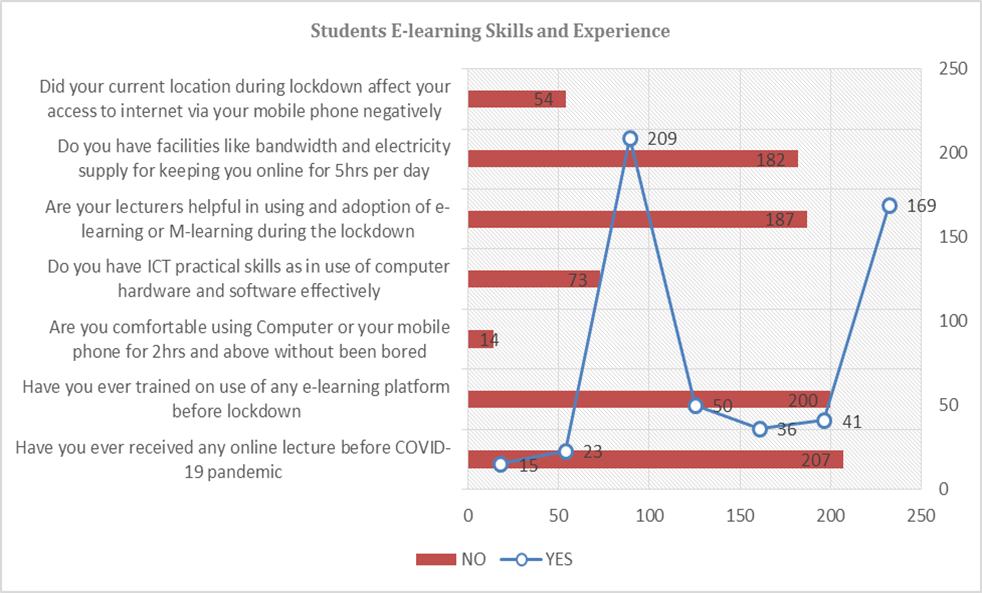
Table 4 shows the students E-learning Skills and Experience where 93.9% of students sampled affirmed that they had never received online lecture before COVID-19 lockdown, while 89.8% never received training on the use of any e-learning resources for learning process, 93.9% claimed to be comfortable using their mobile phone using their computer and mobile phone non-stop for over 2hrs, while 67.3% have skills and experience of using computer resources effectively. 83.7% are of opinion that their teachers are not helpful in using e-learning during lockdown, and 81.6% don’t have bandwidth and stable power supply to keep them online for at least five hours a day.
Table 4: Students E-learning Skills and Experience
Facilities
Yes
No
Have you ever received any online lecture before COVID-19 pandemic
15
207
Have you ever trained on use of any e-learning platform before lockdown
23
200
Are you comfortable using Computer or your mobile phone for 2hrs and above without been bored
209
14
Do you have ICT practical skills as in use of computer hardware and software effectively
50
73
Are your lecturers helpful in using and adoption of e-learning or M-learning during the lockdown
36
187
Do you have facilities like bandwidth and electricity supply for keeping you online for 5hrs per day
41
182
Did your current location during lockdown affect your access to internet via your mobile phone negatively
169
54
Figure 10: Pictorial Representation of Students E-Learning and M-Learning Skills and Experiences
CONCLUSION
Pronouncement by the government directing schools to switch to e-learning due to COVID-19 pandemic has exposed Nigeria inadequacies towards adoption of E-Learning and M-learning in schools. Findings from this research clearly shown that majority of students and teachers had become e-learning or M-learning digital immigrants due to vulnerability to obstacles that militates against adoption and effective use of e-learning that revolves round non-availability of e-learning and M-learning resources like e-content, e-library, dedicated e-learning and M-learning portal, avoidable Bandwidth, and steady power supply. Nigeria can still forge ahead if the recommendation from this research are well addressed.
Findings
Finding from this research shows that:
Majority of the sampled population are vulnerable to limited or no connection to internet with their mobile phone due to their location during lockdown the people in that category is 75.7% of sampled population
Authors experience with the students during only teaching using WhatsApp platform revealed that students living in urban area or city enjoy better internet connection compare to those living in the rural areas
100% of sampled population of teachers have good ICT practical skills to explore e-learning and m-learning, while 22.4% has such skills among the students
79.6% of sample population of teachers have modern computer and mobile phone, to explore e-learning and m-learning, but lack resources as in bandwidth and power supply to use the devices effectively
Resources like power supply, bandwidth availability, e-library, and customize e-learning platform needed to explore e-learning and M-learning resources are not readily available
Students and teachers are not trained on the use of e-learning and it benefit to educational development only 11% of total sampled population had received training on use of e-learning in the past
Recommendation
The implications of our findings is that teachers and students are ready to explore e-learning and M-learning in schools for teaching and learning while the resources and other facilities to be provided by school management and government are not readily available. Consequently we hereby recommended that the following issues should be holistically addressed for e-learning and M-learning to strive in our schools: further training on awareness, knowledge, and interaction with e-learning and M-learning resources as tools for teaching and learning in this modern day of ICT explosion; adequate provision of resources and facilities like e-content, e-library, dedicated e-learning and M-learning portal, avoidable Bandwidth, and steady power supply; review of ICT policy to favor educational institutions, students, and teachers towards acquiring ICT infrastructure and making Bandwidth available at avoidable or no cost for public institutions.
REFERENCE
McLean, P. Human Networks Bridging the Digital Divide in Rural Nigeria. Public Sphere Project, 2017.
Intel Corporation. Bridging the Digital Divide in Nigeria. White Paper, 2007. Archived 21 September 2017 at the Wayback Machine. Retrieved 30 April 2020.
Nkanu, W.O. “Digital Divide: Bridging the Gap through ICT in Nigerian Libraries.” The University Library, Cross River University of Technology, Calabar, Cross River State, Nigeria, 2017. Retrieved 25 April 2020.
Olutola, A.T. and O.O. Olatoye. “Challenges of E-learning Technologies in Nigerian University Education.” Journal of Education and Social Research, vol. 5, no. 1, January 2015.
Anene, J.N. et al. “Problems and Prospects of E-learning in Nigerian University.” Journal of Technology and Inclusive Education (IJTIE), vol. 3, no. 2, December 2014, pp. 83–90.
Oyerinde, O.D. “A Review of Challenges Militating against E-learning and M-learning Implementation in Developing Countries.” International Journal of Science and Advance Technology, 2014.
Clement, J. “Nigeria: Number of Internet Users 2017–2023.” Statista, 2 December 2019, https://www.statista.com/ statistics/183849/internet-users-nigeria/. Retrieved 27 April 2020.
Advertisement
Recommended Articles
Research Article
Pedagogic Competencies Provided To Student Teachers through Biology Teacher Education in Universities in Kenya In Light of Classroom Practice
Download PDF
Research Article
Outcome of COVID-19 in Patients with Myasthenia May Not Only Depend on the Immunologic Disease
Josef Finsterer,
...
Ana C Fiorini
Published: 31/10/2020
Download PDF
Research Article
A Study To Understand Research Into The Formation of Educator Profiles for Use by Institutions Whose Primary Mission is The Preparation of Future Educators
Jin Xianzhao,
...
Aminul Islam
Published: 29/07/2024
Download PDF
Research Article
The Effect of a Picture Book on the Pre-Primary School Children's Literacy Skills Development: Implication on the Teacher Education and Child Language Development
Dominion ,
Joanna Ngozi
Published: 15/07/2020
Download PDF
PO Box 101, Nakuru
Kenya.
Email: office@iarconsortium.org
Editorial Office:
J.L Bhavan, Near Radison Blu Hotel,
Jalukbari, Guwahati-India
Yekini, N. A., Adigun, J. O., Ojo, O. & Andakinwole, A. K. (2020). Assessment of Adoption of E-Learning and M-Learning during Covid-19 Lockdown in Nigeria. International Academic Journal of Education & Literature, 1(1), 1-6.
MLA
Yekini, N. A., et al. "Assessment of Adoption of E-Learning and M-Learning during Covid-19 Lockdown in Nigeria." International Academic Journal of Education & Literature 1.1 (2020): 1-6.
Chicago
Yekini, N. A., J. O. Adigun, O. Ojo and A. K. Andakinwole. "Assessment of Adoption of E-Learning and M-Learning during Covid-19 Lockdown in Nigeria." International Academic Journal of Education & Literature 1, no. 1 (2020): 1-6.
Harvard
Yekini, N. A., Adigun, J. O., Ojo, O. and Andakinwole, A. K. (2020) 'Assessment of Adoption of E-Learning and M-Learning during Covid-19 Lockdown in Nigeria' International Academic Journal of Education & Literature 1(1), pp. 1-6.
Vancouver
Yekini NA, Adigun JO, Ojo O, Andakinwole AK. Assessment of Adoption of E-Learning and M-Learning during Covid-19 Lockdown in Nigeria. International Academic Journal of Education & Literature. 2020 Jan;1(1):1-6.



 Download PDF
 Download XML