Ethnobotanical study on Assessment of Indigenous Attitude on Traditional Plant Medicine Use Among People of Wonchi District, Southwest of Addis Ababa, Oromia Regional State, Ethiopia
Ethiopia is a country characterized by a wide range of climate and ecological condition, which helped to have high diversity of medicinal plants and up to 80% of the population use traditional medicine for primary health care. Therefore, this study was aimed in assessing the attitude of traditional plant medicine use among communities of Wonchi District. Results: From the total 198 informants 70.2% informed that modern medicine is preferable than traditional medicine, while, 29.8% of informants prefer TM over modern medicine .This is due to the presence of different attitude among the informants.Only 29.8% of participants recommended using traditional plant medicine for others.
Keywords
Local People
Medicinal Plants
Traditional Medicine
Wonchi District
INTRODUCTION
Background of the Study
Ethnobotany is abroad term referring to the study of direct interrelations between humans and plants [1]. The indispensable dependency of human up on plants for their livelihood was primarily started by domestication and dates back 10,000 years [1]. From plants, human can obtain food, pesticides, medicines, fuel, fodder, construction materials, tools, and derives aesthetic and spiritual fulfillments. Over centuries, indigenous people have developed their own locality specific knowledge on plant use, management and conservation [2]. The complex knowledge, beliefs and practices generally known as indigenous knowledge (IK) or traditional knowledge develops and changes with time and space, with change of resources and culture. Thus, indigenous knowledge on plants appeared when humans started and learned how to use plants.
Traditional people around the world, thus, depend on this unique knowledge of plant resources on which they depend for food, medicine and general utility including tremendous botanical expertise [1]. This implies that humans are dependent on other organisms for their life. Although various animal and mineral products contribute to human welfare, the plant kingdom is most essential to human wellbeing especially in supplying his basic needs. This close interaction and dependency of humans on plants is studied under the field of ethnobotany [3].
According to WHO [4], consultation of medicinal practitioners is very helpful for the development and incorporation of useful approaches in planning and budgeting system for health care provision of most developing nations and indigenous communities. In Africa, traditional medicine plays a central role in health care needs of rural people and urban poor. Here, it is said that, this situation would remain so long as modern medicine continues to be unable to meet the health care of the people of the continent effectively [5]. The value and role of this health care system will not diminish in the future, because they are both culturally viable and expected to remain affordable, while the modern health care service is both limited and expensive [4].
Indigenous traditional medicinal practices were carried out essentially based on private practice, i.e. private agreement between consenting parties, and the knowledge of traditional practice in most cases has descended through oral folk lore [6]. The secret information retained by traditional healers is relatively less susceptible to distortion but less accessible to the public. However, the knowledge is dynamic as the practitioners make every effort to widen their scope by reciprocal exchange of limited information with each other.
Incomplete coverage of modern medical system, shortage of pharmaceuticals and unaffordable prices of modern drugs, make the majority of Ethiopian still to depend on traditional plant medicine .The problem of ensurin. g the distribution of modern medicine become more serious, as the gap between supply and demand has continued to widen. According to Demissew Dagne there is a considerable global interest in tapping the accumulated knowledge of traditional plant medicine to the well fare of the human population.( Hence the present study was initiated to investigate the indigenous medicinal plant knowledge, attitude and practice on local communities of Wonch District, Western Ethiopia.
Statement of the Problem
Traditional medicine is an ancient form of health care practices long before appearance of scientific medicine which have played and continue to have important role in providing curative services to very large number of people particularly in the rural areas of almost all countries of Africa. It is the culture of many people because of its accessibility to the people even in most remote areas particularly in the community where care is given at low cost to patients in their home. Most people have good attitude towards traditional plant medicine, although it is not always the best form of health care system.
Threat to indigenous knowledge on medicinal plants is manifested not only due to impact of modernization. However, secrecy during collection, oral based knowledge transfer, refusal from the younger generation to inherit the knowledge and unavailability of the species, all resulted in accelerated rate of indigenous knowledge loss. Supplementary difficulty is the system of verbal knowledge transfer dictating vernacular names of plant, mode of preparation, diseases treated and habit of the plant hardens the secrecy. Combined with these factors also age of the healers passing the knowledge i.e. old age healers provide the description with doubtful authenticity to the learners.
In many parts of Ethiopia, considerable numbers of researches have been done on the knowledge, attitude and practice of traditional plant medicine [7]. Like in other parts of country, in the current study area, the knowledge on medicinal plants depth and width become lesser and lesser due to its secrecy, unwillingness of young generation to gain the knowledge, influence of modern education, religious and awareness factors, which all results in gradual disappearance of indigenous knowledge on medicinal plants (Researcher long term direct observation). Out there was no much formal research work that had been done on the indigenous knowledge, attitude and practice on the use of traditional plant medicine in the study area. Therefore, this study was initiated to document the traditional medicinal plant species and associated knowledge, attitudes and practices in the study area.
Research Questions
The results of this study addressed the following research questions:
What is the attitude of people towards traditional plant medicine
Objectives of the Study
General Objective: The general objective of this study was to document attitude of the local people towards traditional plant medicine use in the community of Wonchi District.
Specific Objectives
The specific objectives of this work were to:
Investigate attitude of people towards traditional medicinal use of plants
Significance of the Study
Due to modernization and secrecy, the indigenous attitude of local people towards traditional plant medicine use is vanishing from time to time. Thus, the result of this study helped to document information related to indigenous their attitude and towards traditional plant medicine use before their total loss. So, the overall traditional medicinal activities would maintain for the feature generation through this documented results. In addition, the result of this study provided base line information for further study in the study area.
Scope and Limitation of the Study
This study encompassed to the assessment of Wonchi District attitude on traditional plant medicine use. However, the study was conducted only on nine Kebeles from the total twenty-three Kebeles due to time shortage and financial problem.
MATERIALS AND METHODS
Descriptions of the Study Area
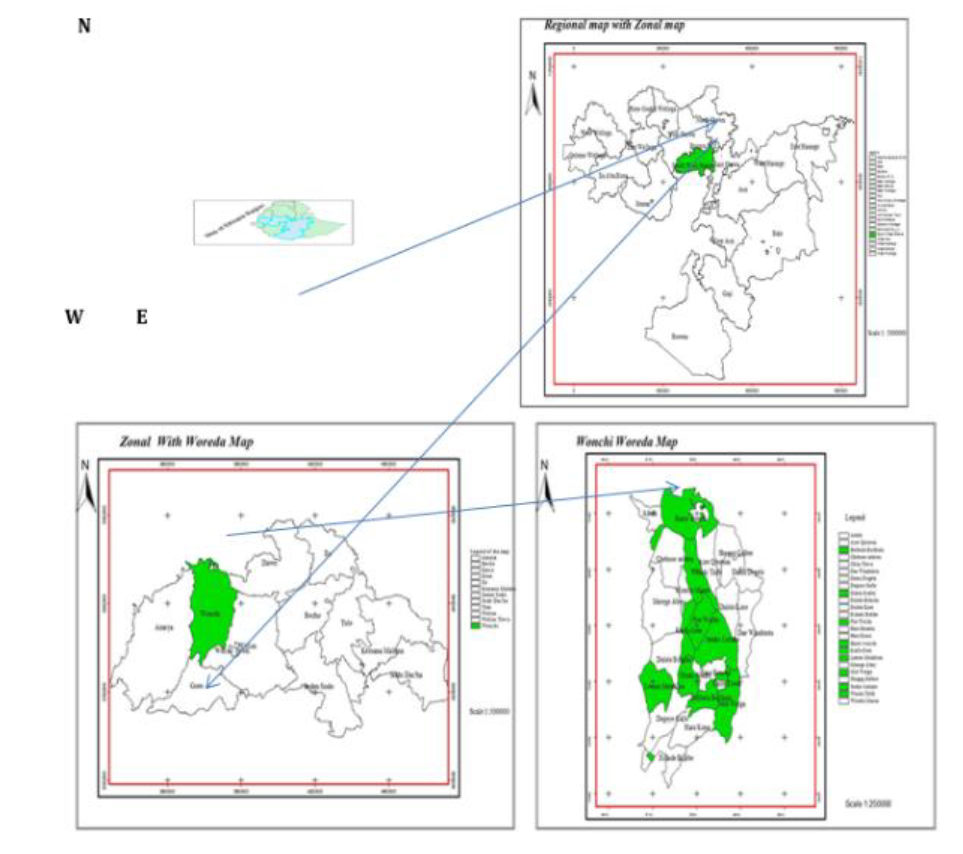
Location: Wonchi District is one of the Districts in the Southwest Shoa Zone, Oromia Region, Ethiopia, which is located 124 km away from southwest of Addis Ababa with the area coverage of 460,516 hectare and the altitude range between 1798m to 2118m above sea level. The administrative center of Wonchi is Chitu and it has beauty full creator lake known as Wonchi Lake from which the district has got its name. As a result many tourists from inside and outside visit this natural lake every year and it is source of income for the country (Figure 1).
Figure 1: Map of the Study Area
Population
Demographically the district has a population of 119, 736 with almost equal gender ratio of 49.8%male and 50.2% male. The average family size is 6 and the average number of children per household was nearly 4 indicating that it is found to focus of development intervention addressing child wellbeing to bring real development in the community. Religion wise, Orthodox constitute 58.9%, Protestants 39.6% and Muslims constitute 1.3% while the ethnic group composition, as per the Terminal evaluation findings of 2013, more than 99% are Oromo, the remaining being Amhara, Gurage and others.
Climate
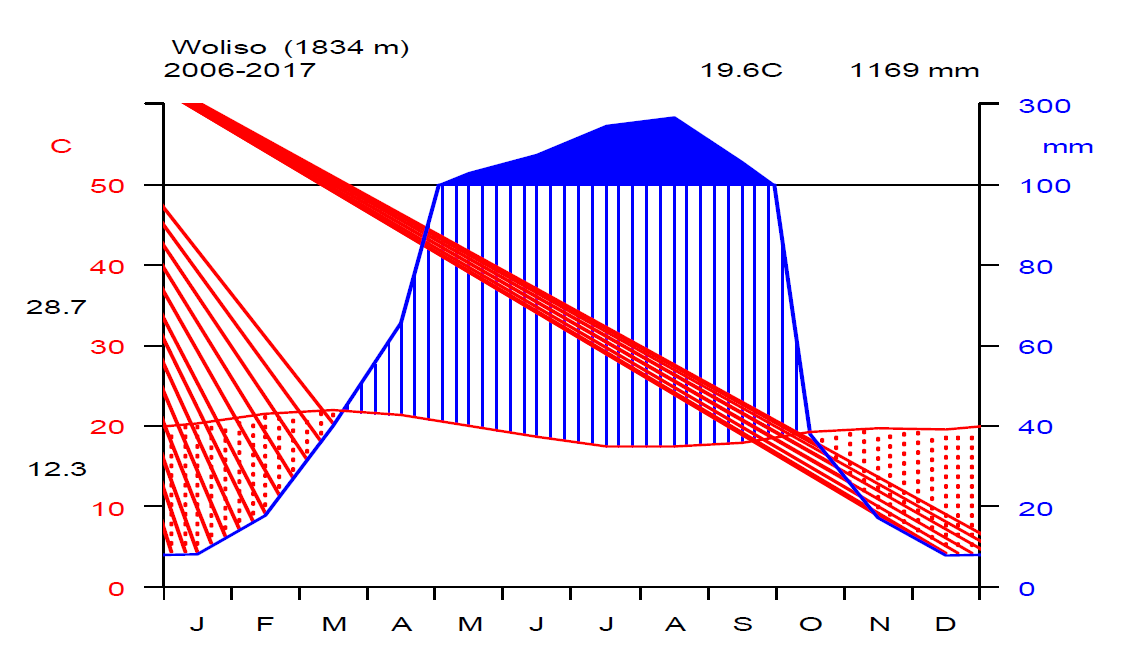
Ecologically the district is divided in to dega or high land (40%) and woinadega or mini land (60%). The mean annual rain fall of the area ranges from 1650-1800mm with annual temperature range of 10-30˚c and mean average of 19.6 ˚c. The study area had 28.70c annual mean maximum and, 19.60c annual mean minimum temperature. The annual mean maximum and minimum temperature were recorded in March and November respectively. The highest rainfall distributions occur from June to September (Figure 2).
Figure 2: Climadiagram of the Study Area from 2006-2017
Land Use Types
Out of the total areas of the District, 82% is cultivated land,11.7% grazing land, 8.9% covered by natural forest,1.03% is water body while others is 18.6%.
Vegetation of the Study Area
Due to variation in altitude and topographical features, the wonchi district vegetation shows three different zones, namely: Afromontane forest, sub alpine and afroalipine) vegetation [8-9]. The common plant species of the study area include: Achyranthes aspera, Albizia schimperiana, Alchemilla pedata, Apodytes dimidiata, Bruceaantidysenterica, Dombeya torrida, Embelia schimperi, Erica arborea, Festuca gilbertiana, Lobelia rhynchopetalum, Hagenia abyssinica, Hypericum revolutum, Jasminum abyssinicum, Juniperus procera, Kniphofia foliosa, Lobelia giberroa, Maytenus arbutifolia, Millettia ferruginea, Nuxia congesta, Olea capensis, Olea europaea subsp. caspidata, Papaneasimensis, Pittosporum viridiflorum, Prunus africana, Phytolacadodicandra, Salix subserrata, Schefflera abyssinica, Thymus schimperiand Zehnaria scabra Vegetation.
Study Design
Field survey design was employed together information on the indigenous attitude of traditional plant medicine of the local people in the study area. During the survey, both qualitative (none numerical) and quantitative (numerical) data were collected.
Reconnaissance Surveys
Preliminary survey was conducted from February 20- 25, 2020. During the preliminary survey general information about the study area were gathered. Based on the information sampling technique, Sampled Kebeles, number of informants and study sites were determined.
Study Site Selection
From a total 23 Kebeles in the District, nine study Kebeles were selected purposively based on availability of key informants following the recommendation of government officials, stakeholders, and religious leaders during reconnaissance survey. The sampled Kebeles are (Belbela,Dimtu,Fite ,Haro wanch,Kurfo gute,Lemen meta hora,Miti welga,Sonkole kake,Waldo telfa ).
Informant Selection
A total of 198 informants were selected. From these 27 were key informants (3 informants per Kebele) which were selected purposively and 171 (19 per Kebele) of them were general informants which were selected randomly (simple random sampling technique following lottery method). Age range of informants selected for the study were from 20 to 80 who lived 5 year and above in the study area. According to Storck et al. and Jarso belay [10], the size of the sample depends on the available fund, time and other reasons and not necessarily depends on total population.
Data Collection Method
Semi-structured interview, observation and guided field walks with informants were employed to obtain ethnobotanical data as used by Giday Yirga. Interview was based on a checklist of questions prepared beforehand in English and translated to local languages (Afaan Oromo). Information regarding their attitude of local community towards traditional plant medicinal use was recorded at the spot. Guided field observation was made on the medinal plants to cheek the availability of the plant in the area, to know the habit and habitat of the plant. Focus group discussion was also made to get more information on medicinal plants, the associated indigenous attitude and reliability of the information collected during individual interview.
Data Analyses
Descriptive statistics were used to analyze the data on medicinal plants use and associated indiginous attitude of local community, on traditional plant medicine use. The results were displayed and summarized in tables and figures by using percentage, frequency and texts.
RESULTS
Socio-Demographic Characterstics of Respondent’s
A total of 198 informants including 27 key informants were selected. As pointed out by Martin [1], the selection of key informants is commonly systematic. Most of the respondents 77.77% were males Table 1. The majority of respondent’s age range was from 40-60 51.5%. Most of the participants 86.86% were married Table 1.
Table 1: Socio-Demographic Characteristics of Respondents in the Study Area
Variable
Response option
Frequency
Percentage
Sex
Male
154
77.77
Female
44
22.23
Total
198
100
Age
20-40
14
7.07
41-60
102
51.51
61-80
82
41.41
Marital status
Single
12
6.06
Married
171
86.86
Windowed
15
7.57
Religion
Christian
142
71.71
Muslim
27
13.63
Waqefata
25
12.62
Others
4
2.02
Education
Uneducated
41
20.70
Able to read and write
67
33.83
12 complete
10
5.05
10 complete
38
19.19
Diploma
39
19.69
Degree
3
1.51
Occupational status.
Farmers
66
33.33
Merchants
25
12.62
Government employer
36
18.18
NGO worker
10
5.05
Others
61
30.80
Almost all religious leader respondents were followers of Orthodox Christian. From all respondents 33.83% were able to read and write. Number of farmers’ respondents predominated 33.33% other respondents while NGO workers are lower in number 5.05% Table 1-2.
Table 2: Distribution of Informant Groups by Number
Respondents
Male
Female
Total
Percentage
Farmers
26
7
33
16.66
Merchants
16
9
25
12.62
Religious leaders
26
6
32
16.16
Health care workers
26
10
36
18.18
Traditional plant medicine users
46
8
54
27.27
Traditional plant medicine healers
14
4
18
9.10
Total
154
44
198
100
Attitude of Local Community towards Traditional Plant Medicine
From the total 198 informants 70.2% informed that modern medicine is preferable than traditional medicine, while, 29.8% of informants prefer TM over modern medicine. This is due to the presence of different attitude among the informants and the detail is expressed in Table 3 below. Only 29.8% of participants recommended using traditional plant medicine for others. Among the participants 8.58% believed that traditional plant medicine culturally accepted in local community and 5.55% of them agreed that it is effective to treat different aliments Table 3. As the study of Aschalew leta and Takele Etana [7], most communities were not used traditional plant medicine. According to the study most educated and urban people use modern medicine and also believed on the effectiveness of traditional plant medicine as bases for modern medicine. As Zelalem Mengesha [11] studies at Jimma town, attitude of community decreases from time to time this is due to lack of good awareness about traditional plant medicine use.
Table 3: Attitudinal Variation on Using Traditional Medicinal Plants
Modern medicine preferred informants
Traditional medicine preferred informants
Reason why not to use traditional medicine
Number of informants
Percentage
Reason to use traditional medicine
Number of informants
Percentage
Lack of effectiveness
41
20.70
Less expensive
31
15.65
Dosage determination difficulty
33
16.66
Easy accessibility
17
8.58
Consider using TMPs as Taboo
65
32.82
Effective
11
5.55
Total
139
70.2
Total
59
29.79
CONCLUSION
A study on medicinal plant use in the area revealed that the community use medicinal plants for maintaining their primary health care. From the study it can be said that the different segment of the community in the study area are in different level of believe with regard to traditional plant medicine use, i.e. difference in age, sex, work and education level has impact on their attitude towards use of traditional plant medicine. In addition from the result of the study it can be concluded that there are considerable number of community members which do have negative attitude towards use of traditional plant medicines specially educated and youngsters are developing negative attitudes. Moreover, the result of the study revealed that, though negative attitude towards traditional plant medicine is believed to be increasing from time to time, still the community is extensively believe on the use of traditional plant medicines.
Recommendations
Based on the results of the study, the following recommendations are forwarded.
Young generation needs raising awareness to avoid negative impacts on the traditional medicinal plants use in the area; hence, documentation of the medicinal plants of the area needs to be continued
Establishing traditional healers associations by providing supports like land, fund and assistances for cultivations of medicinal plants in the district would help to conserve medicinal plants
The societies have no good awareness with tradition plant medicine healers. So that all stakeholders should work together to change the situation and to benefit from traditional plant medicine
The government should create possible conditions and include to the teaching curricula about traditional plant medicine use
To change the attitude of the society any concerned body should give trainings, seminaries about traditional plant medicine use
The government and other officials should recognize the use of traditional plant medicine and also the healers of traditional plant medicine need any supports from concerned bodies
The insights of religious institution and health care institution should be positive and work together with traditional plant medicine
The user’s negative attitude should be changed in to positive and the lack of knowledge about traditional plant medicine use also should be changed by giving training to them and through creating awareness. All stakeholders should develop positive attitude for traditional plant medicine healers. The healers of traditional plant medicine should use appropriate measurements to give the medicine for users
Abbreviations
MM; modern medicine, MP; medicinal plants, TMPU; Traditional medicinal plant use
Declarations
Ethical Approval: Written ethical clearance was obtained from the research and ethical commite of the department of biology university of Gonder.A formal letter was written to wonchi district adminsration to conduct the study.Written informed consent was sought and obtained from every participant who decided to take part in the study.They were assured about the confidentiality of their responses.
Consent for Publication
Not applicable
Availablity of Data and Materials
The data sets used and/or analysed during the current study available from the author for reasonable request.
Completing Interests
The author declares that they have nofinancial and non financial completing interests.
Author Contributions
GM was involved in the conception, design, analysis, interepretation, report and manuscript writing.
Acknowledgements
I extend my deepest gratitude to those who participated in the study for their time to provide relevant information.I wish to extend my thanks to data collectors and supervisors.I also indepted to all those who apply their effort in the process of this study.Finally,thankful to university of Gonder for their financial support provided.
REFERENCE
Martin, G.J. Ethnobotany: A method manual. Chapman and Hall, 1995, pp. 265–270.
Cotton, C.M. Ethnobotany: Principles and applications. John Wiley and Sons Ltd., 1996, pp. 347–374.
Teketay, Demel. “Deforestation, wood famine and environmental degradation in Ethiopia’s highland ecosystems: Urgent need for action.” Northeast African Studies (New Series), vol. 8, no. 1, 2001, pp. 53–76.
World Health Organization. The promotion and development of traditional medicine. Technical Report Series no. 622, World Health Organization, 1979.
Jansen, P.C.M. Spices, condiments and medicinal plants in Ethiopia: Their taxonomy and agricultural significance. Center for Agricultural Publishing and Documentation, 1981.
Debela, Asfaw et al.An overview of traditional medicine in Ethiopia: Prospective and development efforts. Edited by Tamirat Ejigu, 1999.
Lata, Aschalew and Takele Etana. Assessment of knowledge, attitude and practice on traditional medicine in Lag Hare Dire Dawa town, Addis Ababa, Ethiopia, 2014.
Woldu, Zerihun et al. “Forest in the vegetation types of Ethiopia and their status in the geographical context.” Forest genetic resource conservation: Principles, strategies and actions, Institute of Biodiversity Conservation and Research and GTZ, 1999, pp. 1–41.
Masresha, Getinet. Diversity, structure and regeneration status of vegetation in Simien Mountains National Park, Northern Ethiopia. PhD dissertation, Addis Ababa University, 2014.
Belay, Jarsso. Ethnobotanical study of traditional medicinal plants used by indigenous people of Jigjiga district, Somali Regional State, Ethiopia. MSc thesis, Haramaya University, 2016.
Mengesha, Zelalem. Traditional vs. modern medicine from Jimma Town, south east Ethiopia. Addis Ababa Publishing House, 2006.
Appendexieses
List of Appendexieses
Appendix 1: Self-administered Questionnaire on Assessment of Indigenous Attitude on Traditional plant medicine use among people of Wonchdistrict.
District________________________Kebele___________________Questionnaire identification number_________________________________________________ Consent form that certify the respondent’s agreement before the distribution of questionnaire.
Dear, elder, merchant, religious leader, Health care worker, traditional plant medicine users and traditional plant medicine healers stake holders
My Name is Gadisa Melkamu Bulcha I came from university of Gonder, College of natural and Computational Science, department of Biology. I would like to inform you that we are going to have questionnaire concerning this study. Before we go to questionnaire, I will ask you to listen carefully to what I am going to tell about the purpose and general condition of the study and tell me whether you agree or disagree to participate in this study, the purpose of this study is to generate information on the attitude of local community towards traditional plant medicine use. In order to effectively attain the goal of the study .I ask you for your help.
Here a questionnaire contains 5 Pages with 28 questions that divided in to 3 parts for you to complete. Check as all questions and all pages are present. There is no need to write your name on the questionnaire and no individual responses will be reported.
Therefore the information you give me should be kept confidential and will be used only for study purpose.
Appendix 2: Checklist of Semi-structured Interview Question for Collecting Ethnobotanical data for medicinal plants.
Part I. General information
Name of the respodent______________age__________ _________sex________Date of interview____________Kebele____________occupation______________age__________Religion____________marital status__________Ethnicity___________educational level_________ Expertise/informant type: healer____________ general informant_______________
1. For how long have you lived in the area? A /since birth B/for the last 20 years C/ for the last 10 years D/ for less than 10 years
2. Other information................................
K/ is the plant marketable?
L/Are the medicinal plants easily accessible? If not why?
M/ Other uses of the plant………..
3. Are the members of the community frequently use the traditional medicinal plant as
Compared to modern medicine? Why?
4. is there any interfere of modernizations with traditional medicine application and use?
If yes how does the modernization interfere with traditional medicinal system?
5. Which group of the community use the traditional medicines most and why?
6. Do you believe on traditional plant medicine plant use?
Yes. B. No
7. If you say ‘’yes’’ for question no_ 1what is your attitude towards using traditional plant medicine?
A. poor B. good C. it is bad d. it is very bad
8. Do you well believe on the effectiveness of traditional plant medicine?
A.Yes B.No
9. If your answer for question no 8 is No why?
10. For traditional plant medicine user only do you get good treatment from traditional plant medicine healers during your treatment?
A, Yes B, No
11. When you compare traditional plant medicine with modern medicine which one is most important for you in different direction? Why? ……………………………………………… …………………………………………………………………………………………………………………
Recommended Articles
Research Article
Antibiofilm activity of Glycoprotein produced from 1q Lactobacillus acidophillus isolated from clinical samples in Iraqi women
Download PDF
Review Article
Hyperuricemia and Cardiovascular Diseases: A Comprehensive Review
Neha Verma,
Ritika Kashyap
Published: 25/07/2024
Download PDF
Research Article
Synthesis, Identification and Study biological activity of some new heterocyclic Compounds containing (five, seven) ring
Hussein Ali Ahmed
Published: 26/09/2023
Download PDF
Research Article
C-Reactive Protein, Vitamin D and Calcium as Biomarkers for the Diagnosis in some Osteoarthriris Patients who Attending Al-Refai Teaching Hospital
Ahlam Mohsen Kudaier
Published: 30/06/2024
Download PDF
PO Box 101, Nakuru
Kenya.
Email: office@iarconsortium.org
Editorial Office:
J.L Bhavan, Near Radison Blu Hotel,
Jalukbari, Guwahati-India
Bulcha, G. M. (2021). Ethnobotanical study on Assessment of Indigenous Attitude on Traditional Plant Medicine Use Among People of Wonchi District, Southwest of Addis Ababa, Oromia Regional State, Ethiopia. IAR Journal of Clinical & Medical Biochemistry, 1(1), 1-6.
MLA
Bulcha, Gadissa M.. "Ethnobotanical study on Assessment of Indigenous Attitude on Traditional Plant Medicine Use Among People of Wonchi District, Southwest of Addis Ababa, Oromia Regional State, Ethiopia." IAR Journal of Clinical & Medical Biochemistry 1.1 (2021): 1-6.
Chicago
Bulcha, Gadissa M.. "Ethnobotanical study on Assessment of Indigenous Attitude on Traditional Plant Medicine Use Among People of Wonchi District, Southwest of Addis Ababa, Oromia Regional State, Ethiopia." IAR Journal of Clinical & Medical Biochemistry 1, no. 1 (2021): 1-6.
Harvard
Bulcha, G. M. (2021) 'Ethnobotanical study on Assessment of Indigenous Attitude on Traditional Plant Medicine Use Among People of Wonchi District, Southwest of Addis Ababa, Oromia Regional State, Ethiopia' IAR Journal of Clinical & Medical Biochemistry 1(1), pp. 1-6.
Vancouver
Bulcha GM. Ethnobotanical study on Assessment of Indigenous Attitude on Traditional Plant Medicine Use Among People of Wonchi District, Southwest of Addis Ababa, Oromia Regional State, Ethiopia. IAR Journal of Clinical & Medical Biochemistry. 2021 Jul;1(1):1-6.


 Download PDF
 Download XML