Research Article | Volume 2 Issue 1 (Jan-June, 2021) | Pages 1 - 8
Impact of Salinity Stress During Germination Stage on Chickpea (Cicer arietinum L)
1
Botany Department, Faculty of Science, Zintan University, Zintan City, Libya
Under a Creative Commons license
Open Access
Received
Jan. 11, 2021
Revised
Feb. 21, 2021
Accepted
April 18, 2021
Published
May 25, 2021
Abstract

The salinity of irrigation water is a serious problem facing crop plants in the Mediterranean region, where plants are exposed to high temperatures and severe shortage of water in the dry season. So, this study was carried out in order to test the effects of five different salinity levels of sodium chloride (0.0, 50, 100, 150, 200 and 300 mM) on seed germination and early seedling growth of Chickpea (Cicer arietinum L.). Fifty homogenous and cleaned seeds were germinated in Petri dishes inthree replicates. The salt stress decreased seed germination, the response of Chickpea (Cicer arietinum L.) to salt stress and water stress was evaluated at the germination stage. The severe reduction in germination percentage and particularly germination speed with prolonged lag period by moderate salinity level at 100 mM NaCl, suggests that Chickpea (Cicer arietinum L.) is a salt-sensitive species during germination. Salinity reduced germination uniformity and germination synchrony and might delay start of germination but accelerates its termination with a consequent shortening of the time spread of germination. The recovery percentage was lower but speed of recovery was higher compared with the corresponding parameters of the control seeds. Recovery percentage was slightly improved with increasing in the concentration of NaCl .

Keywords
INTRODUCTION

Chickpea (Cicer arietinum L.) is among the earliest human grown grain crops.Today chickpea ranks third in world production after beans (Phaseolus  spp.) and field pea (Pisum sativum L.) among food legumes [1]. Besides being an important food source for humans and animals, the crop also  plays an important role in the maintenance of soil fertility, particularly in arid regions [2]. Nowadays, the crop is grown on an area of 14.56 million ha in the world with a total yield of 11.5 million ton , so we see a strong trend to increase interest in chickpea cultivation worldwide, especially in the countries of North America, Australia, Europe [3]. Soil salinity is one of the main constraints in the growth of chickpea. The soil salinity is assumed to be one of the key factors contributing to acritical decrease in crop productivity [4] . Chickpea is often grown not only in the arid climatic conditions of the Asian and African areas, but also on salt soils or on salt water irrigated soils in India, Pakistan and Australia [5,6]


Chickpea is especially susceptible to salt stress at the reproductive stage of development,  [7] with crop roots suffering (Tejera et al., 2006) leading to lower productivity  [8,9]. Salinity stress cause a decrease in plant height, crop growth rate and total plant biomass respectively by 20, 15 and 28 % [10]. Saline water irrigation significantly compromises almost all of the crop's physiological mechanisms, resulting in worse production [11].


In Chickpea germination of seeds is delayed and reduced, and vegetative plant growth is suppressed under saline conditions [12,13], which varies from germination to vegetation and from fruiting to podding; at the same time, chickpea tolerance for salinity differs from one genotype to another [14]. Many have very high germination potential and seedling growth in salt soil, while others germinate well in salt soil, but with very low seedling growth [15,16] demonstrated that there is no difference in seed germination in the conditions of salt stress relating to the form of chickpea (kabuli or desi). However, [17] demonstrated that the form of chickpea kabuli was more prone to increased soil salinity (0.9–4.9 ds/m) than the form desi. Salinity had a significant impact on seed  germination and dry weight seedling [18] found that, the salt concentration had a major impact on seed germination and seedling growth parameters, these characteristics decreased dramatically as the salt concentration increased from 2 to 20 dsm-[19] reported that, no effect of NaCl treatment on germination frequency was observed; however, a dramatic decline in early seedling growth was observed as NaCl concentration increases.  [20]  reported that, salinity stress decreased all of the parameters examined with increased concentration of NaCl in common bean, except for mean germination time.  [21] recorded that, salinity significantly delayed germination at 300-400 NaCl for germination, emergence of seedlings, fresh and dry weight of both shoots and roots, and seed yield decreased within growing salinity. Germination percentage and velocity, plumulus length, radical length and dry seedling weight were higher in control [22]. 


A lot of researchers reported similar results with different crops [23-25].This study aimed to investigate the effects of different concentrations of NaCl on Chickpea seed germination.

MATERIALS AND METHODS

Germination conditions.

This experiment aimed to characterize the range of salinity tolerated by Chickpea (Cicer arietinum L.) at the germination stage. Seeds, selected for homogeneity, were germinated at 25 C in the dark in 12-cm Petri dishes lined with filter paper moistened with five levels of NaCl: 0.0, 50, 100, 200 and 300 mM; 50 seeds per dish. At intervals seeds and emerging seedlings were transferred under dim light to new dishes lined with filter papers, saturated with the experimental solutions to prevent buildup of salt. Germination was monitored daily for 12 days from sowing and three replicates seeds were considered germinating when the radical was emerged to a length of 2 mm. After approaching steady germination percentage in the test solutions, the non-germinated seeds were transferred from the high salt solutions to distilled water to monitor recovery of germination from salt stress, and the number of seeds germinating after transfer was counted daily for 11 days. 


Definitions, calculations and statistical analysis.

Final cumulative germination percentage and final percentage recovery of germination from salinity stress were arcsine transformed before performing statistical analysis to ensure homogeneity of variance. Data were analyzed using SPSS version 22. The effect of temperature on seed germination in the  in the  experiment and of  salinity stress and their interaction on seed germination in the third experiment were assessed using  two-way ANOVA respectively. Mean separation was performed using the Duncan's multiple range test at p < 0.05.


According to [26] the germination parameters estimated in this work were grouped into five categories - taking into account the different notations and expressions in the literature. These are the germinability or final germination percentage, rate or speed, times, uniformity and synchrony of germination. The following parameters were estimated.


Germinability or germination capacity. It is the final cumulative germination percentage and was calculated as the total number of germinants at the end of germination period as a percentage of the total number of seeds.


Rate or speed of germination. Estimated by using several calculations as follows:

Mean daily germination (MDG) or Daily germination speed (DGS). Calculated as:

MDG = .                (% d-1)
The cumulative germination % is the number of germinants as a percentage of the total number of seeds.


Peak value (PV) is the maximum MDG, or the maximum quotient derived by dividing daily the accumulated number of germinants by the corresponding number of days; i.e., the mean daily germination of the most vigorous component of a seed lot.


Germination value (GV). Called the Czabator index of germination velocity, was calculated as:

       GV = PV ×  final MDG                                       (% d-1)


Timson index of germination velocity. Calculated as:

Timson index =  =     (% d-1)

Where G1, G2, G3, Gi and Gn are the cumulative number of germinants at the first, second, third, ith and final time respectively and T is the total germination period; that is  to sum the cumulative germination % for certain intervals and divide by the final germination period.


Speed of accumulated germination (SAG). Calculated as:

SAG =Σ = + + + ………..+               (% d-1)


Germination rate index (GRI), also called speed of germination was calculated as:

GRI = Σ  =  + + + ………..+                   (% d-1)

 + + ………..+


The germination  index (GI), also called the "germination rate" is  a measure of both  percentage and speed of  germination and assigns maximum arithmetic weight to embryos or  seeds  that germinate  first and  less weight  to those that germinate  later.

GI = Σgi × (T-j)

Where gi is the daily germination percentage or number of newly germinated seeds at time ti,T is the total period of germination and j = i-1; that is

GI = Σg× (T-i+1)= g1×T + g2 × (T-1) + G3 × (T-2) + …... + gn×1          (%.d)


The coefficient of germination (CG), also called the coefficient of velocity of germination(CVG), or Kotowski coefficient of germination was calculated using the following formula:

CVG =                                     (d -1)

Where gi is the  number of newly germinants at times ti.

It is the reciprocal of MGT  multiplied by 100 = (1/MGT) ×100

This coefficient, which is the reciprocal of the mean germination time, was used to calculate the mean germination rate or , which in turn was used to calculate the weighted mean germination rate (

=                 (d-1)


Weighted mean germination rate (WMGR or). Calculated using the mean germination rate ( of each replicate and its variance (S2V) as follows:

=(d-1)

where Wj =              S2j =()4 × S2t         and              nj =


Mean germination time (MGT or  ), also called mean emergence time (MET) or mean length of incubation time (MLIT) or mean days for germination (Mdays), is a measure of the average length of time required for maximum germination of a seed lot. It is one of the measures of time of germination and can be employed also as an inverse measure of speed of germination, and was calculated according to the following equation:

MGT =                                                 (d)

Where gi is the number of seeds newly germinated, or the daily germination percentage at time ti from sowing, not the cumulative germination %, and N is the total number of germinants or the final cumulative germination percentage.

The variance of germination time (S2t) was calculated according to the following formula:

  S2=                                                             (d2)

S2was used in the calculation of the coefficient of variation of germination time (CVt); one of the measures of germination uniformity.


Germination times:

The first day of germination (FDG) is the time of first germination or the time of germination of the faster or most vigorous seeds.


The last day of germination (LDG) is the time of last germination or the time of germination of the slower or the least vigorous seeds.


Time spread of germination (TSG) is the time elapsing between FDG and LDG and was calculated as:    TSG = (LDG - FDG) + 1


Mean germination time (MGT or), was mentioned above among the indices of rate of germination. 

T10 or time to 10% germination is a measure of the lag period between imbibition and onset of germination.


Uniformity of germination:

The coefficient of uniformity of germination (CUG) measures the variability among seeds in relation to the mean germination time of the sample and was calculated as:

CUG =                                                          (d-2)

Where gi is the number of newly germinated seeds on time tifrom sowing and is the mean germination time. High values would be associated with concentrated germination in time. 


The coefficient of variation of the germination time (CVt) is another measure of the germination uniformity or variability in relation to the mean germination time and was calculated as:

CV=                                                                 %

Where St is the standard deviation of the germination time and the mean germination time.


Synchrony of germination was estimated using the synchronization index (), calculated as:

= - Σfi × log2fi                   (bit)                  and  fi =

where fi is the  relative frequency of germination and gi the number of seeds germinated on day i. Low values of  indicate more synchronized germination.


The recovery from salinity stress was calculated using the following formula of Khan and Ungar (1984):

Percent recovery =


where a is the total number of seeds germinated after being transferred to distilled water, b is the total number of seeds germinated in saline solution and c is the total number of seeds. In other words, the recovery percentage is the number of newly germinated seeds after transfer to water (a-b) as a percentage of the number of seeds transferred (those non-germinated in the saline solution (c-b).

The threshold and critical salinity levels for a specific process (germination index or embryonic growth) are defined as those levels leading to 5 and 50 % reductions respectively

RESULTS

Salt response of Chickpea (Cicer arietinum L.) during germination. 
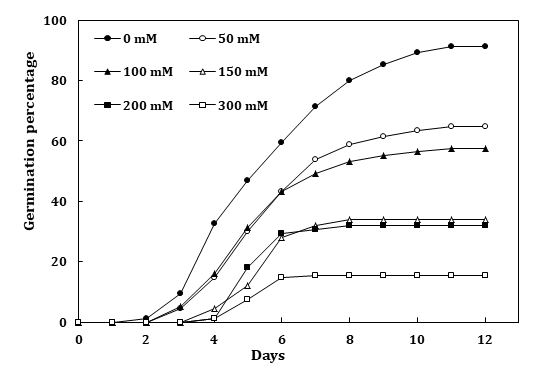
This experiment aimed to specify the range of NaCl salinity tolerated by Chickpea (Cicer arietinum L.)  during germination and to characterize the effect of salinity stress on germination parameters of this species. A wide range of salinity has been examined in this experiment (0.0-300 mM NaCl). Time course of germination revealed progressive reduction in magnitude and speed, with prolonged lag of germination with the increase in salinity level from 0.0 to 300 mM NaCl (Figure 1). The FGP was reduced from 91% in non-salinized seeds to 15% in seeds treated with 300 mM NaCl. Similarly, speed of germination was sharply reduced under the impact of salinity. The speed of germination, in terms of GV and Timson index was sharply reduced from 84.2 and 60 % d-1, respectively in non-salinized seeds to 3.7 and 11 % d-1, respectively in seeds treated with 300 mM NaCl as shown in Table (1). 


Uniformity and synchrony of germination exhibited a threshold of 50 mM NaCl, beyond which germination uniformity was sharply increased (CVt lowered by from 34.6% at 0.0 mM NaCl to 12.7% at 300 mM NaCl) and germination synchrony was substantially increased ( lowered from 2.79 bit at 50 mM NaCl to 1.09 bit at 300 mM NaCl) as shown in Table (1). 

The first day of germination was non-significantly affected by increasing salinity up to 50 mM NaCl, but it was doubled as salinity level further increased to 300 mM NaCl. LDG was maintained  (by 10%) with the increase in salinity from 0.0 to 50 mM NaCl, followed by 25% reduction upon Increasing salinity pretreatment from 100 to 300 mM . TSG was significantly higheraffected by increasing salinity from 0.0 to 100 mM NaCl but was sharply shortened (by 87%) with further increase in salinity up to 300 mM NaCl. T10 was almost doubled with the increase in salinity from 150 to 300 mM NaCl as shown in Table (1). 

Figure 1. Time course of germination of Cicer arietinum L. seeds under the impact of increasing levels of NaCl salinity.  Each value is the mean of 3 replicates.


Table 1. Germination parameters of Cicer arietinum L seeds under the impact of increasing levels of NaCl salinity. Each value is the mean of 3 replicates ± SE


mM NaCl

 
Parameter

0

50

100

150

200

300


Germinability (%)

91.3 ± 1.76a

64.7 ± 1.76b

45.3 ± 2.40c

34.0 ± 2.40d

22.0 ± 1.15e

15.3 ± 4.05f

Timson index (%) 

59.5 ± 1.39a

41.8 ± 0.58b

31.7 ± 2.10c

22.4 ± 2.10d

21.8 ± 0.24de

10.5 ± 0.24f

T10 (day)*

3.00

3.40

3.50

4.50

4.70

5.40

CVt (%)

34.6 ± 2.97a

30.8 ± 2.47ab

21.5 ± 2.36c

17.5 ± 3.39cd

14.4 ± 2.98de

12.6 ± 0.29def

E (bit)

2.79 ± 0.16a

2.74 ± 0.07ab

2.07 ± 0.15c

1.81 ± 0.24d

1.43 ± 0.35de

1.09 ± 0.29e

FDG (day)

2.33 ± 0.33a

3.00 ± 0.00ab

3.33 ± 0.33b

4.33 ± 0.33c

4.67 ± 0.33cd

4.67 ± 0.33cd

LDG (day)

11.0 ± 0.00a

10.7 ± 0.33b

9.00 ± 0.00c

9.00  ± 0.00c

9.00 ± 0.00c

9.00 ± 0.00c

TSG (day)

9.67 ± 0.33a

8.67 ± 0.33b

6.67 ± 0.33c

5.67 ± 0.33d

5.33 ± 0.33d

5.67 ± 0.33d

 Means followed by the same letter are non-significantly different at P ≤ 0.05. 

*T10 was calculated using the mean germination percentages of the time course of germination curves; therefore, they are not followed by SE.


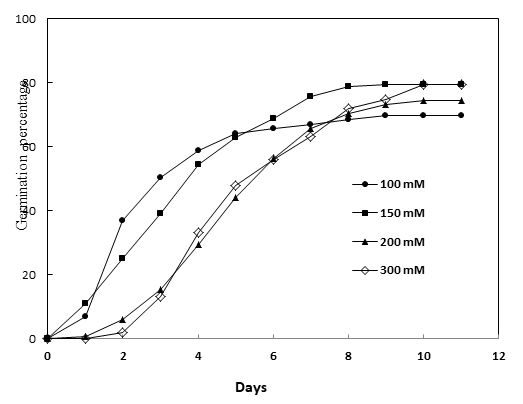
Uniformity of recovery increased (CVt decreased by 41%) as salinity pretreatment exceeded a threshold of 150 mM NaCl up to 300 mM NaCl. On the other hand, synchrony of recovery was reduced ( increased by 26%) upon increasing salinity pretreatment from 100 to 150 mM NaCl, with no further change at higher salinity pretreatment. Increasing salinity pretreatment from 150 to 300 mM doubled FDG without effect on LDG; consequently, TSG was maintained at 9 days across the range of salinity pretreatment from 100 to 200 mM NaCl but was shortened to 8 days (11% decrease) upon further increase in salinity pretreatment up to 300 mM NaCl as shown in Table (2). 

Figure 2. Time course of germination recovery from salt stress of Cicer arietinum L. seeds. Seeds were incubated with 100-300 mM NaCl for 12 days and non-germinated seeds were transferred to distilled water to monitor recovery from salt stress for a period of 11 days.


Table 2. Parameters of germination recovery from salt stress of Cicer arietinum L. seeds. Seeds were incubated with 100-300 mM NaCl for 12 days and non-germinated seeds were transferred to distilled water to assess recovery from salt stress.  Each value is the mean of 3 replicates ± SE.


mM NaCl 

 
Parameter

100

150

200

300


Recovery %

69.8 ± 2.5a

79.6  ± 3.3abc

74.4  ± 4.3ab

79.3 ± 2.1abc

Timson index  (% day-1)

57.1  ± 4.7ab

59.5  ± 3.7a

46.4  ± 3.8abcd

47.4 ± 6.3abc

T10 (d)*

1.10

0.90

2.40

2.60

CVt (%)

54.7 ± 7.2a

54.3 ± 5.5a

37.7 ± 1.5b

32.5  ± 2.4bc

E (bit)

2.14 ± 0.2a

2.70 ± 0.1bc

2.79 ± 0.0bc

2.56 ± 0.3ab

FDG (day)

1.00 ± 0.0a

1.00 ± 0.0a

1.67 ± 0.3ab

2.33 ± 0.3bc

LDG (day)

7.67 ± 0.0a

8.33 ± 0.0a

9.67 ± 0.3abc

9.33 ± 0.3ab

TSG (day)

7.67 ± 0.0a

8.33 ± 0.0ab

9.00  ± 0.6b

8.00  ± 0.0a


Means followed by the same letter are non-significantly different at P ≤ 0.05. 

*T10 was calculated using the mean germination percentages of the time course of germination curves; therefore, they are not followed by SE.

DISCUSSION

The widespread occurrence of Cicer arietinum L. in diverse habitats of varying levels of soil salinity gives the impression that the plant is salt-resistant.  Nevertheless, the severe reduction in germination percentage and germination speed with prolonged lag period by moderate salinity level of 100 mM NaCl, with almost cessation of germination at 300 mM NaCl suggests that Cicer arietinum L is a salt-sensitive species during germination according to the classification adopted. Seed germination is delayed and reduced, and vegetative plant growth is suppressed under saline conditions in Chickpea [12,13]. The reduction in germination efficiency under salt stress was more severe in terms of germination speed than in germination magnitude (the final germination percentage). This is in agreement with the behavior of Vicia faba [27] , and supports the conclusion that germination speed represents a more reliable measure of salt injury during germination than does the magnitude of germination. 


The reduced germination efficiency, expressed as reduced percentage and speed of germination, under the impact of salinity stress was associated with substantial lag of germination (increased T10) and reduced germination uniformity (increased CVt) and germination synchrony (increased ). However, whereas germination percentage increased in proportion with the increase in germination speed in almost a linear pattern, the increases in CVt and (i.e. the reductions in germination uniformity and germination synchrony, respectively) approached a limit beyond germination speed of 23% day-1   [5,6]. The effect of salinity on uniformity and synchrony of germination seems to be species specific and dose-dependent; leading either to non-significant changes in soybean [28] and Physalis peruviana [29] or to reduction in Moringa oleifera [30]  and Senna spectabilis [31]. In Elymus farctus, moderate salinity led to limited lowering in germination uniformity, which was followed by sharp increase at high salinity, and this was accompanied with increased germination synchrony at high salinity [32] . Whereas plant fresh weight was reduced under the impact of water stress [33].


The changes in times of germination of Cicer arietinum L. under salt stress suggest that salinity might delay start of germination but accelerates its termination with a consequent shortening of the time spread of germination. Similar response has been reported in Elymus farctus, particularly in absence of nutrients [32]. However, increasing salinity might delay both the onset and termination of germination, in wheat [32,34] 


The lower recovery percentage, which was associated with higher speed of recovery compared with the corresponding parameters of non-treated seeds, along with the limited improvement in recovery percentage with the increase in the level of salinity pretreatment might refer to a toxic ion effect of the low salinity levels on seed viability but a priming effect of high salinity, probably via an osmotic effect. In addition, these results suggest that salinity might exert a toxic effect on a portion of the seed population but the surviving portion will be kept ready to recover at higher speed and lower uniformity relative to their non-treated counterparts. The toxic ion effect on seed germination is expected at low salt levels, where the salt ions can diffuse into the seed and damage the embryo but the priming osmotic effect is expected at high salt levels [30]


Generally, restoration of germination efficiency after release of salt stress points to an osmotic effect, but low recovery means specific ion toxicity. [35] reported that the reduced germination recovery upon prolonged duration of seed soaking in saline medium which was related to uptake of Na+ and release of K+ from seeds under salt stress. The specific toxic effect of salt ions is likely to emerge in glycophytes whereas the osmotic effect is more likely in halophytes and salt-resistant species. Seeds of halophytes, due to their unique metabolic machinery, usually recover completely when salt stress is released indicating an osmotic effect [36,37]. On the other hand, the high recovery of seeds from abiotic stress compared with the original germinability means a priming effect of the stress pretreatment, which can be manipulated to enhance seed germination and plant growth, especially in poor quality seeds or under stressful environments [38] In addition, the present finding suggest, that salinity pretreatment seems to enhance start of recovery upon release of stress, with marginal effect on its termination and consequent prolongation in the TSG during recovery.

CONCLUSION

Chickpea germination and initial growth are strongly affected by salinity stress. The most susceptible stage is germination. Chickpea can be cultivated without any considerable decrease of its growth and development in slightly saline conditions . while the crop is exposed to strong suppression by the higher degrees of salinity. Therefore, we conclude that the crop has to be cultivated at the lands with no or slight salinity level.


Acknowledgments

The author is grateful to Botany Department, Faculty of Science, Zintan University, Zintan City, Libya, and Prof. Dr. Helal Ragab Moussa for help their during this  study.

Conflict of Interest:

The authors declare that they have no conflict of interest

Funding:

No funding sources

Ethical approval:

The study was approved by the Zintan University, Zintan City, Libya.

REFERENCES
  1. FAO, Food. "Agriculture Organization (2009)." The State of Food Insecurity in the World, 2008.

  2. Saxena, M. C. "Status of Chickpea in the Mediterranean Basin." Status of Chickpea in the Mediterranean Basin 9.1 (1990): 17-24.

  3. Merga, B. et al. "Economic Importance of Chickpea: Production, Value, and World Trade." Cogent Food & Agriculture 5.1 (2019): 1615718, https://doi.org/10.1080/23311932.2019.1615718.

  4. Priyadharshini, B. et al. "Evaluation of Black Gram Genotypes for Saline Tolerance at Seedling Stage." Indian Journal of Agricultural Research 53.1 (2019): 83-87.

  5. Haileselasie, T. H. et al. "The Effect of Salinity Stress on Germination of Chickpea (Cicer arietinum L.) Land Race of Tigray." Current Research Journal of Biological Sciences 4.5 (2012): 578-583.

  6. Vadez, V. et al. "Large Variation in Salinity Tolerance in Chickpea is Explained by Differences in Sensitivity at the Reproductive Stage." Field Crops Research 104.1-3 (2007): 123-129, https://doi.org/10.1016/j.fcr.2007.06.013.

  7. Kotula, L. et al. "Salt Sensitivity in Chickpea (Cicer arietinum L.): Ions in Reproductive Tissues and Yield Components in Contrasting Genotypes." Plant, Cell & Environment 38.8 (2015): 1565-1577, https://doi.org/10.1111/pce.12494.

  8. Singla, R. et al. "Influence of Salinity on Growth and Yield Attributes in Chickpea Cultivars." Turkish Journal of Agriculture and Forestry 29.4 (2005): 231-235.

  9. Sohrabi, Y. et al. "Effect of Salinity on Growth and Yield of Desi and Kabuli Chickpea Cultivars." Pakistan Journal of Biological Sciences 11.4 (2008): 664-667.

  10. Atieno, J. et al. "Exploring Genetic Variation for Salinity Tolerance in Chickpea Using Image-Based Phenotyping." Scientific Reports 7.1 (2017): 1300, https://doi.org/10.1038/s41598-017-01228-0.

  11. Kumar, N. Physiological Responses of Chickpea (Cicer arietinum L.) Cultivars Under Saline Irrigation. CCSHAU, 2018.

  12. Yadav, H. D. et al. "Effect of Chloride Salinity and Boron on Germination, Growth and Mineral Composition of Chickpea (Cicer arietinum L.)." Annals of Arid Zone 28.1-2 (1989): 63-67.

  13. Sharma, S. K. "Note on the Performance of Some Chickpea Varieties Grown on Chloride-Dominant Saline Soils." Annals of Arid Zone (1982).

  14. Volkmar, K. M. et al. "Physiological Responses of Plants to Salinity: A Review." Canadian Journal of Plant Science 78.1 (1998): 19-27, https://doi.org/10.4141/P97-019.

  15. Asfaw, T. et al. "Micro Molecular Structure of Humic Substance." Soil Science 129 (2000): 266-278. Here is your updated reference list with the requested formatting:

  16. Soltani, A. et al. "Germination, Seed Reserve Utilization and Seedling Growth of Chickpea as Affected by Salinity and Seed Size." Seed Science and Technology 30.1 (2002): 51-60.

  17. Gholipoor, M. et al. "Effects of Salinity on Initial Seedling Growth of Chickpea (Cicer arietinum L.)." Acta Agronomica Hungarica 48.4 (2001): 337-343.

  18. Kandil, A. A. et al. "Germination and Seedling Growth of Some Chickpea Cultivars (Cicer arietinum L.) Under Salinity Stress." Journal of Basic and Applied Sciences 8.2 (2012): 49-53.

  19. Kaya, M. et al. "Interaction Between Seed Size and NaCl on Germination and Early Seedling Growth of Some Turkish Cultivars of Chickpea (Cicer arietinum L.)." Journal of Zhejiang University Science B 9.5 (2008): 371-377, https://doi.org/10.1631/jzus.B0820192.

  20. Cokkizgin, A. "Salinity Stress in Common Bean (Phaseolus vulgaris L.) Seed Germination." Notulae Botanicae Horti Agrobotanici Cluj-Napoca 40.1 (2012): 177-182.

  21. Mensah, J. K. et al. "Effect of Salinity on Germination, Seedling Establishment and Yield of Three Genotypes of Mung Bean (Vigna mungo L. Hepper) in Edo State, Nigeria." Nigerian Annals of Natural Sciences 8.2 (2009): 17-24.

  22. Keshavarzi, B. H. M. et al. "Effect of Salt (NaCl) Stress on Germination and Early Seedling Growth of Spinach (Spinacia oleracea L.)." Annals of Biological Research 2.4 (2011): 490-497.

  23. Almas, E. D. et al. "Effect of Salt and Water Stresses on Germination and Seedling Growth of Artemisia vulgaris L." International Journal of Agriculture and Crop Sciences 6.11 (2013): 762-765.

  24. Mousavi, G. S. et al. "Effect of Salinity Stress on Germination and Growth Parameters of Seedlings of Basil (Ocimum basilicum L.)." Technical Journal of Engineering and Applied Sciences 2.4 (2012): 84-87.

  25. Rahman, M. et al. "The Effect of Salinity on Seed Germination and Seedling Growth of Echinochloa crusgalli." Ohio Journal of Science 90.1 (1990): 13-15.

  26. Rahimi, A. et al. "Seedling Growth of Two Plantago Species." Pakistan Journal of Biological Sciences 9.15 (2006): 2812-2817.

  27. El-Bastawisy, Z. M. et al. "Genotypic Variability in Salt Tolerance of Vicia faba During Germination and Early Seedling Growth." Journal of King Saud University-Science 30.2 (2018): 270-277.

  28. Rastegar, Z. et al. "The Effect of Salinity and Seed Size on Seed Reserve Utilization and Seedling Growth of Soybean (Glycine max)." International Journal of Agronomy and Plant Production 2.1 (2011): 1-4.

  29. de Souza, C. L. M. et al. "Effect of Priming on Germinability and Salt Tolerance in Seeds and Seedlings of Physalis peruviana L." African Journal of Biotechnology 13.19 (2014): 1955-1960.

  30. Elhag, A. Z. et al. "Effect of Sodium Chloride on Germination and Emergence of Moringa (Moringa oleifera L.) Seeds."

  31. Jeller, H. et al. "Efeitos dos Estresses Hídrico e Salino e da Ação de Giberelina em Sementes de Senna spectabilis." Ciência Florestal 11.1 (2001): 93-104.

  32. El-Katony, T. M. et al. "Nutrients Alleviate the Deleterious Effect of Salinity on Germination and Early Seedling Growth of the Psammophytic Grass Elymus farctus." Botany 93.9 (2015): 559-571.

  33. El-Katony, T. M. et al. "Drought Stress Affects Gas Exchange and Uptake and Partitioning of Minerals in Swallowwort (Cynanchum acutum L.)." Rendiconti Lincei. Scienze Fisiche e Naturali 29.1 (2018): 23-34.

  34. Eskandari, H. et al. "Weed Control in Maize-Cowpea Intercropping System Related to Environmental Resources Consumption." Notulae Scientia Biologicae 3.1 (2011): 57-60.

  35. Othman, Y. et al. "Variation in Germination and Ion Uptake in Barley Genotypes Under Salinity Conditions." World Journal of Agricultural Sciences 2.1 (2006): 11-15.

  36. Hardegree, S. P. et al. "Partitioning Water Potential and Specific Salt Effects on Seed Germination of Four Grasses." Annals of Botany 66.5 (1990): 587-595.

  37. Duan, D. et al. "Effects of Salt and Water Stress on the Germination of Chenopodium glaucum L. Seed." Pakistan Journal of Botany 36.4 (2004): 793-800.

  38. Nerson, H. "Seed Production and Germinability of Cucurbit Crops." Seed Science and Biotechnology 1.1 (2007): 1-10.

Recommended Articles
Research Article
A study of parasitic infections and evaluation of the nutritional status and level of( IFN-ˠ (ng/l), IL-2 (pg/ml), and) IL-10 (pg/ml), at children in Al-Hussein Teaching Hospital
Download PDF
Research Article
Survey on the pollutants effect of some physicals and chemicals characteristics of the White Nile River around Khartoum state in the Sudan
...
Published: 20/01/2021
Download PDF
Research Article
Growth and Yield Performance of “Sakurab” Scallion Green Onion (Allium Fistulusom L.) Under Different Rates of Chicken Dung and Sources of Soil Amendment
Published: 20/01/2021
Download PDF
Research Article
Strategy of Cocoa Commodity Based Agrowisata Development in Jembrana Regency
...
Published: 30/01/2021
Download PDF
Chat on WhatsApp
Flowbite Logo
PO Box 101, Nakuru
Kenya.
Email: office@iarconsortium.org

Editorial Office:
J.L Bhavan, Near Radison Blu Hotel,
Jalukbari, Guwahati-India
Useful Links
Order Hard Copy
Privacy policy
Terms and Conditions
Refund Policy
Shipping Policy
Others
About Us
Team Members
Contact Us
Online Payments
Join as Editor
Join as Reviewer
Subscribe to our Newsletter
+91 60029-93949
Follow us
MOST SEARCHED KEYWORDS
Copyright © iARCON International LLP . All Rights Reserved.