This study is investigated on the barks of a specific species of Pouteria genus known as Planchonella obovata (PO) from the family Sapotaceae to identify antioxidant, cytotoxic and analgesic activity. Several studies have been explored that many species of have showed medicinal properties like antioxidant, anti-inflammatory, anticancer, antimicrobial property and for this reason species of Pouteria genus are used for treating purpose from many years. Barks of Planchonella obovata collected and extracted with ethanol solvent by soxhlet extraction process. Antioxidant studies of ethanolic extract of barks of Planchonella obovata as DPPH free radical scavenging assay found that IC50 value 1.15µg/ml compare with standard Ascorbic acid 3.338 µg/ml, total phenolic content 145.56±2.55 mg/g, total flavonoid content is 8.75±9.922mg/g, total Antioxidant found 250±6.614 mg/g and Reducing power capacity 46.4% assuming standard as 100%. In cytotoxicity study LC50 value 3318.47µg/ml compare to standard vincristine sulfate (LC50 value 2.313µg/ml). In Hot Plate test dose 500 and 700 (mg/kg) showed the maximum % of elongation respectively 110.96% at 120 min and 150.16% at 60 min compare to standard (Diclofenac Sodium BP-100mg/kg) 55.15% at 120 min which much lower than the extract of Planchonella obovata. The acetic acid induced writhing test at dose 300,500,700 mg/kg showed significant (p<0.001) %of inhibition 65.75%, 76.71% and 84.93% respectively where the standard has 56.16% (p<0.05).In The ethanolic extracts of Planchonella obovata barks found mild antioxidant activity with highly significant DPPH scavenging capacity. Insignificant cytotoxic activity found and showed good Analgesic activity.
Medicinal plants have been using from centuries to treat many diseases. Biological active compounds derived from medicinal plant for the purpose of treating various diseases and to discover new pharmaceutical formulation. Plant is an important source of medicine and plays a key role in world health [1]. Medicinal herbs or plants have been known to be an important potential source of therapeutics or curative aids. The use of medicinal plants has attained a commanding role in health system all over the world. This involves the use of medicinal plants not only for the treatment of diseases but also as potential material for maintaining good health and conditions. Many countries in the world, that is, two-third of the world’s population depends on herbal medicine for primary healthcare. The reasons for this is because of their better cultural acceptability, better compatibility and adaptability with the human body and pose lesser side effects. From records, most of the used drugs contain plant extracts. Some contain active ingredients (bioactive components or substances) obtained from plants. Through recent researches, plant-derived drugs were discovered from the study of curative, therapeutic, traditional cures and most especially the folk knowledge of indigenous people and some of these claims and believe of people are irreplaceable despite the recent advancement in science and technology. Some of the drugs believed to be obtained from plants are aspirin, atropine, artimesinin, colchicine, digoxin, ephedrine, morphine, physostigmine, pilocarpine, quinine, quinidine, reserpine, taxol, tubocurarine, vincristine and vinblastine. The importance of medicinal plants cannot be taken lightly [2].
Planchonella obovatais an evergreen tree with a conical crown; it can vary considerably in height, from around 10 meters to 30 meters or more. The bole can be crooked and gnarled, or straight and free of branches for over 10 meters; it often has low, sharp spreading buttresses. The crown appears coppery from below because the twigs, buds, leaf stalks and undersides of the young leaves are rusty brown and scurfy. The plant is harvested from the wild for local use as a medicine and source of wood [3]. Planchonella obovata is a species of tree in the family Sapotaceae. They have a self-supporting growth form.
They have simple, broad leaves. Individuals can grow to 40 m [4]. Bark brown, shallowly-fissured with pinkish to reddish-brown inner bark. Low spreading buttresses (up to 1m high) may be present in mature specimens. All bruised parts of the plant exude white latex [5].
Some species of Pouteria were used as traditional medicine. Pouteria caimito leaves for anti malaria reduce pain, and wound healing. Flesh of fruit to relieve cough, bronchitis, and other lung disorders. Latex as a laxative. Pouteria cambodiana (Pierre ex Dubard) Baehni Stem bark decoction of stem bark to facilitate breast milk other parts for nausea, vomiting, fever and relieve back pain. Pouteria ramiflora (Mart.) Radlk Fruits and root as anthelmintic, dysentery, and inflammation. Pouteria campechiana (Kunth) Baehni stem bark antipyretic and used for healing injured skin. Peel of fruits fever reducing medication. Leaves decoction of leaves used for diarrhea. Pouteria sapota (Jacq.) seed and seed oil used to reduce pain in the ear, to treat kidney stone, rheumatism, and digestive disorder [6].
Chemicals and Reagents
Chemicals and reagent used Ethanol (Merck, Germany), 1.1-diphenyl-2-picrylhydrazyl (DPPH Sigma Chemicals, USA), Ascorbic acid (Analytical grade) SD Fine Chem. Ltd., Biosar, India DMSO(Merck, Germany), Folin-ciocalteu reagent (Merck, Germany E.), Sodium carbonate(Merck (India) Limited),Gallic acid (Sigma Chemicals, USA), Ethanol (Merck, Germany), DMSO (Merck, Germany), Aluminum Chloride (Fine Chemicals, India E.), Potassium Acetate (Merck (India) limited), Ethanol (Merck, Germany), Quercetin (Sigma Chemicals, USA), DMSO(Merck, Germany), Phosphate buffer (0.2 M, pH-6.6), Potassium ferricyanide (1%), Trichloroacetic acid (10%), Ferric chloride (0.1%), Concentrated H2SO4(98%) (Merk Germany), Sodium Hydrogen Phosphate (Merk Germany), Ammonium Molybdatetetrahydrate (Sigma chemical company, USA), Ascorbic acid as standard Sigma chemical company, USA, Artemia Salina Leach (Brine eggs), sea salt, Vincristine sulfate, Diclofenac Sodium BP 100mg/kg.
Extraction
The extraction of compounds was carried out using the relatively simple soxhlet method [7]. Before placing the all materials in the extractors, all the soxhlet extractor parts are cleaned well and dried properly. Loaded the sample (409gm of course powder of the barks of Planchonella obovata) into the thimble. Place the thimble into the main chamber of the soxhlet extractor. Ethanol solvent was added to a three neck round bottom flask and place onto a heating mantle. Attach the soxhlet extractor on the round bottom flask. Then attach a reflux condenser above the extractor, with cold water entering at the bottom and exiting above. Finally, the apparatus was set up, heated the solvent at 78˚C to reflux and leave to extract for the required amount of time about 2 weeks. The extract thus obtained were collected and denoted as Ethanol extract of the barks of Planchonella obovata (PO).
Evaporation
The obtained ethanol extract is filtered and then evaporated by rotary evaporator (Bibby RE-200, sterlin Ltd, UK), connected with water bath and temperature was maintained below 40-45°C. The crude extracts were collected after complete evaporation. The dried crude extract was then preserved at +4°C in the refrigerators. A brown chocolate viscous concentrate was found in case of Planchonella obovata after evaporation and this gluey concentrate was designed as ethanol extract of the barks namely PO.
Antioxidant Study
DPPH Free Radical Scavenging Assay: The stock solution (sample extract/standard) is serially diluted to achieve the concentrations of 800 µg/ml, 400 µg/ml, 200 µg/ml,100 µg/ml, 50 µg/ml, 25 µg/ml, 12.5 µg/ml. Each test tube contains 1ml of each concentration and is properly marked. 2 ml of 0.004% DPPH solution in the solvent is added to each test tube to make the final volume 3 ml (caution: DPPH is light sensitive, so making the solution and adding it to the test tubes should be done in minimum light exposure). Incubate the mixture in room temperature for 25-30minutes in a dark place. Then the absorbance is measured at 517 nm. The scavenging of DPPH free radical (neutralization) is indicated by the deep violet color being turned into pale yellow or colorless [9].
Determination of Total Phenolic Content
The content of total phenolic compounds in plant extracts of Planchonella obovata were determined as described previously [10] using the Folin-Ciocalteu Reagent (FCR) 1.0 ml of plant extract (200μg/ml) or standard of different concentration solution was taken in a test tube. 5 ml of Folin-Ciocalteu (Diluted 10fold) reagent solution was added to the test tube. 7.5% Sodium carbonate solution (4 ml) was added to the same test tube and mixed well. Test tubes containing standard solutions were incubated for 30 minutes at Room temperature to complete the reaction but the test tubes containing extract solution were incubated for 1 hour at room temperature to complete the reaction. Then the absorbance of the solution was measured at 765 nm using a Spectrophotometer against blank. A typical blank solution containing the solvent used to dissolve the plant extract.
Determination of total flavonoid
Total flavonoid was determined using the Aluminum chloride colorimetric method described by Wang and Jiao [11] 1.0 ml of plant extract (200μg/ml) or standard of different concentration solution was taken in a test tube.3 ml of ethanol was added to the test tube. Then 200μl of 10% aluminium chloride solution was added into the same test tube. 200 μl of 1M potassium acetate solution was added into the test tube. Finally, 5.6 ml of distilled water was mixed with the reaction mixture. Then reaction mixture was incubated for 30 minutes at room temperature to complete the reaction. Then the absorbance of the solution was measured at 415 nm using a Spectra photometer against blank. Ethanol served as blank.
Reducing power capacity
The reducing power of plant extracts or standards can be detected based on the ability to reduce ferric ions in the reaction mixture to ferrous ions. The reduction will favor the production of green color complex where the intensity is dependent on the concentration of reductants [12].
Take different aliquots of standard (ascorbic acid) (6.25-200 µg) and extract into a series of test tubes in triplicates. Make up the volume to 1 ml with ethanol in all the test tubes. A test tube with 1 ml of ethanol serves as the blank. Add 2.5 ml of phosphate buffer (0.2 M, pH-6.6) and 2.5 ml of potassium ferricyanide (1%) sequentially to the test tubes including the blank. Incubate the mixture at 50° C for 20min. Then, add 2.5 ml of trichloroacetic acid (10%) to the mixture. Centrifuge the contents at 650× g for 10 min at room temperature. Mix the upper layer of solution (2.5 ml) with distilled water (2.5 ml) and add 0.5 ml of ferric chloride (0.1%). Read the absorbance of the green color formed at 700 nm. Increase absorbance of the reaction mixture indicates increased reducing power.
Total antioxidant capacity
The total antioxidant activity of the extract can be evaluated by the phosphor molybdenum method according to the procedure of prie to et al., The assay is based on the reduction of Mo (VI)-Mo (V) by the extract and subsequent formation of green PO4 /Mo (V) complex at acidic pH [13].
1.0 ml of plant extract or standard of different concentration solution is taken in a test tube. 10 ml of reaction mixture containing 0.6M sulphuric acid, 28mM sodium phosphate and 1% ammonium molybdate was added into the test tube. The test tube was incubated at 95° C for 90 min to complete the reaction. Then the absorbance of the solution was measured at 695 nm using a spectrophotometer against blank after cooling to room temperature. A typical blank solution contained 10 mL of reaction mixture and 1 mL of ethanol and it is incubated under the same condition at the rest of the sample solution.
Cytotoxicity Study
Brine Shrimp Lethality Bioassay: Cytotoxicity of extract of the barks of Planchonella obovata was determined by Brine Shrimp lethality bioassay described by Meyer et al. [14-15]. 38gm sea salt (without iodine) was weighted, dissolved in 1 litter of distilled water and filtered off to get clear solution. Brine shrimp was hatching of in sea water. 10 nauplii were taken carefully by micropipette. 32mg of each of the test samples were taken and dissolved in 200µl of pure dimethyl sulfoxide (DMSO) and finally the volume was made to 20ml with sea water. Thus the concentration of the stock solution was 1600µl/ml. Then the solution was serial diluted to 800, 400, 200, 100, 50, 25, 12.5, 6.25 µl/ml with sea water. Then 5ml of plant extract solution was added to 5ml of sea water containing 10 naupli. Vincristine sulfate used as a cytotoxic agent (positive control) at low concentration (10, 5, 2.5, 1.25, 0.625, 0.313, & 0.157 µg/ml). 50 µl of DMSO was added to each of three pre-marked test tubes containing 4.95ml of simulated sea water and 10 shrimp nauplii to use as negative control group. After 24 hours, the test tubes were inspected using a magnifying glass against a black background and the number of survived nauplii in each tube was counted. From this data, the percentage of the brine shrimp nauplii was calculated for each concentration.
Analgesic Study
Experimental Animal design: Healthy adult Swiss Albino mice of either sex (20-35g, and 5-7 weeks of age) were purchased from the department of pharmacy, Jahangirnagar University. All mice were fed with commercial pellets and have had access to water ad libitum. The mice were acclimatized for a week before the commencement of the experiment in all procedures to minimize stress. All mice used in this study were handled by the internationally accepted standard guidelines for the use of laboratory animals [16].
Acute toxicity study
Swiss albino mice of either sex (20-35g weight) were used for acute oral toxicity studies. No adverse effects or mortality were detected in the mice up to 1000mg/kg for ethanolic extract of PO barks during the 24h observation period. Based on the results obtained from this study, the dose for analgesic and activity was fixed to be 300mg/kg, 500mg/kg and 700mg/kg b. w of plant extract for dose dependent study.
Animal Grouping and Design for In-Vivo Pharmacological Activity
Swiss albino mice of either sex weighing 20-35g were randomly divided into 5 groups of 4 mice per group. Group 1 was assigned as negative control and received vehicles 10 ml/kg. Group 2 was served as positive control and treated with standard drug; Diclofenac Sodium BP (100 mg/kg) for hot plate test, and writhing test. Groups 3,4,5 were used as test groups and given the extract/sample of 300mg/kg, 500mg/kg & 700mg/kg respectively. Doses were selected based on an acute toxicity study done previously. All treatment administrations were performed orally 10ml/kg.
Identification of Animals during Experiment
Each group consists of four mice and hence it is difficult to identify and observe at a time four mice receiving same treatment. Thus it was important to identify individual animal of a group during the treatment. To denote individual animal, they were marked or coded I, II, III and none (for number four) on their tails.
Hot-Plate Method
The animals were divided into five groups of four mice. Weight and number the mice Group I, the control group received saline solution, group II, the standard group received (Diclofenac Sodium BP 100mg/kg) and group III, IV, V received 300, 500, 700 mg/kg sample solution respectively. Animals were placed in a Perspex cylinder on a heated surface. The time between placement of the animal on the hot plate and the occurrence of discomfort, indicated by either licking of paws or jumping of the surface, was recorded as response latency. The cut-off time for hot plate latency was set at 15s. The latency of discomfort was measured at 0, 30, 60, 120, 180 min after test solution administration [17].
Acetic Acid Induced Writhing Test
The animals were divided into five groups of four mice. Weight and number the mice. Five groups of four mice were feed with normal saline (10ml/kg), diclofenac-Na (100 mg/kg) and the sample solution (300mg/kg, 500mg/kg, 700mg/kg) for extract. 30 minutes later each mouse was injected with 0.7% acetic acid at a dose of 10 ml/kg body weight. The number of writhing responses was recorded for each animal during a subsequent 5min period after 15 minutes of the I.P. administration of Acetic acid and the mean abdominal writhes for each group was obtained Kumar [18]
Statistical Analysis
Analysis of results was done using Statistical Package for Social Sciences (SPSS) software version 26. All results obtained were expressed as mean ± standard error of the mean (Ethanol extract of barks of PO) of responses. The statistical significance was determined by using a One-way Analysis of Variance (ANOVA) followed by a Dunnett post hoc test to compare variations among groups and the results were considered significant at p<0.05. The analyzed data were then presented using tables and graphs where necessary.
DPPH Free Radical Scavenging Assay:
The present data of DPPH free radical scavenging assay found that IC50 value of the PO is 1.15µg/ml (Figure 1) and the standard ascorbic acid observed 3.3382µg/ml (Figure 2-3)

Figure 1: Calibration curve of Ascorbic Acid

Figure 2: Calibration curve of the ethanolic extract of the barks of PO

Figure 3: IC50values of Standard Ascorbic Acid and PO

Figure 4: Calibration Curve of Gallic Acid
Determination of Total Phenolic Content
The results of the present study exhibited phenolic content (145.56±2.55 mg/g) (Table 1) in the ethanolic extract of the barks of PO equivalent to standard GAE.
Table 1: Total Phenolic contents of the ethanolic extracts of the barks of PO
| Sample Name | Abs. | Wt. of Plant Extract (g/mL) | GAEconc. (C)(µg/ml) | GAEconc. (C) (mg/ml) | V (mL) | c*V (mg) | TPC as GAE, A = cv/m(mg/g) | Mean value±SD |
| PO | 0.6 | 0.0002 | 28.556 | 0.028 | 1 | 0.028 | 142.78 | 145.56±2.55 |
| 0.606 | 0.0002 | 29.222 | 0.029 | 1 | 0.029 | 146.11 | ||
| 0.609 | 0.0002 | 29.556 | 0.029 | 1 | 0.029 | 147.78 |
Table 2: Total flavonoid contents of the ethanolic extracts of the barks of PO
| Sample solution(µg/ml) | Weight of dry extract per g/ml | Absorbance | QEconc.(C) (µg/ml) | QEconc.(C) (mg/ml | TFC as QE, A = cv/m(mg/g) | Mean value±SD |
| PO | 0.0002 | 0.093 | 4 | 0.004 | 20 | 8.75±9.9216 |
| 0.0002 | 0.078 | 0.25 | 0.00025 | 1.25 | ||
| 0.0002 | 0.081 | 1 | 0.001 | 5 |
Table 3: Total antioxidant capacity of the ethanolic extracts of the barks of PO
| Sample solution(µg/ml) | Weight of dry extract per g/ml | Absorbance | AAEconc.(C) (µg/ml) | AAEconc.(C) (mg/ml | TACasAAE,A = cv/m(mg/g) | Mean value±SD |
| PO | 0.0002 | 0.097 | 48.500 | 0.049 | 242.500 | 250±6.614378 |
| 0.0002 | 0.102 | 51.000 | 0.051 | 255.000 | ||
| 0.0002 | 0.101 | 50.500 | 0.051 | 252.500 |
Table 4: Absorption of Ascorbic acid and ethanolic extract of Planchonella Obovata barks
| Concentration | Ascorbic Acid absorbance | Planchonella obovata absorbance |
| 1.56 | 0.565 | 0.613 |
| 3.125 | 0.664 | 0.628 |
| 6.25 | 0.713 | 0.625 |
| 12.5 | 0.758 | 0.637 |
| 25 | 0.79 | 0.642 |
| 50 | 0.899 | 0.642 |
| 100 | 1.109 | 0.695 |
| 200 | 1.236 | 0.7 |

Figure 5: Calibration curve of Quercetin

Figure 6: Calibration curve for ascorbic acid
Determination of Total Flavonoid Content
The absorbance is then measured spectrophotometrically to determine the presence of Flavonoid compounds. The barks extract of PO of the present study was found to low amount (8.75±9.9216mg/g) (Table 2) of Flavonoids.

Figure 7: Absorbance of Ascorbic Acid and Ethanolic extract of the barks of PO
Determination of Total Antioxidant Capacity
In the present study of total Antioxidant activity, ethanolic extracts of the barks of PO observed 250±6.614378 (mg/g) ascorbic acid equivalent (Table 3-4)
Reducing Power Capacity
Form the curve of absorbance of ethanolic Extract of PO and Ascorbic acid against concentration it is showed that at 200 (µg/ml) the absorbance of ethanolic extracts of PO and Ascorbic acid respectively 0.700 &1.236 (Figure 7). The reducing power capacity is increased with the increase of absorbance. Here from the (Figure 7) the absorbance of ethanolic extracts of PO is (1.236-0.700 = 0.536) lower than the Ascorbic Acid. Assuming the standard ascorbic acid as 100% effect the ethanolic extracts of PO giving effect only 46.4%.Reducing power capacity is 46.4% assuming standard (Ascorbic acid) as 100%
Cytotoxicity Study
PO was exhibited very low cytotoxicity (LC50 value 3318.471 µg/ml) compared to standard Vincristine sulfate (LC50 value 2.313µg/ml). (Figure 8-11)
Hot Plate Method Test
The maximum analgesic activity of Diclofenac Sodium BP was observed 55.15% at 120 min (Table 5). But the highest analgesic activity of extract of PO was observed 150.60%at 60 min (Table 5). Maximum % elongation of standard is 55.15% at 120 min is lower than the lowest % of elongation 93.46% (700mg/kg) of PO (Table 5). The % of elongation increased with the increasing of dose of PO. Maximum %of elongation of dose (300mg/kg) was observed 77.41%at 120min, dose (500mg/kg) was 110.96% at 120min, where dose (700mg/kg) was observed highest % of elongation of 150.16% at 60 min (Table 5).
Acetic Acid Induced Writhing Test
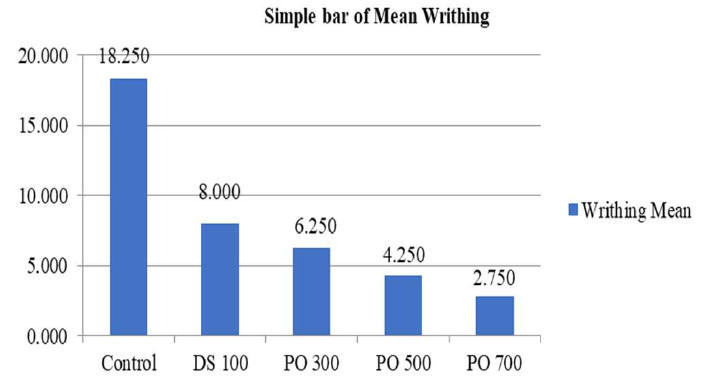
The extract PO at dose 300mg, 500mg & 700 mg showed significant peripheral analgesic activity (p<0.05, p<0.01) as compared to the control. The %of inhibition of PO is 65.75%, 76.71%, 84.93% at dose 300, 500, 700(mg/kg) respectively showed significant inhibition of the writhing induced by acetic acid compare to the control (Table 7). The % inhibition of Standard 100mg/kg is 56.16% (Table 7). PO showed the maximum % of inhibition 84.93% at dose 700mg (Table 7). Mean writhing is decreasing with the increase of dose (Figure 12).

Figure 8: Brine Shrimp Cytotoxicity of Vincristine Sulfate

Figure 9: Brine Shrimp Cytotoxicity of the barks of PO

Figure 10: LC 50 values of standard Vincristine Sulfate and PO

Figure 11: Effect of Administration of Extracts Planchonella Obovata (PO) On Latency to Hot Plate Test in Mice

Figure 12: Effect of Diclofenac Sodium BP and Extracts PO on acetic acid-induced writhing in mice
Table 5: percentage Of Elongation (Percentage Increase in Reaction Time or Pain Threshold Inhibition)
| Parameter | H_0min | H_30min | H_60min | H_120Min | H_180Min |
| DS 100 | 10.48% | 28.34% | 55.15% | 50.65% | |
| PO 300 | 54.29% | 74.59% | 77.41% | 34.31% | |
| PO 500 | 105.71% | 101.63% | 110.96% | 92.16% | |
| PO 700 | 134.29% | 150.16% | 133.55% | 93.46% |
Dunnett t-tests treat one group as a control and compare all other groups against
Table 6: Effect of Diclofenac Sodium BP and Ethanolic Extract of PO on Acetic Acid-Induced Writhing in Mice
| Groups | Mean Writhing | % Inhibition | p-Value |
| Control | 18.25±3.17 | 0.00 | - |
| DS 100 | 8.00±1.73* | 56.16 | 0.014 |
| PO 300 | 6.25±2.02** | 65.75 | 0.005 |
| PO 500 | 4.25±3.28** | 76.71 | 0.002 |
| PO 700 | 2.75±1.03** | 84.93 | 0.001 |
Dunnett t-tests treat one group as a control and compare all other groups against it. DS = Diclofenac Sodium BP (as Standard Drug) with a dose 100mg.PO = Planchonella obovatawith dose 300mg, 500mg, 700mg.Control = Water control. p<0.05 = *, p<0.01 = **, p<0.001 = ***
In DPPH free radical scavenging assay IC50 value of PO is 1.15µg/ml compare to Standard IC503.338µg/ml (Figure 1), which indicates that it has highly significant DDPH scavenging capacity. Total phenolic content is 145.56±2.55 (mg/g) (Table 1), indicating that has mild Phenolic content. Total flavonoids content is 8.75±9.9216mg/g (Table 2), which indicating low flavonoid content. Total antioxidant capacity observed 250±6.614378 (mg/g) (Table 3) denoting mild antioxidant capacity. Reducing power capacity is 46.4% assuming standard as 100%, showing mild reducing power capacity. These tests revealed that the ethanolic extract of the barks of PO has mild antioxidant activity with highly significant DPPH scavenging capacity.
From the cytotoxicity study it is revealed that the plant possesses with very high LC50 value which is 3318.471 µg/ml compared with standard Vincristine sulfate LC50 value 2.313µg/ml (Figure 10). It can be said that PO has insignificant cytotoxicity effect.
In comparison, from analgesic activity study (Hot plate test and Acetic acid induced writhing test) the ethanolic extract of the barks of PO at dose 500 and 700 (mg/kg) showed better analgesic effect than standard Diclofenac Sodium BP 100mg/kg.
In this study we investigated the Antioxidant, Cytotoxic and Analgesic Activities of a Sapotaceae Family plant, Planchonella obovata. Ethanolic extracts of the Barks of Planchonella obovata was studied. In the barks found mild Antioxidant activity with highly significant DPPH scavenging capacity. Insignificant cytotoxic activity found and showed good Analgesic activity. In future more study required to isolate the active principle for developing the analgesic property.
Sandberg, F. and D. Corrigan. Natural remedies: Their origins and uses. Taylor & Francis, 2001.
Oladeji, O. “The characteristics and roles of medicinal plants: Some important medicinal plants in Nigeria.” Natural Products Industry Journal, vol. 12, no. 3, 2016, pp. 102.
Fox, J.E.D. The natural vegetation of the Sabah and natural regeneration of the dipterocarp forests. Bangor University, 1972.
Ashton, M.S. et al. A field guide to the common trees and shrubs of Sri Lanka. WHT Publications, 1997.
Duncan, W.H. and M.B. Duncan. Trees of the southeastern United States. Vol. 18, University of Georgia Press, 2000.
Fitriansyah, S.N. et al. “Pharmacological activities and phytochemical compounds: Overview of Pouteria genus.” Pharmacognosy Journal, vol. 13, no. 2, 2021, pp. 577–584.
Luque de Castro, M.D. and L.E. García-Ayuso. “Soxhlet extraction of solid materials: An outdated technique with a promising innovative future.” Analytica Chimica Acta, vol. 369, nos. 1–2, 1998, pp. 1–10.
Velioglu, Y. et al. “Antioxidant activity and total phenolics in selected fruits, vegetables and grain products.” Journal of Agricultural and Food Chemistry, October 1998, vol. 46, no. 10, pp. 4113–4117.
Singleton, V.L. et al. “Analysis of total phenols and other oxidation substrates and antioxidants by means of Folin–Ciocalteu reagent.” Methods in Enzymology, vol. 299, 1999, pp. 152–178.
Vinson, J.A. et al. “Dried fruits: Excellent in vitro and in vivo antioxidants.” Journal of the American College of Nutrition, vol. 24, no. 1, 2005, pp. 44–50.
Oyaizu, M. “Studies on products of browning reaction: Antioxidative activities of products of browning reaction prepared from glucosamine.” The Japanese Journal of Nutrition and Dietetics, vol. 44, no. 6, 1986, pp. 307–315.
Javanmardi, J. et al. “Antioxidant activity and total phenolic content of Iranian Ocimum accessions.” Food Chemistry, vol. 83, no. 4, 2003, pp. 547–550.
Ghisalberti, E.L. “Detection and isolation of bioactive natural products.” Bioactive natural products: Detection, isolation and structural determination, edited by S.M. Colegate and R.J. Molyneux, CRC Press, 1993, pp. 15–18.
Zhao, G.X. et al. “Additional bioactive compounds and trilobacin, a novel highly cytotoxic acetogenin, from the bark of Asimina triloba.” Journal of Natural Products, vol. 55, 1992, pp. 347–356.
Yimer, T. et al. “Evaluation of analgesic and anti-inflammatory activities of 80% methanol root extract of Echinops kebericho M. (Asteraceae).” Journal of Inflammation Research, vol. 13, 2020, pp. 647.
Neto, A.G. et al. “Anti-inflammatory activity of plant extracts.” Journal of Ethnopharmacology, vol. 96, 2005, pp. 87–91.
Kumar, R.S. et al. “Anti-inflammatory and analgesic activities of ethanol extract of Indigofera trita Linn.” Pharmacologyonline, vol. 1, 2009, pp. 278–289.