Key Findings: This study suggests that phoenixin-14 (PNX-14) (a female reproductive hormone disorder affecting millions of women of reproductive age with a global prevalence ranging from 4-20% based on diagnostic criteria) in the serum of obese women with polycystic ovary syndrome (PCOS) can be used as a biomarker to detect PCOS and compare it with healthy women and study its relationship with some vitamins, electrolytes, and minerals. The results indicated an increase in the levels of both phoenixin-14 and barium in the serum of obese women with polycystic ovary syndrome, while a significant decrease in the concentrations of (calcium, potassium, lithium, sodium) and vitamins (C, D3, E) in the serum of women with polycystic ovary syndrome at a probability level (p≤ 0.05) compared to healthy women. What is Known and What is New: A well-known aspect of this summary is the crucial role of phoenixin-14 in polycystic ovary syndrome (PCOS). The novel contribution is to explore phoenixin-14(PNX-14) as a potential biomarker for PCOS, along with the study of biochemical and clinical parameters in PCOS patients, providing insights into modern diagnostic approaches and potential clinical implications.
Polycystic ovary syndrome (PCOS) is a hormonal disorder of the female reproductive endocrine system, affecting millions of women of reproductive age, with a global prevalence of 4-20% based on diagnostic criteria [1]. It occurs when there is a defect in the ovaries, which leads to the eggs not developing properly or remaining trapped in the ovary and not being released from it at the time of natural ovulation. Then, multiple cyst-like follicles form around those eggs, hence the name polycystic ovary syndrome [2]. The causes of polycystic ovary syndrome are (the role of genes, environmental pollutants, unhealthy diet, lifestyle, and insulin resistance) [3], [4].
Obesity is a major risk factor for polycystic ovary syndrome (PCOS) through its effect on hyperandrogenism and insulin levels in the blood [5]. Studies have shown that approximately 50% of women with PCOS are obese, and weight loss is an important treatment for improving symptoms in PCOS and obese women seeking fertility and childbearing, in particular [5-6]. A large percentage of women, up to 80%, who suffer from polycystic ovary syndrome suffer from overweight or obesity [5].
Phoenixin [PNX) is a neuropeptide hormone that has been identified in humans, pigs, chickens, rodents, frogs, and other organisms [7]. Phoenixin is derived from the C-terminus of small integral membrane protein 20(SMIM20) and exists primarily in two isoforms, PNX-14, a 14-amino acid short peptide chain,and PNX-20, a 20- amino acid long peptide chain derived from the original 60-amino acid peptide [1,8]. The molecular weight of phoenixin is (1583.78) [9-10].
Ascorbic acid, or vitamin C, is considered a micronutrient necessary for human health, as it is a powerful antioxidant and a strong reducing agent, as it scavenges oxidizing free radicals and destroys oxygen-derived species such as hydroxyl radicals and hydrogen peroxide radicals (H2O2]. It is obtained from food. Vitamin C is classified as one of the most important primary medicines within the category of vitamins and minerals [11]. Olaniyan and his colleagues studied and examined the changes in the ovaries of Wistar rats after giving them vitamin C. They found that giving vitamin C to Wistar rats with polycystic ovary syndrome plays a major role in regulating the menstrual cycle and maintaining ovarian function, as its levels change throughout the cycle [12].
Vitamin D is not strictly a vitamin, due to its steroid-like molecular structure, and it can be considered a hormone. Its main function is to absorb calcium in the digestive tract and maintain appropriate levels of calcium and phosphate in the serum to support bone mineralization and health [13-15].
According to studies conducted on women with polycystic ovary syndrome, an inverse relationship was found between body mass index and vitamin D concentrations in patients with polycystic ovary syndrome, as low plasma vitamin D levels led to low calcium levels, Low calcium levels have been associated with inhibition of follicle formation in patients with polycystic ovary syndrome. These low concentrations of the vitamin have led to menstrual cycle disturbances and consequently impaired fertility [16-17].
Calcium is a vital nutrient necessary for the formation of the human body structure and the maintenance of normal physiological functions. Calcium constitutes approximately (1.5% to 2.2%) of the human body weight. Most of it is found in the bones (99%) of the total calcium in the form of calcium phosphate, which enhances their development and strength [18-19]. It is an important substance for many indispensable molecules such as (25-hydroxyvitamin D), and it is necessary for the regulation and structure of the body [20-21].
A study by Greenlee et al. found that dairy products (which are high in calcium and fortified with vitamin D) support female fertility, with women who drank more than three cups of milk per day having a 70% lower risk of infertility compared to women who didn't drink milk at all [22].
Barium is a chemical element and one of the alkaline earth metals in Group 2 of the periodic table. [23] Barium is widely used in the manufacture of plastics and personal care products. Prenatal exposure of pregnant women to barium has harmful effects on the child's intellectual function in preschool [24]. The toxicity of barium compounds depends on their solubility. Free ions are easily absorbed through the lungs or gastrointestinal tract. Accidental ingestion of soluble barium compounds can lead to toxicity [25]. A positive relationship has been found between exposure to several toxic metals, including barium, and the risk of PCOS. There is an inverse relationship between barium and FSH and a direct relationship with LH in women with PCOS [26].
Lithium is a very common black cation widely used in batteries that power small electronic devices. Lithium affects ion transport and is also used medically to treat bipolar disorder. Lithium is used in supplements, but in small, controlled doses. Lithium treats psychiatric disorders by increasing the activity of chemical transmitters in the brain. Lithium may also be necessary for other functions, such as blood cell growth. From a cross-sectional pilot study, lithium-treated females showed no effect on menstrual abnormalities and metabolic parameters [27-28].
Population Study
The study was conducted at Al-Salam Teaching Hospital in Nineveh Governorate from July 1, 2022, until the end of September 2022. This study included (100) blood samples collected from women aged between (16-47) years, (50) of whom were obese and underweight women with PCOS, and (50) of whom were apparently healthy women. After their cases were diagnosed by gynecologists and infertility specialists, samples were collected from the women during the early follicular phase (day two or five of the menstrual cycle). The group of obese women was divided into three groups according to the degree of obesity (morbidly obese, grade I obese, and grade II obese). Both the diseased and healthy women were divided into four age groups: 20, 21-30, 31-40, and 40 years.
Collection of Blood Serum Samples:
5 ml of blood was drawn from the women, the serum was separated, placed in clean, tightly sealed tubes, and stored at -20°C until use [29].
Estimation of Life Variables:
Assay the Concentration of Phenixin-14(Pnx-14): The concentration of phoenixin-14 in serum was estimated using the ELISA method, using a ready-made analysis kit from the Chinese company Fine Test (Catalog No.: EH4521), and the Enzyme Linked Immune Sorbent Assay (ELISA) technique.
Assay the Concentration of Vitamins C, D3 and E
The concentration of vitamin C was estimated (by oxidation of ascorbic acid by copper (Cu) to form dihydro ascorbic acid (DHAA) and diketo gluconic acid [30-31], while the concentration of vitamin D was estimated using a Cobas device (type (e411). The principle of the technique used is based on measuring the light spectrum absorbed by the molecules of the cells of the substances to be measured in the blood serum.
The concentration of vitamin E was estimated by following the redox reaction called the Emmeric-Engle Reaction, which involves the oxidation of Tocopherol-to-Tocopherol Quinone [32].
Assay the Concentration of Electrolytes and Minerals (Na+1, K+1, Ca+2, Li+1, Ba+2)
Electrolytes and minerals the levels of (Na+1, K+1, Ca+2, Li+1, Ba+2) were determined in the blood serum using flame photometry [33]. The measurements were carried out in the College of Basic Education/Department of Chemistry/University of Mosul.
Statistical Analysis
Data analysis was performed using the statistical program (Origin Pro2021(64-bit)) in order to determine:
Standard deviation (SE) and mean
Choosing a T-test to find the difference between values or to know the significant differences between groups that appear with the probability value. If the probability level is(P≤0.05), then it is a significant difference, but if it is(P≤0.05), then it is an insignificant difference
Determine the existence of a correlation between the hormone phoenixin-14 and the rest of the measured biochemical variables using the linear correlation coefficient [34]
The results shown in Table 1 show a significant increase in the concentration of phoenixin-14 at the probability level (P≤0.05) in the serum of women with polycystic ovary syndrome (PCOS) (119.45±5.30 pg/ml) compared to the healthy group (3.66±99.08 pg/ml),This result is consistent with what Szeliga et al. [35] found. The concentration of PNX-14 in the blood serum of women with PCOS was higher compared to healthy women, and this is attributed to the increased production and secretion of PNX-14 as a result of the increase in its receptor (G protein-coupled receptor GPR173).
The Results Mentioned in Table 1 Showed A Significant Decrease in the Concentration of Both
Vitamin C at the probability level (p≤0.05) in the serum of obese women with PCOS compared to healthy women, which is consistent with what was stated by Fatima et al. [36], and the reason for the decrease in the concentration of vitamin C is attributed to its low intake in the diet according to a study conducted by Olaniyan et al. [37]
A significant decrease in the concentration of vitamin D3 at the probability level (p≤0.05) in the blood serum of obese women with PCOS compared to healthy people. This supports the findings of Larysz et al. that women suffering from polycystic ovary syndrome have lower concentrations of vitamin D3 in the blood compared to the general population. This is due to the fact that fat-soluble vitamin D3 is retained within fatty tissue, which prevents its conversion to its biologically active form [38]
A significant decrease in the concentration of vitamin E at the probability level (p≤0.05) in the blood serum of obese women with PCOS compared to healthy
Table 1: Biochemical Variables Measured in the Blood Serum of Obese Women with Pcos Compared to Healthy Women
| Biochemical variables | Normal group (no=50) | PCOS group (no=50) | ||
| (SE) | (SE) | (Mean) | (SE) | |
| phoenixin-14(pg/ml) | 3.66 | 5.30* | 119.45 | 5.30* |
| Vitamin C (mg/100ml) | 0.07 | 0.06 | 0.41- | 0.06 |
| Vitamin D3 (pg/ml) | 1.04 | 1.41* | 16.64- | 1.41* |
| Vitamin E (µmol/L) | 0.91 | 0.23 | 8.75 | 0.23 |
| Na+1 (mmol/L) | 7.22433 | 4.4959 | 0.04376 | 4.4959 |
| K+1 (mmol/L) | 6.27518 | 8.91158 | 0.03961 | 8.91158 |
| Ca+2 (mmol/L) | 2.50183 | 3.81283 | 0.0655 | 3.81283 |
| Li+1 (mmol/L) | 0.01011 | 5.08401 | 0.02504 | 5.08401 |
| Ba+2 (mmol/L) | 3.01861 | 3.83517* | 0.05663 | 3.83517* |
Note: Refers to a significant at (p≤0.05)
Table 2: Study of the Relationship Between Pnx-14 and Some Biochemical Variables in The Blood Serum of Obese Women with Pcos
| PCOS group(no=50) | Biochemical variables |
| r-value | |
| 0.2562- | Vitamin C (mg/100 ml) |
| -0.2404 | Vitamin D3 (pg/ml) |
| 0.0594- | Vitamin E (µmol/L) |
women. This is consistent with what was reported by Chen et al. [39]. One study found that vitamin E receptors in pancreatic beta cells show an effect of the vitamin on insulin secretion and the discovery of a response to vitamin E on the insulin receptor gene suggests a mechanism for the effect of vitamin E on insulin sensitivity.Therefore, low vitamin E levels represent a risk factor in the development of insulin resistance in women with PCOS, causing increased insulin concentration affecting the ovaries, which causes increased androgen production
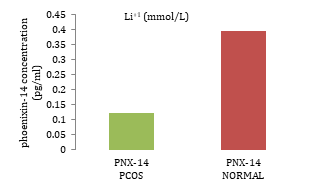
While the results shown in Table 1 showed a significant decrease in the levels of sodium, potassium, lithium and calcium in the blood serum of obese women with PCOS compared to healthy women, This result is consistent with what was reported by Pokorska-Niewiada et al. [40] and the reason is attributed to hormonal imbalances of the hypothalamus, pituitary gland, and reproductive glands and oxidative stress associated with women suffering from polycystic ovary syndrome, which makes them vulnerable to the risk of electrolyte and mineral imbalance.
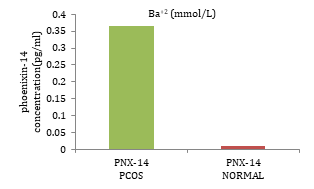
As for barium, it was found that there was an increase in barium levels in the blood of obese women with PCOS compared to healthy women. This is consistent with Liang and Zhang, who stated that the reason for the increase in barium levels is due to an inverse relationship between barium and the FSH hormone in women with PCOS, which leads to an imbalance in the LH/FSH ratio [26].
Study of the Relationship Between Pnx-14 and Some Biochemical Variables in the Blood Serum of Obese Women with Pcos
The results shown in Table 2 showed an inverse relationship between the concentration of the hormone PNX-14 and both vitamins C, D3, and E in the blood serum of obese women with PCOS. There are no other studies on this relationship.

Figure 1: Phoenixin-14 Concentration (Pg/Ml)

Figure 2: Phoenixin-14 Concentration-14 (Pg/Ml)

Figure 3: Phoenixin-14 Concentration (Pg/Ml)
Study of the Relationship Between Phoenixin-14 Hormone and Electrolytes and Minerals (Na+1, K+1, Ca+2, Li+1, Ba+2) Measured in The Blood Serum of Obese Women With Pcos Compared to Healthy Controls
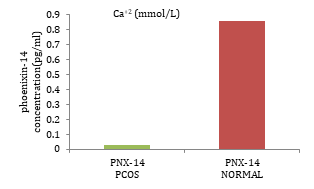
The results show an inverse relationship between sodium, potassium, calcium, and lithium levels and PNX-14 at the probability level (P≤0.05) in the blood of obese women with PCOS compared to healthy women. This may be due to electrolyte imbalance resulting from PCOS.
While barium showed a significant direct relationship between the concentration of the hormone PNX-14 and barium at the probability level (P≤0.05) in the blood of obese women with PCOS compared to healthy women. According to what was mentioned by researchers Liang and Zhang et al. (44), the reason for this relationship may be that the hormone phoenixin stimulates the secretion of the hormone LH, which leads to an increase in the ratio of

Figure 4: Phoenixin-14 Concentration (Pg/Ml)

Figure 5: Phoenixin-14 Concentration (Pg/Ml)
Figure 1-5 shows the relationship of phoenixin-14 hormone with electrolytes and minerals (Na+1, K+1, Ca+2, Li+1, Ba+2) measured in the blood of obese women with PCOS and compared with healthy people.
Elevated serum PNX-14 concentrations in obese women with PCOS are a good biomarker for diagnosing and predicting the syndrome compared to healthy controls. A positive correlation was observed between PNX-14 and barium, while an inverse relationship was found between PNX-14 and vitamins C, D3, and E, as well as electrolytes and minerals (calcium, potassium, sodium, and lithium).
Acknowledgments
I extend my sincere thanks and appreciation to the University of Mosul (College of Science) and the Nineveh Health Department for following up on the protocol study and facilitating the conduct of this research study.
E. Lyczynska et al. "Effect of phoenixin-14 on angiogenesis, cell proliferation, and apoptosis in porcine corpus luteum: role of GPR173 and ERK1/2, AKT, and AMPK signal pathway." Theriogenology, vol. 238, 2025, pp. 117366.
E. J. Houston and N. M. Templeman "Reappraising the relationship between hyperinsulinemia and insulin resistance in PCOS." Journal of Endocrinology, vol. 265, no. 2, 2025.
R. M. Ali et al. "Association of CYP17 gene polymorphism (rs743572) with polycystic ovary syndrome." Meta Gene, vol. 31, 2022, pp. 100996.
R. Singh et al. "Gonadotropins as pharmacological agents in assisted reproductive technology and polycystic ovary syndrome." Trends in Endocrinology and Metabolism, 2023.
J.M. Hazlehurst et al. "How to manage weight loss in women with obesity and PCOS seeking fertility?" Clinical Endocrinology, vol. 97, no. 2, 2022, pp. 208–216.
T. Bai et al. "Therapeutic effects and potential mechanisms of caffeine on obese polycystic ovary syndrome: bioinformatic analysis and experimental validation." Scientific Reports, vol. 15, no. 1, 2025, pp. 14640.
A.E. Joham et al. "Challenges in diagnosis and understanding of natural history of polycystic ovary syndrome." Clinical Endocrinology, vol. 97, no. 2, 2022, pp. 165–173.
A.N. Muzammil et al. "A systematic scoping review of the multifaceted role of phoenixin in metabolism: insights from in vitro and in vivo studies." Frontiers in Endocrinology, vol. 15, 2024, pp. 1406531.
T.Friedrich and A. Stengel "Role of the novel peptide phoenixin in stress response and possible interactions with nesfatin-1." International Journal of Molecular Sciences, vol. 22, no. 17, 2021, pp. 9156.
E.K. McIlwraith, N. Zhang and D. D. Belsham "The regulation of phoenixin: a fascinating multidimensional peptide." Journal of the Endocrine Society, vol. 6, 2022, pp. bvab192.
X.Z. See, W. S. Yeo and A. Saptoro "A comprehensive review and recent advances of vitamin C: overview, functions, sources, applications, market survey and processes." Chemical Engineering Research and Design, 2024.
Y. Bai et al. "Micronutrients and polycystic ovary syndrome in the IEU OpenGWAS project: a two-sample unidirectional Mendelian randomization analysis." Scientific Reports, vol. 15, no. 1, 2025, pp. 9721.
F. Bertoldo et al. "Definition, assessment, and management of vitamin D inadequacy: suggestions, recommendations, and warnings from the Italian Society for Osteoporosis, Mineral Metabolism and Bone Diseases (SIOMMMS)." Nutrients, vol. 14, no. 19, 2022, pp. 4148.
M. Rolando and S. Barabino "Dry eye disease: what is the role of vitamin D?" International Journal of Molecular Sciences, vol. 24, no. 2, 2023, pp. 1458.
D. Menichini and F. Facchinetti "Effects of vitamin D supplementation in women with polycystic ovary syndrome: a review." Gynecological Endocrinology, vol. 36, no. 1, 2020, pp. 1–5.
E.A. Sulaiman, S. Dhiaa and M. M. Merkhan "Overview of vitamin D role in polycystic ovarian syndrome." MMSL, vol. 91, no. 1, 2022, pp. 37–43.
S. Lin et al. "Potential dietary calcium supplement: calcium-chelating peptides and peptide-calcium complexes derived from blue food proteins."Trends in Food Science and Technology, vol. 145, 2024, pp. 104364.
M. Sun et al. "Disorders of calcium and phosphorus metabolism and the proteomics/metabolomics-based research." Frontiers in Cell and Developmental Biology, vol. 8, 2020, pp. 576110.
M. Li et al. "Serum macroelement and microelement concentrations in patients with polycystic ovary syndrome: a cross-sectional study." Biological Trace Element Research, vol. 176, 2017, pp. 73–80.
S.M. Moe "Rationale to reduce calcium intake in patients with CKD." Current Opinion in Nephrology and Hypertension, vol. 27, no. 4, 2018, pp. 251.
J. Janiszewska, J. Ostrowska and D. Szostak-Węgierek "Milk and dairy products and their impact on carbohydrate metabolism and fertility—a potential role in the diet of women with polycystic ovary syndrome." Nutrients, vol. 12, no. 11, 2020, pp. 3491.
T.P. Hanusa "Barium." Encyclopedia Britannica, 2023. Available from: https://www.britannica.com/science /barium
J. Tong et al. "Association of maternal and cord blood barium exposure with preschoolers' intellectual function: evidence from the Ma'anshan Birth Cohort (MABC) study." Science of The Total Environment, vol. 858, 2023, pp. 160029.
C. Liang et al. "Exposure to multiple toxic metals and polycystic ovary syndrome risk: endocrine disrupting effect from As, Pb and Ba." Science of The Total Environment, vol. 849, 2022, pp. 157780.
F.R. Spellman "The science of lithium." CRC Press, 2023.
M.C. Vantyghem "Iatrogenic endocrine complications of lithium therapy."Annales d'Endocrinologie, vol. 84, no. 3, 2023, pp. 391–397.
N.R.J. Burtis and E. R. Ashwood "Tietz text book of clinical chemistry." 3rd ed., W. B. Saunders Company, USA, 2008, pp. 155–388.
S.P. Colowick and N. O. Kaplan "Method in enzymology." vol. 58, Academic Press, New York, 1979.
T. Stanley, T. David and S. Howerds "Selected method for the determination of ascorbic acid in animals cells, tissues and fluids." Method in Enzymology, vol. 62, 1979.
H. Varly, A. H. Gowenlock and M. Bell "Practical clinical biochemistry." 5th ed., vol. 2, Harold Varly, Great Britain, 1976.
L.A. Mustafa "Peroxy nitrate, two vitamins A and E, trace elements and electrolytes in patients caused with rheumatoid arthritis." Biochemical and Cellular Archives, vol. 20, 2020.
OriginLab Corporation "Origin pro (64-bit), version 9.8.0.200." Northampton, Massachusetts, USA, 2021.
A. Szeliga et al. "Neuroendocrine determinants of polycystic ovary syndrome." International Journal of Environmental Research and Public Health, vol. 19, no. 5, 2022, pp. 3089.
Q. Fatima et al. "Evaluation of antioxidant defense markers in relation to hormonal and insulin parameters in women with polycystic ovary syndrome (PCOS): a case-control study." Diabetes and Metabolic Syndrome: Clinical Research and Reviews, vol. 13, no. 3, 2019, pp. 1957–1961.
O.T. Olaniyan et al. "Vitamin C suppresses ovarian pathophysiology in experimental polycystic ovarian syndrome." Pathophysiology, vol. 26, no. 3–4, 2019, pp. 331–341.
K. Lejman-Larysz et al. "Influence of vitamin D on the incidence of metabolic syndrome and hormonal balance in patients with polycystic ovary syndrome." Nutrients, vol. 15, no. 13, 2023, pp. 2952.
J. Chen et al. "Effect of a short-term vitamin E supplementation on oxidative stress in infertile PCOS women under ovulation induction: a retrospective cohort study." BMC Women's Health, vol. 20, 2020, pp. 1–9.
L. Zhao et al. "Polycystic ovary syndrome (PCOS) and the risk of coronary heart disease (CHD): a meta-analysis." Oncotarget, vol. 7, no. 23, 2016, pp. 33715.
G. Muscogiuri et al. "Low levels of 25(OH)D and insulin-resistance: 2 unrelated features or a cause-effect in PCOS?" Clinical Nutrition, vol. 31, no. 4, 2012, pp. 476–480.