This study investigates the effects of Nerium oleander oil on sex hormones (testosterone, estrogen and progesterone) in male and female albino rats. In addition to evaluating serum levels of thyroid hormones (T3, T4 and TSH) Using a controlled laboratory setup. Forty adult male and female albino rats were divided into control (G1) and treatment groups (G2, G3, G4). treatment groups were treated with different concentrations of oleander oil (50 mg/kg, 100 mg/kg and 200 mg/kg) respectively. Hormonal analysis was conducted using ELISA kits to determine serum levels after administration of Nerium oil for 30 days. The results revealed significant alterations in hormone levels in treated rats compared to controls, indicating a potential hormonal modulatory effect of the oil. Males’ Significant reduction in testosterone levels observed in treated groups, especially at high doses (100 and 200) mg/kg by (0.83±0.06 and 0.53±0.03) ng/mL respectively. In the same way, estradiol and progesterone have reduced in the high doses till reach (0.30±0.02 pg/mL and 0.17±0.03) respectively at p<0.05. In female, a mild but statistically insignificant decrease in estrogen and progesterone levels compared to control. Group 3 exhibited a significant decrease (p<0.05) in both hormones. In the aspect of thyroid gland in male rats, it is found that T3 (ng/dL) gradually decreases through G2 and G3 to the lowest in G4 (0.883±0.015) in comparsion to the highest in G1 (1.627±0.025) at statistically significant differences between all groups (LSD = 0.0392). T4 (µg/dL) follows a similar trend, highest in G1 (6.300±0.000), lowest in G4 (3.400±0.200). TSH (µIU/mL) fall in Opposite trend: Lowest in G1 (0.650±0.010) and increases to highest in G4 (1.233±0.015). In females, T3 (ng/dL) has highest in G1 (1.45±0.015), progressively decreasing through G2 and G3, with the lowest in G4 (0.79±0.010). T4 (µg/dL) decreases from G1 (5.63±0.058) to G4 (3.13±0.152), showing a clear downward trend. TSH (µIU/mL) shows an inverse trend compared to T3 and T4: lowest in G1 (0.713±0.015), increasing to highest in G4 (1.410±0.01). There's a progressive decline in T3 and T4 and a rise in TSH from G1 to G4. This suggests a worsening of thyroid function, with G4 potentially indicating a hypothyroid state. These findings suggest caution in the medicinal use of Nerium oleander, especially regarding reproductive and thyroid glands health.
Keywords
Nerium oleander
Male and female albino rats
Sex hormones
Thyroid hormones
INTRODUCTION
The evergreen shrub Nerium oleander, sometimes referred to as oleander, is indigenous to portions of Asia and the Mediterranean area. It is well known for both its powerful biological components and its aesthetic attractiveness [1].
Numerous physiologically active substances found in the plant, mainly cardiac glycosides like nerine and oleandrin, have been shown to have an impact on the neurological and cardiovascular systems. Oleander extracts have long been used in traditional medicine by a variety of cultures to treat illnesses like inflammation [2], heart disease and skin issues. However, the plant's toxicity outweighs these medicinal benefits, thus a thorough and regulated examination of its pharmacological effects is required.
Nerium oleander is a common decorative plant that is well-known for its strong bioactive substances, such as flavonoids, oleandrin and cardiac glycosides. Nerium oleander has long been employed in folk medicine, but it is also thought to be extremely poisonous. Little is known about how it affects the endocrine system [3], specifically the control of sex hormones. Because female albino rats' hormonal pathways are comparable to those of humans, they make an excellent model for assessing these impacts [4].
The potential of phytochemicals to alter hormones has drawn increasing scientific attention in recent years. This interest is motivated by the increasing prevalence of reproductive health issues linked to environmental and dietary exposure to hormone-modulating substances. In this context, Nerium oleander presents an intriguing subject of research due to its complex chemical profile. The current study investigates the effects of oleander oil, derived from the plant's leaves and flowers, on sex hormone regulation in laboratory rats. Specifically, we examine how oleander oil administration influences serum testosterone levels in males and estradiol and progesterone levels in females. By doing so, we aim to elucidate potential pathways through which oleander oil may interact with the hypothalamic-pituitary-gonadal axis, ultimately affecting reproductive functions. Study Objectives involve first, Measuring the effect of oleander oil on testosterone levels in male rats. Second, Measuring the effect on estrogen and progesterone levels in female rats. Then, Comparing the hormonal changes between treated groups and the control group.
Previous studies on Nerium oleander have highlighted its toxicological and pharmacological potential. Some research has demonstrated cytotoxic and antioxidant effects, while others noted its potential to induce organ toxicity. However, few investigations have examined its hormonal impact, especially in female models. A study by Narasimha et al. [5] indicated possible reproductive toxicity in rodents, while more recent research by Kuma etal. [6] suggested the presence of phytoestrogens in oleander extracts. This literature gap underlines the importance of the current study to provide empirical data on hormonal disruptions.
This study explores whether the administration of Nerium oil alters sex hormone levels and thyroid hormones, which are critical for male and female health.
MATERIALS AND METHODS
Oleander oil was prepared by using Clevenger apparatus, then concentrations were prepared (50, 100, 200) mg/ kg.
Forty adult albino rats (20 males, 20 females) weighing 150–180g and kept in healthy environment in animal laboratory [7]. Each sex group were divided into; G1 of Control group (corn oil), G2 was administrated with low dose (50 mg/kg) of oleander oil, G3 of medium dose (100 mg/kg), G4 of high dose (200 mg/kg) of the same oil. The treatment experiment lasted 30 days via oral administration.
Blood was collected on day 30 via cardiac puncture. Serum levels of T3, T4, TSH, Testosterone, Estradiol, Progesterone were measured by using ELIZA essay [8. the data were analyzed statically by using ANOVA method to find significant difference and probability [9].
RESULTS
Sex Hormones Results in Male and Female Albino Rats
The results of Table 1 were related to sex hormones in male rats, the results show that the oleander oil (100 mg/kg) has significant effect on levels of testosterone, estradiol and progesterone hormones in serum by (0.83±0.06) ng/ml, (0.45±0.05) pg/ml and (0.29±0.04) ng/mL respectively at significant difference p<0.05. then, values were highly reduced when males were administrated oleander oil (200 mg/kg) B.W. hormones levels are testosterone (0.53±0.03) ng/ml, estradiol (0.30±0.02) pg/mL and progesterone 0.17±0.03) ng/ml at significant difference p<0.001(Figure 1).
In female rats, the mean concentrations of estrogen and progesterone across the four experimental groups (G1–G4) are summarized in Table 2 and illustrated in Figure 2.
Table 1: Sex Hormons Values Before and After Treatment in male rats
Hormone
G1
Control
G2
50 mg/kg
G3
100 mg/kg
G4
200 mg/kg
LSD
Testosterone (ng/mL)
1.36 ± 0.05
1.23 ± 0.04
0.83 ± 0.06*
0.53 ± 0.03**
0.12
Estradiol (pg/mL)
0.75 ± 0.03
0.63 ± 0.04
0.45 ± 0.05*
0.30 ± 0.02**
0.08
Progesterone (ng/mL)
0.12 ± 0.02
0.18 ± 0.03
0.29 ± 0.04*
0.17 ± 0.03
0.07
*Statistically significant at (p<0.05)
**Highly statistically significant at (p<0.001)
Figure 1: The effect of Nerium oleander on sex hormones in male albino rats
Table 2: Sex Hormons Values Before and After Treatment in female rats
Hormone
G1
Means ± SD
G2
Means ± SD
G3
Means ± SD
G4
Means ± SD
LSD
Estrogen (pg/mL)
45.6 ± 2.1
42.3 ± 3.0
40.3 ± 3.2
36.8 ± 2.5*
6.35
Progesterone (ng/mL)
22.3±1.4
20.1±1.7
18.6±1.3
16.4±1.3*
6.78
*Statically different from the control at p<0.05 compared
Figure 2: The effect of Nerium oleander on sex hormones in female albino rats
Estrogen (pg/mL) levels demonstrated a decreasing trend from (45.6±2.1) pg/mL in G1 to (36.8±2.5) ng/mL in G4. A statistically significant reduction was observed in G4 compared to the other groups (p≤0.05), with a Least Significant Difference (LSD) value of 6.35, indicating that the reduction in G4 exceeded the threshold for statistical significance.
Similarly, progesterone (ng/mL) levels decreased progressively from (22.3±1.4) ng/mL in G1 to (16.4±1.3) ng/mL in G4. The reduction in G4 was statistically significant (p≤0.05), as denoted by the asterisk, with an LSD value of 6.78. Although numerical decreases were observed between other groups, only the change in G4 reached statistical significance.
These results suggest that the treatment or condition associated with G4 may significantly suppress both estrogen and progesterone levels compared to the control (G1) and intermediate groups.
Thyroid Hormones Results in Males and Female Rats
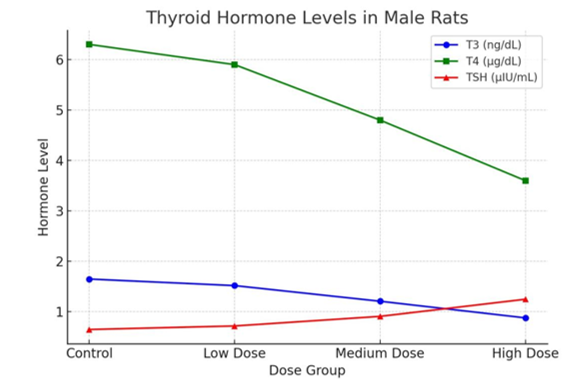
In males, Table 3 showed that there is a significant difference among groups in thyroid hormones T3, T4 and TSH serum levels. The effect of oleander oil on hormones is towards reduction with increasing oil concentrations. T3 has a highest level in control group with (1.627±0.025) ng/dl then begins in reduction when animals were administrated oleander oil in appositive relation, from (1.523±0.025) ng/dl in G2, (1.213±0.015) ng/dl in G3 till reaching to lowest level of T3 in G4 with (0.883±0.015) ng/dl with significant difference p˂0.05.
The same effect of oleander oil concentrations on T4 by reduction their levels in blood serum. Through the Table (3), its found the oil reduced T4 in G2, G3 and G4 by (5.933±0.058, 4.900±0.100, 3.400±0.200) µg/dL respectively in comparison to control group. On the other hand, it is noticed that TSH levels in serum have raised from (0.650±0.010) (µIU/mL in G1 gradually to (0.710±0.010, 0.910±0.010, 1.233±0.015) µIU/mL in G2, G3 and G4 respectively (Table 3, Fig. 3).
The Effect of Oleander Oil on Thyroid Hormones in Female Albino Rats
The effects of treatment on serum thyroid hormones (T3, T4 and TSH) are presented in Table 4 and illustrated in Figure 4.
Triiodothyronine (T3) levels significantly decreased across the experimental groups, with G1 showing the highest concentration (1.45±0.015 ng/dL) and G4 the lowest (0.79±0.010 ng/dL). Statistical analysis revealed that all group means differed significantly from each other (p≤0.05), as indicated by the distinct superscript letters (a–c). The LSD value was 0.0217, confirming the observed differences were statistically meaningful.
Thyroxine (T4) followed a similar decreasing pattern, with levels declining from 5.63±0.058 µg/dL in G1 to 3.13±0.152 µg/dL in G4. Each group showed statistically distinct means (p≤0.05), supported by an LSD value of 0.2369. The trend indicates a progressive suppression of T4 with increasing treatment or exposure.
Thyroid-Stimulating Hormone (TSH) levels exhibited an inverse pattern, increasing from 0.713±0.015 µIU/mL in G1 to 1.410±0.010 µIU/mL in G4. The differences among all groups were statistically significant (p≤0.05), as reflected by the distinct superscript annotations (a–c) and an LSD value of 0.0261.
Overall, the results demonstrate a clear dose-dependent modulation of thyroid function, with T3 and T4 levels decreasing and TSH levels increasing significantly in response to treatment.
Table 3: The effect of Oleander oil on thyroid hormones in male rats
Hormones
G1
Means ± SD
G2
Means ± SD
G3
Means ± SD
G4
Means ± SD
LSD value
T3(ng/dL)
1.627 ± 0.025a
1.523 ± 0.025b
1.213 ± 0.015c
0.883 ± 0.015d
0.0392
T4 (µg/dL)
6.300 ± 0.000a
5.933 ± 0.058b
4.900 ± 0.100c
3.400 ± 0.200d
0.2174
TSH(µIU/mL)
0.650 ± 0.010a
0.710 ± 0.010b
0.910 ± 0.010c
1.233 ± 0.015d
0.0217
**data as (mean ±SD). Means with different letters in same row are in significant difference at (p˂0.05)
Table 4: The effect of Oleander oil on thyroid hormones in female rats
Thyroid hormones
G1
Means ± SD
G2
MEANS ± SD
G3
Means ± SD
G4
Means ± SD
LSD value
T3(ng/dL)
1.45±0.015*
1.31±0.010*a
1.10±0.010*b
0.79±0.010*c
0.0217
T4 (µg/dL)
5.63±0.058*
5.17±0.116*a
4.23±0.152*b
3.13±0.152*c
0.2369
TSH(µIU/mL)
0.713±0.015*
0.803±0.010*a
1.030±0.020*b
1.410±0.01*c
0.0261
*all values have significant difference in comparison to control group
**values have a significant difference among treatment groups
**data as (mean ±SD). Means with different letters in same row are in significant difference at (p˂0.05)
Figure 3: The effect of Nerium oleanderon thyroid hormones in male albino rats
Figure 4: The effect of Nerium oleander on thyroid hormones in female albino rats
DISCUSSION
The findings of this study reveal that oleander oil exerts a measurable effect on sex hormone levels in laboratory rats, with notable differences based on sex and dosage. In male rats, a consistent decline in testosterone levels was observed across all treatment groups, indicating a possible suppression of Leydig cell function or hypothalamic regulation. This effect may be attributed to the glycosidic compounds in oleander that interfere with steroidogenesis or signal transduction mechanisms in endocrine tissues [10].
In female rats, the response was more complex. While estradiol levels declined with increasing doses of oleander oil, progesterone exhibited a biphasic pattern, decreased at moderate doses before decreasing at higher concentrations. This pattern may suggest an adaptive or stress-related feedback mechanism, where the body initially compensates for hormonal disruption but fails to maintain homeostasis under prolonged or intensified exposure [11].
It is also plausible that oleander oil induces oxidative stress or inflammation in gonadal tissues, which in turn disrupts normal hormone synthesis and release. Prior studies have shown that oxidative damage can impair ovarian and testicular function and the phytochemicals in oleander have been linked to both antioxidant and pro-oxidant activity depending on dosage and exposure context [12].
The findings of this study reveal that oleander oil exerts a significant effect on both reproductive and thyroid hormone levels in male laboratory rats. Testosterone levels declined with increasing oleander oil dosage, suggesting an inhibitory effect on the hypothalamic-pituitary-gonadal axis. Furthermore, T3 and T4 levels also decreased, accompanied by an increase in TSH, indicating a potential hypothyroid state induced by the treatment [13].
These changes might be caused by bioactive substances in oleander that interfere with neuroendocrine communication or directly damage glands, upsetting endocrine function. The disturbance of thyroid hormones implies that the oil affects not only reproductive processes but also metabolic and homeostatic systems that are controlled by the thyroid gland. Functional components produced from plants: protect against a variety of diseases by controlling endocrine glands.
The results of this investigation show that oleander oil significantly affects the levels of thyroid and reproductive hormones in male lab rats. As the dosage of oil increased, testosterone levels decreased, indicating a hypothalamic-pituitary-gonadal axis inhibitory action. Additionally, TSH increased along with a reduction in T3 and T4 levels, suggesting that the medication may have caused a hypothyroid condition [14].
These changes might be caused by bioactive substances in oleander that interfere with neuroendocrine communication or directly damage glands, upsetting endocrine function. The disturbance of thyroid hormones implies that the oil affects not just reproductive processes but also thyroid-regulated metabolic and homeostatic systems.
This dual hormonal effect draws attention to the intricacy and possible danger of oleander extract exposure. Even though some phytochemicals might have therapeutic benefits, these findings call for caution and support more research to clarify mechanisms of action and establish safe thresholds for use.
CONCLUSION
In conclusion, oleander oil influences thyroid and reproductive hormones in both male and female rats, functioning as a broad-spectrum endocrine modulator. A systemic endocrine disruption is suggested by the feedback reactions and hormonal suppression that have been seen. These results highlight the significance of using plant-derived bioactives under strict supervision and need more research on Nerium oleander's pharmacological and toxicological characteristics. Lab rats' sex hormones are dramatically changed by oleander oil. Effects depend on both gender and dosage. The results confirm oleander's potential for use in fertility control.
Recommendations
Conduct histological studies of reproductive tissues
Investigate molecular mechanisms of hormonal disruption
Assess long-term toxicity of oleander oil
REFERENCES
Shridhar, N.B. "Nerium oleander toxicity: A review." International Journal of Advanced Academic Studies, vol. 4, no. 10, 2022, pp. 23–32.
Seher, A., et al. "Oleander." Medicinal Plants of South Asia, Elsevier, 2020, pp. 525–39.
Benson, K.F., et al. "Antioxidant, anti-inflammatory, anti-apoptotic, and skin regenerative properties of an aloe vera-based extract of Nerium Oleander Leaves (NAE-8®)." Clinical, Cosmetic and Investigational Dermatology, 2015, pp. 239–48.
Farkhondeh, T., et al. "Toxicity effects of nerium oleander: Basic and clinical evidence." Human & Experimental Toxicology, vol. 39, no. 6, 2020, pp. 773–84.
Narasimha Kumar, G.V., et al. "Plants and phytochemicals for protection against chemotherapy-induced and drug-induced cardiotoxicity." Cardioprotective Plants, Springer Nature Singapore, 2024, pp. 263–316.
Kumar, V., et al. "A retrospection on mercury contamination, bioaccumulation, and toxicity in diverse environments: Current insights and future prospects." Sustainability, vol. 15, no. 18, 2023, p. 13292.
World Health Organization. WHO Guidelines for Laboratory Animal Experimentation.
Sigma Aldrich. Manual of Hormonal Assay by ELISA, 2022.
Landau, S., and B.S. Everitt. A Handbook of Statistical Analyses Using SPSS. Chapman and Hall/CRC, 2003.
Khalid, W., et al. "Plant-derived functional components: Prevent from various disorders by regulating the endocrine glands." International Journal of Food Properties, vol. 25, no. 1, 2022, pp. 976–95.
Ghorbani Ranjbary, A., et al. "Long-term oral administration of oregano essence effectively relieves polycystic ovarian rats through endocrine and inflammatory balance." Evidence‐Based Complementary and Alternative Medicine, 2022, p. 5303583.
Monageng, E., et al. "A review on the impact of oxidative stress and medicinal plants on Leydig cells." Antioxidants, vol. 12, no. 8, 2023, p. 1559.
Smith, S.J. "Low testosterone concentrations in men: Identifying causative factors and non-pharmacological treatment strategies." Doctoral dissertation, Murdoch University, 2023.
Wani, J.A., et al. "Therapeutic effects of nigella sativa on hormonal dysfunctions." Black Seeds (Nigella Sativa), Elsevier, 2022, pp. 217–38.
Recommended Articles
Research Article
Identification of some Bacterial virulence factors of Staphylococcus aureus and Klebsiella pneumoniae
Download PDF
Research Article
Electrochemical Comparative Studies On The Redox Behavior Of Cu(II) And Cr(II) Before And After Interactions With Ciprofloxacin In Solutions
H. M. Naseem Akhtar,
M. Q. Ehsan
Published: 10/08/2021
Download PDF
Research Article
In Acute Appendicitis, Neutrophil/Lymphocyte Rate and C-Reactive Protein’s Radiological Relation with Appendix Diameter and İnvestigation of İts İmpact on The Diagnosis
Ethem Bilgiç,
Özden Yıldırım Akan
Published: 10/03/2021
Download PDF
Research Article
Non – Invasive Ventilation in Patients with Type 2 Respiratory Failure
Sarang Patil
Published: 10/03/2021
Download PDF
PO Box 101, Nakuru
Kenya.
Email: office@iarconsortium.org
Editorial Office:
J.L Bhavan, Near Radison Blu Hotel,
Jalukbari, Guwahati-India
Details Walaa A. Abdulridha, A. (2025). The Effect of Oleander Oil (Nerium Oleander) on Thyroid and Sex Hormones in Male and Female Albino Rats. International Academic Journal of Applied Bio-Medical Sciences, 6(1), 1-5.
MLA
Details Walaa A. Abdulridha, Author. "The Effect of Oleander Oil (Nerium Oleander) on Thyroid and Sex Hormones in Male and Female Albino Rats." International Academic Journal of Applied Bio-Medical Sciences 6.1 (2025): 1-5.
Chicago
Details Walaa A. Abdulridha, Author. "The Effect of Oleander Oil (Nerium Oleander) on Thyroid and Sex Hormones in Male and Female Albino Rats." International Academic Journal of Applied Bio-Medical Sciences 6, no. 1 (2025): 1-5.
Harvard
Details Walaa A. Abdulridha, A. (2025) 'The Effect of Oleander Oil (Nerium Oleander) on Thyroid and Sex Hormones in Male and Female Albino Rats' International Academic Journal of Applied Bio-Medical Sciences 6(1), pp. 1-5.
Vancouver
Details Walaa A. Abdulridha A. The Effect of Oleander Oil (Nerium Oleander) on Thyroid and Sex Hormones in Male and Female Albino Rats. International Academic Journal of Applied Bio-Medical Sciences. 2025 Jan;6(1):1-5.


 Download PDF
 Download XML