Toothpaste, commonly found in households, is often used as a remedy for minor burns. However, its typical pH range of 7 to 10 poses a significant risk of irreversible eye damage upon contact. This case study focuses on a 12-year-old girl who suffered an accidental burn near her eye from a burning wooden stick. In an attempt to treat the burn, toothpaste was applied around the eye, a traditional home remedy. This application inadvertently led to the toothpaste contacting the cornea, resulting in a substantial epithelial defect. The child experienced immediate burning sensations and was rushed to the emergency room. Upon arrival, she underwent an extensive normal saline wash followed by the application of a pad and patch, along with topical antibiotics. Previous incidents have highlighted the potential consequences of ocular injuries caused by toothpaste, which can lead to severe eye problems. It is crucial to raise awareness about the judicious use of toothpaste and the potential harm it can cause to the eyes. Additionally, it is important to educate clinicians about the severity of injuries caused by toothpaste and the necessity for prompt and appropriate management of such cases.
Keywords
Toothpaste
Burns
Home remedy
Ocular Risks
INTRODUCTION
The use of household items for first aid purposes is a common practice, but not all such practices are safe or effective. One such remedy is the application of toothpaste on burns, a method traditionally believed to provide relief. However, this approach, particularly when used near sensitive areas such as the eyes, can lead to serious complications. The pH levels of most toothpastes range between 7 and 10, which, while generally safe for oral use, can be harmful when in contact with the eyes. This case report presents a critical examination of the ocular risks associated with the application of toothpaste on burns, as illustrated by the case of a 12-year-old girl who sustained a corneal injury after toothpaste was applied to a burn near her eye. Prior studies have demonstrated that substances with extreme pH levels, including many common household items, can cause significant chemical injuries to the eyes. These injuries can range from mild irritation to severe conditions such as corneal ulcers and opacities [1-6].
The report aims to raise awareness about the potential dangers of misusing toothpaste as a remedy for burns and to emphasize the need for immediate professional medical care in cases of ocular exposure to chemical agents.
Case Description
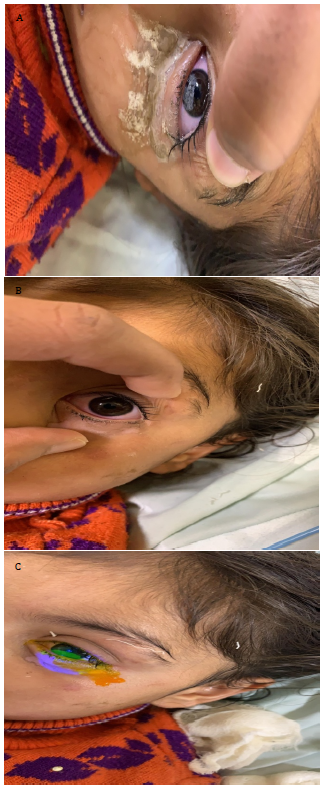
A 12-year-old girl sustained an injury near her left eye when she was accidentally struck by a burning wooden stick while playing with her brother. In response to the burn, her mother applied toothpaste around the affected area. Approximately 30 minutes after the application, the child began to experience a severe burning sensation in her eye. She was promptly taken to the emergency room for medical attention. Upon examination, her visual acuity was found to be normal (6/6) in her right eye, but she could only count fingers at a distance of one meter with her left eye. Notably, a whitish deposit was observed on the surface of her left cornea, attributed to the infiltration of toothpaste into the eye. An extensive normal saline wash was conducted, successfully removing the whitish deposit. Post-wash, her visual acuity in the left eye improved to 6/6. Both eyes exhibited normal pupillary reactions. Further examination using fluorescein staining under cobalt blue light revealed a large epithelial defect in the left eye. The dye was then washed off, and treatment was administered, which included a pad and patch along with 0.5% moxifloxacin eye drops and chloramphenicol eye applicap. The child was monitored over the next three days, during which the epithelial defect completely healed (Figure 1).
Figure 1:(A-C): Images of Case Who Sustained an Injury Near Her Left Eye
DISCUSSION
This discussion aims to analyze the risks associated with such practices and the importance of proper first-aid measures.
Toothpastes, widely used for oral hygiene, have pH levels typically ranging from 7 to 10, making them potentially hazardous when they come into contact with the eye. The alkalinity or acidity of toothpaste, although safe for dental use, can cause chemical injuries when in contact with ocular tissues. Alkali substances, in particular, are more dangerous to the eye as they can penetrate the cornea more rapidly compared to acidic substances, which tend to form a protective layer preventing further penetration [6-7].
Chemical injuries to the eye, such as those from toothpaste, can result in a spectrum of conditions from mild irritation to severe complications like corneal ulcers and opacities. These injuries necessitate immediate and appropriate intervention. The standard immediate treatment involves rigorous irrigation with water or saline to dilute and remove the chemical agent. Delay in such treatment can lead to prolonged contact time of the chemical with the ocular surface, thereby increasing the risk of severe injury [3-4,7-8].
Moreover, this case underscores the need for public education about the risks of using unproven home remedies, particularly in sensitive areas like the eyes. Awareness campaigns and educational programs should highlight the importance of seeking professional medical advice for burns and eye injuries instead of resorting to home remedies.
CONCLUSION
In conclusion, the case of the 12-year-old girl serves as a cautionary tale about the dangers of using toothpaste as a treatment for burns near the eyes. It emphasizes the need for immediate professional medical intervention and highlights the importance of public education in preventing such hazardous practices. The medical community should also be vigilant in educating patients about the appropriate first-aid measures for chemical eye injuries and the potential risks of common household substances.
REFERENCE
Kattan, A.E. et al. “Current knowledge of burn injury first aid practices and applied traditional remedies: a nationwide survey.” Burns & Trauma, vol. 4, 2016, p. 37.
Healthline. “Toothpaste on burns: does this home remedy work?” Healthline, 2023, Accessed 22 Dec. 2023.
Burncenters. “Why you shouldn’t put toothpaste on burns: harmful home remedies to avoid.” Burncenters, 2023, Accessed 22 Dec. 2023.
Colgate. “Toothpaste on burns: does this home remedy work?” Colgate, 2023, Accessed 23 Dec. 2023.
Times of India. “Never apply toothpaste on burn area, say doctors.” Times of India, 2014, Accessed 23 Dec. 2023.
Chirongoma, F. et al. “First aid practices, beliefs, and sources of information among caregivers regarding paediatric burn injuries in Harare, Zimbabwe: a cross-sectional study.” Malawi Medical Journal, vol. 29, no. 2, 2017, pp. 151–154.
Soni, P. and Bende, N. “Comparison of pH of different types of toothpastes used in India.” International Journal of Science and Research, vol. 11, no. 3, 2022, pp. 1252–1255.
Mazur, M. et al. “Green dentistry: organic toothpaste formulations.” Dental and Medical Problems, vol. 59, no. 3, 2022, pp. 461–474.
Recommended Articles
Research Article
A study on the feasibility of online classes for medical education
Seema Bose,
Atindra Krishna Ghosh
Published: 15/02/2021
Download PDF
Research Article
Amyand’s Hernia: A Rare form of Common Entity
Download PDF
Research Article
Prevalence of Typhoid Fever among Patients Attending General Sani Abatcha Specialist Hospital Damaturu, Nigeria
Ahmed Idriss Jajere,
...
Usman Umar Faruk
Published: 10/10/2020
Download PDF
Research Article
A case report of management of a Case of Hyperalgesia by Ultrasound guided Fluoroscopically Verified Transforaminal Nerve Root Block
Sunil Dutt,
...
Anil Kumar
Published: 29/06/2024
Download PDF
PO Box 101, Nakuru
Kenya.
Email: office@iarconsortium.org
Editorial Office:
J.L Bhavan, Near Radison Blu Hotel,
Jalukbari, Guwahati-India
Verma, N., Raj, P. & Tuli, R. (2024). Toothpaste on Burns a common home remedy for burns and its Ocular Risks. IAR Journal of Medical Case Reports, 5(1), 1-3.
MLA
Verma, Nakul, Prithvi Raj and Rajeev Tuli. "Toothpaste on Burns a common home remedy for burns and its Ocular Risks." IAR Journal of Medical Case Reports 5.1 (2024): 1-3.
Chicago
Verma, Nakul, Prithvi Raj and Rajeev Tuli. "Toothpaste on Burns a common home remedy for burns and its Ocular Risks." IAR Journal of Medical Case Reports 5, no. 1 (2024): 1-3.
Harvard
Verma, N., Raj, P. and Tuli, R. (2024) 'Toothpaste on Burns a common home remedy for burns and its Ocular Risks' IAR Journal of Medical Case Reports 5(1), pp. 1-3.
Vancouver
Verma N, Raj P, Tuli R. Toothpaste on Burns a common home remedy for burns and its Ocular Risks. IAR Journal of Medical Case Reports. 2024 Jan;5(1):1-3.


 Download PDF
 Download XML